|
Your Scoreboard Is Lying to You. So Is Your Checklist.
Some leaders will burn down next year to win this quarter.
Others will polish the factory floor while the business goes nowhere.
One is addicted to outcomes. The other worships process. Both are destroying value, and both are convinced they're doing it right.
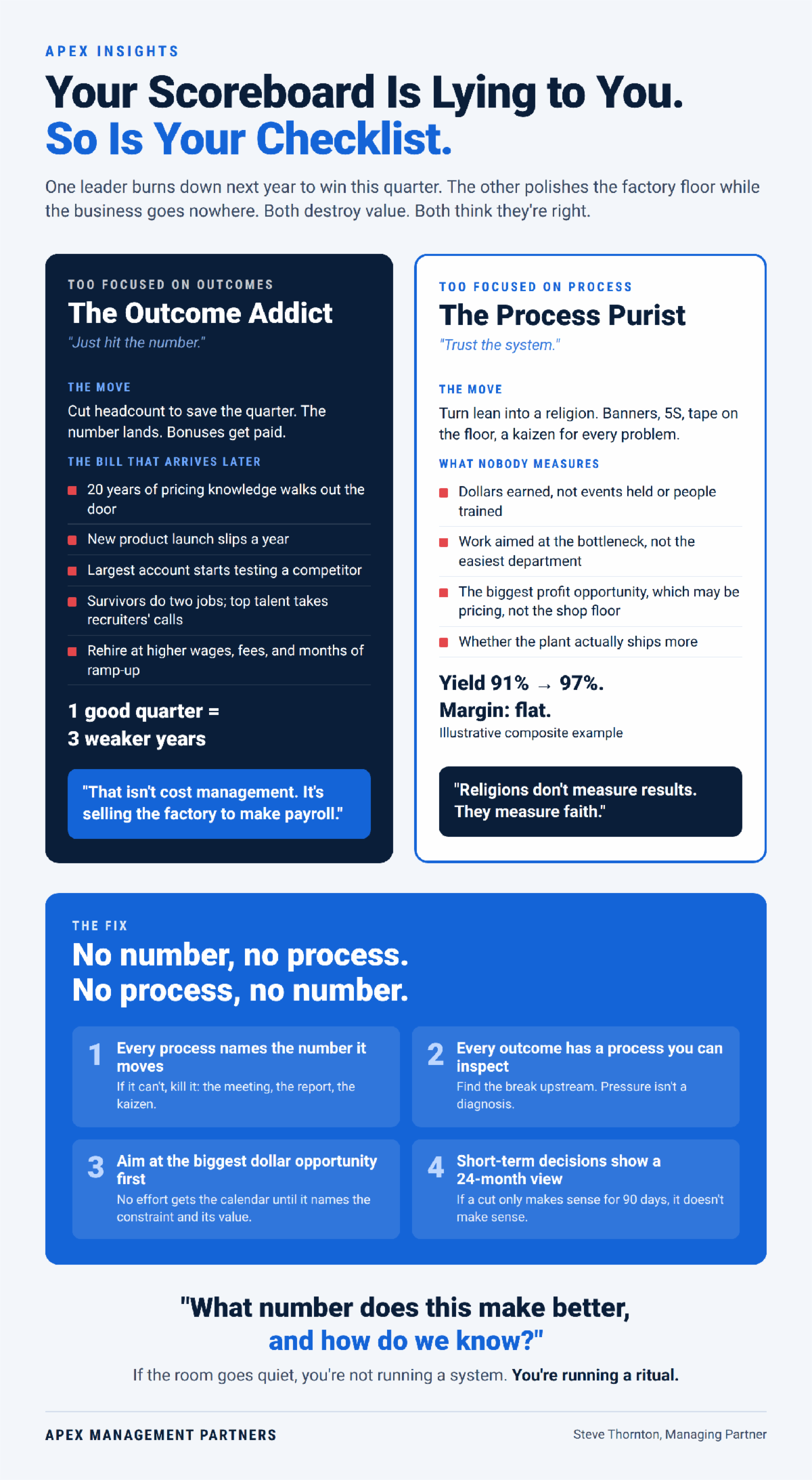
The Outcome Addict: Winning the Quarter, Losing the Company
The quarter is going to miss. The CEO and CFO look at the biggest controllable cost, which is people, and cut. The number lands. The board is happy. Bonuses get paid.
Then the bill arrives.
The estimator who carried 20 years of pricing knowledge is gone, and margins quietly slip. The engineers six months from launching a new product line are gone, and the launch slips a year. The rep who kept your largest account happy is gone, and that account starts testing a competitor. The survivors are doing two jobs, and your best people are taking recruiters' calls.
Twelve months later, revenue and margin are both down. The company rehires at higher wages, pays recruiting fees, and waits months for new people to get up to speed. It traded one good quarter for three weaker years.
Let's call it what it is. That isn't cost management. It's selling off the factory to make payroll and calling it efficiency.
Here's the test nobody runs: if that cut were a capital investment, would you approve it? Because cutting the people who drive future revenue is a disinvestment, just one that never shows up on a capital request.
The Outcome Addict can't explain their results, so they can't repeat them. When the number misses, the only tool left is pressure.
The Process Purist: The Religion of Lean
The other side is more dangerous, because it looks like maturity.
The lean sensei arrives. The banners go up. Everyone learns 5S, value stream mapping, and kaizen. Tool boards get outlined in tape. Kaizen events fill the calendar. And lean becomes the answer to everything. Quality problem? Kaizen. Sales down? Value stream map. Cash tight? More 5S.
Lean is a powerful toolset. But too many companies don't run it as a toolset. They run it as a religion. And religions don't measure results. They measure faith.
Ask your lean program three questions:
-
"How much money has this made us?" Not events held or people trained. Dollars. Most programs can't answer, because the sensei counts activity, and activity is the only thing the sensei controls.
-
"Why did we start there?" The first kaizen lands in the tool crib or the easiest department, while the bottleneck that limits the whole plant sits untouched. An hour saved anywhere but the constraint is an illusion. The department looks better. The plant ships the same amount.
-
"Is this aimed at our biggest profit opportunity?" Often that opportunity isn't on the shop floor. It's pricing, or the customers who eat capacity and return little profit, or quotes that underbid complex work. No amount of tape on the floor fixes a pricing problem.
I've seen this play out (the details here are a composite). Two years of lean. A beautiful plant. First-pass yield up from 91% to 97%. Visitors impressed.
Gross margin? Flat. Throughput at the bottleneck never moved. The extra inspection added labor to every job, and nobody changed the pricing to cover it. Dozens of processes improved. The business didn't.
The Process Purist stopped asking whether the system works. They just kept following it.
The Fix: No Number, No Process. No Process, No Number.
"A little of both" is a slogan, not a system. The answer is a hard link between the two.
Every process must name the number it moves. If it can't, kill it. That includes the meeting, the report, and the kaizen event.
Every outcome must have a process you can inspect. When revenue misses, look upstream at quote volume, close rate, and job size. Find the break. Fix it. Pressure isn't a diagnosis.
Aim at the biggest dollar opportunity first. No improvement effort gets the calendar until it names the constraint it's attacking and what that's worth.
Make short-term decisions show a 24-month view. Before you cut headcount, put the revenue, customers, capability, and rehiring costs at risk on the table. If the cut only makes sense for 90 days, it doesn't make sense.
The Bottom Line
Outcomes without process give you leaders who mortgage the future to save the quarter.
Process without outcomes gives you a beautifully organized plant that makes the same money it did three years ago.
Pick the process your team follows most faithfully. Ask one question:
"What number does this make better, and how do we know?"
If the room goes quiet, you're not running a system. You're running a ritual.
The question isn't whether you should make this shift. It is what's keeping you from starting today?
Question for You to Ponder
Are you ready to lead your business to its Pinnacle?
Outcome (if you act)
More profit and a better quality of life.
Call to Action
-
Ask me for a copy of the Path to Pinnacle
- Schedule a Meeting with Me
Our Mission: Accelerate Profitable Growth and Improve Execution
|