High-Leverage Practices for Students with Disabilities | |
Happy September! You made it through the first month of school! This year we will be focusing on the High-Leverage Practices (HLPs) in Special Education from the CEEDAR Center and Council for Exceptional Children (CEC). Keep reading for resources and more! | | | |
High-Leverage Practices and
Students who are Deaf/Hard of Hearing
| |
|
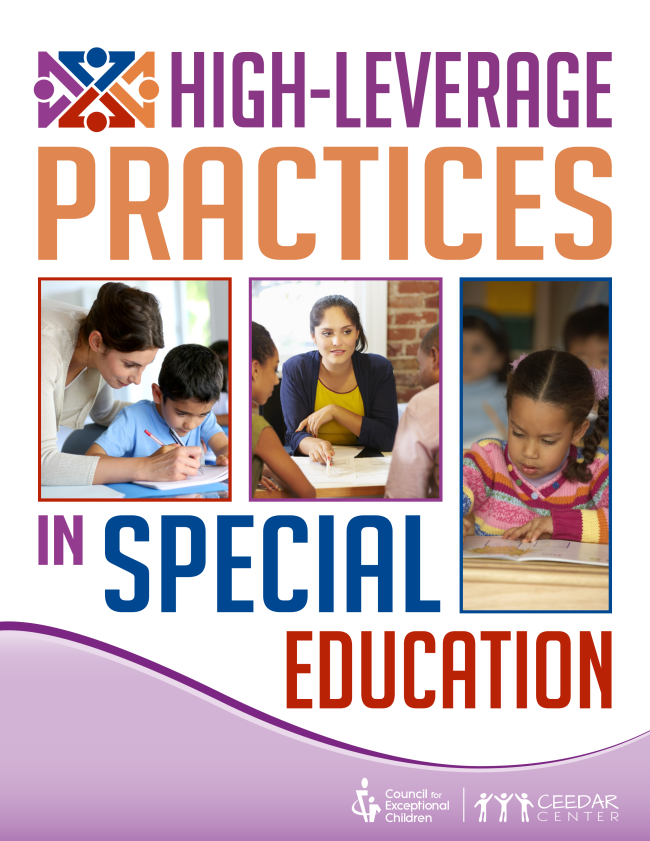
The Collaboration for Effective Educator Development, Accountability and Reform (CEEDAR) Center and the Council for Exceptional Children (CEC) has developed and published a set of high-leverage practices (HLPs) for educators working with students with disabilities. The HLPs are categorized by four aspects of practice:
- Collaboration
- Assessment
- Social/emotional/behavioral
- Instruction
“From these four aspects of practice, there are 22 practices intended to address the most critical practices that every K–12 special education teacher should master and be able to demonstrate. The selected practices are used frequently in classrooms and have been shown to improve student outcomes if successfully implemented.” (McLeskey et. al, 2017).
In the 2021-2022 TA-Live! series, RMTC-D/HH will dive deep into the understanding that Exceptional Student Education (ESE) professionals can use these strategies to improve instruction; however, teachers of the D/HH can utilize these practices through the lens of their specialized knowledge of students who are D/HH.
In order to make the most of your time and increase collaborations, RMTC-D/HH will be “flipping” the TA-Live! professional development series. “Flipped” learning for this opportunity means the center will post a video, discussing a practice with recommended resources addressing each of the high-leverage practices for students with disabilities for review before the scheduled virtual discussion.
For the first scheduled discussion on September 8, 2021 at 2PM ET (1PM CT), participants will be expected to watch two videos before meeting:
| |
RMTC-D/HH staff members and stakeholders will then have the opportunity to meet as a group of experts to collaborate and examine the application of these practices during a live discussion. These discussions will not be recorded, but a notetaker will be provided to gather resources. Participants will have the opportunity to develop and sharpen core effective practices to leverage successful outcomes for students who are D/HH across all settings, content areas, and grade levels. These resources will be maintained in a LiveBinder. | |
|
Deaf Awareness Month is celebrated during the month of September. Hearing Like Me (Guth, 2020) has written an article, “Deaf Awareness Month: 10 Things to Know About Being Deaf,” that provides information on things to know about individuals who are deaf and hard of hearing, and also how to spread awareness regarding individuals who are D/HH.
Included in Deaf Awareness Month is the International Week of Deaf People (IWDP), an initiative of the World Federation of the Deaf (WFD). The theme for the 2021 IWDP is Celebrating Thriving Deaf Communities. The IWDP will be celebrated during 2021 September 20-26.
Do you have an innovative way you celebrate Deaf Awareness Month in your district or community? Share it with us in the Virtual Learning DHH Collaborative Basecamp!
| |
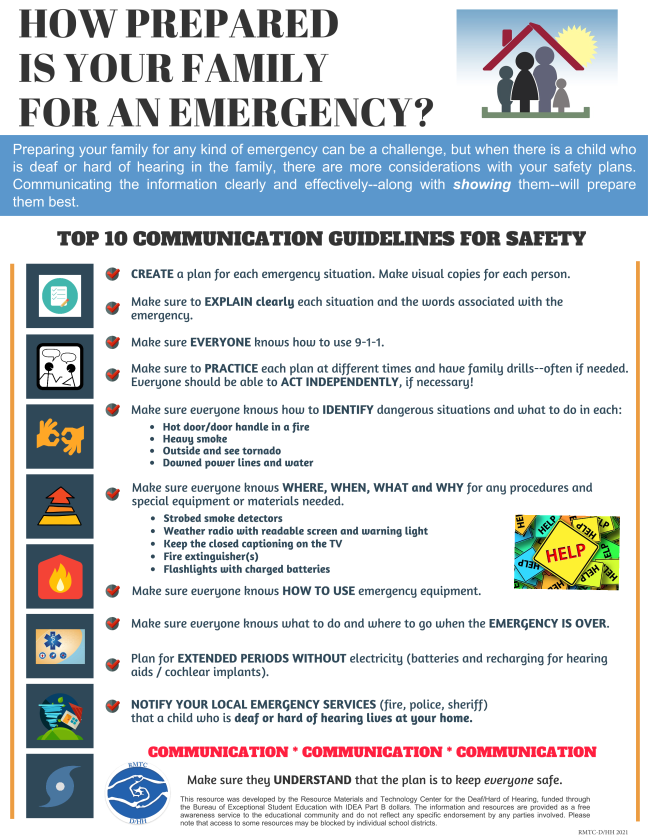
National Preparedness Month | | |
|
|
Please join RMTC-D/HH for Thinking on THIRDSdays, open office hours when you are free to ask questions in order to provide support to Florida students who are D/HH. Led by RMTC-D/HH staff, this opportunity allows district personnel the opportunity to pose and respond to peer inquiries about the education, planning, programming, and needs of students who are D/HH.
When?
Every third Thursday of the month
Where?
Virtual
| | |
Itinerant Teacher's Handbook Study | | | |
|
|
Please join RMTC-D/HH for the Itinerant Teacher’s Handbook Study beginning September 7, 2021. This 10-week online study is designed to provide information and guidance to itinerant teachers of students who are deaf or hard of hearing in the state of Florida. It covers itinerant roles and responsibilities as well as other topics important to the success of these highly specialized teachers. You will find the answers to essential and practical questions, along with shared tools for organization, and a network of updated resources for collaboration.
When?
Beginning September 7, 2021 through November 9, 2021
Where?
Virtual
| | |
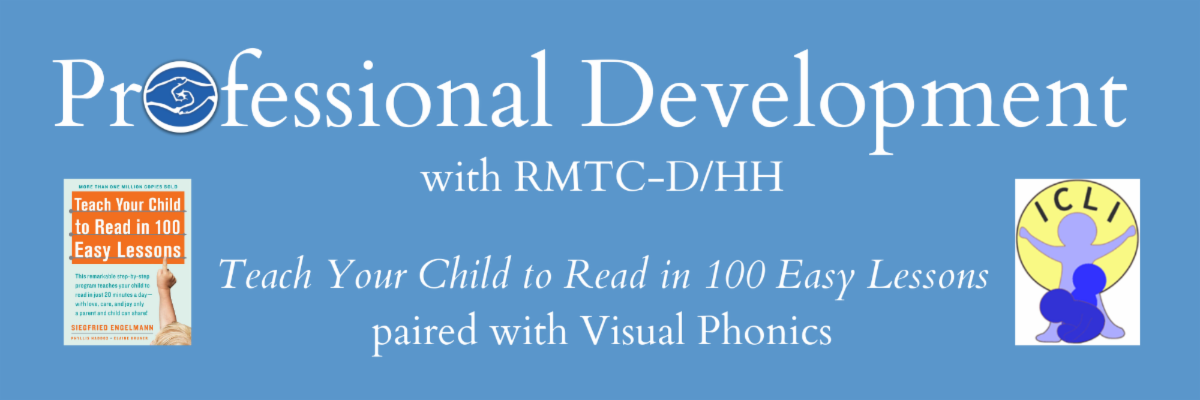
Teach Your Child to Read in 100 Easy Lessons Paired with Visual Phonics | | | |
|
When?
Fridays in October
Beginning Friday 8, 2021
Where?
Virtual
| | |
|
You have completed Visual Phonics* training, now what? Take it to the next level by pairing Visual Phonics with Teach Your Child to Read in 100 Easy Lessons. This supplementary intervention training is for professionals currently working with students who are deaf or hard of hearing in the state of Florida.
Teach Your Child to Read in 100 Easy Lessons is a complete, step-by-step program that shows teachers how to simply and clearly teach their students to read using the DISTAR method. Twenty minutes a day is the standard for implementation, and within 100 teaching days, the research suggests students will be decoding on at least a second-grade reading level. This program is a scripted, easy-to-follow, and an enjoyable way to help students to gain the essential skills of reading.
| | |
American Sign Language Expressive Skills Test | | | |
|
Did you know that over the summer RMTC-D/HH staff members received certification in the American Sign Language Expressive Skills Test (ASL EST)? The ASL EST assesses children's (aged 4-13 years) expressive sign language, specifically their ability to produce a signed narrative using appropriate ASL grammar. Completion of training and certification in ASL EST is required before administering the test. Please contact RMTC-D/HH should you require assistance administering the ASL EST. | | |
Expanded Skills Spotlight | |
|
|
Resources:
In order to keep all the resources in one place, RMTC-D/HH has created a LiveBinder that is categorized by the twenty-two “High-Leverage Practices for Students with Disabilities” from the CEEDAR Center and the Council for Exceptional Children (CEC). To see the resources available by each category, check out the LiveBinder!
| | | |
 |
Resources from the RMTC-D/HH Media and Materials Loan Library:
The below resources are from the Media and Materials Loan Library* that have relevance to the high-leverage practices.
Evidence-Based Practice in Educating Deaf and Hard of Hearing Students (Catalog Number: 1924) by Marc Marschark and Patricia Spencer summarizes and evaluates research findings across multiple disciplines pertaining to the raising and educating of children who are deaf, providing a comprehensive but concise record of the successes, failures, and unanswered questions in the education of children who are deaf.
Madness in the Mainstream (Catalog Number: 1866) is a rare account of what goes on behind the scenes in some educational settings. Deaf author Mark Drolsbaugh pulls no punches as he reveals the consequences of life in the mainstream for students who are deaf and hard of hearing.
The Itinerant Teacher’s Handbook, Second Edition, (Catalog Number: 1868) provides indispensable information for new and experienced itinerant teachers alike. This is a practical guide to accomplishing a two-fold mission: teaching students who are deaf or hard of hearing the knowledge and skills they need to become successful adults and helping others effectively interact with these students.
*Florida stakeholders can borrow these and many other resources from RMTC-D/HH's Media and Materials Loan Library, for FREE. Each material comes with a return label, making even the shipping at no charge to the borrower.
| | | |
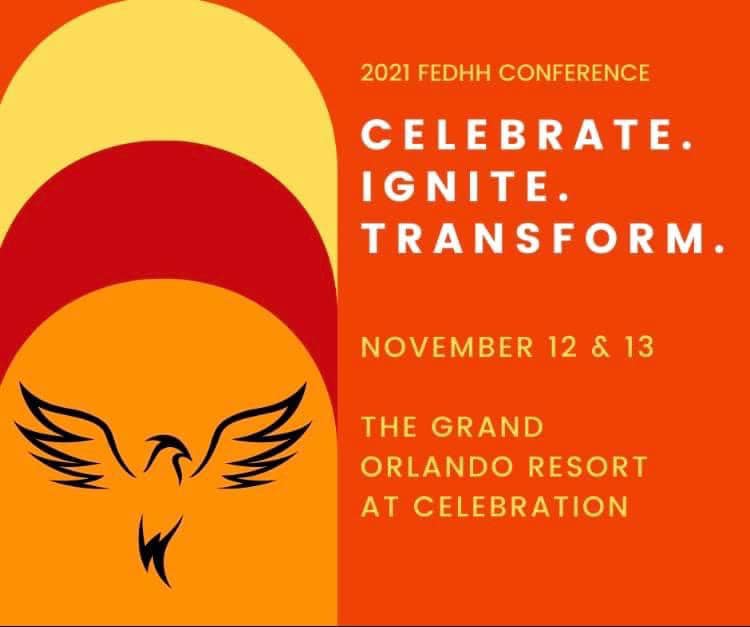
FEDHH
The Florida Educators of Students who are Deaf and Hard of Hearing (FEDHH) conference is being held at The Grand Orlando Resort at Celebration in Kissimmee, FL. The theme for the 2021 FEDHH Conference is “Celebrate. Ignite. Transform.”
| |
|
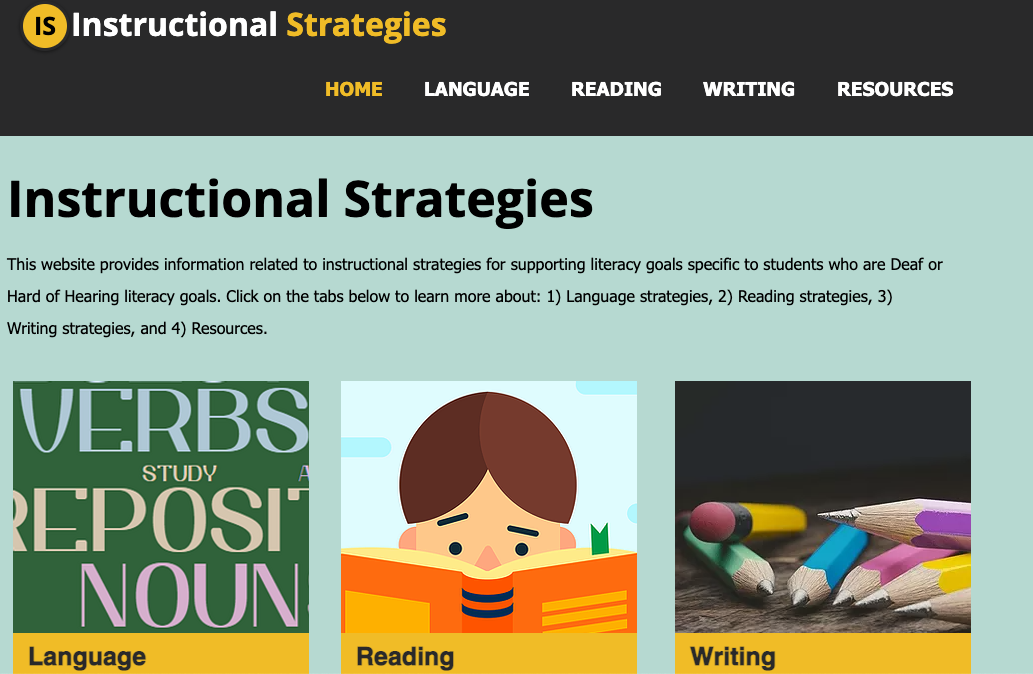
Avenue PM Instructional Strategies
Avenue PM has a new website that provides information related to instructional strategies for supporting literacy goals specific to students who are deaf/hard of hearing. Included in these strategies are language strategies and reading strategies. Avenue PM plans to release writing strategies soon!
| |
|
Professional Development with Hearing First
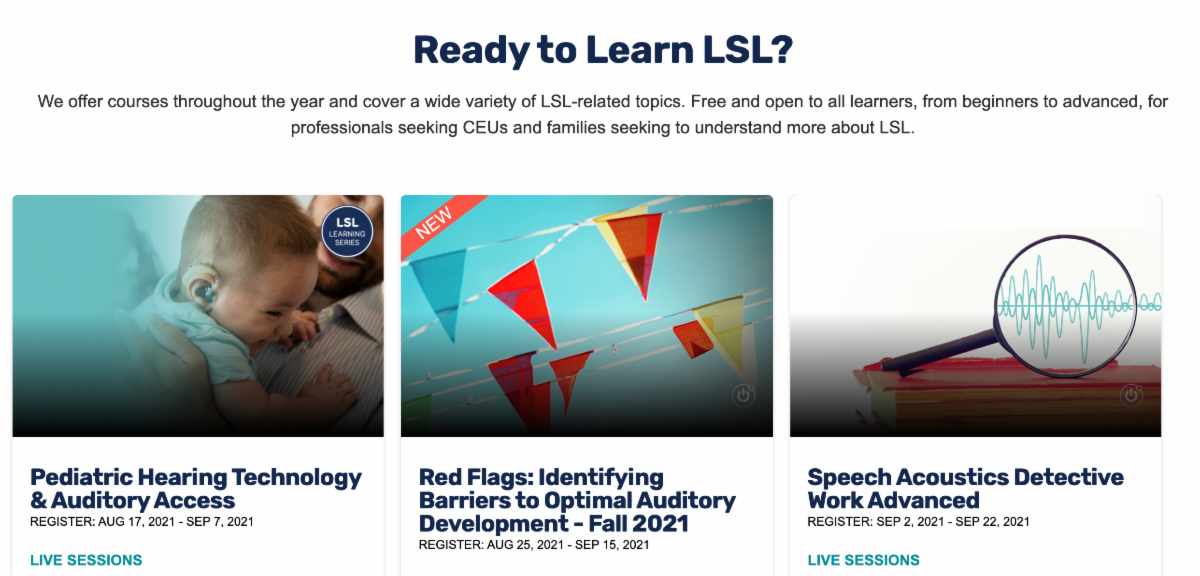
Hearing First offers free professional development, a platform to ask questions and share, blog, and resources to empower listening and spoken language (LSL) outcomes for children who are D/HH. AG Bell CEUs are provided at no cost for some of the courses. Check their catalog of learning experiences regularly for new offerings.
| |
|
Disney+ with ASL Captions
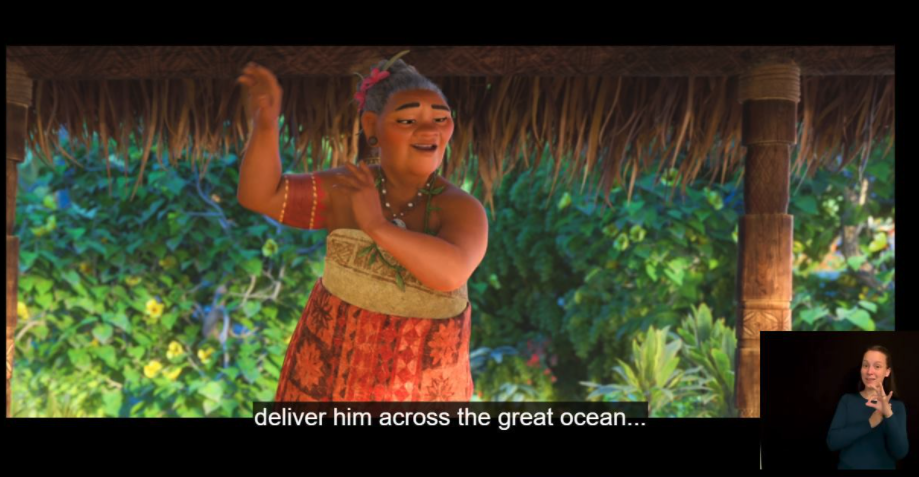
ASL captions for Disney+ movies recently launched via the Google Chrome Extension SignUp. The SignUp Google Chrome Extension overlays ASL interpretation on Disney+ for more accessible captioning. The movies that are currently available include the following: Moana, The Incredibles, Zootopia, and Despicable Me.
| |
|
World Princess Week with Disney using ASL Captions
Disney is celebrating World Princess Week 2021 with clips, fun facts, read-alongs, songs, and more. The best part is the videos are fully accessible in spoken English, ASL, and captions. They even matched the ASL interpretation to the speaker. Checkout their YouTube Playlist for all the videos.
| |
|
Motion Light Lab ASL Literacy Activities
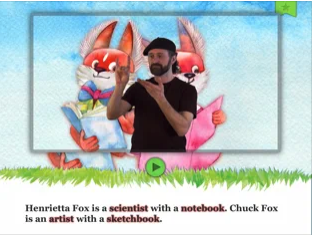
Motion Light Lab, based out of Gallaudet University, has a new ASL Literacy Activities section based on the most recent storybook app - A Tale of Two Foxes.
| |
|
ASDC Transition Webinar for Families
American Society for Deaf Children (ASDC) is hosting a webinar series A Parent's Guide to Transition - It Starts with a Vision! (4-Part Series) in October: “In this 4-session webinar series, we'll talk about what post-high school transition planning is, why it's important, and when it can start. You'll get tips for working with your child's IEP team and learn ways to involve your child in exploring interests, identifying college/career paths, and preparing for a smooth transition into life as a young adult.”
| |
|
Upcoming Events: Save the Date! | |
-
September 1-November 3, 2021 Rolling Start: Visual Phonics Asynchronous Online Training
-
September 7, 2021: Itinerant Teacher’s Handbook Study Begins
-
September 8, 2021: TA-Live! High-Leverage Practices Introduction
-
September 16, 2021: Thinking on THIRDSdays
-
September 17, 2021: Working with the Experts: Real World Auditory Learning for Children who are D/HH: Using the CID SPICE for Life Curriculum
-
October 5-6, 2021: Visual Phonics Virtual Live Training
-
October 6, 2021: Visual Phonics REFRESHER (for previously-trained users)
-
October 8, 15, 22, and 29, 2021: Teach Your Child to Read in 100 Lessons Paired with Visual Phonics
-
October 21, 2021: Thinking on THIRDSdays
| |
Check out the RMTC-D/HH 2020-2021 Calendar for more upcoming events! | |
RMTC-D/HH provides Tech Notes as a free resource to teachers, professionals, and parents around the state in order to pass along potentially useful information and expand the knowledge and opportunities available to educators and families of children who have hearing loss. This email was funded by the Florida Department of Education Bureau of Exceptional Student Education through federal assistance under the Individuals with Disabilities Act (IDEA), Part B funds. The information included does not reflect any specific endorsement by any parties involved. | |
Suggested Citation:
Resource Materials and Technology Center for the Deaf/Hard [RMTC-D/HH]. (2021). High-leverage practices for students with disabilities. Tech Notes. https://www.rmtcdhh.org/tech-notes-archive/
| | | | |