High-Leverage Practices for Students with Disabilities | |
HLP8 - Provide positive and constructive feedback to guide students’ learning and behavior | |
Happy November! The theme for this month is based on the eighth high-leverage practice from High-Leverage Practices (HLPs) in Special Education: Provide positive and constructive feedback to guide students’ learning and behavior. Keep reading for resources and more! | | | |
How does feedback correlate with behavior? | |
|
The high-leverage practice (HLP) “Provide positive and constructive feedback to guide students’ learning and behavior” is both the 8th and the 22nd practice. Two different research syntheses were conducted on this practice. One for social/emotional/behavioral practices and one for instructional practices. This article will focus primarily on the social/emotional/behavioral research.
The question to ask is, how does feedback correlate with behavior? The High-Leverage Practices in Special Education states, “Just like academic skill mastery, if teachers want students to build social behavior skill mastery they must provide specific, contingent feedback.” (McLeskey et. al, 2017, p. 58). Feedback is one of the top ten influences on student outcomes (Hattie, 2012). Read a snippet from the High-Leverages Practices (McLeskey et. al, 2017, p. 58):
If students make social behavior learning errors, (i.e., problem behavior), feedback should focus on what social skill the student should have used (Lewis, Jones, Horner, & Sugai, 2010). If students demonstrate the appropriate social skill, feedback should acknowledge student effort and include the classroom expectation or rule (e.g, “I see you are working hard to be a ‘respectful’ learner: You are working quietly so others can learn”).
When thinking about feedback, educators should understand that students who are deaf/hard of hearing (DHH) may need explicit instruction in social skills that may have been overlooked due to language barriers. Depending on the student’s hearing level, they may be more apt to engage in visual behaviors (i.e., physical) they see, especially when they may not have access to the auditory correction given for another student’s visual behaviors. This is where collaboration with the teacher of the deaf/hard of hearing (ToDHH) and the general education teachers AND with all educators and the family is so important. Social behaviors often carry across locations, so if the behavior modification is being conducted at school, but not at home, there can be confusion on the student's part as well as the potential for no or little progress on that issue. School-to-home collaboration can go a long way in problem solving such issues and keeping them from reoccurring. For more information on collaborating with families, see HLP3, “Collaborate with families to support student learning and secure needed services.”
For a deeper dive on HLP8, educators can join the TA-Live! discussion session and/or watch the videos:
| |
Evidence-Based Practices for
Students who are DHH
| |
|
Evidence-based practices for students who are deaf/hard of hearing (DHH) are scarce. The high variability of students in this low-incidence population makes research difficult and is a contributing factor to the lack of published work on topics related to the education of students who are DHH. This, however, does not mean that evidence-based practices should not be used for students who are DHH. On the contrary, evidence-based practices should be used as much as possible to close the achievement gap of these students and optimize outcomes for them. It may be that professionals have to take evidence-based practices designed for other student populations and adapt them to be accessible for students who are DHH. There are many practices that prove practical as well as effective for students who are DHH with some adaptation.
RMTC-D/HH staff reached out to Johns Hopkins University regarding the review of literacy strategies and curricula specifically designed for students who are deaf/hard of hearing to be considered as evidence-based as outlined in the criteria for the Every Students Succeeds Act (ESSA). A list of strategies/curricula with their corresponding research were sent for review by the Johns Hopkins University team. The Johns Hopkins University team will develop a section on both the Evidence for ESSA website and the Best Evidence Encyclopedia website that will be dedicated to populations of “special focus,” of which “Deaf/HOH” will be the first category. While the websites are in the process of being updated, Johns Hopkins University has begun including articles in summaries on the Best Evidence in Brief newsletter. The Best Evidence in Brief archived newsletters feature two evidence-based literacy interventions/curricula for students who are DHH:
Educators can sign up for the Best Evidence in Brief newsletter to receive upcoming evidence-based resources for students who are DHH.
| |
|
In the TA-Live! series, RMTC-D/HH is diving deep into the High-Leverage Practices in Special Education from the CEC and CEEDAR Center.
Before the next scheduled discussion, participants will be encouraged to*:
*Unable to complete the homework? Please still feel free to join RMTC-D/HH staff for a discussion on resources and tools Florida educators utilize related to the HLP discussed.
| |
For this month’s TA-Live! discussion session, RMTC-D/HH will be joined by the Florida Positive Behavioral Interventions & Supports Project (PBIS). Have questions for PBIS you would like to submit before the discussion session? Please fill out this form.
|
When?
November 16, 2022 from 2:00 p.m. to 3:00 p.m. ET (1:00 p.m. to 2:00 p.m. CT). With a watch party of the homework starting at 1:45 p.m. ET (12:45 p.m. CT).
| | |
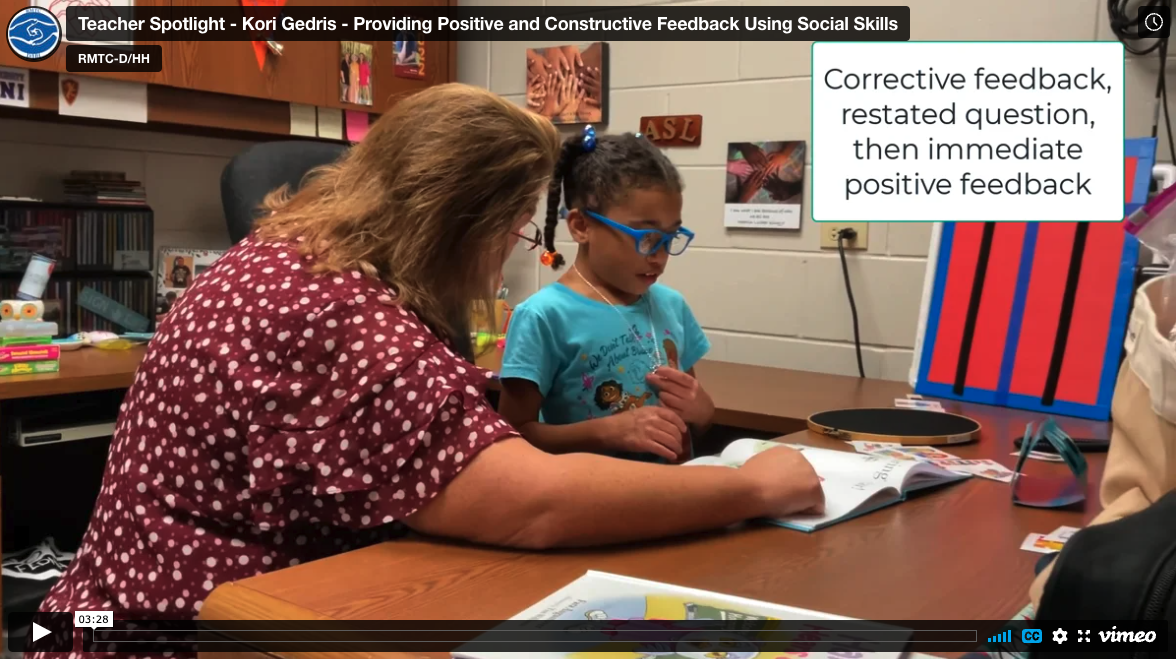
RMTC-D/HH Teacher Spotlight | |
Expanded Skills Spotlight | |
|
|
Resources:
In order to keep all the resources in one place, RMTC-D/HH has created a LiveBinder that is categorized by the twenty-two “High-Leverage Practices for Students with Disabilities” from the CEEDAR Center and the Council for Exceptional Children (CEC). To see the resources available by each category, check out the LiveBinder!
| | | |
Resources from the RMTC-D/HH Media and Materials Loan Library:
The below resources are from the Media and Materials Loan Library* that have relevance to the high-leverage practice "HLP8 - Provide positive and constructive feedback to guide students’ learning and behavior."
*Florida stakeholders can borrow these and many other resources from RMTC-D/HH's Media and Materials Loan Library, for FREE. Each material comes with a return label, making even the shipping at no charge to the borrower.
| | | |
|
|
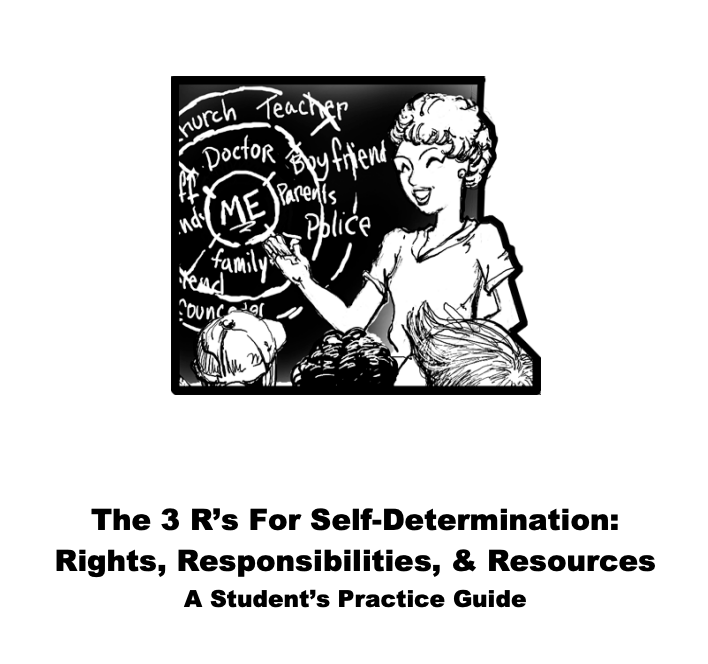
Advocacy in Action - A Self-Advocacy Curriculum for Students who are D/HH
(Catalog Number: 1938): Advocacy in Action provides tools for teachers to help students identify and develop self-advocacy skills. The text is designed to be easily individualized for each student or small group of students and for each teacher or parent.
| | | |
|
|
C.O.A.C.H.–Self-Advocacy & Transition Skills for Secondary Students who are Deaf or Hard of Hearing
(Catalog Number: 1939): This book uses a problem solving model of C.O.A.C.H. – Concern- Observe- Access- Collaborate- make it Happen to address access and communication needs. The book includes: rationale for the instruction model, step-by-step directions, goals and activities, assessments, and reproducible worksheets. Each section addresses specific aspects of advocacy and develops underlying skills to support application.
| | | |
|
|
Building Skills for Independence in the Mainstream
(Catalog Number: 1940): Building Skills for Independence in the Mainstream was developed as a guide for DHH professionals to support their work with classroom teachers and with students to develop the skills needed for independence with hearing aids and self-advocacy.
| | | |
|
|
Steps to Assessment - A Guide to Identifying Educational Needs for D/HH Students
(Catalog Number: 1943): The focus of this guide is appropriate assessment practices for children from transition to school at age three through high school. Categories of assessment are presented, as are ways to apply information from assessment results to identify instructional and accommodation needs for students who are DHH.
| | | |
|
|
Building Skills for Success in the Fast-Paced Classroom
(Catalog Number: 1958): The purpose of this book is to provide resources that will assist students who are DHH in optimizing their achievement through improved access and self-advocacy. It targets skills that must be mastered in order to benefit from the general education curriculum.
| | | |
|
|
Steps to Success
(Catalog Number: 1959): Steps to Success is an instructional model for students who are deaf or hard of hearing in grades kindergarten through 12. It is designed to develop skills that will enable a student to be an effective listener, a successful communicator, a proficient reader, and a knowledgeable consumer of goods & services related to hearing needs.
| | | |
Florida Summit on Childhood Deafness | |
|
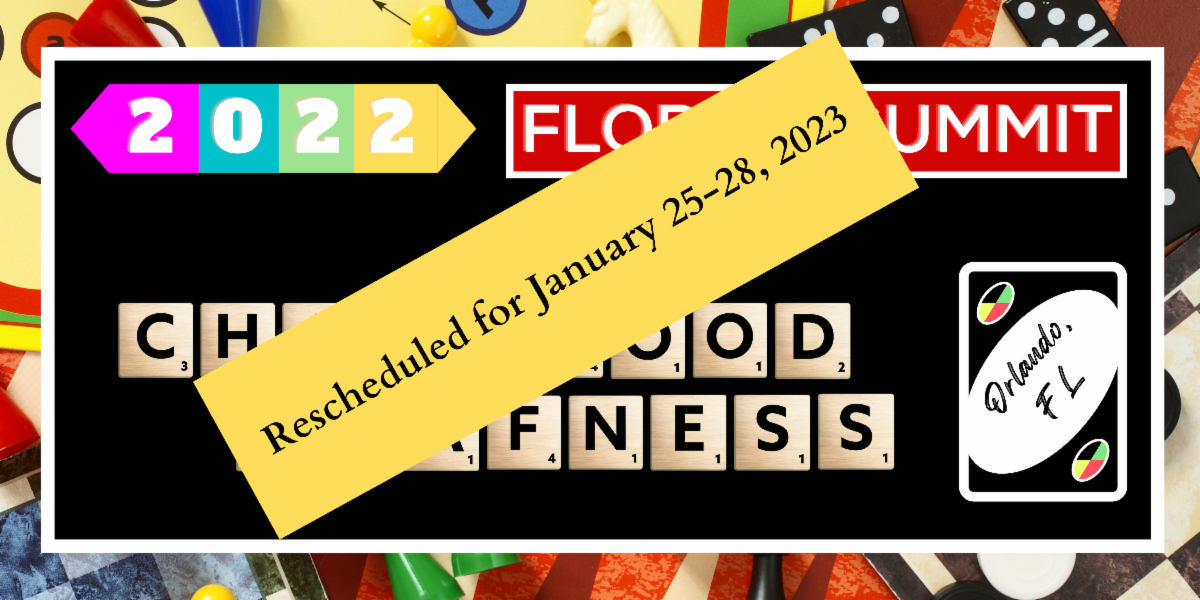
Out of an abundance of caution for Subtropical Storm Nicole, FEDHH has decided to postpone the Summit on Childhood Deafness.
The event has been rescheduled for the dates of January 25-28, 2023. All hotel reservations that were booked through the room block code will be transferred to the new dates. If you will not be able to join us in January, you will need to call the hotel directly and cancel. If you booked at another hotel, please make sure to reach out to them and cancel due to unforeseeable circumstances (i.e., Subtropical Storm Nicole).
More information will be forthcoming as the new event approaches. We greatly appreciate your understanding in this difficult situation.
We hope to see you in January.
For more information, please email flsummitdhh@gmail.com.
| |
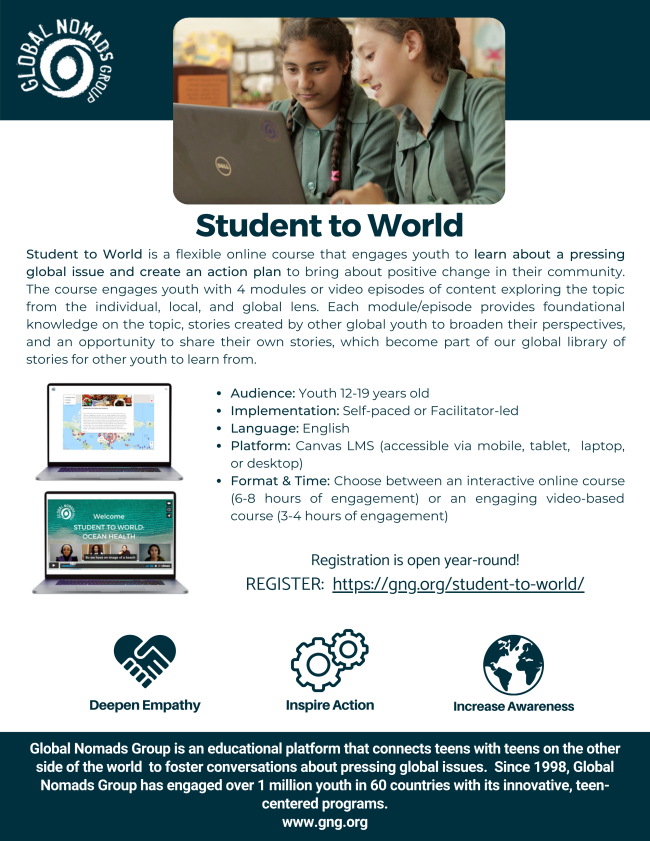
Student to World Online Classes
Student to World Online Classes offers eight FREE modules that were developed by international groups of teens for other teens. The video courses were designed with accessibility in mind. They have ASL interpretation, captioning, and audio descriptions embedded. Topics include overcoming bias, ocean health, art in action, sports, global hunger, women’s rights, mental health, and human rights.
Registration is open year-round!
For more information, please contact Christine Goussous at: christine@gng.org
| |
|
Virtual Science Fairs hosted by RIT/NTID
RIT/NTID offers virtual science fairs for students who are deaf/hard of hearing in grades 6, 7, and 8. The next competition is the Rube Goldberg Machine November 14 - December 9, 2022. Check out the Virtual Science Fair page to learn more and register today!
| |
MarineLab
NTID Regional STEM Center (NRSC) is providing an all-expenses paid field trip to the MarineLab at Key, Largo, FL! NRSC will book flights and transportation to the MarineLab camp and provide overnight staff to supervise the students. Register your class now!
| |
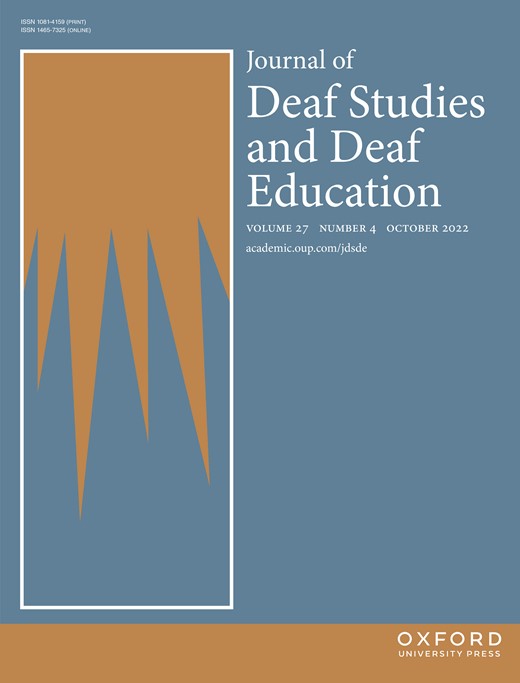
Journal of Deaf Studies and Deaf Education
A new issue of the Journal of Deaf Studies and Deaf Education has been released. Read articles like, “Perspectives of D/HH-Students on Mainstream Higher Education: A Qualitative Study,” “Predicting Early Literacy: Auditory and Visual Speech Decoding in Deaf and Hard-of-Hearing Children,” “Contribution of Lexical Quality and Sign Language Variables to Reading Comprehension,” and more!
| |
|
GoCC4All
The Dicapta Foundation has developed a new app called GoCC4All that is compatible with both iOS and Android operating systems. They are making emergency alerts accessible for all. Emergency alerts and captions can be displayed on a mobile device or braille display.
| |
|
Pre-Employment Transition Services (Pre-ETS)
Pre-Employment Transition Services (Pre-ETS) offer students with disabilities an early start at career exploration and preparation for adult life. Beginning at age 14, students with disabilities can connect with VR for Pre-ETS through the school transition staff, guidance counselor, or self-referral. Students with disabilities may participate in Pre-ETS without having to apply to VR or be determined eligible for services. Learn more from the Florida Vocational Rehabilitation webinar Pre-ETS Training for School District Staff and VR Staff.
| |
|
Upcoming Events: Save the Date!
-
November 7, 2022: DeafTEC Math Conference in Rochester, New York
-
November 11, 2022: Get Your Sign On
-
November 16, 2022: TA-Live! HLP8
-
December 1, 2022: Expanded Skills CoP
-
December 9, 2022: Get Your Sign On
-
January 5, 2023: Expanded Skills CoP
-
January 13, 2023: Get Your Sign On
-
January 15-April 15, 2023: Supporting Success for Children with Hearing Loss Virtual Conference
-
January 26-28, 2023: The 2022 Summit on Childhood Deafness with pre-conference options available January 25, 2022 (RESCHEDULED)
Check out the RMTC-D/HH 2022-2023 Calendar for more upcoming events!
| |
|
RMTC-D/HH provides Tech Notes as a free resource to teachers, professionals, and families around the state in order to pass along potentially useful information and expand the knowledge and opportunities available to educators and families of children who are deaf/hard of hearing. This email was funded by the Florida Department of Education Bureau of Exceptional Education through federal assistance under the Individuals with Disabilities Act (IDEA), Part B funds. The information included does not reflect any specific endorsement by any parties involved. | | |
|  |
|
References:
Hattie, J. (2012). Glossary of Hattie’s influences on student achievement. Visible Learning. https://visible-learning.org/glossary/
Kennedy, M. J., Peeples, K. N., Romig, J. E., Mathews, H. M., & Rodgers, W. J. (2018). High-leverage practices #8 & #22: Provide positive and constructive feedback to guide students’ learning and behavior. https://highleveragepractices.org/hlps-8-and-22-provide-positive-and-constructive-feedback-guide-students-learning-and-behavior
McLeskey, J., Barringer, M-D., Billingsley, B., Brownell, M., Jackson, D., Kennedy, M., Lewis, T., Maheady, L., Rodriguez, J., Scheeler, M. C., Winn, J., & Ziegler, D. (2017, January). High-leverage practices in special education. Arlington, VA: Council for Exceptional Children & CEEDAR Center. https://ceedar.education.ufl.edu/hlps/
| |
Suggested Citation:
Resource Materials and Technology Center for the Deaf/Hard [RMTC-D/HH]. (2022, November). HLP8: Provide positive and constructive feedback to guide students’ learning and behavior. Tech Notes. https://www.rmtcdhh.org/tech-notes-archive/
| | | | |