|
Theme:
- High-Leverage Practices (HLPs) 14: Cognitive and Metacognitive Strategies
Articles:
- Cognitive and Metacognitive Skills for Students who are DHH
- Communicating with Children who are DHH Over the Holiday Breaks
News from RMTC-D/HH
- TA-Live! High-Leverage Practices: HLP 14
- Innovation and Connection Conference
Expanded Skills Spotlight
- Communicating with Others
- Standards: SP.PK12.DH.5.4a and SP.PK12.DH.5.4b
Teacher Toolkit
- LiveBinder of Tools for HLPs
- Loan Library Resources
Did You Know?
- FSDB Expanded Core Curriculum (ECC) Series
- FSDB Pineapple PD Videos
- MED-EL Resources on Theory of Mind and Metacognition
- FEDHH Board
Upcoming Events
| |
HLP 14: Cognitive and Metacognitive Strategies | |
The theme for this month is based on the 14th practice from the Collaboration for Effective Educator Development, Accountability, and Reform (CEEDAR) Center and Council for Exceptional Children (CEC)’s High-Leverage Practices in Special Education: Teach cognitive and metacognitive strategies to support learning and independence. Keep reading for resources and more! | | | |
Cognitive and Metacognitive Skills for
Students who are DHH
| |
|
The High-Leverage Practices (HLPs) are a set of research-based teaching strategies that have been proven effective in improving student learning outcomes across diverse educational settings. HLP 14, which focuses on teaching cognitive and metacognitive strategies to support learning and independence, is particularly relevant for students who are deaf and hard of hearing (DHH). There is a body of research that supports the need for explicitly teaching cognitive and metacognitive strategies to students who are DHH (Strassman, 1997; Borgna et al., 2010; Brigham & Hartman, 2010; Benedict et al., 2015; Trussell et al., 2018; Yan & Paul, 2021).
Students who are DHH face unique challenges in the classroom. Communication and language access may impact the cognitive and metacognitive skills for a student who is DHH. As a result, different approaches to teaching these skills may need to be considered. Equipping these students with cognitive and metacognitive strategies can greatly enhance their educational experience and promote independence.
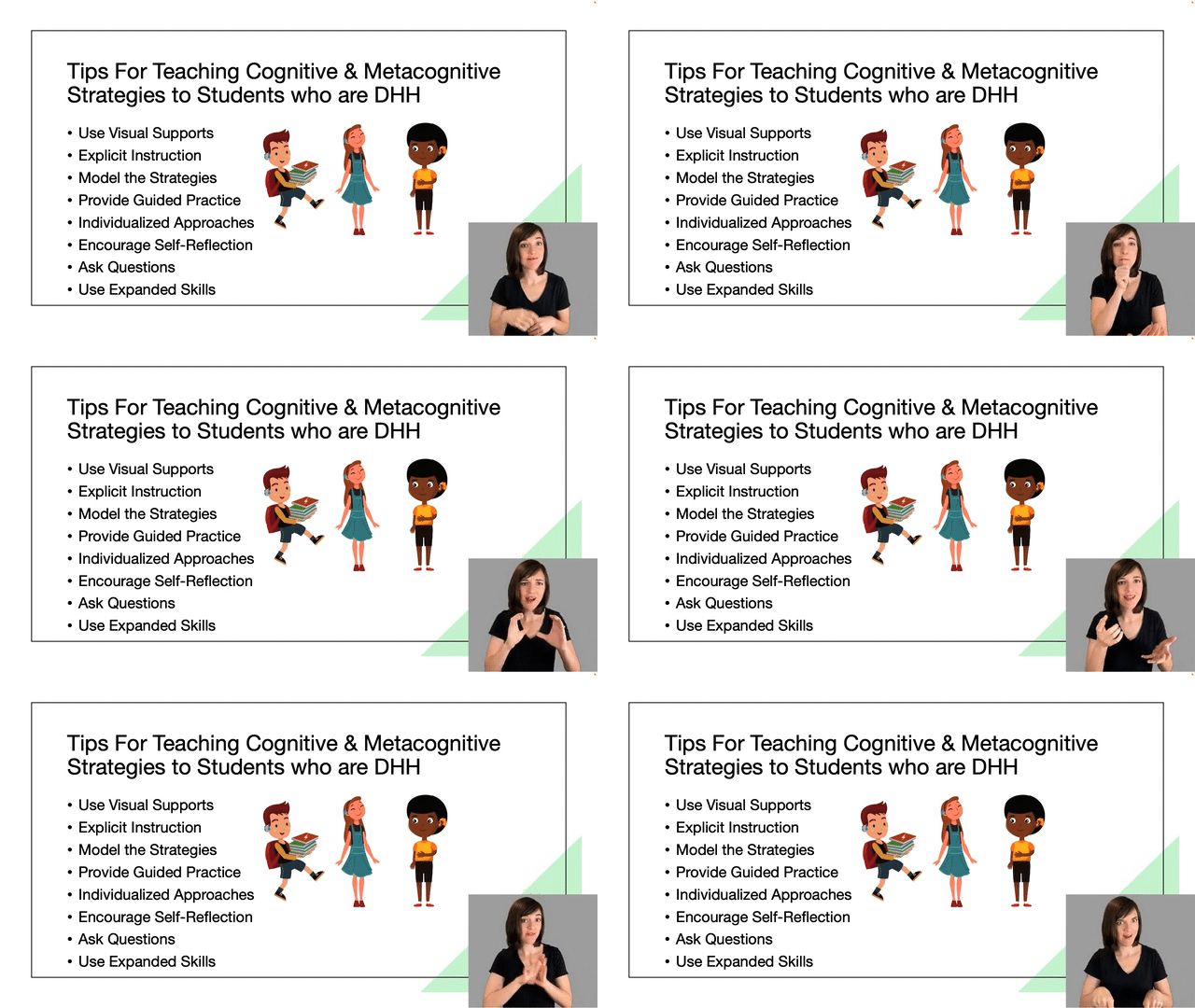
Tips for teaching cognitive and metacognitive strategies:
-
Use Visual Supports: Since many students who are DHH rely heavily on visual information, incorporate visual aids like diagrams, charts, and graphic organizers to convey concepts and strategies.
-
Explicit Instruction: Be clear and explicit in your instruction. Break down complex strategies into manageable steps and provide examples to illustrate their application.
-
Model the Strategies: Demonstrate how to use cognitive and metacognitive strategies effectively. Model note-taking, summarization, problem-solving, and self-monitoring during class discussions.
-
Provide Guided Practice: Offer guided practice sessions where students can apply these strategies with your support. Gradually decrease your involvement as they become more proficient.
-
Individualized Approaches: Recognize that each student may have unique learning preferences. Work with them to identify the strategies that work best for them individually.
-
Encourage Self-Reflection: Promote metacognitive awareness by encouraging students to reflect on their learning processes. Ask them questions like, "What strategies helped you learn best?" or "How did you adapt your approach when faced with a challenge?"
-
Ask Questions: Promote higher order thinking by asking students questions like, “What do you think?” “Why do you think this strategy is the most effective?”
-
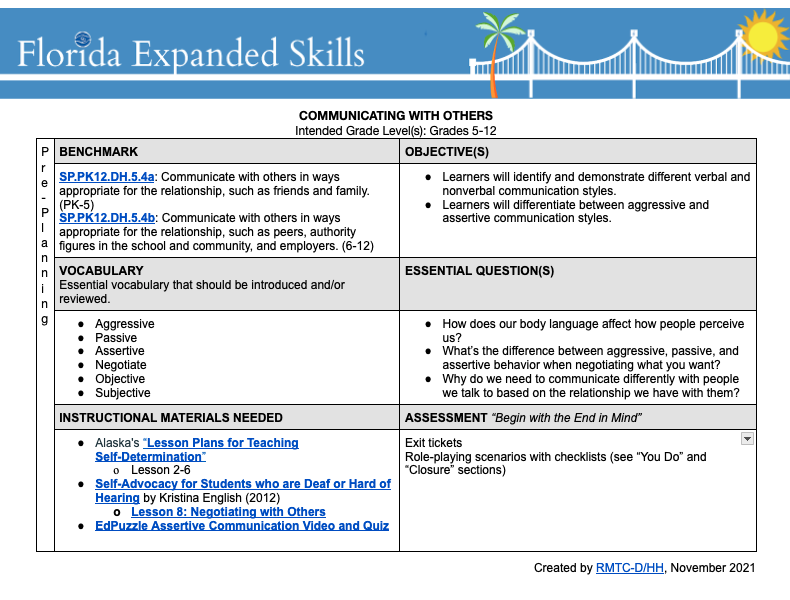
Use Expanded Skills: Florida’s Expanded Skills Standards have a number of standards that relate to cognitive and metacognitive skills. For example, standard SP.PK12.DH.5.4b states, “Communicate with others in ways appropriate for the relationship, such as peers, authority figures in the school and community, and employers.” (For an example of a lesson plan using this standard, see the Expanded Skills Spotlight!)
Remember that teaching cognitive and metacognitive strategies to students who are DHH may require additional time and creativity, but with patience and effective communication, these students can develop these essential skills and thrive in both academic and social settings.
| |
Communicating with Children who are DHH
Over the Holiday Breaks
| |
|
As the holiday season approaches, here are some quick tips to help you give families guidance for the holidays with their child who is DHH from the National Center on Postsecondary Outcomes (NDC, 2019):
- Involve them.
- Educate yourself.
- Eyeball the environment.
- Turn on the captions.
- Hire a professional.
- Use what you have.
- Play deaf-friendly games.
- Check in and ask questions.
For more information on each suggestion, refer to the article “A Holiday for the Whole Family: Tips to Include Deaf Guests” from NDC.
| |
|
In the TA-Live! series, RMTC-D/HH is diving deep into the Collaboration for Effective Educator Development, Accountability and Reform (CEEDAR) Center and the Council for Exceptional Children (CEC)’s High-Leverage Practices in Special Education and how teachers of the DHH can utilize these practices through the lens of their specialized knowledge of students who are DHH.
When?
The next TA-Live! session will be January 10, 2024 from 2:00 p.m. to 3:00 p.m. ET (1:00 p.m. to 2:00 p.m. CT). With a watch party of the homework starting at 1:45 p.m. ET (12:45 p.m. CT).
| For January's TA-Live! discussion session, RMTC-D/HH will be joined by the Florida Inclusion Network (FIN). Have questions for FIN you would like to submit before the discussion session? Please fill out this form. | | |
Innovation and Connection Conference (ICC)
RMTC-D/HH is proud to have been invited to participate in the Innovation & Connection Conference presented by the Mailman Center for Child Development. Join us on December 6, 2023 from 9:30 a.m. to 3:45 p.m. ET (8:30 a.m. to 2:45 CT) as “a dynamic group of presenters from the University of Miami Debbie School, the University of Miami Children’s Hearing Program, and invited speakers from the Resource Materials and Technology Center for the Deaf/Hard of Hearing have collaborated to deliver and facilitate this workshop filled with resources, case studies, discussion, and thought-provoking action planning to improve capacity throughout the state of Florida for optimizing outcomes for children who are DHH.”
For more information, including the agenda, and to register, please see the Innovation & Connection Conference flyer, or see the Conference Registration page. For questions, please contact Roselyn Antao.
| | |
Communicating with Others | |
|
|
Resources:
In order to keep all the resources in one place, RMTC-D/HH has created a LiveBinder that is categorized by the twenty-two “High-Leverage Practices for Students with Disabilities” from the CEEDAR Center and the Council for Exceptional Children (CEC). To see the resources available by each category, check out the LiveBinder!
| | | |
Resources from the RMTC-D/HH Media and Materials Loan Library:
The below resources from the Media and Materials Loan Library* have relevance to Deaf Awareness Month.
*Florida stakeholders may borrow these and many other resources from RMTC-D/HH's Media and Materials Loan Library, for FREE. Each material comes with a return label, making even the shipping at no charge to the borrower.
-
#1507 Teaching as Inquiry: Asking Hard Questions to Improve Practice and Student Achievement (Book)
-
#1523 Classroom Instruction That Works: Research-Based Strategies for Increasing Student Achievement (Book)
-
#1947 101 "Answers" for New Teachers and Their Mentors - Effective Teaching Tips for Daily Classroom Use (Book)
-
#1948 Thinking About You, Thinking About Me: Teaching Perspective Taking & Social Thinking to persons w/Social Cognitive Learning Challenges (Book)
| | | |
Have you seen the new items in the loan library? Check them out! | | | |
|
|
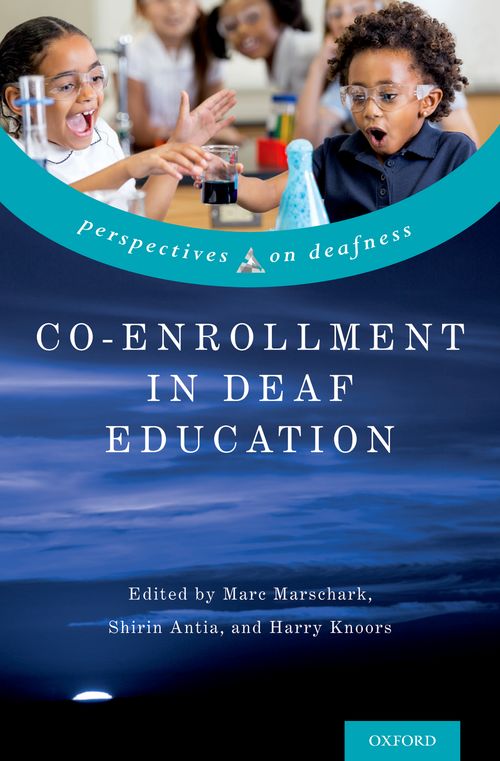
Co-Enrollment in Deaf Education
(Catalog #1983)
| | | |
|
|
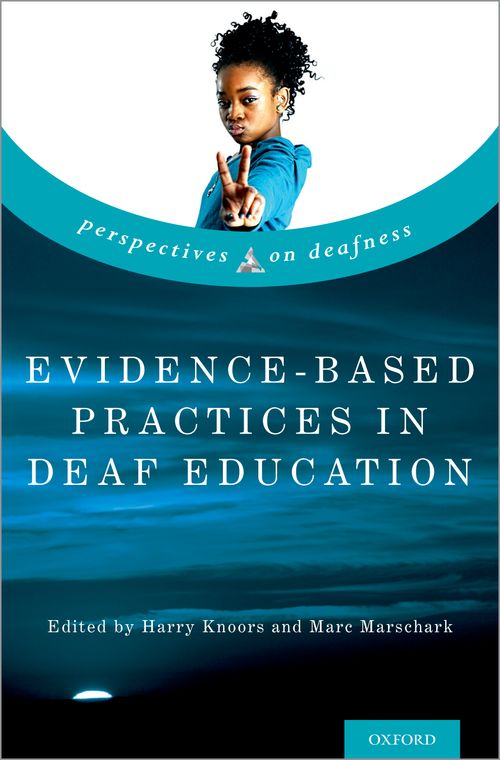
Evidence-Based Practices in Deaf Education
(Catalog #1984)
| | | |
|
|
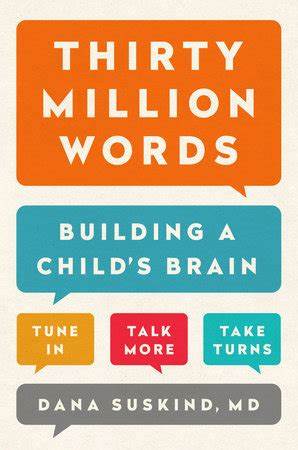
Thirty Million Words: Building A Child's Brain (Catalog #1985)
| | | |
FSDB Expanded Core Curriculum (ECC) Series
FSDB is continuing its ECC Interactive Learning Series for children who are blind/visually impaired or deaf/hard of hearing and who are between six and fourteen years old. The event will be Saturday, December 9, from 10 AM to Noon, Eastern time. Registration is required.
For more information and to register, please see the ECC Interactive Learning Series flyer or the ECC Registration Page. For questions, please contact Jennifer Valderama or call 904-827-2454.
| |
FSDB Pineapple PD Videos
Did you know that FSDB has short videos highlighting different strategies for teaching students who are DHH? Check out some videos that highlight cognitive and metacognitive strategies!
| |
MED-EL Resources on Theory of Mind and Metacognition
MED-EL has several articles, videos, and blogs pertaining to theory of mind and metacognition:
| |
FEDHH Board
The FEDHH Board is in need of new board members. If you or someone you know is enthusiastic, organized, and ready to be part of an amazing collaborative team, please fill out a nomination form.
| |
RMTC-D/HH provides Tech Notes as a free resource to teachers, professionals, and families around the state in order to pass along potentially useful information and expand the knowledge and opportunities available to educators and families of children who are deaf/hard of hearing. This email was funded by the Florida Department of Education Bureau of Exceptional Education through federal assistance under the Individuals with Disabilities Education Act (IDEA), Part B funds. The information included does not reflect any specific endorsement by any parties involved. | |
Suggested Citation:
Resource Materials and Technology Center for the Deaf/Hard [RMTC-D/HH]. (2023, November). High-Leverage Practice 14: Cognitive and Metacognitive Strategies. Tech Notes. https://www.rmtcdhh.org/tech-notes-archive/
| | | | |