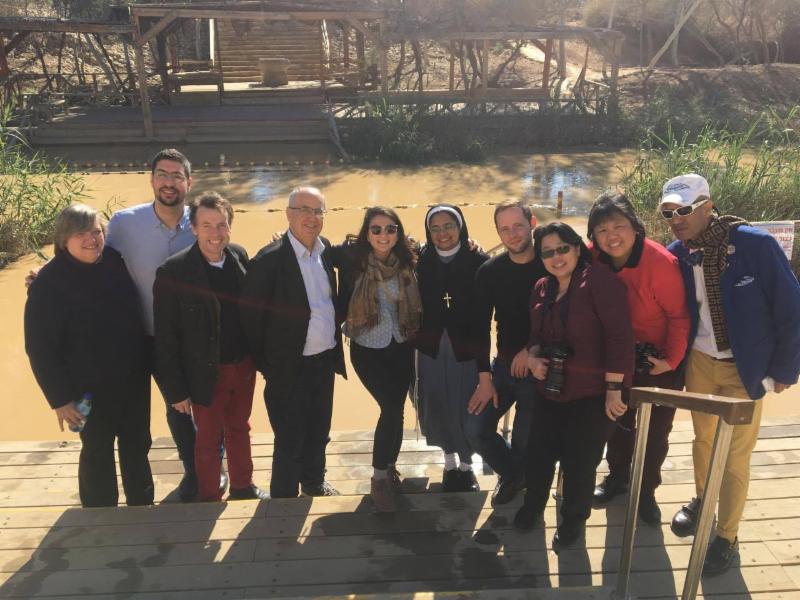
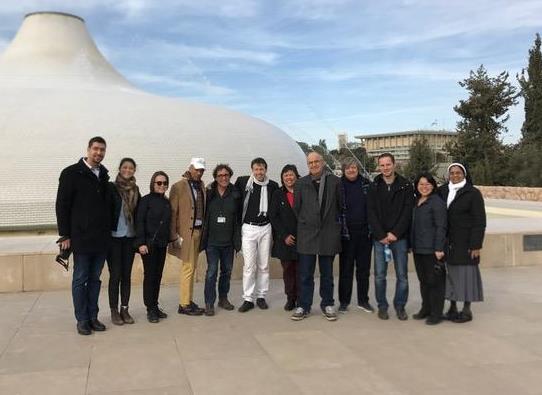
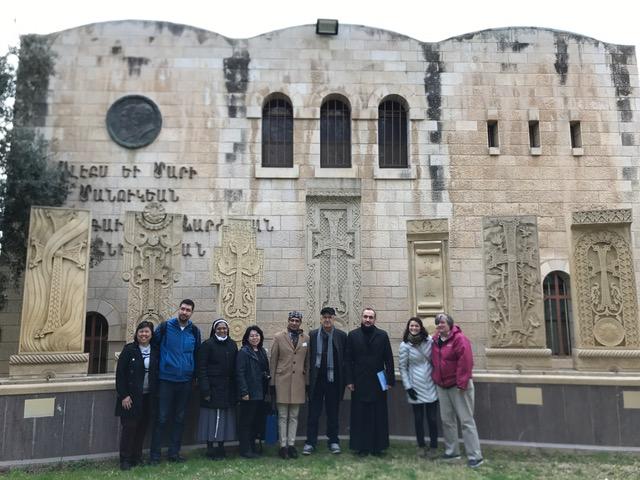
Our alumna from Ukraine, Lidiia Batig (Cohort VIII), has interviewed the Berrie Fellows and asked them to share their thoughts and experiences about the Israel Study Tour. Below are reflections and thoughts of our students.
1. After a few months of studying interreligious dialogue at the Angelicum in Rome and after your study tour to Israel, what has changed in your perception/understanding of interfaith dialogue?
Sr. Anie Deepa (India):
The study of interreligious dialogue has helped me to broaden my perception about Judaism and Jews. The study tour was an eye-opener for me and I could experience the warmth in the relationship which I never thought about before. Now I am able to understand more clearly the need of interfaith dialogue and reading the history together for healing the wounds.
Rafiqur Rahman (U.S.A):
I have learned authentic interreligious dialogue is rife with challenges and setbacks. For example, engaging the Other within Israeli society at a grassroots level, necessitates at a bare minimum, attempting to intellectually grasp
-
I am unsure if this is even possible
-
the madness associated with the Shoah (
בשואה
).
Any engagement with the Jewish people must always bear in mind the memory and occurrence of the Shoah
-
interreligious dialogue is impossible without it. It is my claim that
any interreligious dialogue not grounded within the context of a faith traditions' own unique historical/cultural heritage is patently disingenuous.
On a more general note, my own life experiences as a person-of-color when dealing with those who are not like me has caused me to recognize that genuine interfaith dialogue must be rooted in real life experiences saturated with uncomfortable memories, emotions, and experiences-real interreligious dialogue is not a Kumbaya event. If I cannot feel your weltschmerz (world-pain or world-weariness) within my heart, how can I meet you where you are now?
Christine Lim (Malaysia):
Coming from Malaysia, a predominantly Muslim country made up of multi-religious, multi-cultural, multi-ethnic citizens who mostly originally came from China, India and Indonesia, I grew up in a society with different skin colours. It was the norm for me to have friends who professed a different faith from me, who were a different colour from me, who had a different culture from me, but we never looked at one another as any different. Studying at the Angelicum and in Israel showed me that interfaith is not only identified by your skin colour or represented by the country of your origin. It is possible to live in harmony with people of different creeds, colour and confession.
Lynda Middleton (U.S.A.):
Through study at the Shalom Hartman Institute and speaking with leaders in interreligious dialogue we learned about what work is being done and how much more there is left to do. Visits to the Old City of Jerusalem, various pilgrimage sites and museums enriched our experience and learning. Rabbi Hartman told us that to be a Rabbinic Jew is to be a learning person- to make yourself a heart of many rooms. The Jerusalem Seminar opened me and some more rooms in my heart for the other. I am grateful to the Berrie Foundation and all of those who made this experience possible.
2. Personally, what were your expectations from the trip to Israel and have they been met?
Christos Kalaitzidis (Greece):
--Our guide, a historian by profession, told us at one point that it's the story that matters, not historical facticity. The stories we tell about national struggles and victories might change overtime, but the purpose is always to serve the community. In a surprising way it makes sense that a good story trumps factual accuracy.
--I found Jewish people to be very friendly and hospitable. This is very much contrary to the stereotype of the stingy Jew.
--I was surprised that most of the ordinary Jews that I met were unbelievers or atheists. Yet they maintain a very strong Jewish identity.
Sr. Anie Deepa (India):
My expectations for the trip to Israel was a cultural fusion and an interfaith exchange. I was hoping to experience the cultural and religious interaction and all of this has been met.
Christine Lim (Malaysia):
This was my second visit to Israel. The first time, I was in a pilgrimage with my Church and we visited the Christian places of interest and Churches mentioned in the Bible. I felt that the visit was much too short and I could not absorb everything. Thus, I had always wanted to revisit Israel at a more leisurely pace.
This visit which was more academic focused showed a different side of Israel. I had come with no expectations as I wanted to be open for a new experience.
The study sessions and the interaction at the Shalom Hartman Institute who had such a great interest in the study of Judaism, the Hebrew Bible, the Midrash, are experiences I will not easily forget. I was impressed by their passion to read, understand and learn more about their and others' faiths.
The visits to the Shrine of the Book, the Yad Vashem and Masada were, for me, the highlights of the trip. To see, to hear and to learn about the depth and width of the people, their history and their faith was really eye opening.
3. Please describe three most surprising things/experiences you have seen/had in Israel. Was there anything that helped you break stereotypes/prejudices you might have had before?
Gabrielle Yang (Malaysia):
-Chavruta - It was filled with such enthusiasm and positiveness to have such an
encounter with the Shalom Hartman Institute's chavruta leaders. Their unassuming
mannerism and getting us to warm up to the sessions was mind blogging, to see the
various perspectives and angles that we could deliberate on Genesis 18 and 22. It was
an enlightening day and to realize that we need to open our hearts and mind.
-The schools of Bet Shammai and Bet Hillel. The Talmud is fascinating. It is full of
contrasting opinions and the beauty is that the Rabbis could discuss, deliberate and
agree to disagree and could come up with many possibilities. Such a beauty, even the
Talmud knows it is not easy for those who need certainty and some answers.
-When we arrived at the Last Supper room. I was disappointed for a second. It fell short
of my expectation but faith, the paschal mystery lifted me to higher grounds. St. John
Paul II asked, "What more could Jesus have done for us? Truly, in the Eucharist, he
shows us a love which goes 'to the end' (cf. Jn. 13:1), a love which knows no measure.
This aspect of the universal charity of the Eucharistic Sacrifice is based on the words of
the Saviour himself. In instituting it, he did not merely say: 'This is my body', 'this is
my blood', but went on to add: 'which is given for you', 'which is poured out for you'
(Lk 22:19-20). Jesus did not simply state that what He was giving them to eat and drink
was His body and His blood; He also expressed its sacrificial meaning and made
sacramentally present His sacrifice which would soon be offered on the Cross for the
salvation of all" (Encyclical Letter Ecclesia De Eucharistia Of His Holiness Pope John Paul II To The Bishops Priests And Deacons, Men And Women In The Consecrated Life And All The Lay Faithful On The Eucharist In Its Relationship To The Church, Given In Rome, At Saint Peter's, 17 April, Holy Thursday, 2003).
Samantha Lin (U.S.A.):
I have had the good fortune to visit Israel three times previously and am always astounded by the liveliness of the country. The amazing ability to rebuild and rethink in just sixty years of history is incredible. The most prominent example of this was the Mahane Yehuda Market. The market fell into disrepair but has been re-invented as a center for life, both young and old, Jewish and Arab, in Jerusalem.
Lynda Middleton (U.S.A.):
I was greatly touched by two events. The most important question asked was, "What is loyalty to God?" What does God expect of us and what does it mean to do good? We discussed the issue through Chavruta study and then experienced it ourselves through a visit to Yad Va Shem. As I gazed at hundreds of pairs of dead people's shoes and paused at the Children's Memorial tears formed in my eyes. So much potential for good was destroyed by so much evil. How could we account either for this horrific evil or for the heroism of those persons who hid, cared for and rescued the persecuted Jews of World War II? The Shoah was not just a past event but is a lived reality in its survivors, in the state of Israel and in a world where hatred, oppression and violence are the everyday reality of many.
Sr. Anie Deepa (India):
-Shrine of the book and the Nano Bible exhibition
-Yad Va Shem programme
-Jewish Prayer service.
Rafiqur Rahman (U.S.A.):
-I came to realize how Loving the Stranger is very complicated within modern-day Israel. For example, when I was visiting the Temple Mount area (i.e., site of the Al-Aqsa Mosque and the Western Wall) on 30th January 2016, I observed how Orthodox Jews had to be escorted (for their safety) by a sizeable Israeli security detail carrying armed submachine guns when visiting the Dome of the Rock.
-The social justice issues bedeviling the marginalized, poor, and oppressed (i.e., Non-Jewish refugees, illegals, etc.) residing within South Tel Aviv, Israel (33 Shivat Zion St.) are very pressing and real.
-The less-than-friendly passerby glances directed towards me when I was posing for pictures with Israeli security border guards within the Old City of Jerusalem; the cold looks I observed made me quite cognizant of the religious, political, and sociocultural tensions existing within the Holy Land.
I have come to the realization that sometimes small gestures-abundantly evidenced by St. Teresa of Calcutta-are vitally important when participating in interreligious dialogue and that grand gestures, though important, need not be present when Loving the Stranger-"If we have no peace, it is because we have forgotten that we belong to each other." Witnessing both Jews and Arabs coming together for authentic interfaith dialogue at the Shalom Hartman Institute is evidence for me that not all individuals subscribe to religious hate - there is potential for hope in the Middle East.
Christine Lim (Malaysia):
Although I had heard stories of occasional clashes between the Jews, Christians and
Muslims living in Israel, I was fortunate not to have experienced or witnessed any of that
during the study tour. I noted that one night, as we were walking along a popular street, one of the few streets where Jews, Christians and Muslims walked freely, it looked like any "normal" street with individuals, couples, friends and families walking about freely. I did not feel unsafe or that I needed to keep on looking over my shoulder. On a few occasions, when I smiled at a
stranger, they smiled back and this made me feel really at ease.
During the same walk, one of the cohort members stopped an Orthodox Jew to ask a few
questions and the Orthodox Jew politely answered all his questions. He was pleasant and
happy to answer the questions, which surprised me as I had the impression that the
Orthodox Jews do not simply speak to anyone.
4. Imagine that you are a journalist (writer) who is being given a possibility to live one year in one of the cities in Israel and then you have to write a book or make a film about that city. Which city would that be and why?
Rafiqur Rahman (U.S.A.):
Tel Aviv, because of the secular nature of the city. It appears, at first blush, to be the polar opposite of Jerusalem. I would be curious to see how the people of Tel Aviv view interfaith relations/dialogue from a secular Jewish perspective.
Christine Lim (Malaysia):
Masada. It showed the ingenuity of Herod the Great in building and fortifying this city.
The resourcefulness to secure the city, the courage of the last inhabitants who held out
against the invading Romans for over three years and their bravery to die rather than to
surrender to the Romans.
Sr. Anie Deepa (India):
I would choose Galilee to stay for one year. The sea shore and the quiet atmosphere attracted me so much. The tranquility and holiness of that place would help me to fulfill my job.
If I am given a chance to make a film on a city I would select Mazada. Because it was the place where many Jews sacrificed their lives and became martyrs.
Samantha Lin (U.S.A.):
I would live in Haifa and write about the experiences of Arab-Israelis in the only major Israeli city that is roughly equal in number of Jewish and Arab Israelis.
Christos Kalaitzidis (Greece):
It definitely would be Jerusalem because of the intense concentration of history and religious significance. Furthermore, history here mixes with the modern in a unique fashion evidenced in the daily life and mentality of people as they navigate the legacy of thousands of years of history and the legacy of three native religions.
Gabrielle Yang (Malaysia):
Yad Vashem, the Shoah memorial, even one with a strong heart would never feel the
same after the journey. It is certainly not a tourist site!
5. What impressed you most at the Shalom Hartman Institute? In your opinion, what is the difference between the Angelicum and Shalom Hartman Institute? What is similar?
Samantha Lin (U.S.A.):
I
felt very welcomed but also challenged at the Shalom Hartman Institute. The scholars were not afraid to push how I thought and to push back on my opinions in a respectful and invorgating way. I was particularly happy to be able to study with several women; as a lay woman involved in the Church I wish there were more female figures at the Angelicum to learn from! I was happy to meet such fantastic women from all different religious spectrums at Hartman.
Christine Lim (Malaysia):
The welcome by the Institute, and the warmness of the chavurta leaders were the first
things that impressed me. It felt like an extended family gathering each morning for coffee
and then, a sharing of a topic of common interest. The sessions were not organised like a
lecture where the professor imparts his or her knowledge and the student absorbs the
knowledge.
At the Institute, their teaching method was one of exchange among students after a brief
introduction by the professor. There were no conclusions to the chavruta sessions but after
each of these, the professor would come and present a conclusion.
Sr. Anie Deepa (India):
The difference between the Angelicum and the Hartman Institute is the difference in the study method. At Hartman the students are given importance to improve their knowledge in the word of God through dialogue in a house setting. At the Angelicum it is more of a theoretical study based on the research by oneself.
But in the classrooms we are allowed to ask questions and clarify our doubts. But we don't use a dialogical interrogative way all the time.
Rafiqur Rahman (U.S.A.):
The thought-provoking academic coursework at the SHI has made me cognizant of the fact that Israel is a pluralistic society composed of many disparate faith communities and, "In the 21st century, Jews [within Israel] are living in an open marketplace of ideas and even identities ... Jews don't agree. We have different notions of God, halakha, ritual, ethics, identity, and politics. In fact, it is nearly impossible to identify any singular, core feature of Judaism that everyone who is Jewish shares in common," and, for this reason, SHI is propagating an inclusive form of Judaism advocating traditional values of tolerance, respect, and hospitality (Deuteronomy 10:19, Leviticus 19:34, etc.).
The Angelicum as a Pontifical University is directed, per Canon Law, "to investigate the sacred disciplines or those connected to the sacred and to instruct students scientifically in the same disciplines, are proper to the Church by virtue of its function to announce the revealed truth,"-it has a different telos compared to SHI (i.e., There is no explicit mention of interreligious dialogue per se). Per Church teaching, all education conducted by any Pontifical University uses scientific and humanistic research, informed by faith, to strengthen the Church.
I see the similarity between SHI and the Angelicum loosely revolving around the theological concept of faith seeking understanding-"It means that faith comes before understanding. We don't have to understand God in His entirety in order to have faith. Faith comes first, and then it leads one to a deeper understanding of everything around us."
Christos Kalaitzidis (Greece):
I was hugely impressed by the architecture of the institute. The gates open onto a flight of stairs that descend on a big open courtyard which leads to a perfectly symmetrical structure of buildings with a lot of smaller courtyards. The descent is a representation of a retreat from the hustle and bustle of the streets of Jerusalem; symmetry is a symbol of pluralist equality of religions; and the open courtyards suggest an openness with which we must approach the study of the diversity of religions.
Besides the obvious difference that the Angelicum is a Catholic institution and the Shalom Hartman Institute is a Jewish one, I think the difference between their approach to pluralism is important. The Angelicum deals with pluralism first and foremost as an interreligious issue. For the Shalom Hartman Institute pluralism is intrareligious issue: Judaism itself is a pluralist religion.
The similarity between the two institutions is that they both look at pluralism through the lens of their own religious tradition. They interpret otherness through a well-defined sense of self rather than challenge the very notions of otherness and self, which is rather the characteristic of secular considerations about pluralism.
6. Please continue and finish the following phrase: "Israel is a Holy Land where I felt....."
Christine Lim (Malaysia):
"Israel is a Holy Land where I felt I could see, hear, smell, walk the streets that Jesus had seen, heard, smelled and walked 2000 years ago. It is a connection to the roots of my Catholic belief."
Samantha Lin (U.S.A.):
"Israel is a Holy Land where I felt grateful to be present in a place important to Jews, Muslims and Christians.
Rafiqur Rahman (U.S.A.):
"Israel is a Holy Land where I felt at home."
Lynda Middleton (U.S.A.):
"Israel is a Holy Land where I felt that sometimes, my own heart would harden as I heard and experienced things that were uncomfortable for me. But as I listened I grew to appreciate how truly difficult it is to value and live pluralism- to own that there may be truths that are not my truth
and that there are ways that are not my ways. These truths and these ways are equally valid ways of understanding God and what life is truly about.
Gabrielle Yang (Malaysia):
"Israel is a Holy Land where I felt that it is not easy to say goodbye to a place where our faith was built upon the rock when Christ called Peter. Peter obeyed and he travelled to Rome. He heard and we too heard, "Do not be afraid!" (Mt. 28:10). They are the words of the Church to us today. Do not be afraid to preserve your Christian presence and heritage in the very place where the Saviour was born."
Sr. Anie Deepa (India):
"Israel is a Holy Land where I felt like my home."
7. In terms of learning, how important was the Israel study-tour for you? What is the most important thing (lesson) that you brought back home from Israel?
Christos Kalaitzidis (Greece):
It was very important for me. I learned and experienced things that change my understanding of religious pluralism for the better. The most important lesson I bring back with me from Israel is a personal appreciation of the Jewish culture and faith. Before the trip I only had an intellectual relationship with the Jewish mentality, now I am personally involved in the issues that matter to the Jews.
Sr. Anie Deepa (India):
In terms of learning the study tour was very important for me because as a Christian I always looked forward to visit the Holy land. It is the citadel of our faith and understanding Judaism is essential to understand Christianity. The most important lesson I brought home is that even though we are different we can live together peacefully. The importance of God and the gratitude towards Him and the willingness to practice the laws given by God is always visible. I could see the children in Israel are being brought up in that way.
Rafiqur Rahman (U.S.A.):
The study tour to Israel was very important for me because I got to see firsthand how difficult interfaith dialogue within the Holy Land can be.
Per Rabbi Dr. Hartman, "In the 21st century, Jews [within Israel] are living in an open marketplace of ideas and even identities ... Jews don't agree. We have different notions of God, halakha, ritual, ethics, identity, and politics. In fact, it is nearly impossible to identify any singular, core feature of Judaism that everyone who is Jewish shares in common," and, for this reason, Israel needs to propagate an inclusive form of Judaism advocating traditional values of tolerance, respect, and hospitality (Deuteronomy 10:19, Leviticus 19:34, etc.)."
Gabrielle Yang (Malaysia):
This is the crux of the matter that I believe the late David Hartman would like me to bring home from Jerusalem: "Israel is not only a response to modern anti-Semitism, but is above all a modern expression of the eternal Sinai covenant that has shaped Jewish
consciousness throughout the millennia. It was not only the Holocaust that brought us back to Zion,
but also, and more important, the eternal spirit of Sinai - the refusal to abandon our historical memories and destiny. One need not visit Yad Vashem in order to understand our love for Jerusalem. Sinai calls us to action, to moral awakening, to living constantly with challenges of building a moral and just society which mirrors the kingdom of God in history.
Sinai creates humility and openness to the demands of self transcendence. In this respect, it is the antithesis of the moral narcissism that can result from suffering and from viewing oneself as a victim."
And to highlight the important difference between Auschwitz and Sinai, it is important to refer back to the Torah that the people of God did not go into Egypt first. They went to Sinai. They made a covenant with God. Then "After we overcome the humiliating memory of slavery and persecution and understood that we were called to bear witness to God's
kingdom in history, only then did we enter the land. The memory of suffering in Egypt was absorbed by the conventional normative demands of Sinai." Therefore, it is important to understand why "who is my neighbour?" is so close to the hearts of the Jewish community. They have suffered and this suffering has opened their hearts to have many rooms.
8. If you had a chance to re-live/repeat one lecture/excursion/conversation that you had in Israel, which experience would that be? Why?
Samantha Lin (U.S.A.):
I would like to go back to our conversation with Fr. David Neuhaus SJ. He was an incredibly passionate, caring, knowledgeable man and we didn't have nearly enough time to talk with him. I would particularly like to stay and go to mass or see the Sunday school classes he teaches to migrant Hebrew-speaking Catholics.
Gabrielle Yang (Malaysia):
A place that I have always dreamed of visiting is the Jordan river, the holy site of the Baptism of our Lord. Fr Stipe Juric, Dean of Theology at Angelicum who accompanied us throughout the journey was awesome at the river. Fr Juric re-enacted our baptism with the water from the Jordan. And I could say "YES" to my baptismal vow again, "Together we
shall renew our baptismal promises. We shall reject sin, and the glamour of evil, and Satan, the father of sin and prince of darkness. We shall profess our faith in the One God, in his Son, our Saviour Jesus Christ, in the coming of the Holy Spirit, in the Church, in life everlasting. And we shall be responsible for the words we say, and be bound by an alliance
with our God." Amen.
Christos Kalaitzidis (Greece):
I had an absolutely amazing conversation with an ultra-orthodox rabbi. One evening the Hartman Institute hosted a dinner where they invited many prominent religious figures, including the first woman rabbi in Israel. But for most of the evening we sat at our tables eating and conversing with our immediate neighbors. I chose a seat at one of four big tables before anyone arrived, and then the many guests arrived, and then this ultra-orthodox rabbi got to sit next to me by chance. We ended up having a private conversation, largely oblivious to the rest of the table and the rest of the guests, that lasted for most of the evening. We had a very good connection, a very interesting and fluid conversation that honestly I didn't expect. I had never spoken to an ultra-orthodox rabbi, so I expected a polite but mostly superficial conversation due to the huge discrepancy between my liberal world view and his, well how to better describe it, ultra-orthodox views. But our conversation was anything but superficial. It was a moving conversation and we shared deeply personal experiences. Opening myself up to the one I considered the "radical other" and his reciprocating it was a profound and magical experience. I can't share with you what was said, but I can say this: I wish to say and hear those things again.
Finally I moved from our table to greet the first ever ordained woman rabbi in Israel. About 10 minutes later the ultra-orthodox rabbi left the dinner.
Sr. Anie Deepa (India):
I would want to return in the Holy Sepulcher Church where Jesus completed his Passion and Death. He is my master and stronghold.
Rafiqur Rahman (U.S.A):
Our Russell Berrie Scholar group had the privilege of an honest Loving the Stranger encounter on the 31st January 2017 with Fr. Dr. David Neuhaus, S.J.-Israeli Jesuit and Patriarchal Vicar for Hebrew-speaking Catholics in the Latin Patriarchate of Jerusalem-concerning the social justice issues bedeviling the marginalized, poor, and oppressed (i.e., Non-Jewish refugees, illegals, etc.) residing within South Tel Aviv, Israel (33 Shivat Zion St.). The fruitful interreligious discourse occurring between Fr. Neuhaus, Fr. Stipe, Dr. Afterman, Mr. Nevo (Israeli tour guide for the ABFWS) and ourselves highlighted for me the real and genuine empathy, we as a group, collectively felt towards Loving the Stranger.
I can honestly say that all of the Russell Berrie Scholar participants grappled with the felicitous question: What role should Judaism, Christianity, etc. adopt to foster a democratically pluralistic Israeli society in which the non-Jewish minority and an ever-increasing number of international refugees feel respected and equal?
Spending more time in South Tel Aviv with Fr. Neuhaus.. S.J. among the marginalized, poor, and oppressed would have been very beneficial for me from a spiritual learning/academic perspective.
Christine Lim (Malaysia):
Visit to the Yad Vashem. To spend more time there to more fully experience the suffering so that I could share a deeper and more meaningful understanding of the Shoah to my family and friends.