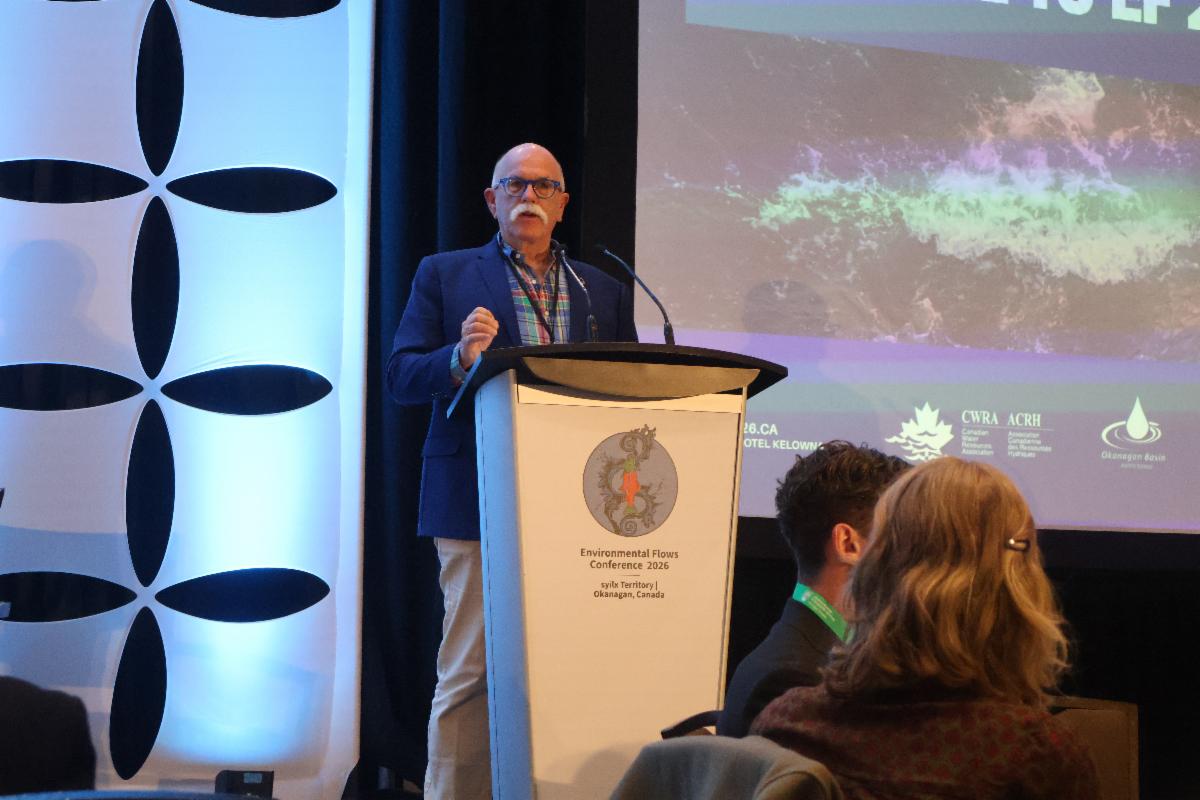
Youth voices, global expertise and Indigenous leadership shape Environmental Flows Conference | Experts from California, Eastern Canada and Europe join Okanagan discussions on water and watershed resilience during fourth consecutive drought year | | OBWB Chair Blair Ireland speaks at EF2026, Oct. 7, 2026 in Kelowna. | |
syilx Territory, Kelowna, B.C. – More than 150 water scientists, First Nations leaders, government staff, water suppliers and youth gathered in Kelowna Oct. 7–9, 2026 for the 2026 Environmental Flows Conference (EF2026), bringing together Indigenous perspectives and international expertise to discuss the future of water.
Held at the Coast Capri Hotel on the traditional, ancestral and unceded territory of the syilx Okanagan people, the conference was co-hosted by the Okanagan Basin Water Board (OBWB), the Okanagan Nation Alliance (ONA) and the Canadian Water Resources Association (CWRA). It was the third conference in a series that began in 2018, and the first co-hosted by all three organizations.
The Okanagan’s fourth consecutive drought year underscored the urgency of planning for environmental flows — the water needed to sustain healthy aquatic ecosystems.
City of Kelowna Mayor Tom Dyas helped open the conference and welcomed attendees to Kelowna, while OBWB Chair Blair Ireland addressed the challenge in his opening-day remarks.
“No single government, nation, or agency can manage this alone. Water doesn’t care, water knows no boundaries and we’ve got to work together for our future,” said Ireland at the conference.
“For most of our history, we have treated the water left in a stream as simply a bonus, after everyone else took their share. Environmental flows ask us to turn that around. They ask us to decide, deliberately and in advance, how much water a creek needs to stay alive, and to plan around that. Without a healthy ecosystem, we don’t have anything.”
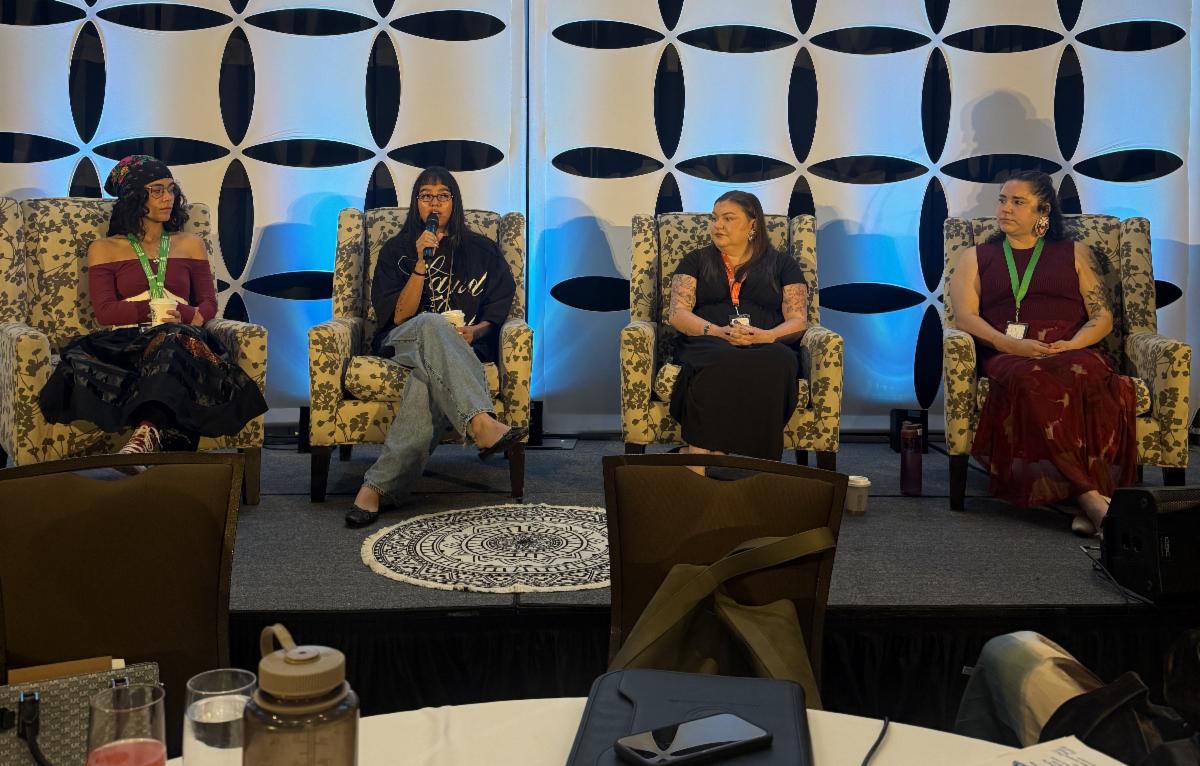
| | The Indigenous Youth Leadership Panel at EF2026, Oct. 8, 2026. (l-r) Serenity Baptiste, Meadow Arcand, Haley Regan and Summer Raven Saulis. | | |
Youth voices challenge participants
An unscripted Indigenous Youth Leadership Panel opened the conference’s second day with a message that resonated throughout the gathering: water is a relative, not a resource.
“How are we acting in ways in which the land and water are grateful for us?” asked panelist Meadow Arcand. “I know that everything depends on water, yet we keep doing these things to harm them.”
Panelists Haley Regan, Serenity Baptiste, Meadow Arcand and Summer Raven Saulis shared their fears about falling lake levels, warming water and how far salmon can still migrate. They then turned the question back on the room: what are you doing to share water knowledge with the next generation?
“When the youth asked what we are doing to share what we know, the room went quiet,” said Dr. Nelson Jatel, Conference Chair and OBWB Senior Director of Water Science & Stewardship. “We brought some of the world’s leading environmental flows researchers to the Okanagan. The most important thing they heard was that this work must be passed on and decided together.”
ONA emphasized the value of bringing Indigenous knowledge holders, youth, researchers and water managers together.
“One of the most impactful sessions was the Indigenous Youth Leadership Panel, which inspired participants throughout the conference and reinforced the importance of elevating youth voices in decisions affecting our waters and future generations,” shared the ONA.
“The panel shared powerful perspectives, including the reminder that 'before we even breathed air on this earth, water was our first relation' and that 'all water is connected.' ONA was honoured to contribute to the conference through our sessions and participation, and we value opportunities to continue sharing syilx perspectives on water, environmental flows, and our responsibilities to future generations.”
Indigenous leadership guides watershed conversations
| | |
Indigenous leadership shaped the program from its opening remarks to its closing session.
Westbank First Nation Chief Robert Louie and Dawn Russell of the Penticton Indian Band opened the conference by framing water as a connector between communities, ancestors and descendants.
ONA fisheries staff shared the story of sockeye salmon returning to Okanagan Lake for the first time in decades following restored fish passage. Summer Raven Saulis of Bilijk Wolastoqiyik explored how much water a river needs to remain a healthy relative.
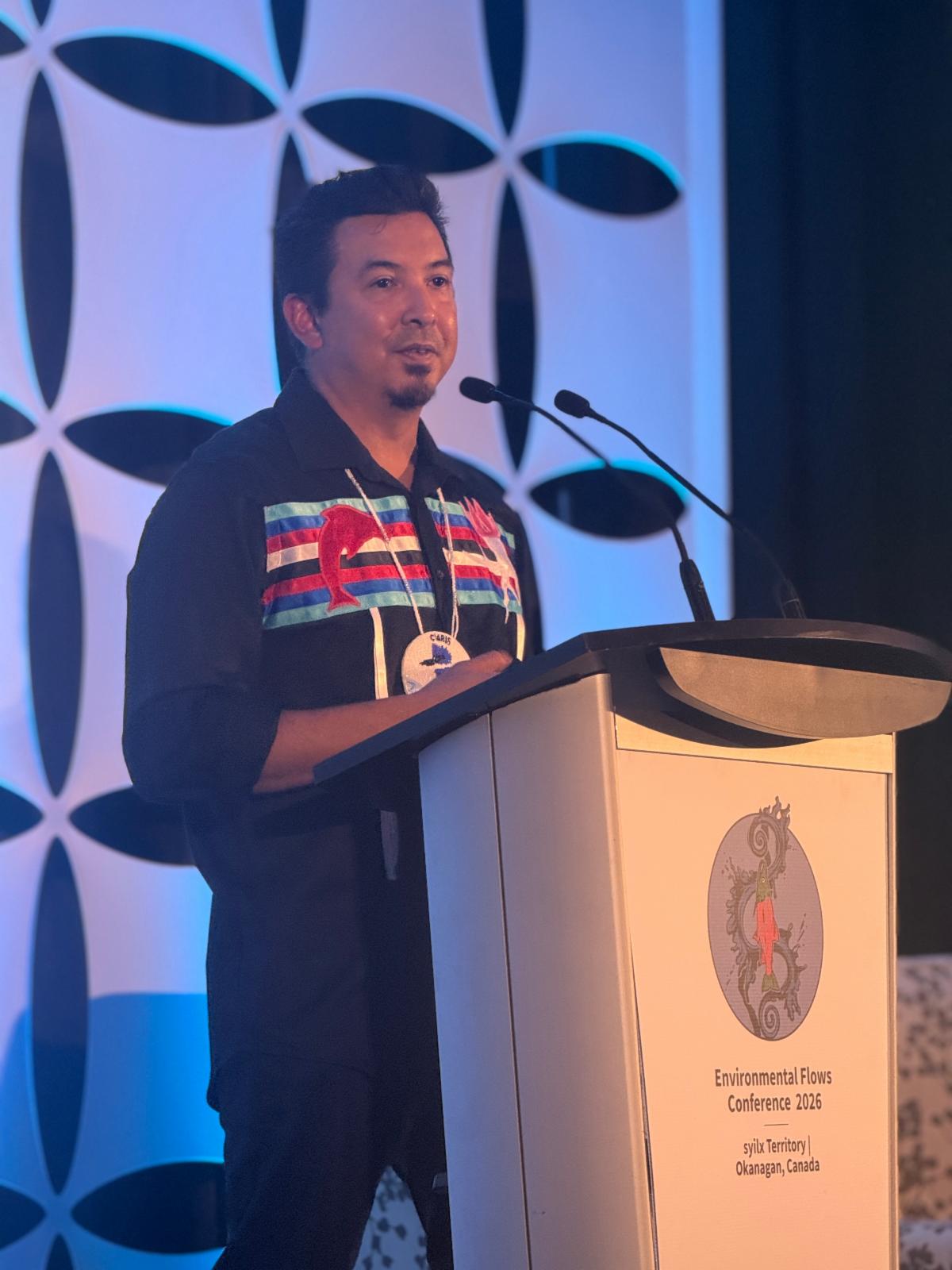
At the gala, keynote speaker and Westbank First Nation Councillor Jordan Coble spoke about his passion for the land, his relationship with water, and the need to work together to show water the reverence it deserves. He called for stronger relationships with one another and with water, supported by the will, policies and laws to protect it.
Coble encouraged attendees to go to the water, introduce themselves and find grounding in that connection. He also described how different knowledge systems can coexist without absorbing one another, retaining their distinct identities while working respectfully toward a common goal.
On Friday, Chief Louie and Lake Country Councillor Tricia Brett, Co-Chairs of the Okanagan Similkameen Collaborative Leadership Table, presented its long-term watershed responsibility plan.
"Westbank First Nation was honoured to attend and speak at the conference, welcoming attendees from across the region and sharing the syilx perspective on our relationship with siwɬkʷ (water). Opportunities like this are important for sharing knowledge, strengthening relationships, and ensuring Indigenous perspectives are part of the conversations shaping the future of our lands and waters," remarked Chief Robert Louie.
"Water sustains all living things, and protecting it is a shared responsibility that calls for collaboration, respect, and a commitment to future generations."
| | |
Youth artwork brings the conference’s themes to life
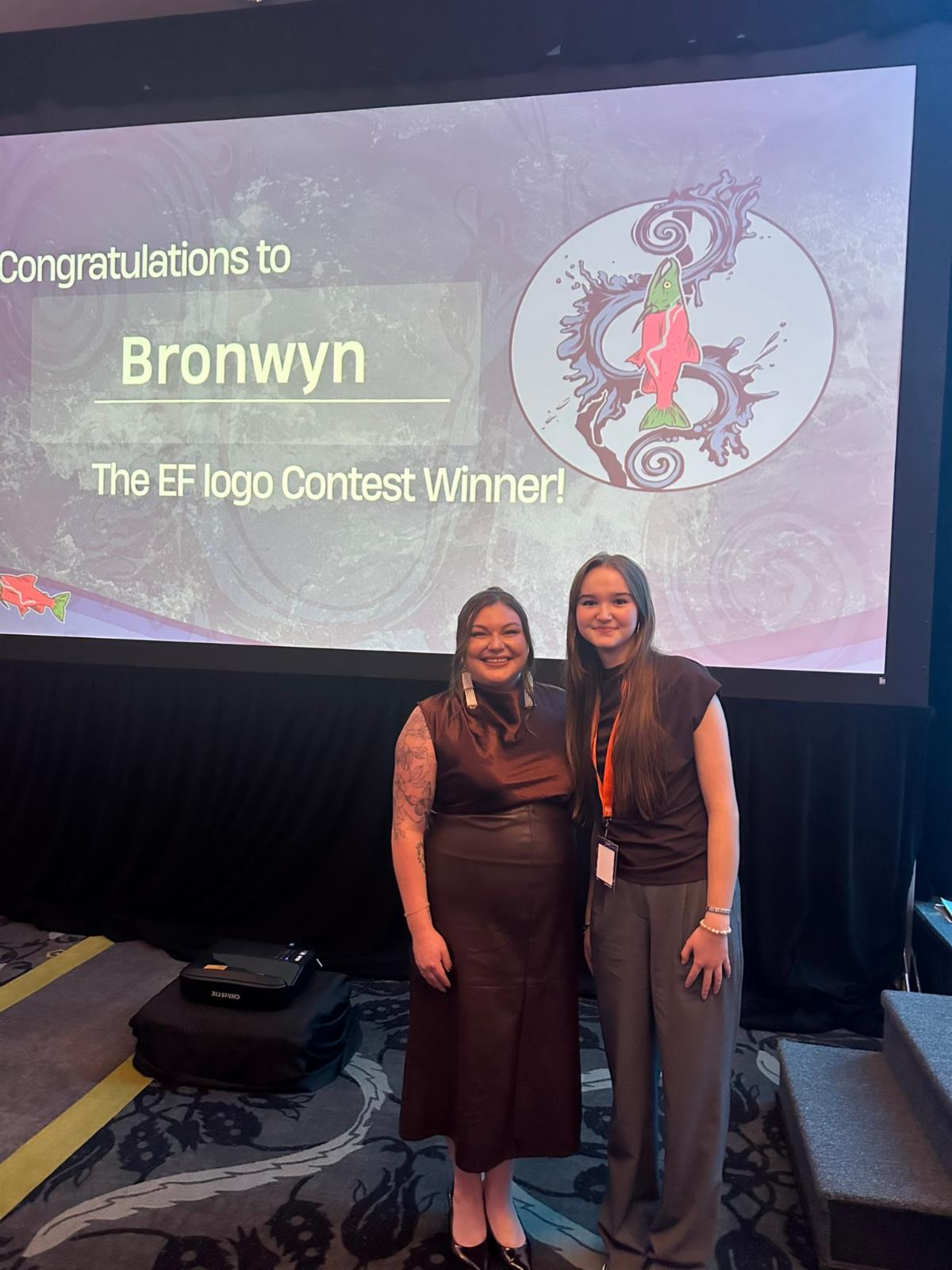
Gala attendees also met and celebrated Bronwyn Frost, the 17-year-old Métis artist who won the EF2026 logo contest. Her artwork became the face of the conference, helping people connect emotionally with a technical subject.
You can purchase items featuring her artwork here.
100 per cent of profits go directly to Bronwyn Frost.
Pictured: Haley Regan and Bronwyn Frost.
| | |
Global experience informs local water decisions
International and Canadian keynote speakers brought practical experience and research from other watersheds.
- Eric Stein and Kris Taniguchi-Quan of the Southern California Coastal Water Research Project described how California developed a statewide environmental flows framework through years of consensus-building with agencies and tribes.
- Rebecca Tharme of Riverfutures travelled from Greece to discuss braiding knowledge systems and why co-producing knowledge is among the strongest predictors that environmental flows will be implemented.
- Dominik Gallenberger of the University of Innsbruck explored how rivers hold memory and what gives flow thresholds their authority.
- Wendy Monk of Environment and Climate Change Canada and the University of New Brunswick spoke on environmental flows methods, modelling and monitoring.
- Nathanael Bergbusch of the University of Waterloo presented on sustainable agriculture and water use for Prince Edward Island.
| | |
Outcomes and next steps
The co-hosts will publish the EF2026 Proceedings & Outcomes, including an action register, in December 2026. Selected research will appear in a special issue of the Canadian Water Resources Journal in 2027.
Organizers thank the City for its support and sponsorship, along with all conference sponsors, speakers, youth panelists, Elders, facilitators, rapporteurs and volunteers.
Presentations and conference materials are available at ef2026.ca
| | | | |