|
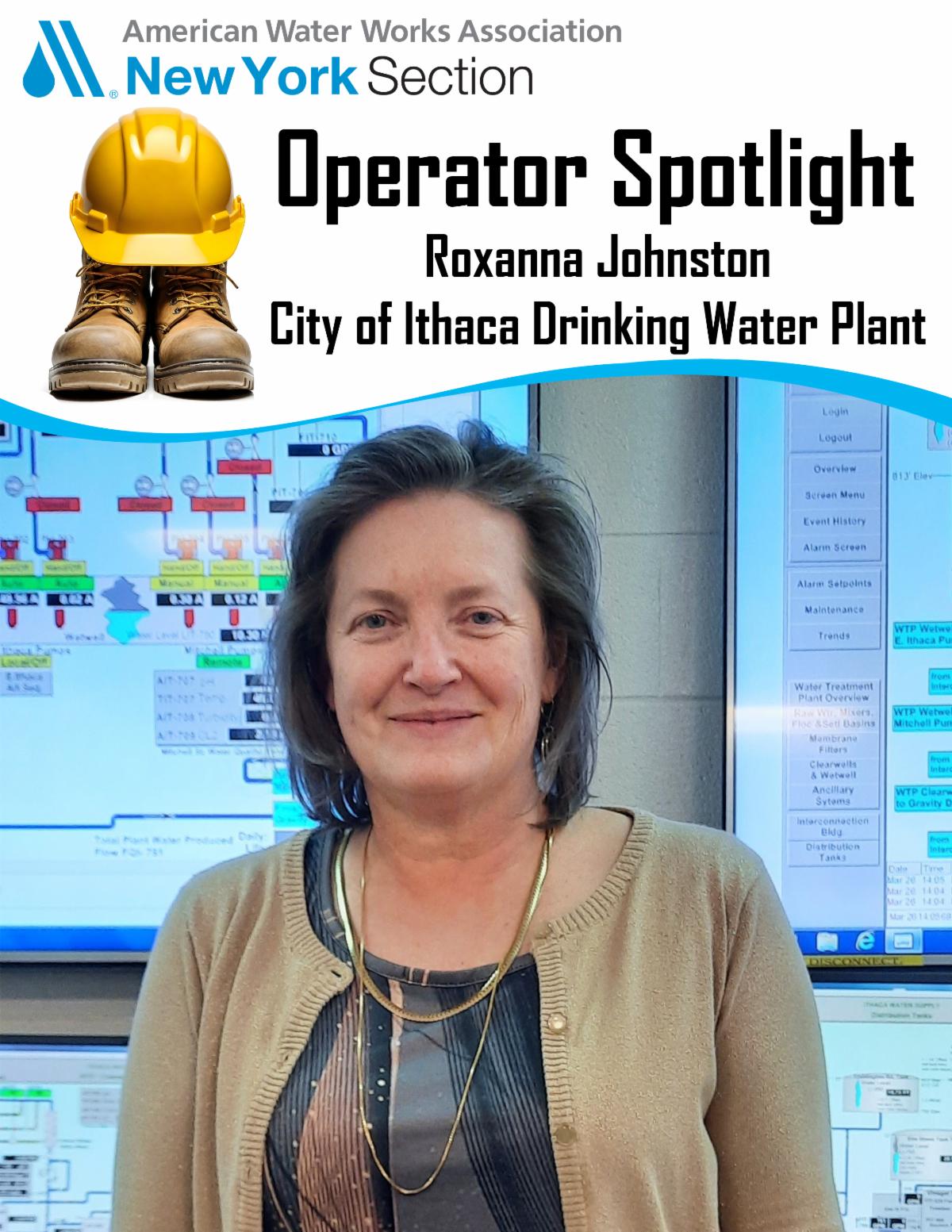
The New York Section AWWA Operator's Committee highlights Operators from all around the state for the outstanding work they do. In this spotlight - they shine the light on Roxanna Johnston with the City of Ithaca.
Q&A with Roxanna
Tell us about yourself.
My name is Roxanna Johnston and I have worked at the City of Ithaca Drinking Water Plant for the past 26 years.
Tell us about the City of Ithaca's Drinking Water Plant.
We get our source water from Six Mile Creek. Six Mile Creek is a 20-mile-long creek in Tompkins County, New York. It originates in the Town of Dryden near the intersection of Irish Settlement Road (Tompkins County Highway 162A) and Card Road and drains into Cayuga Inlet, which flows into Cayuga Lake.
We treat about 2.5 MGD of water a day and use a conventional surface water with membrane filtration to treat it.
What are some projects that the City has done to improve its drinking water?
By far the largest project was building a new water plant. The original drinking water plant began operating in 1902, with major updates in the 50’s. Work on the new facility started in 2013 and was completed in 2017. During construction of the new plant, we weathered a record-breaking drought and subsequently discovered a previously unrecognized vulnerability to manganese in our source water. That was a curve ball and led to several projects with Cornell University. Key parts of the upgrade included installation of inclined plate settlers and replacement of our dual media filters with membrane filtration. We also added chlorine dioxide to address disinfection byproducts, and now, manganese!
Most recently, we adopted a Drinking Water Source Protection Plan (DWSP2) for Six Mile Creek in 2022. Since then, we’ve brought in nearly $125,000 in grants. We are establishing a funding mechanism to support the local Soil and Water Conservation District’s water quality projects in our source water.
How did you come to work in the water industry?
I came to Ithaca straight out of graduate school. As a biology/ecology major, I had a lot of lab experience, and Ithaca needed a lab technician. Ironically, my research work had been in the Canyonlands of Utah where water isn’t so plentiful!
What does your daily work routine look like?
I’m the Watershed Coordinator for the City of Ithaca and the Lab Director for the drinking water plant so there are two distinctly different parts of the day. Two very capable laboratory technicians run our ELAP certified lab. My job is to "put out fires", oversee our QAQC programs and coordinate larger efforts like lead and copper sampling. On the watershed front, I send a lot of emails and participate in a lot of meetings! We have two open grants for our DWSP2 plan. I am also the chair of the Cayuga Lake Watershed Intermunicipal Organization, which helps find funding and technical support for municipal water resource projects. The best days are when I give tours or attend events like the Ithaca Festival sharing information about tap water with our residents.
What do you feel is one of the biggest challenges facing the water industry today?
I think we’re losing ground on source water protection. Headwater and wetland protections have diminished despite being critical to source water quality and watershed resilience. Their importance only grows as the climate becomes less stable. Once the water gets to the treatment plant, the challenge is clearly in maintaining a highly skilled workforce.
What is one of the biggest challenges that you have faced in your career and how did you overcome it?
Silly but noteworthy, I’m the first female to work at the Ithaca drinking water plant. I consider it a giant step forward that my hiring resulted in the bathroom getting a door.
A close second is getting the DWSP2 adopted. I’ve wanted to write a source water watershed management plan for years. Through the state’s DWSP2 program, I received free technical support to do just that. That support was, and still is, critical in producing the watershed plan and transitioning into implementation. Now I’m working to make source water protection an integral part of our water treatment process. I’m doing that with the help of engaged municipal partners in the watershed and by working closely with the local Soil & Water Conservation District.
What have you found to be one of the most rewarding aspects of your career?
Sharing information about drinking water and watershed ecology with customers, friends, and young people.
Tell us a bit more about yourself.
I hold a 1A License and a BS in Biology. I’m an avid gardener and my husband hunts and fishes – we both enjoy cooking and preserving our harvests. We also enjoy taste testing fermented drinking water!
If you would like to be contacted for a spotlight feature, let us know! Just send Jenny Ingrao, Executive Director, an email - jenny@nysawwa.org!
|