-
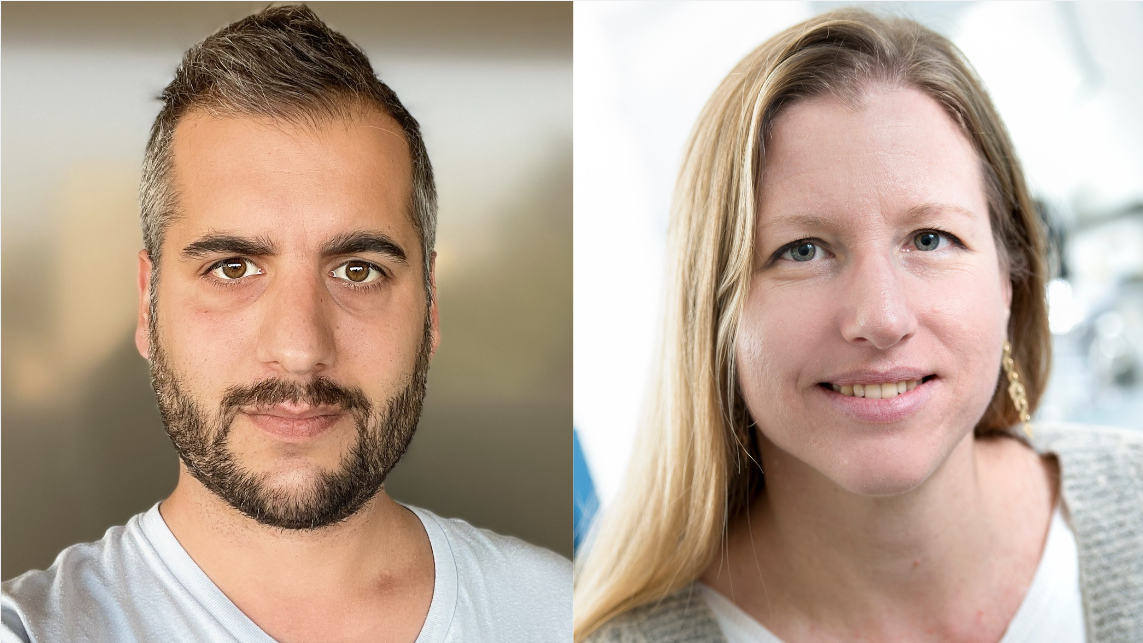
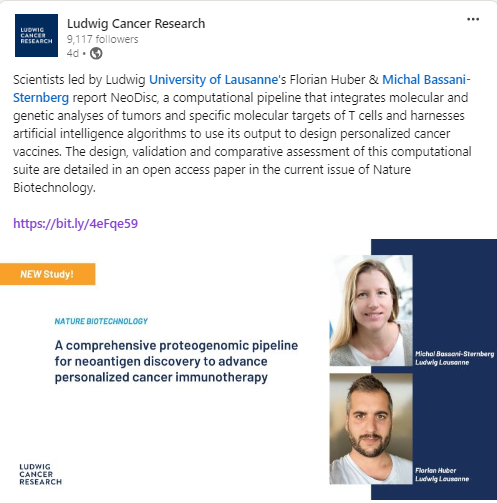
Researchers led by Ludwig Lausanne's Florian Huber and Michal Bassani-Sternberg report in Nature Biotechnology their development, validation and comparative assessment of a start-to-finish computational pipeline named NeoDisc that designs personalized cancer vaccines for patients.
-
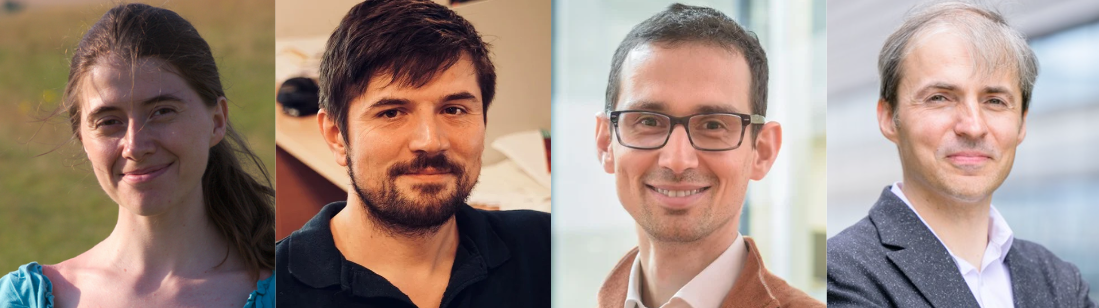
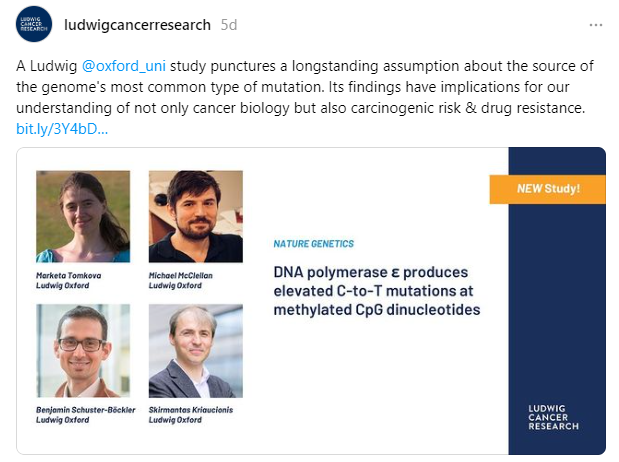
Study in Nature Genetics led by Ludwig Oxford's Marketa Tomkova, Michael McClellan, Benjamin Schuster-Böckler and associate investigator Skirmantas Kriaucionis punctures a longstanding assumption about the source of the most common type of mutation seen in the genome.
-
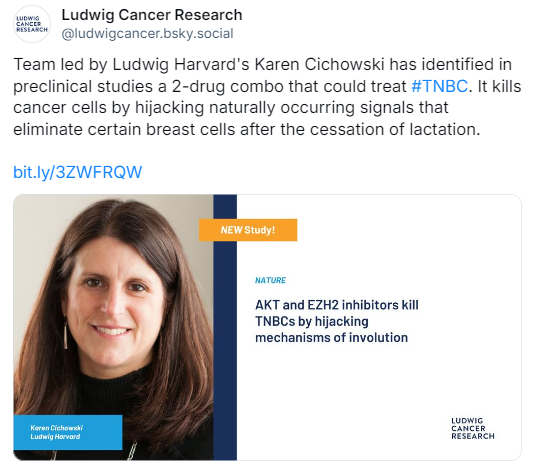
Researchers led by Ludwig Harvard’s Karen Cichowski report in Nature a combination of two therapeutic agents that, in preclinical studies, drove triple-negative breast cancer cells to differentiate and then killed them by inducing involution, a process ordinarily engaged in the post-lactational breast.
| |
|
Researchers led by Ludwig Lausanne's Florian Huber and Michal Bassani-Sternberg report here their development, validation and comparative assessment of a start-to-finish computational pipeline named NeoDisc. The pipeline integrates multiple molecular and genetic analyses of tumors and the specific molecular targets of T cells, and harnesses artificial intelligence algorithms to use the output to design personalized cancer vaccines for patients. Aside from neoantigens, NeoDisc also detects in cancer cells erroneously expressed noncoding DNA, developmental genes and other aberrantly expressed gene products as well as viral antigens in cases of virally induced tumors. It then applies bot h machine learning and rule-based algorithms to prioritize those most likely to elicit T cell responses and design a personalized cancer vaccine for the relevant patient.
Additional coverage: Ludwig Cancer Research
| |
|
Differential accessibility (DA) analysis of single-cell epigenomics data enables the discovery of regulatory programs that establish the identity of different types of cells in the body and steer responses to physiologically normal and pathological perturbations. Researchers co-led by Ludwig Princeton's Michael Skinnider present here a systematic evaluation of statistical methods employed to identify DA regions in single-cell ATAC-seq (scATAC-seq) data. They leverage a compendium of scATAC-seq experiments with matching bulk ATAC-seq or scRNA-seq to assess the accuracy, potential biases, robustness and scalability of each statistical method, and present best practices for scATAC-seq analysis. They also apply these best practices to develop an improved R package—a collection of functions, data, and documentation to extend the capabilities of the R programming language—for such analyses.
| |
|
This study, led by Ludwig Oxford Leadership Fellow Marketa Tomkova, postdoc Michael McClellan, Assistant Member Benjamin Schuster-Böckler and Associate Investigator Skirmantas Kriaucionis, punctures a longstanding assumption about the source of the most common type of DNA mutation seen in the genome, in which cytosine (C) is swapped for a thymine (T). This mutation was thought to be primarily the result of spontaneous deamination, which is about twice as likely to happen in epigenetically methylated cytosines, which occur in DNA at so-called “CpG” positions. The researchers show that far from being random products of that spontaneous reaction, CpG to TpG mutations are primarily generated during DNA replication, and caused by the tendency of DNA polymerase ε (Pol ε) to make editing mistakes when it encounters methylated cytosines.
Additional coverage: Ludwig Cancer Research
| |
|
Researchers led by Ludwig Harvard’s Karen Cichowski report here that by combining two therapeutic agents they could drive the cells of triple-negative breast cancer (TNBC) into a more treatable state. Using samples obtained from TNBC patients, they discovered that a combination of EZH2 and AKT inhibitors first coax TNBC cells to differentiate and then kill them by triggering a process similar to involution, which normally occurs when breast tissue returns to a non-lactating state after a mother stops producing breast milk. The researchers also used machine learning to predict patient responses to this strategy, which could help set the stage for clinical trials.
Additional coverage: Ludwig Cancer Research
| |
 |  | A mouse version of a MAGE-type cancer antigen, P1A, has been extensively used in tumor immunology and immunotherapy studies since Ludwig researchers reported its discovery in 1991. Yet, so far, only one epitope targeted by CD8+ T cells has been identified, and it is presented to the T cells by an MHC I molecule expressed by mice of the H-2d genetic background, such as DBA/2 and BALB/c strains. This has limited the variety of genetically engineered models that can be used in tumor immunology studies involving P1A. Researchers led by Ludwig Oxford’s Silvia Panetti, Benoit Van den Eynde, Carol Sze Ki Leung and alumnus James McAuliffe employed a vaccination strategy using P1A to induce immune responses in C57BL/6 mice, which have a H-2d genetic background and have been used to generate a large variety of genetically altered mice. They identify a P1A epitope that is presented in these mice and four T cell receptors that bind it. They also show that T cells expressing these receptors suppressed growth of P1A-expressing tumors and increased survival in a C57BL/6 mouse model. This expands the diversity of murine cancer models available for studies involving P1A.
| |
|
Cellular & Molecular Immunology — October 14, 2024
| |
|
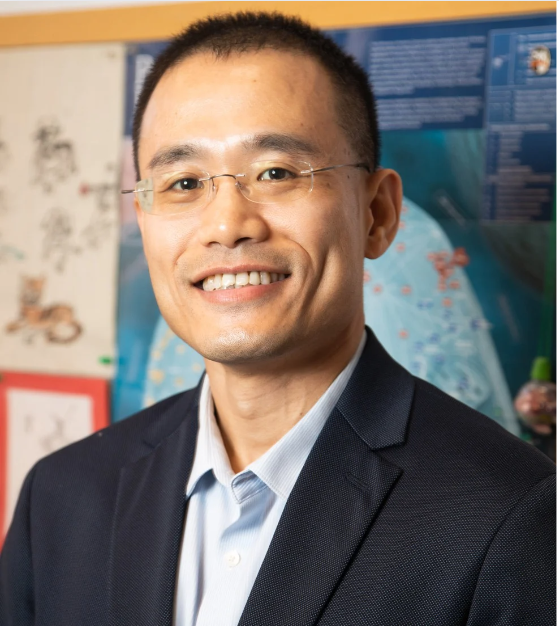
Lipid metabolism is a critical regulator of CD8+ T cell-mediated antitumor immunity, with excess lipids in the tumor microenvironment (TME) impeding T cell activity. Ludwig Princeton researchers led by Yibin Kang review here recent findings on how various factors and processes related to lipid metabolism—including lipid uptake, synthesis and oxidation—influence antitumor activity within the TME, with a special focus on how they affect mitochondrial function in tumor-infiltrating T cells. Kang and his co-authors also summarize therapeutic approaches that target lipid metabolism to boost antitumor immunity and enhance immunotherapy.
| |
|
The Brain Tumour Charity — September 25, 2024
| |
|
We encourage you to register for this November 21 webinar, in which Ludwig Lausanne's Spencer Watson, a senior research fellow in Johanna Joyce's group, will detail how the Joyce lab employed spatial multi-omics to investigate the evolving, post-treatment glioblastoma landscape. He and his colleagues recently reported in Cancer Cell that GBM tumors grow out of the fibrous scars of malignant predecessors destroyed by therapeutic interventions, identified mechanisms underlying this phenomenon and evaluated a combination therapy that sabotaged the process in preclinical studies. Watson will discuss their approach to this study, which integrated mass-spec proteomics, chromium single-cell RNA-seq, high-dimensional digital pathology and Xenium In Situ single-cell spatial transcriptomics in genetically engineered mouse models treated with immunotherapy.
| |
ICYMI: In case you missed it... | |
|
Get involved
Events, careers and collaboration opportunities
| |
|
Two career opportunities at Ludwig Lausanne are now accepting applications: PhD position in aging of hematopoietic stem cells and Postdoctoral position in immunometabolism.
Critical Issues in Tumor Microenvironment: Angiogenesis, Metastasis and Immunology
Register for the course, "Critical Issues in Tumor Microenvironment: Angiogenesis, Metastasis and Immunology", directed by Ludwig Harvard’s Rakesh Jain and taking place from October 28-31, 2024. Contact Dr. Taylor Uccello, TUCCELLO@mgh.harvard.edu, for more information.
MD-PhD position in oncology
The Petrova Lab at the University of Lausanne is seeking applications for an MD-PhD position to investigate the mechanisms behind heterogeneous chemotherapy responses colorectal cancer.
Assistant, Associate or Full Professor
Princeton University seeks applications for an assistant, associate or full professor to contribute to a major new initiative at the interface between cancer, immunity, and metabolism (Ludwig Princeton Branch). We welcome applications from candidates using biological, chemical, physical, engineering and/or computational approaches to tackle questions at this interface.
Postdoctoral Research Associate - AI/Machine Learning for Mass Spectrometry
The Skinnider Lab at Princeton University aims to recruit between 1 to 2 postdoctoral or more senior research positions to work on projects related to machine-learning for mass spectrometry-based metabolomics data.
| |
Do you know of any news, studies or events that would be relevant to the Ludwig community? Please contact us! | |
Ludwig Cancer Research | www.ludwigcancerresearch.org | |
Please note these clips are not intended to be a comprehensive overview of the news, but a compilation of Ludwig coverage, as well as topics and issues considered to be most relevant to our scientific community. Any views or opinions presented in the news clips are solely those of the cited news sources. When available, a link to the original study is provided. *Asterisk indicates a subscription or login may be required.
| | | | |