IPSA Member Dues
Membership renewal forms for 2020/2021 are out both electronically. Please be on the look out for these and be sure to renew your membership!
We will be accepting renewals by check, online at
www.ipseed.org or by contacting the IPSA office at 870-336-0777.
As part of your renewal process, we are asking you to fill out all information on the new form for the Directory & Vendor guide. This will be an improved version of what we did last year.
Thank you for your continued membership and support of IPSA.
|
|
Connect with us on social media!
|
|
Introducing '
The Spirit of Independence
'!
|
Just in time for the 4th of July celebration, we are announcing our theme for the 2021 IPSA Annual Conference in Tucson, Arizona.
"The Spirit of Independence" is recognizable to us on many levels, but especially to our pride in our business and country.
As we work through this time of COVID-19, your Annual Conference Committee is still working hard to plan some fun in the sun in Arizona and hopefully better days.
Working with Rich Tiller at the Ag Speakers Network, we have again booked Association Favorite, Peter Zeihan to speak about the world changes from Covid and the 2020 Election. Peter has just introduced his 3rd book "Dis United Nations. We also are building an exciting program that will simulcast via the web for those not able to attend (and as an online option in case).
Mark you calendar for January 18-21 at the JW Marriott at Starr Pass in Tucson!
|
|
|
WinField United Moving CROPLAN Cotton Seed to the Armor Brand
|
WinField United will add cotton to its Armor brand seed offerings for the 2021 growing season as it moves its proprietary cotton seed from CROPLAN to the Armor portfolio.
Based in Jonesboro, AR, Armor has long been known as a strong advocate for farmers in the Southern U.S. and supplier of quality corn and soybean seed. The company and brand were acquired by WinField United in 2017.
“Cotton has always been a personal, high-touch business,” said Kelly Phipps, seed marketing director for WinField United. “As a regional brand, Armor is well-positioned to offer personalized service to cotton growers, address the challenges they’re facing and help move the industry forward.”
WinField United will leverage its industry-leading agronomic research, product development capabilities and locally-owned and operated retailers to continue bringing high level solutions to cotton growers through the Armor brand. The transition from CROPLAN cotton to the Armor brand will complement both Armor’s soybean seed and CROPLAN’s corn seed, giving farmers in the region top-of-the-line products in each crop category to consider when making seed decisions this fall.
“We’re excited to bring farmers more options and expand the Armor portfolio where it is recognized and trusted,” said Jim Hedges, vice president of seed, WinField United. “This change for our proprietary cotton seed business enables us to place the full weight of the WinField United system behind our investment in the Armor brand through our history of innovation in product development, as well as through our agronomic expertise and retail network.”
|
Corteva Invests In Cotton, Acquires Full Ownership of PhytoGen
|
After a 12-year joint venture with J.G. Boswell, Corteva has announced it plans to purchase the full ownership of PhytoGen Seed Company.
“With this action, we intend to build on the strong foundation we established with J.G. Boswell Company over the last two decades – continuing to serve cotton customers with our growing global portfolio of leading cottonseed products,” Steve Reno, Corteva Agriscience Seed Business Platform President said in a news release. “This step further strengthens Corteva Agriscience’s commitment to the cotton market – and positions the Company well to diversify and grow this business globally over time.”
PhytoGen was founded in 1980 by California-based J.G. Boswell Company. Mycogen Seeds (an affiliate of Dow AgroSciences, now part of Corteva) formed a joint venture with J.G. Boswell Company in 1998 to bring together its germplasm, cotton breeding and seed production with a focus on the U.S. market.
PhytoGen markets Upland, Pima, and Acala cotton varieties. Corteva will own PhytoGen patents, trademarks, and proprietary germplasm. The company says the PhytoGen portfolio, including PhytoGen Breeding Traits, PhytoGen varieties with Enlist cotton trait, PhytoGen varieties with WideStrike and WideStrike 3 insect protection, is well suited to address current cotton yield challenges.
“This acquisition provides a solid proof point of our consistent commitment to driving long-term growth through targeted investments in solid margin opportunities that at the same time strengthen our ability to serve our customers,” James C. Collins, Jr., Corteva Agriscience Chief Executive Officer said in a news release.
In addition to this cottonseed news, earlier this spring Corteva announced the Brevant brand of seed, and the company will be retiring the Mycogen, Terral and REV brands for corn and soybeans. In the mid-south and southeast, a unified Pioneer and PhytoGen sales team will serve farmers.
|
Pesticide Pressures: Enlist Duo Registration Before Ninth Circuit
|
In 2014, the Environmental Protection Agency (“EPA”) registered a pesticide called Enlist Duo under the Federal Insecticide, Fungicide, and Rodenticide Act (“FIFRA”). Manufactured by Dow AgroScience (“Dow”), Enlist Duo contains two active ingredients, 2,4- dichlorophenoxyacetic acid (“2,4-D”) and glyphosate. Both 2,4-D and glyphosate are used to control broad-leaf plants, and 2,4-D in has been used to combat weeds that have developed a resistance to glyphosate. However, 2-4-D is known to be volatile, meaning droplets of 2-4,D can vaporize into the air and drift off-target. Because of its volatility, 2,4-D has primarily been used as a pre-emergent, meaning it would be applied to the ground before planting to clear a field of weeds. EPA’s registration of Enlist Duo in 2014 was the first time a 2,4-D pesticide was registered for use over the top of crops. Following the 2014 registration of Enlist Duo, multiple lawsuits were filed in the United States Court of Appeals for the Ninth Circuit challenging EPA’s decision.
|
Reuters: Bayer Shares Fall After Judge Questions Part of Proposed Roundup Settlement
|
Bayer shares fell more 6% on Tuesday after a U.S. judge questioned part of the German company's proposed settlement to deal with future claims relating to allegations that its widely used weedkiller Roundup caused cancer.
Last month Bayer agreed to pay as much as $10.9 billion to settle close to 100,000 U.S. lawsuits related to Roundup.
That included $1.25 billion to support a separate class agreement to address potential future litigation. That part of the settlement requires court approval.
“The Court is skeptical of the propriety and fairness of the proposed settlement, and is tentatively inclined to deny the motion,” Judge Vince Chhabria said in a filing with the United States District Court, Northern District of California.
Bayer had planned on creating an independent panel of scientific experts to help assess whether glyphosate caused cancer.
Regulators including the U.S. Environmental Protection Agency and the European Chemicals Agency, have determined glyphosate to be non-carcinogenic, supporting Bayer’s claim that the active ingredient in its Roundup product is safe for agricultural use.
But in a filing published on July 6, Chhabria said: “Even with the consent of both sides, it’s questionable whether it would be constitutional (or otherwise lawful) to delegate the function of deciding the general causation question (that is, whether and at what dose Roundup is capable of causing cancer) from judges and juries to a panel of scientists.”
Chhabria also questioned whether potential claimants want to remain bound by a ruling reached by the proposed scientific panel if research is still ongoing.
“In an area where the science may be evolving, how could it be appropriate to lock in a decision from a panel of scientists for all future cases?,” Chhabria wrote.
In 2015, the World Health Organization’s cancer research arm determined the herbicide to be a “probable carcinogen”, and since 2018, three consecutive U.S. juries, who listened to scientific evidence from both sides during trials, found that Roundup causes cancer.
Responding to Chhabria’s ruling, Bayer said: “We appreciate the judge’s order raising his preliminary concerns with the proposed class settlement, which we take seriously and will address at the preliminary approval hearing on July 24.”
|
Paycheck Protection Program (PPP) Update
|
The U.S. House of Representatives on July 1 approved an extension of the $660 billion Paycheck Protection Program (PPP) lending program. The Senate approved the extension on June 30. It would keep the PPP, which expired at midnight on June 30, operating through August 8. The bill now goes to President Trump for signing into law. More than $130 billion in funds remained unused in the PPP as of June 30.
|
Green Party Defends Europe's Simultaneous Ban on Gene-Edited Crops and Use of Biotech in Medicine
|
Natasha Foote, EurActiv and the Genetic Literacy Project
Editor's note: In June a faction of Germany's Green Party argued it was time the EU revised its strict regulation of gene-edited crops. Party officials have since announced the Greens don't support such regulatory reform.
The paper, published by a faction of German Greens on 10 June, offered their support for genetic engineering, saying it could play a key role in improving sustainability, and called for a reconsideration of EU regulation on genetic engineering.
This was the first time that such a dissenting position came from within the Greens and raised questions as to whether the tide is changing in the party.
But [Martin Häusling, agriculture spokesman for the Greens/EFA in the European Parliament] strongly denied this, saying that there is "no momentum building for new genetically modified organisms (GMOs)".
While he admitted that there have been debates and that it is "only fair" that this technology is assessed from different angles, he maintained that the "vast majority of Greens in Germany - and Europe - are undoubtedly against deregulation of new GMOs".
The paper also makes a point about inconsistencies .... highlighting that while GM technology is regularly used in medicine, it is not permitted for agriculture.
Commenting on the idea that the EU's stance is inconsistent in this respect, Häusling .... explained that the main difference between [medical] technologies and genetically modified crops grown on the field is that the use is limited to the patient and does not "escape into nature".
Editor's Note: Never mind that the same processes intrinsic to CRISPR already happen in nature with regularity. This is lame "scientific reasoning" which prompts one to believe anti-technology sentiment is purely political - which it is. Interesting that it's perfectly acceptable in medicine though. This despite evidence of permanent and even heritable characteristics being possible via CRISPR use in medical technology.
|
EPA Greenlights GMO Mosquito
|
Britt Erickson, Chemical & Engineering News
The U.S. Environmental Protection Agency (EPA) has granted UK-based Oxitec an experimental use permit to test whether releasing genetically modified Aedes aegypti mosquitoes can reduce the population of the pest, which transmits diseases such as Zika, chikungunya, and dengue. The company plans to release male mosquitoes that have been genetically modified to produce a protein that prevents their female offspring from surviving.
The experiment will be conducted for two years in Florida beginning this summer and in Texas starting next year. Oxitec has completed similar tests n Brazil that the company says successfully suppressed the wild Aedes aegyptipopulation.
"Our aim is to empower governments and communities of all sizes to effectively and sustainably control these disease-spreading mosquitoes without harmful impact on the environment and without complex, costly, operations," Oxitec CEO Grey Frandsen says in a statement. The US Food & Drug Administration concluded in 2016 that Oxitec's genetically modified mosquito will not have significant impacts on the environment.
In 2017, the FDA transferred regulatory jurisdiction for the technology to the EPA. Federal permit in hand, Oxitec is now seeking approval from state and local regulators.
|
SEND US YOUR EVENTS!
ASTA PLDC Virtual Online Education Series
July 16, 2020
ISU Seed
Science & Technology
Short Course
ISU Seed Science Center
November 6-10, 2020
Seed Business 101 Field Crops
November 16-20, 2020
ASTA CSS & Seed Expo
Chicago
December 7-10, 2020
IPSA Annual Conference
Tucson
January 18-20, 2021
|
|
Mike Peterson and Kevin Cavanaugh Form Peterson Corn Genetics, LLC
|
July 9th, 2020 - Mike Peterson, President and owner of Peterson Genetics, Inc. (a leading soybean genetics licensing company) based in Cedar Falls, Iowa, has partnered with Kevin Cavanaugh, formerly Research Director at Beck’s Superior Hybrids, Inc. to form Peterson Corn Genetics, LLC. The company plans to provide independent seed companies with unsurpassed genetic options that fit their customers’ needs.
Mike Peterson says, “I am excited to utilize the expertise of a veteran in the seed industry, Kevin Cavanaugh, to be President of this new venture. Kevin understands customers’ needs, has a deep understanding of hybrid performance and the overall seed corn industry. We plan to source and supply superior genetics for the benefit of independent seed companies throughout North America."
Peterson Corn Genetics (formerly MBS Genetics, LLC, a wholly-owned entity of Peterson Genetics, Inc.) will enhance the scope of genetics currently offered and will provide seedsmen with performance data to assist in product placement. Kevin Cavanaugh explains, “I am pleased to be partnering with Mike Peterson. Mike has a sense for his customers’ needs and has built close relationships with seed companies over a long, extensive career. I feel the timing is perfect to introduce Peterson Corn Genetics to offer customers additional options for their corn genetic needs.”
For questions, please contact Mike Peterson at Mike@PetersonGenetics.com or Kevin Cavanaugh at Kevin@PetersonCornGenetics.com.
|
Colin Steen to Lead Legacy Seed Companies as New CEO
|
Legacy Seed Companies has announced the appointment of Colin Steen as its chief executive officer. Steen will begin his tenure July 6, 2020, and follows that of company Legacy Seeds founder Bruce Ceranske, who remains active on the board as vice chairman.
“As Legacy Seed Companies continues to grow, we were looking for a leader with a compelling vision for how best to nurture and expand our portfolio of independently run seed brands,” said executive chairman Kip Pendleton. “Colin’s wide range of relevant experiences, including his leadership role of Golden Harvest, a large family founded seed business, and most recently leading venture capital investments made him the ideal choice to seize the many opportunities that lie ahead.”
A veteran of more than 25 years in agribusiness, Steen has held numerous senior executive positions, most recently serving as managing director for Syngenta Ventures. Prior to that, he had roles managing the Golden Harvest corn and soybean business in the Midwest and running the NK Seeds business for Syngenta, where he worked closely with top retailers across the United States.
At Legacy Seed Companies, Steen will lead all commercial, administrative, operational, and financial aspects of the organization, working closely with the board to establish strategic direction.
“I’m thrilled about this opportunity. Legacy Seed Companies has ambitious goals for both present and future growth focused on creating end customer value, and I’m eager to start building on the solid foundation that has already been established,” said Steen.
Kincannon & Reed, a leading executive search firm focused on the food, agribusiness, and biosciences sectors, was retained by Legacy Seeds to execute the national search for its new CEO.
|
Reuters: Farmers dial back crop plantings as COVID uncertainty rocks markets - USDA
|
CHICAGO (Reuters) - U.S. farmers planted nearly 5 million fewer acres of corn this spring than estimated by the U.S. government in March, the biggest cut in 37 years, as the coronavirus pandemic roils demand for the crop.The drop in corn seedings, as well as an 11.1% cut in cotton plantings, accounted for the bulk of the U.S. Agriculture Department’s 7.2 million-acre reduction to its estimate of the amount of major crops seeded this spring.
Soybean plantings fell below market expectations, with export demand in focus due to uncertainty about purchases from China arising from trade tensions.
Both corn <0#C:> and soybean <0#S:> futures soared to multi-month highs after the closely watched report was released.
“We were planting into peak fear,” said Ted Seifried, chief ag market strategist of the Zaner Group. “There was poor pricing, poor outlook in the market ... some guys not able to get into the fields - and we were in the middle of the pandemic.”
The USDA pegged corn plantings at 92.006 million acres, down from its March outlook for 96.990 million. Analysts had been expecting the report to show corn acres at 95.207 million, according to the average of estimates given in a Reuters poll.
Demand for corn-based ethanol fuel dropped sharply during the spring as drivers stayed at home during lockdowns, making corn less appealing to farmers.
The drop in corn seedings was the biggest between the March intentions and actual plantings since 1983, when farmers seeded 9.362 million acres less than they had planned.
“It would suggest that farmers - as their finances are tightening up - were more conservative than normal in planting this year’s crops,” said Arlan Suderman, chief commodities economist for StoneX.
Soybean acreage was seen at 83.825 million compared with 83.510 million in March. Analysts had been expecting 84.716 million acres of soybeans.
|
Jason Gearhart impacted by house fire
|
Our thoughts are with IPSA member Jason Gearhart of Buckhorn Inc and his family after their house was struck by lightening resulting in a house fire. In Jason's words: "The last few days have been a blur. You never think it will happen to you, but on Monday afternoon our house was struck by lightening and caught on fire. Everyone is safe and even though there is extensive damage, our house can be repaired. Within hours our amazing friends and neighbors had purchased clothes and toiletries for all of us, offered up their homes and a shoulder to cry on. We are incredibly humbled and feel so lucky to have this amazing community and support around us. Thank you to the Westfield Fire Department for saving our house and asking each of my children what they could go back in and get for them (Camryn - stuffed animals, Cayden/Codey- basketball bag and iPad 🙄 😃). We have read all of your texts and 100% feel the love and support which means more then you’ll ever know" - Jason and Jennie
|
Farmer survey encourages Syngenta to commit $2bn to sustainable ag by 2025 & two tech breakthroughs each year
|
Major seed and ag chemicals provider Syngenta is adding another initiative to the ongoing list of corporate sustainability commitments sweeping big food and big agribusiness after the results of a farmer survey revealed deep concerns about the impact of climate change.
The announcement also happens to come on the heels of 2020’s Pollinator Week.
Through The Good Growth Plan, Syngenta is pledging to invest $2 billion into sustainable agriculture by 2025 and to deliver two new technological breakthroughs to market each year, according to a company press release. The plan is a refresh from the original Good Growth Plan launched in 2013, which included targets like bringing over 14 million hectares of farmland back from the brink of degradation and enhancing biodiversity on over 8 million hectares. Syngenta claims that it has met or exceeded all of the targets from the 2013 Good Growth Plan.
“When we speak to farmers, we see they are the first to be harmed by climate change and biodiversity loss. Now the Covid restrictions could also have long-lasting effects on the food and agriculture sector,” said Alexandra Brand, chief sustainability officer at Syngenta Group said in the statement. “That’s why the significant levels of investment in innovation that you see in the new Good Growth Plan are needed to fight climate change and provide for a food system working in harmony with nature.”
Farmer survey reveals climate concerns
Syngenta commissioned a study with Ipsos MORI to assess large-scale farmers’ attitudes across the US, France, China, Brazil, India, and throughout Africa. According to its conclusions, 72% of survey respondents are worried about the impact that climate change will have on crop yields, animal health, and their ability to do business over the next five years. Fifty-nine percent believed reducing greenhouse gas emissions would make their farms more financially stable or competitive.
A separate survey of European farmers found 46% said their businesses had been significantly impacted by the coronavirus pandemic. However, 53% said climate change was still the immediate priority and 63% agreed climate change would have a greater impact on their business than Covid-19 over the next five years.
The specific commitments in the new plan comprise four areas: Accelerate innovation for farmers and nature, strive for carbon-neutral agriculture, help people stay safe and healthy, and partnering for impact. The Good Growth Plan also includes a commitment to reduce the carbon intensity of Syngenta’s operations by 50% by 2030 in line with the Paris Agreement on climate change. The target was validated by the Science Based Targets initiative.
Syngenta is already taking steps to put the fourth pillar of its plan into action. It also announced a partnership with the Solidaridad Network, an international development organization. The goal of the partnership is to implement sustainable solutions at scale to empower farming communities to achieve food security in developing regions. One of the projects is focused on helping smallholder coffee farmers in Colombia to increase incomes by 25% implementing new ways to fight the coffee borer beetle.
The company had already entered into a partnership with The Nature Conservancy in October 2019 aiming to regenerate one million hectares of degraded farmland over the next five years in Brazil.
Major competitor Bayer seems to be taking a different tact. Bayer held a Crop Science R&D Pipeline Showcase in February 2020 that highlighted the ag giant’s current portfolio of technology and revealed that a new herbicide is coming down the pipeline. The chemical is still in R&D and Bayer could not reveal many details about the new addition but stated that it will make its commercial debut in 2030, and will be able to battle glyphosate-resistant weeds. The new molecule is part of Bayer’s 10-year effort to discover new ways to battle weeds that are now resistant to glyphosate, which has cost the company $5.6 billion.
The press release lacked details about Syngenta’s commitment to advance two “technology breakthroughs” each year. With a new managing director taking the helm of Syngenta Ventures in 2018, the outfit has been actively investing in a variety of agrifood technologies. The company seems to be focusing on technologies tied to reducing farmers’ dependence on chemical inputs. In March 2020, it backed WeedOUT, which is aiming to commercialize the first species-specific biological herbicide. In May, it invested in a $7 million seed round for Israeli autonomous chemical reduction tech Greeneye. And in 2018, it invested in a $2.9 million seed round for Danish pheromone-based pest control startup BioPhero.
Some of its other recent investments include South American agribusiness marketplace Agrofy, the acquisition of satellite data analytics startup FarmShots, and the acquisition of Brazilian farm management software startup Strider.
Whether Syngenta will advance two technologies a year through startup investment or inhouse R&D remains to be seen.
In other Syngenta news, the company recently relaunched and rebrandedfollowing its merger with the agricultural businesses of Chinese chemicals giant Sinochem, in preparation for an expected IPO in China. The new entity, named Syngenta Group, also incorporates Israeli crop protection company Adama. Chinese state-owned enterprise (SOE) ChemChina owns both Adama and Syngenta, and is reportedly undergoing a merger with fellow SOE Sinochem.
|
Recent Trends in GE Adoption -USDA Release
|
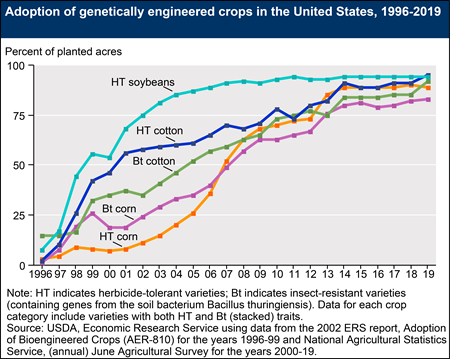
Herbicide-tolerant (HT) crops, which tolerate potent herbicides (such as glyphosate, glufosinate, and dicamba), provide farmers with a broad variety of options for effective weed control. Based on USDA survey data, the percent of domestic soybean acres planted with HT seeds rose from 17 percent in 1997 to 68 percent in 2001, before plateauing at 94 percent in 2014. HT cotton acreage expanded from approximately 10 percent in 1997 to 56 percent in 2001, and reached a high of 95 percent in 2019. Adoption rates for HT corn grew relatively slowly immediately following the commercialization of GE seeds. However, adoption rates increased following the turn of the century. Currently, approximately 90 percent of domestic corn acres are produced with HT seeds.
Insect-resistant crops, which contain genes from the soil bacterium Bt (Bacillus thuringiensis) and produce insecticidal proteins, have been available for corn and cotton since 1996. Domestic Bt corn acreage grew from approximately 8 percent in 1997 to 19 percent in 2000, before climbing to 83 percent in 2019. Bt cotton acreage also expanded, from 15 percent of U.S. cotton planted acreage in 1997 to 37 percent in 2001. Currently, 92 percent of U.S. cotton acres are planted with genetically engineered, insect-resistant seeds.
Increases in adoption rates for Bt corn may be due to the commercial introduction of new varieties resistant to the corn rootworm and the corn earworm (prior to 2003, Bt corn varieties only targeted the European corn borer). Adoption rates for Bt corn may fluctuate over time, depending on the severity of European corn borer and corn rootworm infestations. Similarly, adoption rates for Bt cotton may depend on the severity of tobacco budworm, bollworm, and pink bollworm infestations.
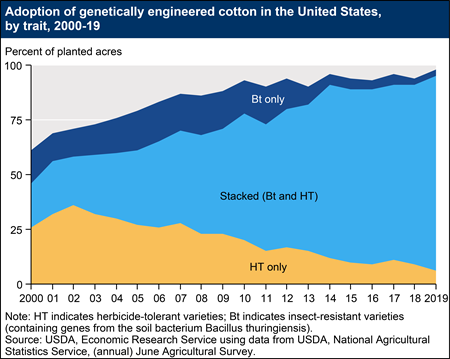
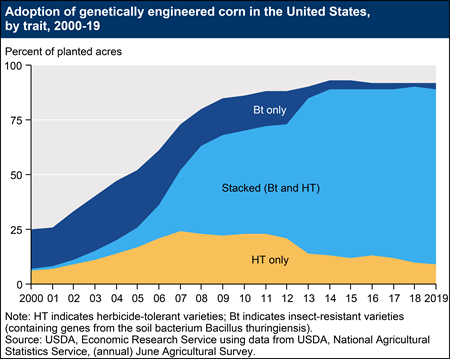
The figures below illustrate increases in adoption rates for "stacked" varieties, which have both (in some cases, multiple) HT and Bt traits. Adoption of stacked varieties has accelerated in recent years. Approximately 89 percent of cotton acres and 80 percent of corn acres were planted with stacked seeds in 2019.
|
New Bayer-Engineered Seed Raises Questions Among Experts on the Future of Weed Control
|
by Johnathan Hettinger/Midwest Center for Investigative Reporting
A new genetically engineered corn seed designed by Bayer to be sprayed by up to five herbicides could represent the future of farming, providing growers with more pesticides to combat the problem of weed resistance.
But for how long? That's the question raised by weed scientists, who say farmers need to start switching to non-chemical options to keep weeds under control.
Over the past 50 years, weed resistance has become a significant problem for agriculture in the U.S., with more than 165 unique species of weeds becoming resistant to chemicals. The problem has increased significantly since the introduction of genetically modified crops and use of accompanying herbicides in the 1990s.
The new seed, which Bayer has petitioned the U.S. Department of Agriculture for approval, could be sprayed by glyphosate, glufosinate, dicamba, 2,4-D and quizalofop, giving farmers multiple options for weed control.
The USDA has a public comment period for the seed open until July 7. As of July 3, 15 comments have been submitted.
Bayer spokeswoman Susan Luke said in an email that, pending regulatory approvals, the company plans a full commercial launch of the seed later this decade.
"We expect HT4 to be widely used - and growers continue to ask for additional crop protection tools to help manage tough-to-control weeds. This product will offer growers more options to manage broadleaf weeds in corn and will provide growers increased flexibility and another tool in the crop protection toolbox," Luke said.
Corn is the most bountiful crop grown in the United States, making up about 92 million acres of farmland, an area about the size of Minnesota or Michigan; about a third of the crop is used for animal feed, about a third is used for ethanol and the rest is split between human food, beverages, industrial uses and exports. About 90 percent of corn grown in the U.S. is genetically modified, according to the USDA.
The product comes at a time when Bayer, which acquired agribusiness giant Monsanto in 2018, and its pesticides are under scrutiny.
In June, Bayer announced a $10 billion settlement of claims that glyphosate, the active ingredient in Roundup, causes cancer. The company also announced a $400 million settlement of claims that dicamba, a herbicide sold by Bayer and German agribusiness company BASF, has drifted and harmed thousands of other farmers.
By purchasing Monsanto, Bayer acquired some of the most popular cropping systems in the U.S.
Monsanto's Roundup Ready crops, engineered to be resistant to the herbicide Roundup, quickly became ubiquitous after being introduced in the 1990s. Glyphosate, the active ingredient, is the most commonly used herbicide in the U.S., but as the amount sprayed in crops increased 40-fold between 1992 and 2016, the number of weeds resistant to glyphosate grew. Over the past 25 years, the number of weeds resistant to glyphosate has increased from zero to more than 45, according to the International Survey of Herbicide Resistant Weeds.
In response, agribusiness companies have released crops engineered to be resistant to other herbicides: Monsanto launched its Roundup Ready II crops, engineered to be resistant to glyphosate and dicamba; BASF launched its Liberty crops, designed to be resistant to glyphosate and glufosinate; Corteva Agriscience, formerly DowDupont, released Enlist crops, designed to be resistant to glyphosate, 2,4-D and quizalofop.
The new Bayer technology combines all of these technologies into one. The new product is not designed to be sprayed by all five weed killers at once, but instead to help streamline the current agricultural system, allowing seed dealers to carry one seed that gives farmers a choice on which combination of weed killers they want to spray.
"It's not a big revolution. It's the way things are moving," said Robert Hartlzer, a weed science professor at Iowa State University. This phenomenon is often called "the pesticide treadmill" - as more weeds develop resistance to more herbicides, new and better herbicides are needed.
The acceleration seems to be getting faster and faster, said Kristin Schafer, executive director of the Pesticide Action Network. PAN is organizing citizens to submit comments against the new Bayer technology, saying the cropping system would be more benefited by switching to crop rotations, more biodiversity on the farm and increased soil health.
"This five-trait corn is absolutely the opposite direction of the way we need to be going," Schafer said.
Some weeds are already starting to show signs of resistance to dicamba, which has increased significantly in use since Monsanto introduced new cotton and soybean seeds resistant to the herbicide beginning in 2015. Dicamba has also caused widespread damage to the environment because it is harder to control.
Hartzler warned that weeds are quickly outpacing technological developments. Weeds have already developed resistance to each of the herbicides included in the technology, though they are still very effective across the United States.
"It's really going to be a short-term fix, but at this point in time, it's what fits the current production system best," Hartlzer said.
Aaron Hager, a weed science professor at the University of Illinois, found in a 2015 study that using multiple herbicides to kill weeds is better at delaying resistance than switching from one herbicide one year to a different the next. Bayer pointed the Midwest Center to that study and said the new seed will help delay resistance.
But Hager said the way that weeds are resistant to herbicides is changing.
Herbicides work by targeting a specific mechanism in a plant and disrupting that mechanism. For the past 30 years, weeds have largely started to develop resistance at the target site, shifting the way they grow and no longer allowing herbicides to bind to the plant.
But increasingly, plants have started to develop metabolic resistance, which is when the plant's internal mechanisms are able to metabolize herbicides into non-toxic products, making them ineffective. The mechanism is similar to crops that are able to sustain being sprayed by herbicides.
"We're in another era now," Hager said. "We're trying to understand what has changed and allows them to function more like the crop."
With metabolic resistance, weeds can develop resistance to herbicides that they haven't been exposed to before, Hartzler said.
Bayer said that these chemicals are needed. Even with best practices, corn can see a 52 percent yield loss without a herbicide being sprayed, according to a study by the Weed Science Society of America. Hager said that farmers won't stop using chemicals, but they can use them along with other options.
Both Hager and Hartzler said they are recommending farmers increasingly use non-chemical options. Hartzler said places like Australia are starting to use combines that can help destroy weed seeds, so they don't continue to grow.
"I know that it's going to change in the relatively near future simply because even the addition of these new herbicide traits is not going to solve the resistance problem," Hartzler said.
Editor's Note: A little context might be useful. The Pesticide Action Network is definitively anti-pesticide, and anti-genetic engineering of any kind, and works tirelessly to reduce the use, or outright ban, virtually all pesticides or modified seed germplasm. This editor knows Aaron Hager, at University of Illinois, personally and professionally and believes him to be one of the best weed scientists currently practicing. We think it useful, from time to time, to include articles of general interest written outside the scientific press and journals to keep up with the things being presented to the public.
|
|
A special thank you to all of our members!
|
|
Todd L. Martin, CEO
Independent Professional Seed Association
|
|
|
|
|
|
|