|
Registration is now open for NACD's 2025 Summer Conservation Forum & Tours! Hosted with Wisconsin Land + Water, the NACD Summer Meeting will be held in Milwaukee, WI, this July 25-29, 2025.
Early bird registration is only open for a limited time, so don't delay. Save $50 per person by registering before July 7.
Experience Milwaukee and surrounding counties with us by joining the tours! Included in the cost of registration are tours to the Milwaukee Metropolitan Sewerage District, the University of Wisconsin-Milwaukee School of Freshwater Sciences, and a variety of conservation project locations and farms. Attendees will learn about water research and conservation, regenerative agriculture, habitat restoration, and more.
Looking to add more fun to your meeting experience? Join us for a night with the Brewers! On Monday, July 28, meet up with colleagues at the American Family Field stadium in Milwaukee to enjoy a baseball game. Tickets can be purchased when registering for the meeting.
Learn more about the Summer Meeting, plan your travel, see the agenda, and reserve your spot amongst the action now!
| TOOLS AVAILABLE TO ASSIST WITH DISTRICT OUTREACH | |
Are you ready to step up your outreach game? Having specialized software to create social media posts, handouts, and custom designs is a great place to start. This guide will aid you in navigating the most popular options and help you decide which one is the best fit.
Canva is quickly becoming one of the most popular publishing programs available because of its ease of use, web-based platform, and extensive library of templates. If you don’t have significant experience with Adobe or Microsoft design products and are looking for an easy way to get started this may be the best choice for you.
Adobe Creative Cloud is the biggest name in graphic design and makes the most powerful tools for creating digital and print media. InDesign is more complex and is best suited for someone that has previous experience with Adobe products or time to learn how to use it.
Microsoft Publisher may be the name you are most familiar with on this list. This design tool has been around since 1991. Microsoft has plans to retire it in 2026, so support and new updates will be limited in the future. However, if you have a long history with Microsoft, you may feel most comfortable with this program, and it’s likely already included in your district’s Microsoft Office subscription.
Learn more tips about each of these platforms, and editable templates NACD offers across each, in our latest Did You Know? blog post.
| WHAT'S UP IN WASHINGTON? GOVERNMENT AFFAIRS UPDATE | |
After a weeklong recess, Congress is back in session with a packed agenda centered on Fiscal Year 2026 (FY26) spending and the One Big Beautiful Bill Act.
Lawmakers are diving into the annual appropriations process, with the House beginning committee work on all twelve funding bills that keep the government running. These bills are currently covered by a temporary measure that expires on September 30, but pressure is mounting as the debt ceiling deadline, likely in August or September, draws closer.
The Trump administration released a budget appendix last Friday proposing deep cuts across several federal agencies. USDA faces a proposed $6.7 billion reduction in discretionary funding, including a $784 million cut to NRCS and a complete elimination of Conservation Technical Assistance. The House Appropriations Subcommittee on Agriculture will take up these proposals in a hearing this Thursday.
Meanwhile, the Senate is preparing to take up the controversial One Big Beautiful Bill Act—a sweeping budget reconciliation package that narrowly passed the House by a single vote (215–214). The bill has drawn bipartisan concern in the Senate over its projected deficit impact, cuts to Medicaid and the Supplemental Nutrition Assistance Program, and the rollback of clean energy tax credits from the Inflation Reduction Act. However, it also includes provisions that boost funding for conservation and agriculture programs by integrating unspent Inflation Reduction Act funds, a top priority for NACD.
Senate leaders have yet to announce how they’ll handle the bill—whether through committee negotiations or by fast-tracking a revised version to the floor.
The U.S. Department of the Interior (DOI) recently published a Request for Information (RFI) seeking feedback to assist the Department and its various offices and bureaus in identifying existing regulations that can be modified, repealed, and changed to be consistent with applicable law. NACD will be submitting comments to DOI and asks that conservation districts privde any insight or thoughts regarding this RFI to Libby Wawro, NACD Natural Resources Policy Specialist, by June 16.
| BUILDING WILDFIRE RESILIENCE FROM THE GROUND UP IN CALIFORNIA | |
In California, the Resource Conservation District of Tehama County (RCDTC) continues to grow its reach through hands-on conservation and wildfire preparedness efforts. This spring, RCDTC’s Arbor Day activities in Red Bluff offered a glimpse into the district’s year-round work. From planting native oak and conifer saplings to leading educational activities on forest health, the outreach reflected the district’s broader efforts to engage citizens in building fire-adapted communities across the county.
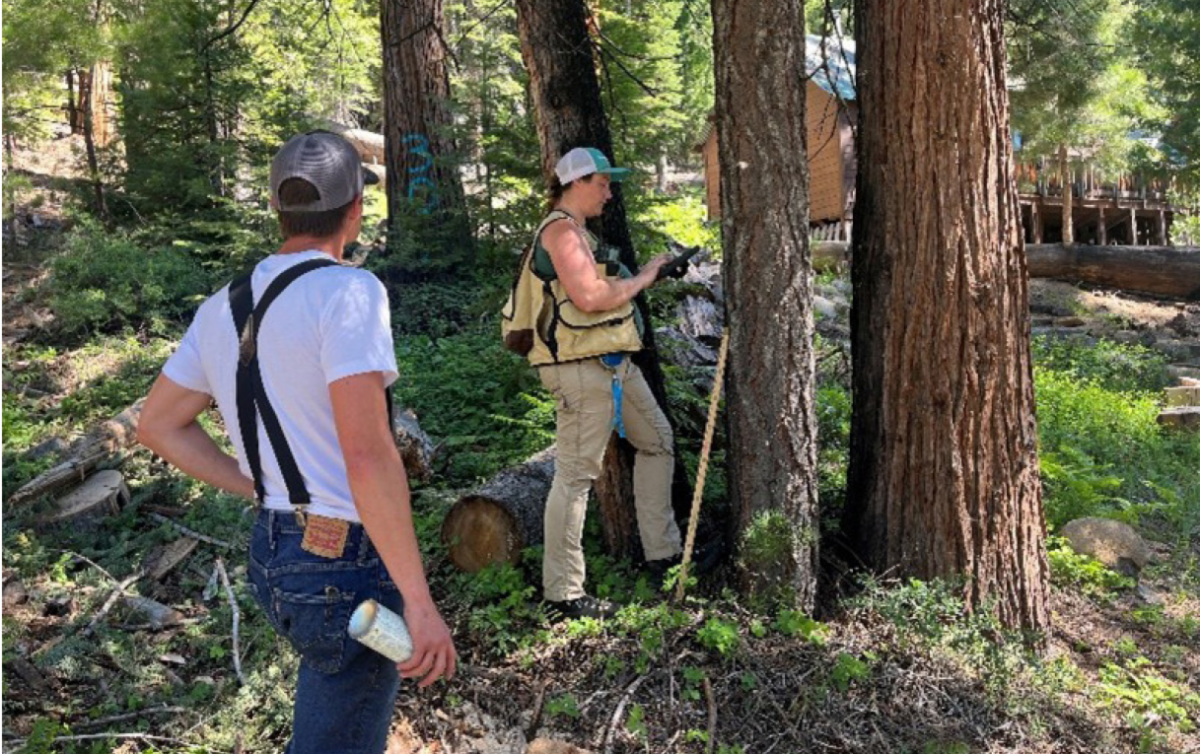
While public education plays a key role, much of RCDTC’s impact lies in its field operations. The district has emerged as a leader in forest and fuels management across a diverse landscape, which includes oak woodlands, mixed conifer forests, and expanding wildland-urban interface. Through the Tehama Mendocino Fuel Reduction Partnership, RCDTC collaborates with the Mendocino National Forest, FireScape Mendocino, and private landowners to implement fuel breaks, mastication, and biomass removal on thousands of acres. The August Complex Fire, which swept through the region, provided field-tested data showing that areas treated with post-mastication debris removal had significantly reduced burn severity and higher tree survival.
| |
RCDTC’s strategic fuels work spans key corridors in both eastern and western Tehama County. In Mineral, the Large Hazard Tree Removal Project addresses hazardous trees along key ingress and egress routes near the community and supports the 25-mile Onion Ridge Fuel Break. This work enhances wildfire resilience, firefighter safety, and protection of critical natural resources, including salmon habitat, deer migration corridors, and the high-elevation meadow ecosystems of the Battle Creek and Childs Meadows areas. The Onion Ridge Fuel Break held for emergency personnel during the Dixie Fire, underscoring the importance of these strategic investments. Elsewhere in the county, RCDTC’s Mill Creek Fuel Break enabled a successful backburn during the Park Fire, and more than 22 miles of Manton Roadside Fuel Treatments now improve evacuation routes and reduce wildfire risk. In western Tehama, roadside vegetation management efforts continue to reduce ignition potential and protect oak-dominated landscapes.
Recently, RCDTC received a Community Wildfire Defense Grant to update the Tehama County Community Wildfire Protection Plan, bringing together more than 60 partners to integrate new data and refine local priorities. The district also plays an active role in regional planning through its leadership in the Tehama-Glenn Fire Safe Council and participation in the Northern Sacramento Valley Coalition. Its watershed assessments and management plans continue to guide conservation and restoration efforts throughout the region.
As fire seasons grow longer and resource challenges more complex, RCDTC offers a replicable model for districts across the country, one rooted in community engagement, backed by strong partnerships, and driven by on-the-ground results.
Learn more about the initiatives on NACD's blog. To see more stories like this each month, subscribe to the Forestry Notes newsletter.
| | Join NACD's Next Conservation Coffee | |
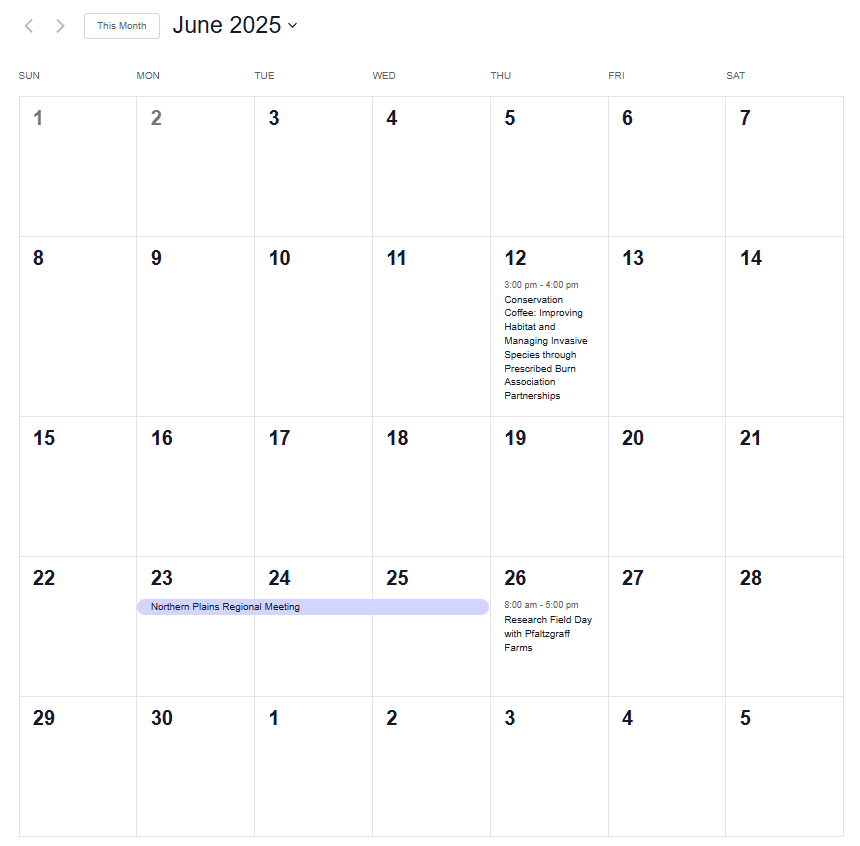
Join us for the next Conservation Coffee on June 12 at 3:00 p.m. ET to explore the topic, "Improving Habitat and Managing Invasive Species through Prescribed Burn Association Partnerships."
Hear from John Hendrix with the U.S. Fish and Wildlife Service (USFWS) and Lisa Owen with the Oklahoma Conservation Commission about programs to improve habitat while managing invasive species through prescribed burn associations. Through targeted removal of invasive species, together conservation districts, state agencies, and the USFWS are improving habitat for native species and increasing local biodiversity.
| Don't Miss Registration for Upcoming Region Meetings! | |
Northern Plains Region
The 2025 NACD Northern Plains Region Meeting, hosted by the South Dakota Association of Conservation Districts, will be held on June 23-25, 2025, at McCrory Gardens, Brookings, SD. Register for the meeting by June 16, 2025.
Southeast Region
The 2025 NACD Southeast Region Meeting and 81st Annual Conference of the Kentucky Association of Conservation Districts will be held on August 2-6, 2025, at the Crown Plaza Louisville Airport Hotel in Louisville, KY. Register for the event by July 18, 2025. Learn more here.
| Watch Latest Urban & Community Webinar | |
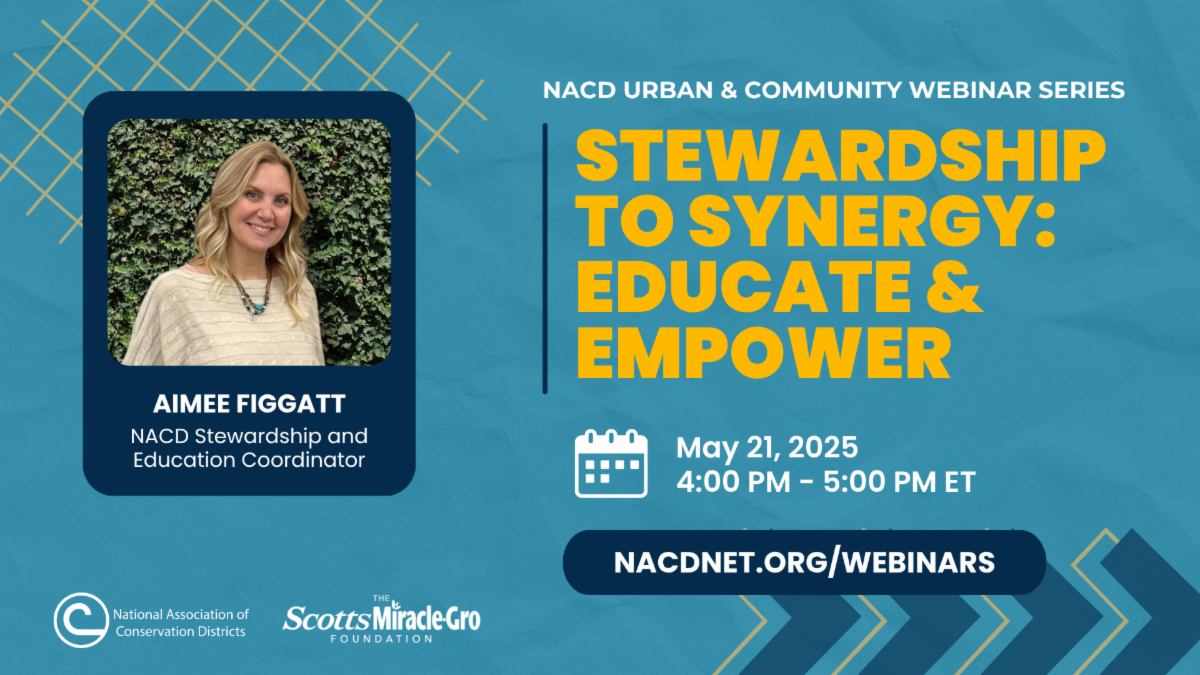
Missed the latest Urban and Community Webinar? A recording of the session, Stewardship to Synergy: Educate & Empower, is now availble to watch on NACD's YouTube page.
Hosted in partnership with The Scotts Miracle-Gro Foundation, learn from Aimee Figgatt, NACD's Stewardship and Education Coordinator, about conservation stewardship and education materials developed with the Foundation, focused on urban and home garden habitats.
| Upcoming Congressional Hearings | |
Wednesday, June 4, at 10:15 a.m. ET - House Natural Resources Subcommittee on Water, Wildlife, and Fisheries holds "Restoring American Seafood Competitiveness." Stream here.
Thursday, June 5, at 10:00 a.m. ET - House Agricultural Subcomittee on Conservation, Research, and Biotechnology holds "Supporting Farmers, Strengthening Conservation, Sustaining Working Lands." See a recording here.
Thursday, June 5, at 10:30 a.m. ET - House Agriculture Appropriations Subcommittee meets regarding FY26 Agriculture, Rural Development, Food and Drug Administration, and related agencies bill. Stream here.
| |
Thanks to everyone that has already paid their membership dues for FY25!
Your contributions allow NACD to promote responsible management and conservation of natural resources on all lands. NACD uses membership dollars to liaise with federal agencies and policymakers on behalf of conservation districts, create learning opportunities for board members and staff, and so much more!
We welcome dues payments at any level, and we offer a variety of ways to pay your dues. Please get in touch with us if you would like a paper invoice or if you need help setting up an account to facilitate paying online.
| Promote your conservation district or state association's tree sale, annual meeting, webinar, field day, or other events on NACD's Calendar of Events! | |