|
As NACD continues to celebrate 2023 as the year of 'One Water' and watershed education, we also look forward to the 2024 NACD Stewardship Week. NACD is excited to announce that next year will cover the topic of forestry under the theme “May the Forest Be with You, Always.”
Stay tuned for new educational materials for the 2024 Stewardship Week! These will be available in late summer of 2023. Every year NACD Stewardship Week is one of the largest national programs to promote natural resource conservation and has been celebrated since 1955. Conservation districts and educators across the U.S. and territories use the free NACD conservation education materials to positively impact their communities and teach the importance of conserving our valuable natural resources.
Past years topics have included soil health, pollinators, food production, and others vital resource concerns. NACD Stewardship Week materials dating back to 2017 are available at the NACD Conservation Education Hub. For any questions, reach out to the NACD Stewardship and Education team at stewardship@nacdnet.org.
| |
SUPREME COURT
RELEASES OPINION ON WOTUS DEFINITION
| |
On May 25, the Supreme Court released an opinion in Sackett v. Environmental Protection Agency (EPA) where they held that the “Clean Water Act’s use of “waters” in §1362(7) refers only to “geographic[al] features that are described in ordinary parlance as ‘streams, oceans, rivers, and lakes’” and to adjacent wetlands that are “indistinguishable” from those bodies of water due to a continuous surface connection”. This ruling will impact which wetlands are considered adjacent to waters of the United States (WOTUS) and therefore, whether those wetlands are under state or federal jurisdiction.
This decision aligns with NACD’s comments on the various WOTUS rules requesting that significant nexus no longer be used as a determination of legal connection, and that jurisdictional waters should be indistinguishable from tributaries and traditional navigable waterways. Or as quoted in the opinion, “that the wetland has a continuous surface connection with that water, making it difficult to determine where the ‘water’ ends and the ‘wetland’ begins.” (Sackett citing Rapanos).
Recently, some members of Congress have floated the idea of amending the Clean Water Act (CWA) to clear up some of the more ambiguous definitions. It is unlikely, given this decision, that Congress will have any further interest in developing their own definition of WOTUS. Some members of the Court raised concerns that the agencies are in the best position to make policy decisions and the majority opinion will impact the ability of EPA and the Army Corps to develop sufficiently protective regulations. EPA Administrator Michael Regan stated that he is disappointed in the decision but will be taking a hard look at the rule and really consider what the next steps may be.
Read the full update on NACD's blog.
|  | REGISTRATION FOR SUMMER MEETING CLOSES SOON | |
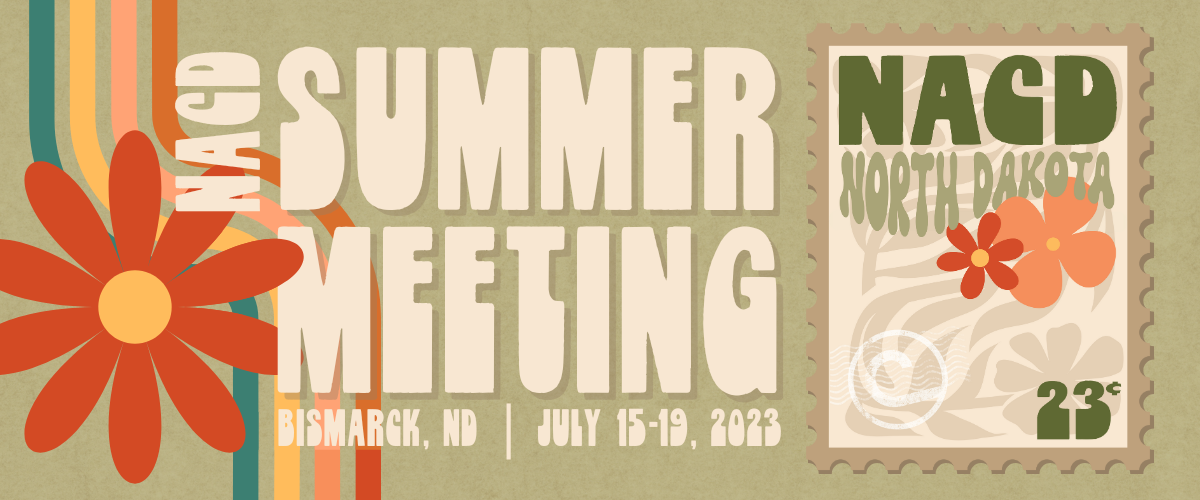
Early bird registration for NACD's 2023 Summer Meeting closes in less than one month! Hosted in partnership with the North Dakota Association of Soil Conservation Districts, the 2023 Summer Meeting will take place in Bismarck, North Dakota from July 15-19, 2023. You don't want to miss these networking opportunities, workshops, or tours!
Sign up to attend before June 23, 2023 to save up to $100 on registration costs with this early-bird special!
NACD is excited to announce three new workshops being held during the Summer Conservation Forum and Tour! These workshops will explore: Conservation Leasing on Public Lands and Ecosystem Services, Perspectives on Ecosystem Service Markets, and Developing Equitable Pathways to Market. Download the event app, to reserve your spots in these workshops! Space is limited.
Learn more about upcoming meeting, agenda, tours, speakers, and how to register and reserve your hotel room on NACD's website.
|
WHAT'S UP IN WASHINGTON? GOVERNMENT AFFAIRS UPDATE
| |
On Saturday, June 3, President Biden signed the Fiscal Responsibility Act into law, raising the federal debt limit and avoiding a default that was expected in early June. The bill was passed by the House and Senate earlier last week and includes provisions to increase the maximum age for SNAP work requirements, while adding exemptions for the homeless, veterans, and individuals who left the foster care system. These changes to SNAP are expected to make it easier for lawmakers to pass the 2023 Farm Bill. The nutrition title of the farm bill authorizes several food assistance programs and consumes about 85 percent of total funding. Senator Debbie Stabenow (D-MI), Chairwoman of the Senate Agricultural Committee, has signaled that the SNAP provisions passed via the debt ceiling bill now take the issue off-the-table in coming farm bill debates. However, Chairman of House Ag Committee Glenn “GT” Thompson (R-PA) has not ruled out making further changes to SNAP eligibility. The issue is expected to be debated in House Agriculture Committee Hearing on Wednesday, June 7.
NRCS is beginning to administer $500 million that will be available to producers through RCPP this fiscal year. This dramatic increase from last year’s funding pool (which totaled $197 million in projects) is mainly due to funding allocated to the program through the Inflation Reduction Act. NRCS has also identified seven key areas of the program where they will make improvements, including streamlining the RCPP portal and simplifying the partner reimbursement process. The first webinar providing general information about this funding announcement was held on May 24. The second and final webinar will take place on June 7, from 2-3:30 p.m. ET. Join via this link. Applications will be accepted through Aug 18. 2023 via the RCPP portal.
|  | NACD would like to take this month’s Soil Health Champions Spotlight to celebrate the life and legacy of Soil Health Champion, David Brandt of Ohio, who passed away on May 23, 2023. Immediately, the news of his passing traveled through the agriculture and soil health communities, emphasizing the impact he had throughout the course of his life on many across the country. Tributes, articles, and social media posts soon followed, revealing a patchwork of stories sharing Brandt’s impact and the legacy he leaves behind. | |
Brandt was one of the first NACD Soil Health Champions upon its inception in 2015 – before the program really got off the ground. This is just one example of how Brandt was an all-around early adopter when it came to soil health. He was always on the front end of the movement and looking forward to whatever came next.
What stood out about Brandt, in a network of soil health champions and among early adopters, was his extremely generous spirit. He was notorious for sharing his time and knowledge to help others. Many of today’s leaders, including some other Soil Health Champions, can trace the beginnings of their soil health journey back to David Brandt. Through one-on-one mentoring, field days on his farm and presentations across the country, his impact can’t quite be quantified.
Brandt began farming in 1971 in Ohio and imported the first no-till drill into the U.S. from Ireland in 1975. A few years later, in 1978, Brandt planted his first cover crop, which was cereal rye, with the goal of improving erosion control on his land. Forty-five years later, Brandt said that cover crops had become the anchor of a diverse crop rotation in his continuous no-till system.
|  | NACD wrote a brief profile for Brandt upon joining the Soil Health Champions Network, which can still be found here on NACD’s website. But to read more about this pioneer in conservation and regenerative agriculture, do an internet browser search for David Brandt or visit YouTube and search for videos of David Brandt. Outside of the conservation field, David Brandt was also known to many for his appearance in a viral meme (pictured above), that brought smiles to many around the world. His story and his legacy carry on in his family, his mentees, and in the furtherance of regenerative agriculture and soil health. | |
NACD Announces New Director of Communications | |
NACD is excited to announce Candice Abinanti as Director of Communications!
Abinanti has served as NACD Southeast Region Representative since December 2018. During that time, she has delivered exceptional communications, service, and support for members throughout the Southeast and across the nation. She has also managed successful NACD delegations to the U.S. Water Alliance's One Water Conference as well as territory outreach to Puerto Rico and the U.S. Virgin Islands.
Prior to her service with NACD, Abinanti served as International Relations Specialist with the Federal Emergency Management Agency for over 10 years. She holds an M.A. in Sustainable Development and a B.A. in Anthropology from the University of Massachusetts in Boston.
Abinanti is based in Charlotte, N.C. and can be reached at candice-abinanti@nacdnet.org. She will continue supporting the Southeast Region until a replacement is named.
| NACD Seeks Southeast Region Representative | |
NACD is seeking candidates for Southeast Region Representative. This full-time position is responsible for providing assistance to the member conservation districts and board of directors to advance conservation education, partnerships, and membership services, and to assist in the implementation of the association’s policies related to the Southeast Region. This is a service-oriented position with a focus on creating and maintaining relationships and increasing the effectiveness of NACD in supporting conservation districts and their state/territory associations.
This is a telework position based in NACD’s Southeast Region (AL, GA, FL, KY, MS, NC, PR, SC, TN, USVI, VA). Interested candidates should apply by June 23, 2023 to receive priority consideration. Visit NACD's careers page for more information and application instructions.
| Final Applications Open for Farmer to Farmer Outreach Grant Program | |
NACD is accepting final applications for the Historically Underserved Farmer to Farmer Outreach Grant Program. These final applications are only open to those who previously submitted a pre-application. This program will award up to $2.7 million in grants for outreach to Native American and historically underserved producers, as well as on the ground projects that mitigate hypoxic conditions in the Gulf of Mexico.
Applicants who have already submitted pre-applications must submit their final project proposals to NACD by June 23, 2023.
For more information, please visit NACD's website or contact conservationprograms@nacdnet.org with any questions.
| Our Town Grant Applications Open | |
The National Endowment for the Arts has released guidelines and instructions for their Our Town grant program. These are now available online. Through project-based funding, Our Town supports activities that integrate arts, culture, and design into local efforts that strengthen communities. These are cost share/matching grants ranging from $25,000 to $150,000, with funding starting July 1, 2024 for 1–2 year projects. The application is submitted in two parts; the part 1 deadline is August 3, 2024.
Opportunities to connect with Our Town staff include a webinar on June 15 at 2:00 p.m. ET and three Q&A sessions on June 27, July 20, and August 10. Registration information is on the Our Town Applicant Resources page.
| |
Wednesday, June 7, 10:00 a.m. ET - House Ag Committee hosts "Innovation, Employment, Integrity, And Health: Opportunities for Modernization in Title IV." Stream here.
Thursday, June 8, 10:00 a.m. ET - Senate Energy and Natural Resources Committee hosts "Federal Response to Escalating Wildfires and to Evaluate Reforms to Land Management and Wildland Firefighter Recruitment and Retention." Stream here.
|
Promote your conservation district or state association's tree sale, annual meeting, webinar, field day, or other events on NACD's Calendar of Events!
| |