|
Registration is now open for NACD's 2025 Summer Conservation Forum & Tours! Hosted with Wisconsin Land + Water, the NACD Summer Meeting will be held in Milwaukee, WI, this July 25-29, 2025.
Early bird registration is only open for a limited time, so don't delay. Save $50 per person by registering before July 7.
To add some extra fun to your meeting plans, join NACD at a Milwaukee Brewers game! Meet up with colleagues at the American Family Field stadium in Milwaukee and enjoy watching the Milwaukee Brewers play ball with the Chicago Cubs starting at 6:40 p.m. on Monday, July 28.
| |
NACD has reserved seats in the Johnsonville Party Deck for Summer Meeting attendees to enjoy the game while socializing with conservation colleagues from across the country. Remaining spots are limited, so grab yours now!
Tickets can be added to your registration for $125. All tickets include access to an all-you-can-eat buffet, unlimited water and soda, two alcoholic drink tickets, and a special Friends of NACD t-shirt.
Learn more about both of these tours on NACD's website and register for the meeting to join us!
| A LIVING LEGACY: DR. BARRY DUNN'S CONSERVATION MESSAGE TO THE NORTHERN PLAINS REGION | |
When Dr. Barry Dunn spoke at the Northern Plains Region Leaders Meeting, hosted by the South Dakota Association of Conservation Districts in Brookings, SD, last week, it didn’t feel like a lecture, it felt like a story we all belonged to. A citizen of the Sicangu Lakota and President of South Dakota State University, Dunn brought a message that wove together memory, movement, and conservation—a reminder that the land connects us across generations.
Dr. Dunn spoke of his grandfather, Claude Lamoureaux, who was named Conservationist of the Year in the 1940s–50s for his work with the Soil Conservation Service, now NRCS. Lamoureaux restored native grasses, improved grazing practices, and helped reintroduce beavers to local waterways, early conservation methods that helped stabilize soil and rebuild ecosystems. That ethic shaped the L7 Ranch and now lives on at the James Family homestead, where Dr. Dunn and his wife Jane have continued that legacy for over 30 years.
He quoted his grandfather: “If you have time to do it again, you had time to do it right,”—words that speak directly to the conservation mindset: careful, intentional, and rooted in long-term stewardship.
He also told the story of his family’s relocation to the Rosebud Reservation after the death of Crazy Horse at Fort Robinson, reminding us that land is not only natural, but historic, emotional, and sacred.
Quoting Aldo Leopold, Dr. Dunn said, “Teach students to see the land, understand what he sees, and enjoy what he understands.”
This resonated with NACD Northern Plains Region Representative Nicole Poitra. "As someone from the Turtle Mountain tribe, I felt that message deeply," said Poitra. "Conservation is not just science—it’s a relationship. And Dr. Dunn lives with that truth."
| NOMINATE CONSERVATION LEADERS FOR HHB AWARDS | |
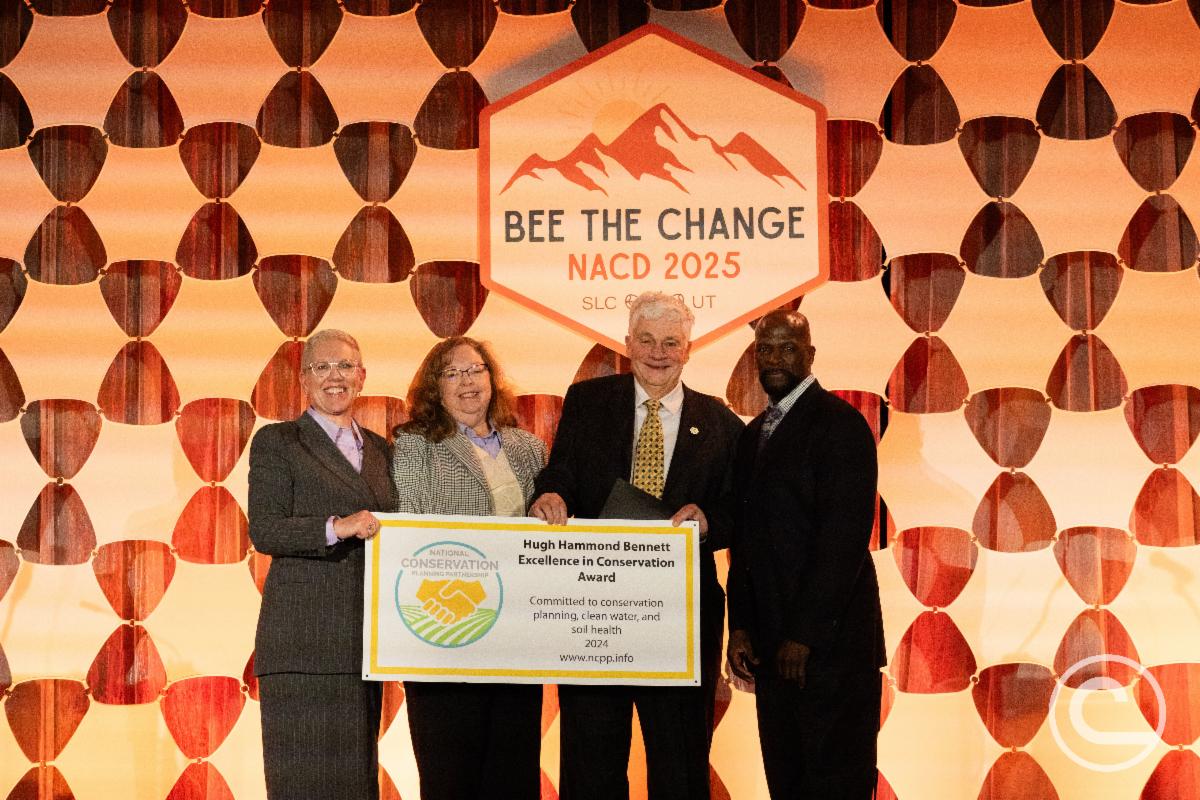
Do you know an outstanding producer or conservation planner? Nominate them for a 2025 Hugh Hammond Bennett (HHB) Award!
The Hugh Hammond Bennett Awards recognize outstanding producers and conservation planners from within the National Conservation Planning Partnership (NCPP).
-
The producer award recognizes any producer working with NCPP partner organizations on conservation planning or the implementation of a conservation plan.
-
The conservation planner award recognizes any NCPP partnership employees. Partner organizations are those recognized by NCPP at the national, state, or local level, including conservation districts.
Nominations are due by September 1, 2025. More information about the award and how to apply can be found on NCPP’s website.
| WHAT'S UP IN WASHINGTON? GOVERNMENT AFFAIRS UPDATE | |
This morning the Senate continued deliberations on its budget reconciliation package, formally titled the One Big Beautiful Bill Act, through an extended voting session commonly referred to as a “vote-a-rama.” This session, which began at 9:00 a.m. on June 30, permits the consideration of an unlimited number of amendments.
Democratic amendments have primarily focused on modifying provisions related to the Supplemental Nutrition Assistance Program (SNAP), Medicaid, and clean energy tax credits. However, these proposals are largely viewed as symbolic. One notable amendment, introduced by Senator Chuck Grassley (R-Iowa), sought to impose income limits on farmers receiving federal farm subsidy payments. This amendment was ultimately withdrawn following negotiations with Senate Agriculture Committee Chair John Boozman (R-Ark.), though it is anticipated that some of its elements may be incorporated into a future legislative measure, such as a “skinny” farm bill.
Meanwhile, the House of Representatives is in recess this week ahead of the upcoming July 4 holiday. Lawmakers are scheduled to return next week to resume consideration of appropriations packages and to review reconciliation language likely passed by the Senate.
Two members of the House Agriculture Committee announced they will not be running for reelection next year. Reps. Don Bacon (R-Neb.) and Dusty Johnson (R-SD) have been consistent champions of conservation through their work on the Ag Committee, and NACD looks forward to their next endeavors.
| LANDSCAPE CHAMPIONS: DISTRICTS DRIVING FORESTRY SUCCESS ACROSS THE COUNTRY | |
Conservation districts across the country continue to lead the charge on locally led conservation, bridging gaps between partners to enhance conservation outcomes, connect landscape-scale efforts, and drive greater impact where it matters most. As federal funding streams shift and traditional stewardship models evolve, districts are continuing to serve as vital local partners, critical to the success of these efforts and the long-term resilience of our natural landscapes.
Whether supporting wildfire resilience, advancing reforestation, restoring critical watersheds, or leading post-disaster recovery, districts are delivering in ways few others can. Their strength lies not only in technical expertise but in their deep-rooted relationships with landowners, community members, and agency partners. This combination positions districts to link federal and state priorities with local knowledge and action, ensuring conservation happens where it’s most needed.
Over the past year, NACD’s Forestry Notes has spotlighted just a few examples of the wide ranging, deeply impactful work conservation districts are leading in forestry across the country. These stories represent more than a look back, they reaffirm the vital, growing role that districts play in advancing forest health, resilience, and community-based stewardship. From coast to coast, districts are proving that locally led conservation is not just effective, it is essential.
- In Jackson Soil and Water Conservation District, Oregon, a coordinated effort to restore riparian corridors is improving water quality, forest health, and fish habitat.
- In North Carolina, Mecklenburg Soil and Water Conservation District and partner districts responded to the aftermath of Hurricane Helene with strategic debris removal, workforce mobilization, and biochar development.
- In northern California, the Resource Conservation District of Tehama County is implementing critical fuel breaks and vegetation treatments that reduce wildfire risk while protecting habitat and water resources.
- Minnesota’s conservation districts are working across county lines to build fire-resilient forests in a state more often associated with lakes than wildfire.
- In Arizona, Tonto Natural Resource Conservation District is demonstrating the power of Good Neighbor Authority as a tool for local implementation, enabling them to deliver targeted invasive species control, native seeding, erosion stabilization, and more.
The district efforts highlighted here offer just a glimpse into the breadth and significance of forestry work being led at the local level. As conservation strategies continue to evolve and as the systems that fund and support this work shift, conservation districts remain essential to ensuring these efforts succeed. Their deep local knowledge, long-standing community relationships, and ability to deliver on-the-ground results make them indispensable partners in meeting the challenges and opportunities of this moment.
Read more about these and other district forestry efforts on NACD's blog. For stories like this delivered to your inbox each month, subscribe to the Forestry Notes newsletter.
| | |
NACD will be closed this Friday, July 4, to celebrate Independence Day. There will also be no edition of Conservation Clips this week.
NACD wishes you a safe holiday! As you celebrate, please remember to practice fire safety. With dry conditions, wildfire risks increase significantly during July 4 celebrations. Follow local fire restrictions, avoid personal fireworks in high-risk areas, and prioritize safety by only attending professional displays.
| NACD Welcomes Director of Finance and Operations | |
NACD is excited to welcome Joseph Shaffer as Director of Finance and Operations.
Shaffer comes to NACD from AmeriCorps where he served as a Payment Integrity Analyst since 2022, ensuring agency compliance with federal policy and regulations, providing program integrity and stewardship of federal resources.
Before his service at AmeriCorps, Shaffer was Senior Director of Grants and Compliance at CAF America where he was responsible for ensuring compliance with internal policies and external regulators.
Shaffer holds a Bachelor of Science degree in Political Science from the University of Dayton and a Master of Public Administration degree from the University of Pittsburgh.
Shaffer is based in Washington, D.C. and can be reached at joseph-shaffer@nacdnet.org.
| ACAM Hosts Sustainable Ranchers in July | |
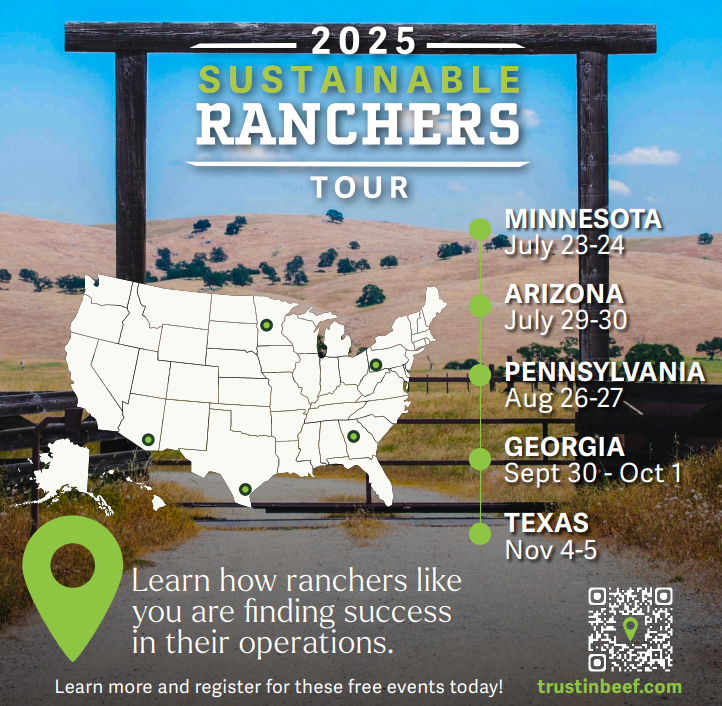
In July, NACD partner, America’s Conservation Ag Movement (ACAM), will host two Sustainable Ranchers Tours!
On July 24, tour the Clear Springs Cattle Company in Starbuck, Minnesota, a 1,000+ acre operation practicing regenerative agriculture, no-till farming, cover crops, and rotational grazing. Learn more and register here.
On July 30, tour the YY Ranch in Wilcox, Arizona, a cow-calf operation run by Arizona's representative on NACD's Board of Directors, Tina Thompson, and her family. Learn more and register here.
Conservation districts and the producers they serve are invited to attend these free events. Help spread the word!
| Learn About Edible Ecosystems & Food Forests | |
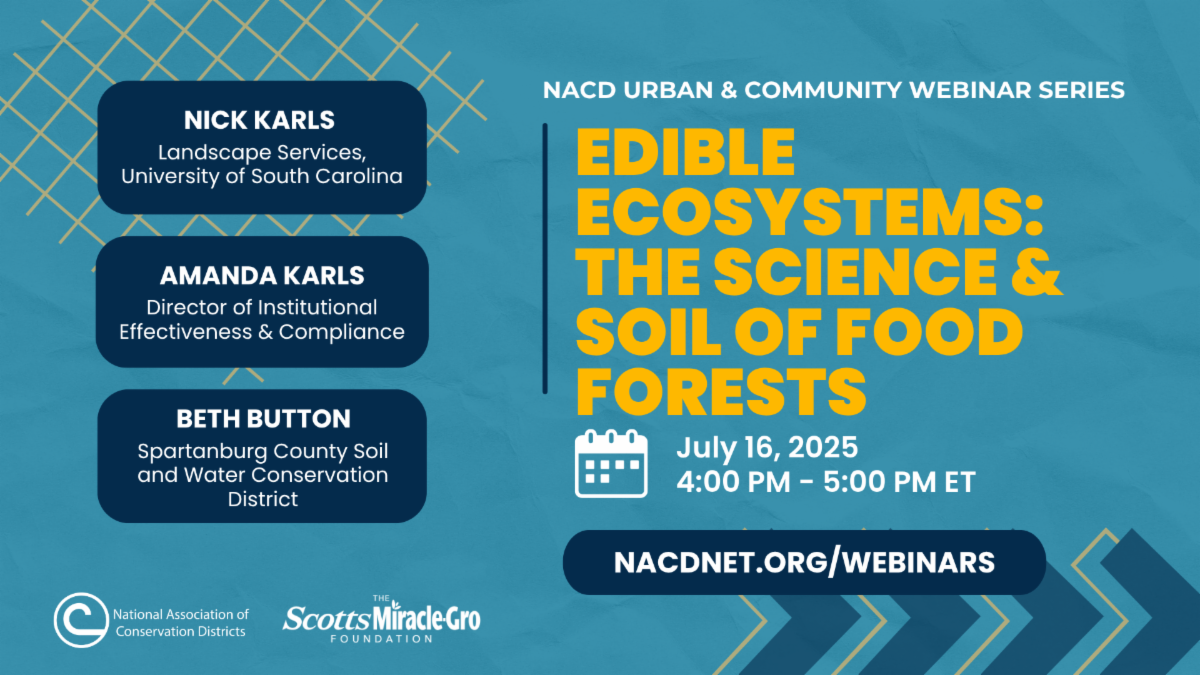
Join us on Wednesday, July 16, at 4:00 p.m. ET for the next NACD Urban & Community Webinar!
Hear from Beth Button with South Carolina's Spartanburg County Soil and Water Conservation District and Nick Karls and Amanda Karls from the University of South Carolina (USC) Upstate about "Edible Ecosystems: The Science & Soil of Food Forests."
Learn how they have created the USC Upstate Food Forest, a two-acre agroforestry system that mimics a natural ecosystem to sustainably grow a diverse range of edible plants while promoting biodiversity, soil health, and community engagement.
Register to learn more about this project and its benefits!
| |
Thank you to all districts that have paid membership dues for FY25! We rely heavily on your contributions to support our advocacy, education, and partnership activities. If you have not contributed yet, you will soon receive an invoice in the mail to renew your membership for Fiscal Year 2025.
You’ll also find a copy of the Summer 2025 edition of The Resource! This edition has important government affairs updates, information about the current NGLI cohort, and more. If you have any questions about your district's membership, how to pay your dues, or how to access all of your membership benefits, please reach out to us.
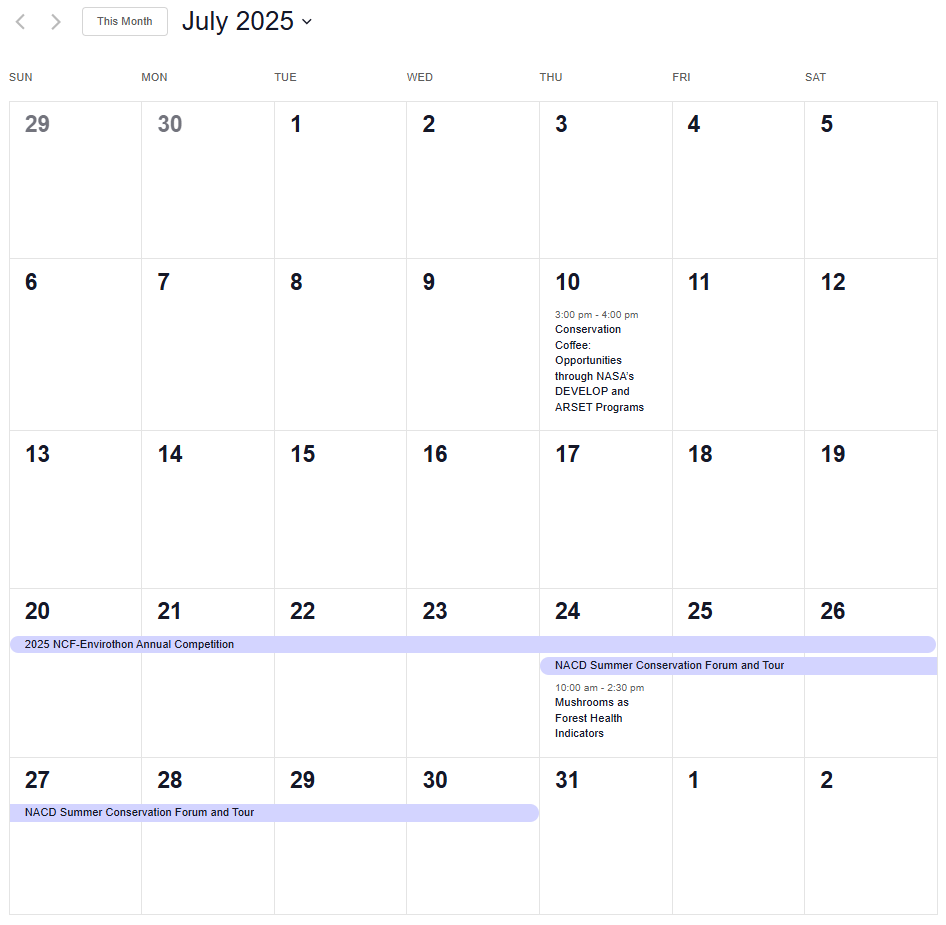
| Promote your conservation district or state association's tree sale, annual meeting, webinar, field day, or other events on NACD's Calendar of Events! | |