|
NACD has released a report about the impacts of recent Executive Orders and funding freezes on America’s locally led conservation delivery system, including conservation districts and the producers and communities they serve. The report was informed by a survey the association distributed to conservation districts last month, which received over 350 responses from across 45 states and territories. Thank you to those who have completed the survey, and we encourage all districts to continue to share local impacts and updates as executive actions develop.
Informed by the survey responses, the report underscores three major themes:
- The funding freeze has widespread impacts on producers, conservation, and local economies.
- NRCS terminations and staffing shortages will have long-term impacts on the quality and timeliness of technical assistance and overall service.
- We must act to protect partnerships and the future of the voluntary, locally led conservation delivery system.
| |
The federal funding pause is also having impacts on infrastructure and placing strain on state, Tribal, and local governments. In response to the survey, conservation districts across the country shared concern for projects that have been put on hold. These include projects to repair high-hazard dams, recover from and mitigate future impacts of wildfires, and replace culverts and other water systems to maintain water quality.
Many respondents commented on the termination of federal employees, lost investment in communities, reduced productivity, and diminished quality and timeliness of service to America’s producers.
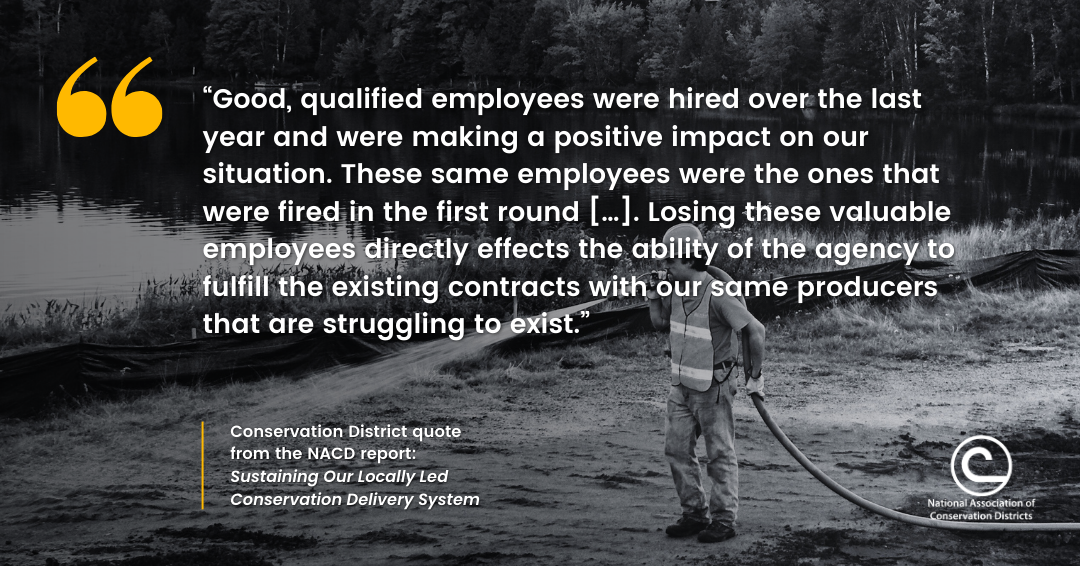
The report includes an extensive collection of anonymized quotes from conservation districts. These quotes explore the varied impacts of these actions across the country.
Read the full report, Sustaining Our Locally Led Conservation Delivery System: Urgent Action Needed to Address Funding Freezes, Bridge Staffing Gaps, and Preserve Partnerships, here.
| REGISTER FOR ADVOCACY TRAINING TO PREPARE FOR NACD'S SPRING FLY-IN | |
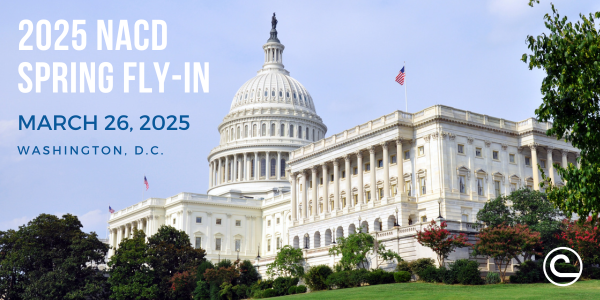
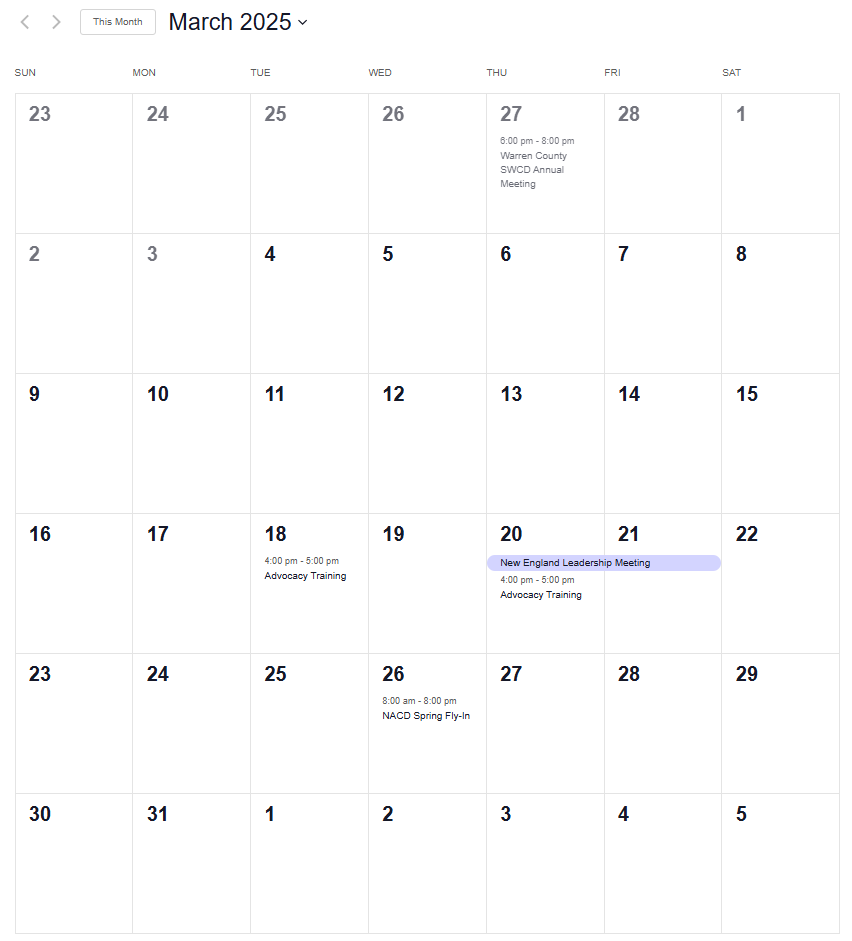
Join us in D.C. for NACD's 2025 Spring Fly-In on March 26!
Each year, hundreds of conservation district leaders from across the country travel to Washington, D.C. to participate in NACD’s Spring Fly-In. This event provides our members with the opportunity to build relationships with their congressional representatives, highlight the importance of locally led conservation, and advocate for strong federal conservation policies. This Fly-In is critical for conservation districts and our country’s conservation delivery system. Your members of Congress need to hear from you directly about the significant local impacts of recent executive actions.
The event will begin at 7:30 a.m. ET in the Senate Hart Office Building Room 702 with a Breakfast Briefing, followed by individually scheduled meetings with congressional offices, and will end with a reception at 5:30 p.m. ET in the Russell Senate Office Building Room 325. Please RSVP here.
The NACD Government Affairs team will hold two virtual advocacy training sessions on March 18 and 20 at 4:00 p.m. ET. These sessions will present the same information and provide time for members to review NACD's priorities, learn some tips and tricks for meeting with representatives, and ask the Government Affairs team any questions. You don't want to miss one of these sessions before making your trip to Washington. Register for session one on March 18, here. Register for session two on March 20, here.
Visit the Fly-In page for more information, including answers to your frequently asked questions.
| |
WHAT'S UP IN WASHINGTON?
GOVERNMENT AFFAIRS UPDATE
| |
NACD is continuing to work with USDA officials regarding the administration of recent executive orders and to advocate for expedited reimbursements to grantees and agreement holders as the administration reviews contracts and financial assistance vehicles. You can view NACD’s latest memo on executive actions here.
Tonight, President Trump is scheduled to address Congress at 9:00 p.m. ET. President Trump has called on Congress to pass a continuing resolution to fund the federal government until the end of the current fiscal year in September. Congress must pass an additional continuing resolution or full-year appropriations bills before March 14 to avoid a government shutdown. The U.S. House and Senate have each passed budget resolutions, the first step in the budget reconciliation process. To move forward, the budget resolutions must be compromised. Currently, the House resolution is considerably larger and includes tax cuts and changes in addition to raising the debt ceiling.
| AGROFORESTRY IN ACTION AT NACD'S ANNUAL MEETING | |
NACD recently held a session at its 2025 Annual Meeting that focused on the importance of agroforestry practices in conservation and the critical role conservation districts play in supporting landowners. This session, featuring case studies from Nebraska’s Natural Resources Districts (NRDs) and Snohomish Conservation District, highlighted the practical applications of agroforestry and how it’s being used to address local environmental challenges.
The NRDs in Nebraska have long been leaders in conservation practices, and their tree planting programs are among the most successful in the country. For over 50 years, the NRDs have worked to stabilize soils, reduce erosion, and enhance water retention by planting trees. In fact, the NRD Conservation Tree Program has planted more than 100 million trees—an achievement that reflects Nebraska’s commitment to improving its landscapes. As part of this initiative, NRDs integrate agroforestry techniques like windbreaks and riparian buffers to create multifunctional landscapes that benefit both the environment and agricultural productivity. These practices not only protect crops and livestock from harsh weather but also reduce runoff, improve biodiversity, and enhance wildlife habitat.
| |
In the Pacific Northwest, the Snohomish Conservation District in Washington state is taking a similarly innovative approach to agroforestry, working with farmers and landowners to integrate trees and shrubs into farming systems. The Snohomish district has implemented several demonstration projects focused on agroforestry, including alley cropping, windbreak installations, and riparian buffer restoration. These projects are designed to improve soil health, reduce water loss, and boost farm productivity—goals that directly benefit local producers.
The work being done in both Nebraska and Washington state is a testament to the power of agroforestry to create sustainable, productive landscapes. These examples show how conservation districts are leveraging agroforestry techniques to address environmental challenges, such as soil erosion, water quality issues, and habitat loss, while also providing economic opportunities for landowners. By integrating trees into agricultural landscapes, both regions are fostering healthier ecosystems and increasing the resilience of farming systems.
NACD, in partnership with the National Agroforestry Center, will be offering three in-person agroforestry trainings for districts and their partners. The first of these trainings is expected to be offered later this year, so please stay tuned for more information!
Read the full story on NACD's blog. For more forestry-focused stories like this delivered to your inbox monthly, subscribe to the Forestry Notes newsletter.
| |
New Stewardship Week Materials Released! | |
In preparation for the 2025 Stewardship Week, hosted April 27 - May 4, NACD has released additional materials for your district's use. Included are templates for a press release, formal proclamation, and radio announcement.
Find these, alongside our other education materials and activity guides, here.
| Arkansas RC&D Featured in Documentary | |
The Arkansas RC&D was featured in a recent documentary, Roots, that explores the efforts of local farmers, nonprofits, and conservation programs working to create sustainable solutions for food access across the state. Featuring insights from NRCS initiatives, community leaders, and everyday heroes, Roots showcases the impact of conservation and collaboration in the fight against hunger.
Watch the documentary for free on YouTube here.
| Sustainability and Innovation Grants | |
The Wright Foundation for Sustainability and Innovation 2025 grant cycle is now open for applications!
Submit your letter of intent by March 21 for the opportunity to apply for funding through one of the two grant opportunities: the Tree Canopy Improvement Grant or the John Harsch Regenerative Agriculture Grant.
For more information, visit their website.
| Village & Wilderness Grant Opportunity | |
The Village & Wilderness organization offers Incubator Grants, available to community-based organizations, including conservation districts, to develop strategic plans and start microhabitat programs. Microhabitats are re-naturalized small spaces in fragmented ecosystems, including such sites as residential yards, school grounds, and the margins of agricultural lands.
Learn more about the grant opportunity and apply by March 21, on their website.
| |
Join the National Watershed Coalition (NWC) on April 22 at 1:00 p.m. ET. for a webinar on Program Opportunities for Flood Prone Communities.
Participants will learn about NRCS Emergency Watershed Protection (EWP) Program assistance with project sponsors for flooding and erosion protection following a natural disaster, including structural solutions that protect communities from additional flooding threats and financial assistance for sponsor-led property buyouts.
Register here to attend.
| |
We want to extend a special thank you to our new Friends of NACD lifetime members: Kim LaFleur, MA – NACD Immediate Past President (Contribution made on behalf of Kim by the Northeast Region districts), Jennifer Kleitz, NM – Doña Ana SWCD District Manager, and Steven Becker, ID – Nez Perce SWCD Board Chair.
“Friends of NACD is at the heart of what we do - invest in each other. These investments provide local districts an opportunity to expand their community involvement and have a major impact,” says LaFleur.
Interested in what projects Friends of NACD has already supported? Check out our blog entries here.
| Promote your conservation district or state association's tree sale, annual meeting, webinar, field day, or other events on NACD's Calendar of Events! | |