|
Dear {First Name},
FIGURE DRAWING
& PORTRAIT ISSUE
| | |
|
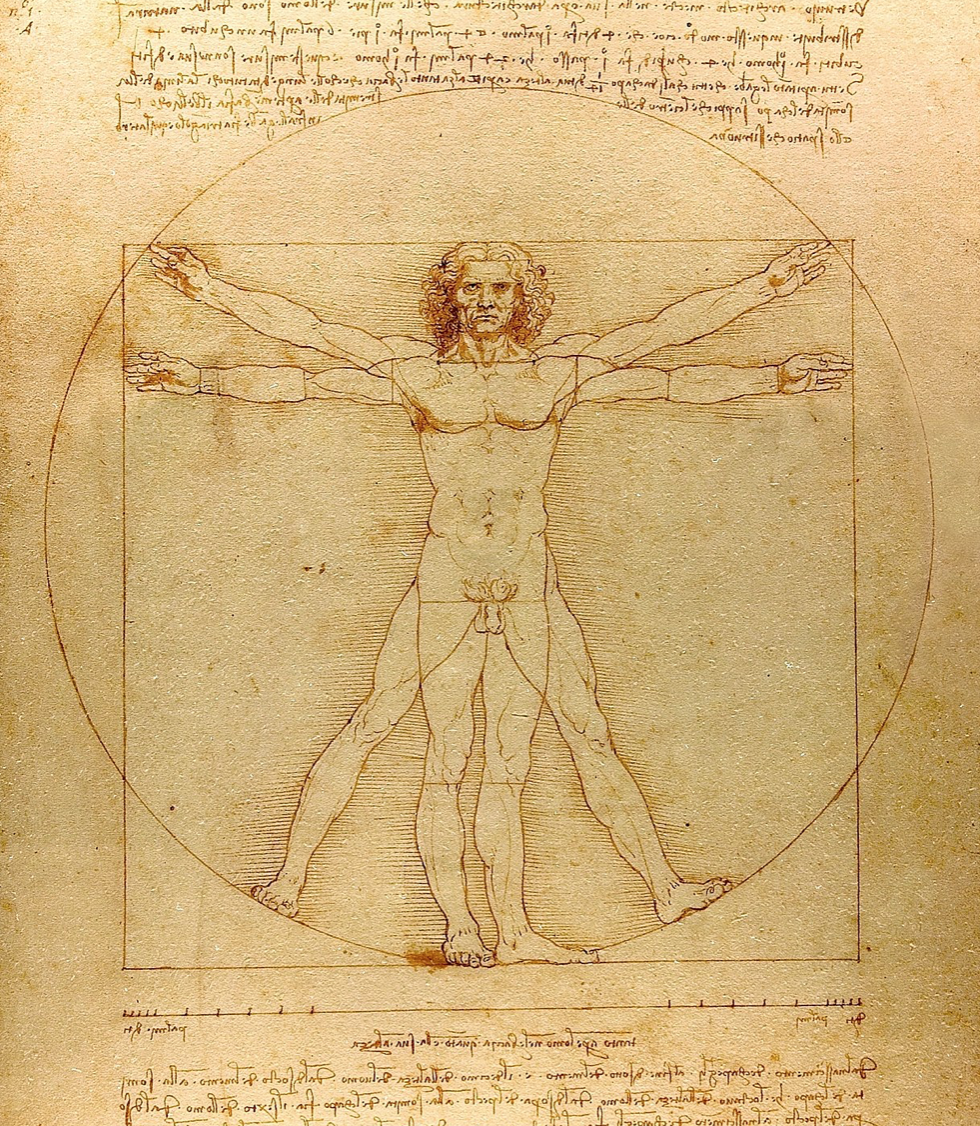
"A man standing perfectly erect in a square, stretching his arms upward, will find that his middle fingers touch the top level of the square level with his head, at the exact point where the circle intersects the square." Leonardo da Vinci, c. 1490 (inspired by Vitruvius, an Ancient Roman architect).
| | |
|
Leonardo and Michelangelo based their figures on both direct observation of bodies, including through dissections, and Neo-Platonic concepts of ideal forms. This pairing of dynamic if sometimes conflicting approaches continues to influence figure drawing and portraiture today. In Leonardo’s “Vitruvian Man,” an ideally proportioned male is in harmony with the material world (the square) and the infinite (the circle). The closer figures and faces corresponded to such divine forms as ovals, spheres and cylinders, the greater their beauty, it was believed.
In this Art Talk, I'll give historical perspectives for Chico Art Center's Figure Drawing and Portrait Group practices. Then, artists in these CAC groups will join me in exploring the following six questions:
| |
|
What Italian Renaissance figure drawing approaches are still practiced by some members of CAC's Figure Drawing and Portrait groups?
Why would artists who primarily paint landscapes, still lifes and abstracts also practice figure drawing?
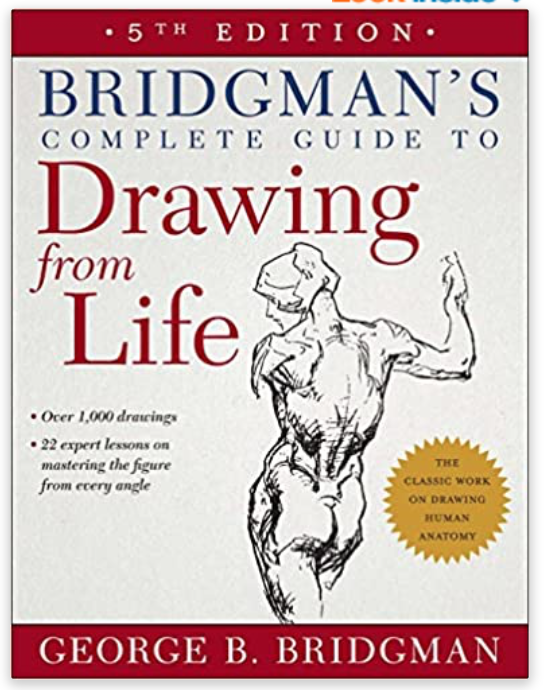
What's a good instruction book to prepare for figure sketching?
What do models contribute to figure drawing and portrait sessions?
How do comissioned portraits differ from head studies or self-portraits?
What impact has photography had on portraiture?
| |
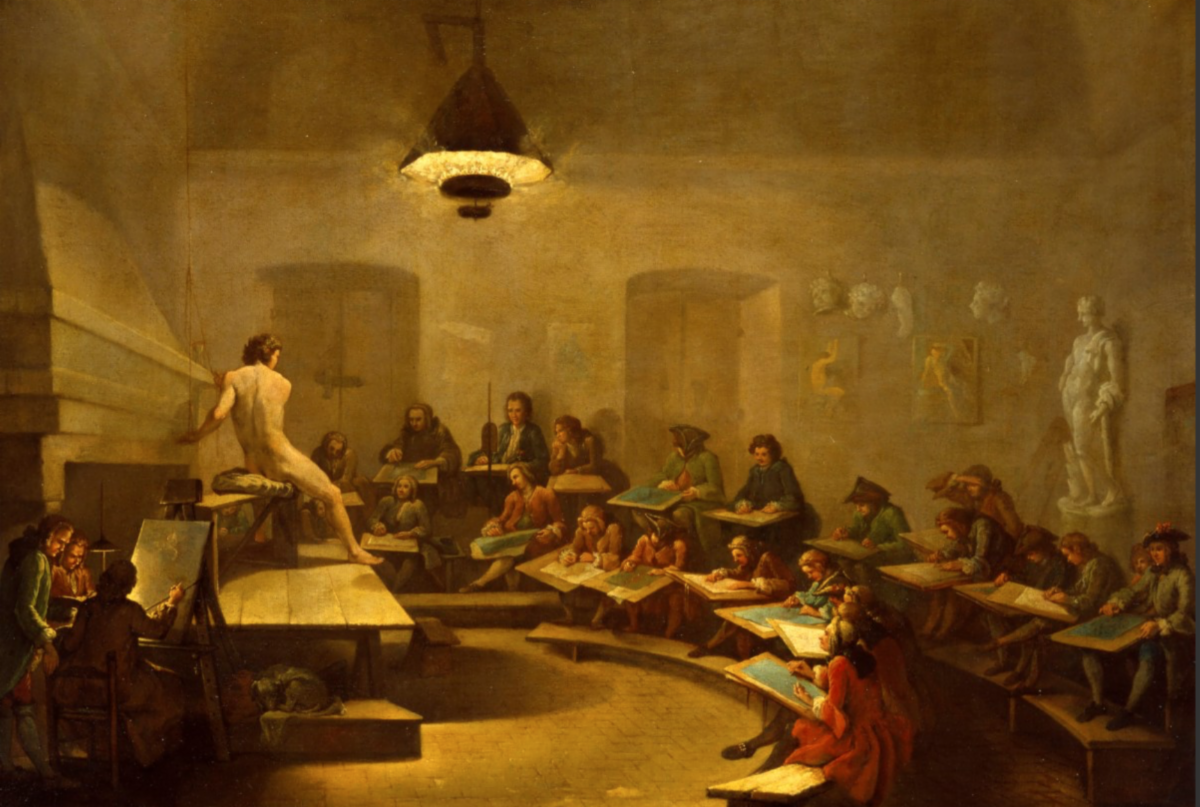
There are neither female artists nor electric lights in this late 18th c. painting, but otherwise the drawing session it depicts at The Royal Academy, London, resembles ones at the Chico Art Center. | |
|
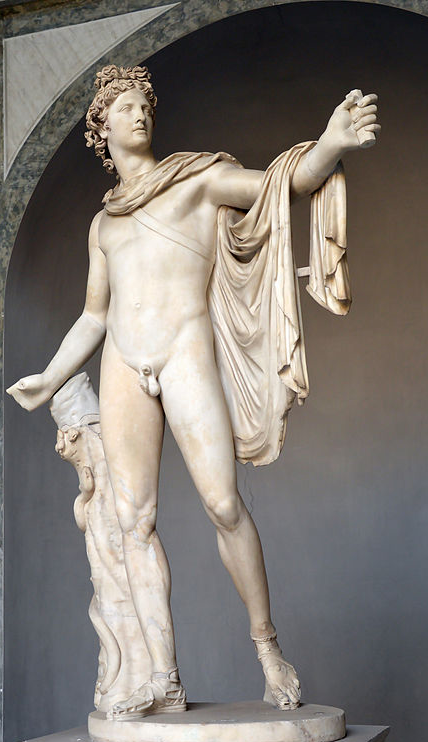
Italian Renaissance artists regarded Hellenistic sculptures, such as the Apollo Belvedere, as models of harmonious proportions and fluid gestures.
Apollo stands firmly on one leg while releasing the other to imply movement. The shoulder and hip on his supporting side compress while those on his released side stretch. This contrapposto (counter balance) stance remains a basic of figure drawing today.
| |  |
|
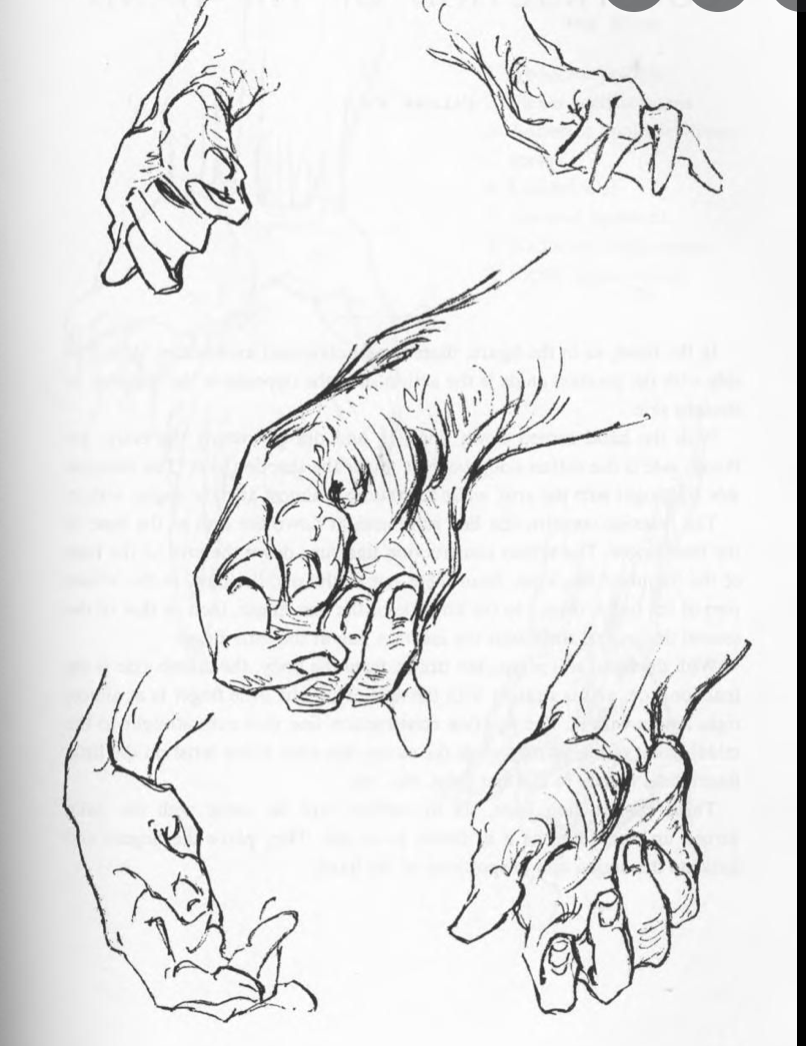
GEORGE BRIDGMAN (1864-1943) studied at the Ecole des Beaux-Arts and taught figure drawing at the New York Art Students' League for 45 years. His figure drawing manuals, still popular today, use Italian Renaissance systems of proportions and geometric shapes.
The contrapposto position of the model in Bridgman's drawing (above) resembles that of the Apollo Belvedere. Throughout his manual, Bridgman uses circles, ovals, wedges, triangles and other geometric shapes as scaffolding for heads, torsos and limbs. In addition, he promotes awareness of muscles, skulls and bones beneath the skin.
| | |
Here's a page on hands whose foreshortened gestures are a challenge for beginners to draw. Bridgman's advice is to start with a simple wedge before adding carefully observed fingers. | | |
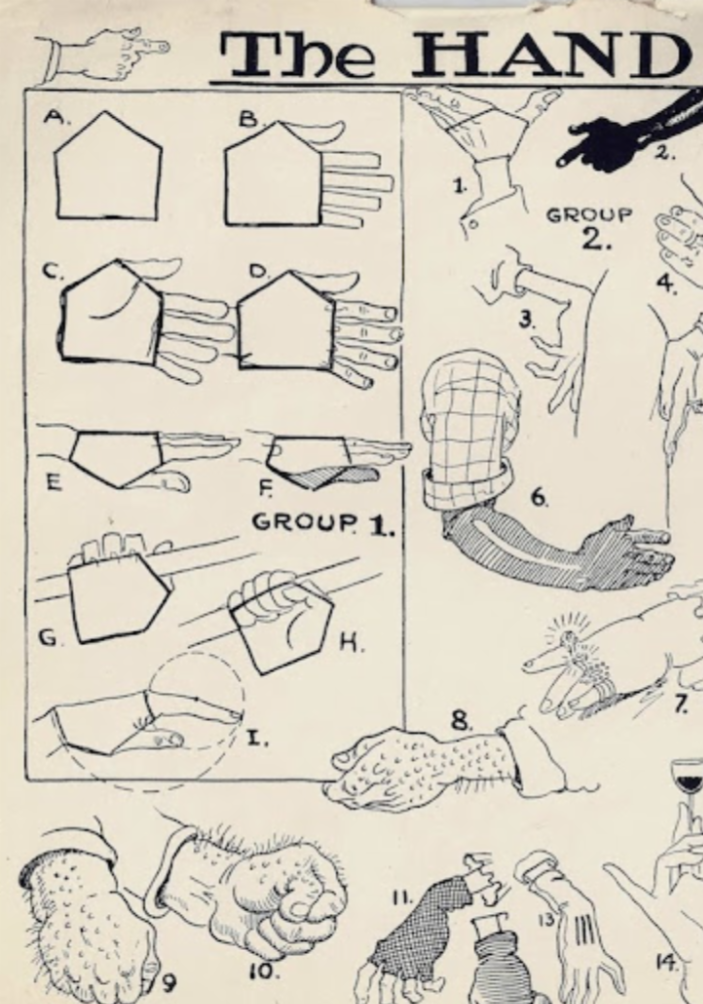
Simplified “How to Draw People” books based on similar geometric principles got many youngsters started in art making. | | |
|
|
|
My first experience with drawing a model was when I was twelve and attended a Saturday kids’ class at the Chicago Art Institute. A hundred of us sat in tiers in a large auditorium as our instructor, glancing at a model in a bathing suit, drew a vertical charcoal line on a big newsprint pad, strung seven-and-a-half head-size ovals down its length, and added slanting shoulder and hip lines. A few more strokes and magically he made the model materialize. Then it was our turn—far harder than it had looked.
After class my girlfriend and I would explore the basement classrooms where we'd heard that adults drew from naked models. It was true, we discovered, taking a peek through curtains over a doorway. We never told our parents.
| | | |
|
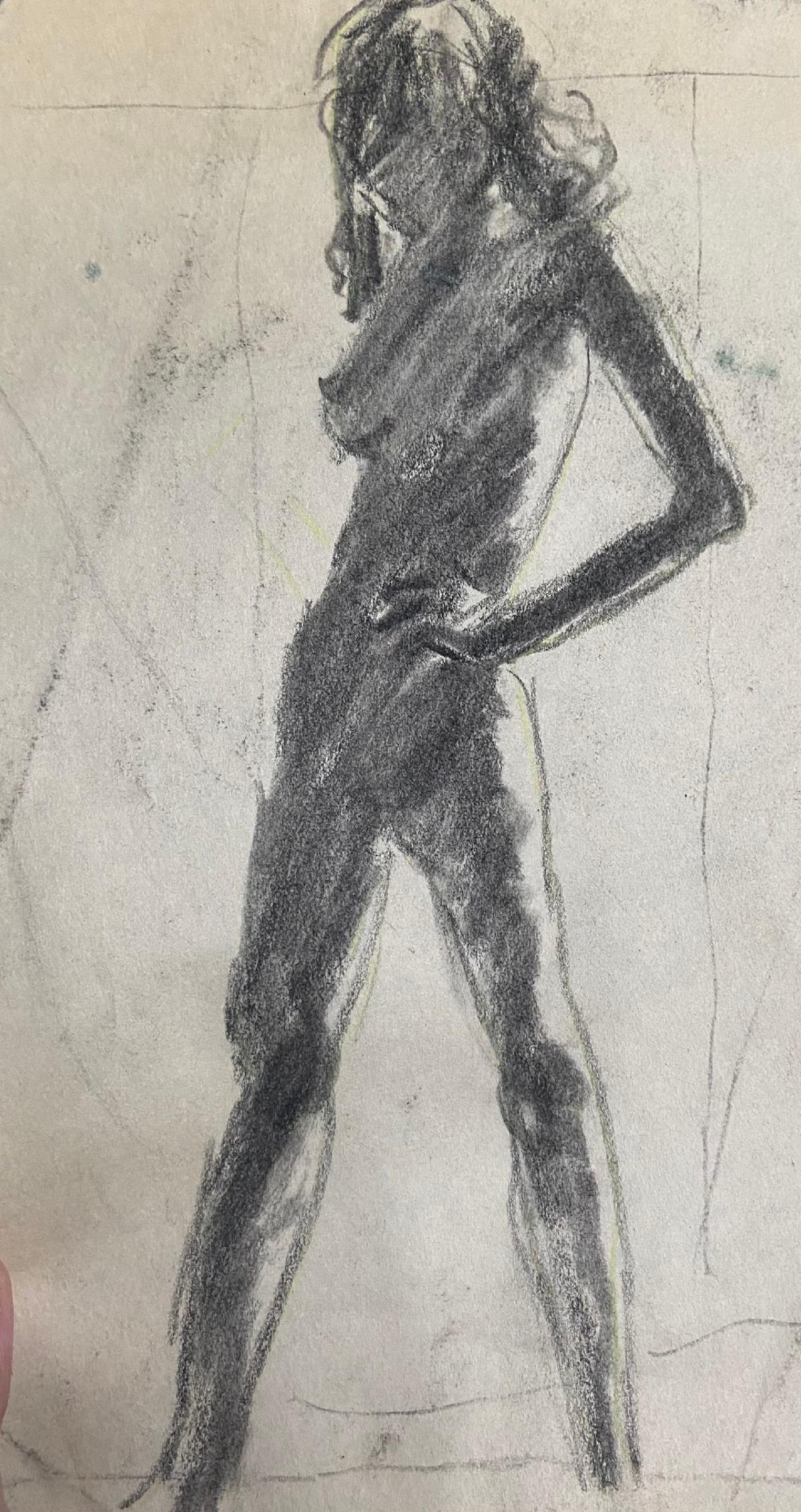
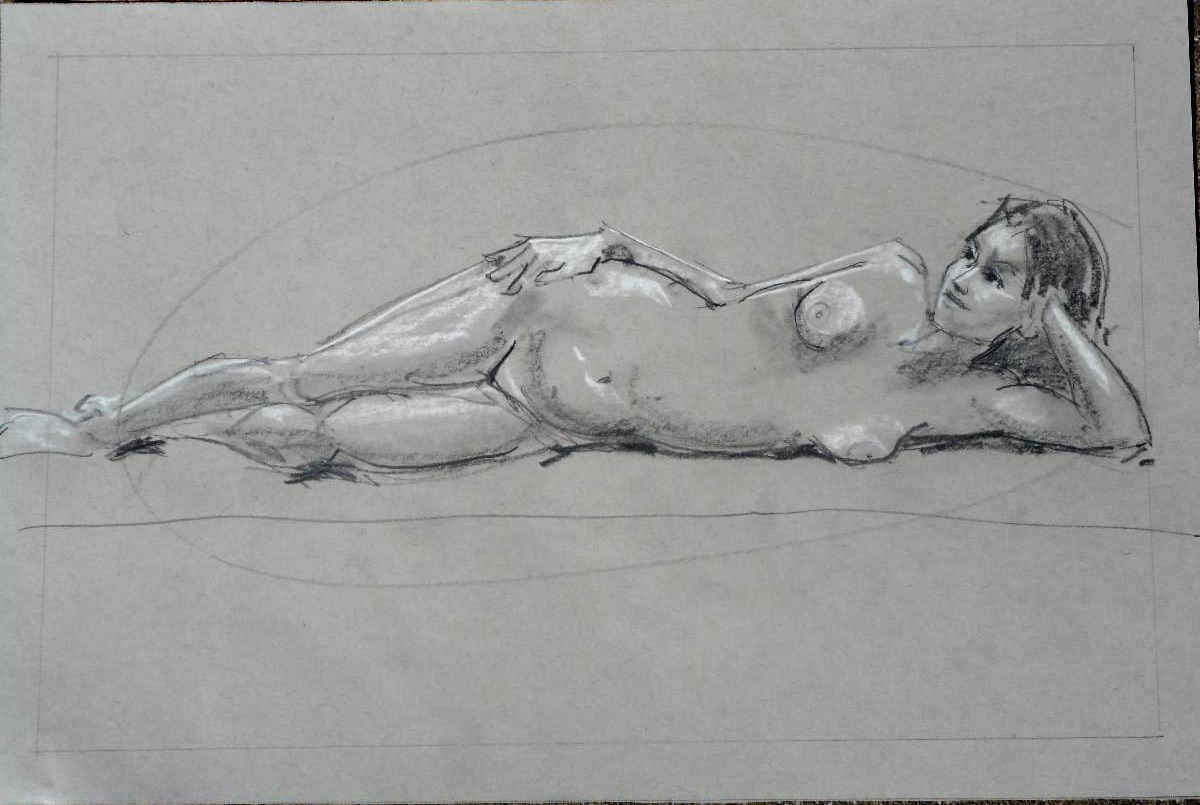
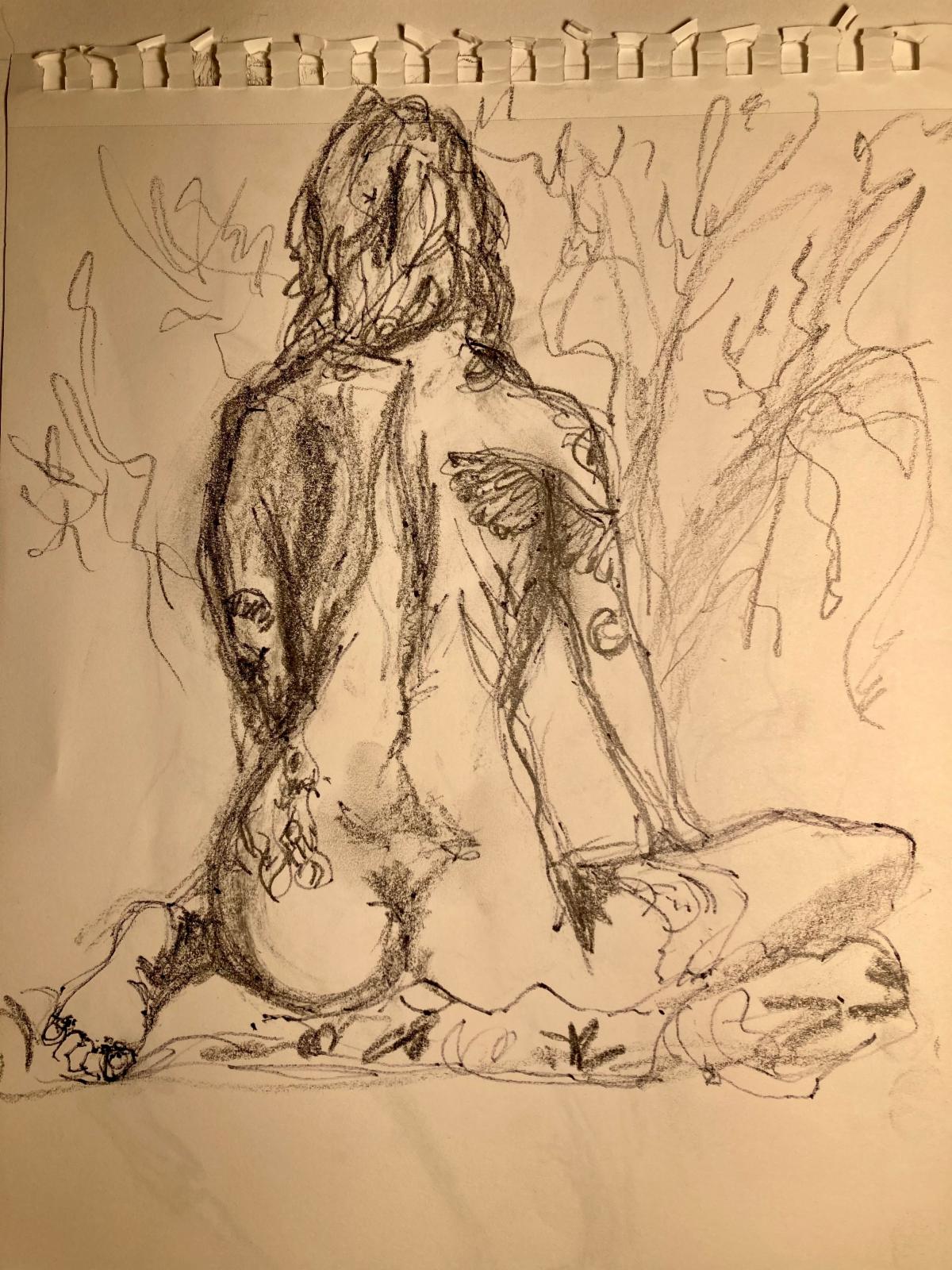
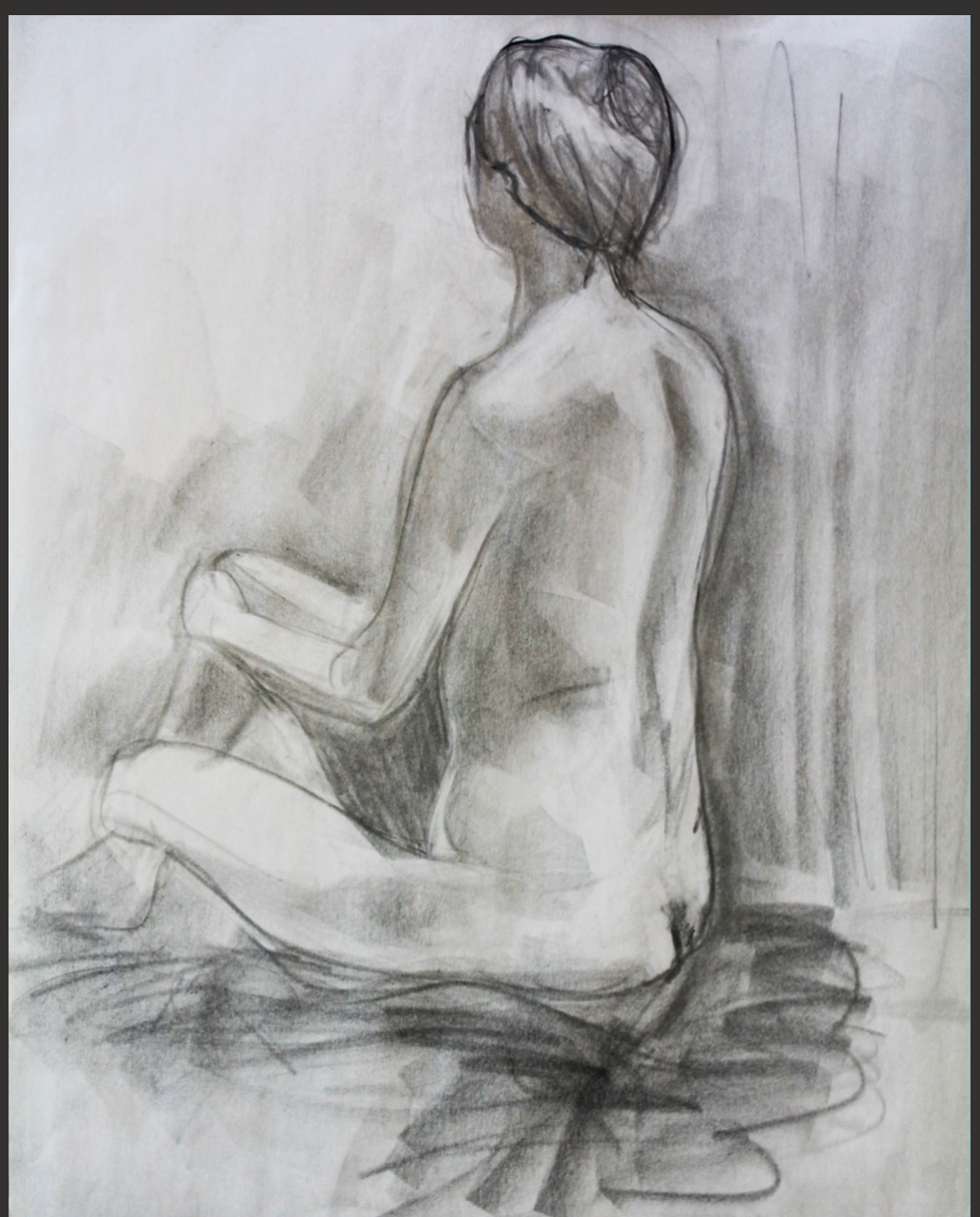
Mitchell, (above) Charcoal, 5 minute pose done in a CAC Figure Drawing Session, 2016
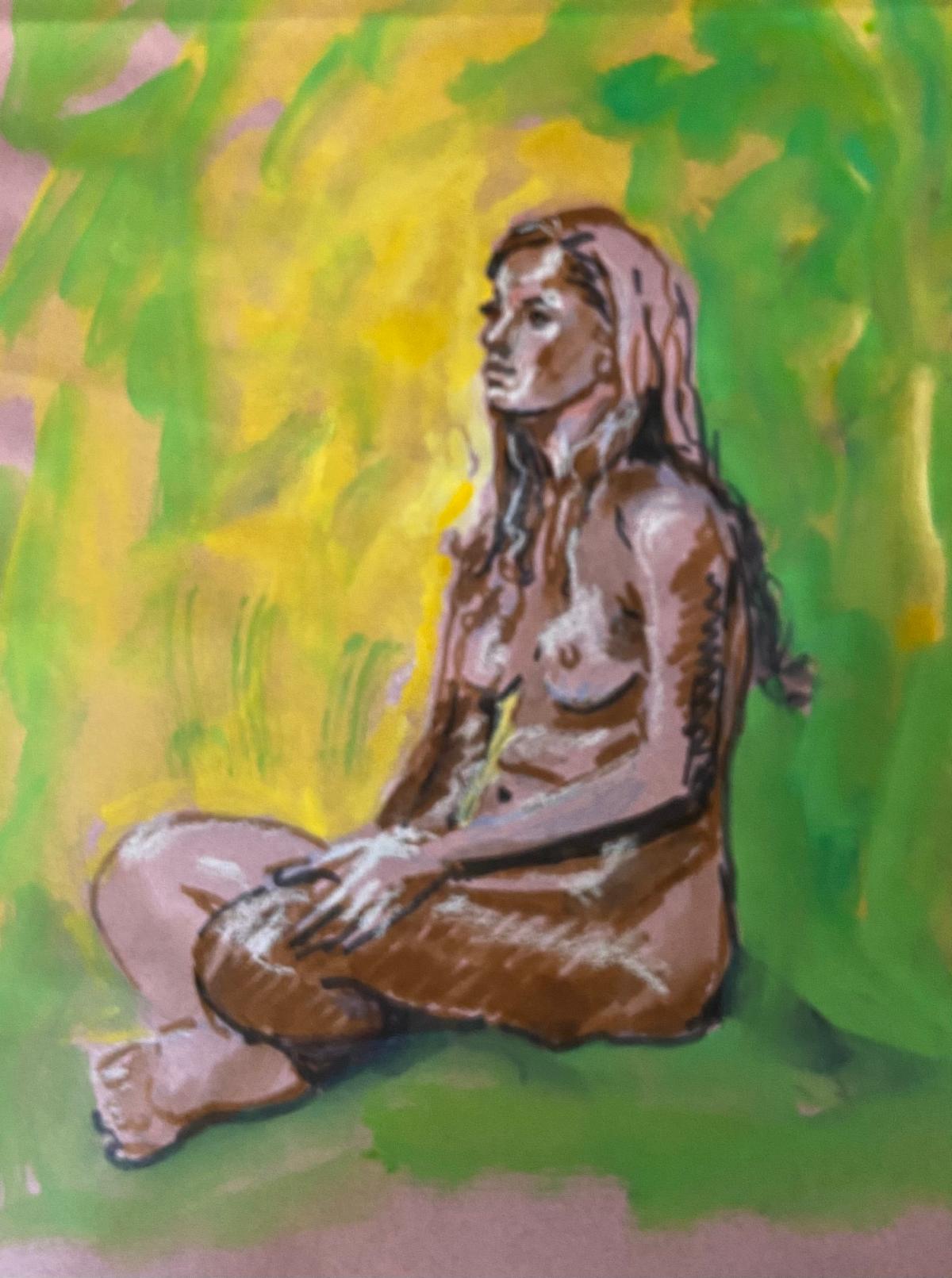
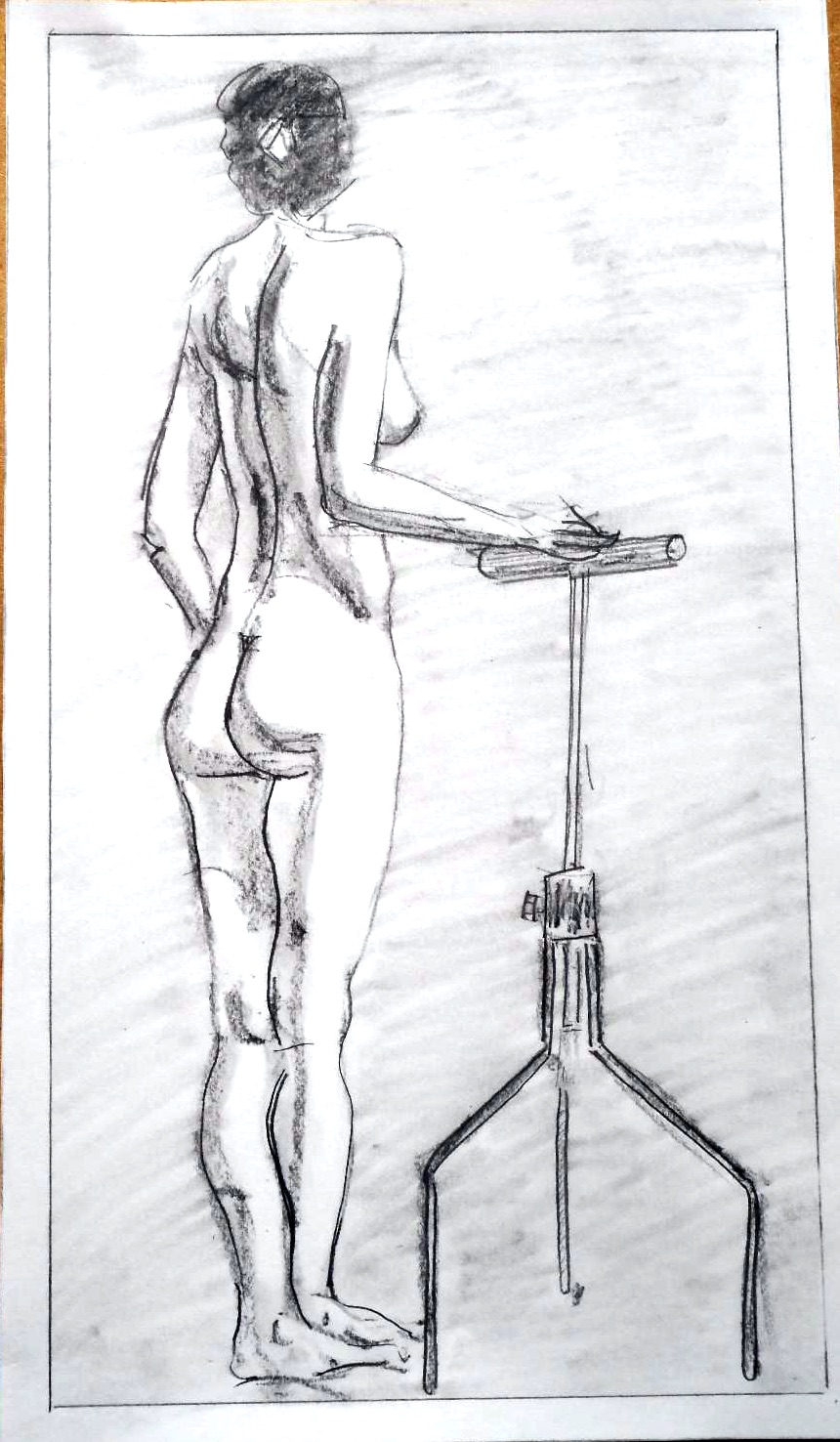
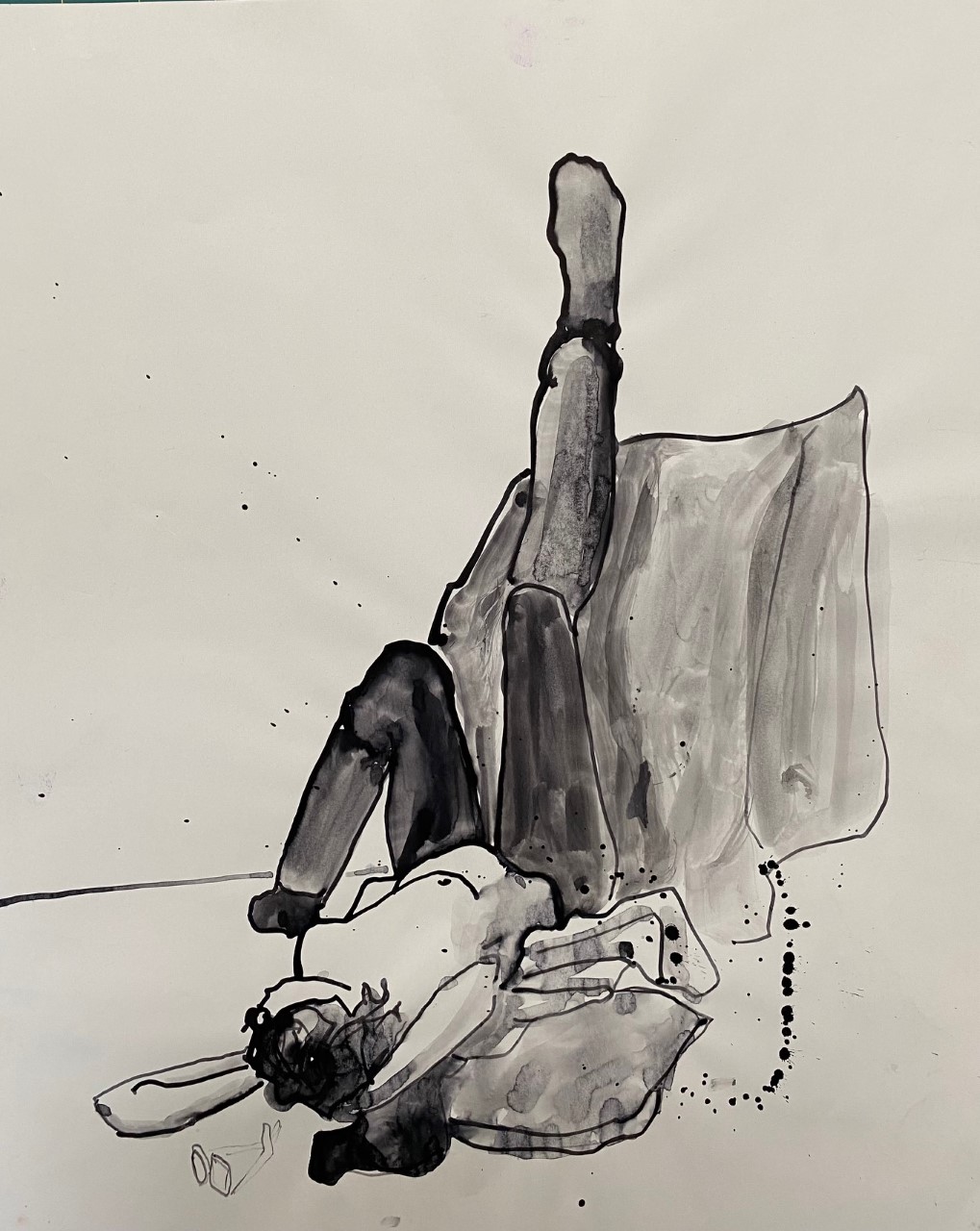
Mitchell, (right) water media, 30 minute pose in a CAC Figure Drawing session.
Before the pandemic, I attended a Chico Art Center Figure Drawing group. It was a welcoming atmosphere in which experienced sketchers gladly helped beginners.
I also took Sal Casa's CAC figure drawing workshop in which he demonstrated Renaissance techniques of starting with simple geometric forms and then modifying them in response to a model's specific physique.
| |
|
Sketching a model in a timed pose demands my utmost concentration and never gets easy. Although landscapes are my main subjects, figure drawing develops my hand and eye coordination and ability to focus intently on what I see. |
MARK GAILEY
Gailey states: “It looks as if work by both figure drawing and portrait groups will be shown in the CAC Art Gallery during the months of February. and March, 2023. In addition to viewing the art, visitors will have a chance to draw clothed models. In exchange for a donation to CAC, skilled artists will draw portraits of visitors that they can keep."
There is Chico Art Center figure drawing session on alternating Mondays from 9 am to noon: $15 for per session. A Portrait Group meets alternate Wednesdays from 1-4: $10.50 per session. For details: Mark Gailey
530.966.6316 (cell) mgailey7@yahoo.com
| |
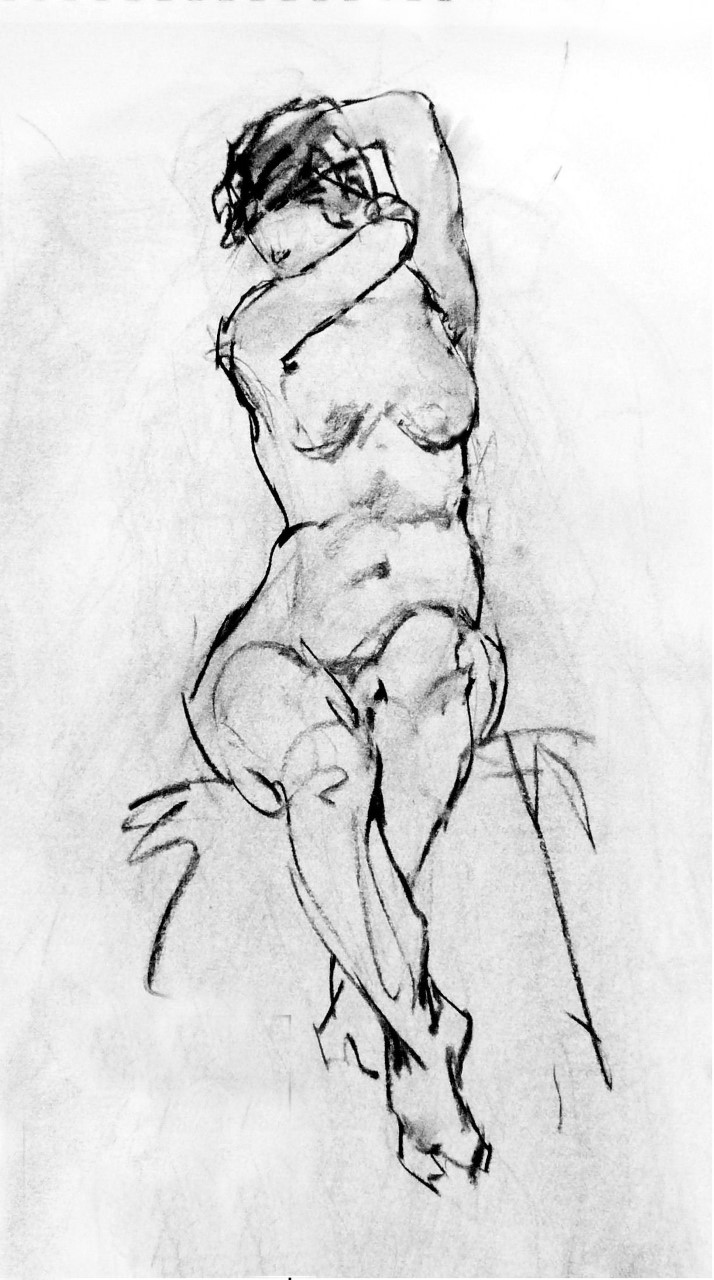
Gailey says: "Several years ago I started relying much more heavily on using measurement to try to ensure proper proportions in my figure drawings of longer poses (i.e., how many 'heads' are in the standing, sitting and reclining figure, etc.). | | |
| |
|
JIM SMYTH
CONCERNING LIFE DRAWING
Life drawing, drawing from the nude human figure, is the one universal exercise for any artist in any medium, “ism”, style or material. It exercises every aspect of the artist's mind, eye and muscle memory. No other single undertaking can do this. Drawing or painting still life teaches one to draw or paint pots, pans, bottles or flowers. Landscape teaches one to draw or paint in a manner that allows any sort of error in judgement. Put an extra tree in the field, an extra branch on the tree – nobody notices. But, put and extra head or arm on the figure and it becomes a problem.
| | |
|
"Life drawing allows the artist to practice abstracting patterns from nature, allows construction of value patterns and edge qualities with greater facility than any other artistic undertaking. Therefore, the abstract artist, the representational artist or a “classical” artist all benefit from life drawing. That is the reason it has been the most popular exercise for artists for over 5 centuries."
| |
|
"My statement is based on 45 years of life drawing. I have done over 250,000 drawings from the figure in those years."
MARIE ALTMAN
| |
Marie says: “I've been to three figure drawing sessions so far. I haven't drawn since Sal Casa’s class at Chico State 45 years ago. I felt emotional and happy remembering how I loved figure drawing and portraiture back then." | |
|
"I like playing and don’t want to let myself get hung up on being perfect because it takes away from the enjoyment.”
-----------------
TONY SLOCUM
Drawing as Therapy
"I love to draw and then I could not. In 2006 I had a stroke. My fine motor control on my right side stopped working."
| |
|
TONY SLOCUM, Figure 1.
"I knew the physical therapist assigned to me. He knew I liked to draw. He said I was lucky that my stroke was mild. I should regain most of what I lost. He recommended that the best thing I could do now was to continue to draw. As soon as I got home, I went to the CAC figure drawing session. Figure 1 (above) is my first drawing after my stroke."
| |
"Figure 2 (above) is my drawing now. Drawing has been a therapy in many ways. It has helped me overcome my physical deficits. More important it has given me a way to continue something I really enjoy." | | |
|
ARTHUR LEMNER
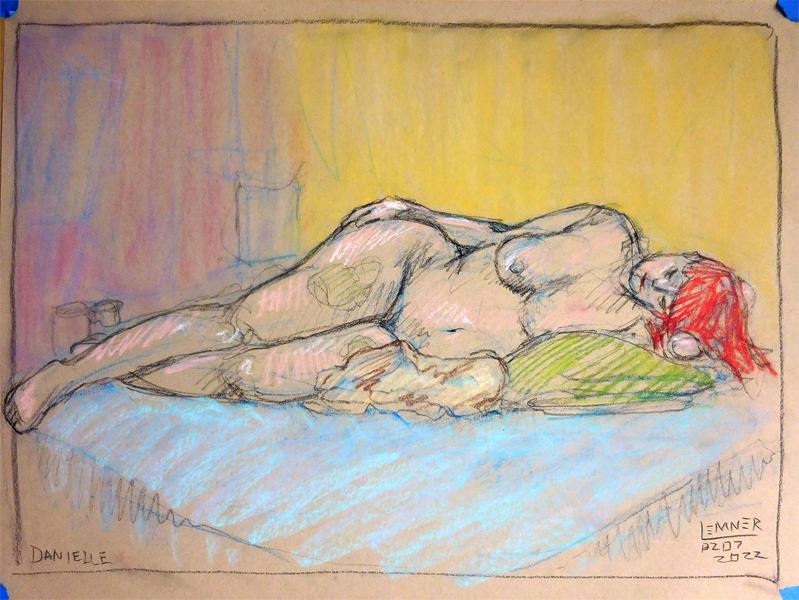
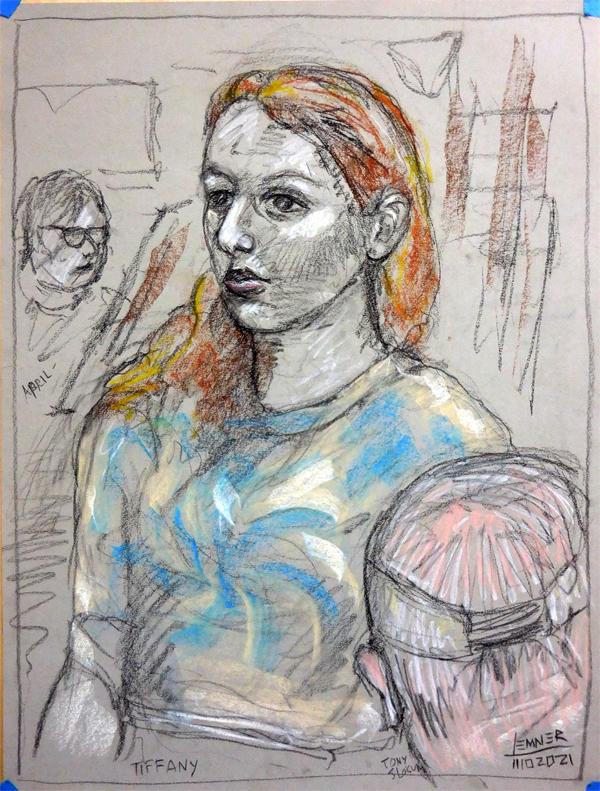
"Drawing and creating artworks for myself and for Art Shows is a passion of mine. For decades I have attended CSUC’s “Drawing from Life,” Butte College’s Figure Drawing sessions, and Chico Art Center’s Figure and Portrait Drawing workshops."
| |
"Because of family responsibilities, having time and energy for art is a challenge. I also have a visual impairment with only one eye that sees double. I choose to maintain what skills I have by challenging myself with the most delicate and difficult of all areas of artistic expression: that of human portrait and figure study." | |
|
RICK VERTOLI
“I like to start my drawing with a big block of XL graphite (05 Soft). This allows me to quickly find the dark tones in the pose. This material really makes a huge mess, which I like. I have graphite all over my hands, my face and the easel. I feel hopelessly into the drawing and need to somehow find my way out.
| |
|
"I then take a kneaded eraser and start to bring out the lights in the drawing. This give and take of lights and darks, is a very painterly approach to the drawing, which is where I feel most comfortable. Next, I start adding lines with a “peel & sketch” charcoal or a China Marker or hard piece of graphite. I wouldn’t say it’s manic, but it is very intense, as I bounce between materials, looking for form, rhythm, relationship of shape, and the underlying story of the pose."
| | |
| |
|
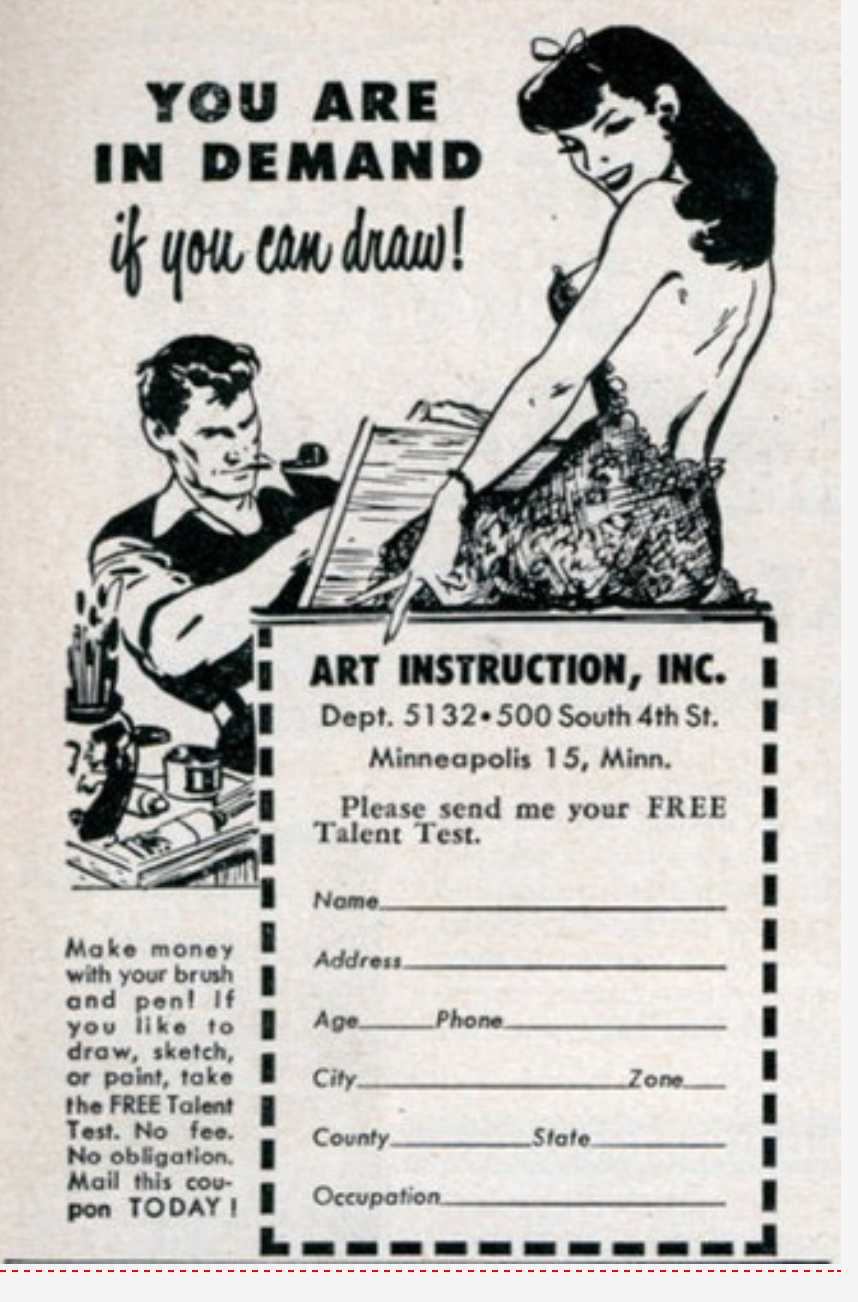
“You are in Demand if you can draw” is typical of magazine ads of The Sixties for art correspondence courses. It shows a male artist, smoking a pipe and drawing a flirtatious model whose gown looks ready to slip from her body.
To a degree these stereotypes persist, although they are being challenged by some artists, art historians and models.
| | |
|
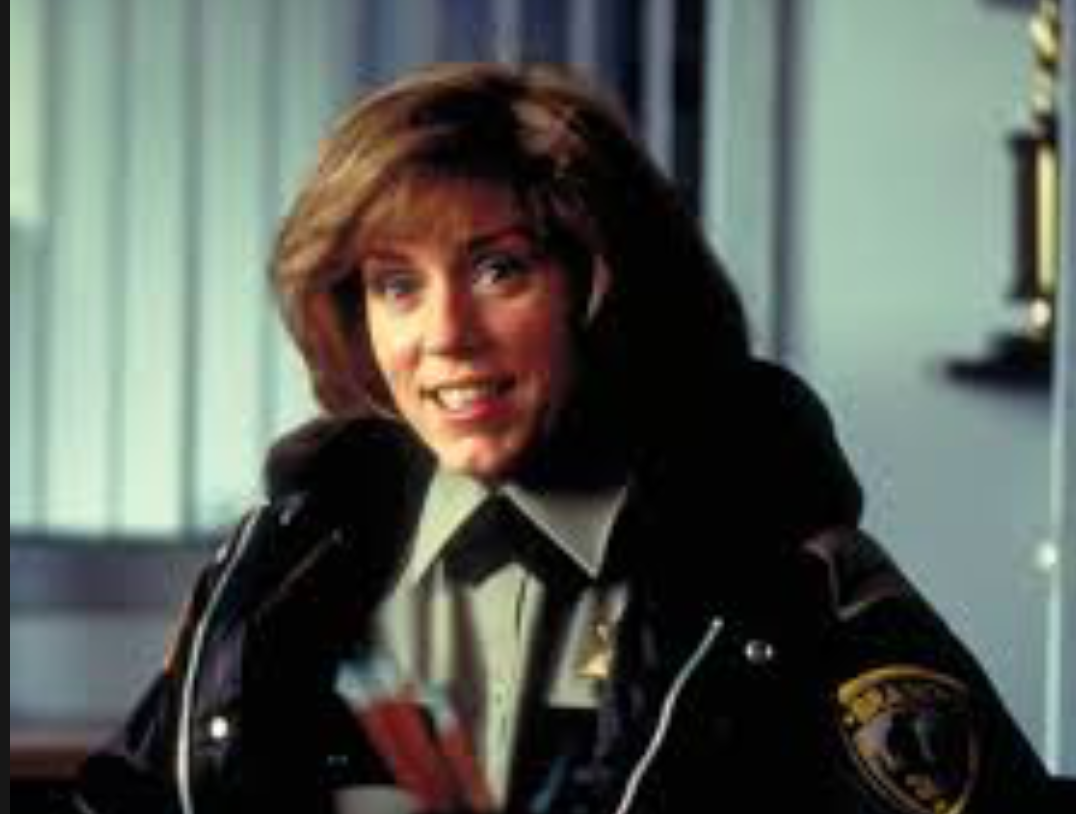
Frances McDormand, still photograph from Fargo
Would Fargo, directed by the Coen Brothers, have been such a hit without McDormand? The contributions of actresses has been acknowleged since early days of cinema, but the impact of models on paintings has only recently been given serious consideration, as in Drema Drudge’s just published novel Victorine, about the life of Edouard Manet's favorite model.
| | |
|
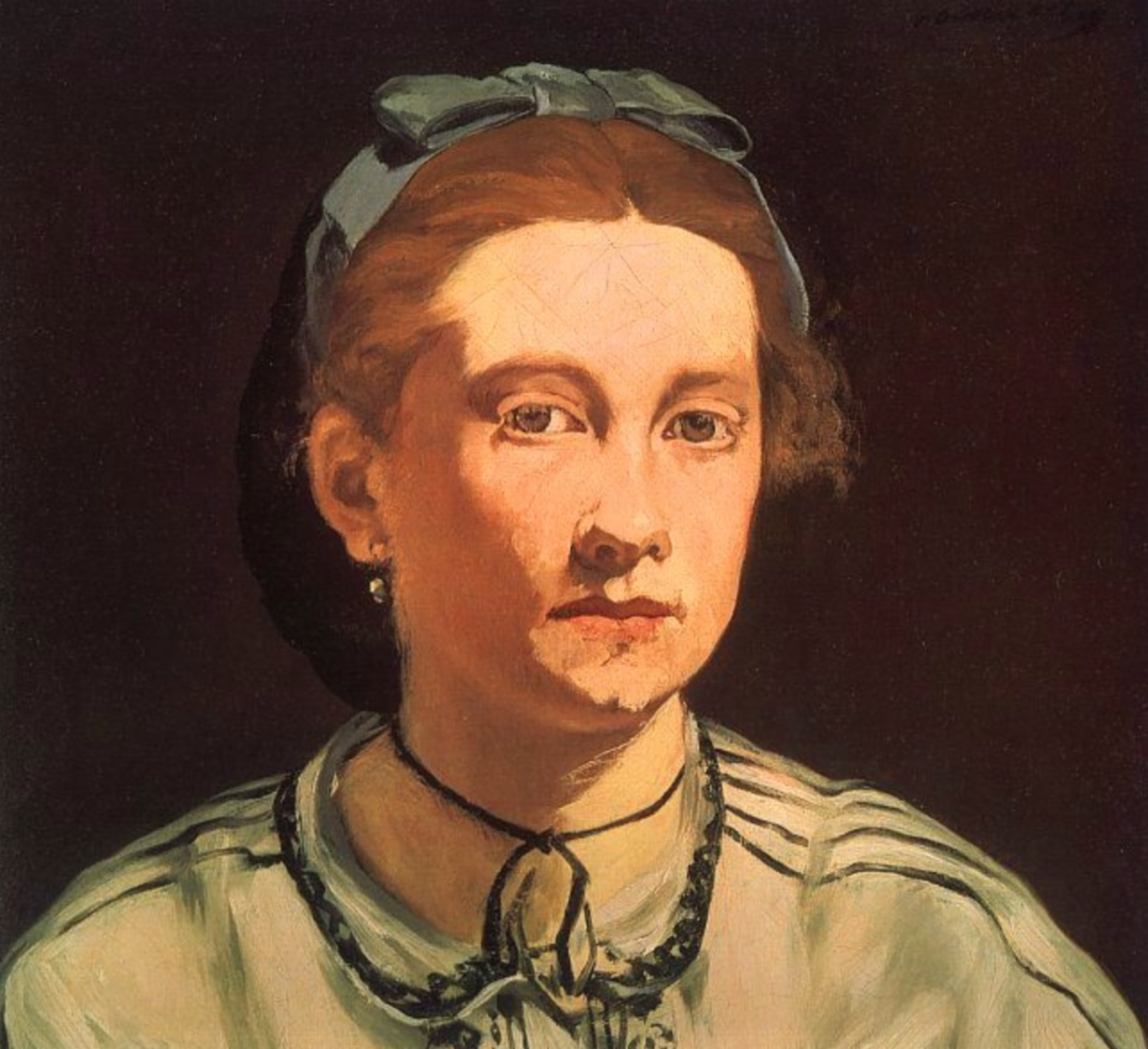
Edouard Manet, "Portrait of Victorine Meurent," 1860, at age l8
As a teenager, Victorine Meurent emerged from poverty and joined Parisian art circles She was already an experienced model when, at l8, she posed for this portrait by Manet. At a time when “respectable women” avoided looking men in the eyes, Victorine's gaze is unflinching.
| | |
|
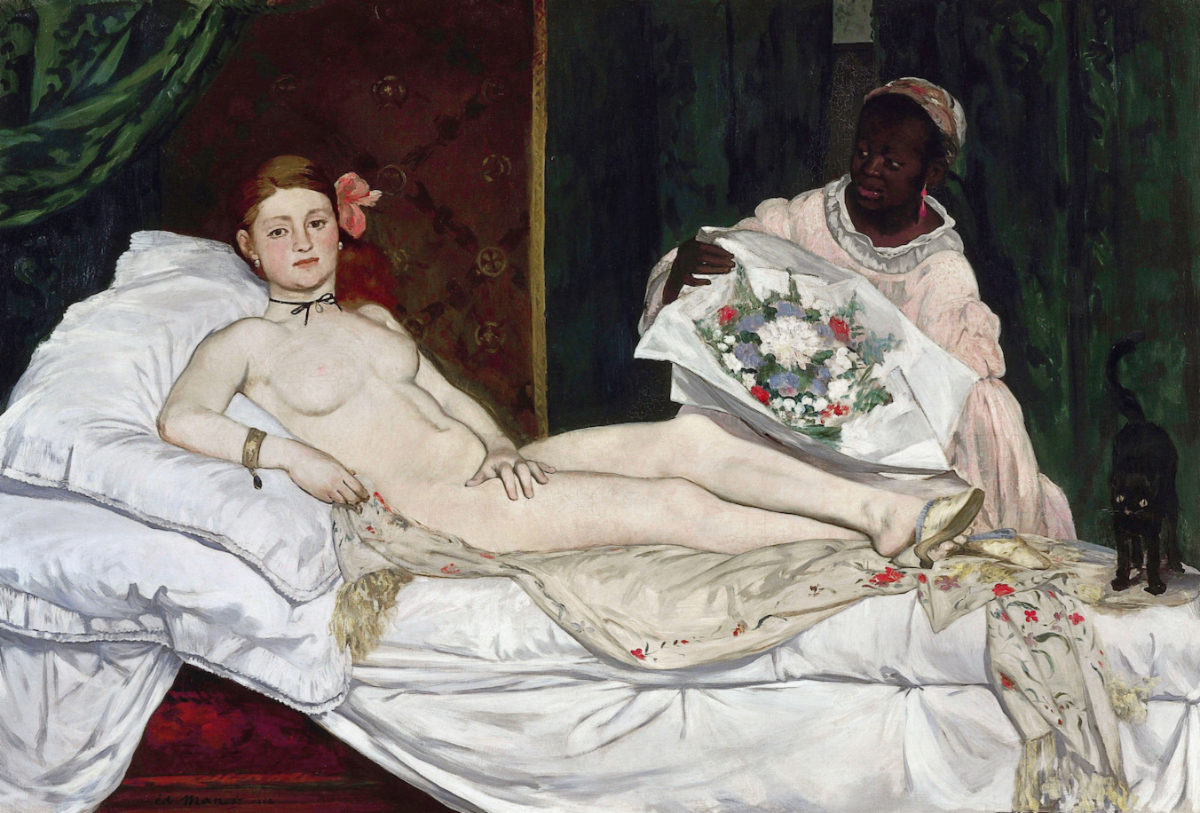
Edouard Manet, "Olympia," 1863, Victorine Meurent was the model
Would Manet’s “Olympia” have created such a scandal if a different model with a less confrontational gaze had posed for the painting? Can "Olympia" be thought of as a collabortion between artist and model with Victorine, through her pose, attitude and expression, providing Manet with such a memorable subject?
Victorine learned to sketch and paint while modeling; portraits by her were accepted by the Paris Salon..
In the following esay, Michaela Harris describes her experiences modelling for the CAC Figure Drawing group.
| | |
|
Michaela Harris
Figure modeling is an activity that has captivated me since my teens. I romanticized the idea of being on the same level as people immortalized in classic and baroque paintings despite only being a struggling college student. I finally found a modeling opportunity that worked with my schedule from a job listing in the aptly named cafe, Naked Lounge.
Mark Gailey from the Chico Art Center responded to my inquiry within a day. A long, detailed email quelled any leftover curiosity or precaution I had about modeling. I would pose for a small, experienced group who joined via referral or invite. The poses must be dynamic, but the model’s comfort is top priority. Discretion and professionalism are the core values of this group.
Figure sessions start by taking my place on a plush platform and striking my first pose. For the first batch of poses, I tend to fall back into old ballet positions from my days as a dancer. The early parts of the session are for short term poses and warm-up drawings. More complex poses are easier to hold during this section. Two minutes eventually become five and 15 and 30, and I cringe when parts of my body inevitably go numb. But the payoff is beautiful.
My sessions with Mark and his group have been quiet and thoughtful experiences. After the first few poses, the thrill of being nude dies down slightly, and the remaining time becomes meditative. Your gaze is often fixed to one point for hours on end. Having the opportunity to clear your mind while participating in art is truly freeing.
The breaks in between each section allow me to see the artists’ progress. It’s liberating to see your natural self depicted with such care. The empowering aspects of this job come from feeling the body in a neutral state. The gaze models are held under is one of artistic merit. There are no other bodies or standards of beauty to compare in this field. We are subjects of art, not objects of desire.
A longer version of this article appeared in The Orion, the CSUC student paper. Michaela has now graduated and has started a job as a reporter.
PORTRAITS
| | |
|
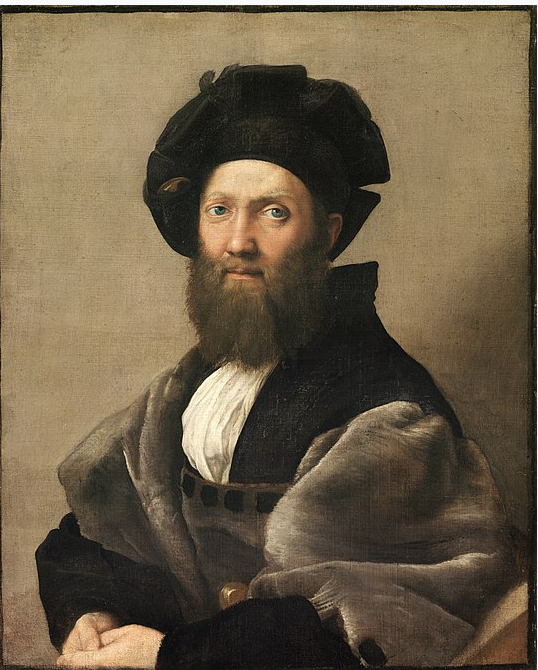
Raphael, “Baldassare Castiglione,” oil, 1514
A frontal position is typical for portraits in Western art. To avoid stiffness, Raphael has given Castiglione's torso a slight twist away from frontality.
| | |
|
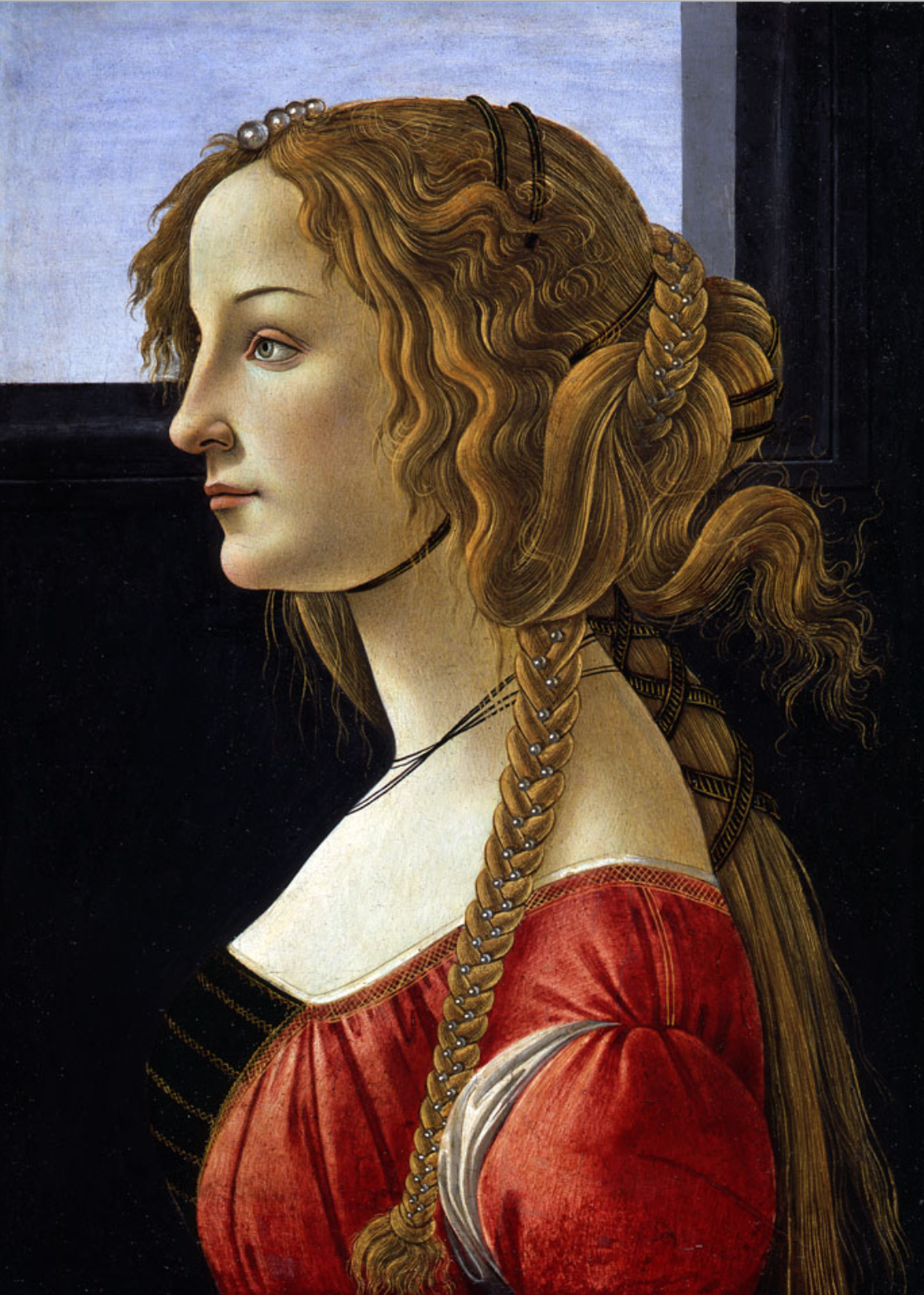
Sandro Botticelli, “Portrait of a Woman,” 1475
Second in popularity, the Italian Renaissance profile portrait derives from classical coins. Since frontal and profile views are easily remembered they have become standard for “mug shots."
| | |
|
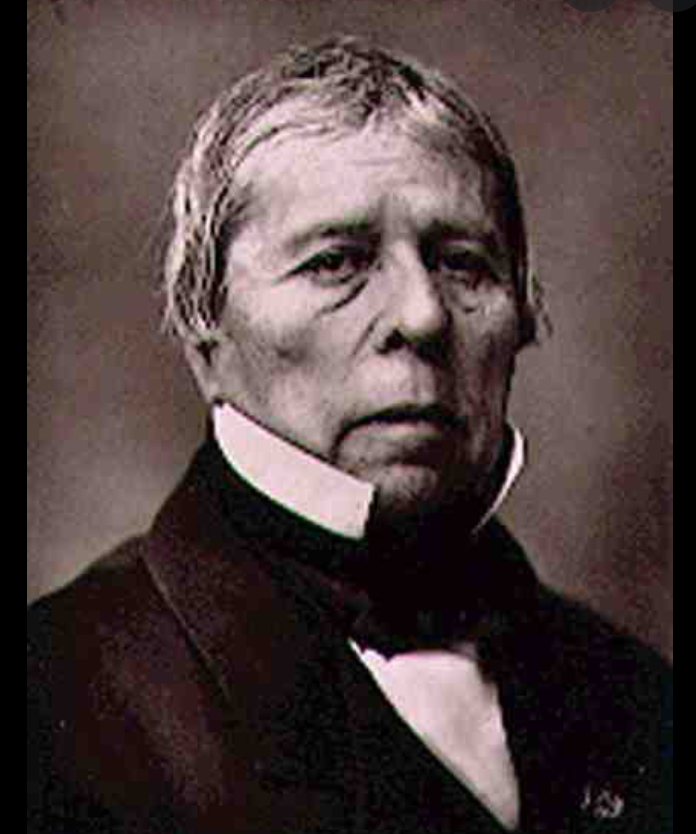
J.D. Ingres, Photograph, French Neoclassical artist, at age 78.
The camera has recorded Ingres at age 78 with a wrinkled forehead, squinting eyes and sunken cheeks
| | |
|
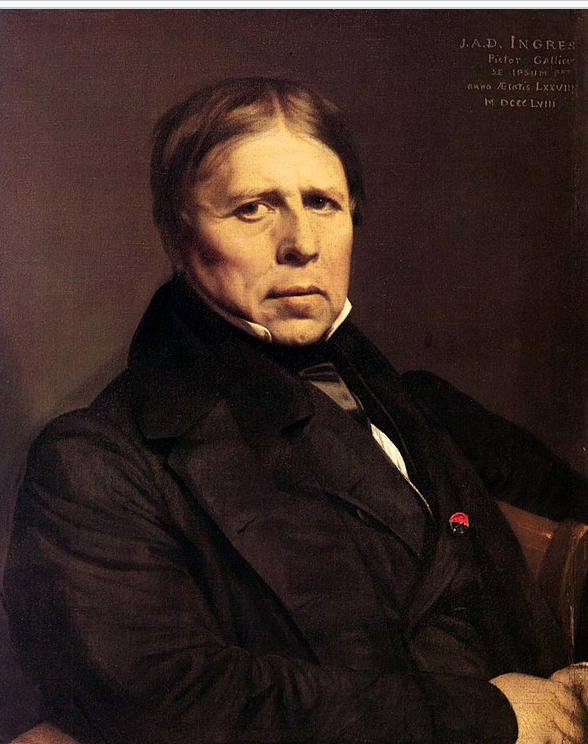
J.D. Ingres, “Self-Portrait at 78.”
When painting his self-portrait at 78 Ingres had complete freedom to show himself as he preferred to be seen. He has give himself larger, wide-open eyes (as befits a master of observation), firm cheeks, and a high-forehead that alludes to his brain-power.
| | |
|
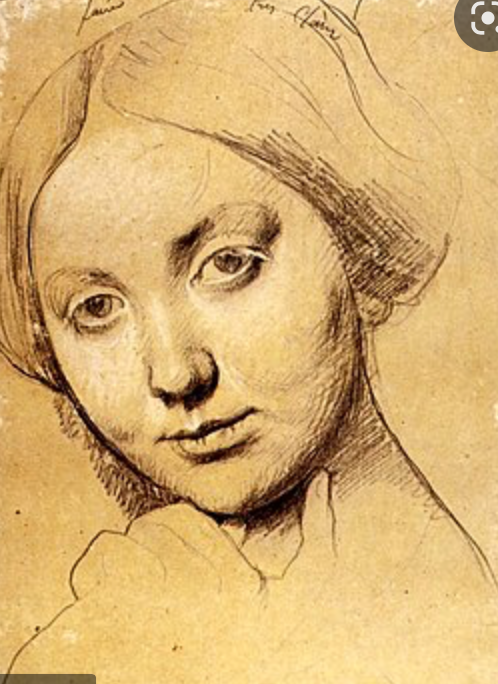
J. D. Ingres, "Comtesse d’Haussonville head study.," l845 graphite and chalk on cream paper
Looking at this head study is like eavesdropping on an intimate conversation between artist and model. Her eyes suggest interest in Ingres as he draws her, and there’s a fleeting flirtatiousness in the upturned corners of her mouth.
| | |
|
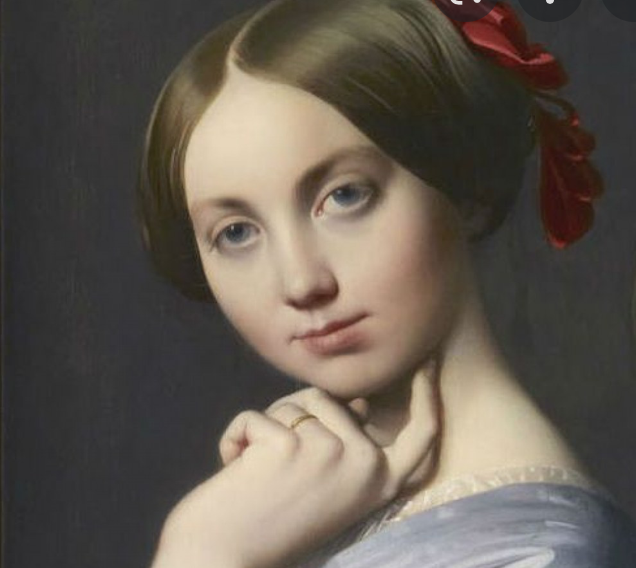
Detail of Ingres’ “Comtesse d’Houssonville,” oil, 1845
In his commissioned portrait, Ingres represents the Comtesse's aristocratic social persona. The formal painting has a less ephemeral, more detached feeling than the sketch. Ingres has emphasized geometry and symmetry in her oval face; her nose is straighter, her nostril less fleshy, the central parting in her hair more prominent. The look of an approachable woman with unique features and personality in the sketch has given way to the ideal, remote beauty of a Raphael Madonna in the painting.
| | |
|
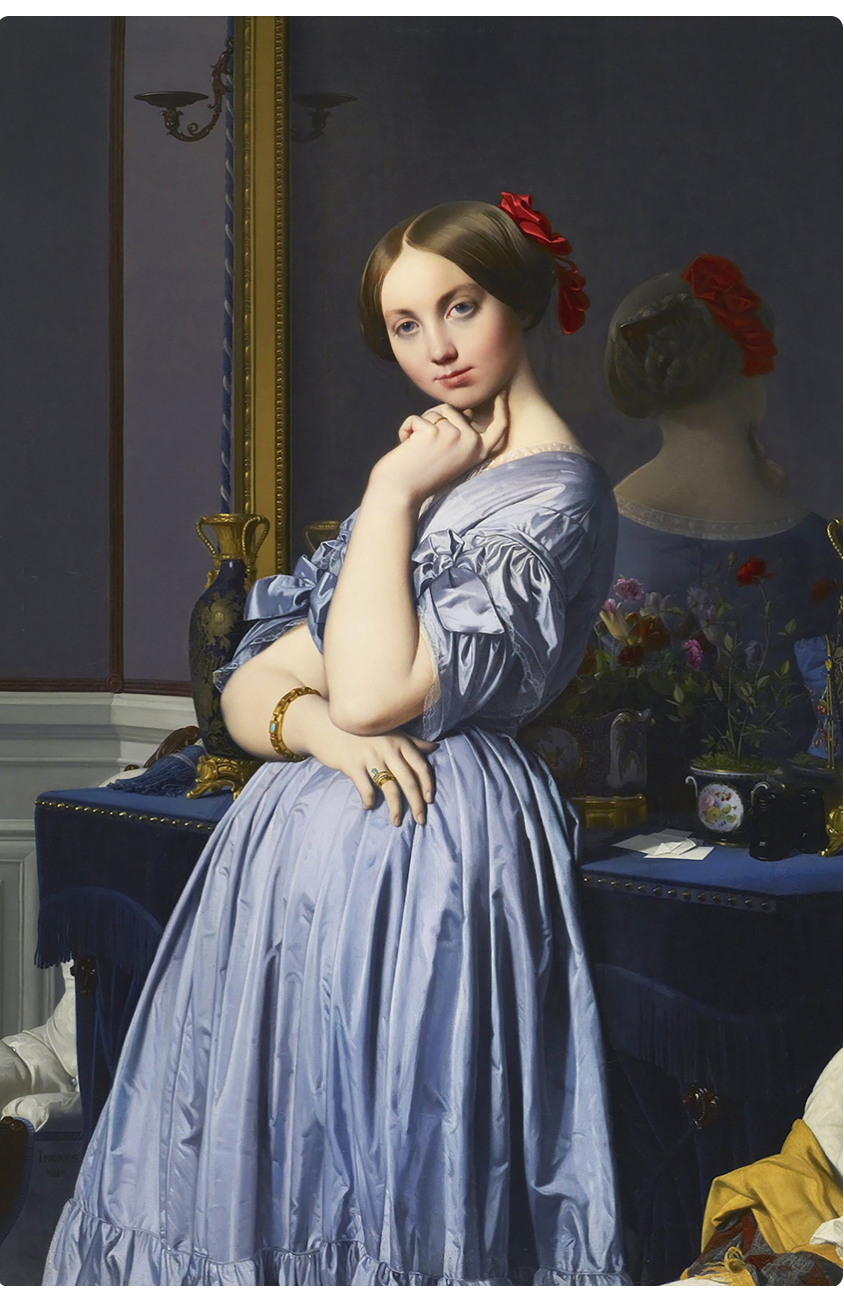
Ingres, in his portrait of the Comtesse, includes evidence of wealth in the room’s furnishings and in her fashionable gown and jewelry. Writing implements establish that she is educated and maintains social connections through correspondence.
(right) Ingres, “Comtesse d’Houssonville,” oil, 1845
| | |
| |
|
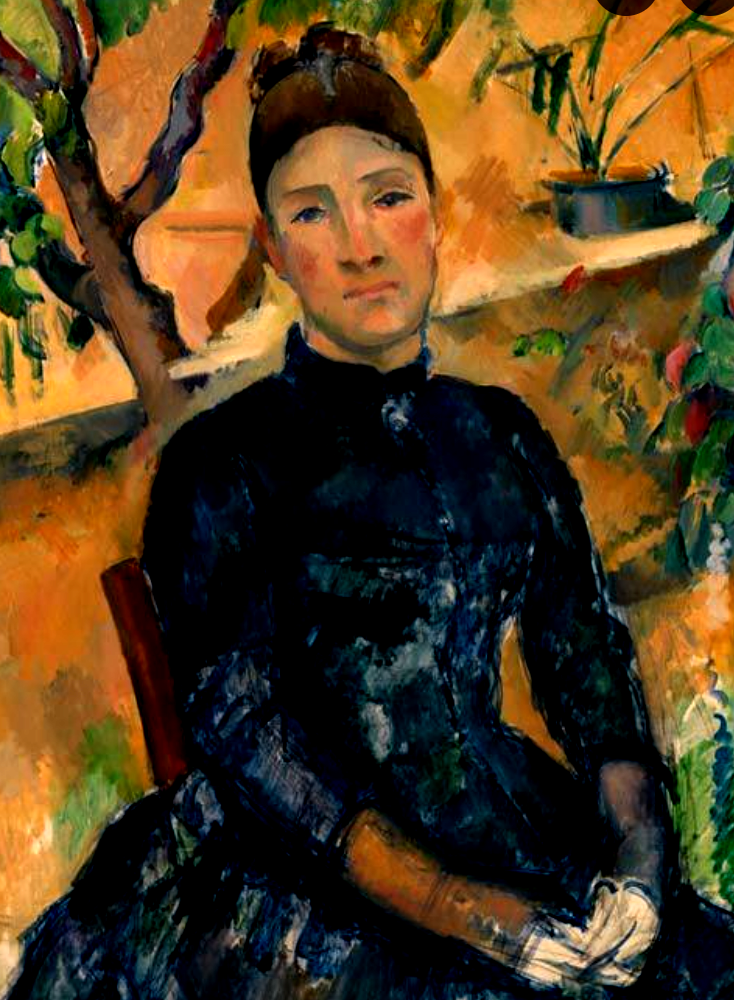
Renaissance inspired use of geometry in figure drawing and painting persisted in the nineteenth century. In 1904, Paul Cézanne wrote: “Everything in nature is formed upon the sphere, the cone, and the cylinder. One must learn to paint these simple figures and then one can do all that he may wish.”
(right)
Paul Cézanne, Portrait of His Wife
| | |
| |
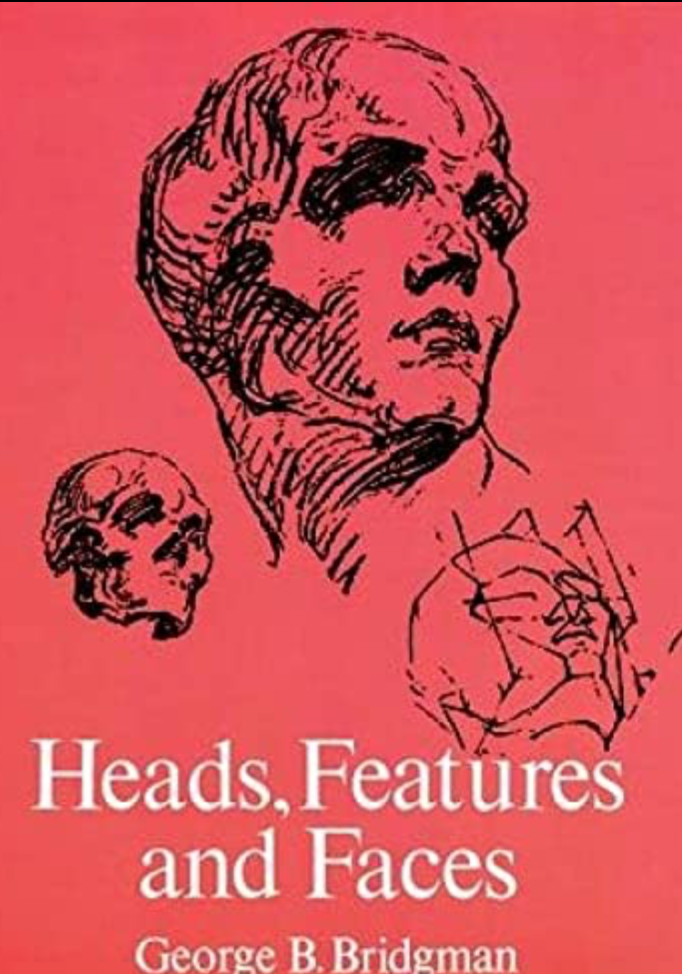
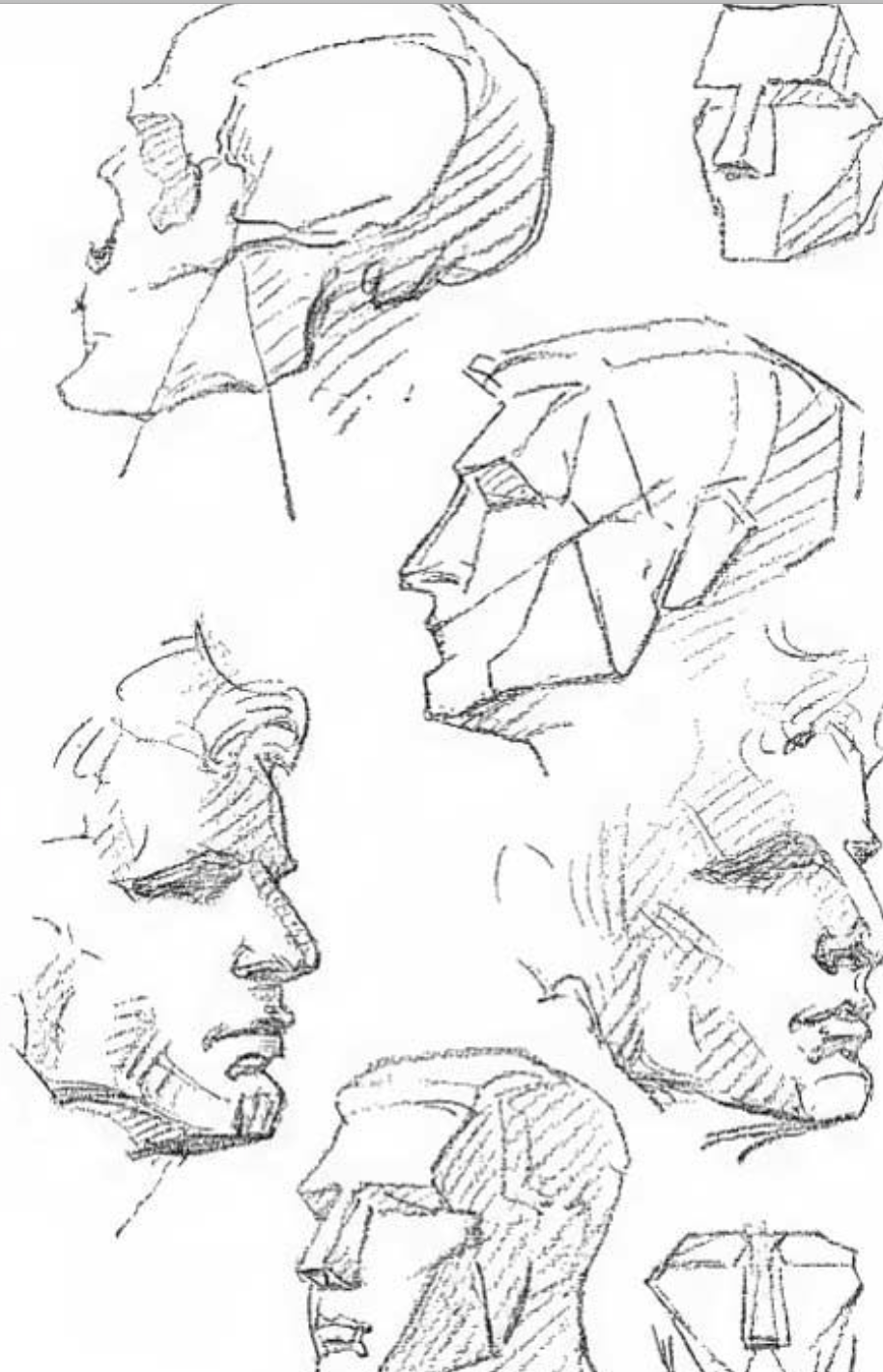
Bridgman has also published manuals on the head. Note the rectangles that enclose the head to the right, and the skull in the lower left. Geometry plus in-depth anatomy--that's so like Leonardo. | | |
Bridgman's manual on heads contains geometric diagrams of proportions and facial planes. In your mind, visualize the "block" from which the central lowest head might have been chiseled .
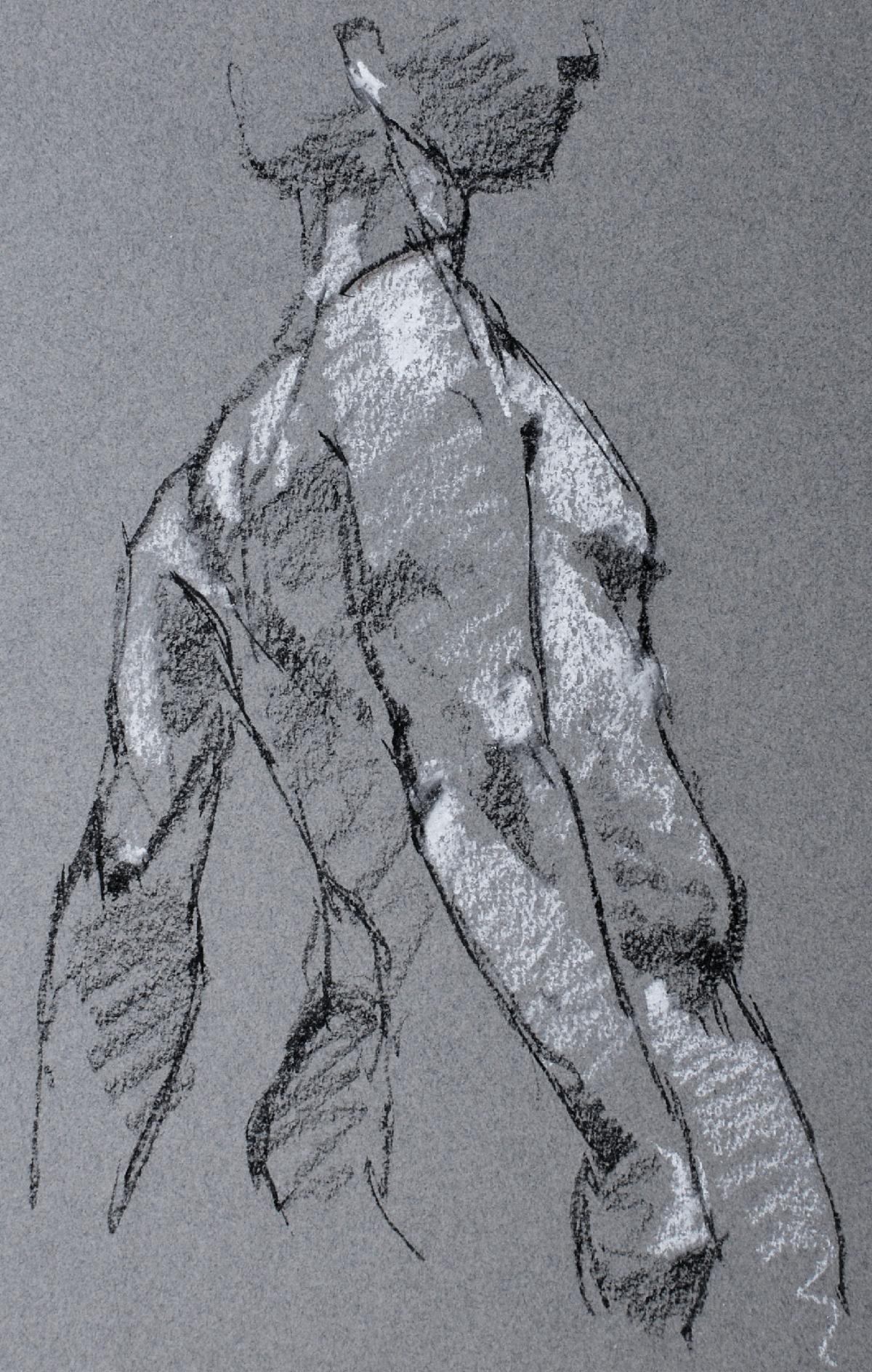
Sal Casa, in his CAC Figure Drawing workshops, often drew charcoal sketches of planes in a model's head and torso.
| | |
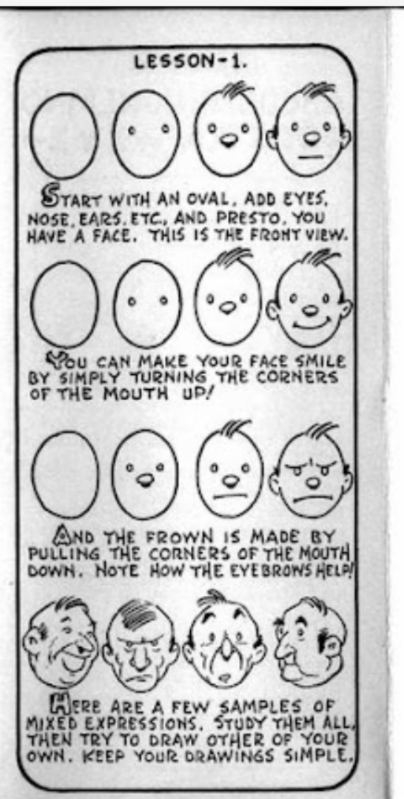
This illustration is from a different “How to Draw Faces” manual that simplifies Bridgman to an extreme degree while using the same principles. | | |
MARK GAILEY
Mark Gailey coordinates the figure sketching and portrait groups
Mark says: "It is such a luxury to draw a model who is holding a motionless pose for an extended period of time. Trying to draw portraits on the fly (i.e., in coffee shops, at airports, etc.) demands a great amount of focus and a excellent photographic memory.
| |
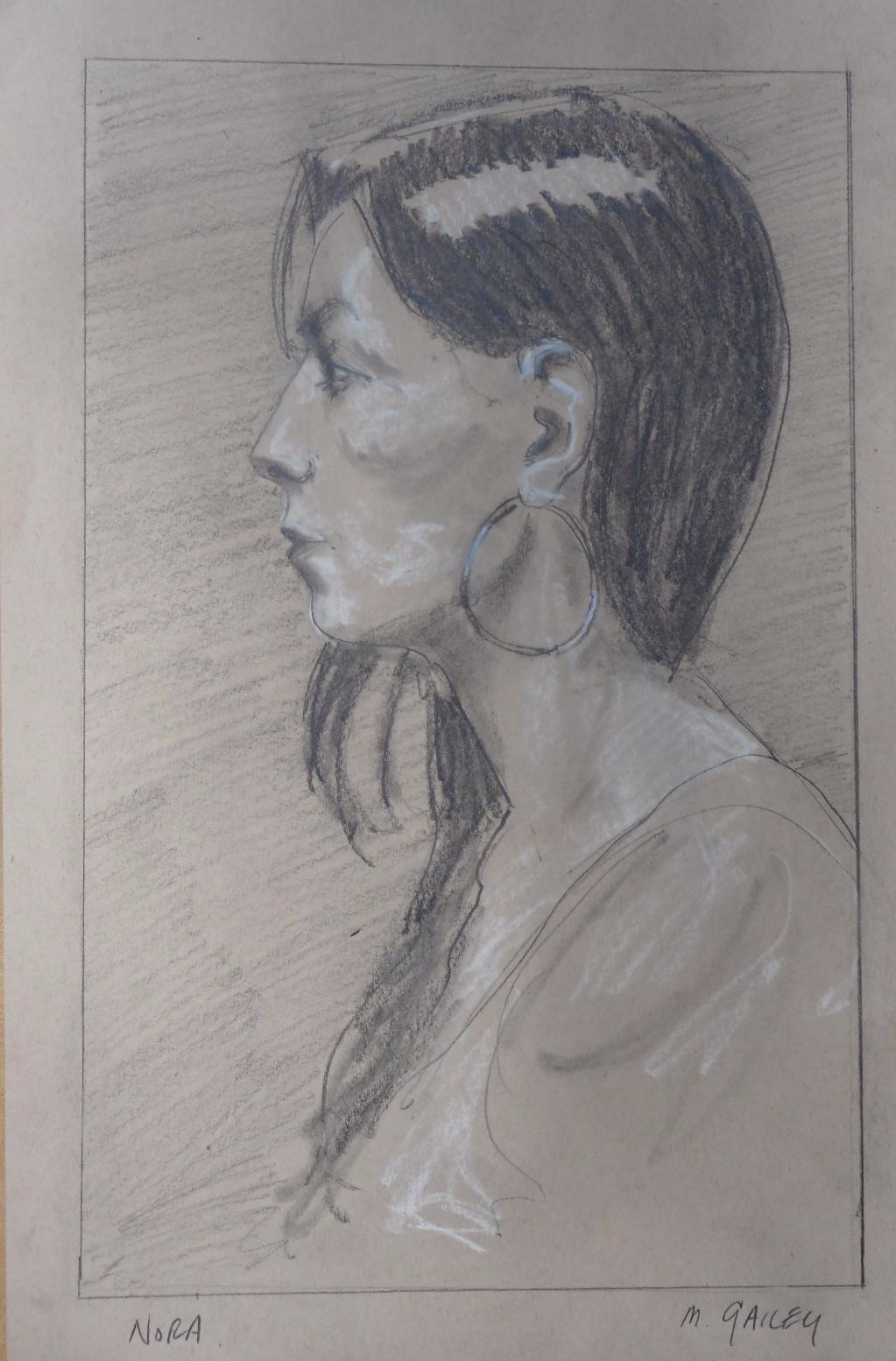
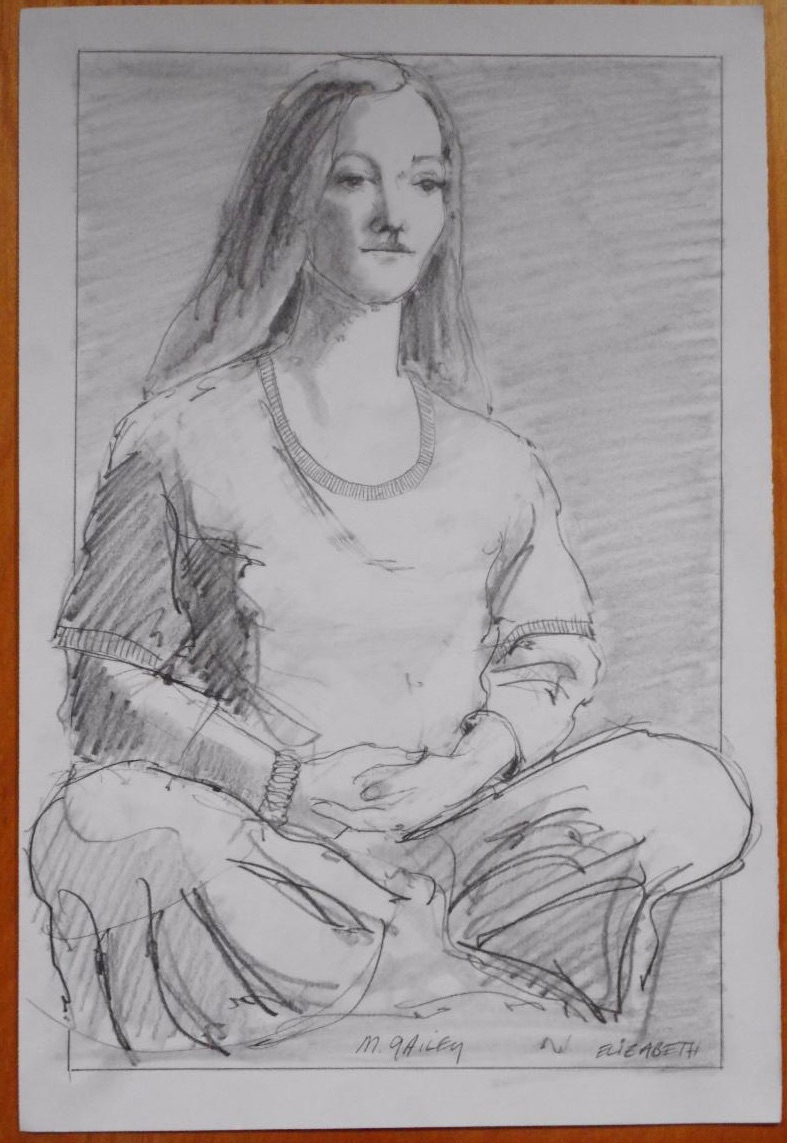
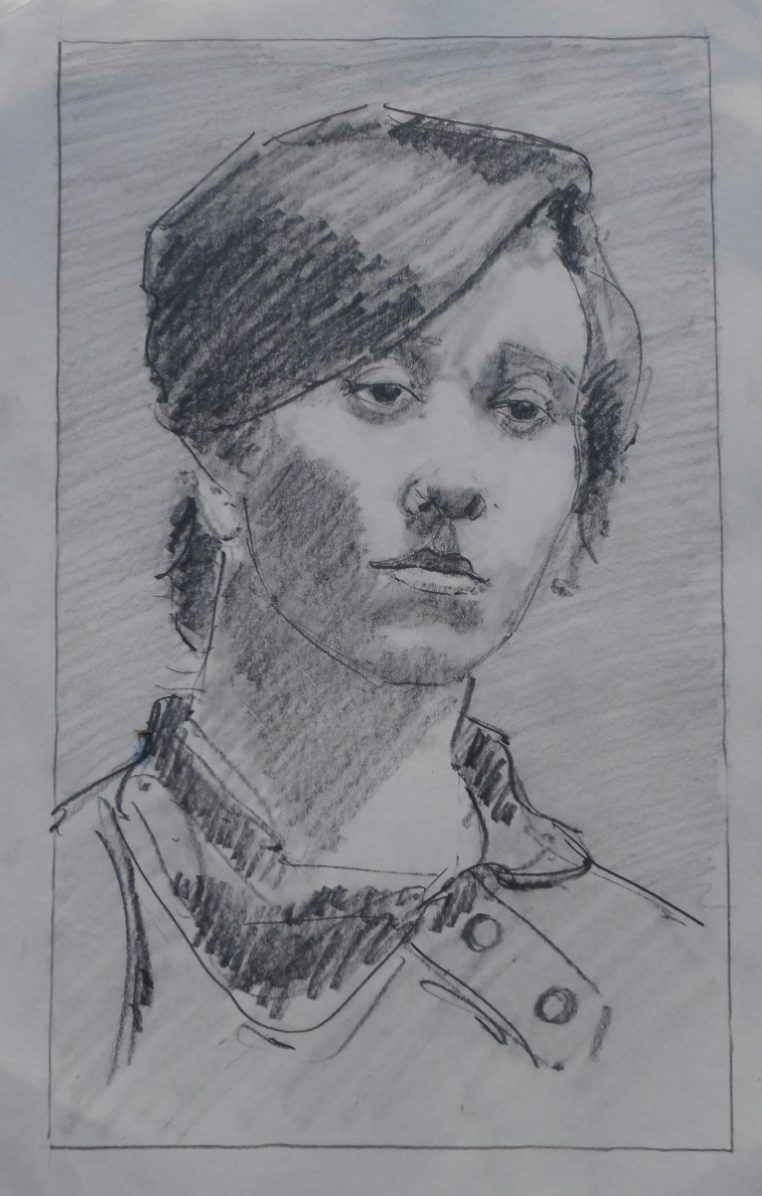
This is Mark Gailey’s portrait of Michaela Harris who wrote the Orion article about her modeling experience for the CAC Figure Drawing group. | |
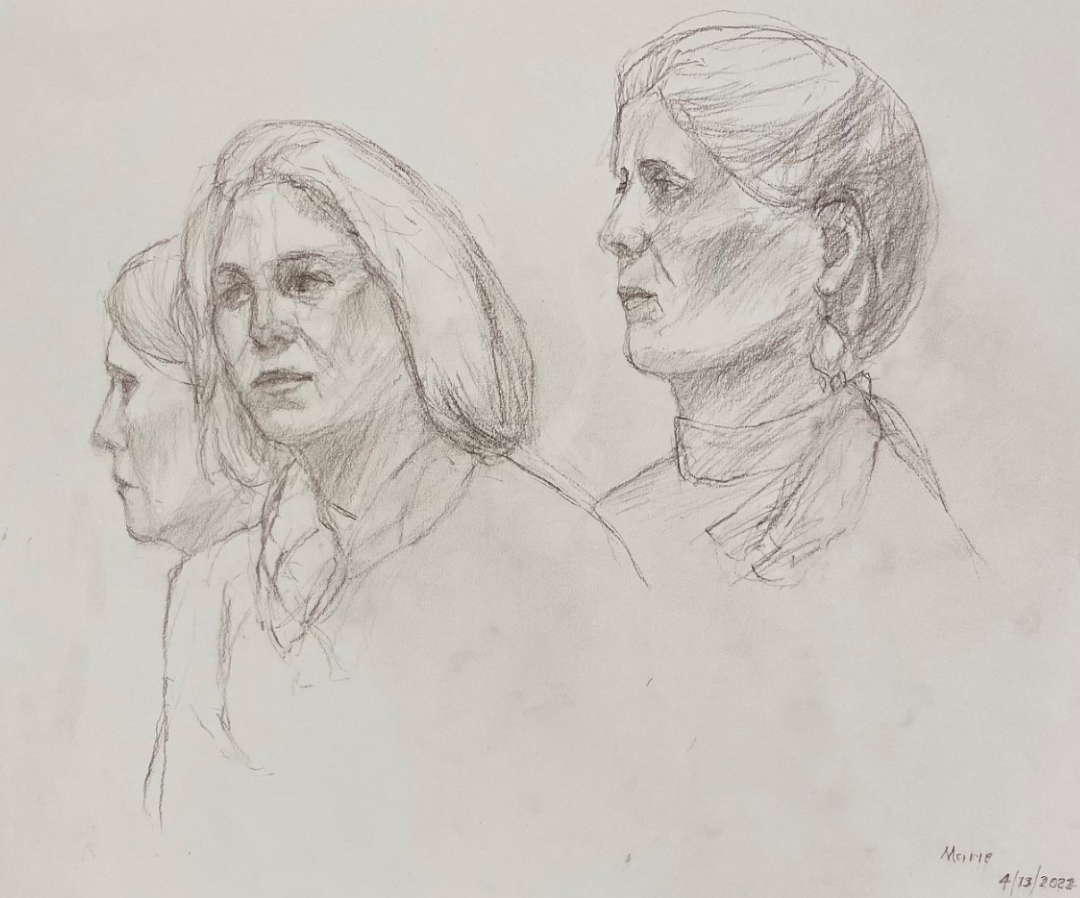
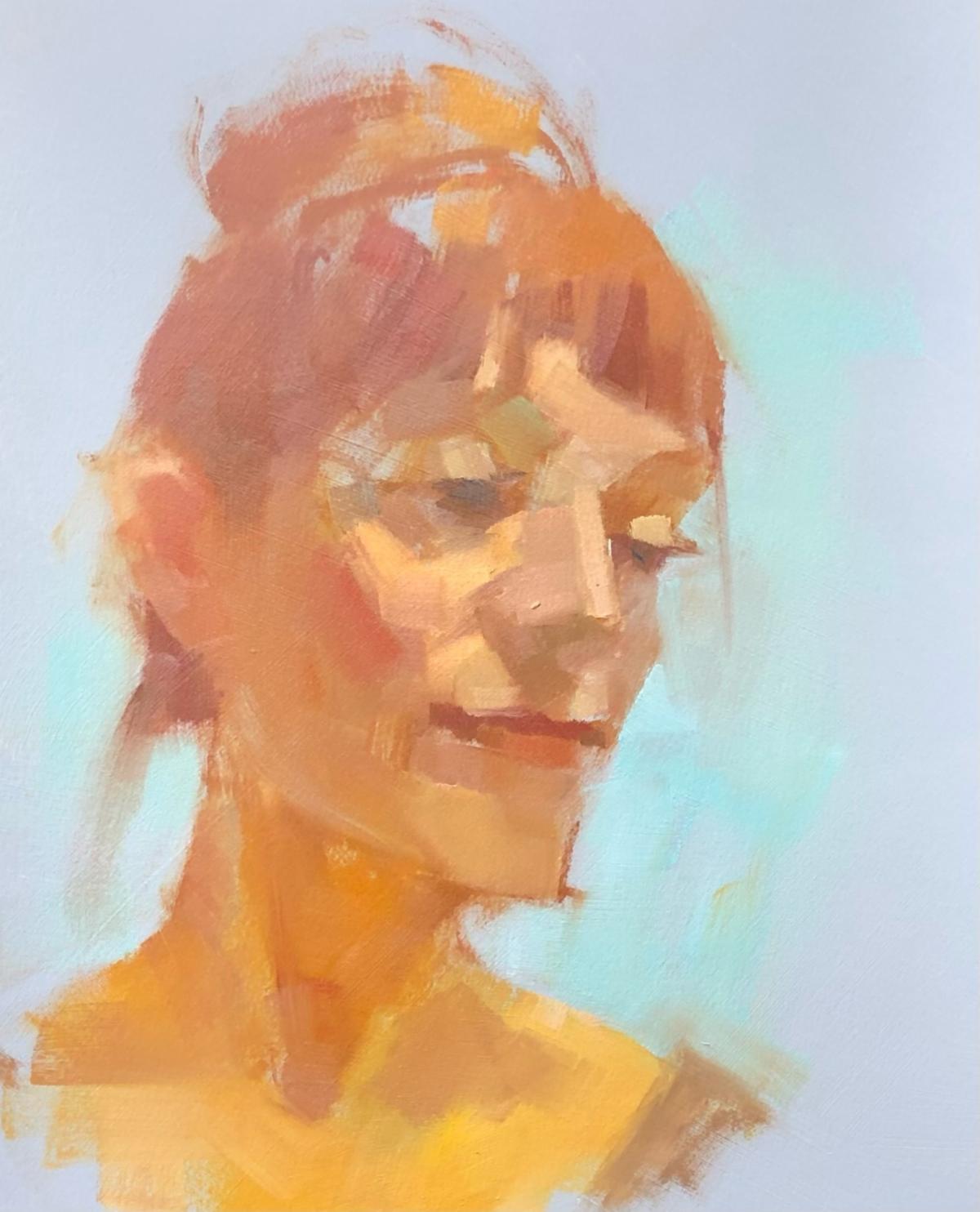
Nancy says: "Every portrait is a process of discovery and one that I never find boring. I usually begin by drawing a few placement lines but beyond that, I try not to do too much drawing and save my time and creative energy for the painting process. The model with the bun is a friend of mine and so I know her face fairly well. The likeness fell into place almost effortlessly." | | |
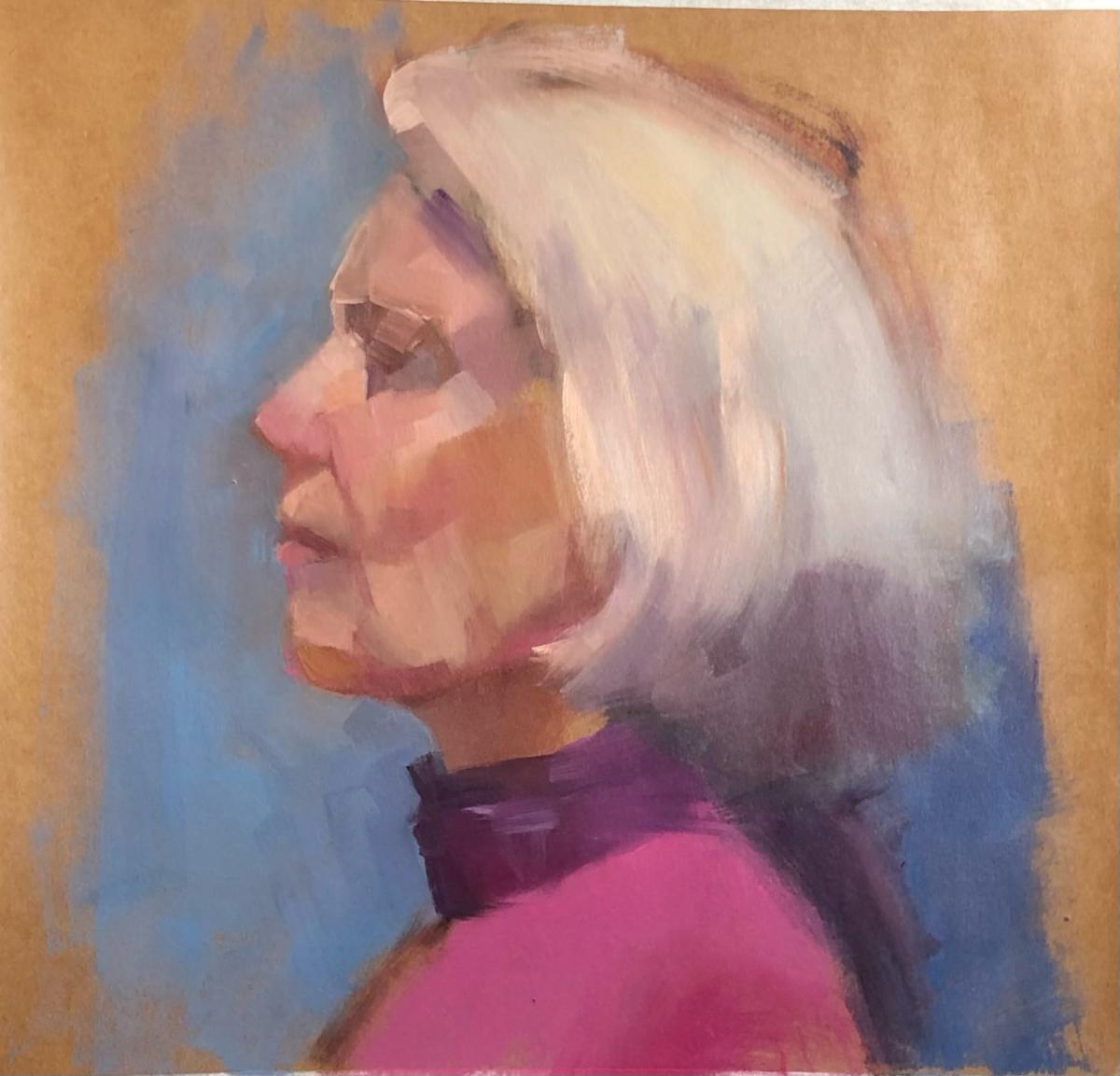
'The painting in profile is all about color. The model wore brightly colored clothing and her face and hair seemed to reflect color in a lovely way that was a joy to paint. Portraiture is one of the most challenging things I’ve ever tried to do, and I’ve had many failures to bear this out, but it is also one of the most rewarding things I’ve ever tried to do." | | |
| |
Arthur says: 'I love the excitement of trying to recreate a fellow human being’s persona. To capture their emotions as well as my own within a very short amount of time is very challenging but rewarding when successful. The joy for me is doing something that has a place in the grand scheme of things. (I wonder what it is?)' | |
|
"I try not to be too reliant upon formulas. When drawing figures, I mix common measurements with a bit of creative line and a dash (sometimes too much) of Bravado! I do at times get a good likeness or at least a version that I like. I always remind myself that whatever I am creating and the way that I am creating it has been done before, and often much better.
So what did I really come for, oh, it was for – pleasure!
---------------------------------------------------------------------
MICHAEL BONE
(Michael is on Mark Gailey's waiting list for the group)
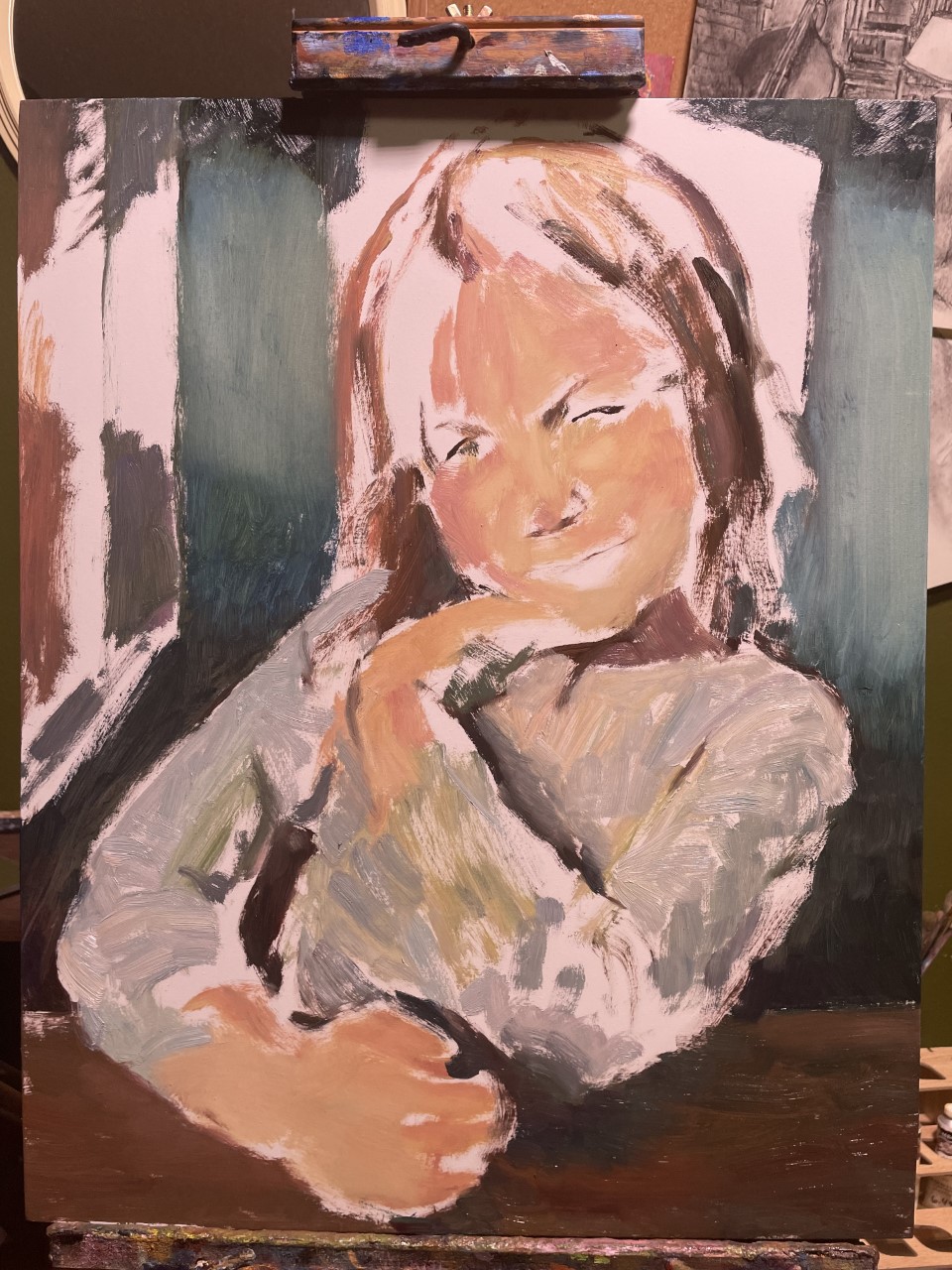
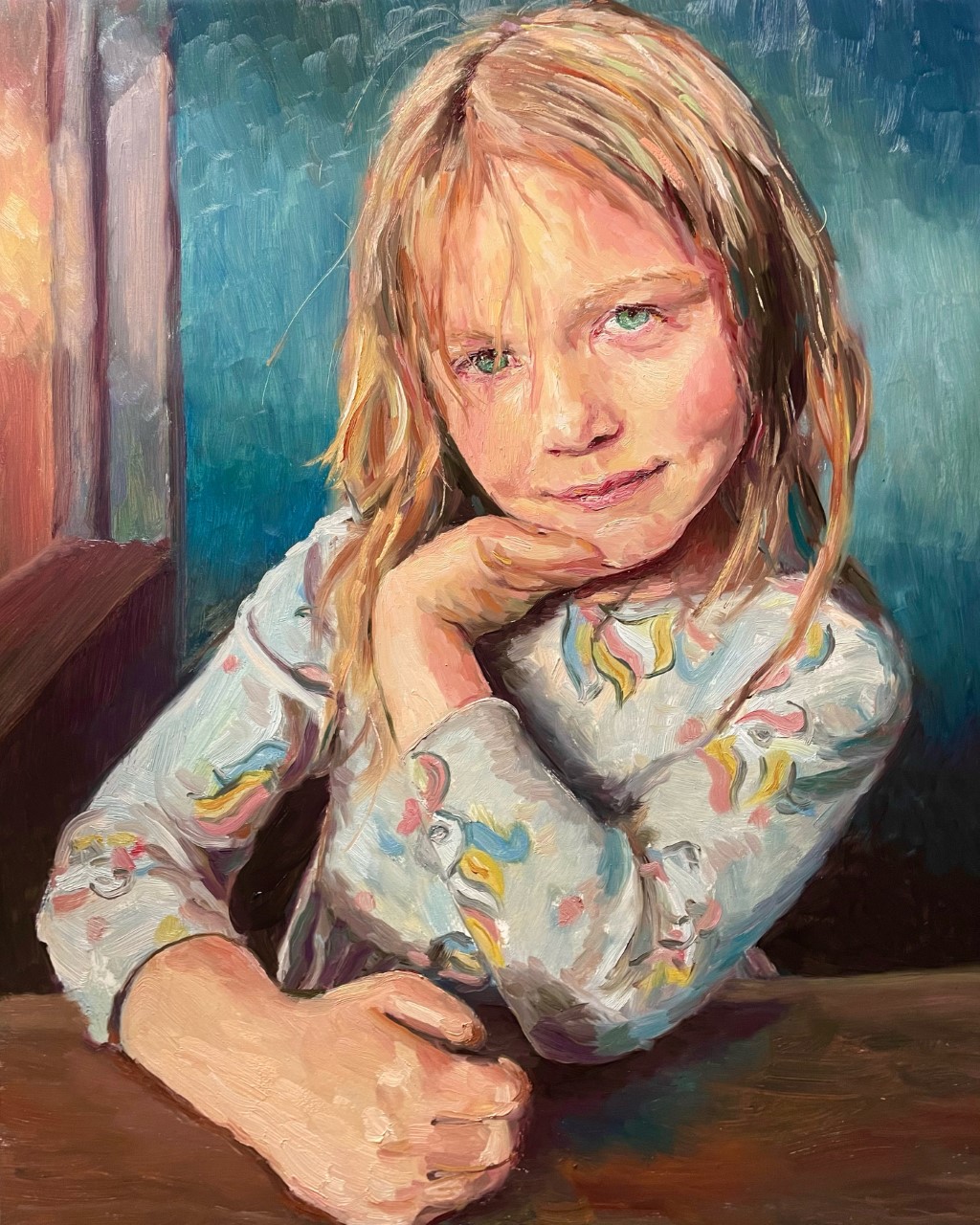
Michael says: "I have the pleasure of spending every day with my daughter Olive. By chance she was lit in a remarkable way when we were at a restaurant and late sun came through the window. I took a quick photo (albeit a bit too close—making her hand look too large). I draw her all the time from life, but to look into her eyes for several hours via photo was lovely."
| |
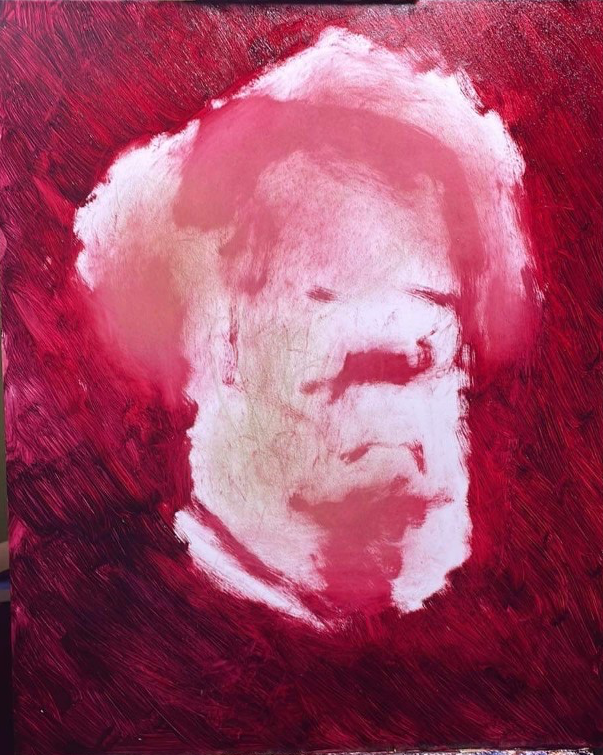
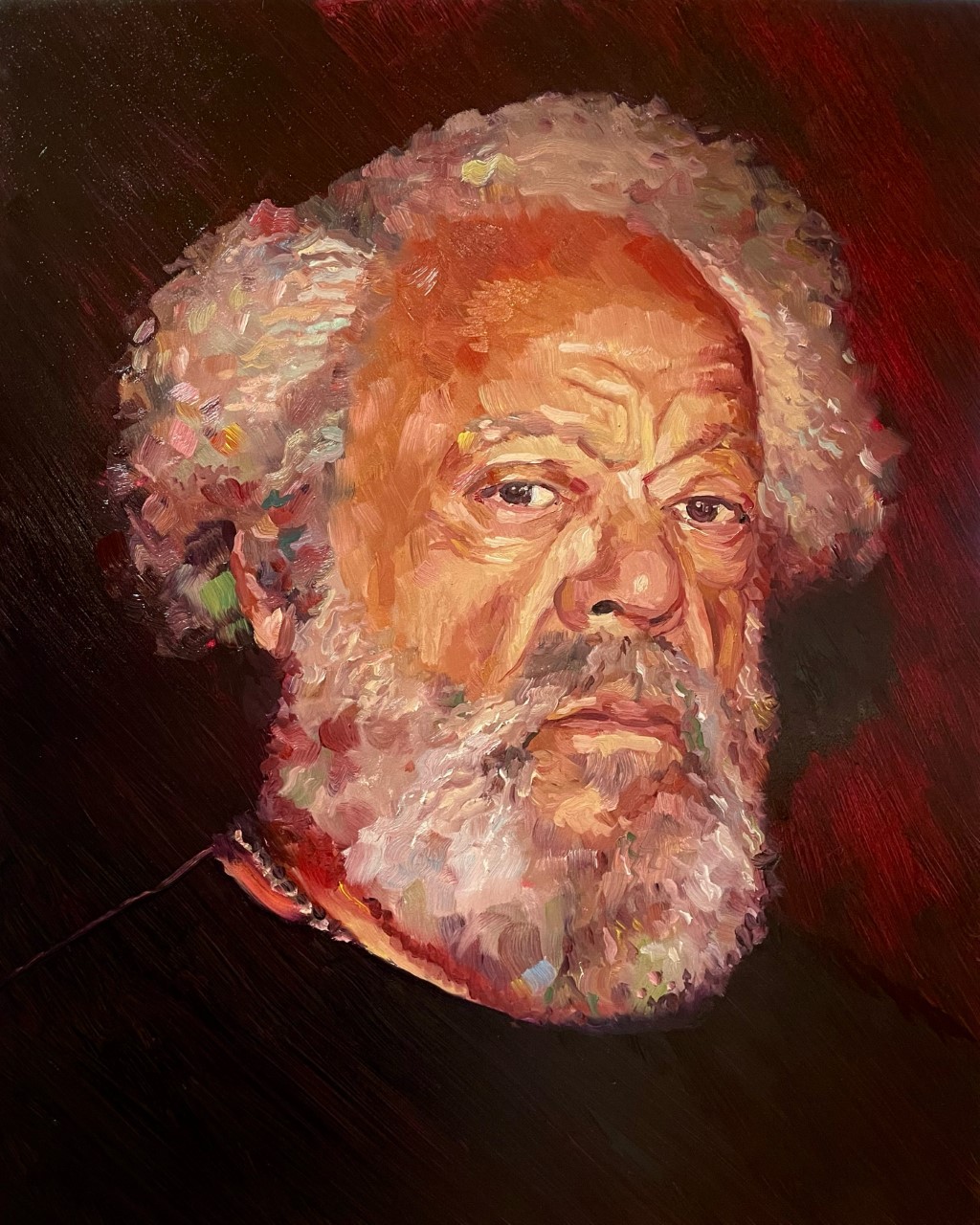
Michael says: "Kelly (roughed in above) is a larger than life character and one of the sweetest people I know." | | |
"Kelly grew out his hair during 2020 and I learned a lot from Kelly’s beard about the magical quality of grey - you can push it into a whole rainbow of color. Grey is like a portal to all colors, as it is in the “center” of a color wheel." | | |
|
ELISSA BEREZNAK
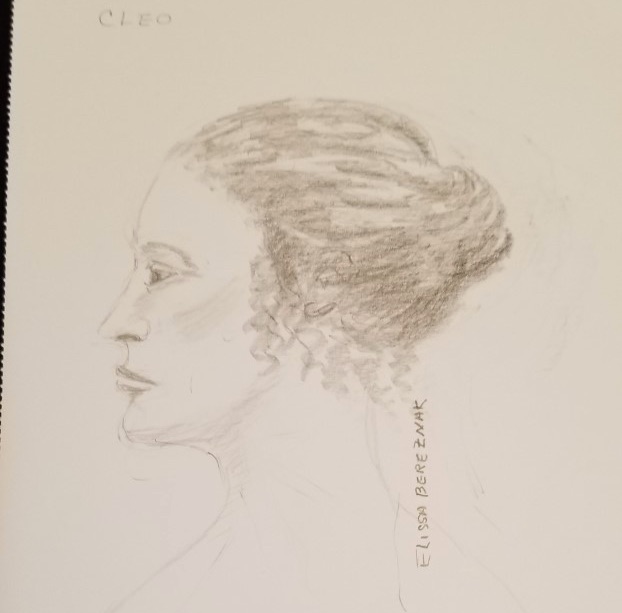
People have always interested me. Now that I have been doing portrait drawings for a few years, I look at people where ever I am and draw them in my mind. My drawings are not photo realistic as I try to capture the essence of the person as well as a reasonably accurate drawing. I am still working on this skill both at home and in our group.
| | |
| |
|
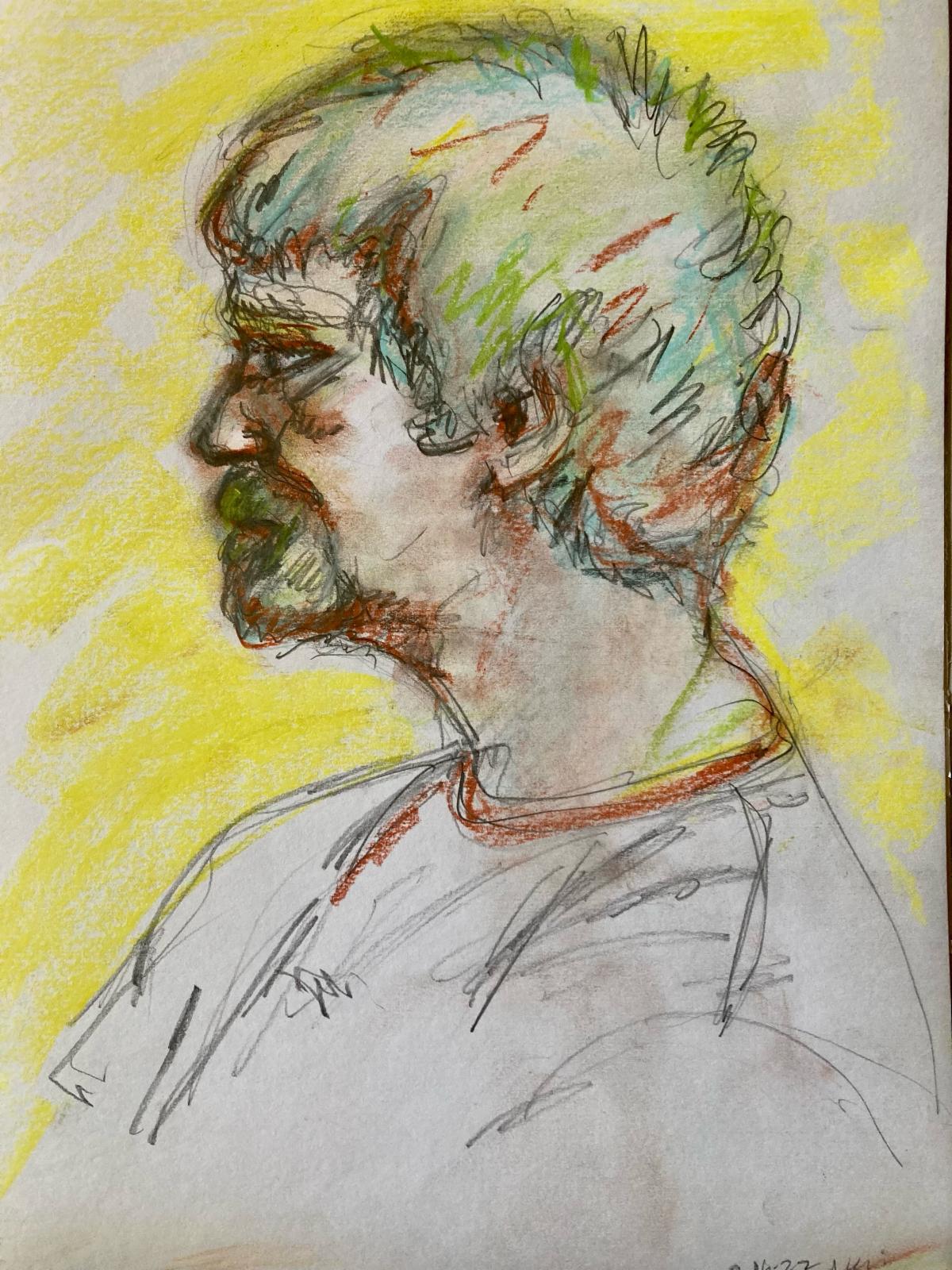
Marie says: "I added color to my drawing of the model because I sensed his inner brightness, How I feel while drawing and the connection I have with the movement of my arm, shoulder, and spine connects me to the person I'm drawing and the setting we're in. It's like practicing yoga and becoming present,
except my body indicates lines on paper that coincide with lines and
energy of a body or face."
| | |
|
Altman concludes: "Indicating light and shadow is a skill I"d like to gain over time".
| | |
|
ELEONORA FURST
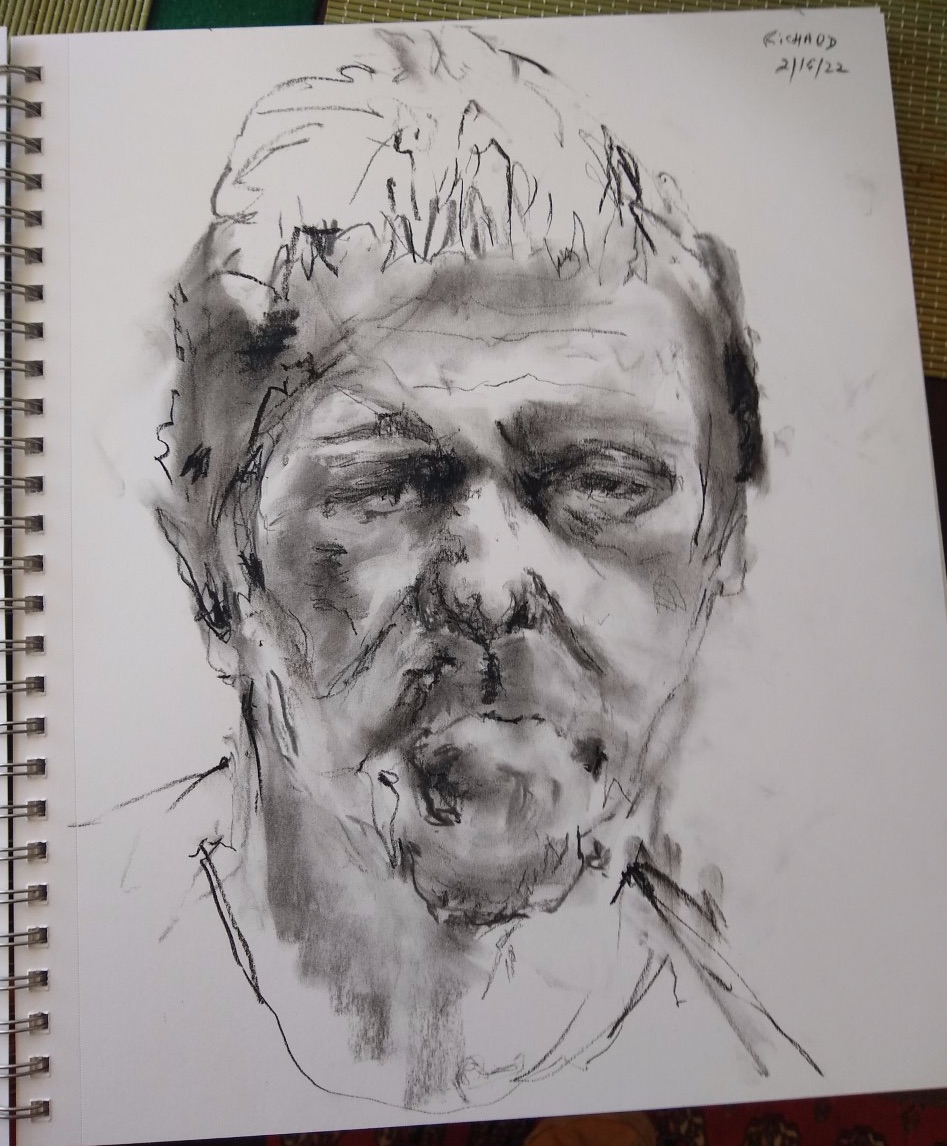
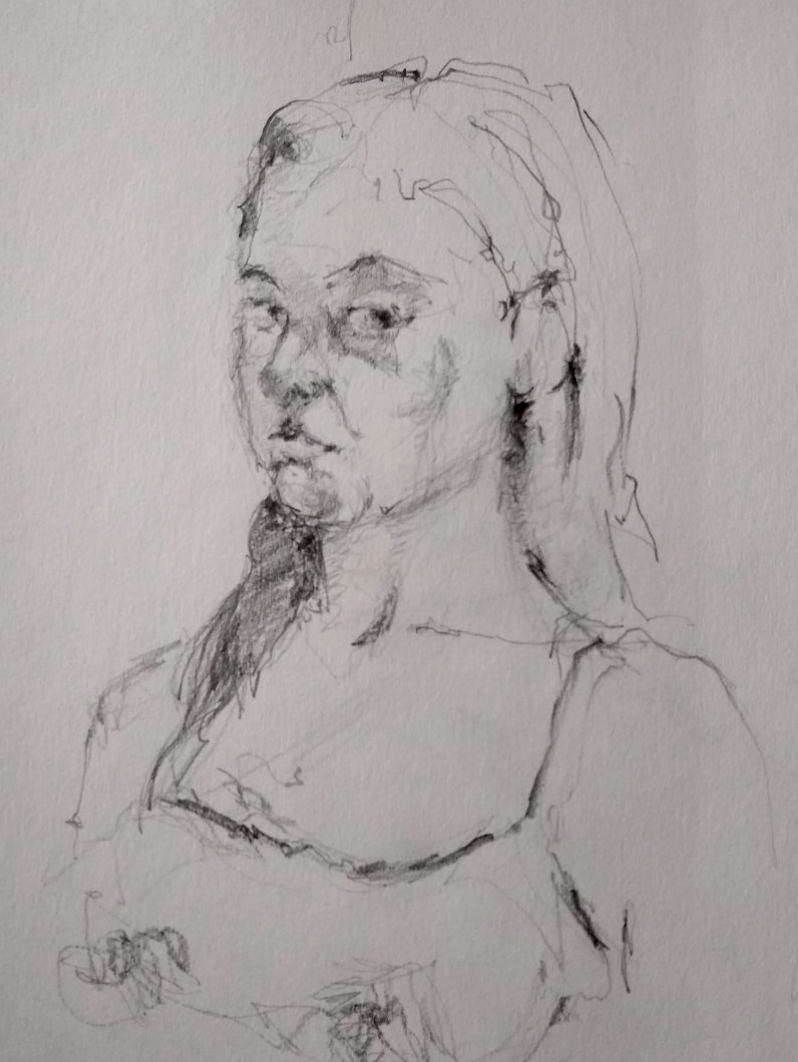
The drawing below is of a guy named Richard that one of our portrait artists met on the street and who, at the last minute, replaced our scheduled model. He had a fantastic face full of life experiences... one of the best models we've ever had in my opinion. His face lent itself very well to charcoal. He did each pose in three 10 minutes slots, which gave me time to evaluate what I was doing and to stop myself from adding stuff out of momentum. Great lesson.
| |
|
Eleonora comments:
"The second is a young model... I have a harder time with pretty young faces, less texture, less angles. She was looking straight ahead, but I turned her gaze to the side just to give the portrait more interest and immediacy."
| | |
| |
|
PORTRAITS TODAY
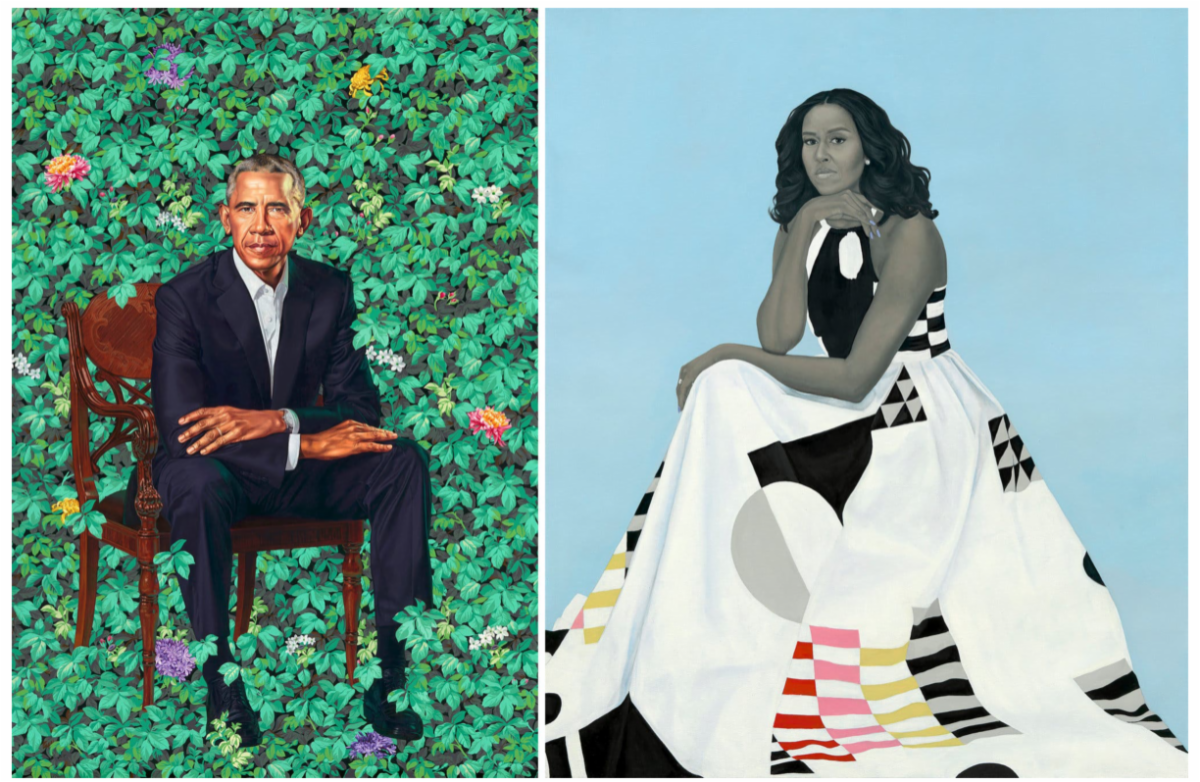
Photography. ranging from i-phone “selfies” to studio portraits with artful lighting is the most popular portrait medium of our time. However, portrait painting persists with museums such as the Metropolitan and the DeYoung attempting more inclusive representations of race and gender.
| |
|
Kehinde Wiley,"President Barack Obama" Amy Sherald, "First Lady Michelle Obama"
The Obama Portraits Tour commenced in Chicago, June 18, 2021, where it consistently broke daily attendance records for the Art Institute of Chicago. “The collaboration of eight premier institutions—the Portrait Gallery included—amidst a global pandemic speaks to the power of portraiture to bring audiences together,” said Kim Sajet, National Portrait Gallery Director.
| |
|
ALICE NEEL (1900-1984)
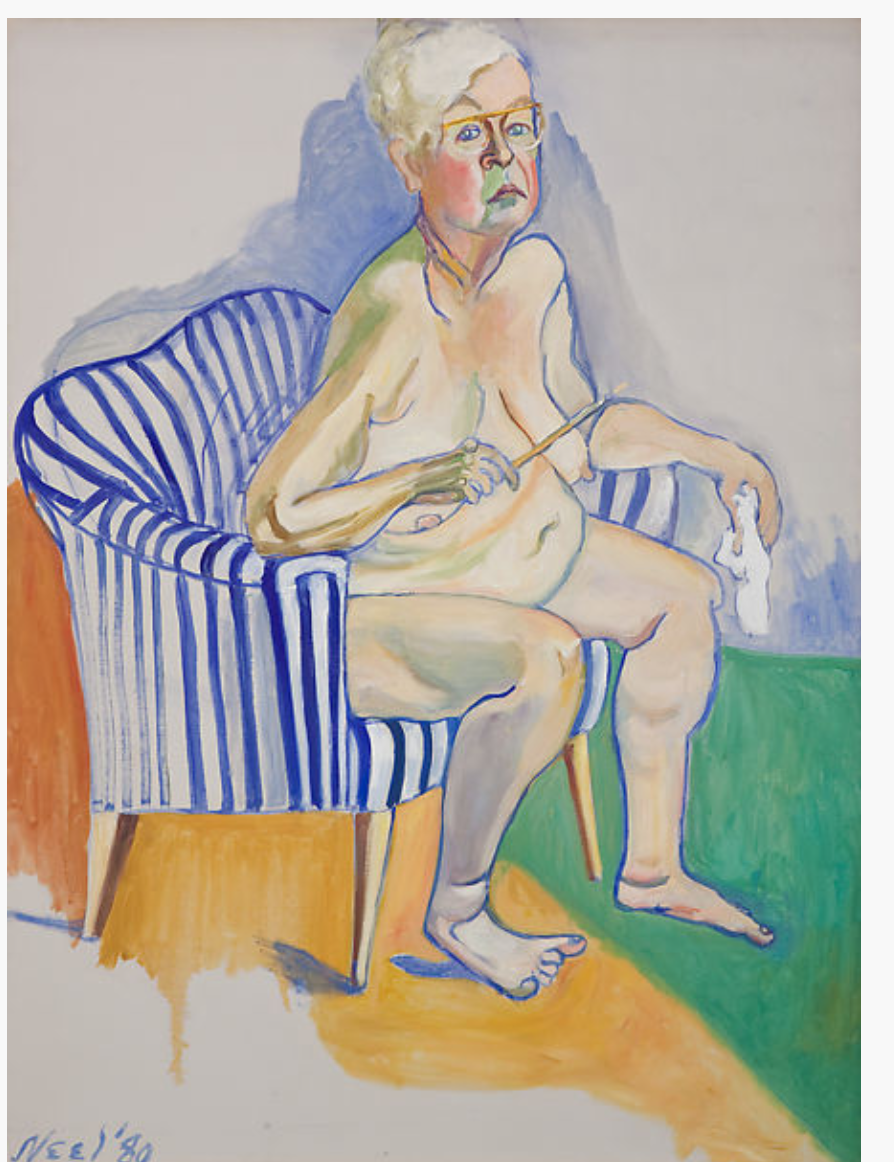
New York Times art critic Roberta Smith, in her April l, 2021 review of the Metropolitan Museum’s Alice Neel retrospective writes: “In 1980, at 80, four years before her death, she would unveil her own sagging nakedness in one of art history’s most quietly shocking and forthright self-portraits.”
| |
“You should keep on painting, no matter how difficult it is, because this is all part of experience, and the more experience you have the better it is…unless it kills you, and then you know you have gone too far.” Alice Neel
July 10 is the last day to see “Alice Neel: People Come First" retrospective at the DeYoung Museum,S.F.
-----------------------------------------------------
| | |
SUTTER MUSEUM CALL FOR ARTISTS | |
|
Artists who live in Northern California are invited to submit qualifications for the creation of large scale commissioned paintings to introduce exhibit themes within the museum. Artists residing in Sutter, Yuba, Colusa, Nevada, and Butte counties are especially encouraged to apply. Themes include: The First People: The Dominance of Agriculture: Diversity of People: Natural Disasters. For details contact Marika Garcia, Development Officer, at (530) 443-3797 or megarcia@co.sutter.ca.us. Entry forms can be found online at our website www.suttercountymuseum.org or picked up at the Museum. Deadline for RFQ entries is July 15th at 5:00pm.
******************************
| |
|
I'M TAKING A BREAK IN August to paint and to prepare my OLLi class in September on Claude Monet.
Call for submission to the September Art Talk on the wide open topic of your summer art activities. Please send 2 or 3 images and 50-100 thoughtful words by a deadline of August 5 to dmitchell@csuchico.edu I can help readers with writer’s block!
Local media vehicles for art publicity have diminished drastically in the last decade. You can make "Art Talk" a more useful free communication outlet for our arts community by forwarding this copy to friends who can click below to subscribe.
https://lp.constantcontactpages.com/su/5LD8IZs
| | | | | |