Letter from the Editor

The Rewards of Repetition


As I mentioned before, I'm obsessed with elegant workflows.

It all goes back to a book I read before I started healthsystemCIO that had a phenomenal impact on my thinking. In “The E-Myth Revisited: Why Most Small Businesses Don't Work and What to Do About It,” Michael Gerber made the case that only businesses that have well-documented and repeatable processes can succeed.


Then, from Gordon Ramsay's Kitchen Nightmares show, I took away the message that excellence demands narrowing your variety. The volume can stay high; the range needs to shrink. Henry Ford must have been onto this when he famously said, “Any customer can have a car painted any color that he wants, so long as it is black.”


These things sound like common sense once absorbed, but many don't absorb them at all. They think variety is not only the spice of life but the key to business. In the restaurant industry, they create catch-all menus that they hope will catch all diners, but the problem is when you try to be a jack of all trades you invariably prove to be a master of none. (Yes, that's a lot of expressions, but they all came out naturally.) It's hard to trust lobster tails at the diner when they sell one a month.


So I started with the premise of doing a few things to the highest degree of excellence: that's the small menu idea. Then I added on Gerber's notion that the only way to achieve consistency is ruthless documentation. One of the greatest compliments my wife and I have for a restaurant is: “It's the same every time!”


Today we're going to talk about how to get that documentation. How to, as I like to think of it, smooth the edges to create the perfect shiny diamond of workflow that produces the same result every time.


My wife has asked me during a dinner out: “How do they keep doing it all these years, they can't have the same people working here all this time.”


And my response is: “They probably have it down to a science. If you are sourcing your food from the same places, and you are using the same kitchen equipment, and you have your recipes and processes WRITTEN DOWN, then all you have to do is hire people who can read,” and that is a low bar indeed.


But I digress. Back to the point at hand. To get the diamond perfect, you need to go through the process many, many, many times. Now, remember, improvements are iterative. All you want to do is just get it a little better each time through. I read an excerpt of an interview with the online influencer MrBeast about making YouTube videos and he advised, “Make 100 videos and improve something small with each video. Doesn't matter what, just improve each vid.”


That sentiment is also echoed by Malcolm Gladwell's “10,000-hour rule,” popularized in Outliers, which contends that mastery requires 10,000 hours of practice. Excellence comes from repeated, deliberate improvement over time.


So, we need to do things many times to be great at them. Of course, since there is so much time involved, we want to make sure we've decided to achieve mastery of the right things: that we've selected the right diamonds to shine. Once we do that it's time to get to work.


I often think about how volume relates to excellence when the fall and spring conference season rolls around. There are services that we offer only around those shows that, of course, I only do once a year. And though I've done them for years, and though I'm obsessed with documentation and capturing learnings, I'm never as comfortable as I am when, let's say, producing a webinar or an interview, which I do with exponentially higher frequency (webinars 2-4 times a month and interviews double that).


I think about this dynamic for you around pilots. You know you need to be great at executing pilots and though I know excessive piloting (pilot fatigue) is an issue for some, I suspect under-piloting is an issue for others. If you wind up piloting with a low frequency, you likely never get quite comfortable. Upping the volume can be a conscious decision that moves you towards excellence.


Here's the small-menu idea applied to your world: more pilots, but fewer types of pilots. If your pilot portfolio is too diverse, the learnings don't accrue. Each one becomes a one-off rather than a contribution to a single body of expertise.


Here's one more nuance to consider. It is very difficult to capture learnings in a coherent way when you have multiple projects going at the same time. So if you are running multiple pilots in parallel, it's a yeoman's task to ensure you are injecting learnings from all into each other as well as into the master. Thus, I've always preferred, if possible, to run new workflows consecutively rather than concurrently, at least until you get a little polish on the diamond.


The idea of pushing volume in pursuit of excellence is a little like the idea that getting better at public speaking requires continually getting on that stage no matter the dread, knowing that with each trial, you're one step closer to competency. Keep this in mind: design a small menu, use repetition as your sandpaper, and turn up the frequency volume, because only practice (apparently 10,000 hours) makes perfect.


New Show Episodes

Mass General Brigham’s Sriraman Says SaaS Outages Expose Hidden Cloud Dependencies

Cloud outages have exposed a gap for health system technology leaders: the multi-region resiliency they paid for did not always exist. Nallan “Sri” Sriraman, CTO at Mass General Brigham, wrote an open letter to SaaS providers calling for greater transparency on hosting and failover. He shares why the resiliency conversation went dormant, what an Oct. 31 outage taught his team, and the six-tier framework Mass General Brigham uses to triage when everything goes dark.

University of Utah Health’s Kawamoto Says Workbench Approach Scales Clinical AI Across the Enterprise

Ken Kawamoto, MD, Chief Health AI Transformation Officer at University of Utah Health, walks through the AI Workbench, an EHR-integrated tool that lets clinicians pull medical record data and analyze it with custom prompts, no one-off engineering required. Kawamoto explains why the approach is delivering 10x-plus time savings on common clinical tasks, why most production AI failures trace back to data context issues, and how a weekly governance cadence keeps the AI program aligned with how fast the technology is changing.

News, Articles & Columns

New AHA, Joint Commission Program Helps Hospitals Benchmark Readiness for 30-Day+ Cyber Outages

The American Hospital Association and The Joint Commission have launched the Cyber Resilience Readiness program, a first-of-its-kind voluntary initiative to help hospitals and health systems evaluate whether they can sustain safe clinical operations through cyber-related technology outages lasting 30 days or longer. The diagnostic framework focuses on patient safety and clinical continuity, complementing traditional IT recovery measures. The free self-assessment and a $2,000 expert review are available now; advisory services and full certification arrive in Summer 2026.

WEDI Launches Interoperability Testing Directory

The Workgroup for Electronic Data Interchange (WEDI) has launched a free testing directory to help payers, providers, and vendors prepare for the Jan. 1, 2027, deadline tied to the CMS Advancing Interoperability and Improving Prior Authorization Final Rule. The directory matches organizations ready to test the four mandated APIs. Robert Tennant, WEDI Executive Director, said partner testing is essential to confirm the rule’s promise of real-time data exchange and reduced administrative burden across the industry.

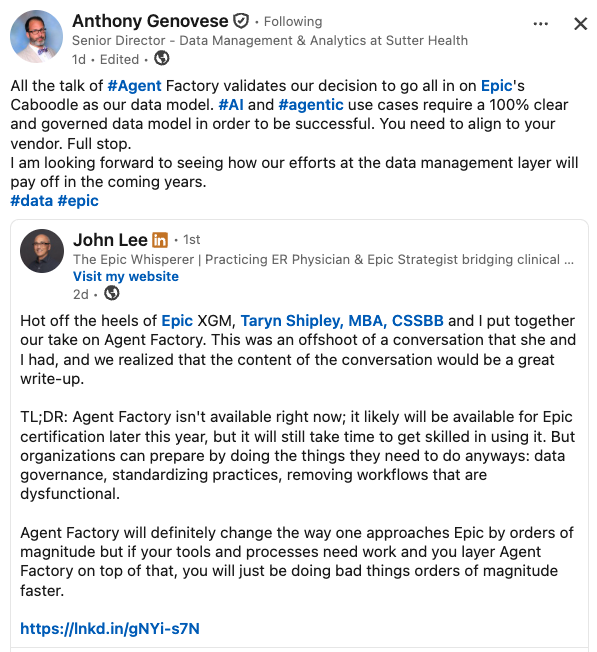
From Custom Molds to LEGO Technic: Epic's Agentic AI Shift

Stephon Proctor, PhD, Associate Chief Health Informatics Officer at Children's Hospital of Philadelphia, describes Epic's shift toward agentic AI and a consolidated "factory layer" architecture featuring modular sub-agents, real-time orchestration, and model-agnostic design that lets customers build with the same primitives as Epic's developers. He likens the transition from earlier siloed tools to a LEGO Technic-style composable system where creativity is bounded by imagination, opening more room for developers and customers alike to deliver tangible improvements in patient care.

Epic's Kryptonite isn't Lotus. It's Epic Customers.

John Lee, MD, Emergency Physician at Edward Hospital Naperville, Informaticist, and Epic Consultant, examines how agentic primary care companies could redraw healthcare's unit from the billable encounter to ongoing AI conversations. Epic's Agent Factory and personas Art, Penny, and Emmie offer a hedge, though its roadmap stays tethered to customers focused on optimizing the existing volume model. The real disruption arrives when self-insured employers route employees to agent-first care.

On Mental Wellness & the Coming Bot Battle

Krista Arndt, Associate CISO at St. Luke's University Health Network, reframes cybersecurity success around resilience, adaptation, and recovery as AI-driven attack tooling proliferates on dark web marketplaces. Drawing parallels to healthcare's approach to disease, she calls out the psychological asymmetry between tireless adversarial bots and human defenders carrying fatigue, burnout, and family responsibilities. The greatest threat to security programs may be emotional depletion, making mental health support and resilience training essential for future SOC leadership.

Annual Sponsor Updates


Beth Israel Lahey Health Partners with Heidi to Roll Out Ambient AI Scribing Capabilities to All of its Physicians


Upcoming Webinars

Click Here to Register for Any of the Webinars Below


AI ROI in Health Systems: Use Cases Delivering Measurable Value in 2026 (5/19)

  • Shakeeb Akhter, SVP/Chief Digital & Information Officer, Children's Hospital of Philadelphia
  • Kristin Myers, EVP/Chief Digital Officer - Head of Technology, Northwell Health 
  • Jordan Ruch, CIO, AtlantiCare


Optimizing Patient Throughput: Technology Strategies for Discharge Efficiency (5/21) Sponsored by iHarbor, the University of Maryland Medical Systems's Innovation Center

  • Sonney Sapra, Chief Information and Technology Officer, UVA Health 
  • Juan Rojas, MD, MS, Associate CMIO, Rush University Medical Center
  • Warren D'Souza, SVP/Chief Innovation Officer, University of Maryland Medical System


Governing AI Data Flows: Strategies for Securely Enabling Clinicians (6/2) Sponsored by Netskope

  • Anahi Santiago, CISO, ChristianaCare
  • Krista Arndt, Associate CISO, St. Luke’s University Health Network
  • Antonio Davis, Director-Head of Information Security (CISO), Northeast Georgia Health System
  • Robert Butler, Director, Information Security, Netskope

Streaming Webinars

Click Here to Access These Events & Our Entire Streaming Library


Strategies for Increasing Visibility​ Into Operational Technology Risk (Sponsored by Claroty)

  • Jim Kuiphof, Deputy CISO, Corewell Health
  • Steven Ramirez, VP/CISO, Renown Health 
  • Skip Sorrels, Field CTO/CISO, Claroty


Building the Data Foundation Your AI Strategy Demands

  • Chuck Podesta, CIO, Renown Health
  • Sarang Deshpande, VP, Data & Analytics, Franciscan Alliance
  • Roshan Hussain, SVP/Chief Data Analytics Officer, RWJBarnabas Health


Discovering Opportunities to Enhance Operational Resilience During EHR Downtime (Sponsored by Interlace Health)

  • Chris Akeroyd, CIO, Lee Health
  • Stuart James, VP, Chief Operations Officer & Deputy CIO, Christus Health
  • Allison Reichenbach, President & CEO, Interlace Health

The Pulse

Top 5 Posts of the Week

New AHA, Joint Commission Program Helps Hospitals Benchmark Readiness for 30-Day+ Cyber Outages – 5/6/2026


ONC’s Keane Says Government Will Strengthen TEFCA Onboarding to Address Provider Privacy Concerns – 4/12/2026


KLAS Finds Provider-Payer Collaborations Focused on Value-Based Care Workflows – 4/28/2026


Cyber Leaders Warn OT Blind Spots May Hide Unacceptable Risk; Network Segmentation Key Countermeasure – 4/23/2026


Technology Giveth and Taketh Away – 4/16/2026

Latest Quick Clips

Why Hospital IT Fails Quietly | Sriraman, MGB #healthsystemCIO #HealthcareIT #CloudResilience


Cybersecurity Is a Chronic Condition | Duemling, VP/CISO, Catholic Health #healthsystemCIO #CISO


Did We Forget Resiliency Basics? | Sriraman, CTO, Mass General Brigham #healthsystemCIO #


Downtime Isn’t the Time to Improvise #HealthcareIT #DowntimePlanning #healthsystemCIO


TPRM Blind Spots | Steven Ramirez, Renown #HealthcareCybersecurity #HealthIT #healthsystemcio

healthsystemCIO

Subscribe

Podcast

YouTube

Advertise

LinkedIn  YouTube