|
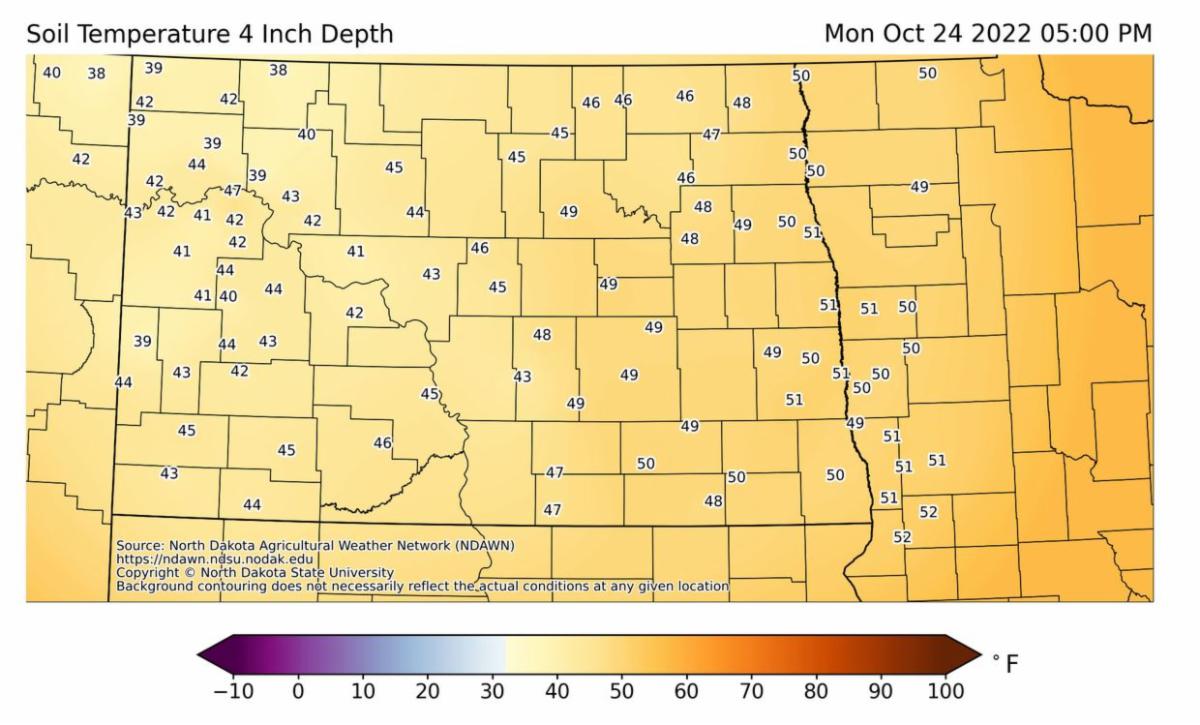
Yesterday, the Dickinson Research Extension Center received its first snowfall of the year. The snowfall accumulation was 3.5 inches. Hopefully, the snow will be gone in a day or two (I have some fishing and hunting yet to do), but the moisture is welcomed. Soil temperatures in our area are hovering around 40oF. Having said that, now is a good time to apply nitrogen fertilizer for next year’s crop. Here are some guidelines for fall nitrogen applications.
1. Soil test and make an agronomic application. The crop nitrogen calculators account for fertilizer price, tillage/no-tillage practice, and region of the state. The crop nitrogen calculator can be accessed at: https://www.ag.ndsu.edu/temp/cnc/
2. Anhydrous ammonia is your best choice for fall nitrogen fertilizer applications as that has the lowest potential for loss. Wait for soil temperatures to be 50oF or less at the four-inch depth. The NDSU North Dakota Agricultural Weather Network (NDAWN) monitors soil temperatures all across the state (figure 1). This information can be found at: https://ndawn.info/soil.html. Urea can be applied, but it is best to place into the soil (band) and wait a week after the soil temps have dropped below 50oF. Wait two weeks after the 50oF threshold has been met for surface urea applications.
Temperature greatly impacts soil biological activity. Soil microbial activity is greatly slowed when soil temperatures are less than 50oF and this reduces the loss of nitrogen fertilizer inputs.
Spring nitrogen applications are more efficient than fall nitrogen applications. However, when there are late springs or issues in the fertilizer supply chain, fall nitrogen applications do offer some benefits and can be a good nutrient management practice.
|