Follow us on LinkedIn and subscribe to our YouTube page for more updates. |
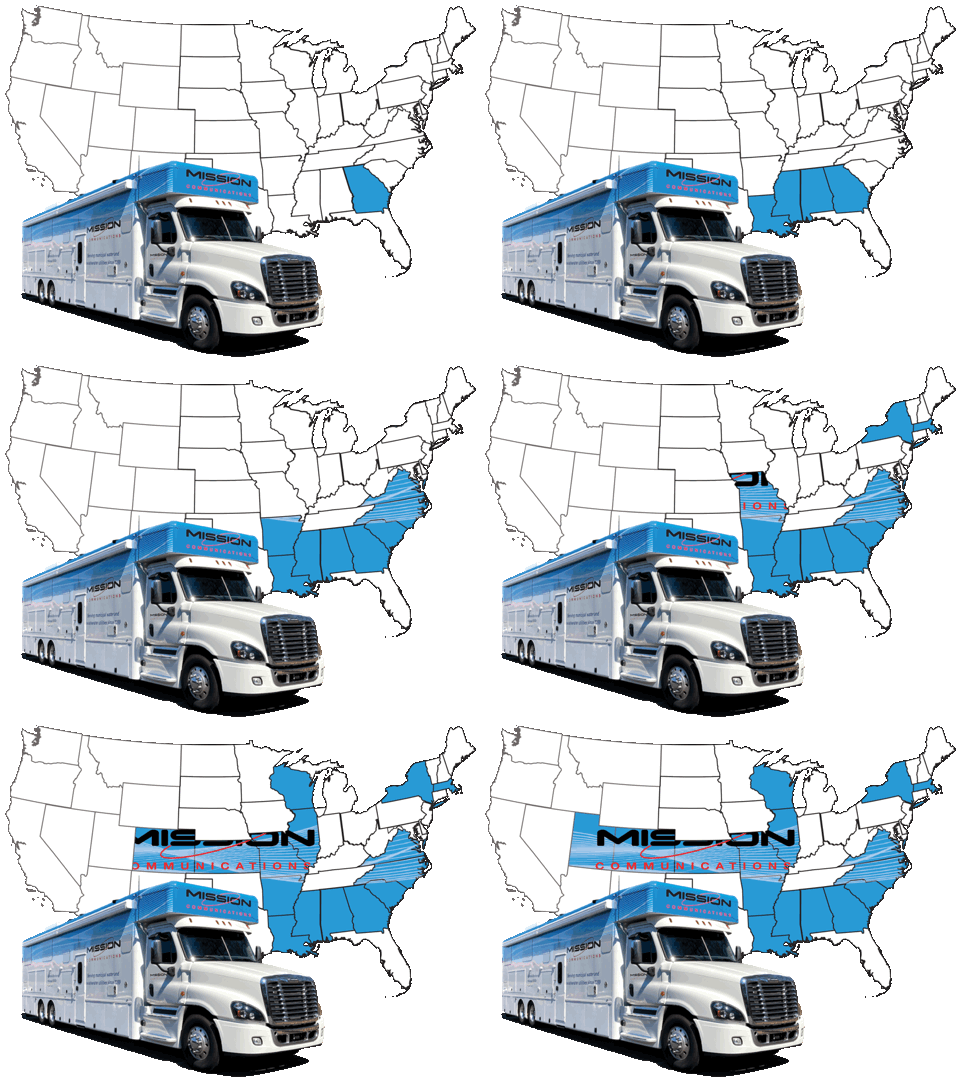
After the sneak preview tour in 2022 that rolled through Georgia, Alabama, Mississippi, Louisiana, and Arkansas, the Mission RV Roadshow has been traveling even further this year, visiting treatment plants, trade shows, offices, town halls, and even a Walmart parking lot.
Northeastern Regional Sales Manager Rich LaPierre grabbed the keys in Georgia and then headed north, working his way through the Carolinas and Virginia, including a stop at the Virginia Rural Water show. Then he drove further up the east coast to New York and Massachusetts, where it fit in nicely at the Massachusetts Water Environment Association Spring Trade Show and BBQ.
As summer came around, Midwestern Regional Sales Manager Eddie Stewart teamed up with Executive Advisor Forrest Robinson, National Sales Manager Matt Crousillac, and Central Regional Sales Manager Michael Hedding and brought it to the midwest, touring Kansas, Missouri, Illinois, and Wisconsin, where it was featured at the Wisconsin Rural Water Association Outdoor Expo.
From there the MTU headed to the Rocky Mountains as West Coast Regional Sales Manager David Button and National Sales Manager, Matt Crousillac brought it to West Valley City, Utah, then traveled to the Rocky Mountain Water Show before an extended residency in Golden, Colorado and Aurora, Co. at the National Rural Water Water Pro Conference.
The show keeps rolling along. If you want the MTU to visit your facility, contact rv@123mc.com.
|
September 25 – September 27
Aurora, CO
September 28 – September 30
Québec City, QC
October 15 – October 17
Charlottetown, PE
October 15 – October 17
Lafayette, LA
October 17 – October 18
Dubuque, IA
October 26 – October 27
Lake Ozark, MO
November 1 – November 3
Kearney, NE
November 15 – November 17
Edmonton, AB
November 16
Gatlinburg, TN
November 28 – November 30
Las Cruces, NM
|
All trade show information is subject to change. Please confirm details with the individual association. |
For inquiries about our Technical Certification Program for continuing education credit, contact sales@123mc.com
Web Portal II—Advanced Features, Reporting, Supergraph, Volumetric Flow
Web Portal I—Unit Setup Options, Notification Setup Options, Alarm Groups, Website Tools
Web Portal II—Advanced Features, Reporting, Supergraph, Volumetric Flow
Survey of Features
Web Portal I—Unit Setup Options, Notification Setup Options, Alarm Groups, Website Tools
Special Topics—Digital Interconnect, Tank and Well, OPC, and More
Survey of Features
Web Portal I—Unit Setup Options, Notification Setup Options, Alarm Groups, Website Tools
Certificates are available for any webinar attended, by request.
|
|
Mission Helps Allied Technical Services Maintain Playable Conditions at “The Horseshoe” |
In North America, fall seems to bring a bit more chaos into our daily routines. Gone are the days of summer vacation, 4th of July, and beach reading. In comes a new school year, cooler weather, and tighter schedules. But fall also brings football! Doug Sayre, president of Allied Technical Services, Inc. found himself in the role of keeping one of the most famous pieces of property in all of Ohio from flooding—Ohio Stadium, home of THE Ohio State Buckeyes football team. Thanks to Allied and Mission, the only chaos in the stadium occurs by the players, between the whistles.
Sayre founded Allied Technical Services in 1994, supplying water and wastewater pumps and solutions in Ohio, including the Cincinnati and Columbus areas. In 2001 they were supplying pumps for the stadium (affectionately known as “The Horseshoe”) during the renovation project in 2001 that brought natural grass back after 30 years of artificial turf. “They excavated deeper and lowered the floor of the field to put in more seating. That required adding a slurry wall into the infrastructure, basically a bathtub all the way around the outside of the stadium. Inside of that is the pump station.”
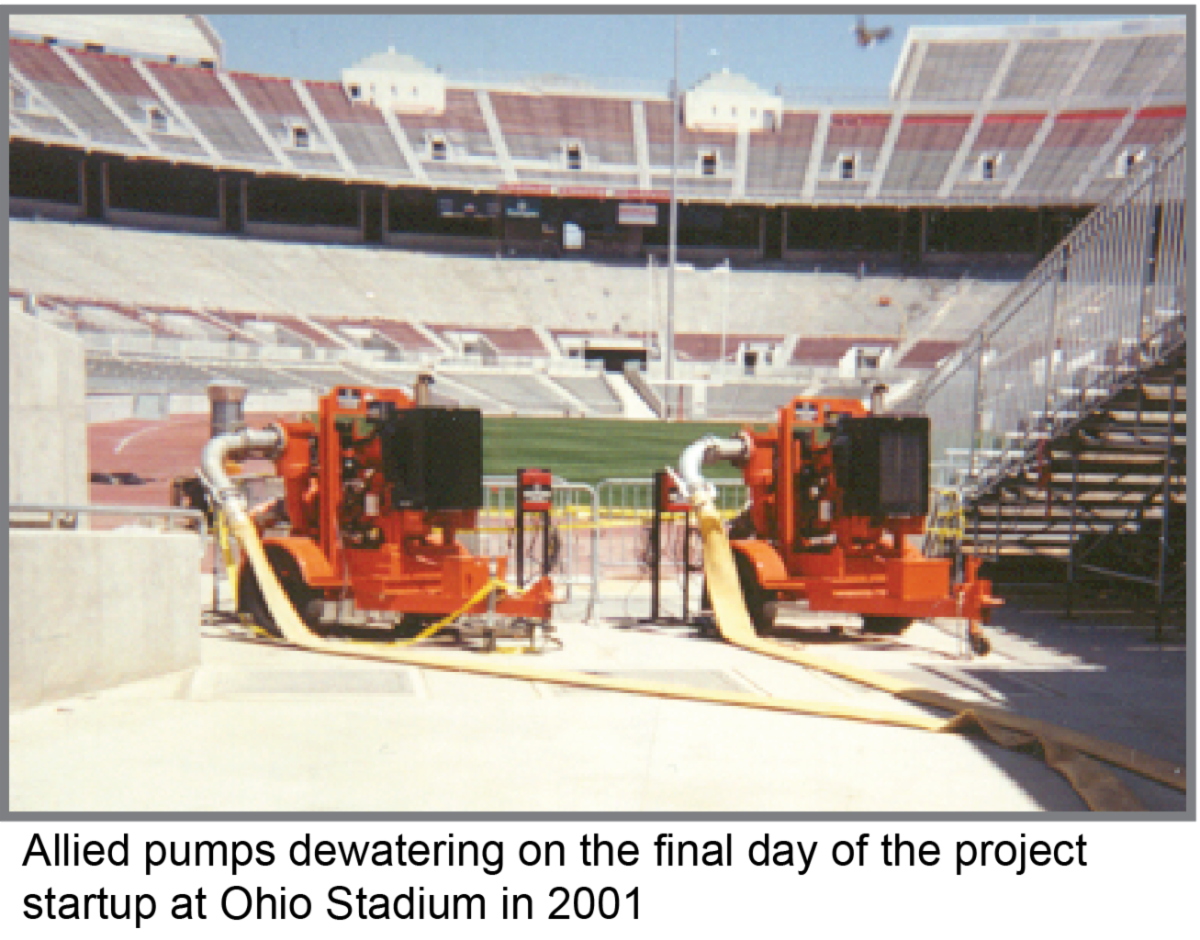
While Sayre was on his way to the jobsite on the final day of the startup, he got word that a failure occurred and the fieldhouse was flooding. A misunderstanding cut the power to his pumps leaving the field and the new facilities unprotected as the water level rose. But his Allied Technical Services equipment and water management expertise came to the rescue. “I told my guys to get two of our six–inch pumps and immediately start dewatering.”
|
He and his staff quickly deployed their diesel pumps, got things under control, and saved the project a lot of money. The university was so impressed with them that they put Sayre and Allied in charge of keeping anything like that from happening again. To control the pumps and monitor the slurry wall, he installed a Mission RTU device right in the stadium.
Sayre’s system handles all non–sanitary water in the facility. He explains, “It takes all the groundwater, rain, and even the runoff from the roof. It probably stores close to 20,0000 gallons all the time. When it starts raining the pumps turn on.” The Mission RTU uses optical floats connected to the digital inputs. When the water level is reached a digital output signal sends a trigger to the pumphouse. Each of the three onsite pumps are capable of moving 9,200 gallons per minute.
He uses reports on the Mission 123SCADA web portal to keep track of his runtimes to maintain the hardware. “One pump may only run for a minute in dry weather each day. Normally it averages three to five minutes.” The Mission RTU automatically sends a high–level alarm if the level gets too high, as well as pump and system faults so that Sayre’s team can check the pumps on 123SCADA. “We use the voice alarm. It calls the office, then my phone and three other operators.” He also uses the schedule feature to customize who gets the alarms: “I have about six different schedules, depending on what’s going on.”
The stadium has seen even more renovations since 2001 and with every new expansion project, Sayre likes to remind each stakeholder how important it is to keep the slurry wall and pumphouse running smoothly. “I open 123SCADA up and find the data from a huge storm that occurred one July that brought a huge amount of rain, I mean the most I’d ever seen in the area. I show contractors how bad it can get.” That storm, Sayre recalls, required all three of his pumps to run close to 30 minutes each.
Sayre likes the cellular connectivity used by the Mission system. “You can do it all kinds of ways but not using telemetry is almost crazy.” The cell networks themselves have come a long way. “People used to not be able to use their phones during a game because the network wouldn’t be ready for that many people. Now there are so many towers and repeaters That over 100,000 people in the stadium can stream from their phones with no problem.”
Ohio stadium has shifted back to artificial turf, this time using field turf. “It still needs to be watered,” explains Sayre. “Not for growth, obviously. It’s to keep it from getting dusty during the games.” That water gets handled by his system too. Thanks to Allied Technical Services, Inc. and Mission, the football playing and viewing conditions, from a water management perspective, are in good hands.
If you would like to learn the many ways that Mission can help your water or wastewater operation, contact sales@123mc.com.
Disclaimer: The content in this article is provided by Mission Communications and Allied Technical Services, Inc. It is not an endorsement by Ohio State University
|
Further Expanded MyDro Inputs/Outputs |
Mission Communications is pleased to announce even more expandable inputs and outputs for the MyDro 850. You can now remotely control more hardware and collect more data with the included 123SCADA web portal that provides custom desktops, reports, data downloads, and unlimited notifications and alarms.
The enhanced OP465 Analog Input expansion module adds seven analog inputs to the two existing onboard analog inputs. That’s three more than the previous version. Now you can monitor nine total analogs using 4–20 mA or 0–5 VDC.
The enhanced OP461 Analog Output expansion module has doubled its capability to four outputs. You can remotely set speed on up to four variable frequency drives, position valves, or control any analog capable of a 4–20 mA configuration.
The OP654 Relay Output / Digital Output (DO) is a brand new expansion module that adds six digital output controls to the MyDro 850’s three onboard digital outputs. This lets you remotely control up to nine devices, automatically or manually with a single MyDro and expansion module. Eight of the nine Digital Relay Outputs can be used with pumps, blowers, and the like to have runtime monitoring, leaving one for a Service Mode Relay or a manual remote lockout. The six new expansion DO data channels are ModbusRTU capable and can be used with Modbus–connected pump controllers or PLCs to set digital parameters like pump lockouts.
The OP653 Digital Input expansion module provides eight wetted or dry–contact inputs up to 50 VDC. When added along with the MyDro's eight onboard dry contact or OP400 current switch inputs, you can have a total of 16 digital inputs.
Of course, the OP750 MyDro Safe Module Plus remains the most popular expansion module and is ideal for sewer lift stations, monitoring pulse instruments like rain tipping buckets, pulse–based flow, and some unique pump lockout functions.
|
Water You Scared of this Halloween |
As Halloween's spectral veil descends upon us, be reminded that every profession, every trade, and every occupation has its own cache of ghostly tales, often lurking just beneath the surface. Amidst the chilling narratives that abound during this haunting season, one might not immediately think of the enigmatic world of water – both its elemental presence and its critical role in the water and wastewater industry. Beyond the serene lakes and meandering rivers, water itself carries its own lore. Here are a few water legends, in honor of the season.
Haunted Chicago Water Tower
One of the most famous American ghost stories of the water industry involves the historic tower on Michigan Street in the city’s popular shopping district. People report seeing images of a man in the windows, thought to be the spirit of the brave tower operator who worked tirelessly as the city fought to overcome the great fire of 1871. He operated the pump that pulled water from Lake Michigan until he met his demise.
Do Not Swim in the Hobbs Reservoir
The Hobbs Reservoir in Layton, Utah has legends of unusual drownings and occurrences. In 1944 a soldier disappeared while swimming and then more people went missing as a result of an unusually strong undertow in the 60s. The private reservoir supports nearby farmers for irrigation and police have posted fences and “no swimming” signs on the shores. The scenic views are hard for many to resist, however, and the lucky ones end up with only a citation.
The Water Ghost Wants to Trade Places with You
An ancient Chinese folk tale speaks to the fear of the sea and of drowning. This tale is of a fisherman who encounters the water ghost of the Huangbo River, whose desire was to return to the mortal realm. The ghost waited to pull the fisherman into the sea but the fisherman discovered him and they made a deal. The fisherman would help him find a suitable mortal if the water ghost would fill his fishing nets for him for three years. But each time the ghost wanted to take a life, the fisherman intervened, denying the ghost of its part of the bargain but ultimately paying the price.
What Else is at Work in the Eastbourne Water Treatment Plant?
Located on the southeastern shore of England, a water treatment plant at Eastbourne, Sussex is thought by many who work there to be haunted. Operators report shadowy figures, hushed voices, and even heavy control room doors opening on their own. The staff and management ultimately hired a spirit expert and a parapsychologist to assess the space. They ultimately determined that if any spirits dwelled there, they were not unfriendly.
Ghostly Pirates Lost Without a Lighthouse
An old lighthouse guided pirates for many years to the shores of the Gulf Coast of Florida where they are believed to have buried their stolen fortunes. A developer tore it down and replaced it with a water tower to support his planned resort in the area. The resort’s land was ultimately flooded but the water tower remains. The ghosts of pirates gone astray without the lighthouse to guide them are thought to be roaming the lands endlessly searching.
Legends and whispered stories haunt all trades and occupations and water will always be a part of folklore and strange tales. Do you have a favorite water–related ghost story? If so, send it to marketing@123mc.com.
|
|