|
Dear Ariana,
July and August mark poignant anniversaries in the history of nuclear violence and subsequent disarmament and nuclear justice work. On 16 July 1945, the United States conducted the "Trinity" test, detonating the first nuclear weapon just south of Los Alamos, New Mexico. This test had devastating consequences for those living near the New Mexico site. The Christopher Nolan film Oppenheimer features some of the Manhattan Project work that led to the Trinity test, although it conspicuously does not depict the fallout, and lasting impact, on "downwinders." Less than a month later, on 6 and 9 August 1945, respectively, the United States dropped two atomic bombs—the only attacks with nuclear weapons to date—on Hiroshima and Nagasaki, Japan.
78 years later, we face a world where not just one country has the power to destroy life and land on such a massive scale, but nine nations are nuclear capable with weapons many times more powerful than the first bombs made and used—this despite the manifest illegality of nuclear weapons testing, use, and threat of use.
A disturbing parallel to the nuclear weapon states' refusal to take seriously their obligations under international law to disarm is the recent development of the US sending cluster munitions to Ukraine intended to aid in its defense against Russia. Cluster munitions are extremely volatile weapons that use one carrier to deliver several (or even several hundred) "bomblets" at once over a wide area. Malfunction is common, and so, often, not all of the bombs detonate on impact, leaving unexploded cluster munitions scattered with the potential to explode at any time, often killing civilians. Cluster munitions are illegal, not only banned by the Convention on Cluster Munitions—which is not ratified by the US, nor Russia or Ukraine—but also prohibited under customary law, as they are inherently indiscriminate weapons that far too often impact civilians.
As we continue to monitor developments in the war on Ukraine, and prospects for peace and disarmament diplomacy, LCNP has also been busy on other fronts, which you can see below. You'll find in this eNews recaps of two recent virtual events, a newly-published paper on nuclear racism, submissions made to the ongoing NPT PrepCom, and more.
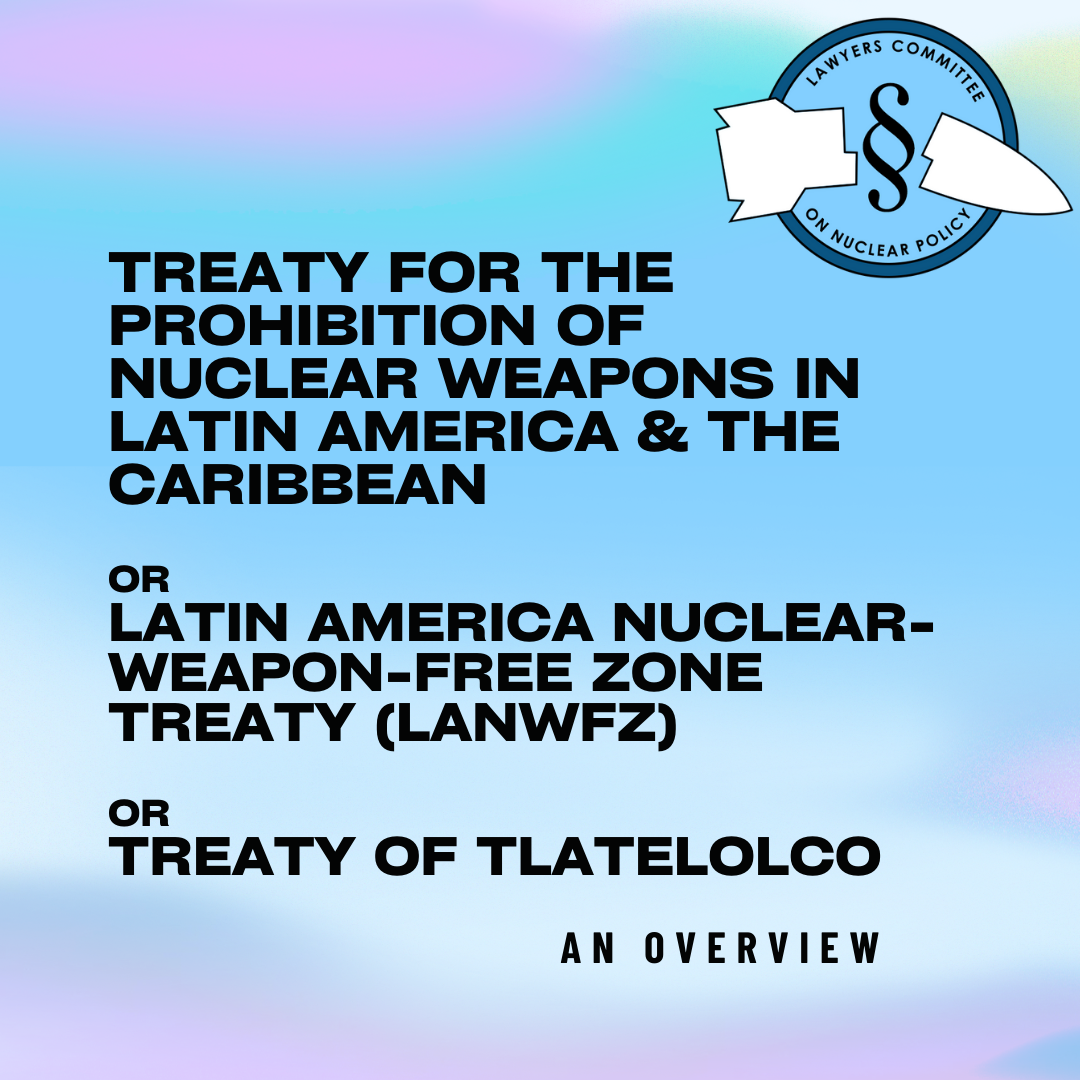
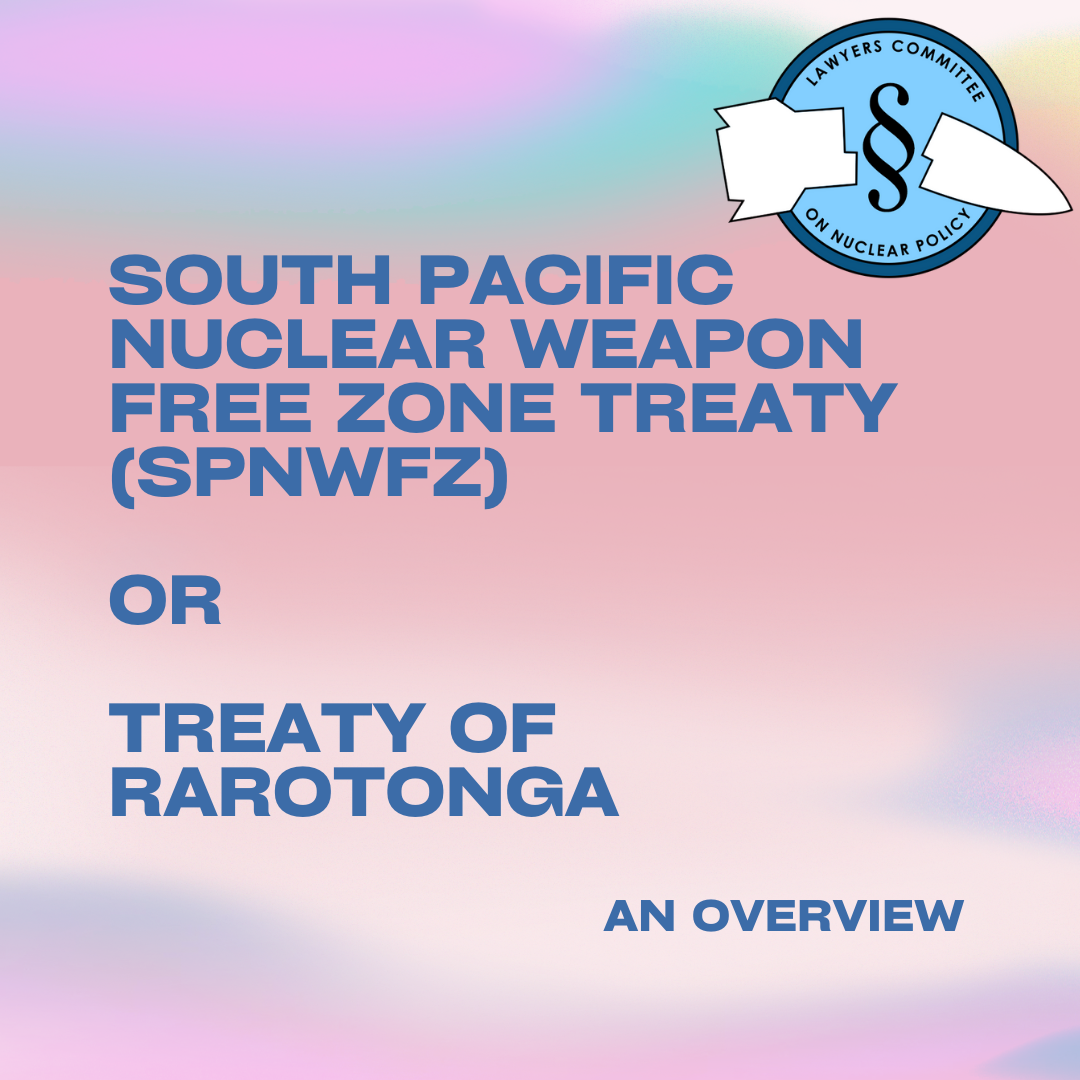
We also recently said goodbye to our wonderful summer intern, Lauren Ehlers. Lauren contributed essential research to LCNP's current projects, had the opportunity to attend various UN sessions, and was the author and artist behind our recent social media slides offering overviews of a few of the Nuclear-Weapon-Free-Zone treaties. You can see these previewed below as well.
Another major development is that next week will be my last as executive director of Lawyers Committee on Nuclear Policy. I have so valued these three years and have been honored to carry on the storied legacy of this special organization, which for 42 years and counting has highlighted the illegality of nuclear weapons and advocated tirelessly for nuclear abolition in pursuit of peace. It has been a true pleasure. John Burroughs, our current senior analyst and former executive director for 21 years, will be stepping back in as interim executive director to carry LCNP forward through this next season of critical work. You can, of course, continue to follow the next developments within LCNP, and in our work, through these eNews issues, our website, and our social media (linked below).
With especially warm wishes,
Ariana Smith
Executive Director
| |
Webinar Replay: Nuclear Fusion "Breakthrough" | |
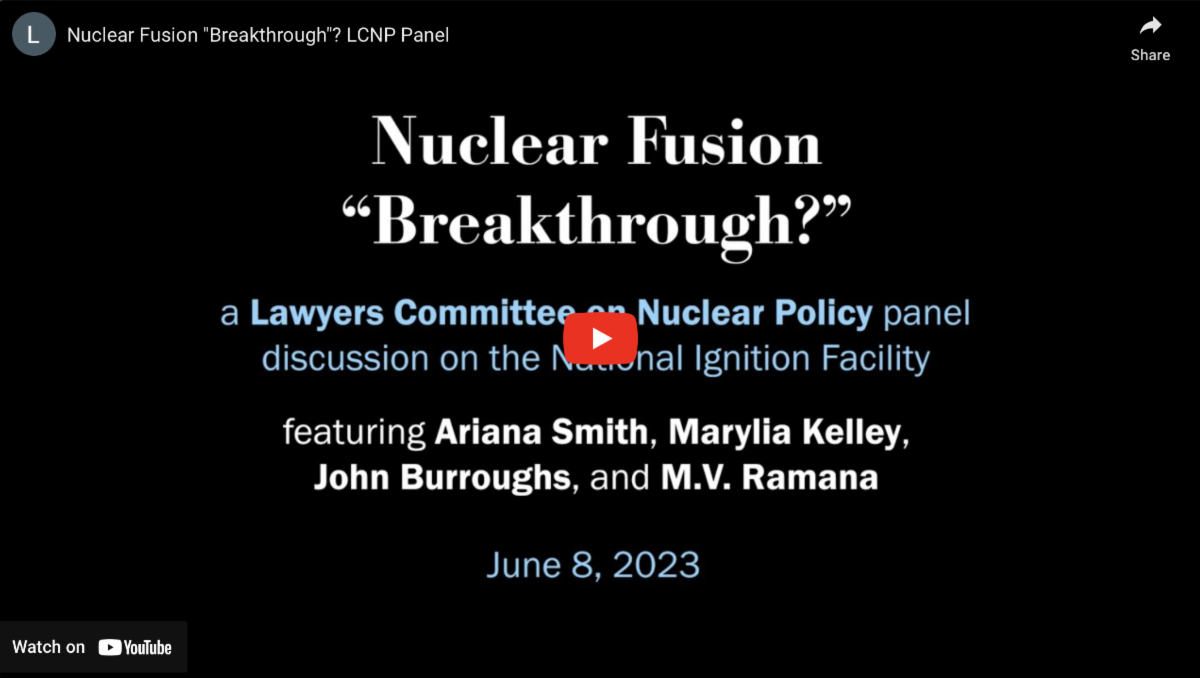 | |
In December 2022, the Lawrence Livermore National Laboratory and the US Department of Energy announced a "breakthrough" in nuclear fusion. An experiment at the National Ignition Facility (NIF) achieved fusion ignition, they reported. While the late-2022 development was largely framed in the media as a hopeful step forward for purportedly limitless nuclear energy purposes, crucial context is that this achievement (which, notably, has not since been replicated) took place at a facility meant to help maintain and support the US nuclear weapon stockpile. The NIF is the world's largest and highest-energy laser facility. It is funded by the Department of Energy's National Nuclear Security Administration, and its purpose, rooted in the Stockpile Stewardship Program, is primarily "to maintain the reliability, security, and safety" of US nuclear weapons without "full-scale" testing.
Lawyers Committee on Nuclear Policy invited esteemed colleagues for an informative discussion offering an overview the NIF's fusion achievement alongside an historical look at the Lawrence Livermore National Lab and its relevance to the US nuclear weapons program, an exploration of how this development implicates international law, and a critique of the relevance of the NIF to the development of nuclear fusion-driven energy.
Moderated by LCNP's Executive Director Ariana Smith, this event featured the following panelists:
Marylia Kelley, Executive Director and Co-Founder, Tri-Valley CAREs (Communities Against a Radioactive Environment), Livermore
Dr. John Burroughs, Senior Analyst, Lawyers Committee on Nuclear Policy (remarks)
Dr. M.V. Ramana, Professor and Simons Chair in Disarmament, Global and Human Security at the School of Public Policy and Global Affairs, University of British Columbia, and Graduate Program Director of its Master of Public Policy and Global Affairs program (remarks)
Click the video above or here to watch the event.
| |
LCNP Board member Elizabeth Shafer explores the multi-faceted, persistent issue of racism both in nuclear weapon development and testing as well as the nuclear policy field:
Racism has been deeply embedded for decades in nuclear issues, as in all areas, in the U.S. and internationally. This issue must be addressed and attitudes toward it—often subtle but always crucial—must be confronted to resolve this dilemma. In the wake of racial killings in the U.S., a group of authors wrote an article in 2020 exploring the importance yet difficulty of overcoming racism, and expanded their inquiry to the nuclear arena: “[h]owever, the nuclear community may find it difficult to hold its own institutions and community accountable for systemic racism.”
Read Elizabeth's full paper here.
| |
“Tactical Nuclear Arms in Belarus 'a Disturbing Development'” - via InDepthNews | 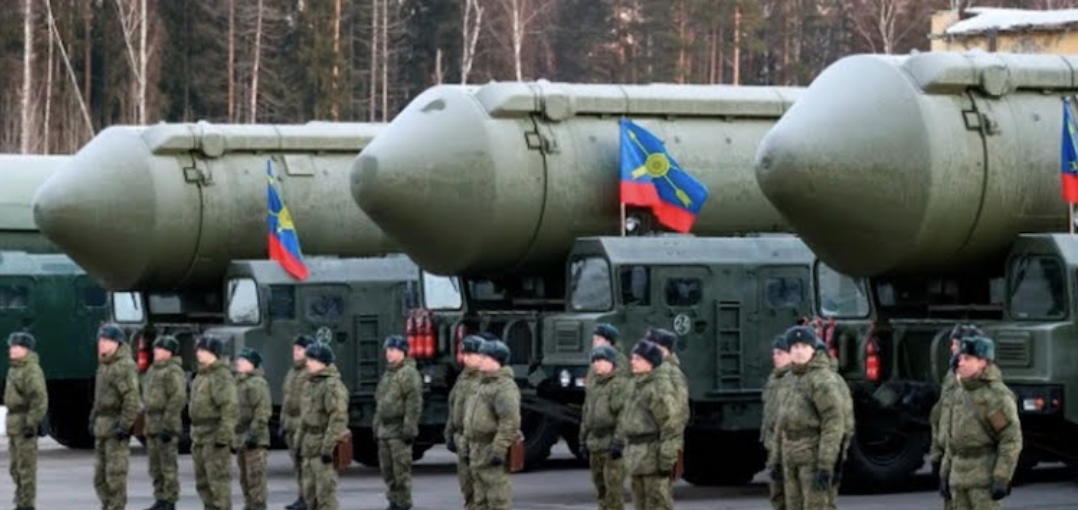 | |
IDN's Thalif Dean reports on developments in the Russia-Belarus nuclear sharing arrangement, including comments by Ariana Smith:
Russian President Vladimir Putin’s claim that he has moved his first batch of nuclear tactical weapons into Belarus last month has led to widespread speculation as to its implications and consequences. But how credible is this claim? Or is this the continued nuclear saber-rattling by Putin?
In a bygone era, Belarus has had a nuclear track record of 81 single warhead missiles stationed on its territory after the Soviet Union collapsed in 1991. In May 1992, Belarus acceded to the Nuclear Non-Proliferation Treaty (NPT), while the weapons were all transferred to post-Cold War Russia by 1996.
Ariana N. Smith, Executive Director, Lawyers Committee on Nuclear Policy and Director, UN Office of IALANA, told IDN Russia’s stationing of tactical nuclear weapons in Belarus “is a disturbing development in the ongoing war of aggression against Ukraine”.
“Nuclear sharing” agreements, which generally involve the deployment of a nuclear-armed state’s weaponry in a non-nuclear weapon state with procedures for delivery of the weapons by the non-nuclear state in a time of war, are incompatible with the Nuclear Non-Proliferation Treaty, she pointed out. “The Russia-Belarus arrangement dangerously escalates an already violent, illegal war rife with nuclear risk, placing the world in peril.”...Russia’s stationing weapons in Belarus, and Belarus’s accepting them, violates international law, said Smith. “It also presents an unacceptable threat to the already weakened state of global arms control and further increases the risk of nuclear weapons use in the conflict”, she declared....
UN Secretary-General António Guterres said in August 2022 that “We have been extraordinarily lucky so far. But luck is not a strategy. Nor is it a shield from geopolitical tensions boiling over into nuclear conflict”.
Today, said Guterres, humanity is just one misunderstanding, one miscalculation away from nuclear annihilation.”...
Elaborating further, Ariana Smith said Senators Graham and Blumenthal recently introduced a resolution that would deem a nuclear detonation by Russia in Ukraine an attack on NATO, invoking war with the US, and threatened “total obliteration” of Russian forces should Russia use a nuclear weapon or cause a nuclear disaster at Zaporizhia. “The language of deterrence and accompanying action, though, amounts to an existentially threatening game of chicken. All of this heightens the risk of not only an intentional nuclear attack, but also nuclear weapon use due to miscalculation or misinterpretation,” she argued. Part of the stated Russian defense of its arrangement with Belarus points to the alleged precedent set by the United States’ nuclear sharing agreements with certain NATO states. While the status of US sharing with NATO states predates the entry into force of the NPT, both US-NATO and Russia-Belarus nuclear sharing threatens further proliferation and should be ended as soon as practicable, declared Smith.
Read the full article here.
| |
Oppenheimer—A discussion with LCNP's John Burroughs
KPFA Sunday Show, July 30, 2023
John Burroughs and host Philip Muldari discuss the Christopher Nolan biopic on KPFA’s Sunday Show. They talk about what was good about the film, including its depiction of the vicious McCarthy-era sidelining of Robert Oppenheimer, leader of the effort to design the first atomic bombs but after World War II a voice for restraint. And they talk about what is missing, not least that the Manhattan project was a vast industrial enterprise for production of plutonium and uranium 235, not just scientists gathered together at Los Alamos, New Mexico to design the bombs.
Click here for the recording. (starts at 1:06:40)
| |
|
Abolition 2000 NWC Reset: Frameworks for Nuclear-Weapon-Free-World
Webinar Replay
| |
|
This online event explored the legal, technical, and institutional measures and frameworks to facilitate the global prohibition and elimination of nuclear weapons. This event includes discussion of a draft working paper to the 2023 Non-Proliferation Treaty Meeting entitled NWC Reset: Frameworks for a Nuclear-Weapon-Free World.
The draft working paper includes reflections on the political environment for comprehensive nuclear disarmament, an outline of three possible approaches for establishing the framework for a nuclear-weapon-free world, plus recommendations to the 2023 NPT PrepCom for the commencement of deliberations to achieve comprehensive nuclear disarmament within timebound commitments.
Chaired by Ariana Smith (USA), Executive Director, Lawyers Committee on Nuclear Policy
Featured Speakers:
Juergen Scheffran (Germany), Professor and chair of Research Group Climate Change and Security at Hamburg University. Co-Chair, International Network of Engineers and Scientists for Global Responsibility. Principal Drafter, 1997 Model NWC. NWC Reset Working Group Member
Elizabeth Shafer (USA), Board Member, Lawyers Committee on Nuclear Policy. Member, 1997 Model NWC Drafting Committee. NWC Reset Working Group Member
John Burroughs (USA), Senior Analyst, Lawyers Committee on Nuclear Policy. NWC Reset Working Group Member
Ivan Siluianov (Russia/Turkey). Secretary to the Abolition 2000 Coordinating Committee. Member, Youth Fusion.
Event video here.
| |
The first treaty to ban nuclear weapons was the Treaty of Tlatelolco, which protects all of Latin America and the Caribbean. Click here to access LCNP's Twitter thread on the treaty, or here to swipe through the Instagram slides. | |  |
The Treaty of Rarotonga was the second established nuclear weapon-free zone, covering the South Pacific. It introduced a new emphasis on maintaining a radioactive waste-free environment after the region was subject to extensive nuclear testing by the U.S., UK, and France. Click here to access LCNP's Twitter thread on the treaty, or here to swipe through the slides. | | |
|
-
The European Leadership Network "assess the dimensions of three possible scenarios in the event that the JCPOA cannot be revived: resumption of nuclear negotiations, building regional solutions, and regional conflict."
| | | | |