Elmo Peeler Note-for-Note Piano Transcriptions
|
|
|
Today is the first day of April and time again for my monthly newsletter, to keep you informed of recent transcriptions and other news of the last month.
|
|
 |
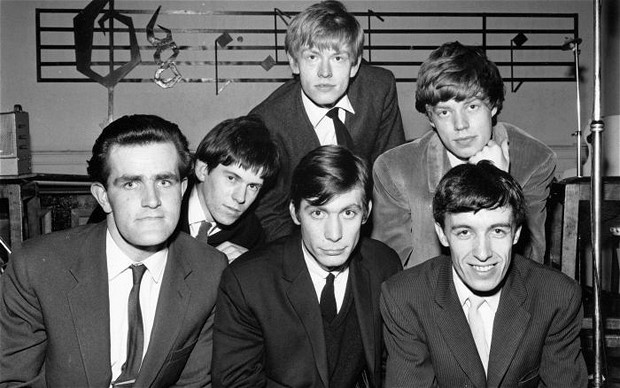
The Rolling Stones - early 1963
(Ian Stewart, far left)
|
|
Who co-founded a major rock band only to be asked to leave the band and become their Road Manager?
That would be Ian Stewart, the piano-player who co-founded the Rolling Stones along with guitarist Brian Jones.
This month we take a close look at Ian Stewart's boogie-rock piano solo in "Around and Around" from the Stones second album (pre-1965).
We'll also check out Keith Emerson's Instrumental Demo of "Lay Down Your Guns", which differs from the album version.
Plus, there's a new exercise to help with Right Hand tremolos. Learn to play them more relaxed and evenly.
BTW, to make sure that my email doesn't end up in your Spam folder, please add me to your Contact list and/or mark my email as "Not Spam".
Note that every Title Heading is clickable.
|
|
|
ALL of the Sheet Music listed on my website has been personally transcribed by me, and guaranteed to be note-for-note perfect.
Whether you:
-
have a cover band and want to get your keyboard parts exactly correct,
-
are a professional who wants to study the styles of rock's greatest keyboard players, or
-
are a hobbyist that wants to learn how to play pop/rock and great piano music,
...these note-for-note transcriptions will prove extremely helpful.
And as always, if you ever need any help, just drop me a note at: elmo@manymidi.com
|
In the News! - Ian Stewart, Co-founder of the Rolling Stones
Plus an Instrumental Demo of Keith Emerson
|
|
|
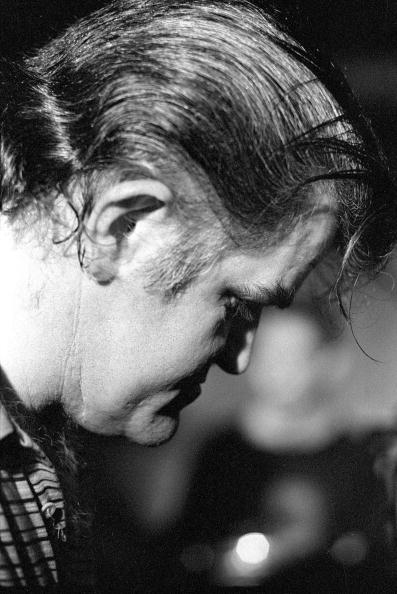
The great Ian Stewart,
co-founder of the Rolling Stones
|
|
Born in Scotland in 1938 and raised in London, Ian Stewart started playing piano when he was six. Stewart, who loved R&B, boogie-woogie, blues and big-band jazz, was the first to respond to Brian Jones' ad in
Jazz News in May 1962 seeking musicians to form an R&B group.
Also that May, Keith Richards met Stewart for the first time, as recalled in his auto-bio:
"I can hear this boogie-woogie piano, this unbelievable Meade Lux Lewis and Albert Ammons stuff. I'm suddenly transported in a way. I feel like
a musician and I haven't even got there! I could have been in the middle of Chicago, in the middle of Mississippi. I've got to go up there and meet this man who's playing this, and I've got to play with him. And if I don't measure up, it's over. That was really my feeling as I walked up those stairs,
creak creak creak. In a way I walk up those stairs and come down a different person.
"Ian Stewart was the only one in the room, with this horsehair sofa that was split, horsehairs hanging out. He's got on a pair of Tyrolean leather shorts. He's playing an upright piano and he's got his back to me because he's looking out of the window where he's got his bike chained to a meter, making sure it's not nicked. At the same time he's watching all the strippers going from one club to another with their little round hatboxes and wigs on. "Phoar, look at that." All the while this Leroy Carr stuff is rumbling off his fingers. And I walk in with this brown plastic guitar case. And just stand there. It was like meeting the headmaster."
In another interview Richards described meeting Stewart: "He used to play boogie-woogie piano in jazz clubs, apart from his regular job. He blew my head off too, when he started to play. I never heard a white piano player play like that before."
Mick Jagger joined in June, and the group played their first gig under the name "the Rollin' Stones" in July 1962.
|
|
|
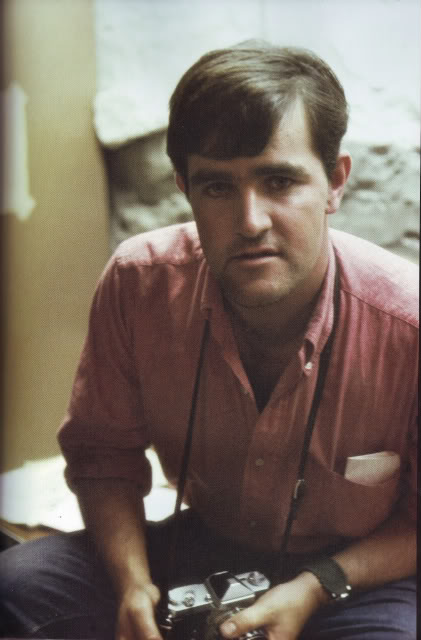
Ian Stewart with camera
|
During this period, Stewart had a job at Imperial Chemical Industries. None of the other band members had a telephone; Stewart said, "My desk at ICI was the headquarters of the Stones organization. My number was advertised in Jazz News and I handled the Stones' bookings at work." He also bought a van to transport the group and their equipment to their gigs.
In May 1963, the band's manager decreed that Stewart should no longer be onstage, that six members were too many for a popular group, and that the older, burly, square-jawed Stewart did not fit the image. He said Stewart could stay as road manager, however, and play piano on recordings, which Stewart accepted. Richards said: "Stu might have realized that in the way it was going to have to be marketed, he would be out of sync, but that he could still be a vital part. I'd probably have said, 'Well, fuck you', but he said 'OK, I'll just drive you around.' That takes a big heart, but Stu had one of the largest hearts around."
Stewart loaded gear into his van, drove the group to gigs, replaced guitar strings and set up Watts' drums the way he himself would play them.
He contributed piano, organ, electric piano and/or percussion to most of the Rolling Stones albums released between 1964 & 1986. Stewart played piano on numbers of his choosing throughout tours from 1969 to 1982. Favoring blues and country rockers, he remained dedicated to boogie-woogie and early R&B. He refused to play in minor keys, saying: "When I'm on stage with the Stones and a minor chord comes along, I lift my hands in protest."
Stewart remained aloof from the band's lifestyle. "I think he looked upon it as a load of silliness," said guitarist Mick Taylor. Stewart played golf, and as road manager showed a preference for hotels with golf courses. Richards recalls: "We'd be playing in some town where there's all these chicks, and they want to get laid and we want to lay them. But Stu would have booked us into some hotel about ten miles out of town. You'd wake up in the morning and there's the (golf) links. We're bored to death looking for some action and Stu's playing golf."
|
|
|
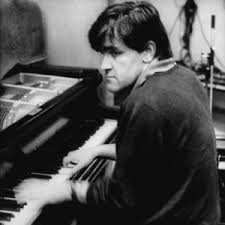
Ian Stewart playing Boogie-Woogie
|
|
Stewart contributed to Led Zeppelin's "Rock and Roll" from
Led Zeppelin IV and
"Boogie with Stu" from
Physical Graffiti, two numbers in a traditional rock and roll vein, both featuring his boogie-woogie style.
Stewart was involved in the 1985 recording for
Dirty Work, but by early December, began having respiratory problems. On December 12, 1985 he went to a clinic to have the problem examined, but suffered a heart attack and died in the waiting room. He was 47.
When
Dirty Work was released, it included at the very end in tribute to Stewart a hidden, unlisted track, "Key to the Highway", a 33-second piano boogie-woogie instrumental played by Stewart.
When the Stones were inducted into the Rock and Roll Hall of Fame in 1989, they requested Stewart's name be included.
Shortly after Stewart's death Mick Jagger said: "He really helped this band swing, on numbers like 'Honky Tonk Women' and loads of others. Stu was the one guy we tried to please. We wanted his approval when we were writing or rehearsing a song. We'd want him to like it."
In his 2010 autobiography
Life, Keith Richards says: "Ian Stewart. I'm still working for him. To me The Rolling Stones is his band. Without his knowledge and organization ... we'd be nowhere."
My Ian Stewart transcriptions:
My other Rolling Stones transcriptions:
|
|
|
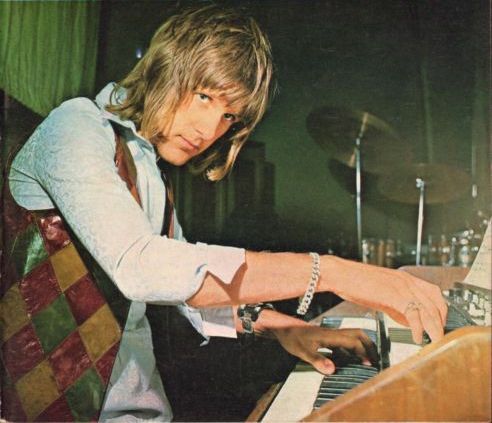
Keith Emerson
|
Born in England in 1944, Keith Emerson was encouraged by his father, an amateur pianist, to learn to read music and to play the piano. He referred to his first teachers as the "local little old ladies", from whom he began learning classical music around the age of eight.
Not owning a record player, he listened to the radio, enjoying Floyd Cramer's 1961 "On the Rebound", and boogie-woogie and country-style pianists, including Joe "Mr Piano" Henderson, Russ Conway and Winifred Atwell.
Emerson describes himself: "I was a very serious child. I used to walk around with Beethoven sonatas under my arm."
Emerson became interested in the Hammond organ after hearing jazz organist Jack McDuff perform "Rock Candy", and the Hammond became his instrument of choice in the late 1960s. Emerson acquired his first
|
|
|
Keith Emerson -
Independence of the Hands
|
|
Hammond organ, an L-100 model, at the age of 15 or 16, on the installment plan.
"My father... introduced me to Oscar Peterson, Art Tatum, Dudley Moore and many others. Mum and Dad didn't smoke or drink. It was a disciplined childhood. When I first went on the road, I wasn't into the rock-n-roll lifestyle. I didn't even like beer. Mum used to polish my L-100 as if it was a piece of furniture."
After leaving school he worked at Lloyds Bank where he played piano in a bar during lunchtimes. Outside work, he played with several different bands.
The flamboyance for which he would later be noted began when a fight broke out during a performance in France by one of his early bands. Instructed by the band to keep playing, he produced some explosion and machine gun sounds with the Hammond organ, which stopped the fight. The other band members told him to repeat the stunt at the next concert.
|
|
|
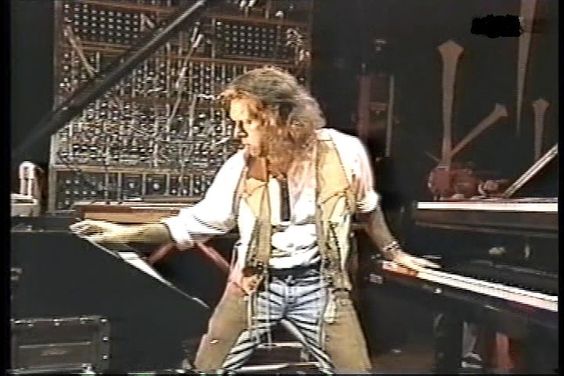
Keith Emerson
|
Emerson said, "I wanted to do for the keyboards what Hendrix, a friend, was doing for the guitar.
"There were lots of funny moments among the broken ribs and blown-off fingernails. When we were touring as Emerson, Lake & Powell [in 1986, with the late Cozy Powell on drums], I was playing this very complex arrangement based on Holst's Mars. One section was hard to remember, so I had a monitor set up above the keyboards with the score. I'm playing away and look up only to see the monitor showing a heavy Swedish porn video..."
It was this band, Emerson, Lake & Powell, that produced one of Emerson's most beautiful melodies and chord progressions, "Lay Down Your Guns".
While transcribing the complete piano part for
Keith Emerson's "Lay Down Your Guns" three months ago, I discovered a rare "Instrumental Demo" of LDYG that had been recorded earlier than the album version. It's in a different key, G (instead of E-flat), and contains enough different musical material that it needed to be transcribed, so that musicians could compare the transcription of the early demo with that of the
final album version and study Emerson's creative process.
This month I'm happy to offer my new note-for-note transcription of that earlier Instrumental Demo (in G) for "Lay Down Your Guns".
My Keith Emerson transcriptions:
|
Note-for-Note Accuracy
Ian Stewart is one of my favorite pianists to transcribe, because of his primal, non-polished approach to boogie-woogie. Keith Richards described Stewart's boogie-woogie playing,"There were loads of guys that were technically ten times better, but with his feel on the left hand, they could never get to where he was. He might have been the laird of Pittenweem, but his left hand came out of the Congo."
This month I've finished transcribing Ian Stewart's piano solo on a very early (1964) Rolling Stones recording, "Around and Around" from their second album,
12 X 5.
The piano doesn't come in until the first Chorus (after the first two Verses), but when it does, it's blazing boogie-rock from Ian Stewart's very first tremolo. The piano part in the Chorus sounds more like a piano solo than an accompanying part, and continues from the Chorus right into an energetic 24-bar boogie-rock piano solo (with guitar accompaniment).
This is a note-for-note transcription of Ian Stewart's wonderful piano solo (including Chorus 1) - a total of 36 bars of tremolos, sixths, thirds, crushed tones, octaves, and rocking rhythms.
In 1986 Keith Emerson formed Emerson, Lake & Powell, and released only one album, which included "Lay Down Your Guns" - one of his most beautiful recordings, concentrating more on lush chords, harmonies and beautiful melodies than his usual virtuoso display. I transcribed
the album version of that recording three months ago.
While doing research into the piece, I came upon an earlier, instrumental recording that, although it had similarities, it also had enough differences to prove quite interesting. And it happens to be in a different key, a Major 3rd higher than the album version (G instead of E-flat).
This is my brand-new note-for-note transcription of Keith Emerson's earlier-recorded (perhaps 1985) "Instrumental Demo" of "Lay Down Your Guns". If you'd like to study Emerson's creative process, how the composition evolved, or would just like to learn Emerson's own slightly different version of "Lay Down Your Guns", this is exactly what you need.
|
April's New Exercise
- Tremolos
One of the Most Important Techniques in Rock, Blues, and C&W
|
|
|
Vladimir Horowitz' hands
|
|
Relaxed, evenly-played tremolos are important for all pianists to master. They've been around since before Beethoven, who used them in his Sonatas. They were ubiquitous in silent-movie piano accompaniments. And they are commonly used in blues, C&W, boogie-woogie, and rock-and-roll. Every good rock pianist from Nicky Hopkins to Billy Powell has had them in their bag of tricks.
But they can be a little difficult to execute for many pianists. Often a pianist's forearm and/or wrist will tense and make the tremolo sound forced or uneven - not smooth and fluid.
This exercise eases the pianist into tremolos in 6ths by starting with slow tremolos, and gradually increasing their speed and number of notes per beat.
This contains four sections:
1) 8th notes
2) 8th-note triplets
3) 16th notes
4) 16th-note triplets
A suggested range of practice tempi, in BPM, is provided for each of the four sections. Plus, ten 'Performance Notes' with practice suggestions are included.
If your tremolos are not what you'd like them to be, this exercise should help.
(BTW, if you need other good, effective technical exercises, please check out
the other 61 exercises available.)
BTW, here is another exercise that can help with tremolos:
|
1960's Combo-Organ Classic
'Custom' (to-order) transcriptions can be expensive because of the time required. And when a recording is particularly long and/or complex, the expense can be too much for one person.
Fortunately, "CrowdFunding" (I use the term generically) has now succeeded four times with important transcriptions: first Ethel Caffie-Austin's "Amazing Grace", then Don McLean's "American Pie", then Johnny Rivers' "Rockin' Pneumonia". and most recently, Chuck Berry's "You Never Can Tell". Thanks very much to everyone that contributed.
The way it works is simple: Drop me a note and let me know how much you'd like to contribute.
No contributor will b
e allowed to pay in advance, but only after the transcription is finished and distributed to all the contributors and everyone is happy with it.
Last month I suggested CrowdFunding a rare "Instrumental Demo" of Keith Emerson's "Lay Down Your Guns". Although no one responded, fortunately the commissioner of my transcription of the album version of LDYG made it possible. And
here is the new transcription.
My new CrowdFunding suggestion is the terrific organ part in "Tall Cool One" by the Ventures. Many will be surprised to learn that the great organist on "Tall Cool One" was a 45-year-old black woman, Evelyn Freeman, sister of Ernie Freeman (who arranged the strings on "Bridge over Troubled Water").
"Tall Cool One" is only 2:32 long but has a wonderful organ part throughout, including several solos.
if you'd like to help 'crowdfund' a transcription of the classic organ part in the Ventures' "Tall Cool One".
My 'CrowdFunded' transcriptions to-date:
|
Johann Sebastian Bach's keyboard music can be outstanding for developing one's technique.
1) Bach's music is not chordal, but is comprised of independent lines ('voices') moving against each other (counterpoint), with some notes sustained while others are not. This develops independence of the fingers.
2) Bach's music requires great articulation, without using the sustain, i.e., damper, pedal, thus flaws can't be covered over or hidden.
So if you want to increase the independence of your fingers and your ability to clearly articulate runs and passages, practice Bach. Start with his 2-part Inventions and then listen to his Preludes & Fugues (which use up to 5 parts or 'voices) and learn your favorites.
I love Bach in all forms - his original of course, plus arrangements by Busoni, Hess, Briskier, etc. - and play/practice Bach daily.
If you'd like to explore Bach and improve your own technique in the process, I'll be happy to help you via Skype lessons.
I've had the good fortune to have
toured the world playing keyboards and arranging/conducting for these Rock and Roll Hall of Fame Artists:
- The Beach Boys
- Rod Stewart - All 'Unplugged' concerts
- Ricky Nelson - Stone Canyon Band
And I've also won classical piano competitions performing Beethoven,
Rubinstein a
nd
Saint-Saens' Piano Concerti. See me playing here. "Josie's Boogie" is quite the virtuoso dramatic mino
r-key showpiece; check out the ascending double-octave run at the ending... :)
Thanks to the internet, I can help you play piano better - rock or classical, by ear or by note.
Perhaps all you need is just an hour on Skype discussing rock keyboards.
If you'd like to improve, drop me a note
at
info@manymidi.com. Tell me three things:
1) Your musical background
2) Where you are currently, musically-speaking
3) Your musical goals
My students include members of:
- Weezer (Rivers & Brian)
- Vampire Weekend (Ezra & newest addition, Greta)
- Incubus (Mike)
- The Strokes (Nick)
- Rooney (Robert)
- Jason Schwartzman ("Mozart in the Jungle")
- Courteney Cox
|
|
|
|
|