Quarterly Newsletter

April 2025

CA Quits Highlights


CA Quits has been busy engaging with health systems and Medi-Cal managed care plans. Read below about the Department of Health Care Services’ 4/1 public hospital meeting and the CA Quits’ 3/19 Medi-Cal Managed Care Plan workgroup meeting. Check out the Education section for a study about how there are low advice rates for Medi-Cal smokers who do not yet report a chronic disease, and the Resource section for our new CA Quits Comprehensive Tobacco History Questionnaire for providers in our refreshed digital CA Quits Toolkit.

Health Systems

Moreen Sharma and Elisa Tong attended the annual California Department of Health Care Services (DHCS) Quality Incentive Pool program (QIP) conference for public hospitals on April 1, 2025 in Sacramento, CA.


The conference’s focus this year was collaboration through QIP public hospitals, Medi-Cal Managed Care Plans, and County Behavioral Health Plans. As Medi-Cal continues its CalAIM transformation, one featured afternoon breakout was Dr. Karen Mark talking about the birthing pathway and population health. Other afternoon sessions allowed for sharing around common concerns and areas of interest, such as data-sharing, collaboration, and problem-solving strategies. CA Quits was delighted to meet our past and current statewide partners and make new connections as well.

In 2025 the tobacco quality metric for the Department of Health Care Services' (DHCS) Quality Incentive Pool (QIP) program will include tobacco assessment and counseling for patients aged 12 years and older as one of their priority measures. This significant update to include ages 12-17 will allow healthcare providers to intervene with preventative counseling and education. In addition, it will identify earlier tobacco and e-cigarette/vape use and treatment options. We thank the Department of Health Care Services and public hospital leadership for supporting this update.


Reminder: The next CA Quits Tobacco Learning Collaborative for public hospital clinics will be 4/28/25. The topic will be on 2025 QIP Tobacco/Nicotine Screening.


For more information, please contact CA Quits Public Hospital Systems Coordinator, Moreen Sharma, mmsharma@ucdavis.edu.


Medi-Cal Managed Care Plans


On March 19, CA Quits hosted their first Medi-Cal Managed Care Plan (MCP) tobacco cessation workgroup meeting of 2025. This meeting highlighted components of the Department of Health Care Services (DHCS) key priorities for quality improvement, which include children's preventive care, maternity outcomes and birth equity, and behavioral health integration. Addressing tobacco and nicotine use across all three priorities improves health outcomes and reduces healthcare costs. MCPs shared their past and upcoming tobacco-related efforts to engage the members they serve and communities.


The DHCS's 2024 Consumer Assessment of Healthcare Providers and Systems (CAHPS®) Survey Summary Report shows 65.7% of Medi-Cal adults reported being advised to quit smoking or using tobacco by their provider, which is below the 50th percentile NCQA national benchmark. However, in 2024, only 1 out of 21 MCPs received the 100 responses required to report on this measure.


NCQA proposed a new HEDIS measure for tobacco use screening and cessation intervention. If approved, MCPs would be required to report on this measure in 2026, which would align with the DHCS public hospitals that currently report on this measure.


For more information about the MCP workgroup or if you are with an MCP and would like to participate, contact Shannon Haggitt, Plan & Partner Manager, srhaggitt@ucdavis.edu.

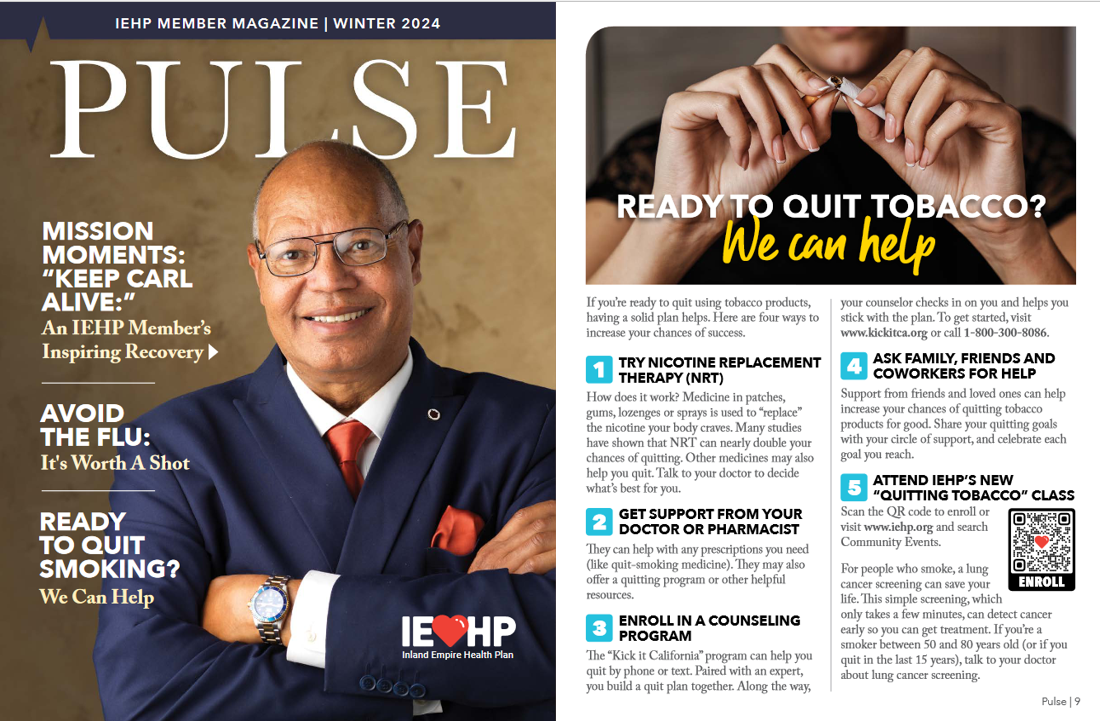
Inland Empire Health Plan’s PULSE Winter 2024 Member Magazine captured the attention of CA Quits and other partners, for their great informational page on helping their members to quit, including awareness of lung cancer screening. IEHP is happy to share their member newsletter with all of our partners!

EDUCATION

Study: Medi-Cal Members Have Tobacco Treatment Disparities by Chronic Disease Status


Drs. Tong and Valencia on our CA Quits team are co-authors on a new study published in AJPM Focus that analyzes the California Health Interview Survey showing that Medi-Cal members who smoke have differing advice rates depending on whether or not they report a chronic disease. Study findings below:


  • California Medicaid members have higher tobacco-use rates and chronic diseases.
  • Half of California Medicaid's 1.5 million smokers report not yet having a chronic disease (e.g., hypertension, diabetes, asthma, or heart disease).
  • However, only a third of smokers without a chronic disease were advised to quit.
  • Smokers with a chronic disease were twice as likely to be advised to quit.
  • California Medicaid needs to improve prevention, not just treatment, of disease.
Read more

Study: Innovative 211 Partnership Helps Low-Income Tobacco Users Quit


By connecting with local 211 agencies, Kick It California, California's free quitline, a study published in Nicotine Tobacco Research shows KIC was able to reach thousands of tobacco users who were mostly Medi-Cal members. This project was funded by the California Tobacco Prevention Program.


The study’s key findings were:


  • Between April 2021 and December 2023, 55,151 individuals were referred to Kick it California through this incentive program.


  • 82% of people referred by 211 and incentivized (earn a $20 gift card) by 211 were Medi-Cal members.


  • 211-referred participants were more than twice as likely to enroll in quitline services compared to those referred by a health care clinic. They were also more likely to complete a first counseling session.


  • On average, 211-referred participants completed the same number of sessions as clinic-referred and self-referred participants without any further incentives beyond the initial $20.


  • All three groups had similar success rates when it came to actually quitting.


Read more

Study: Vaping Does Not Help U.S.

Tobacco Smokers Quit


A new study published in JAMA Network Open from UC San Diego researchers settles a longstanding question: Does vaping help you quit? According to their results, the answer is no.


The study found:

  • Smoking cessation was actually 4.1% lower among smokers who vaped daily.
  • Similarly, smoking cessation was 5.3% lower among smokers who vaped, but not daily, compared to matched smokers who did not vape.
Read More
 

Study: Tobacco Product Use Trends among U.S. Adults Shows Increased Vaping Offsets Lower Smoking Rates


CDC's MMWR (Morbidity and Mortality Weekly Report) using National Health Interview Survey shows adult tobacco use trends in 2017-2023:


"During 2017–2023, the approximate 6.8 million-person decrease in the number of adults who currently exclusively smoke cigarettes was offset by an approximate 7.2 million person increase in the number who currently exclusively use e-cigarettes [...]. While current cigarette smoking has decreased to the lowest level in 60 years, current tobacco product use among adults has not changed since 2017."

Read more

NEWS


Press Release: CDC Cuts Will Devastate State Quitlines and Efforts to Help Tobacco Users Quit, Leading to More Tobacco-Caused Disease and Death


The North American Quitline Consortium issued a press release about the potential impact on funding of state quitline and tobacco program activities with the elimination of the Centers for Disease Control's Office of Smoking and Health.

Read more

RESOURCES


  • 4/23/25 (Webinar) - AMPLIFY! African American Coordinating Center is hosting a tobacco cessation webinar Let's Grind and Leave Tobacco Behind! Some of the topics include: Explore the impact of the community takeover event and its community engagement strategies and how to plan a successful fitness-based tobacco control event.


CA Quits | www.caquits.com.

Subscribe to our e-newsletter