The American Society of Le Souvenir Français Inc.
Monthly Bulletin - Vol. III. No 5 - May 2023
|
|
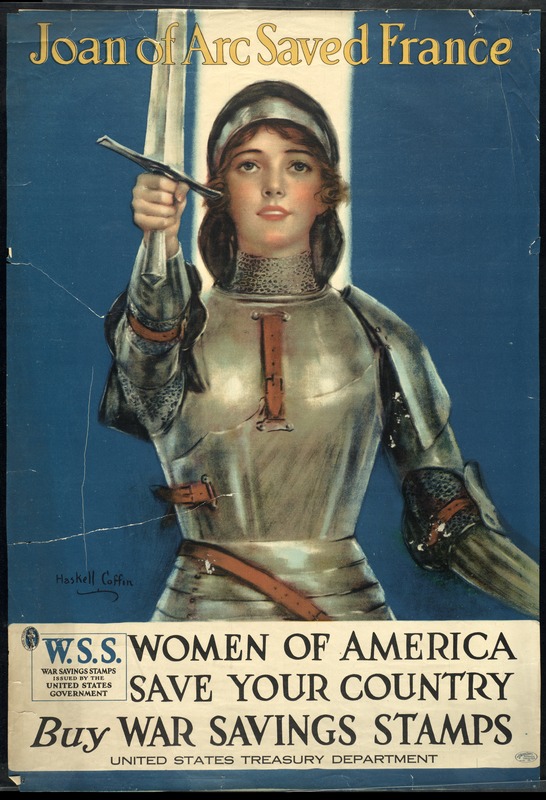
Cover illustration: Joan of Arc saved France--Women of America, save your country--Buy War Savings Stamps / Haskell Coffin by The United States Printing & Lithograph Co., [1918], Library of Congress Prints and Photographs Division, Public Domain
|
|
EDITORIAL
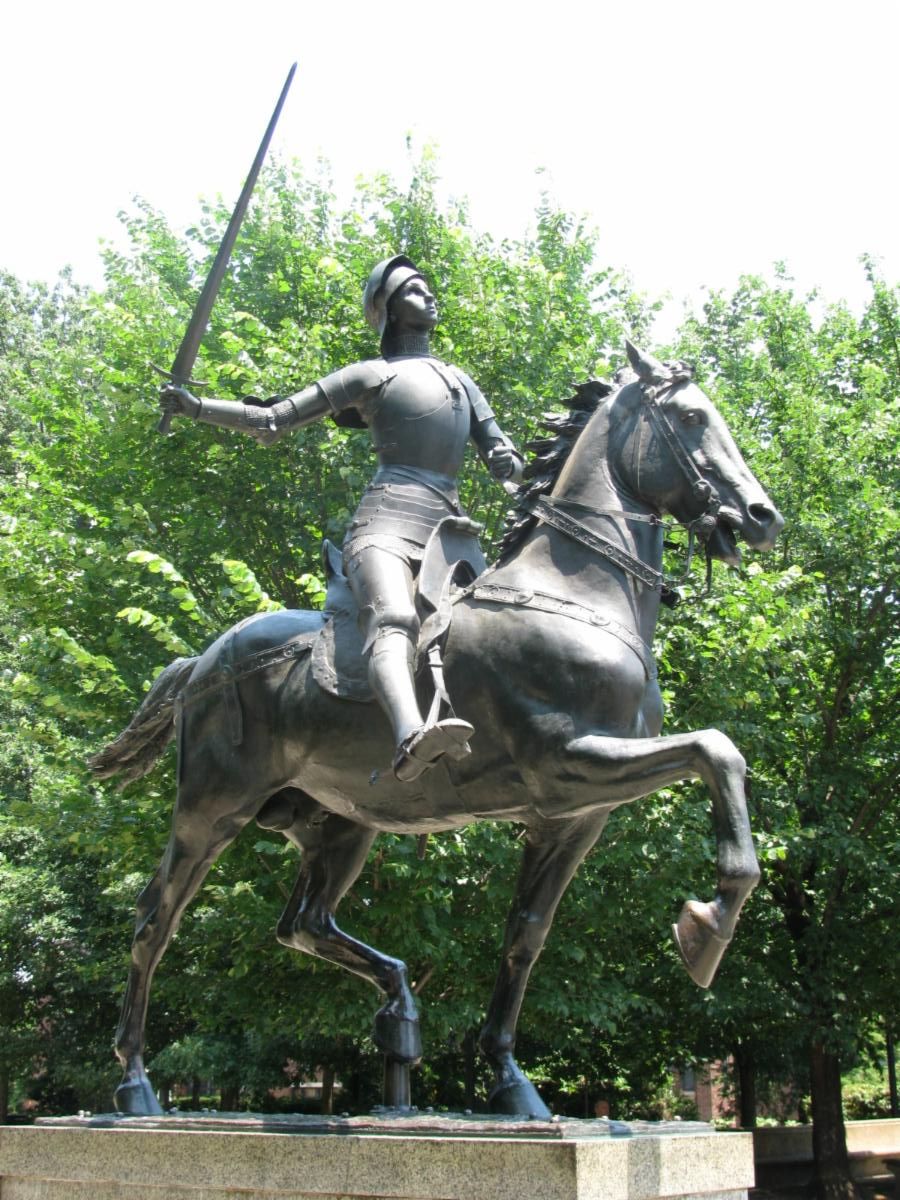
How and why would a French medieval hero be a popular figure in the United States? With majestic equestrian statues coast-to-coast in large cities such as Portland, San Francisco, New Orleans, Washington DC, Philadelphia, New York, and even more modest ones such as Gloucester, MA, or Farmville, VA, one can say that Joan of Arc has left quite an imprint. Furthermore, with hundreds, if not thousands, of sculptures in numerous churches named Joan of Arc (more than in France!) as well as in universities and schools, this symbol of France has been adopted in many ways in the United States.
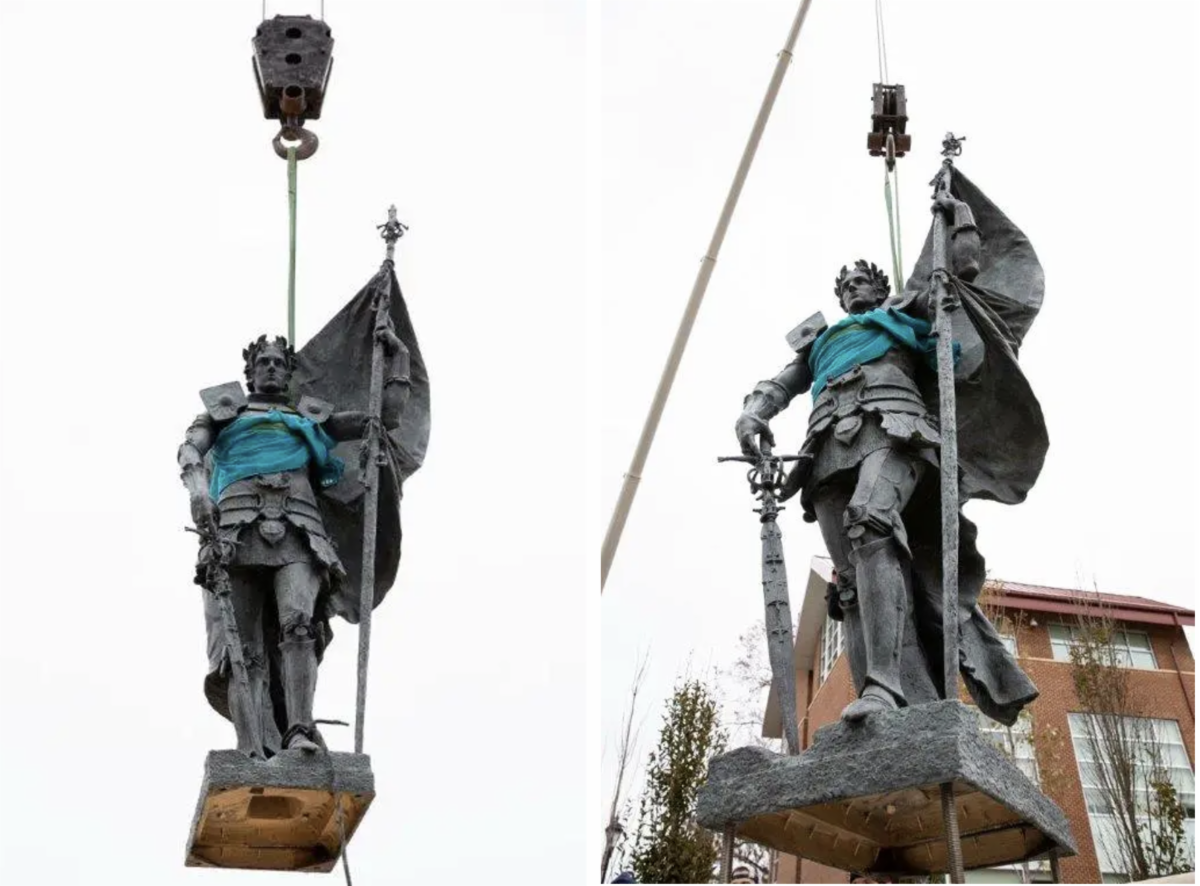
And this is not just a faint echo of a distant past... Witness the recent inauguration (2018) of a statue of Joan of Arc at Longwood University, Virginia, by Alexander Stoddart, the renowned Scottish sculptor who was until recently the Queen's Sculptor in Ordinary...
If you venture a bit on the internet, there are many questions such as:
"Why is St. Joan of Arc famous"? "How does Joan of Arc inspire us today"?
"What impact did Joan of Arc have on the world"? or... "Was Joan of Arc a feminist"?...
This Bulletin does not aim at writing a thesis about the hero Saint. And, full disclosure: we are admittedly slightly old-fashioned and do not use ChatGPT... We simply wish to highlight several sites in our vast nation where you can experience the radiant power of this historical figure, and hopefully get inspired, like generations of Americans before us.
Further down in these pages, we will continue to follow general Lafayette on some of his footsteps during the month of May 1825. Under the leadership of our friends and partners at the American Friends of Lafayette, several Committees are busy preparing the upcoming bicentennial of his triumphant tour all over 24 States. In dozens of cities, there will be exact reenactments of speeches, banquets, receptions, and other processions which left a long-lasting mark on all those who witnessed the moving Farewell Tour of America's best friend.
As always, at this end of this Bulletin we will announce other upcoming events from like-minded organizations that are of great interest to our members and sympathizers.
Thank you for your remarks, suggestions and support. Thank you also for your donations. We will soon send an illustrated recap of all our activities and exciting project as part of our mid-year membership call.
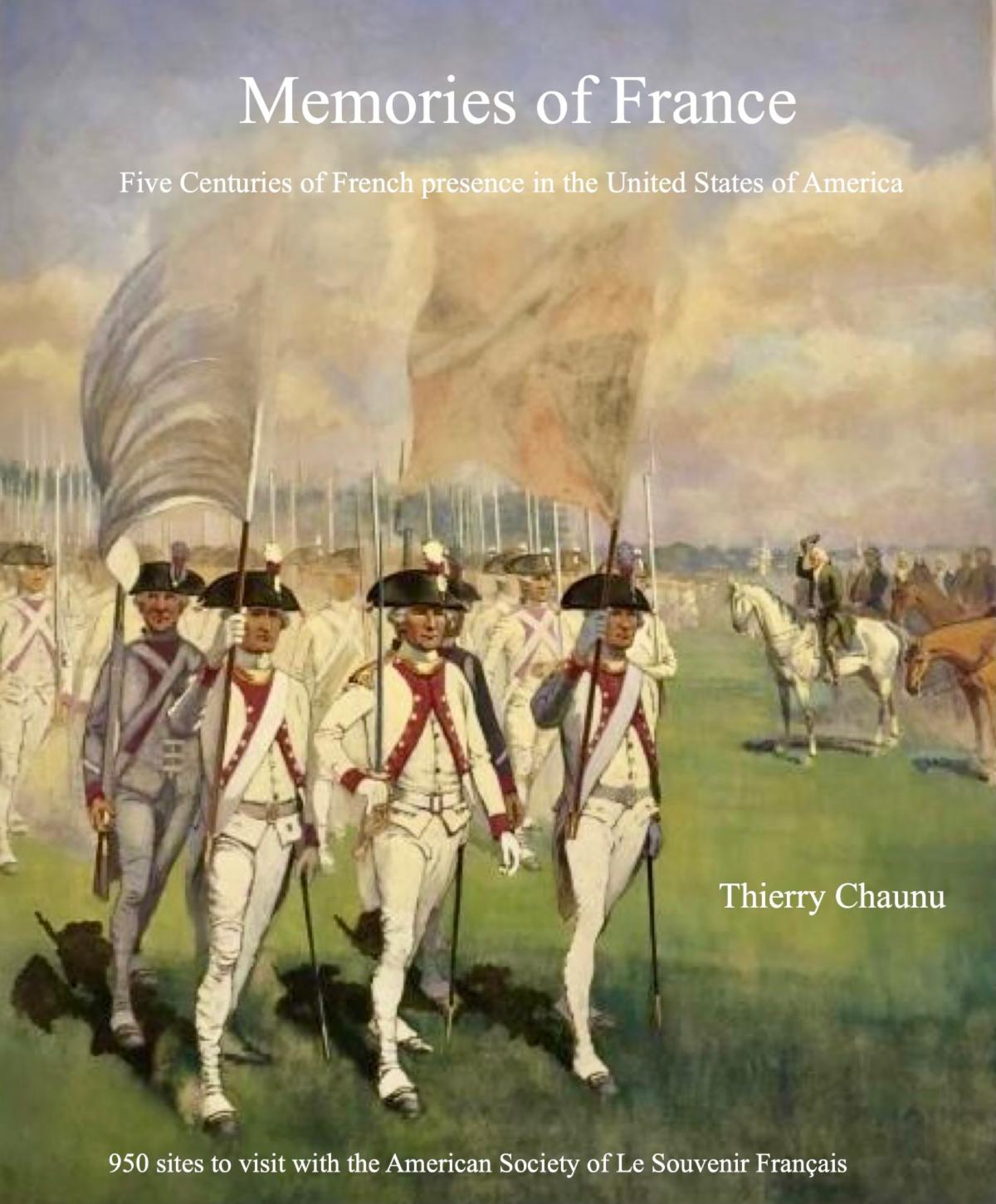
Another way to support us is to buy the e-book Memories of France at: Amazon.com. All royalties go to your Society.
On behalf of the Board of Directors,
Thierry Chaunu, President,
American Society of Le Souvenir Français, Inc.
|
|
Why is St. Joan of Arc famous in the USA? |
|
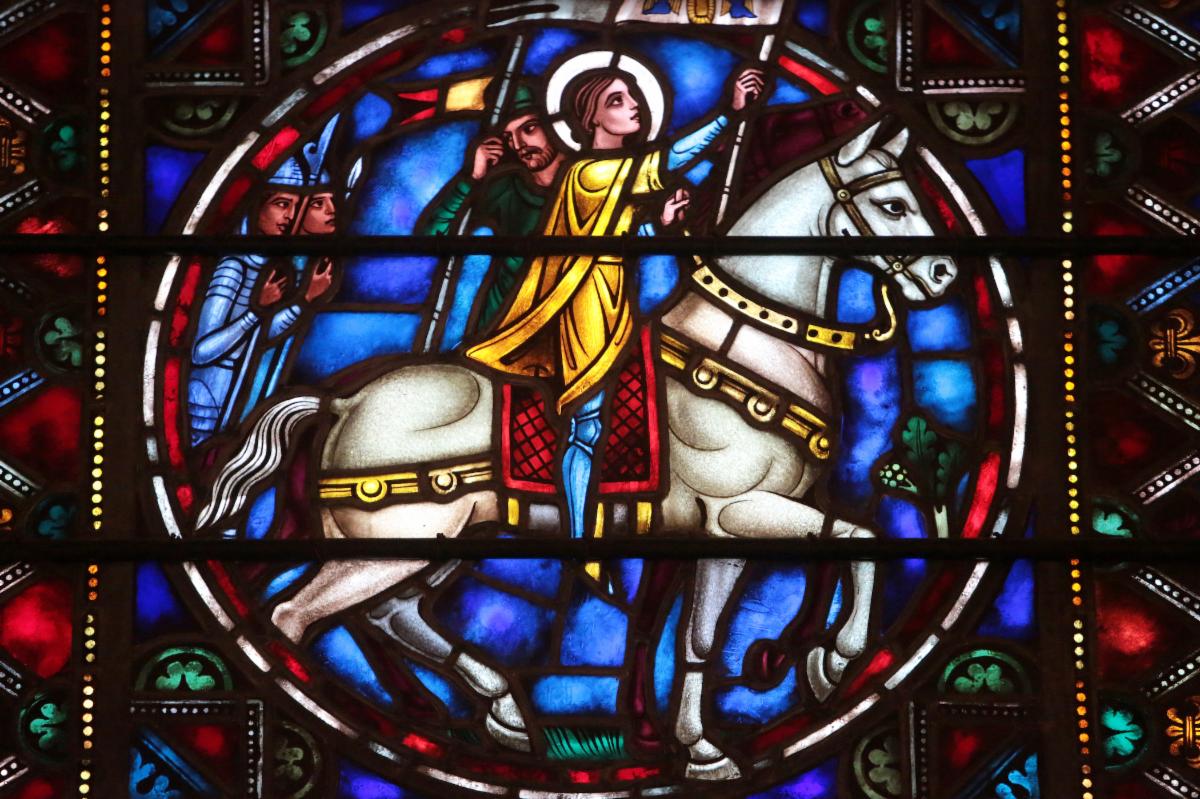
St. Bartholomew's Episcopal Church, 325 Park Ave, New York, NY 10022
This colorful stained-glass windows by Hildreth Meiere (1892-1961) depicts Joan of Arc on a horse. St. Bartholomew's Episcopal Church, commonly called St. Bart's, is a historic Episcopal parish founded in January 1835. Photo Licensed from iStock #2090645509
|
|
Who was Jeanne d'Arc? To be fair play, let us quote the Encyclopedia Britannica:
"St. Joan of Arc, byname the Maid of Orléans, French Sainte Jeanne d’Arc or La Pucelle d’Orléans, (born c. 1412, Domrémy, Bar, France—died May 30, 1431, Rouen; canonized May 16, 1920; feast day May 30; French national holiday, second Sunday in May), national heroine of France, a peasant girl who, believing that she was acting under divine guidance, led the French army in a momentous victory at Orléans that repulsed an English attempt to conquer France during the Hundred Years’ War. Captured a year afterward, Joan was burned to death [...] as a heretic. She became the greatest national heroine of her compatriots, and her achievement was a decisive factor in the later awakening of French national consciousness"
This, of course, does not explain why Americans would be interested in this medieval historical figure. As stated above, we won't be writing a thesis. Instead, we will simply read the inscriptions on the monument or markers themselves, as well as the published press articles at the time of their installation, to start understanding the complex dynamics at play between patriotism and faith, geopolitical and social considerations.
We will therefore take a tour of some major Joan of Arc sculptures coast-to-coast.
Saddle up!..
|
|
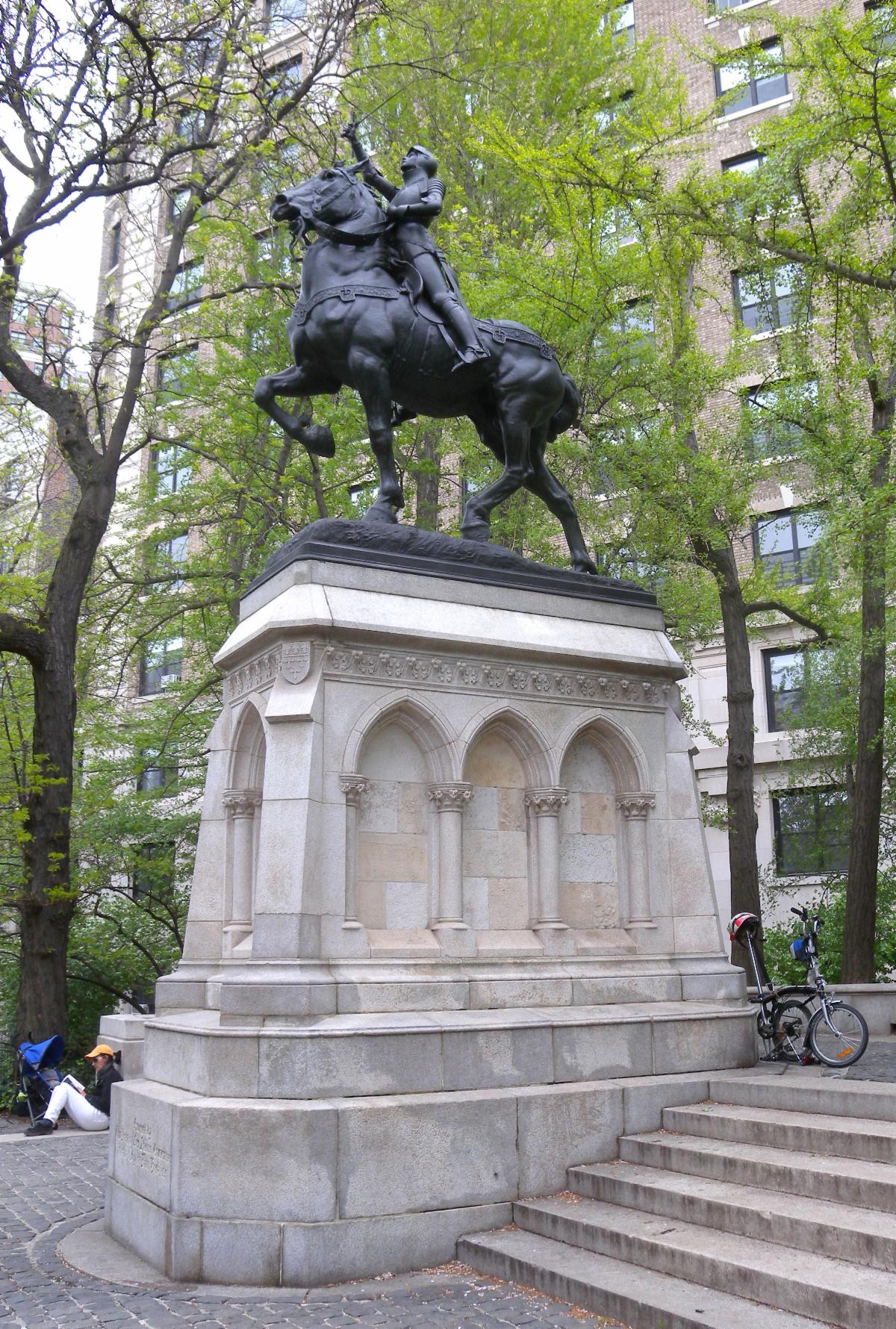
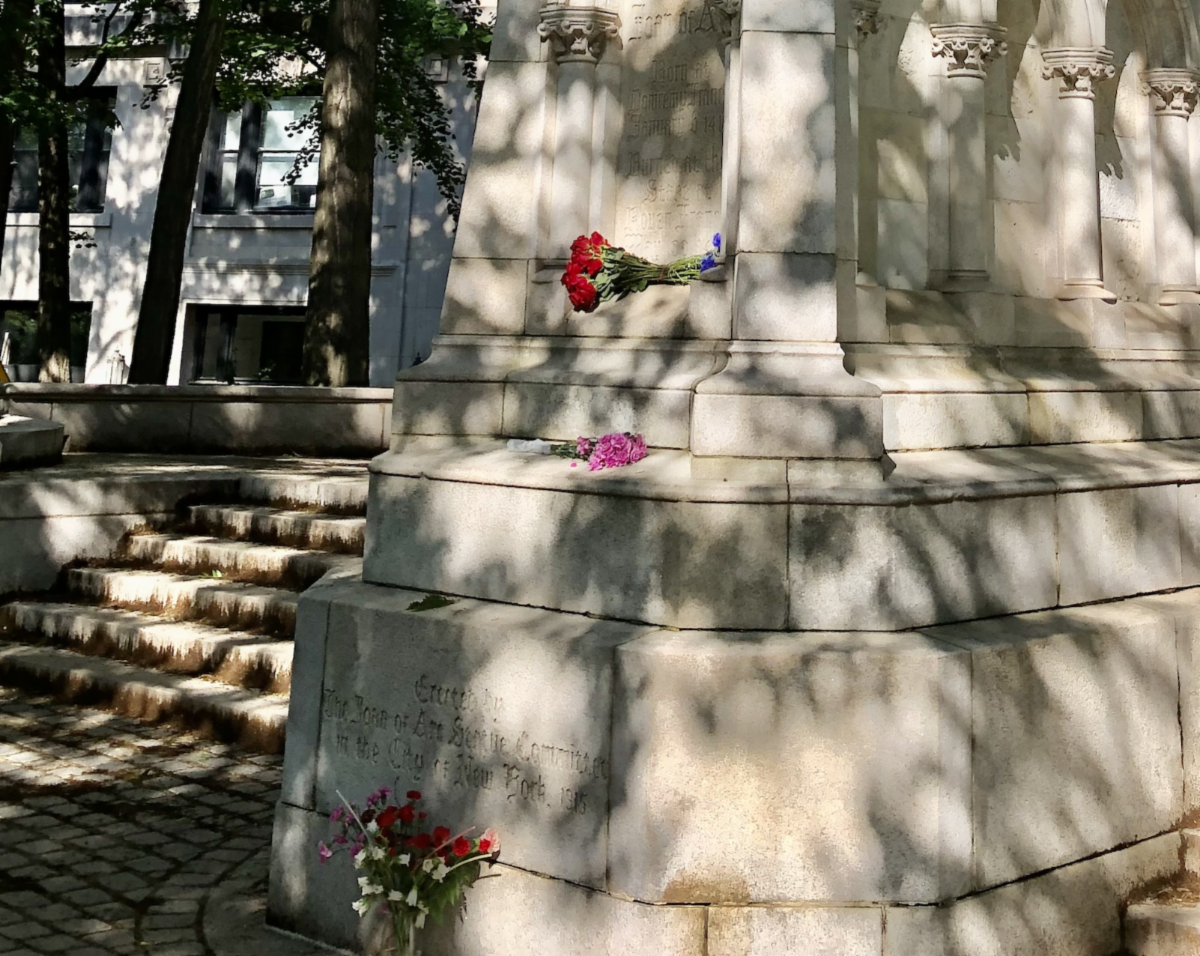
Statue of Joan of Arc, Riverside Park, New York City, NY
(1909 - 1915) - Spiritual tribute from private citizens
|
|
Statue of Joan of Arc, Riverside
Riverside Drive & W. 93rd St Joan of Arc Park, New York, NY 10025
Photos: top by Jim Henderson - Own work, CC0,
https://commons.wikimedia.org/w/index.php?curid=10579700
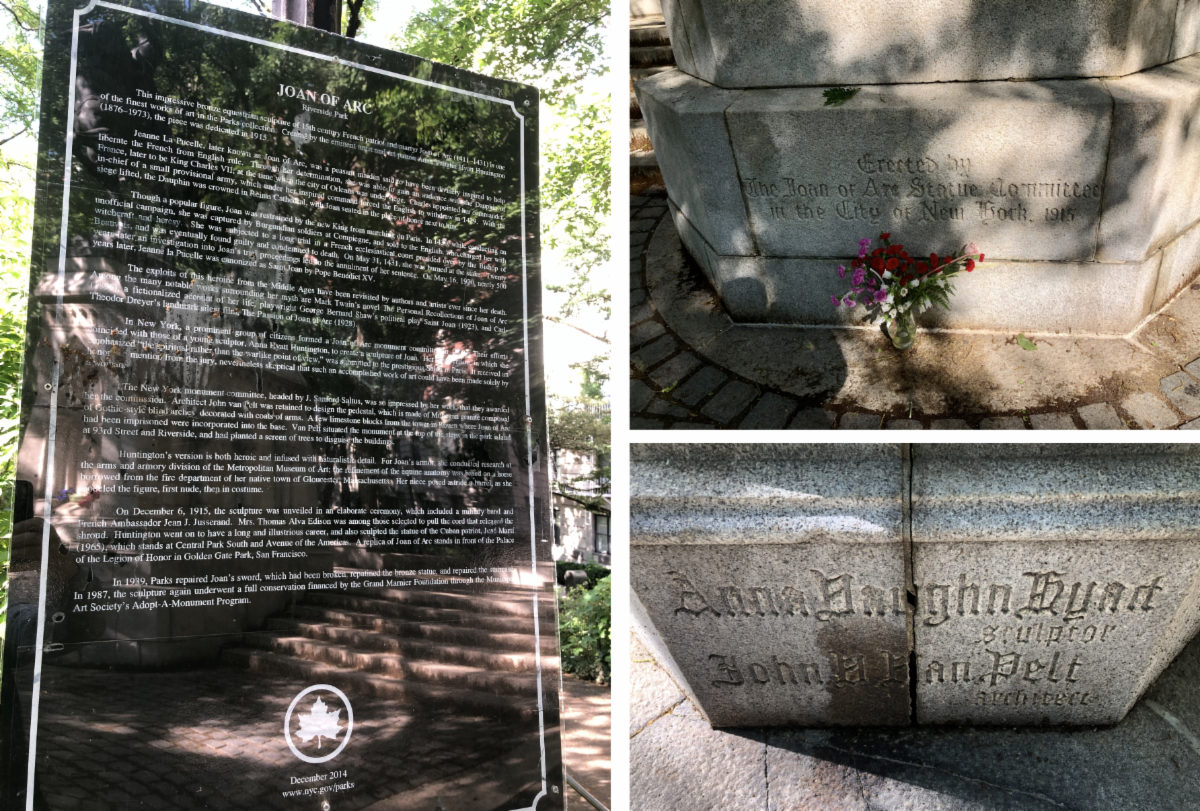
Photos: middle and bottom by Thierry Chaunu, May 31, 2021
It is telling to see that on these photos, anonymous New Yorkers came to lay some bouquets of flowers at the feet of Joan of Arc. These photos were taken, incidentally, on May 31, 2021, the day of celebration of the Saint.
|
|
The sculpture aims at emphasizing “the spiritual, rather than the warlike point of view”, as explained by the artist.
• Specifications:
• Sculptor: Anna Vaughn Hyatt Huntington
• Architect: John V. Van Pelt
• Description: Equestrian figure (over life-size) on integral plinth on pedestal
• Materials: Bronze, Mohegan granite
• Dimensions: Total H: 20'4" W: 6'1" D: 12'3"
• Cast: by the Gorham Manufacturing Company to one-and-a-half-times life size.
• Inscription on the pedestal:
JOAN OF ARC / BORN AT / DOMREMY FRANCE / JANUARY 6TH,1411 / BURNED AT THE / STAKE AT / ROUEN, FRANCE / MAY 30TH, 1431/
ERECTED BY / THE JOAN OF ARC STATUE COMMITTEE / IN THE CITY OF NEW YORK 1915.
• Inscription on the marker from the City of New York:
"Joan of Arc - Riverside Park"
• "This impressive bronze equestrian sculpture of 15th century French patriot and martyr Joan of Arc (1411-1431) is one of the finest works of art in the Parks collection. Created by the eminent artist and patron Anna Vaughn Hyatt Huntington (1876-1973), the piece was dedicated in 1915.
Jeanne La Pucelle, later known as Joan of Arc, was a peasant maiden said to have been divinely inspired to help liberate the French from English rule. Through her determination, she was able to gain an audience with the Dauphin of France, later to be King Charles VII, at the time when the city of Orleans was under siege. Charles appointed her commander-in-chief of a small provisional army, which under her inspired command forced the English to withdraw in 1429. With the siege lifted, the Dauphin was crowned in Reims Cathedral, with Joan seated in the place of honor next to him.
Though a popular figure, Joan was restrained by the new King from marching on Paris. In 1430, while conducting an unofficial campaign, she was captured by Burgundian soldiers at Compiegne, and sold to the English, who charged her with witchcraft and heresy. She was subjected to a long trial in a French ecclesiastical court presided over by the Bishop of Beauvais, and was eventually found guilty and condemned to death. On May 1431, she was burned at the stake. Twenty years later an investigation into Joan’s trial proceedings led to the annulment of her sentence. On May16, 1920, nearly 500 years later, Jeanne la Pucelle was canonized as Saint Joan by Pope Benedict XV.
The exploits of this heroine from the Middle Ages have been revisited by authors and artists ever since her death. Among the many notable works surrounding her myth are Mark Twain’s novel The Personal Recollections of Joan of Arc (1896), a fictionalized account of her life, playwright George Bernard Shaw’s political play Saint Joan (1923), and Carl Theodor Dreyer’s landmark silent film, The Passion of Joan of Arc (1928).
In New York, a prominent group of citizens formed a Joan of Arc monument committee in 1909. Their efforts coincided with those of a young sculptor, Anna Hyatt Huntington, to create a sculpture of Joan. Her first version in which she emphasized “the spiritual, rather than the warlike point of view”, was submitted to the prestigious Salon in Paris. It received an honorable mention from the jury, nevertheless skeptical that such an accomplished work of art could have been made solely by a woman.
The New York monument committee, headed by J. Sanford Saltus, was so impressed by her work, that they awarded her the commission. Architect John van Pelt was retained to design the pedestal, which is made of Mahogany granite composed of Gothic-style blind arches decorated with coats or arms. A few limestone blocks from the tower in Rouen where Joan of Arc had been imprisoned were incorporated into the base. Van Pelt situated the monument at the top of the steps int eh park island at 93rd Street and Riverside, and had planted a screen of trees to disguise the buildings.
Huntington’s version is both heroic and infused with naturalistic detail. For Joan’s armor, she conducted research at the arms and armory division of the Metropolitan Museum of Art; the refinement of the equine anatomy was based on a horse borrowed from the fire department of her native town of Gloucester, Massachusetts. Her niece posed astride a barrel, as she modeled the figure, first nude, then in costume.
On December 6, 1915, the sculpture was unveiled in an elaborate ceremony, which included a military band and French Ambassador Jean J. Jusserand. Mrs. Thomas Alva Edison was among those selected to pull the cord that released the shroud. Huntington went on to have a long and illustrious career, and also sculpted the statue of the Cuban patriot, José Martí (1965), which stands at Central Park South and Avenue of the Americas. A replica of Joan of Arc stands in from tof the Palace of the Legion of Honor in Golden Gate Park, San Francisco.
In 1939, Parks repaired Joan’s sword, which had been broken, retained the bronze statue, and repaired the staircase. In 1987, the sculpture again underwent a full conservation financed by the Grand Marnier Foundation through the Municipal Art Society’s Adopt-A-Monument Program."
Other noteworthy facts:
• It is the city's first monument ever dedicated to a historical woman.
• French Ambassador to the United States Jean Jules Jusserand, who spoke at its dedication on December 6, 1915, went on to win the first Pulitzer Prize in 1916 for his historical essay "With Americans of Past and Present Days"
• The $35,000 ($937,500 in 2023) needed to erect the statue was donated by numismatist J. Sanford Saltus, namesake of the American Numismatic Society's Saltus Award.
• Sculptor Anne Huntington was catapulted into the international spotlight after the statue was unveiled with such dignitaries as Mina Edison, Thomas Edison's second wife. It earned Anna Hyatt Huntington the Legion of Honor.
|
|
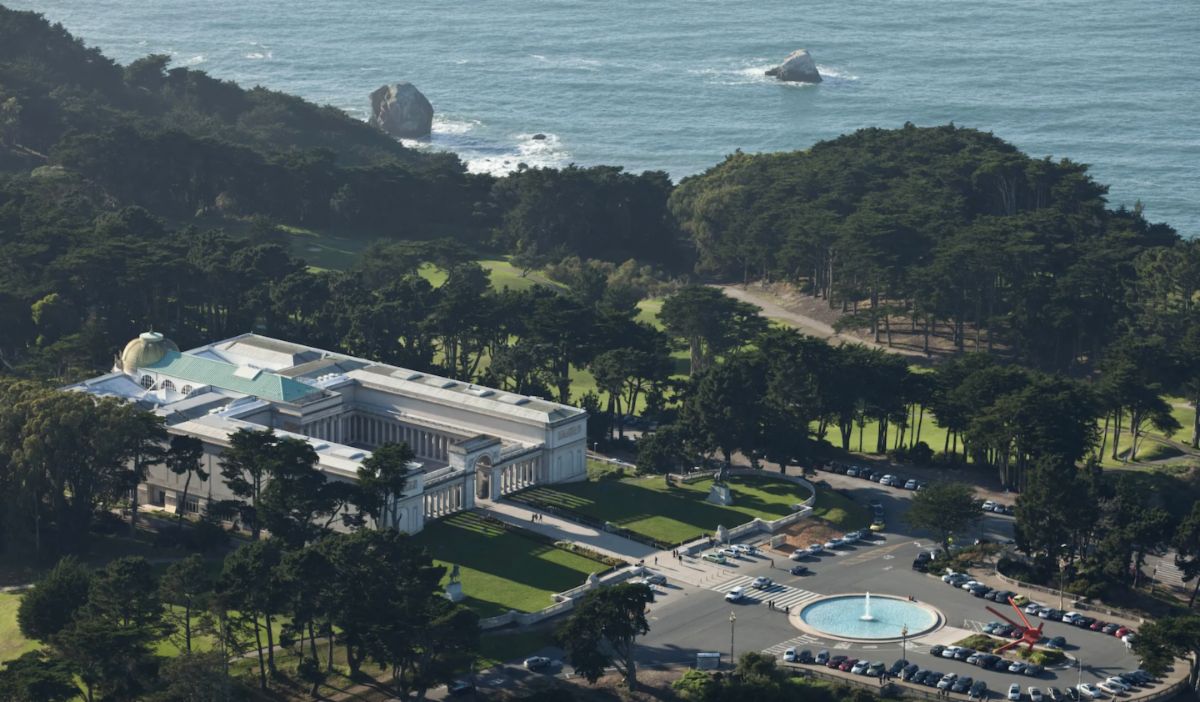
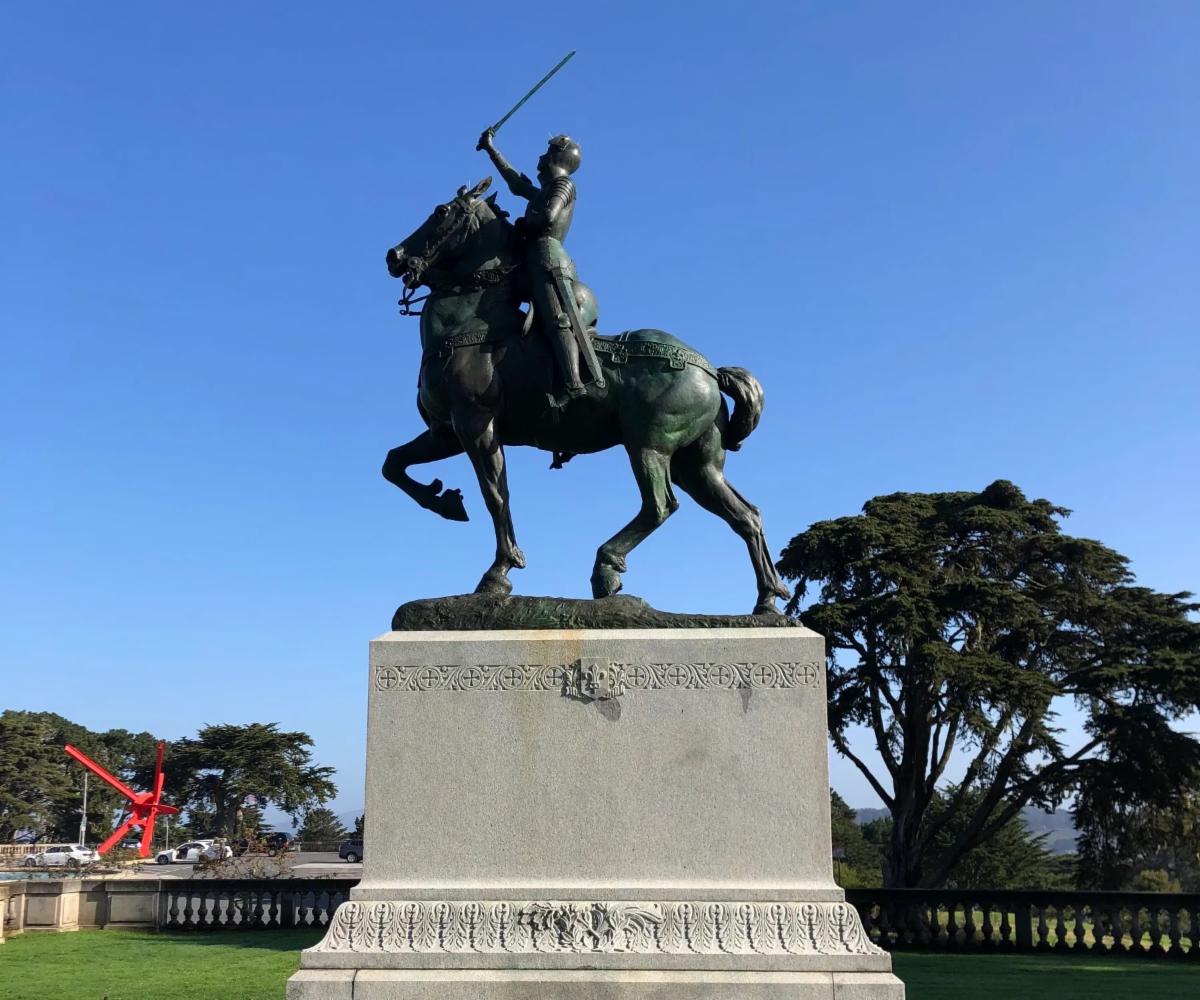
Statue of Joan of Arc, San Francisco, California
(1926) Donation of the artist
|
|
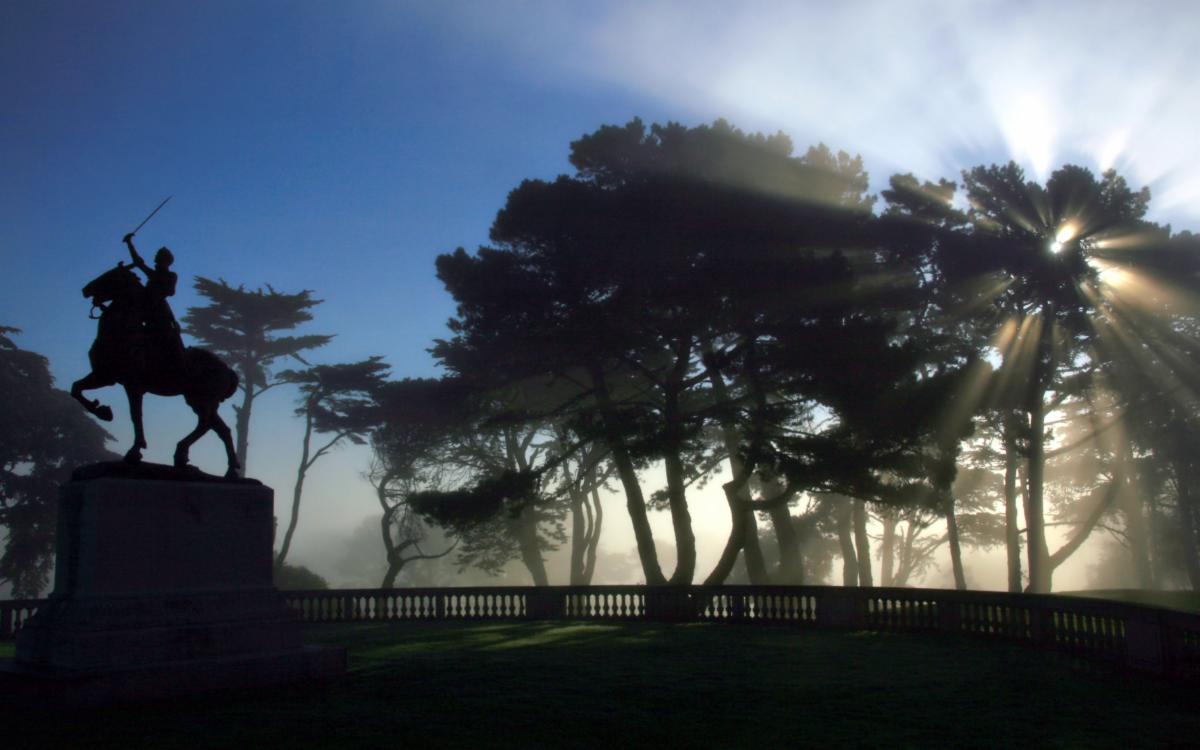
Statue of Joan of Arc, Maid of Orleans, San Francisco, CA Legion of Honor museum
Lincoln Park, 100 34th Avenue, San Francisco, CA 94121
GPS: 37.784667,-122.499814
Top and Middle: Photos Fine Arts Museums of San Francisco
https://www.famsf.org/stories/conserving-anna-vaughn-hyatt-huntington-s-joan-of-arc-at-the-legion-of-honor
Bottom: Photo by Brocken Inaglory, CC BY-SA 3.0,
https://commons.wikimedia.org/w/index.php?curid=5932820
|
|
• The Legion of Honor, formally known as the California Palace of the Legion of Honor, is an art museum in San Francisco, California.
• The sculpture is a work by Anna Vaughn Hyatt Huntington, and donated by the artist and her husband, Archer Huntington, in 1926, just a few years after their marriage and the opening of the Legion of Honor.
• It is one of five full-scale casts of the statue.It was first exhibited at the Salon in Paris in 1910. The original cast from 1915 is in Riverside Park in New York City (see slide above).
Three others stand in public sites in Gloucester, Massachusetts (where Hyatt lived and maintained a studio); Québec City, Québec, and Blois in France.
• The statue won Anna the Legion of Honor from the French government in 1927.
• It was extensively restored in 2019. Click on the photos and links above to read an in-depth account of the restoration process.
|
|
Statue of Joan of Arc in Portland, Oregon
(1924) in honor of the doughboys of World War I
|
|
Statue of Joan of Arc, Portland, OR
Coe Circle (at NE 39th & Glisan), Portland, OR 97232
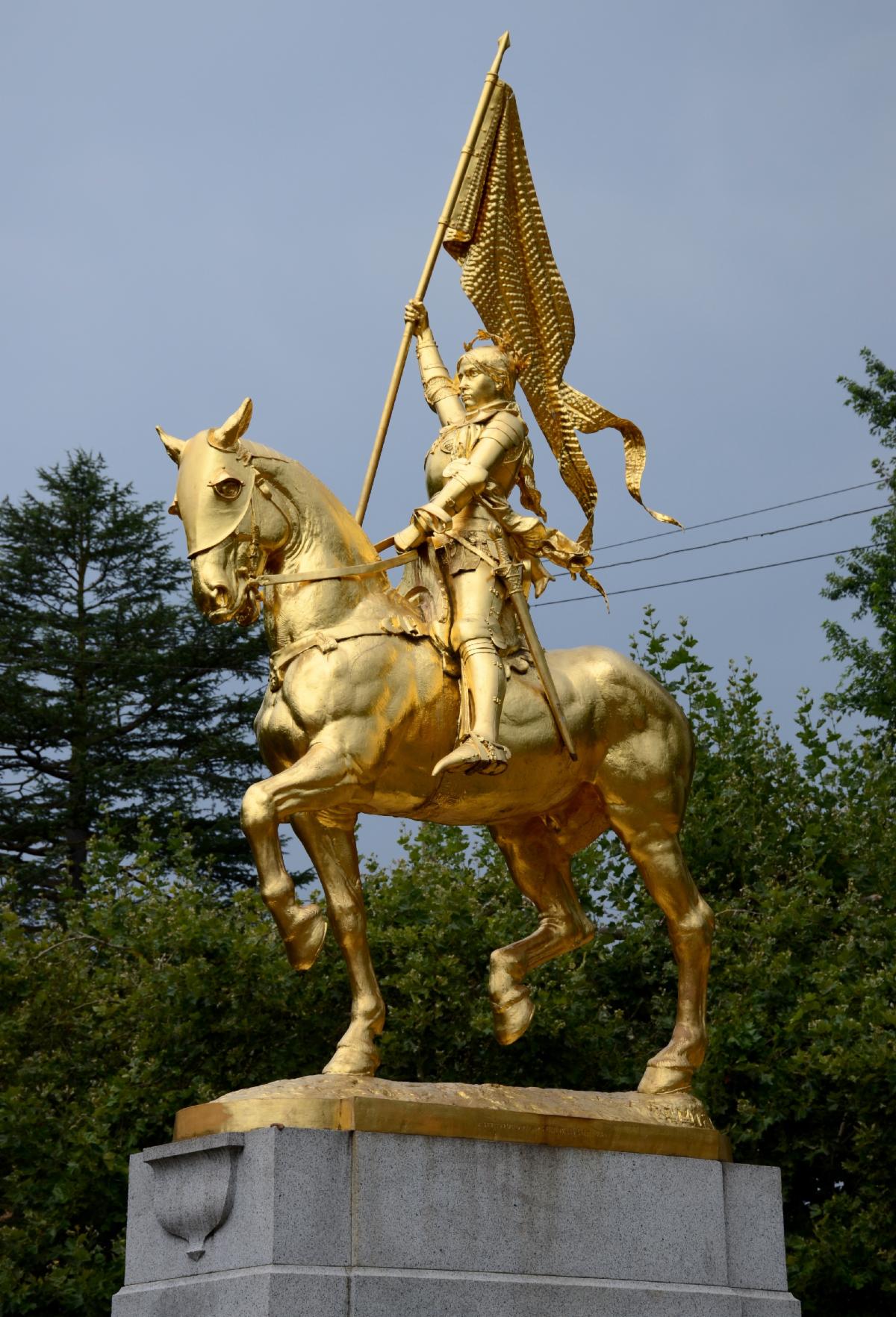
Gilt bronze equestrian sculpture of Joan of Arc by Emmanuel Frémiet in Coe Circle (at NE 39th & Glisan) in the Laurelhurst neighborhood of Portland, Oregon, U.S.A
By Steve Morgan - Own work, CC BY-SA 3.0,
https://commons.wikimedia.org/w/index.php?curid=42102142
|
|
The statue was donated to honor the American soldiers slain on French soil during World War I.
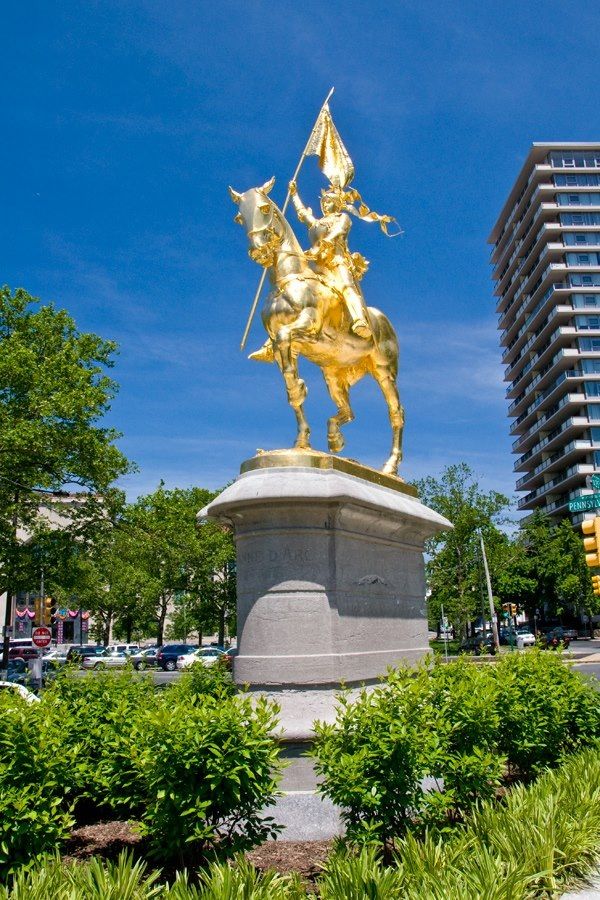
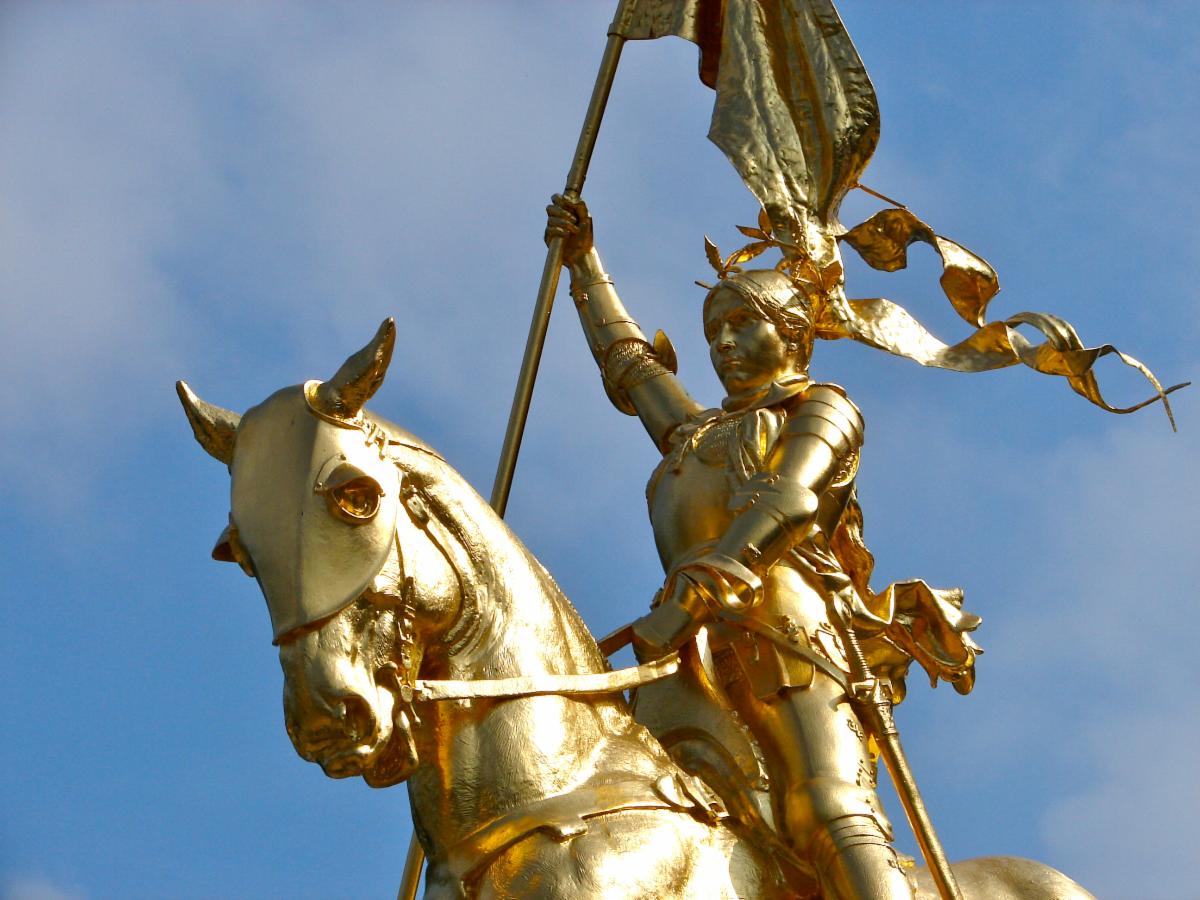
• It is a replica of the Gilt bronze equestrian sculpture of Joan of Arc by Emmanuel Frémiet, Place des Pyramides, Paris.
• The copy in Portland, which features a granite base designed by Margaret Goodin Fritsch (the first woman to graduate from the University of Oregon’s School of Architecture), was given to the City of Portland in 1924 by physician and Oregon US Senator Henry Waldo Coe.
• Dr. Henry Waldo Coe donated the statue to the city in 1924 in honor of the doughboys of World War I. His son unveiled her during a patriotic ceremony on Memorial Day, 1926, a day that was also the anniversary of her martyrdom (May 31, 1431).
• The statue was restored in 2005, thanks to The National Endowment for the Arts as well as Target Stores, who created made a 'Save Outdoor Sculpture' conservation award of $24,000 towards the work needed on the statue.
• It is one of 8 such replicas of this statue of Joan of Arc in the world: Paris, Nancy, Mircourt and Lille - all in France; and Melbourne, Australia; New Orleans, LA and Philadelphia, PA.
• Younger generations may not immediately recognize the historical context, albeit they admittedly possess a healthy dose of humour. In a recent blog, one may read the following: "Tell me, O wise one: What does a flambéed French saint have to do with the Rose City? I ask because recently, in Laurelhurst, I came upon the improbable statue of one Joan of Arc"...And the answer is...: "Why a French saint and not, say, a beaver with a salmon in its mouth, riding a bear? Well, I know you’ll find this hard to believe, but throughout the 19th and early 20th centuries, France was basically America’s girlfriend. For years, the two love-struck nations exchanged gooey mash notes in the form of statuary, including the Statue of Liberty..." Willamette Week news blog, Nov 22, 2022
|
|
The Statue of Joan of Arc in Washington D.C.
(1916): to celebrate the friendship between France and the USA
|
|
“Joan of Arc Memorial”
Meridian Hill Park, Washington DC 20009
Photo: By Slowking4 - Own work, GFDL 1.2
https://commons.wikimedia.org/w/index.php?curid=26984545
|
|
• The piece was first proposed in May 1916 by Mme. Carlo Polifeme, president of the Society of French Women of New York, which gave the statue to the city of Washington D.C. She proposed it to the Commission of Fine Arts in order to celebrate the friendship between France and the United States.
• Joan of Arc is a 1922 cast of Paul Dubois's 1889 statue of Joan of Arc, located at Meridian Hill Park in Washington, D.C.
• Joan of Arc is an equestrian statue, with the Patron Saint of France riding a trotting horse, resting upon a three-tiered granite base (H. 52 in. x W 11. ft.). Her body is twisted slightly, and her right arm is raised behind her. She is wearing a helmet with a raised visor and she looks skywards. In her left hand she holds the reins to her horse. The sword she originally held in her right hand was stolen in 1978, and not replaced until December 2011. The pedestal was designed by American artist H.L. Davis.
• The statue was completed in 1922 in Paris; the original was cast in three copies, currently located respectively in Reims (1890), Paris (1895) and Strasbourg (1922). According to the National Park Service website (click on the photo above): ..."This statue, a copy of the original at the Rheims Cathedral, was erected in 1922. The statue was a gift from the Society of French Women in Exile [sic] in New York. Approval for the statue occurred under an act of Congress on March 20, 1922 (42 Stat. 468) and the casting of the monument was supervised by the Ministre des Beaux Arts in Paris. Cost: Unknown. Statue was erected at no cost to the United States."
• According to the National Commission of Fine Art it was described, at the time, as being "regarded by artists as the finest equestrian statue of modern times."
• It is the only equestrian statue of a woman in Washington, D.C.!
• Inscription:
JEANNE D’ARC
LIBERATRICE
1412–1431
AUX FEMMES D'AMERIQUE
LES FEMMES DE FRANCE
(In English):
"JEANNE D'ARC / LIBERATOR / 1412–1431 /
TO THE WOMEN OF AMERICA / THE FRENCH WOMEN "
• An inscription on the back of the pedestal reads:
Offert Par / “Le Lyceum” / Société Des Femmes De France / À New York /
Le 6 Janvier 1922
|
|
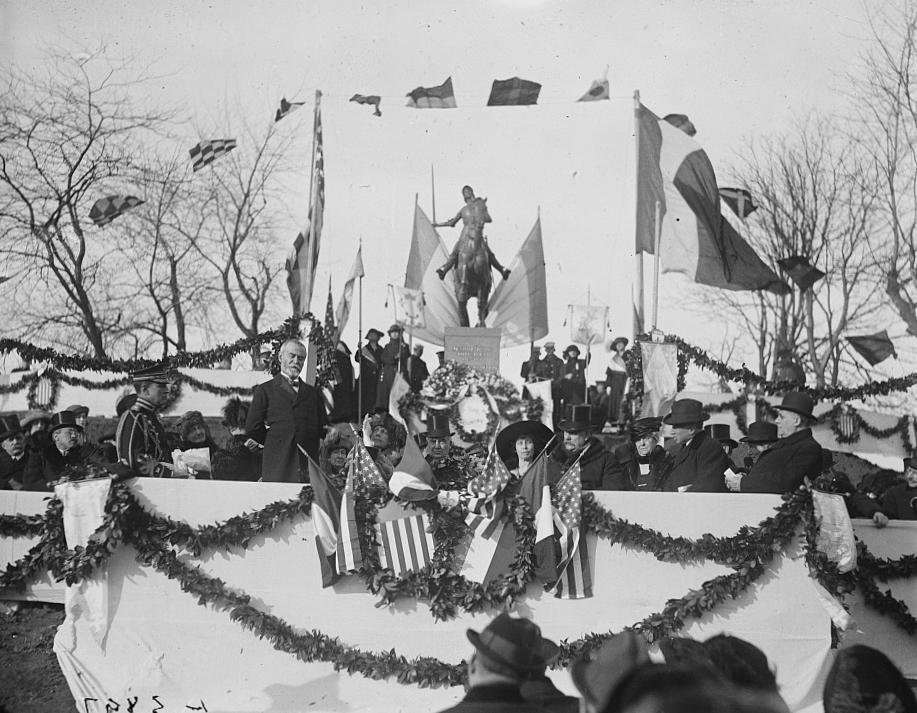
President, Mrs Harding and Secretary of War, Weeks attend the unveiling of a statue of Jeanne d'Arc at Meridian Hill Park.
Click on the photo above to watch a newsreel of the dedication, or on the link:
- Location: Washington DC Meridian Hi...
- Date: 1922, January 6
- Duration: 4 min 20 sec
- Sound: NO SOUND
- Clip: 65675053057
|
|
• On 6 January 1923 when the piece was dedicated, President Harding and the French Ambassador were the guests of honor. Mrs. Harding and Mme Jusserand, who represented France, also attended. Speeches at the dedication ceremony were given by U.S. Secretary of War Weeks; Mme. Carlo Polifeme, president of the Society of French Women of New York, which gave the statue to the city; and Mrs. George Maynard Minor, president of the National Society of the D.A.R., who accepted the statue on behalf of the women of the United States. Amb. Jusserand also presented a medal from France to Mme. Polifeme for her work in getting the statue erected in Washington, D.C.
• ... “For liberty and peace, Lafayette brought you his sword; for peace and justice Jeanne d’Arc brings you her faith...” said Mrs. Carlo Polifeme, president of the Society of French Women of New York, which gave the statue to the city, in presenting the statue. She added: ...“Jeanne d’Arc will keep alive the burning flame of our love and bring blessings from her new basilique to to her new country. Nothing more sacred could be dedicated to the women of America, nothing more beautiful offered to the beautiful city of Washington than this pious work of art. Jeanne d’Arc is a living prayer, a perfect disciple of all virtues, a divine symbol for all.”
• Longtime French Ambassador to the United States (and Pulitzer Prize winner) Jules J. Jusserand, expressed in turn ... “the heartfelt thanks of his country” to President and Mrs. Harding for attending the unveiling. According to newspapers reports, he traced the history of Jeanne d’Arc and said that the success of the allied arms at Verdun when the German army was threatening to overrun continental Europe, "was due to the undying spirit of Jeanne d’Arc which prevailed in the breasts of soldiers".
• On the 500th anniversary of Joan's martyrdom, Paul Claudel, Ambassador of France in Washington, held a tribute to the Saint in 1931, in spite of the separation of Church and State.
|
|
Statue of Joan of Arc in Philadelphia, Pennsylvania
(1890) a gift to the city by the French community
|
|
Statue of Joan of Arc, Maid of Orleans, Philadelphia, PA
Kelly Drive at 25th Street, Philadelphia, PA 19130
Photo top: https://www.pinterest.com/pin/323344448216557488/
Bottom: by Smallbones - Own work, CC0
https://commons.wikimedia.org/w/index.php?curid=15441710
Statue by Emmanuel Frémiet (1824- 1910) Gilded bronze on granite base, Height 15′, width 4'8", depth 7'4" (base height 8’4″, width 5'6", depth 10')
|
|
A gift of friendship and gratitude by the French community to the City of Philadelphia.
• A Bronze marker reads:
“Joan of Arc 1889 by Emmanuel Fremiet.
A Gift to the City to commemorate the French Centennial
by Philadelphia French Citizens and the Fairmount Park Art Association. Restored and Rededicated 2010
by the City of Philadelphia and French Heritage Society.”
• In 1898, French sculptor, Emmanuel Fremiet fashioned his gilded bronze statue of Joan of Arc, his model was a 15 year old girl by the name of Valérie Laneau.
• Amazing but true: she too had been born in the town of Donrémy-la-Pucelle on the same day and month, January 6, as Joan had, and at the age of 77, Valérie was engulfed by flames from an oil lamp that she had been trying to light and she died on May 30, the anniversary of the death of Joan of Arc...
• This replica was originally placed on the Girard Avenue Bridge in Philadelphia. It was then relocated to a site near the Philadelphia Museum of Art in 1959, next to Pennsylvania Avenue, aka Benjamin Franklin Parkway (itself modeled after the Champs-Elysées in Paris in 1917 by 2 French city planners, Paul-Philippe Cret and Jacques Grébert).
|
|
The Statue of Joan of Arc in New Orleans, Louisiana
(1958-1972) “A Gift of the People of France to the Citizens of New Orleans”
|
|
Statue of Joan of Arc, Maid of Orleans, New Orleans, LA
Place de France, Decatur St, New Orleans, LA 70116
Top: photo by Thierry Chaunu © 2020 The American Society of Le Souvenir Français, Inc.
Middle: By Youtupedia - Template:Youtupedia.org, Public Domain, https://commons.wikimedia.org/w/index.php?curid=11624072
|
|
• "Rearing back on her steed, Joan represents the strength, power, and perseverance of New Orleans, a city that no foe may defeat." Katelyn Woodel, New Orleans Historical Society
• Inscription:
"Joan of Arc
Maid of Orleans
(1411-1431)"
“A Gift of the People of France to the Citizens of New Orleans”
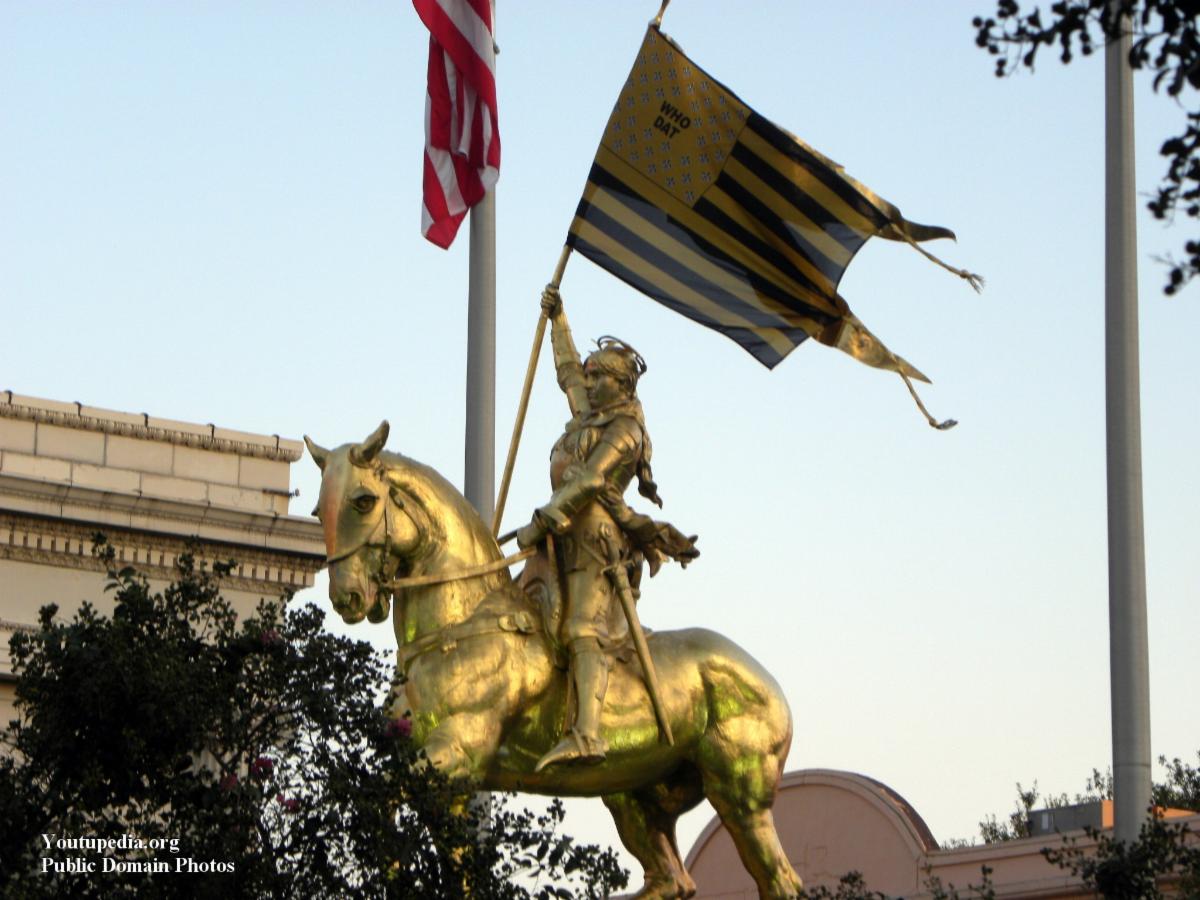
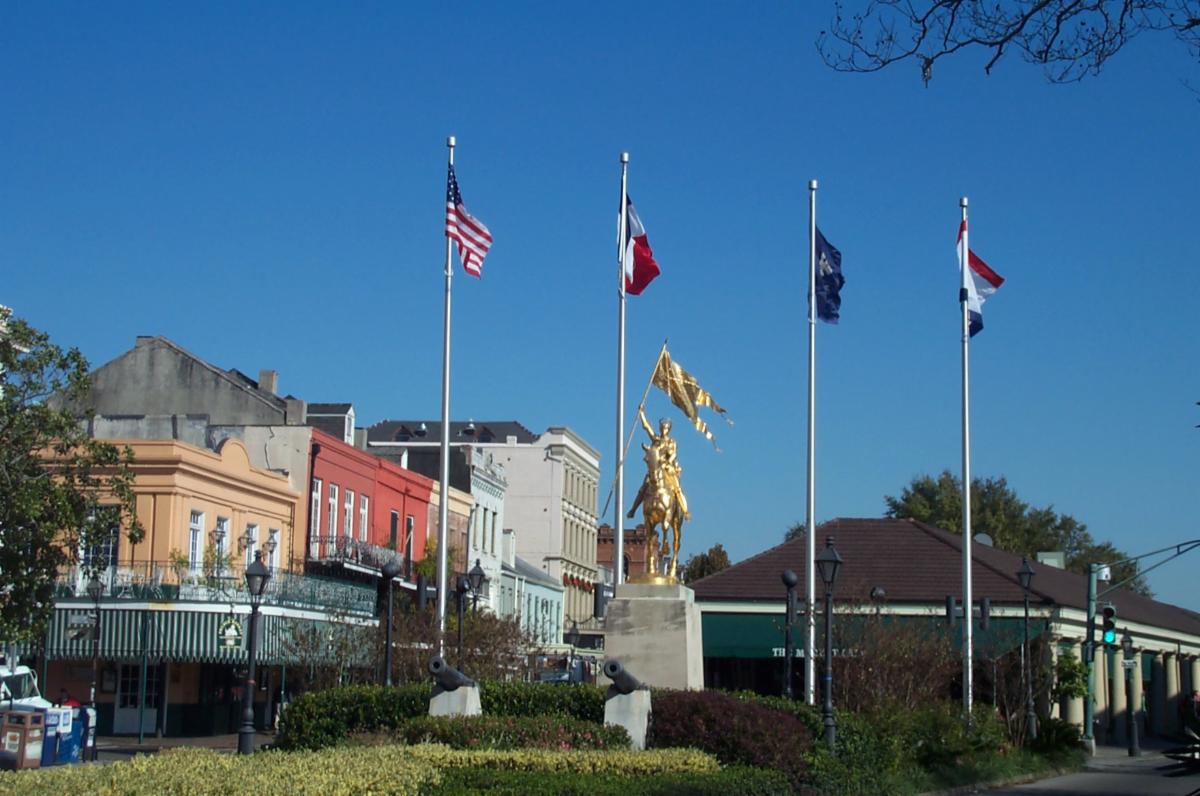
• Erected in 1972, it is a copy of the 1899 statue at the Place des Pyramides in Paris by Emmanuel Frémiet.
• It was sent to New Orleans in 1958 by Robert Whyte of the World House in New York. When the statue arrived in the city, the city could not afford the $35,000 necessary to erect it. Consequently, it was stored for 8 years.
• In 1960, General Charles De Gaulle visited New Orleans and was received triumphantly. On his return to France, he asked citizens to form a Committee to start a fund-raising to finance the pedestal ($36,500) who reached their goal in 1964.
• Finally, in 1972, it was placed on a 17-foot pedestal on the Place de France at the foot of Canal Street. The statue was gilded in 1985.
• This statue was originally located in front of the International Trade Mart Building, but after the purchase of that location by Harrah’s casino, it was moved in 1999 to its present location of the 'Place De France" on Decatur Street in the French Quarter, next to the French Market on Decatur Street.
• On the first day of the Carnival Season, the parade traditionally pauses in front of the statue to pay its respect.
• "Each year on January 6th, the Krewe de Jeanne d’Arc honors St. Joan and the French heritage of New Orleans with a celebration. “As the first day of the carnival season, that date suggests renewal-the awakened sprite carrying the battle flag from the dead of winter toward the light of Spring. Joan has given us hope. Once more she is called to battle.” - Errol Laborde (editor and publisher of Louisiana Life magazine)
|
|
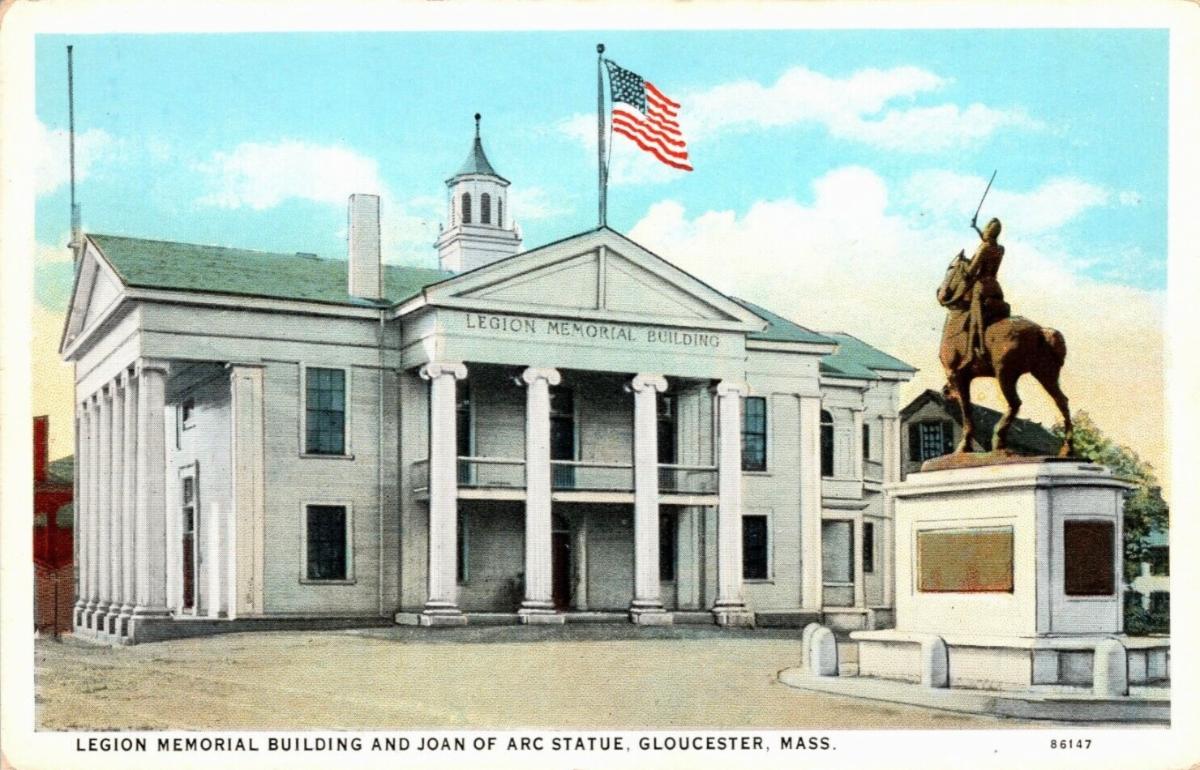
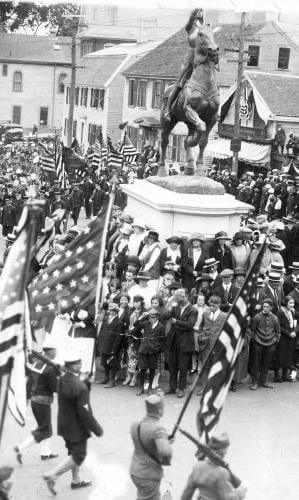
Statue of Joan of Arc in Gloucester, Massachusetts
(1921) "a gift of the French Government to honor the the sons of Gloucester who gave their lives during the Great War"
|
|
Statue of Joan of Arc
Maid of Orleans, Gloucester, MA
10 Washington St. Gloucester, MA 01930
Photos: Top: Postcard date unknown published by C.T. American Art 3.5" x 5.5" (9 x 14 cm)
Middle and bottom: Located at the traffic circle between Washington and Middle Streets, inauguration in 1921 DiscoverGloucester.com
|
|
• The World War I Memorial was presented to the City of Gloucester by the French Government in 1921 and rededicated in 2001 honoring the sons of Gloucester who gave their lives during the Great War
• The monument’s base was made of granite quarried in neighboring Cape Ann and “inscribed with the names of those who made the great sacrifice”. The statue’s base also contains stones from France: four came from the Reims Cathedral, and one came from the dungeon of a castle where Joan was held for her trial.
• Although not yet a saint (she was canonized in 1920), Joan of Arc was a popular persona during World War I—she led the French army in a momentous victory during the Hundred Years’ War.
• She was also an early feminist icon used by the women’s suffrage movement in the early 20th century in the United States and United Kingdom. This contemporary political symbolism may have appealed to Huntington who faced discrimination in the art world based on her gender.
• It is one of five full-scale casts of the statue. It was first exhibited at the Salon in Paris in 1910. The original cast from 1915 remains in Riverside Park in New York City (see slide above). Three others stand in public sites at the Legion of Honor in San Francisco, CA (see slide above); Québec City, Québec, and Blois in France.
• Joan of Arc is mounted on horseback with her a sword raised in her right arm facing the Legion Memorial Building. This building was dedicated to those Gloucester residents that served in World War I.
• Gloucester’s Congressman A. Piatt Andrew founded the American Field Service (which provided ambulances to support the French Army prior to the United States’ entry into the conflict) and was instrumental in forming the National American Legion at this post. This American Legion building was once Gloucester’s City Hall.
|
|
Three Statues of Joan of Arc
at Longwood University, Virgina
A symbol of Feminine strength:
|
|
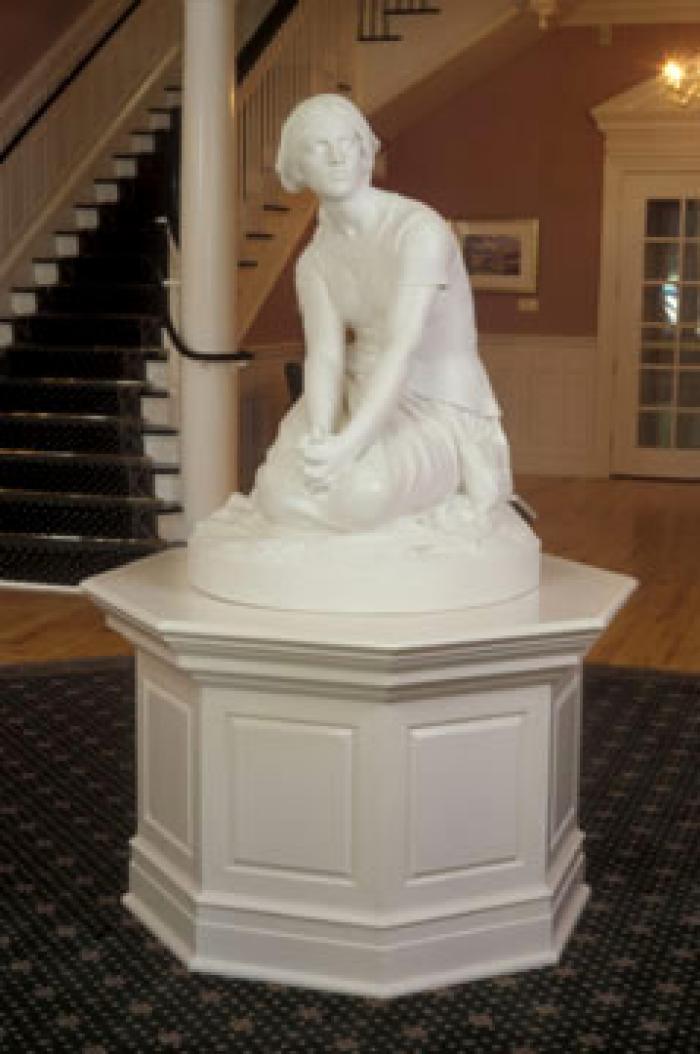
"Joanie on the Stonie" (Class of 1914) |
|
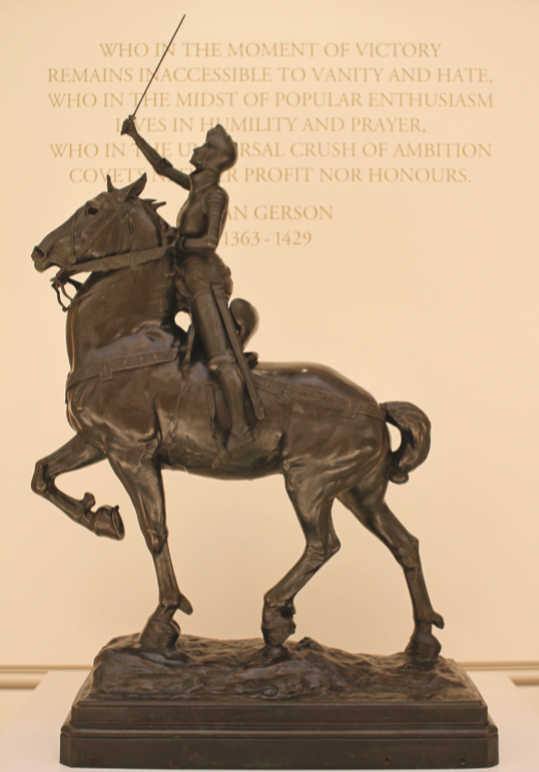
"Joanie on the Pony" (Gift of the artist, 1927) |
|
3rd sculpture of Joan of Arc on campus
(dedicated in 2018)
|
|
201 High St, Farmville, VA 23909
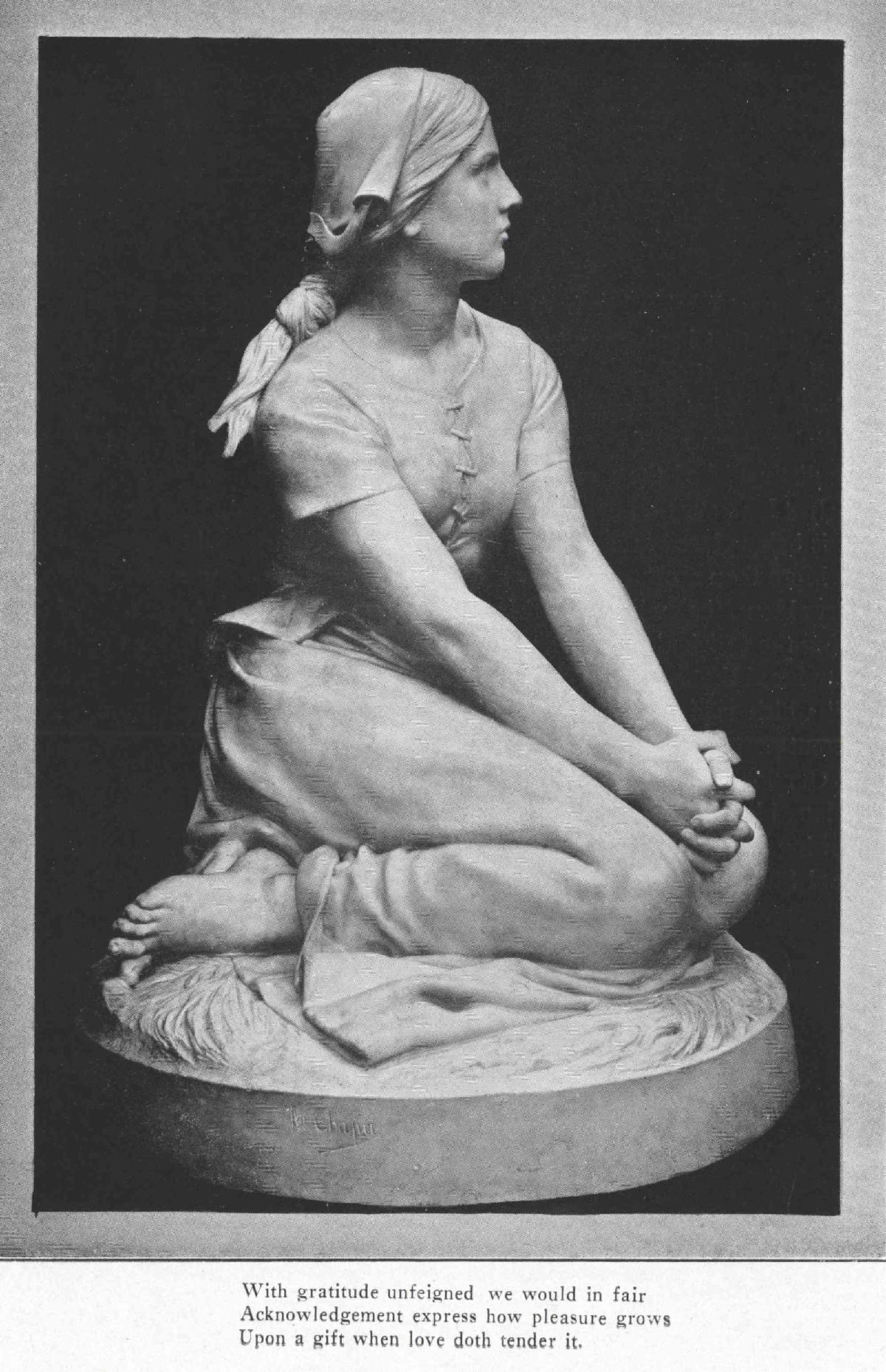
Top photo: sculpture in plaster by Antoine Chapu, (Le Mée, Seine-et-Marne 1833 - Paris 1891) Made in 1870-1872 by Maker: Caproni
129 North Main Street Farmville, Virginia 23901
Photo credit: WikimediaCommons © Artist : public domain
Middle Photo:
The Joan of Arc sculpture fondly known as Joanie on the Pony is a reduced version of the bronze 1915 monument Joan of Arc by Anna Vaughn Hyatt Huntington. Longwood’s copy, based on a casting of Huntington’s monument in New York City, was a gift from the artist in 1927 in response to a request from students. Huntington was one of the foremost American sculptors of the early 20th century.
Bottom photos: the crane is used to install the sculpture, not to remove it!
|
|
• Longwood University was founded in 1839 as Farmville Female Seminary Association. From 1884 to 1949 it was the State Female Normal School or State Normal School for Women, modeled after the French Ecole Normale Supérieure.
• Unique among public American universities is Longwood’s adoption of a patron hero, Joan of Arc, who is said to protect and inspire students.
Saint Joan may seem an odd choice as an emblem for a small Southern college. However, Joan of Arc had achieved cult status among Catholics and non-Catholics alike in the late 19th and early 20th centuries. Her story of pious dedication and strength was deemed especially appropriate to the formation of young women...
• It’s a story of courage and faith and leadership, and one that resonated particularly strongly in the early 20th century, as women across the globe staked new ground for themselves.
Around the turn of the 20th century, popular Longwood English professor J.M. Grainger suggested that Joan of Arc, the 15th-century French heroine, would be a good choice as an inspirational figure for students. The idea stuck, and, with the gift of “Joanie on the Stony” by the Class of 1914 and a subsequent purchase in 1927 of Anna Hyatt Huntington’s statue quickly nicknamed Joanie on the Pony,” Joan of Arc became an irreplaceable part of campus.
The university’s has now three prized sculptures of the 15th century French heroine are Jeanne d’Arc:
• Since 2018, a new addition. At more than 15 feet tall, the heroic figure of Joan of Arc strikes an assertive pose and captures the historic woman at the height of her military prowess, raising the Siege of Orleans in 1429.
Joanie on the Stony:
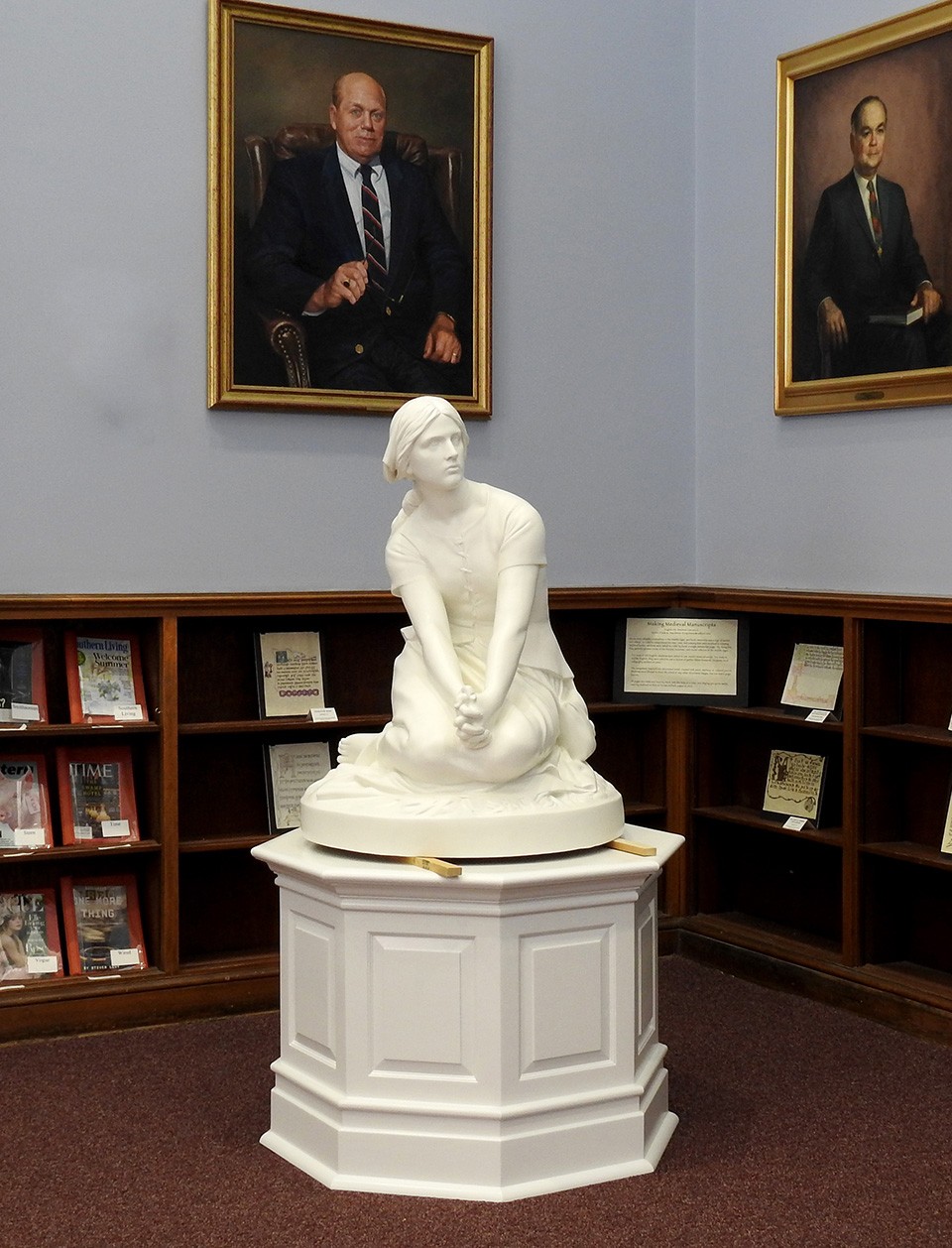
• It is a scultpture in plaster by Antoine Chapu, (Le Mée, Seine-et-Marne 1833 - Paris 1891), made in 1870-1872 by Caproni. The Original in marble (1870-1872) is at the Musée d'Orsay, Paris.
• It is part of four life-size plaster copies located at four Virginia colleges that were normal schools (training grounds for female teachers):
- Farmville, Longwood University (this one)
- Fredericksburg, University of Mary Washington
- Harrisonburg, James Madison University
And at Radford, Radford University.
• It was given by the Class of 1914.
• It is inscribed: "Caproni Casts / P P Caproni & Bro / -Makers- / Boston U S A"
Around the turn of the century, Caproni was considered the premier caster of the world. He and his craftsmen replicated statues by covering them with hundreds of paper-thin tin sheets pressed along the contours of each original, casting these contour-moulds in plaster, and finishing each one off with a coat of paint. These finely crafted replica statues were for the most part sold to public schools, libraries, colleges, museums, symphony halls and patrons of the arts..
• "For 13 years, Joanie on the Stony presided over Longwood’s women. Her central place under the Rotunda made her, practically, a landmark in the hub of daily campus life, which bred a deep familiarity with her figure. Students met at the statue before heading to the dining hall, between classes or before heading downtown. Unlike other women’s colleges around the state that had the same Joan of Arc statue—Radford, James Madison, Mary Washington—the figure stirred something deep inside students at Longwood. Something that demanded more of Joan of Arc."
An early note from CHI to freshman students illustrates just how campus burned with the intensity of feeling:
" This your challenge. With the spirit of Joan as your guide, seek to grow in mental stature as you quietly contemplate the advice, the wisdom, the inspiration of your administration, your faculty, and especially of your friends—the upperclassmen, the girl next door, the roommate … Let the boundless faith of Joan permeate your life and spur you on to the highest endeavor. Dream, hope, plan with her, and with greater maturity go on to build the tangible out of your intangible dreams. To feel the spirit of Joan of Arc and to sense her vision of the ideal is to enlarge the spirit of the college and to watch it grow."
Joanie on the Pony
• Students after WWI were literally enamored with the sculpture and wanted more of Joan of arc. Since 1914, students like Overbey had devoted countless hours to the study and compilation of everything Joan of Arc. Hundred-page scrapbooks were filled with clippings, original poetry, photos and postcards of their heroine. They professed their devotion to her example in lengthy Rotunda columns. They dedicated page after page of the Virginian yearbook to her spirit.
• The Joan of Arc sculpture fondly known as Joanie on the Pony is a reduced version of the bronze 1915 monument Joan of Arc by Anna Vaughn Hyatt Huntington. Longwood’s copy, based on a casting of Huntington’s monument in New York City, was a gift from the artist in 1927 in response to a request from students.
• Rituals and myths dealing with the two statues abound. Joanie on the Stony, for example, heralds the occasion of every CHI walk with a pair of mysteriously appearing blue and white carnations. Joanie on the Stony is also said to bring good luck for tests to students who touch her clasped hands on their way to class.
Joanie: the new sculpture (2018)
• Just more than a century after the first statue arrived on campus, the Master Plan envisioned Longwood installing a new likeness of Joan of Arc in tribute to her enduring legacy on campus.
• The new cast bronze sculpture, which is at the southern end of Brock Commons, is by renowned Scottish neoclassical sculptor Alexander Stoddart, who was the Queen's Sculptor of the Ordinary, and now the King's Sculptor of the Ordinary.
• The figure of Joan of Arc is holding a flag— which she is said to have preferred to a sword—and dressed in traditional military armor of the period
• At more than 15 feet tall, the heroic figure of Joan of Arc strikes an assertive pose and captures the historic woman at the height of her military prowess, raising the Siege of Orleans in 1429. Wearing a heavy suit of armor and wielding a legendary sword, this vision of Joan of Arc stands at the southern end of Brock Commons, between Hull and Bedford halls.
Longwood President W. Taylor Reveley IV said, “This majestic statue that we dedicate today will inspire us across all our years: Joan of Arc, poised forever young, in a moment of defiant triumph.”..."Unlike the two Joans that have taken on iconic status in the last century, Stoddart’s Joan, while neoclassical in form, is intentionally of the 21st century. Her deliberate androgyny, unflinching power and forward-moving posture reflect a time when, globally, women are again staking new ground."
• “She’s not meant to be cute or sweet,” said Stoddart. “She’s meant to be a daunting figure. I wanted to make her what we Scots would call a bit gallus. There’s no real English equivalent, but it’s sort of self-confident, daring, even cheeky. Think Steve McQueen or James Cagney from those old movies. But if you think about it, she was a teenage girl in charge of 5,000 men. She’d have to be more than a bit gallus to pull that off. Look at what’s happening in the world today with gallus women taking charge of their own lives. I wanted Joan to reflect that.”
|
|
Joan of Arc statue at Laroche University, Milwaukee, WI |
|
Laroche University
John J. Wright Library
9000 Babcock Blvd, Pittsburgh, PA 15237
|
|
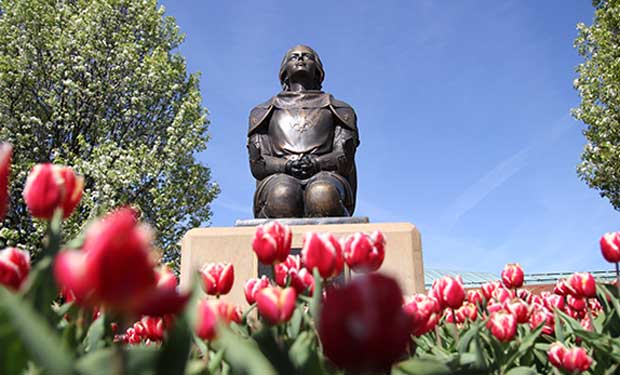
• John Cardinal Wright (1909-1979) was a staunch support in the early days of the University’s history. He had a life-long devotion to St. Joan of Arc.
• The statue of St. Joan of Arc in front of the John J. Wright library honors Cardinal Wright’s devotion to La Roche University.
• The sculpture, an original design, was commission for the 2010 rededication of the Library. The chief artist is Paco Reyes from Esculturas de Diseno Italiano, whose studio is located in Bogota, Columbia.
• Joan (1412-1431) clad in battle armor is depicted kneeling. The 48 inch sculpture is made of fiberglass casting with a bronze-like finish.
|
|
Sculpture of Joan of Arc at Radford University, Radford, VA |
|
Radford University
McConnell Library
945 E Main St, Radford, VA 24142
|
|
• Hailed a heroine and symbol of strength, Joan of Arc was a fitting addition to the female-dominated Commonwealth campuses, which have since sought to trace their own Joan’s journey.
• An excerpt from an article written by Mike Lay, titled “In Search of Joan,” presents a rough timeline of Radford’s Joan: “After years of moving around campus, the statue came to rest in the library during the late 1960s. There she remained until 1983 when she was relegated to storage to make room for the library’s growing book collection. In August of 1992, she was rediscovered in an attic storage room and installed on the porch of Russell Hall. She eventually made her return to the library in September of 1995 on the occasion of the inauguration of Radford University’s fifth president, Douglas Covington.”
|
|
Sculpture of Joan of Arc at James Madison University,
Harrisonburg, VA
|
|
James Madison University
800 S Main St, Harrisonburg, VA 22807
Entrance of Carrier Library
Photo Top: Joan of Arc sculpture at Carrier Library
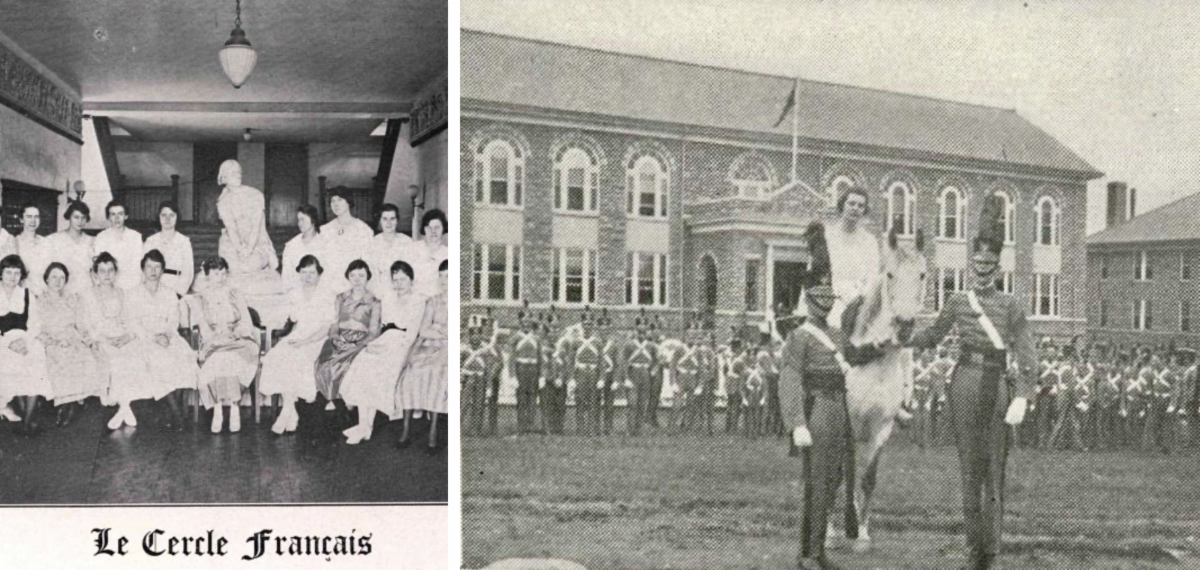
Photo Left: Le Cercle Francais posed with Joan in the lobby of Alumnae Hall.
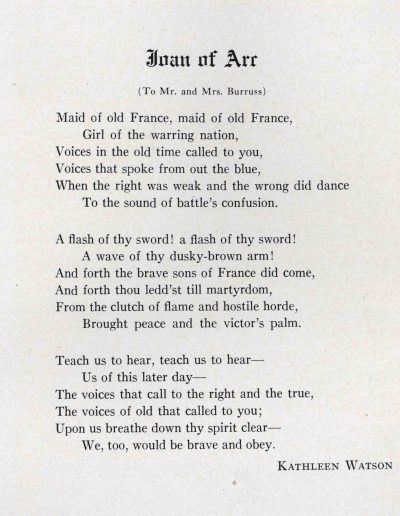
Photo right: 1918 Schoolma’am Miss Pauline Callender acting as Joan of Arc on a white horse for the Liberty Loan Parade. Flanked and backed by students from Augusta Military Academy.
|
|
• Joan of Arc was presented to the campus in 1917 by President and Mrs. Julian Burruss, with the couple stating that they wished for Joan’s courage, leadership, and holiness to serve as an “inspiration to all womankind.”
• The United States formally entered WWI that same year, and the gift of a larger than life-size statue of our ally’s patron saint and national hero synthesized the patriotism and industry sweeping through the campus in support of the war. Students were organized into battalions (with President Burruss himself commanding), economy was admired to provide for the war effort, and at least one student, a Miss Julia McCorkle, served heroically in the hospitals of France.
|
|
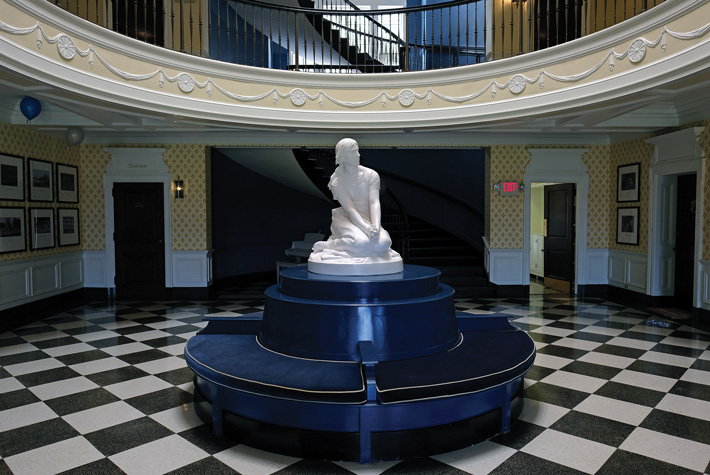
Schoolma’am, 1928 A poem about St. Joan of Arc and dedicated the President and Mrs. Burruss, written by Kathleen Watson (Class of 1917) |
|
Sculpture of Joan of Arc at Mary Washington University, Fredericksburg, VA |
|
Mary Washington University
Ball Hall
1701 College Ave, Fredericksburg, VA 22401
|
|
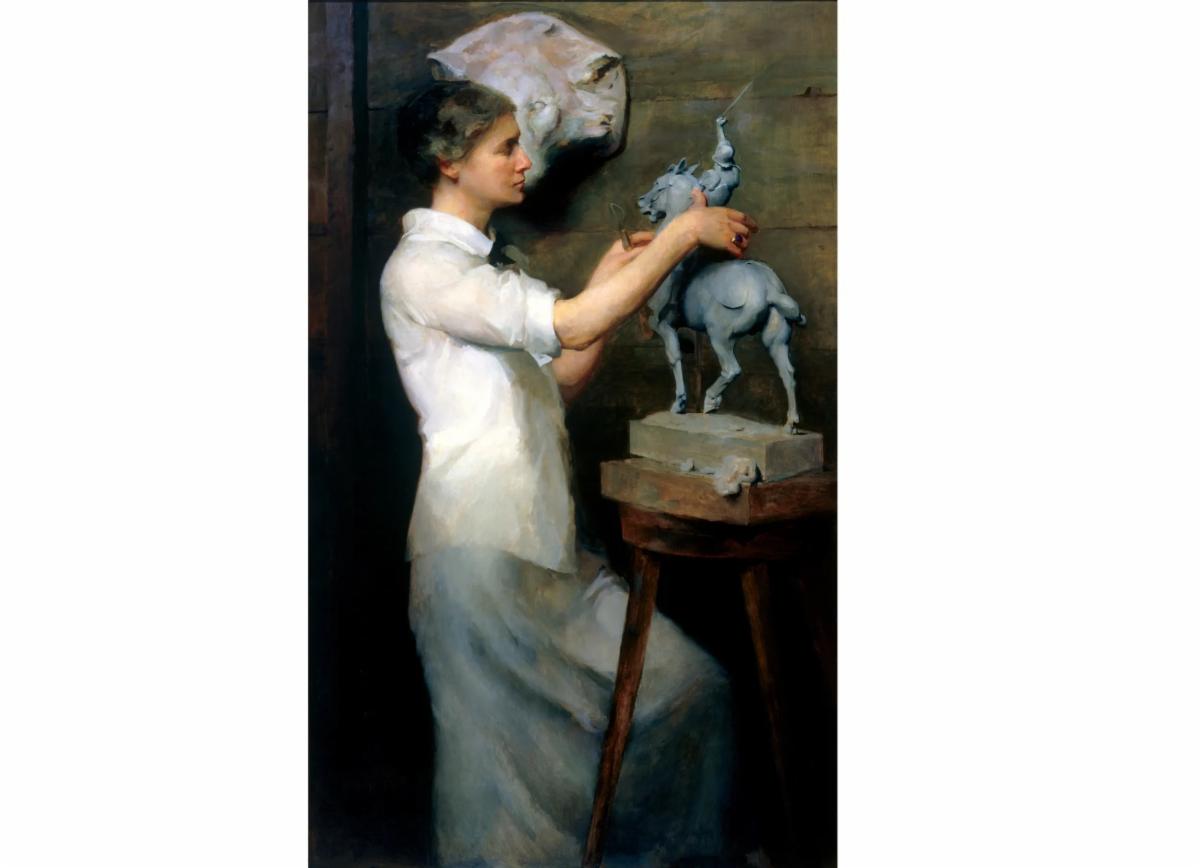
• When Ball Hall opened in all its grandeur in 1935, the statue took an honored place in the center of the atrium, beneath a circular skylight, ringed by a spiral staircase. Through the years, Joan held bouquets and Solo cups; she was decked out in sunglasses and scarves, commencement cloaks and Halloween costumes, mortarboards and makeup.
• “She reflects women’s ability to bring about change,” said Cedric Rucker ’81, associate vice president and dean of student life. “Think about the time of Mary Washington’s founding, when people didn’t really want women to have access to education.”..."A woman determined to fight for her country, she represents “the skills, talent, prowess, and leadership abilities in our community,” Rucker said. “She’s the perfect symbol for the University of Mary Washington.”
|
|
Special tribute to American sculptor Ann Hyatt Huntington |
|
Marion Boyd Allen, Portrait of Anna Vaughn Hyatt, 1915. Oil on canvas, 65 x 40 in. (165.1 x 101.6 cm). Collection of Maier Museum of Art at Randolph College, Lynchburg, VA, M.1922.1
|
|
Anna Vaughn Hyatt Huntington (March 10, 1876 – October 4, 1973) was an American sculptor who was among New York City's most prominent sculptors in the early 20th century. At a time when very few women were successful artists, she had a thriving career. Hyatt Huntington exhibited often, traveled widely, received critical acclaim at home and abroad, and won multiple awards and commissions.
|
|
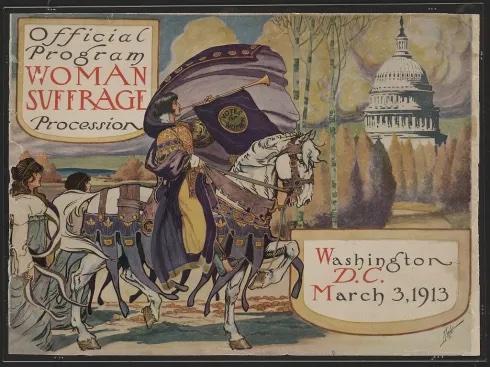
Joan of Arc, a proto feminist and
symbol of Suffragettes
|
|
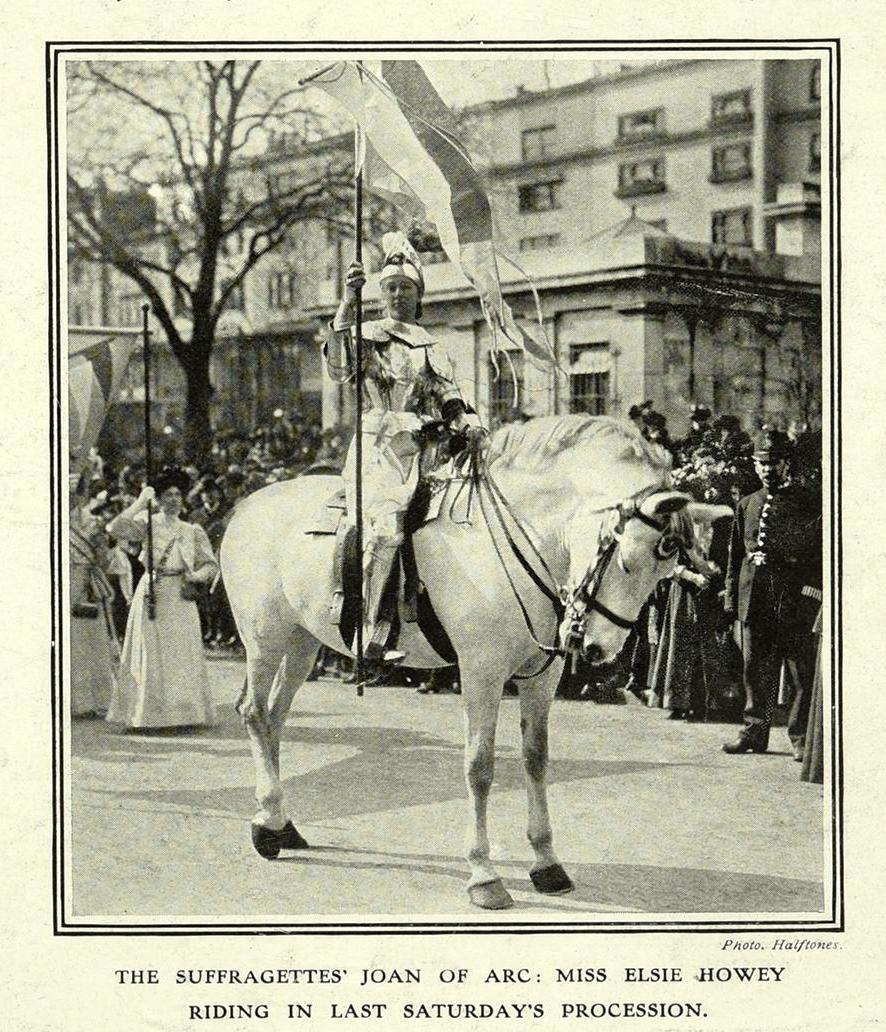
The Suffragette Elsie Howey as Joan of Arc on horseback at a procession in honour of the release of Mrs. Pethick Lawrence from Holloway Prison, 24 April 1909
The Illustrated London News. The National Archives, London (ZPER 34/134)
|
|
"Joan has long been a feminist icon, and the suffragette movement used her image on some of their posters. She lived in the 15th century when sex was the defining characteristic, when women had little or no rights, freedom, or choice"
Other possible discussion themes (collected from several websites):
• How are women represented in the public art in New York?
Joan of Arc is one of a select few sculptures memorializing women in New York. While there are plenty of female figures to be found in public sculpture in the city, most of those images are allegorical or general, rather than representative of specific people.
• What does the commissioning of a statue of Joan of Arc say about the relationship between the United States and France?
During World War I, people looked to Joan of Arc as an symbol of the strong political relationship between France and the United States, and the commonalties in the countries' values as represented in the story of Joan of Arc
• How does Joan of Arc inspire us today?
Like Joan, our faith also has the power to protect us and help us do hard things. Whether Joan's accomplishments came about because of her faith in God, or faith in herself, much can be learned from her life about the power of faith and what's really possible if one is willing to believe
As an icon, Joan of Arc is the ultimate blank canvas, taking on all brushstrokes, often reflecting back what people want to see in her. She has, in fact, stood as a symbol for opposing forces throughout the last 600 years, sometimes simultaneously: French nationalism, French defeatism; the Catholic Church, opposition to the church; patriotism, emancipation; audacity, largesse; the far political right, women’s liberation; biblical literalism, LGBTQ+ rights. She’s Saint Joan, canonized by the same church that convicted and killed her five centuries before.
“She is both used and abused by a great many groups,” said Dr. Kelly DeVries, a professor of medieval history at Loyola University in Maryland, who authored a seminal work about Joan in 2011 and spoke at Longwood’s annual Medieval Conference that year. “Historically speaking, what we have is an incredibly brave, spiritually obsessed, devoted, zealous woman who changed history. It never happened that way before and hasn’t happened that way since. But her story is so powerful and so inspiring that a lot of different types of people see themselves in her, and that’s why she endures more than six centuries after her death.”
" Joan was pretty modern in the fifteenth century, which might account for some of her timelessness thereafter. She resurfaces pretty predictably in times of conflict: the French Wars of Religion in the sixteenth century, the French Revolution in the eighteenth century, World Wars I & II in the twentieth century. All of her cultural depictions could fill a museum, or an encyclopedia, but certainly she is transformed into a nineteenth-century romantic heroine by Friedrich Schiller’s 1801 play, The Maid of Orleans. She was embraced by the Suffrage movements on both side of the Atlantic in the early twentieth century, and she remains a feminist hero(ine) in our own time. "
|
|
Joan of Arc at West Point Military Academy
a symbol of military prowess and leadership
|
|
Mural, Panorama of Military History in the Cadet mess
West Point Military Academy, Washington Hall refectory,
754-790 Derussy Rd, West Point, NY 10996
This giant mural inside the refectory includes several figures from French military history: In addition to Joan of Arc (detail shown), marshall Joffre, Napoléon, Charles Martel....
Photos: Thierry Chaunu (2022)
|
|
• Thomas Loften Johnson painted the mural in 1936 as part of a Depression-era Works Progress Administration project. Called the Panorama of Military History, it depicts twenty-four military leaders and their most famous battles.
In the painting, the soldiers are shown kneeling around Joan of Arc, and she herself seems to be lying prone upon a crimson banner embroidered with silver fleur-de-lis.
• In an essay published in 2018 “The Maid of the Highlands: Joan of Arc Reflected in West Point Iconography” (click on the photo above to access the document), Dr. John Pendergast, Associate Professor in the Department of Foreign Languages at the United States Military Academy, West Point, makes a compelling case that the helmet on the Academy’s crest is directly inspired by Friedrich Schiller, the German Romantic Idealist poet and playwright, who wrote a play in 1801 called "Die Jungfrau von Orleans", usually rendered in English as The Maid of Orleans.
• Regarding her extraordinary military skills, being a young peasant aged 17, Dr. Pendergast notes: ..."she herself summarized her abilities quite plainly in her advice to other officers: “I used to say to them, ‘Go boldly among the English,’ and then I used to go boldly among them myself.” Army officers will recognize this approach as a fundamental aspect of leadership: ask of your soldiers only that which you are willing to do yourself. It seems safe to say that Joan epitomizes the mission statement of the USMA: “To educate, train, and inspire the Corps of Cadets so that each graduate is a commissioned leader of character committed to the values of Duty, Honor, Country and prepared for a career of professional excellence and service to the Nation.”
• ...“She committed herself to ridding her country of English invaders so that her people could come together as a nation and live freely. George Washington—the man after whom West Point’s central academic building is named—and Thomas Jefferson—who decreed that the USMA should exist—would surely have agreed that Joan’s was a cause worth fighting and dying for. The founders and leaders of the USMA have enshrined that opinion in images of the Maid that continue to surround cadets, faculty, staff, and visitors to the Highlands of West Point to this day...”
Dr. John Pendergast, “The Maid of the Highlands: Joan of Arc Reflected in West Point Iconography”, 2018
|
|
Joan of Arc, a symbol of America's support in hard times |
|
(with Joan of Arc in the background)
Henri Laussucq (American, 1882 - 1975), Poster, 1943, Library of Congress, Public Domain
|
|
Shared values with France, illustrated by our cover illustration and the poster above:
• Designed to instill patriotism, confidence, and a positive outlook, War Posters were used extensively during WWI & WWII to assist the military and persuade all Americans to help with the war effort.
• The poster “Joan of Arc,” by Haskell Coffin (1878-1941), was commissioned by the United States Treasury Department to urge people to buy war savings stamps. Stamps were low-priced and could be pasted into a booklet that when filled was traded for a war bond.
• The religious image and the intent of the poster is clear; just as God intervened through Joan to save France centuries before, He would, with America’s help, again help His people triumph in France.
• Like Joan of Arc, the name of General Lafayette, the French hero of the Revolutionary War, was also often invoked to arouse American sympathy for the plight of France during the First World War.
|
|
EPILOGUE
Joan of Arc's Chapel and "Joan of Arc stone"
in Milwaukee, Wisconsin
and dozens of Joan of Arc churches coast to coast
|
|
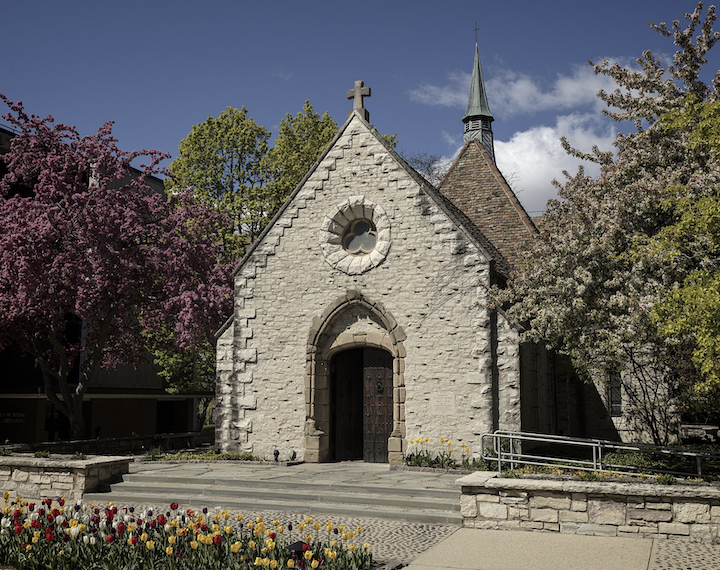
Joan of Arc chapel, Marquette University,
1421 W Wisconsin Ave, Milwaukee, WI 53233
A church from the 15th century, initially built in France, moved to New York in 1927, and then to Milwaukee, Wisconsin, in 1964.
|
|
There are more Joan of Arc churches in America than in France.
It is beyond the scope of our monthly Bulletin to describe them and all the statues of Joan of Arc, from California, Arizona, Nevada, Texas, Colorado, to Montana, Idaho, Minnesota, Nebraska, Kansas, Illinois, Wisconsin, Michigan, Louisiana, North Carolina, Indiana, Ohio, Missouri, Georgia, Florida, Maryland, Virginia, Delaware, Pennsylvania, New York, New Jersey, Connecticut, Massachusetts, Rhode Island, New Hampshire...
But there is one particular place that we chose to conclude this month's story.
It is a tale of Americans' devotions for the patron saint of France, with a mix of religious and patriotic motivations: the Joan of Arc Chapel at the Marquette University in Milwaukee, Wisconsin:
• This medieval chapel built in the early 1400 was located in a village near Lyon in the Rhone River valley. After the French Revolution it fell into decay, despite its association with the beloved saint. It was rescued in the 1920s by Jacques Couelle, an archeologist and architect who was one of France’s leading restorers of ancient buildings. In 1921 the French government was strapped for funds and was selling several historical buildings to wealthy Americans.
• According to a sign on display at the original site in France, Joan of Arc may have visited and prayed at the chapel on 9 March 1429 after meeting King Charles VII of France. Legend relates that Joan prayed to a statue of the Virgin Mary while standing on a flat stone which is now behind the altar. Afterwards, she knelt down and kissed the stone, and ever since, the temperature of the stone has been colder than those that surround it.
• When Gertrude Hill Gavin — daughter of an American railroad magnate and a devotee of St. Joan of Arc — learned of the chapel, she acquired it and had it dismantled and shipped to her property on Long Island, where, a few years earlier, she had erected a French Renaissance chateau also purchased in and shipped from France. Soon after, France enacted a law banning the export of such treasures.
• Gavin was so enamored with St. Joan that she renamed the chapel, which had been called St. Martin de Seysseul for 500 years, in honor of the young French saint. In 1933, Pope Pius XI gave Gavin written permission — the letter hangs in the chapel’s nave — to have Mass said in the building.
• Gavin also bought a 13th-century Gothic altar and “Joan of Arc Stone.” Backed by an official French endorsement of authenticity, the stone is believed to be one upon which Joan prayed for success before battle. The stone, reportedly kissed by the lips of the saint, was installed in the base of a wall niche behind the altar.
• In 1962, the castle was destroyed in a fire that raged for days, however the Chapel was miraculously left intact by the flames. The estate went to a welathy couple, Marc B. Rojtman and his wife, Lillian, who decided to donate it to Marquette University. The Cahepl was dismantled again stone by stone, rebuilt in Wisconsin and dedicated in a moving pageant ceremony on May 26, 1966.
|
|
PART TEN OF THE SERIES
"LAFAYETTE, GUEST OF THE NATION"
If you missed the episodes from our past Bulletins...
• President James Monroe invited Lafayette, the last surviving major general of the American Revolutionary War, to tour the United States, officially to celebrate the nation's 50th anniversary but also to instill the "spirit of 1776" in the next generation of Americans at a time of great political divide. His tour drew large crowds and sparked a renewal of patriotism.
• From July 1824 to September 1825, Lafayette made a tour of all 24 States in the United States. He was received with a hero's welcome everywhere he stopped. Immense crowds, children, old veterans would come from miles away and wait hours to have a chance to see him, approach him, touch him. Many honors and monuments were presented to commemorate and memorialize the visit.
• The 24 states visited were: Alabama, Connecticut, Delaware, Georgia, Illinois, Indiana, Kentucky, Louisiana, Maine (ex-Massachusetts / North part), Maryland, Massachusetts, Mississippi, Missouri, New Hampshire, New Jersey, New York, North Carolina, Ohio, Pennsylvania, Rhode Island, South Carolina, Tennessee, Vermont, Virginia, Washington D.C.
• The main means of transportation were stagecoach, horseback, canal barge, and steamboat.
• Throughout the years 2024 and 2025 each city will celebrate this most illustrious Frenchman, ranked alongside the Founding Fathers, practically on a par with George Washington. If anyone harbors any doubt about it, one only needs to read some of the hundreds of local newspaper articles and the accounts or memoirs of contemporary witnesses accounts.
|
|
• Several of his stops are memorialized with markers and plaques, some decades-old, and an increasing number of brand new ones, thanks to the energy and enthusiasm deployed by Julien Icher, president of the LafayetteTrail.org, whose goal is to dedicate all 175 markers by 2024.
• These new markers from the LafayetteTrail.org are all made in the same distinctive blue and red cast metal and signed by the William C. Pomeroy Foundation which is generously funding this gigantic project.
• The American Society of Le Souvenir Français Inc. is honored to partner with these two like-minded organizations, as well as all other American patriotic associations and volunteers who are participating in these celebrations, under the umbrella of America250.
|
|
As we started with the August 2022 Bulletin, we continue our narration every month with some of the most salient episodes of this remarkable journey of the corresponding month 199 years ago, while keeping you abreast of the many celebrations planned by the local committees of the American Friends of Lafayette in 2024 and in 2025.
For this series we borrow primarily from the testimonies of a privileged close witness, Auguste Levasseur, Lafayette’s personal secretary, who traveled along with the Marquis and his son, George Washington Lafayette, and who published his extensive daily journal: “Lafayette en Amérique 1824-1825, ou Journal d'un voyage aux Etats-Unis" (Published by the Librairie Baudoin, Paris, in 1829). We also rely on other well-documented sources, such as Samuel Lorenzo Knapp. “Memoirs of General Lafayette : with an Account of His Visit to America and His Reception By the People of the United States; From His Arrival, August 15th, to the Celebration at Yorktown, October 19th, 1824”(Published in November, 1824)
|
|
- May 4 – Arrived in Nashville, Tennessee May 7 - Stopped in Shawneetown, Illinois
- May 8–9 – Their steamboat Mechanic sinks on the Ohio River; all passengers reach shore safely, but Lafayette loses property and money; the party is picked up the following day by the passing steamboat Paragon
- May 11 – Spent a day in Jeffersonville, Indiana, returned to Louisville that evening
- May 14 – Attended dinner and a ball in Frankfort, Kentucky
- May 15 – Spent the night at the home of Major John Keene, five miles from Lexington, Kentucky May 16–17 – Attended a military parade and spoke at Transylvania University and the Lexington Female Academy in Lexington
- May 18 – Arrived in Georgetown, Kentucky
- May 19–20 – Stayed in Cincinnati, Ohio
- May 21 – Arrived in Maysville, Kentucky
- May 22 – Visited the Our House Tavern in Gallipolis, Ohio
- May 24 – Visited Wheeling, Virginia
- May 25 – Visited Washington, Pennsylvania, dining at The George Washington Hotel and staying at the Globe Inn
- May 29 – Visited Brownsville, Pennsylvania attended a meeting of Brownsville Lodge No. 60 F&AM and dinner held in his honor.
- May 29 – Visited Braddock, Pennsylvania May 30–31 – Stayed in Pittsburgh
We will only select below a few noteworthy stops. For a more complete list, refer to TheLafayetteTrail.org or our e-book Memories of France
|
|
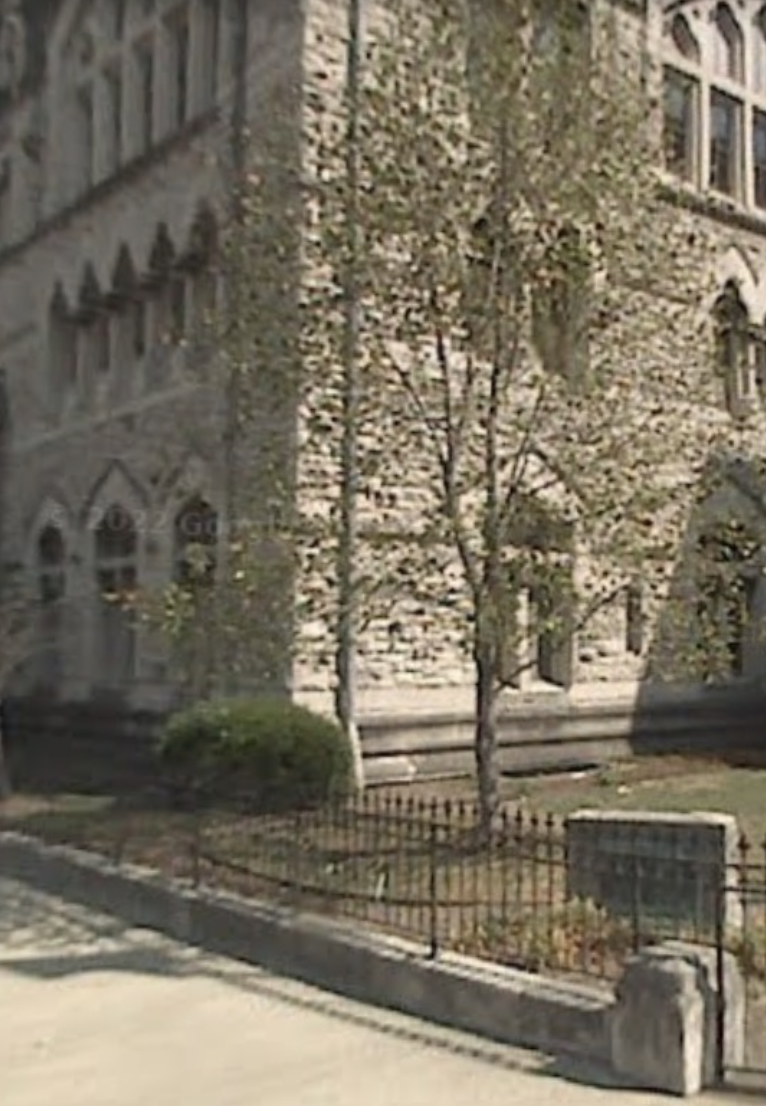
Marker, Lafayette’s visit, Nashville, TN
May 5, 1825
|
|
May 5, 1825
100 8th Ave S, Nashville, TN 37203
Photo: Image capture Sept 2007 (c) Google 2022
|
|
• ...“The next morning, as soon as we rose, we proceeded to the southward of the city, where we found all the militia of the adjoining counties collected in a camp, which they occupied for some days whilst waiting for the arrival of Lafayette; some of the corps we saw under arms, had come, we were told, more than fifty miles, to add by their presence to the solemnity of the reception given to the guest of the nation. The general, after having seen them manœuvre before him, went through their ranks to express his admiration of their discipline, and his gratitude for the proofs of affection they had shown him.” (Auguste Levasseur, Lafayette en Amérique 1824-1825, p. 340., Vol II)
• Inscription:
“Also called The Commons, originally 240 acres extending south to the river. Given to Davidson Academy by the State of North Carolina, famous as a mustering ground. Here 4,000 Tennessee Militia were reviewed by Andrew Jackson and Lafayette on the latter's visit to Nashville in 1825.
Erected 1928 by Division of Archives and History State of Tennessee.”
|
|
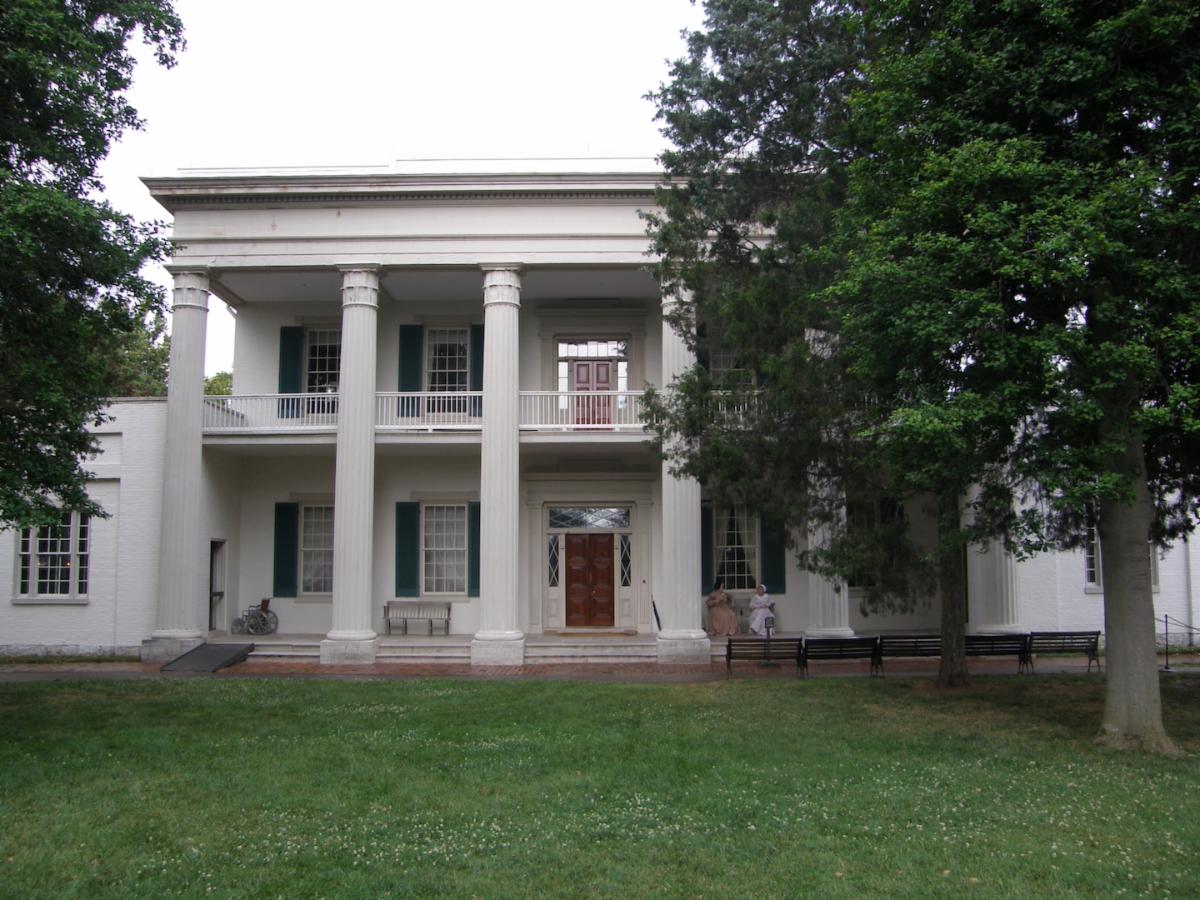
Marker, Lafayette’s tour, Hermitage, TN
May 5, 1825
|
|
May 5, 1825
4580 Rachels Ln, Hermitage, TN 37076
Photo top: The Hermitage near Nashville, TN: By Jim Bowen https://commons.wikimedia.org/w/index.php?curid=12652919
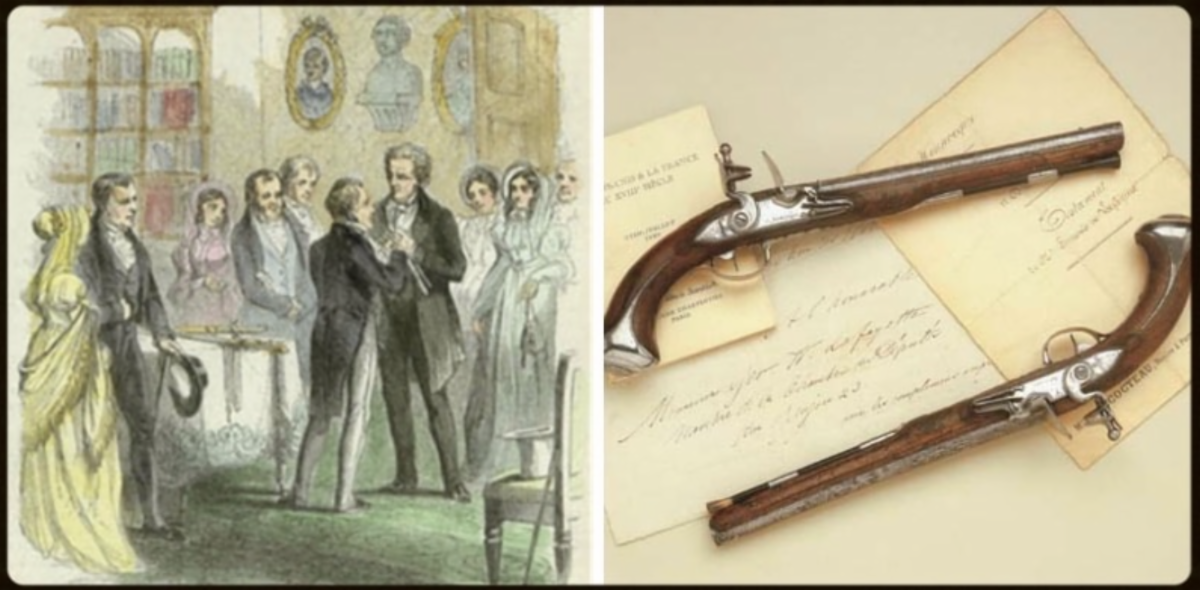
Photo bottom: Lafayette’s Pistols are now on exhibit at Fort Ligonier near Pittsburgh (Illustration Harpers Magazine)
|
|
• ...“But it was to the pistols, that General Jackson wished more particularly to draw our attention; he handed them to General Lafayette and asked him if he recognized them. The latter, after examining them attentively for a few minutes, replied that he fully recollected them, to be a pair he had presented in 1778 to his paternal friend Washington, and that he experienced a real satisfaction in finding them in the hands of one so worthy of possessing them. At these words the face of old Hickory was covered with a modest blush, and his eye sparkled as in a day of victory. “Yes! I believe myself worthy of them,” exclaimed he, in pressing the pistols and Lafayette’s hands to his breast; “if not from what I have done, at least for what I wished to do for my country.” All the bystanders applauded this noble confidence of the patriot hero and were convinced that the weapons of Washington could not be in better hands than those of Jackson.” Auguste Levasseur. “Lafayette in America in 1824 and 1825, Vol. II, page 347”
• Inscription:
Lafayette's tour
“General Lafayette visited
the Hermitage on May 5, 1825.
Andrew Jackson exhibited the
pistols Lafayette had given
George Washington in 1778.”
William G. Pomeroy foundation 2021
|
|
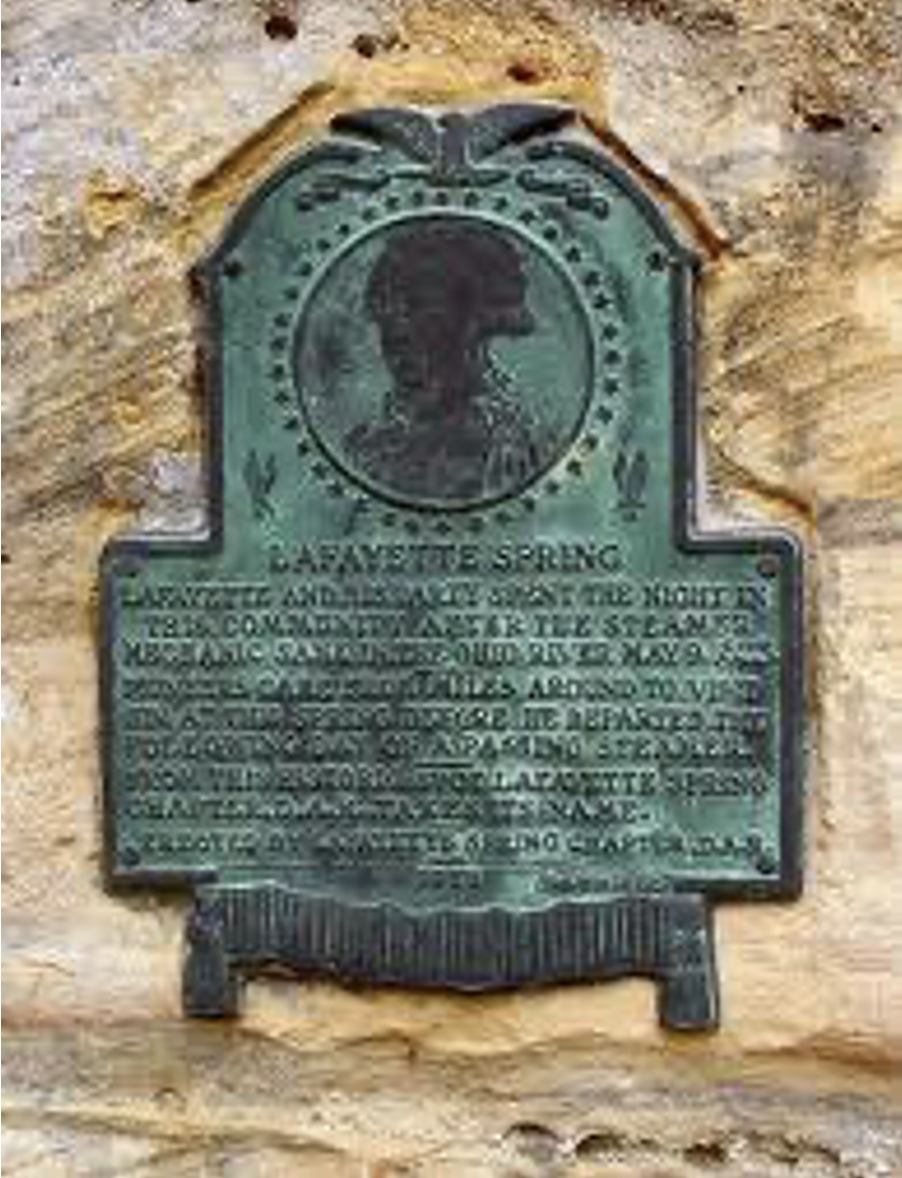
Plaque, “Lafayette Spring”, Cannelton, IN
May 9, 1825
|
|
May 9, 1825
Plaque, "Lafayette Springs"
Ohio River Scenic Byway, 6475 IN-66, Cannelton, IN 47520
Photo: LAFAYETTE SPRING CHAPTER, D.A.R.
Marker, “Lafayette”
May 9, 1825
6500 IN-66, Cannelton, IN 47520, USA
|
|
• On the 8th of May at 11 PM, the steamboat Mechanic hit a rock and sank to the bottom of the Ohio River. Lafayette fell to the river and was rescued by a deck of hands to a lifeboat. He lost a desk with $8,000 and valuable papers. He and fellow passengers were rescued on the Kentucky shore and slept overnight on mattresses. The next morning, they crossed the river to a house on the Indiana side. It was here that Lafayette held an informal reception with pioneers of the area following the shipwreck of his steamboat, the Mechanic, May 9, 1826. Early in the morning, Lafayette and his retinue crossed into Indiana to a house sheltering them from an incoming storm. A passing steamboat, the Paragon carried them to Louisville, KY. Today, a marker memorializes the event.
• Inscription:
Lafayette spring
"Lafayette and his party spent the night in this community
after the steamer Mechanic sank in the Ohio river May 9,1825.
Pioneers came from miles around to visit him at this spring before
he departed the following day on a passing steamer
From this historic spot Lafayette spring chapter, D.A.R. takes its name”
Erected by Lafayette Spring chapter, D.A.R. 1958
• “...One of them, a vessel of large size and remarkable beauty, was the Paragon; she came from Louisville and was going to New Orleans, with a heavy cargo of whiskey and tobacco. By a very lucky circumstance for us, one of our companions in misfortune, Mr. Neilson, was one of the owners of this vessel, and hastened to put it at the disposal of the Tennessee committee to transport General Lafayette, generously taking on himself all the chances of another misfortune and the loss of insurance. Immediately our whole party, abandoning our bivouac, repaired on board of the Paragon.” Excerpt From Lafayette in America in 1824 and 1825, Vol. II by Auguste Levasseur
• Inscription:
Lafayette's tour
on May 9, 1825, General
Lafayette survived sinking of
steamboat ”Mechanic" nearby &
continued to Louisville aboard
passing steamboat “Paragon”.
Daughters of the American Revolution
William G. Pomeroy Foundation 2023
|
|
Marker, Lafayette’s tour, Frankfort, KY
May 14, 1825
|
|
May 14, 1825
218 Wilkinson St, Frankfort, KY 40601
|
|
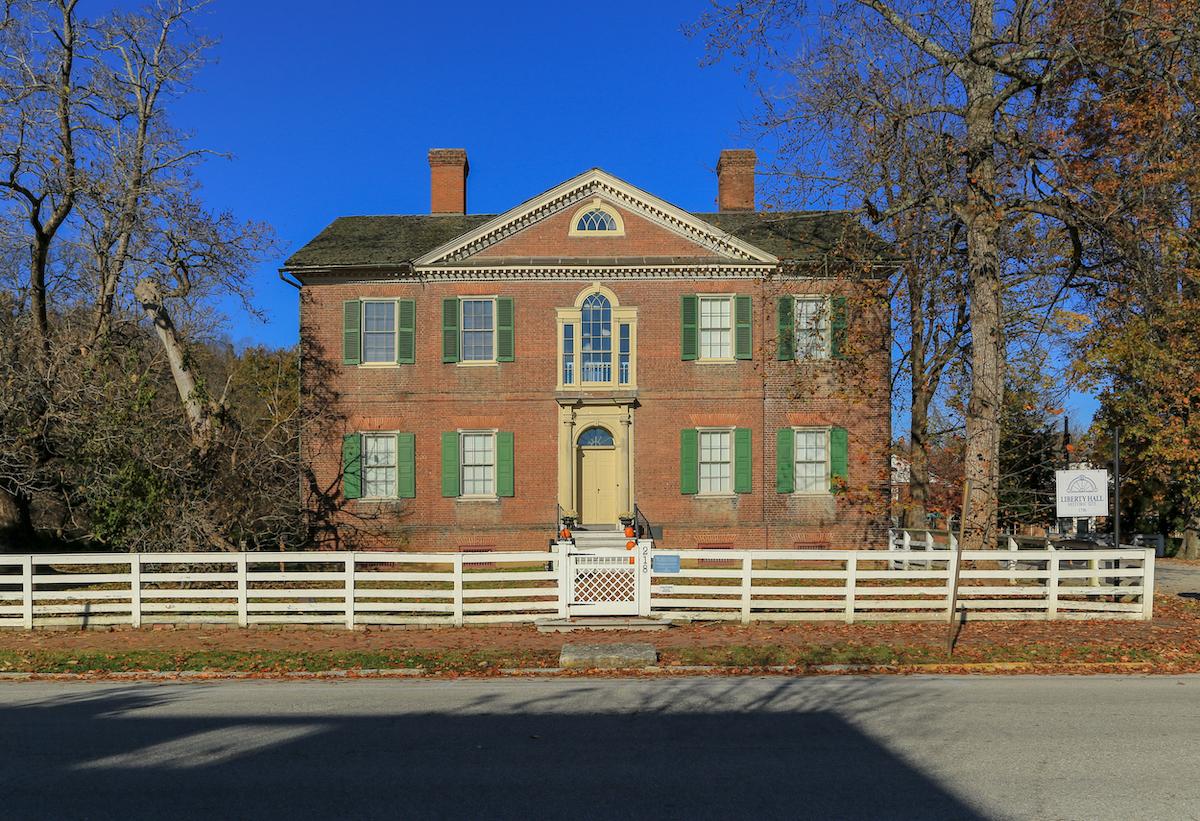
• During the ball at Weisiger’s tavern, Lafayette paid his respects to Margaretta Brown at Liberty Hall. Margaretta Brown was the wife of John Brown (one Kentucky’s first two US Senators )and ardent “gradual” abolitionist.
•…”the arrival of General Lafayette occasioned as much bustle (in proportion to the population) here as at New York, and I must relate a circumstance which I know will give you pleasure, as it was the cause of great gratification to me. There was a splendid Ball to be given in the evening, but as there were many Ladies who did not attend Balls, and yet wished to see the General, they were introduced to him at his Markee, I was one of the number and had such a hearty and long-continued shake of the hand as to occasion the envy of many an impatient expectant”… (Letter to her mother, Mrs. John Mason, of New York City, in July 12, 1825)
• Inscription:
“On May 14, 1825, General
Lafayette was entertained
with a ball at Weisiger's
tavern. He also visited
Margaretta Brown here.”
William G. Pomeroy foundation 2022
|
|
Marker, “Lafayette’s visit in Cincinnati, OH
May 19, 1825
|
|
100 Joe Nuxhall Way, Cincinnati, OH 45202
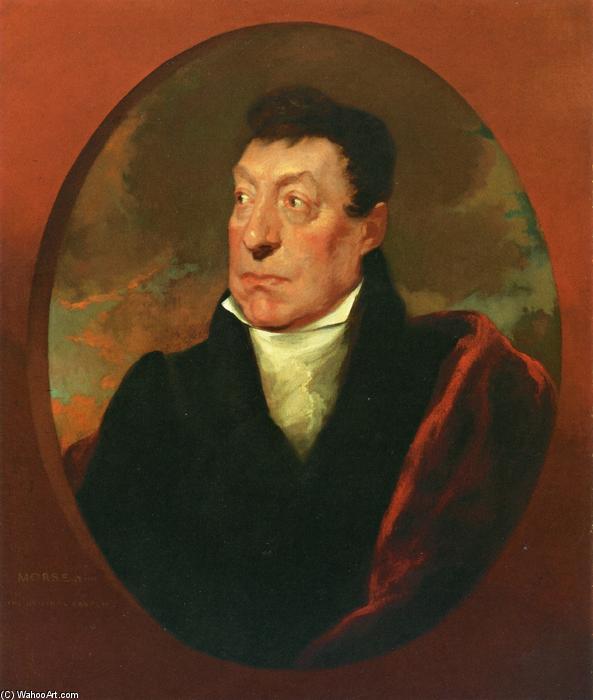
Photo: By Samuel Finley Breese Morse - Public Domain
|
|
...“The arrival of the steam-boat in the bay, was announced by discharges of artillery from Fort Condé; and when we reached the wharf at Mobile, the general found the committee of the corporation and all the population assembled to receive him. He was conducted to the centre of the town under a triumphal arch" […] “He was then led to an immense hall, expressly constructed for his reception. He there found all the ladies, to whom he was presented by the governor” […] “In returning his thanks to the orator and the citizens of Alabama, the general took a rapid survey of the struggles for liberty in which he had borne so important a part, and concluded by expressing his deep conviction of the necessity of the closest and most intimate union among the states. The inhabitants of Mobile, hoping that the general would pass some days with them, had made great preparations for entertainments to him, but the most part were rendered useless. Limited in his time, he was obliged to yield to the solicitations of the deputation from New Orleans, who pressed him to depart the next morning. Nevertheless he accepted a public dinner, a ball and a masonic celebration; after which we went on board the vessel which was to take him to New Orleans, to obtain a few hours of that repose, which a day filled with so many pleasant emotions had rendered absolutely necessary.”
Excerpt From "Lafayette in America in 1824 and 1825", Vol. II page 170-171
By Auguste Levasseur
• Inscription:
“On this site stood the home of Mayor Samuel H. Garrow, where the Marquis de Lafayette was entertained on his visit to Mobile, April 7, 1825. Lafayette, French officer, statesman, and hero of the American Revolution, visited the United States as "Guest of the Nation" in 1824-1825. Mobile gave an enthusiastic welcome to the distinguished general.”
“Erected 1975 by the Historic Mobile Preservation Society.”
(Original marker was erected in 1936)
|
|
Marker and Mural, Lafayette’s visit, Maysville, KY
May 21, 1825
|
|
May 21, 1825
Mural at Limestone Landing Park Trail, 25 East McDonald Parkway Maysville, KY 41056
Marker at 221 Sutton St, Maysville, KY 41056, USA
Photo: Image capture April 2018 (c) 2022 Google
|
|
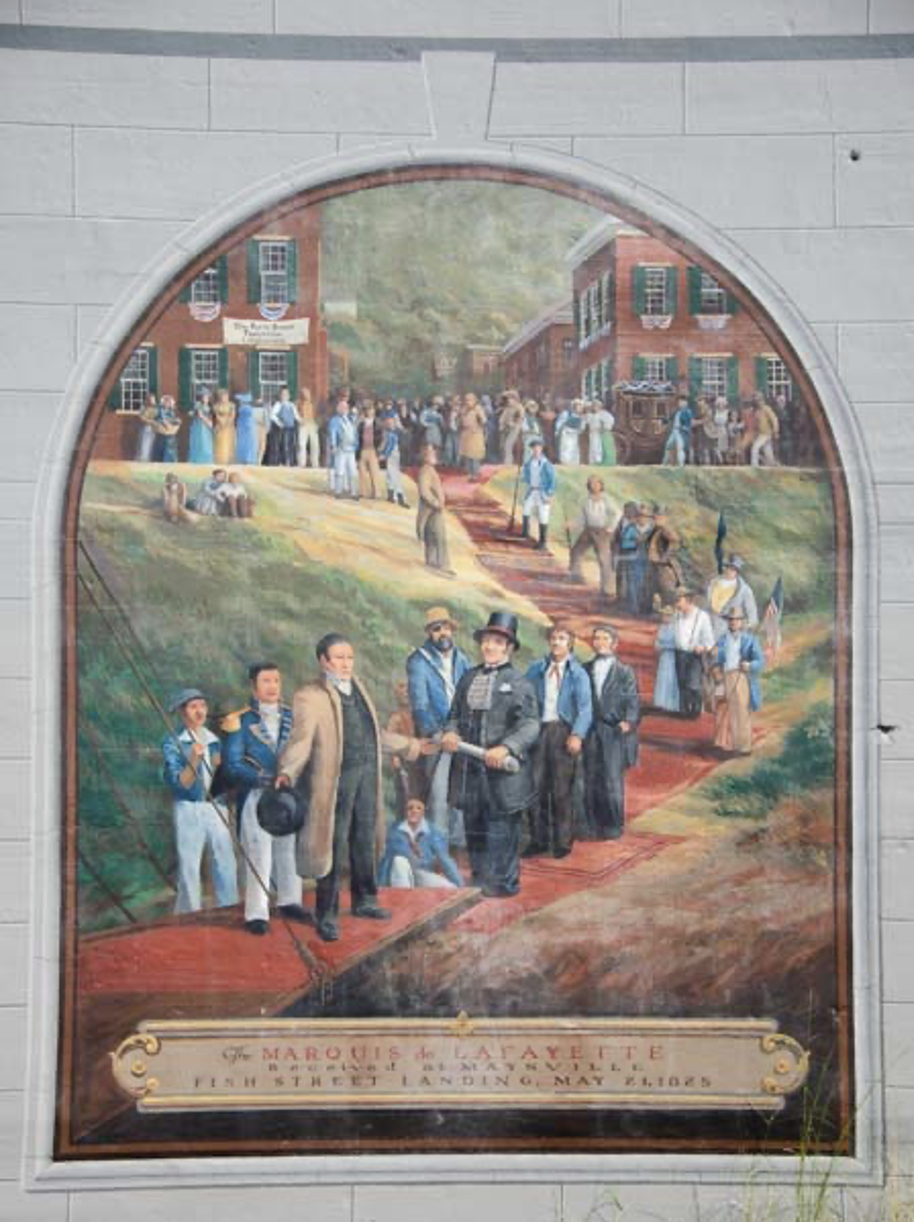
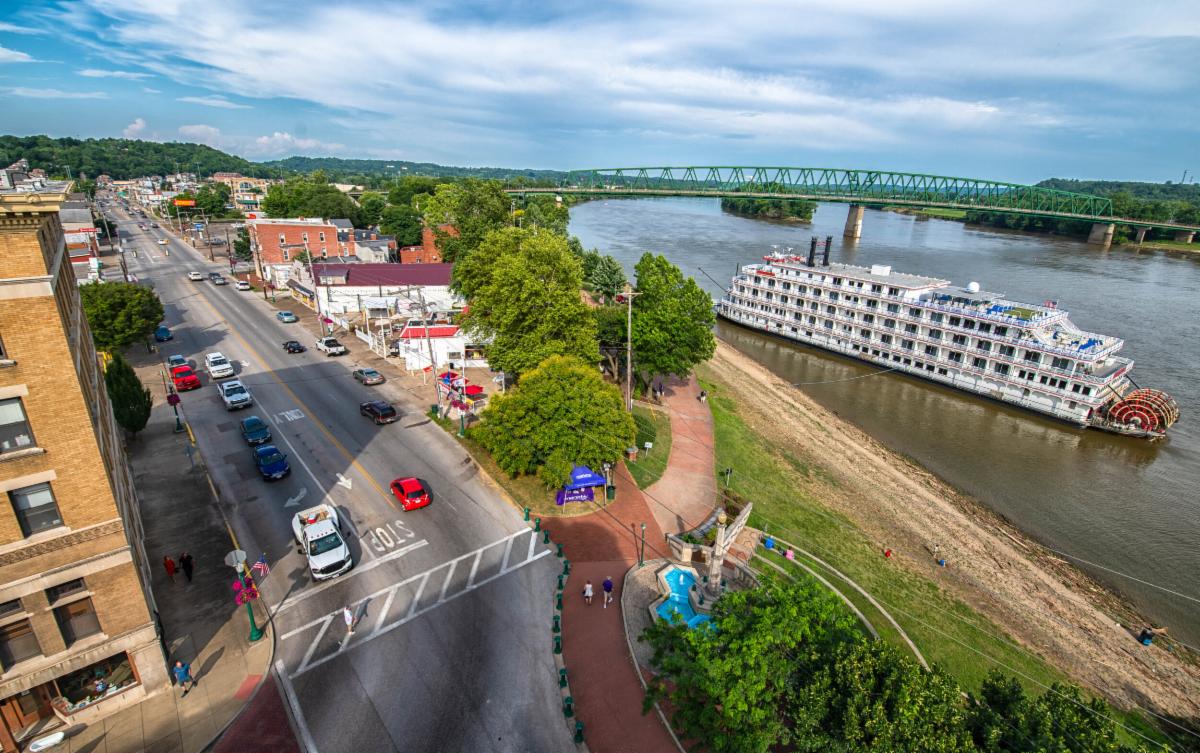
• On May 21st 1825, General LaFayette, his retinue and the Governor of Ohio reached Maysville, Kentucky, on the steamer Herald.
The reception tendered this great visitor was one of the most colorful celebrations ever held on Maysville soil. The General was met at the foot of Fish Street (now known as Wall Street) by a Committee of elected officials, veterans and merchants. Landed at the decorated wharf, LaFayette was greeted by a mad throng. Carpets, given by John Armstrong, a wealthy merchant of Maysville, lined the grade leading to what is now Front Street. He was tendered a reception at the hotel of Maurice Langhorne, at the southeast corner of Market and Front streets.
• Inscription:
"On May 21, 1825, during a third, triumphal, visit to America, the Marquis de la Fayette, 67, visited Maysville. In appreciation for his services on General Washington's staff, and a commander of American troops, the town rolled out the red carpet and Revolutionary War veterans paraded. Local artist Aaron Corwine painted his portrait as he boated from Cincinnati."
Erected 1998 by Maysville-Mason County Area Chamber of Commerce, Limestone Economic Development, Inc.
• The approach of the general was announced by the firing of cannon from the steamboat and the ringing of the church bell ...[...] The procession moved up Fish to Second street; thence up Second to Main Cross street to Capt. Langhorne’s hotel, where a large room was prepared, with suitable refreshments, and very handsomely decorated. Here the general received, individually, his revolutionary companions and the large concourse of citizens who had assembled to behold , the greater part of them for the first, and the whole, in all probability, for the last time, this venerable patriot, and early and efficient friend of American freedom...” the Maysville Eagle of May 18, 1825
• Inscription of Lafayette Tour Marker:
Lafayette's tour
“On May 21, 1825, General
Lafayette landed at fish St.
Escorted to capt. Langhorne’s
Hotel, he dined and met with
Revolutionary war veterans.
William G. Pomeroy Foundation 2022”
|
|
Marker, Lafayette’s visit, Marietta, OH
May 22, 1825
|
|
May 22, 1825
(The date on the marker is erroneous)
100 W Ohio St, Marietta, OH 45750
The Lafayette Hotel was built in 1914 and named in honor of this illustrious first tourist, who landed just across (photo taken from the current hotel website, showing a river view of a room)
|
|
• Inscription:
Lafayette
Landed at this point, May 25, 1825
——— • • • ———
“Returning in 1824 to the young Nation he had greatly assisted during the Revolutionary War, Marie Joseph Paul Yves Roch Gilbert du Motier, Marquess de la Fayette embarked on an unprecedented and triumphal Tour of the United States which lasted 1½ years. In early 1825 he left New Orleans by boat landing at Marietta on May 25, 1825 stopping overnight at the residence of Nahum Ward. From Marietta, Lafayette proceeded to Pittsburgh then overland to Boston where he dedicated and laid the cornerstone of Bunker Hill Monument in Boston on June 17, 1825. Lafayette arrived in France in October 1825 and was received with great honor in the Court of Charles X at Versailles. (See picture in Hotel Lafayette Lobby). Marietta was founded in 1788 and named in honor of the Queen of France, Marie Antoinette (1755-1795).
Erected 1959 by S. Durward Hoag, Innkeeper.”
|
|
Marker, Lafayette’s tour, West Alexander, PA
May 25, 1825
|
|
May 25, 1825
119 Main St, West Alexander, PA 15376
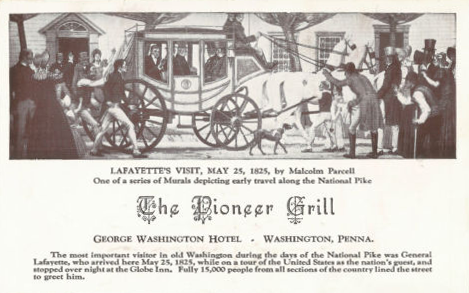
Photo: unknown publisherPainting Malcom Parcell - Ebay auction, Public Domain, https://commons.wikimedia.org/w/index.php?curid=30555452
Postcard depicting the 1825 visit of Gilbert du Motier, Marquis de Lafayette to Washington, Pennsylvania, where he dined at The Pioneer Grill located in The George Washington Hotel and stayed at the Globe Inn.
|
|
• Inscription:
Lafayette's tour
“On May 25, 1825, general
Lafayette was warmly
welcomed by the citizens of
West Alexander with whom
he shared refreshments.”
William G. Pomeroy Foundation 2022
|
|
Marker, Lafayette’s tour, Uniontown, PA
May 26, 1825
|
|
May 26, 1825
Eberly Square, 4 N Beeson Blvd, Uniontown, PA 15401
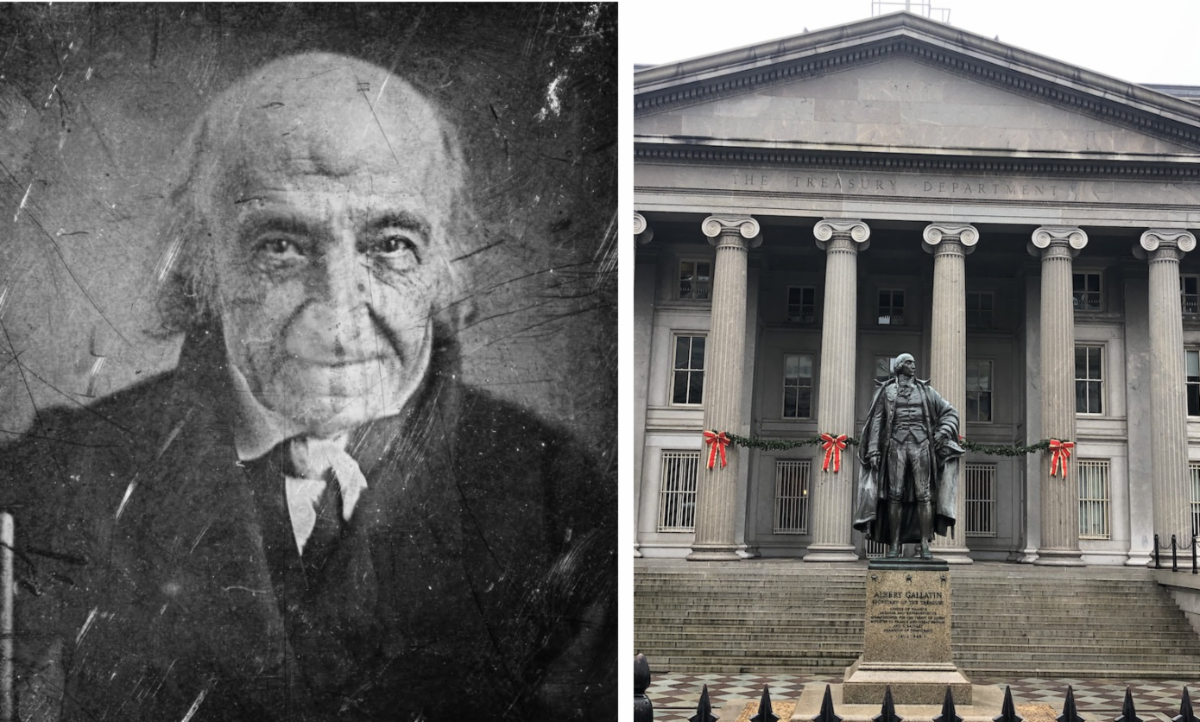
Right: Statue of Albert Gallatin in front of the northern entrance to the United States Treasury Building, photo: Thierry Chaunu 2021
|
|
• ...“At Uniontown, the seat of justice for the county of Lafayette, he was received with a simplicity and cordiality calculated to recall the character of the founders of Pennsylvania. “For the purpose of addressing their national guest, the inhabitants of Uniontown employed, as their organ of communication, one of his oldest and best friends, Mr. Gallatin, known in Europe from his diplomatic labours, and whom the American leaders have always reckoned among the number of their most able defenders. Placed upon a stage raised in the centre of the town, Mr. Gallatin received General Lafayette, and addressed him in the name of the surrounding people, who listened in silence.” (Auguste Levasseur. “Lafayette in America in 1824 and 1825, Vol. II., p. 397)
• Albert de Gallatin (born in Geneva, Switzerland, January 29, 1761 – August 12, 1849), nicknamed “America’s Swiss Founding Father” by scholar and author Nicholas Dungan, was Secretary of the Treasury (1801-1814), and Ambassador to France (1816-1823), an ethnologist, linguist, and a longtime close friend of Lafayette.
• Inscription:
Lafayette Tour
“On May 26, 1825, general
Lafayette was welcomed at
the courthouse by Albert
Gallatin. He returned May 28
en route to Pittsburgh.”
PA Daughters of the American Revolution
William G. Pomeroy foundation 2022
|
|
Marker, Lafayette’s Tour, Point Marion, PA
May 27-28, 1825
|
|
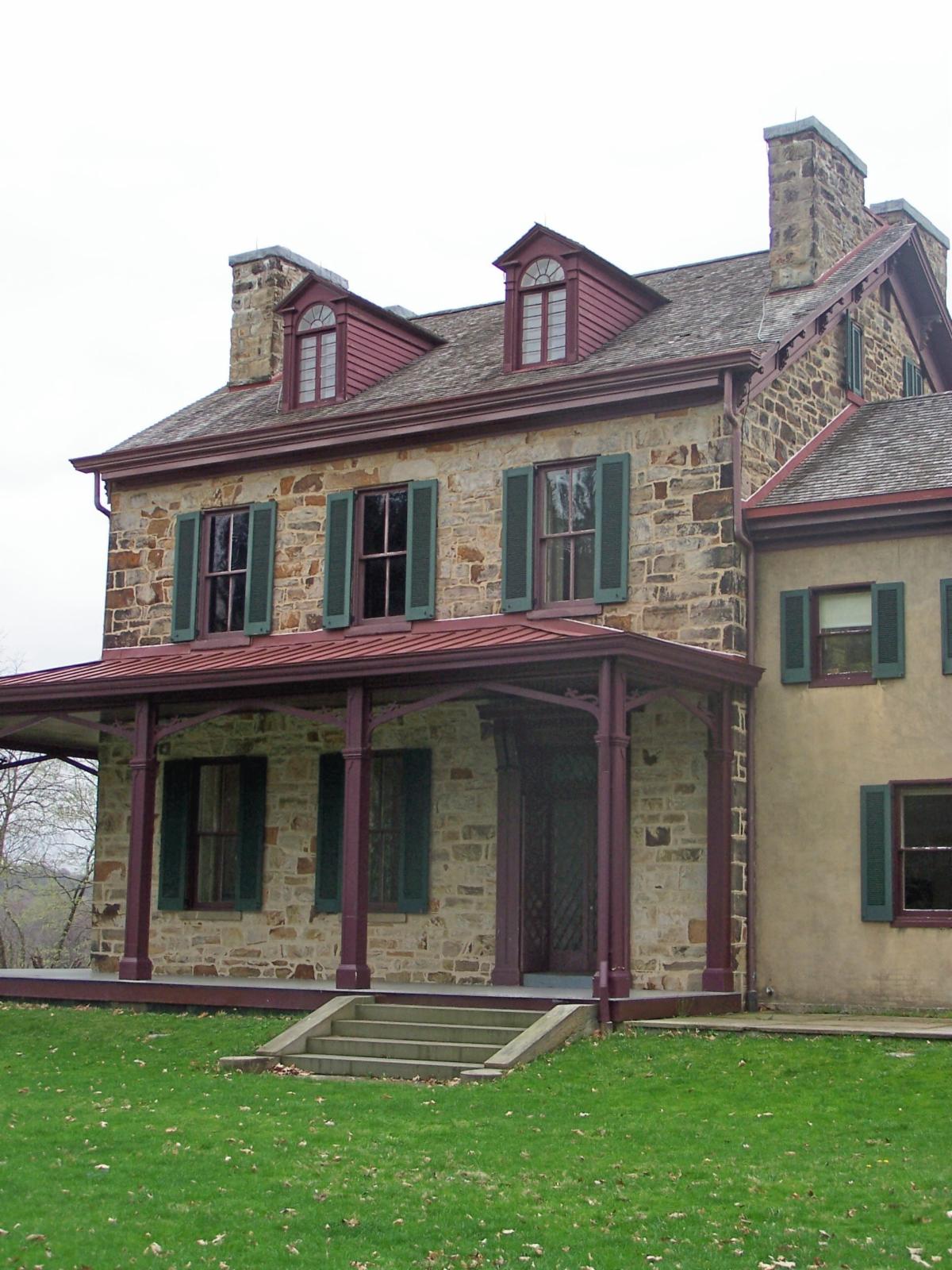
Friendship Hill National Historic Site,
223 New Geneva Road, Point Marion, PA 15474
|
|
• Friendship Hill was the home of Geneva-born Albert Gallatin (1761–1849) who was a U.S. Congressman, the longest-serving Secretary of the Treasury under two presidents, and ambassador to France and Great Britain. The house is maintained by the National Park Service.
• Gallatin and Lafayette’s friendship was renewed during Gallatin’s stay in France as Ambassador in Paris in 1816 and Gallatin invited Lafayette and his retinue to rest a couple of days in his country home. But the crowd of visitors who continuously pressed in the gardens didn’t leave much private time for the two friends.
• Inscription:
Lafayette’s tour
General Lafayette visited
his friend, Albert Gallatin,
former secretary of the
Treasury, here at his home
May 27 and 28, 1825
William G. Pomeroy foundation 2020
|
|
Marker, Lafayette’s tour, Elizabeth, PA
May 29, 1825
|
|
May 29, 1825
104 S 2nd Ave, Elizabeth, PA 15037
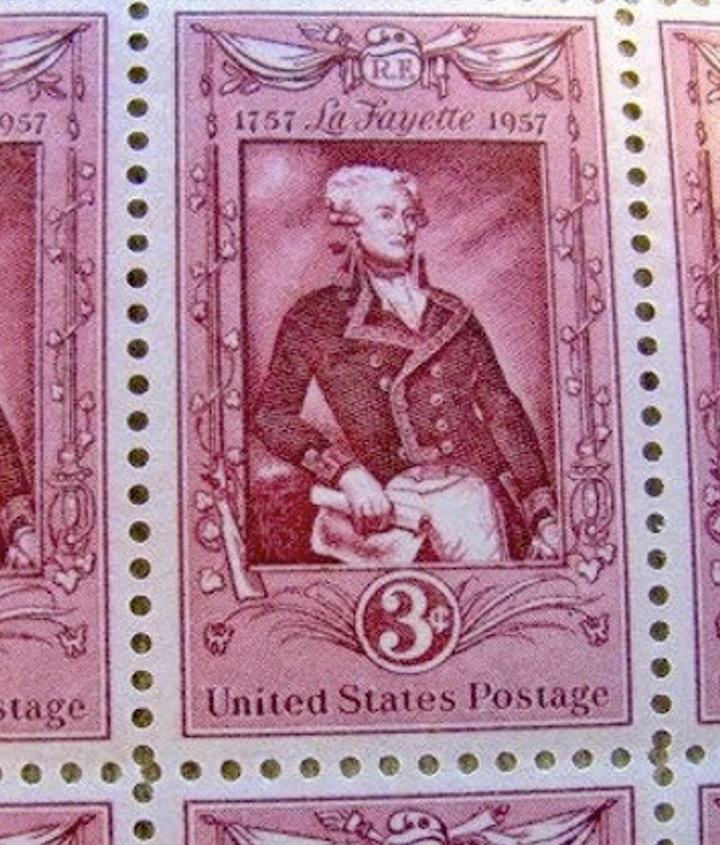
Photo: 3¢ US Post Office Stamp issued for the Bicentennial of Lafayette's birth, 1957, Public Domain
|
|
• ..."Past noon, Lafayette alighted at Major John Walker's Hotel, located at the southwestern corner of Market and Water streets. He was addressed from the footsteps of the adjacent house. He then boarded a ship and proceeded to Braddock's field (site of the French victory over the British in July 1755).
•“On the 28th of May Mr. Gallatin reconducted us to Uniontown, when we took leave of him to go to Elizabethtown, a little village situated on the banks of the Monongahela. We arrived there about twelve o’clock; when a boat, propelled by four oars, received us on board, and we descended the river to the famous Braddock’s Field, which we reached some time after sunset. ” (Auguste Levasseur. “Lafayette in America in 1824 and 1825", Vol. II. p. 400)
• Inscription:
Lafayette Tour
“On May 29, 1825, general
Lafayette was welcomed in
Elizabeth. he embarked on a
barge & proceeded downriver
toward Braddock's field.”
William G. Pomeroy foundation 2022
|
|
WE WILL CONTINUE TO TRAVEL WITH LAFAYETTE
OVER THE NEXT 4 MONTHS!...
|
|
PAST MONTHLY BULLETINS
OUR GOAL: turn the spotlight on a famous, or less famous, episode or historical figure during the long shared history between France and the United States, with illustrations and anecdotes.
You can have access to all our past Monthly Bulletin
since February 2021 by visiting our website:
You can click on the photos throughout our bulletins and also on the links indicated in blue for more information and direct access to sources.
|
|
Next month in June we will complete our series on the French Forts in North America, narrating the building of forts in the Lower Mississippi basin and Louisiana. |
|
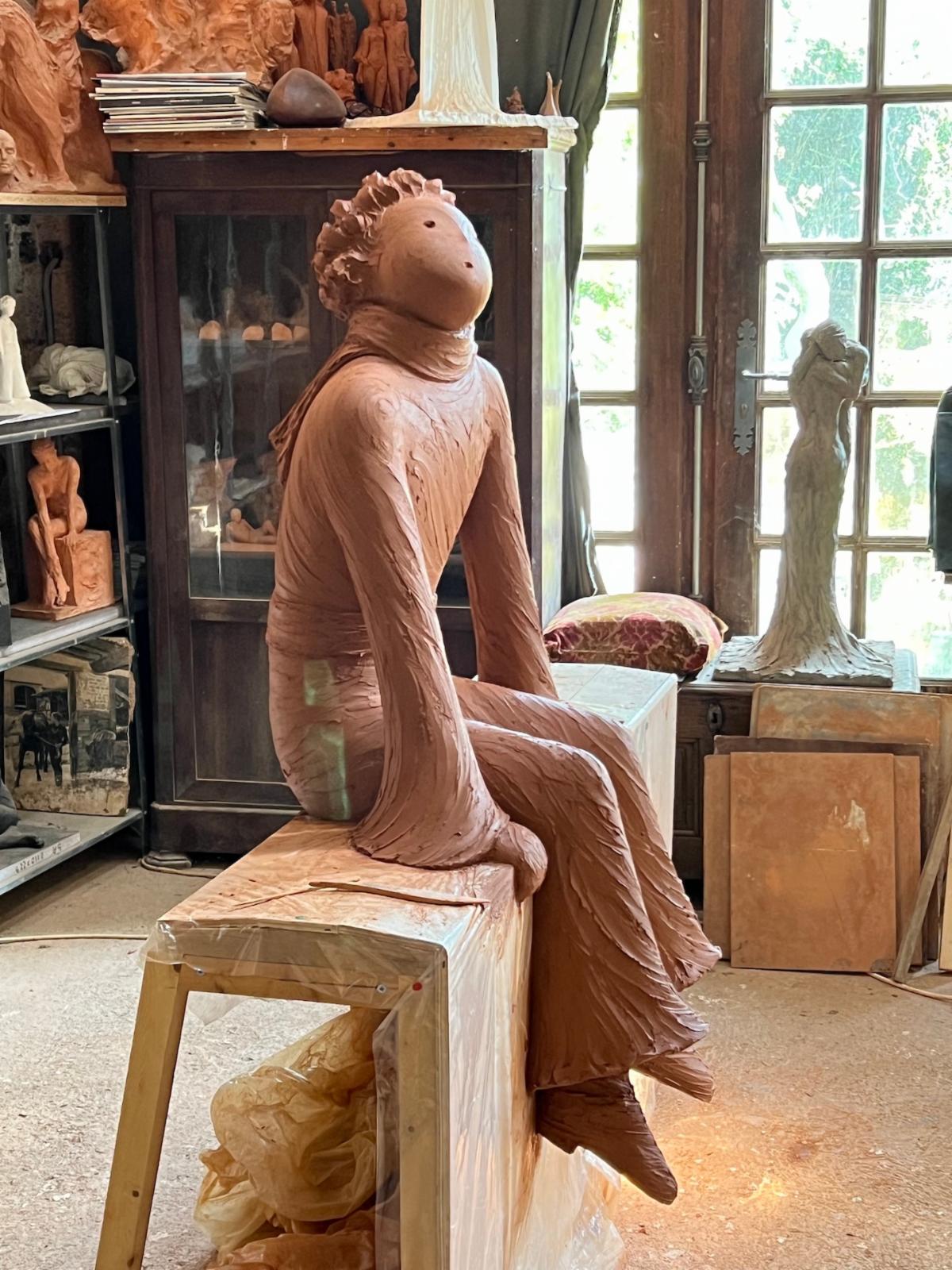
THE SCULPTURE OF LE PETIT PRINCE®
SOON AT HOME IN NEW YORK
FINAL VERSION OF THE SCULPTURE!
|
|
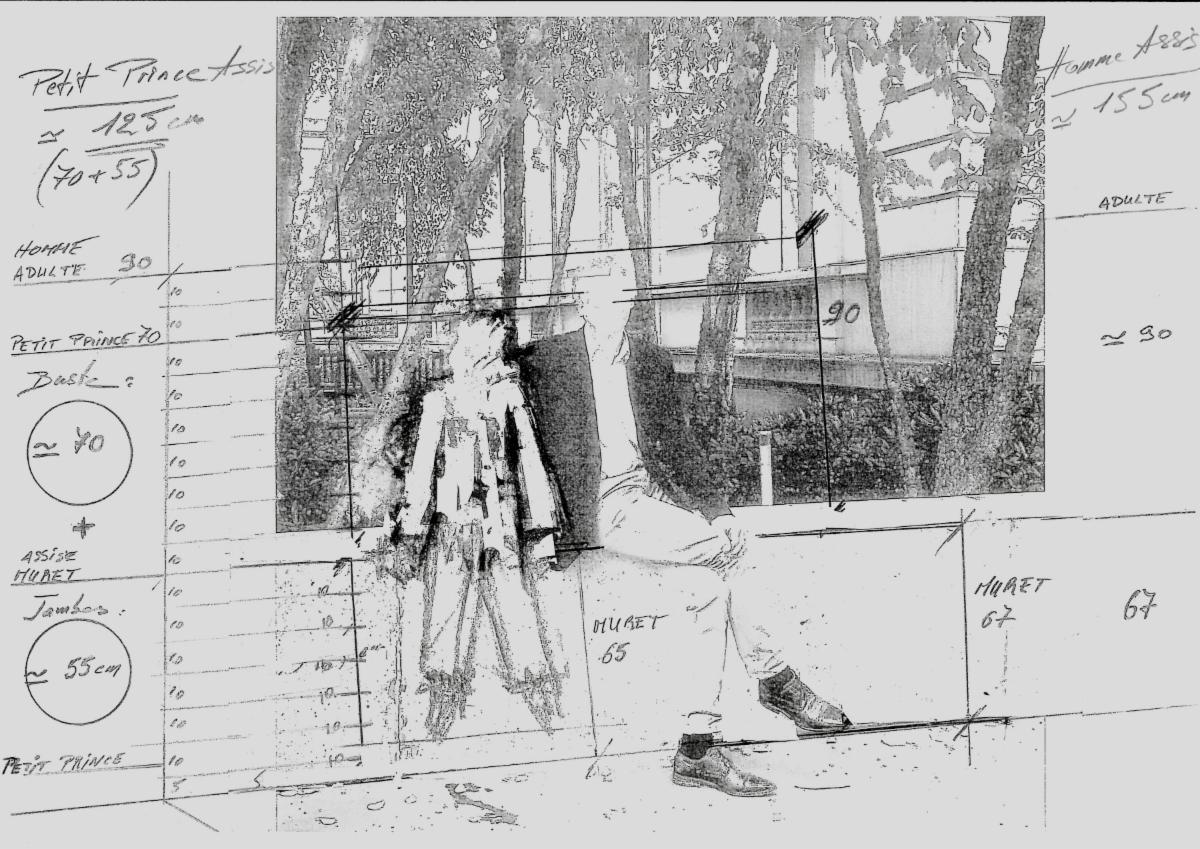
Photos and illustration courtesy of sculptor Jean-Marc de Pas. LE PETIT PRINCE® in the artist's studio at the Château de Boisguilbert, Normandie, looking at the stars and soon to be cast in bronze before flying courtesy of Air France to its new home at the French Cultural Services - Villa Albertine, NY.
|
|
Our association The American Society of Le Souvenir Français is at the origin of the Little Prince sculpture project in Manhattan.
For the record, our association had already honored Antoine de Saint Exupéry in the year 2000, by placing a plaque at 3 East 52nd Street, but wanted to pay homage to him with a sculpture, as is the case in several countries. The idea of a sculpture was first proposed by the late Colonel Roger Cestac, president of our association in the 1990's.
Antoine de Saint Exupéry wrote The Little Prince® entirely in New York, and his name is among the 463 volunteers and conscripts from New York who “Died For France”.
Originally intended for Central Park, it couldn't be materialized for a host of reasons and the project lingered for several years. Immediately upon his election at the head of our organization in 2021, Thierry Chaunu, along with fellow Board Members Jean-Hugues Monier & Francis Dubois decided to make it a top priority.
With the unfailing and constant support of The Antoine de Saint Exupéry Youth Foundation headed by its Vice-president Mr. Olivier d'Agay (great-nephew of the author), Nicolas Delsalle-Mun, General Delegate of the Foundation, and members of the Saint-Exupéry family, a “Steering Committee” composed of MM. Nicolas Delsalle, Jean-Hugues Monier, Francis Dubois and Thierry Chaunu pursued the project from start to finish.
Thanks to Brigitte Van den Hove-Smith, Regional Delegate for the Southeast region of the USA who did the introduction, the Board of our association selected the renowned French sculptor Jean-Marc de Pas in March 2022 after a bidding process.
This project received in May 2022 the high patronage of the French Ambassador in the United States Mr. Philippe Etienne and the General Consul of France in New York, Mr. Jérémie Robert.
An Honorary Committee, co-chaired by American author Stacy Schiff (Pulitzer Prize) and Mr. Olivier d'Agay was formed in June 2022 and co-signed a fundraising campaign, to which many French and American donors, individuals and companies, responded enthusiastically.
Finally, among several possible locations, the choice of Cultural Services-Villa Albertine on Fifth Avenue was chosen in September with the active support of the Cultural Attaché Mr. Gaëtan Bruel.
We officially presented the project on October 13, 2022, at the French Cultural Services - Villa Albertine in New York.
To date, the sculpture is in the process of being examined by the Landmark Commission, after having received a very favorable opinion during a preliminary hearing (8 votes "for", 1 abstention).
The final version of the sculpture is about to be transported to the foundry, then will be transported to New York by Air France, for an installation in August and an inauguration scheduled for around September 20, 2023.
We will keep you informed in the coming Bulletins.
|
|
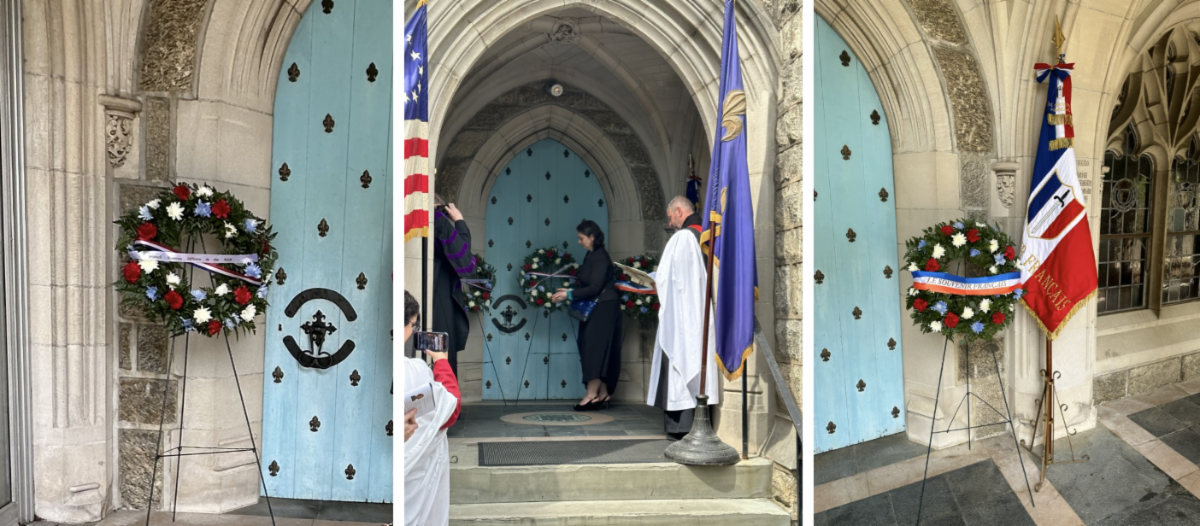
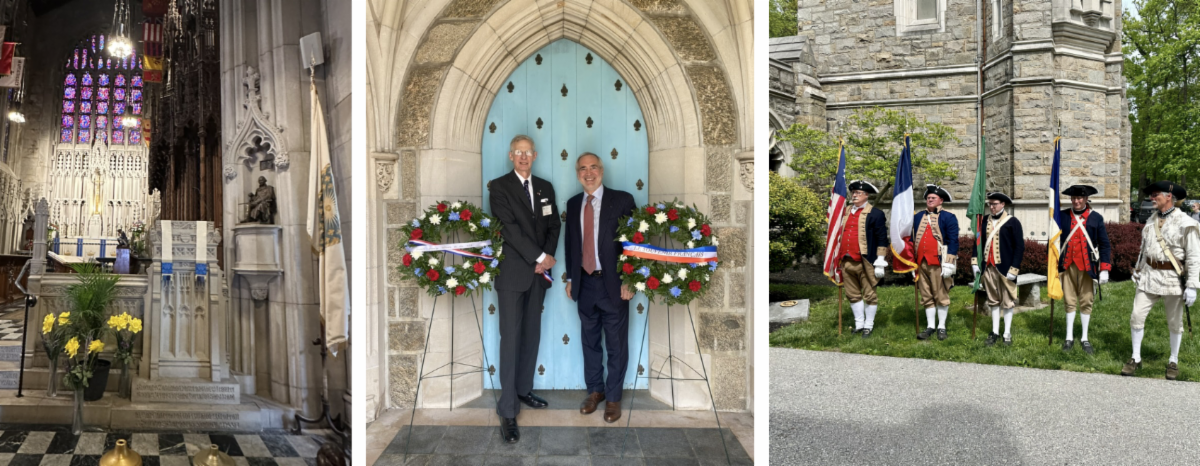
ANNUAL CELEBRATION OF
FRENCH ALLIANCE DAY
Washington Memorial Chapel, Valley Forge, Pennsylvania
May 7, 2023
|
|
Valley Forge Memorial & Washington Memorial Chapel
2000 Valley Forge Park Rd, Valley Forge, PA 19481
Photos: FredFons1, Katia Graytok, Thierry Chaunu
|
|
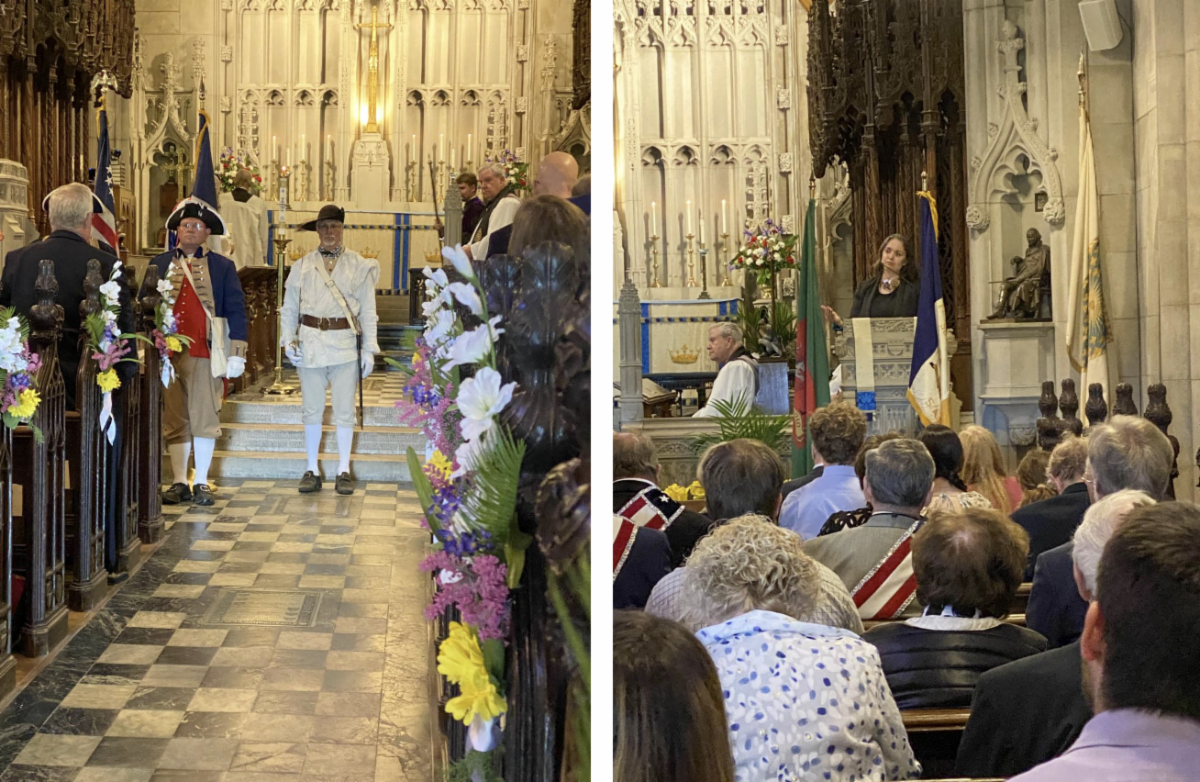
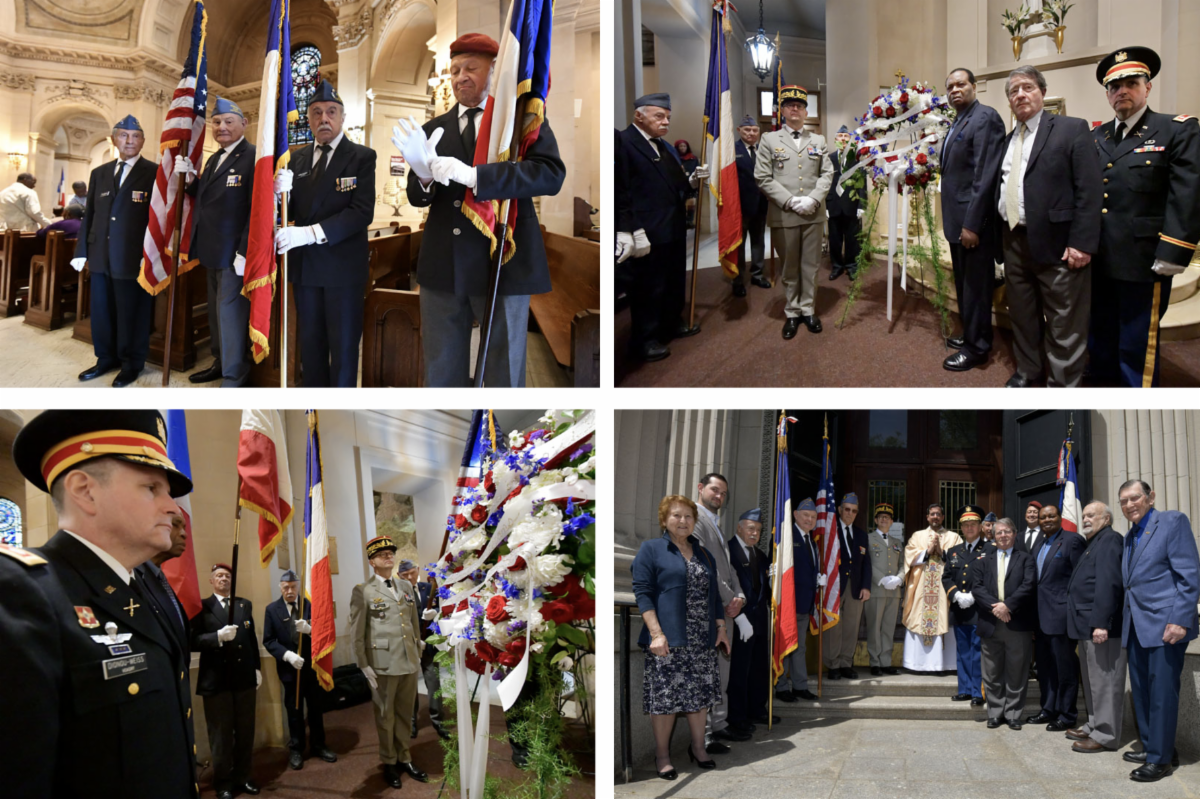
• We are honored to attend every first Sunday of May a most special celebration service at the George Washington Memorial Chapel.
As we do every year, we placed alongside the tricolor standard a wreath with the ribbon of our association The American Society of Le Souvenir Français.
Another wreath was placed by the Association of French Reserve Officers in the United States (ACREFEU). The new Honorary Consul of France, Ms. Marine Havel, spoke during the ceremony and laid a wreath from the French Government to pay tribute to soldiers and sailors, French and American, who died in the struggle for American independence.
• According tho the instructions of General George Washington, every year, on the first Sunday in May, Washington Memorial Chapel at Valley Forge commemorates the Treaty and its celebration at the Valley Forge encampment on May 6, 1778 with a mass to thank France and King Louis XVI. The Treaty of Alliance, Friendship and Commerce between France and the United States, signed in Paris in February 1778, turned the tide of America's struggle for independence during the American Revolution.
• We thank Rev Father Tommy Thompson, Rector, president David Lauhoff, past president Gardiner Pearson, new executive Director Mark Thompsson, and salute all the other dignitaries present, as well as all the re-enactors for their most gracious welcome and friendship.
• The Chapel is both a place of worship and a memorial to George Washington, the Founders and Patriots, and the Continental Army. It seeks to ensure that the ideals and principles of the American Revolution are understood and kept alive by contemporary and future Americans. The mission of Washington Memorial Heritage, a 501 (c ) 3, is to preserve the Chapel and support its secular mission. For more information, contact: Board@wrmheritage.org
|
|
ANNUAL MASS AND WREATH-LAYING CEREMONY
V-DAY MAY 8, 1945
Eglise Notre-Dame of Manhattan
|
|
Photos Top, clockwise: French War Veterans Paul Garabédian, Jean Legall, Henry Dubarry, Michel Dumerchat • Général de brigade Vincent de Kytspotter / PhD, Head of Military and Defense Mission, French Permanent Mission to the United Nations, Prof. Clément Mbom, Board Member, American Society of Le Souvenir Français Inc., Patrick du Tertre, president of the Association of French Reserve Officers in the United States (ACREFEU) and 1st Vice President of our Society, Lt. Col. Dionysios Dionou-Weiss, US Army • Group photo on the steps around Alain Dupuis, president of the Federation of French War Veterans, 2nd Vice President of our Society and Deputy General Delegate of Le Souvenir Français in the United States.
|
|
A busy month with our friends of TheLafayetteTrail.org
New Markers inaugurated May 1, 3, 13, 15, & 17, 2023 !
|
|
Messages from Julien Icher, President, The Lafayette Trail, Inc:
Dear Member,
• The Lafayette Trail, Inc. is pleased to announce the dedication of a new Lafayette Trail historic marker near Cannelton, Perry County, IN on Monday, May 1, 2023. The marker dedication ceremony took place at Lafayette Spring. The site is located east of Cannelton, IN along Indiana Route 66 (also known as the Ohio River Scenic Byway) past the U.S. Army Corps of Engineers station.
• The Lafayette Trail, Inc. is pleased to announce the dedication of a new Lafayette Trail historic marker in Cincinnati, OH on Wednesday, May 3, 2023,
The marker dedication ceremony took place in the immediate vicinity of the American Queen Paddle Wheel Monument located at 100 Joe Nuxhall Way, Cincinnati, OH 45202.
• The Lafayette Trail, Inc. is pleased to announce the dedication of a new Lafayette Trail historic marker in Richmond, VA on Saturday, May 13, 2023
The marker dedication ceremony took place at Masons' Hall, located at 1807 E Franklin St, Richmond, VA 23223.
• The Lafayette Trail, Inc. is pleased to announce the upcoming dedication of a new Lafayette Trail historic marker in Poughkeepsie, NY on Monday, May 15, 2023, at 10 am ET.
The marker dedication ceremony will take place at the Waryas Park Promenade off Main Street, in Poughkeepsie, NY 12601.
The event will include formal remarks from all the stakeholders involved in the preparation of the marker, the actual unveiling, as well as photo opportunities with local officials. The ceremony is expected to last 45 minutes.
Limited street parking will be available for attendees near the unveiling site.
• The Lafayette Trail, Inc. is pleased to announce the upcoming dedication of a new Lafayette Trail historic marker in Red Hook, NY on Monday, May 15, 2023, at 2 pm ET.
The marker dedication ceremony will occur at Montgomery Place. Attendees can park their vehicles in the parking lot of the Montgomery Place Visitors Center located at 55 Montgomery Place, Red Hook, NY 12571.
Montgomery Place is the property of Bard College. We are very grateful to the leadership of Bard College for its keen interest in interpreting the connection of Montgomery Place to General Lafayette via the Frenchman's visit to Janet Livingston Montgomery on September 19, 1824.
The site of the unveiling is located within walking distance of the visitors' center. Bard College will provide a few golf carts for individuals who may need special accommodations to get to the marker site.
The event will include formal remarks from all the stakeholders involved in the preparation of the marker, the actual unveiling, as well as photo opportunities. The ceremony is expected to last 45 minutes.
A reception will take place near the site of the unveiling following the conclusion of the ceremony. Afterward, attendees will have the possibility to walk the grounds of Montgomery Place. The mansion will NOT be open to the public.
• The Lafayette Trail, Inc. is pleased to announce the upcoming dedication of a new Lafayette Trail historic marker in Johnstown, NY on Wednesday, May 17, 2023, at 10 am ET. This ceremony will kick off our new historic marker series focusing on Lafayette's Revolutionary War life!
The marker dedication ceremony will take place at 3 N William St, Johnstown, NY 12095. The event is expected to last 45 minutes.
Limited street parking will be available for attendees near the unveiling site.
We hope you can join us! Best regards,
Julien P. Icher, Founder & President, The Lafayette Trail, Inc.
EPISODE 22 of "FollowTheFrenchmen" on YouTube:
We are pleased to announce the release of episode 22 of Follow The Frenchmen, our Video Series about the Lafayette Trail! The episode takes place in Southern Illinois. Click on the video player at the top of this email to check it out now!
The Southern part of Illinois is home to the French roots of the State. American settlers gradually replaced the Native Americans and the French population as the dominant demographic occupying the region.
In 1825, French-born Revolutionary War hero General Lafayette visited Kaskaskia and Shawneetown. The Frenchman's visit intervened after both towns' most thriving periods. It left a lasting mark in the memory of the two communities. Since then, assaults from nature have challenged the permanence of cultural history in the area. Over time, floods have decimated and transformed the region.
In this episode, find out how Lafayette's visits to Kaskaskia and Shawneetown in 1825 rekindled the French origin of the State of Illinois and its transition from colonial times to U.S. republicanism.
Discover how natural disasters have since then transformed the fabric of cultural history and imposed a narrative of resilience on the many cultures that had established themselves along the rivers.
Today, the history of Kaskaskia and Shawneetown is inseparable from elements of fluvial geomorphology pertaining to the evolutions of the Mississippi and Ohio Rivers. Nevertheless, revisiting Lafayette's visits to the area in 1825 offers an opportunity to celebrate and remember the diverse societies that once occupied the land.
You may also view episode 22 by visiting our official YouTube Channel. The video includes Closed Captioning. To enable this feature, click on the
CC icon on the right side of the navigation bar at the bottom of the screen.
|
|
MAY 20TH, 2023
"Follow the French: Rochambeau Festival"
|
|
Three Encampment Site Tour / Event:
Audio digital tour overlay and customized individual site events:
Hartsdale, NY: Odell House - Rochambeau Headquarters
Yorktown Site, 99 Moseman Road, Yorktown, NY (one of five 1781 encampment locations, AKA Yorktown Grange Fairgrounds)
North Castle, Smith’s Tavern
Odell House - Rochambeau Headquarters
425 Ridge Rd, Hartsdale, NY 10530
Free, Open to the general public
Yorktown Site, Yorktown Grange Fairgrounds
99 Moseman Road, Yorktown, NY 10598
Free, Open to the general public
North Castle, Smith’s Tavern
440 Bedford Rd, Armonk, NY 10504
NEW!!
"Follow the French", sponsored by Friends of Odell House...
...directly on your smartphone!
A detailed narration of the encampments of the French Army led by General Rochambeau has just been released on a the free app downloadable on your smartphone TravelStorysGPS.
The episodes Follow the French, sponsored by Friends of Odell House,
can be downloaded at:
The app works on. iPhone and Android, and can be downloaded for free at
You can now visit the different sites and listen to the narrations while driving, as the episodes play automatically based on your GPS location - no need for access to Wifi or cell coverage!
|
|
ANNOUNCEMENT FROM THE UNITED VETERANS COUNCIL |
|
• The United War Veterans Council invites you to join us on Tuesday, May 23, for its annual They Turned the Tide event, commemorating the Allied service members who won the Battle of the Atlantic and made possible the liberation of Europe during World War II.
• This year's commemoration will mark the 40th Anniversary of the Memorial, the 80th Anniversary of the battle, and the 100th Anniversary of the American Battle Monuments Commission, stewards of the East Coast Memorial and of U.S. military cemeteries around the world.
Date: Tuesday, May 23
Time: 5:30 - 6:45pm
Location: East Coast Memorial, Battery Park, Lower Manhattan (Map)
Keynote speaker: Vice Admiral John Mustin, Chief of Navy Reserves, U.S. Navy
Invited attendees:
- Military representatives of U.S. and Allied nations (Great Britain, Australia, Belgium, Brazil, Canada, France, Norway, New Zealand, the Netherlands and Poland)
- Representatives of the American Battle Monuments Commission
- U.S. and international veterans, military, families and supporters
- JROTC (High School) student cadets
Historical spotlight: Event plans include an offshore salute from the brand-new USCG Warren Deyampert, named for a seaman whose name is etched on the Memorial Wall.
Uniform/attire: Summer whites or equivalent for military; Business/Dressy Business Casual (e.g. jacket & tie/ladies equivalent) for civilians.
|
|
OTHER SAVE THE DATES!
Monday, May 22, 2023 at 6:30PM lecture on the French presence in New York and French contributions to American arts and literature by Pierre F. de Ravel d'Esclapon, lawyer, professor and historian as part of a series organized by the General Consulate. Registration required at Eventbrite.
Sunday, May 28 - Memorial Day tribute at the One Hundred Seventh Infantry Memorial at Central Park on 5th avenue and 67th Street. Meeting at 10:30AM in front of the Armory on Park Avenue at 68th Street. Departure at 10:45AM for the monument and return to the Armory (Public wreath-laying ceremony). As every year, the Federation of French War Veterans, the American Society of Le Souvenir Français, the Association of French Reserve Officer in the United States (ACREFEU) will be represented.
Monday, May 29: Memorial Day parade in Douglaston, Long Island at 11:00AM for show and speeches. Parade starts at 1:00PM
As every year, the Federation of French War Veterans will participate.
Tuesday, June 6, Belgian government ceremony at 10:00AM (Location to be announced in our next Bulletin).
Wednesday, June 7 at the French General consulate in New York, at 6:00PM fundraising for the Cadets Lafayette Marching Band. Performance by Jacques and Marie Letalon.
Call (347) 306-0157 for registration
Tuesday, June 13 : Paris-American Club dinner at the National Arts Club, 15 Grammercy Park, New York, NY.
Thierry Chaunu, president of the American Society of Le Souvenir Français, Inc. will present remarks on the sculpture of Le Petit Prince® and its author Antoine de Saint Exupéry, and the leading role of our association with this worthy endeavor.
Call Francis Dubois at (917) 880-2274 for inquiries.
Friday July 7: Concert by the Les Petits Chanteurs de Monaco (Monaco Boys Choir) at St. Bartholomew’s Church 325 Park Avenue (at 51st Street) Presented by Great Music at St. Bart's - MMPAF.org
Friday July 13: Bastille Day celebration at Central Park in New York organized by the CAFUSA (Central Committee of French-Speaking Societies in New York), Dr. Gérard Epelbaum, president.
Details will be announced in next month's bulletin.
Saturday, July 14: annual wreath-laying ceremony at the Statue de Rochambeau and the Monument to the French Fleet, Newport, R.I. (details in our next June Bulletin) and weekend "Tribute to France" in Newport, R.I. with many activities and re-enactors, sponsored by the Newport Historical Society, the Alliance Française of Newport, the National Park Service, with the participation of the Washington Rochambeau Revolutionary Route, the American Friends of Lafayette, the American Society of Le Souvenir Français, Inc.
Tuesday, October 3: dedication of our new historical marker "Duc de Lauzun and his Legion of hussars" at the Battle of the Hook at Gloucester, VA.
Thursday, October 19: Celebration of the combined French-American Victory at Yorktown, VA.
|
|
EXCITING NEWS FROM THE WASHINGTON-ROCHAMBEAU REVOLUTIONARY ROUTE (W3R) |
|
"Rochambeau 300" has been selected as one of the signature event which will be part of W3R-US America 250 celebration. The project is to celebrate the 300th anniversary of the birth of Jean-Baptiste Donatien de Vimeur, Comte de Rochambeau on July 1st, 1725 in Vendome, France.
At age 57, he was chosen by Louis XVI and his ministers to lead the army that would reinforce Washington's forces. "Expédition Particulière" was the code name for the army sent to America.
In the summer of 1781, the French army marched through the 9 states and DC from Newport, RI to Yorktown, VA which are now forming the Washington Rochambeau Revolutionary Route.
Plans are for this celebration to start in July 2025 in Newport, RI during the annual observance of the arrival of the French army in July 1780.
It would end on October 19, 2025 in Yorktown as part as of the commemoration of the 224th anniversary of the surrender of Lord Cornwallis to General George Washington and its allied French troops.
|
|
Latest News:
Battle of Rhode Island Association announces partnership with the Newport Historical Society
The Battle of Rhode Island Association (BoRIA) solidified a web partnership with the Newport Historical Society (NHS). Founded in 1854, the purpose of the NHS is to collect, document, and preserve Newport’s unique contribution to our national narrative over the course of five centuries. Their continuing mission is to chronicle, advocate for the importance of, and communicate this history to a broad audience, so that knowledge of our past will contribute to a deeper understanding of the present and better preparation for the future.
BoRIA Director Joe Studlick remarked “We’re excited to be working with the Newport Historical Society whose mission mirrors our goals of informing and educating about both Rhode Island and Newport’s Revolutionary War history. They are one of the leading historical societies in the state and nation.”
The Battle of Rhode Island Association is a registered 501(c)(3) non-profit committed to raising awareness of Rhode Island’s role in the War for Independence. Donations may be made payable to “BoRIA” at PO Box 626, Portsmouth, RI 02871.
|
|
SUPPORT US AND BUY (OR OFFER) OUR E-BOOK ON AMAZON! |
|
Book Cover : "Scenes from the American Revolution: The French "Soissonnais" Regiment Being Reviewed at Philadelphia by President Washington and Congress, 1781". By Charles MacKubin Lefferts (American, 1873 – 1923). Reproduced with permission of the New York Historical Society Museum. |
|
Support our organization! Purchase or offer this e-book which makes great reading for all ages. All royalties go to the American Society of Le Souvenir Français, Inc. Simply click on this link: Amazon.com
We are pleased to have given to the Consulate General of France several dozens of sites for the application mapstr. The complete and extensive descriptions are only available in our book, copyrighted by our organization.
MEMORIES OF FRANCE
950 sites of French presence in the United States over the past 5 centuries
Everyone knows that Lafayette, the Statue of Liberty, or New Orleans, were all French imports…
But did you know what the first protestant prayer in America, the first recorded birth of a European in North America, the first commercial artist, the first free school west of the Mississippi, the first discovery of Niagara Falls, the first grapefruit planter in Florida, the first discoverer of oil in America, the first Pulitzer Prize in history, the first archbishop of New Mexico, to name just a few, have in common? (Hint: they were all French)
CONTENTS:
Guide - historical directory of more than 950 sites where a French footprint has been left across the 50 states of the present United States, from 1524 to the turn of the 20th century.
It is written in two versions: in English and in French.
It is a tribute to explorers, missionaries, soldiers, adventurers, French, illustrious or unknown, who left their mark in the United States and are recognized, whose memory is honored by a monument, a statue, a stele, a panel, a billboard, a plaque...
Each page corresponds to one site and includes:
• Photo (with url link)
• Address with postal code
• Exact GPS coordinates
• A brief historical explanation
• The exact transcription of the inscription appearing on the pedestal or plaque
• One or more internet links directing the reader to more detailed information
• Some divider pages are dedicated to a brief biography of a related historical figure
This Guide can thus be compared to:
• An “Enthusiast’s dictionary” compiling the traces left by Frenchmen in the United States
• A collection of French postcards from the 50 States
• A tourist guide for all lovers of US history
Available in e-book
• E-book price: $19.50
• The book is copyrighted © American Society of Le Souvenir Français, Inc.
|
|
OUR MISSIONS:
• To preserve the memory of the French soldiers, sailors and airmen who gave their lives for freedom, and who are buried in the United States.
• To honor French Citizens who did great deeds in the United States, or with a strong connection with the United States,
• To promote the appreciation for French culture and heritage in the United States, and the ideals that unite our two nations, in order to pass the torch of memory to younger generations.
• To strengthen the long-standing traditional bonds of friendship between the American and French peoples, and to this end: erect or maintain memorials and monuments and encourage historical research, public presentations and publications in the media.
We are looking to complete our geographic coverage with Regional Delegates for the SouthWest in cities such as Austin, or Houston, and Louisiana, in cities such as New Orleans or Baton Rouge.
The American Society of Le Souvenir Français, Inc. is an independent American corporation, apolitical, established in 1993 in NY, with 501 (c) 3 non-profit status.
|
|
Board of Directors
American Society of Le Souvenir Français, Inc.
Members (2023):
Françoise Cestac, Honorary President • Thierry Chaunu, President • Yves de Ternay, Treasurer • Patrick du Tertre, 1st Vice President • Henri Dubarry • Francis Dubois • Alain Dupuis, 2nd Vice President • Daniel Falgerho, General Secretary • Pierre Gervois • Caroline Lareuse • Clément Mbom, Education Advisor • Jean-Hugues Monier, Auditor • Harriet Saxon • Nicole Yancey
Regional Delegates:
Jacques Baisnenou, Great Lakes and Midwest • Bruno Cateni, South
Prof. Norman Desmarais, New England • Alain Leca, Washington D.C. •
Marc Onetto, West Coast • Brigitte Van den Hove – Smith, Southeast • Nicole Yancey, Yorktown & Virginia, former Honorary Consul of France in Virginia
|
|
Help us implement several historic commemorative projects celebrating the 245-year-old Franco-American friendship and alliance! |
|
The American Society of Le Souvenir Français, Inc. is a registered NY State non-profit corporation and has full IRS tax exempt 501(c)3 status. All donations are tax deductible.
Copyright © 2023 The American Society of Le Souvenir Français, Inc.
All Rights Reserved
Merci de nous contacter si vous souhaitez recevoir ce bulletin dans sa version traduite en français.
Contact: Thierry Chaunu, President
697 Third Avenue #341 New York, NY 10017
|
|
|
|
|
|
|