|
|
Visual Art Source is a nonprofit platform, our mission to further the discourse of both visual art, the the Visual Art eNewsletter, and social, political and cultural issues as seen through an art critical lens, The Democracy Chain eJournal.
You are invited to support the writers who make it all possible. Please click the any of the cups. Please forward the eNewsletter and while you are at it follow us on social media.
|
|
|
This Week's Contents
(scroll to see the full content of each article; please click the cup and compensate the writer)
|
|
Celia Álvarez Muñoz,
“Breaking the Binding”
|
Nick Vaughn and Jake Margolin,
“50 States Project”
|
Elaine Reichek,
“Frock-Conscious”
|
|
Please consider our sponsoring venues |
|
Celia Álvarez Muñoz, "Breaking the Binding"
by Liz Goldner
|
|
Continuing through August 13, 2023
The proliferation of Chicano art in the half-century since “Los Four” mounted major installations at UC Irvine in 1973 and at LACMA in 1974 has mined the culture and activism of contemporary Chicanos, along with references to their Aztec and other roots. Texas-born Celia Álvarez Muñoz’s artistic vision goes beyond traditional Chicano iconography. Her work combines the symbols and storytelling of Chicano art genre with conceptualism. Employing painting, sculpture, bookmaking, photography and text, she unearths memories of cultural immersion in multilingual El Paso, Texas where she grew up without losing sight of her Chicana identity.
|
|
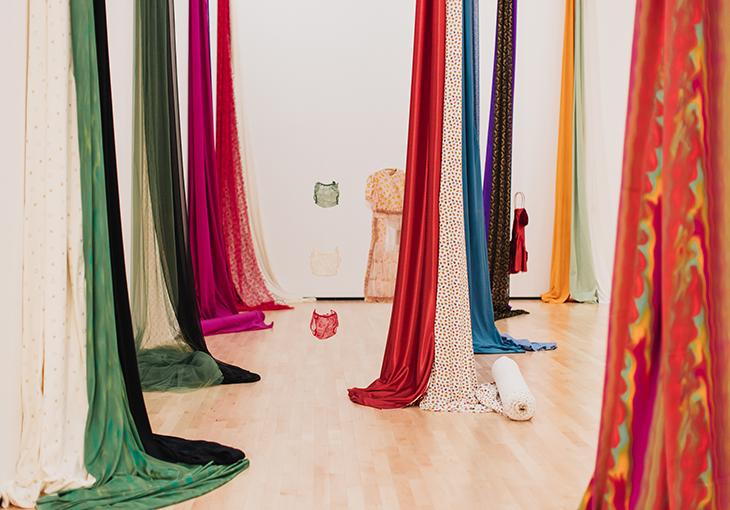
Celia Álvarez Muñoz, “Fibra" (detail), 1997, bolts of fabric, dresses, shorts, dimensions variable.
Photo: Daniel Lang. All images courtesy of the artist
|
|
Álvarez Muñoz (b. 1937) also infuses her work with reverence for the nurturing she received from her mother, aunt, and grandmother while her father was off at war. Her maternal grandmother related many stories of their family’s migration from Jalisco, Mexico, to El Paso, and witnessing gunfights of the Mexican Revolution from the rooftops. |
|
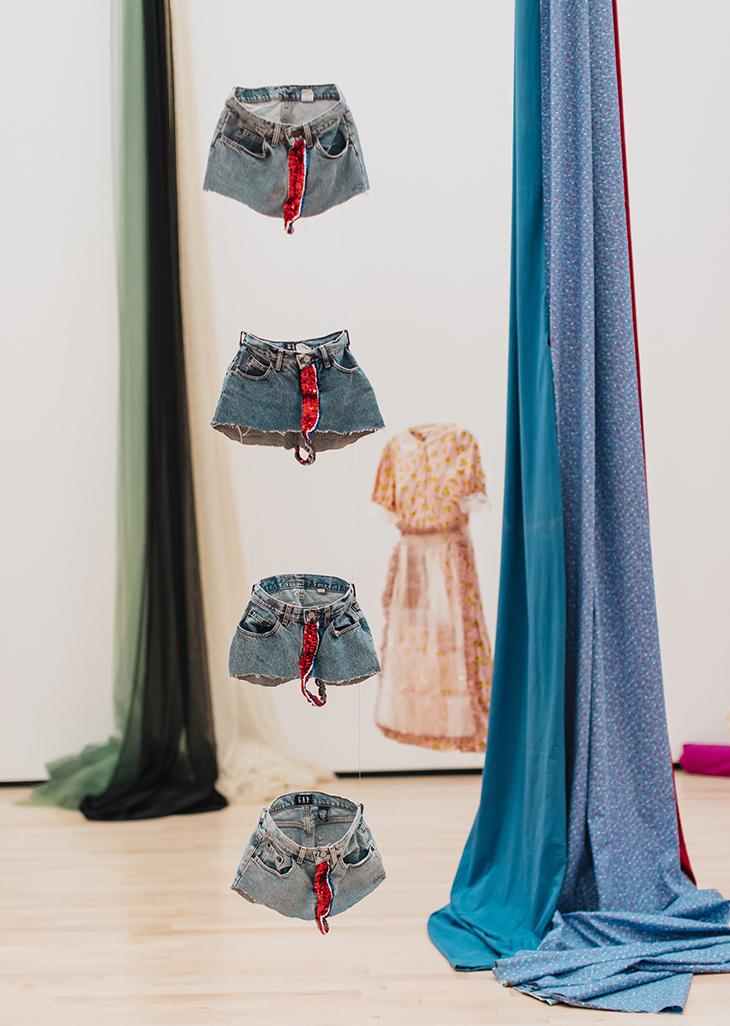
Celia Álvarez Muñoz, “Fibra" (detail), 1997, bolts of fabric,
dresses, shorts, dimensions variable. dimensions variable.
Photo: Daniel Lang.
|
|
With her family’s blessings, Álvarez Muñoz attended a high school across town, affording her art classes and pointing the way to studing art in college. Following graduation, marriage, motherhood and moves around the country, she returned to Texas at age 40, soon after enrolling at North Texas State University to study conceptual art and bookmaking, working toward an MFA.
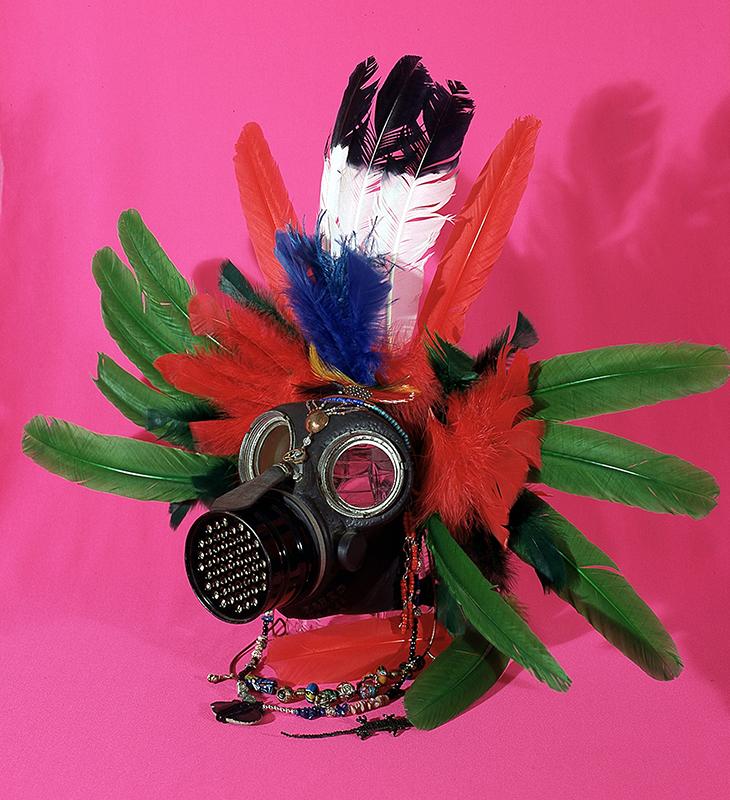
In 1981, to fulfill a class assignment, she created a performance piece, making herself into an art professor, lecturing to her class. She then announced that a pre-conquest site had just been discovered in Mexico City, that an artifact had been found there, and that she was presenting it to the class. The artifact was a plumed mask she created from a World War II-era gas mask, embellished with brightly-colored feathers and beads.
Continuing her performance, Álvarez Muñoz claimed that the mask belonged to the previously unknown Aztec god, “Petrocuatyl.” That invented word combined the English prefix for gasoline and the Nahuatl word for serpent: it alluded to the Western world’s veneration for oil, along with its history of racism and colonialism. That long-ago performance is represented here by the Cibachrome print, “Petrocuatyl” (1988), with explanatary text and relevant imagery from “National Geographic.” It is a highlight of this exhibition of 35 artworks.
Two compelling installations are “Fibra y Furia” and “Fresas” (both 1997). Focusing on the over-sexualization of females by the fashion industry, these conjoined displays begin with a backdrop of large bolts of colorful fabric hanging down from the museum ceiling. Displayed among the fabrics are a macabre bridal gown, decorated with decaying leaves and vines, a red prom dress with exaggerated heart breasts sewn onto it, several pairs of very brief, jaggedly cut denim shorts with the crotches covered with red sequined fabric and lacy panties. Included also is a demure housewife dress, complete with apron, it sums up a culture that assigns women their domestic places.
|
|
Near these two displays is a mixed media vanity table, covered with the powders, rouges and tools that women use when making themselves up. “Chameleon” (1986) symbolizes the artist's reverence for her eccentric Aunt Lulu who loved to make herself up, and more importantly who recognized Álvarez Muñoz’s artistic talents early on by gifting her with a set of colored pencils. Suggesting that making art and applying make-up are linked, the artist pays homage to her aunt. |
|
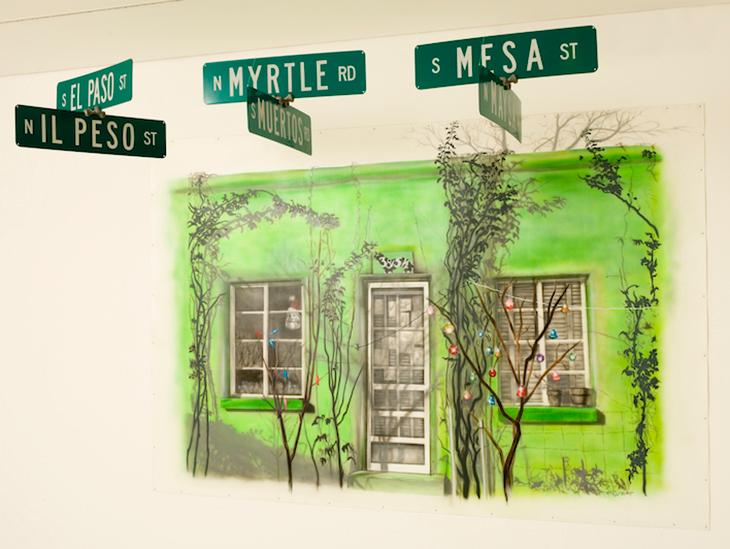
Celia Álvarez Muñoz, "Lana Sube," 1988, airbrushed acrylic on canvas, six metal street signs, hardware, dimensions variable |
|
Three installations in her “Enlightenment” series include the mixed media “Which Came First?" (1982), "Ave Maria Purísima," (1983), and "La Honey" (1983). “Enlightenment” refers to Álvarez Muñoz’s finally committing herself, somewhat late in life, to the pursuit of art professionally. These conceptual pieces are constructed as artist’s books that contain cryptic language and photographs, addressing language, puberty, and sexuality. Her stories are about coming of age on the El Paso/Ciudad Juárez border. |
|
Celia Álvarez Muñoz, "Petrocuatl," 1988, performance
ca. 1981, cibachrome print, 20 x 16"
|
|
The boldly executed “El Límite” (1991) combines memories from the artist’s visually rich childhood. Composed of large photos on vinyl of sardine-can toy trains, carrying food and other tools of survival, with text rising from the trains, this piece references her father’s youth spent train hopping and later riding trains during World War II. Part of the text reads, “Stories by Dad came from two sources; invented and real-life adventures. At times hard to separate or distinguish ... My favorite stories dealt with the War, when he was moved across the world and throughout Europe, again, mostly by train ... near the railroad tracks, they played with toys made out of things that don’t belong together.”
On the lighter side, “Lana Sube” (1988) is an installation of paired metal street signs, humorously alluding to the anglicized versions of Latino street names, alongside the often-spoken “Spanglish” versions of the names. The anglicized sign “El Paso St” is paired with “Il Peso St.” “Myrtle Rd” is paired with “Muertos Rd.” “Mesa St” is paired with “Maysa St.” A large painting of a brightly decorated home completes the installation.
Álvarez Muñoz’s art merges storytelling with conceptual elements. Their visual construction and narrative intentions are multifaceted. Yet it is their autobiographical aspects, their spirit of paying homage and expressing gratitude for the people and community that nurtured Álvarez Muñoz, that shine through.
|
|
|
|
Liz Goldner is an award-winning art writer based in Laguna Beach. She has contributed to the LA Times, LA Weekly, KCET Artbound, Artillery, AICA-USA Magazine, Orange County Register, Art Ltd. and several other print and online publications. She has written reviews for ArtScene and Visual Art Source since 2009.
|
|
Nick Vaughn and Jake Margolin, "50 States Project”
by Donna Tennant
|
|
Continuing through July 29, 2023
Nick Vaughan and Jake Margolin are “social cartographers.” Their expansive “50 States Project” maps and animates lost and obscured LGBTQ+ political and social histories and narratives through an aesthetic gaze. The scope of the project is monumental, with a developing series of 50 discrete installations (six have been realized so far), giving life to lost queer places and stories in each of the 50 states. Vaughn and Margolin’s collaborative, multi-disciplinary practice involves deep archival research and results in work that incorporates visual media, lectures, and performance.
|
|
Nick Vaughn and Jake Margolin, “The Chandelier Club,” 2022, charcoal powder
and wind on paper, 37 1/2 x 73 1/2”. All images courtesy of McCain Gallery
|
|
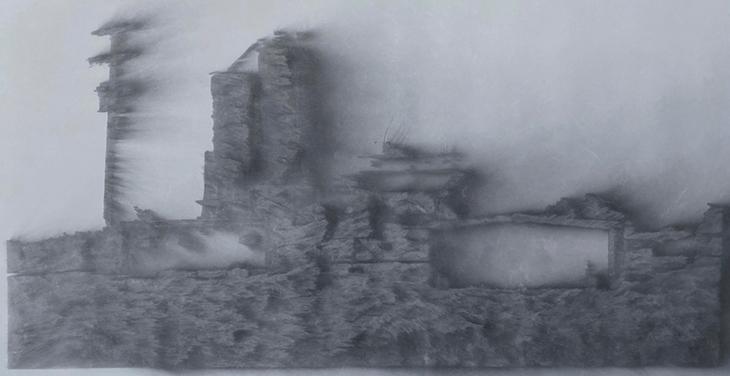
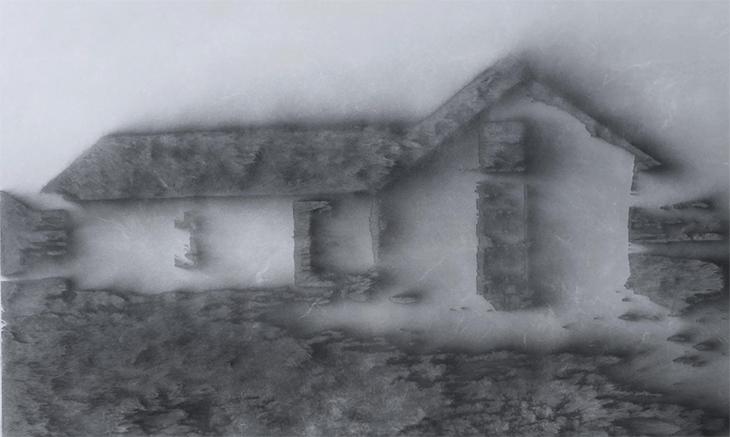
The current exhibition reflects the breadth of their vision through thus-far realized work with the presentation of three projects carefully curated from the greater endeavor. Three large “wind drawings” on opposing walls appear as subtle outlines of images blown away by wind and time. Their appearance echoes the images’ own frailty and ephemerality, wind and time blowing them into the forgotten. In fact, the process that created them is metaphorically similar. After research, Vaughan and Margolin traveled to the sites of former gay bars and other LGBTQ+-related locations and photographed them. The photographs were then laser-cut, and charcoal powder was stenciled onto large sheets of paper. An air compressor blew away the excess powder, leaving a ghostly image of the original photograph. |
|
Nick Vaughn and Jake Margolin, “Sheep Camp,” 2022, charcoal power and wind on paper, 37 1/2 x 61 1/2” |
|
In “The Chandelier Club,” the image of a defunct gay club appears to be blowing away, with the carbon clinging to the paper under the assault of time and wind. The artists describe the wind drawings as “the remaining records of the images … as ephemeral, delicate, and fragile as the hidden queer histories they are derived from.” |
|
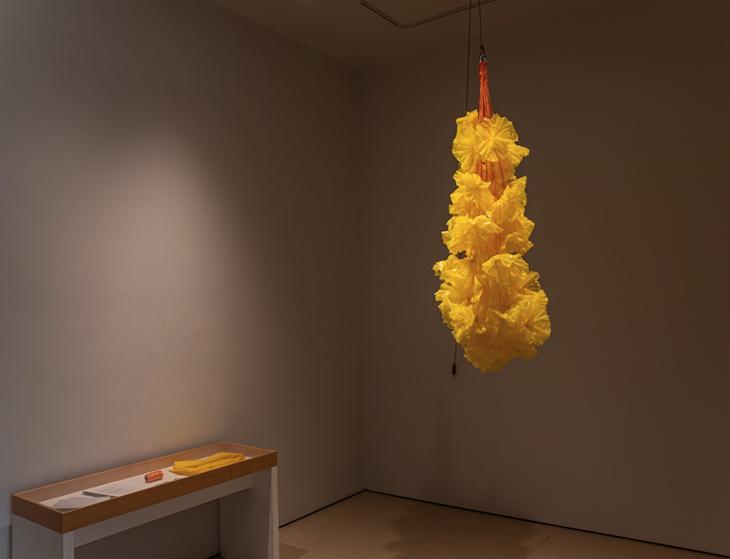
Nick Vaughn and Jake Margolin, “Spiritus: Obergefell v Hodges,” 2023, plastic bags, breath, complete text of oral arguments, decision, and dissent in Obergefell v Hodges, string, dimensions variable |
|
Vaughan and Margolin are inspired by the nature and condition of the historical materials they have encountered in their research. The aging newspapers, documents, and photographs are in peril of fading like the lives they barely recall. The pair began to think of ash and charcoal as materials that would allow them to achieve a similar aura.
“The wind drawings, out of anything we’ve done to date, feel like they exist in that ambiguous place of being both sad and beautiful, of having this thing that’s disappearing and falling apart, but it’s also permanent,” Vaughan told Arts and Culture Texas in July 2022.
“Norma Trist: a Livre d'Artiste; or Pure Carbon: A Story of the Inversion of the Sexes” is an artist book made in collaboration with Flatbed Press in Austin, Texas. The subject is the 1895 book by Eugene von Boeckmann, published in Austin, that features what is likely the first lesbian protagonist in a novel. The layout of the text is based on the 2016 installation “50 States: Texas,” in which the complete text was stenciled over 100 linear feet of paper with loose graphite powder. It was degraded over the course of the exhibition by the external environment.
|
|
Six intaglio prints and a 149-page accordion-bound serigraph text with illustrations, produced in the same carbonized and blown approach as the wind drawings, are contained in an elegant custom-made box. The typography is based on the lead typeface from the original book and was designed by Margolin and Vaughn. Each chapter is illustrated with an image taken by the artists of what currently stands on the sites of historic lesbian and gay bars across the state of Texas. For this exhibition, all the print pieces are displayed outside their box, with the prints wall-mounted and the book displayed on a desk surface. |
|
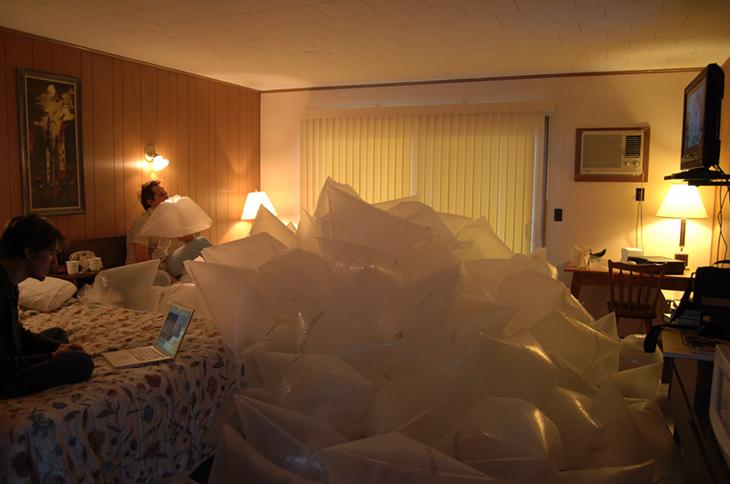
“Spiritus: Obergefell v Hodges” consists of remnants from a recent performance piece. The artists read the entirety of the Obergefell Supreme Court decision that led to the national legalization of gay marriage. They read the text into yellow plastic bags, filling the performance space with these bags until they formed a “critical mass.” Subsequently, the yellow bags were deflated, and the spent bags were bound into a compelling hanging piece. In a companion piece titled “Spiritus: 20 Hours of Fox News Read into Bags as a Volume of Breath,” the artists alternate speaking the news referenced in the title into white bags, filling a motel room. This performance is documented in a two-minute video loop. Once again, they have utilized carbon as a material, breathing their content into the bags. Like the wind drawings, these performances were ephemeral and metaphoric.
Vaughan and Margolin are partners in both their lives and their practice, and their commitment to the 50 States Project has become their life’s work. They are researchers and artists by nature, and they dedicate those sensibilities to discovering and mapping the stories of queer people and places that have been forgotten to history and time.
|
|
Nick Vaughn and Jake Margolin, “Spiritus; 20 Hours of Fox News Read into Bags as a Volume of Breath,” 2011, clear plastic bags, breath, panorama motel (Granville NY), still from 2 minute video loop |
|
|
|
Donna Tennant is a Houston-based art writer who writes reviews for various publications. Over the past 40 years, she has written about art for local and national publications, including Visual Art Source, Houston Chronicle, ARTnews, Southwest Art, Artlies, and the Houston Press. She has a bachelor of arts in art history from the University of Rochester and a master of arts in art history from the University of New Mexico.
|
|
Elaine Reichek, "Frock-Conscious"
by David S. Rubin
|
|
Continuing through July 22, 2023
An accomplished practitioner of hand stitched as well as digitally controlled embroidery, New Yorker Elaine Reichek has succeeded, over the course of five decades, in breaking down distinctions between the so-called fine arts and everyday crafts. In Reichek’s view, the two genres are not so dissimilar, a point that she makes in her current exhibition. Here she juxtaposes two traditional hand-embroidered darning samplers (one devoted to the alphabet and numbers, the other to decorative patterns) with one that replicates in thread a composition based on a 1970s color grid by conceptual artist Sol LeWitt.
|
|
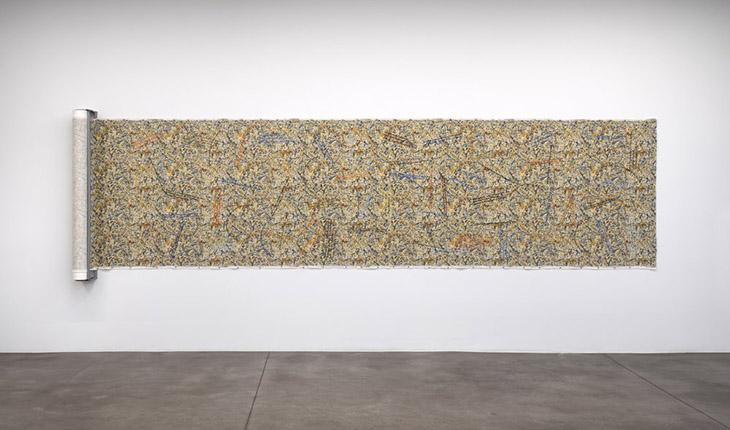
Elaine Reichek, “JP Textile/Text 2,” 2021, digital embroidery on printed cotton fabric, with metal
roll-dispenser, magnet boards, and magnets, 62 x 210”. All images courtesy of Shoshana Wayne Gallery.
|
|
Reichek often reimagines the work of male artists, only using thread, a medium and discipline historically associated with female domesticity. As a medium it has served as a means of questioning the absence of women, until recently, throughout art historical canons. Nevertheless, it is fitting that Reichek pay homage to LeWitt, one of the chief architects of conceptual art. In her own work she adheres to his belief in the primacy of ideas. She diverges from LeWitt’s approach in that her art is not determined by specific procedural rules, which allows her more creative freedom and a wider range of expressive possibilities. Whereas LeWitt’s work is usually minimal in form and serious in tone, Reichek’s covers a wider spectrum of styles and temperaments, ranging from abstract to representational and from sensuous to playful. |
|
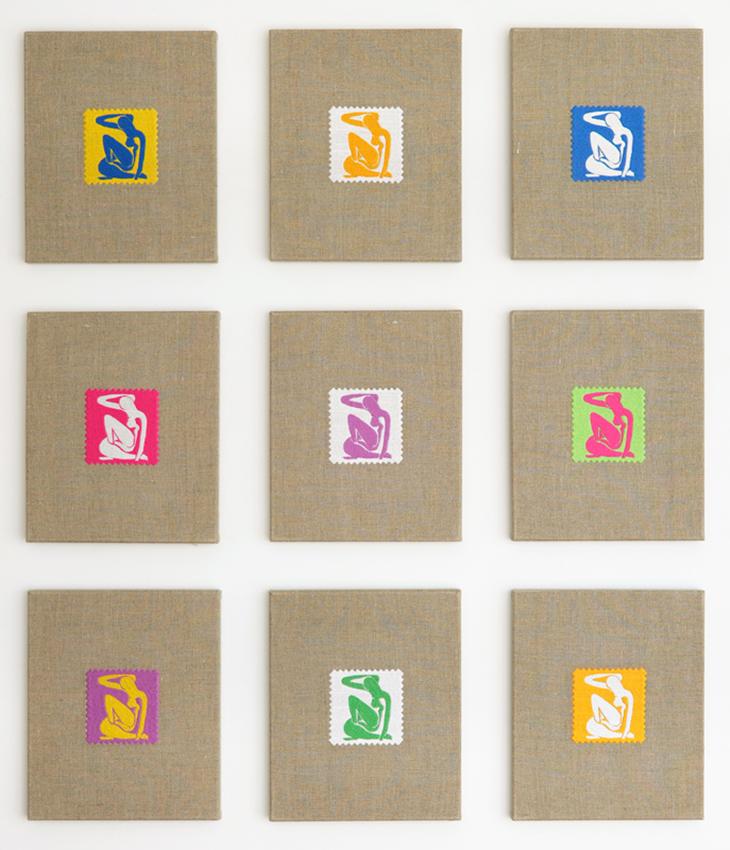
Elaine Reichek, “Swatches, Matisse 1-9,” 2007, digital
embroidery on linen, 41 x 35” (overall) / 12 x 10” (each panel)
|
|
Among the wittier works here are two large-scale works that brilliantly parody the drip paintings of Jackson Pollock. In lieu of conventional canvas, Reichek has embroidered “JP Textile/Text 1” and “2” using cotton fabric that was manufactured by Kravet, Inc. and printed in a Pollock-like pattern known as “Spatter.” Over these found compositions, Reichek has digitally stitched multiple bibliographical references to writings on Pollock, camouflaging them within the preexisting allover matrix. In one version, the altered fabric is mounted over wood and hung like an actual Pollock painting. In the other, it extends across the wall laterally, pulled from a metal dispenser that contains the unused portion of the fabric roll, mimicking at once a wrapping-paper table and a religious scroll. While the bibliographic entries sewn into these works call attention to Pollock’s well established position within art history, the mass-produced fabric reminds us of his great commercial success and influence on popular culture. To reinforce this line of thinking, Reichek also exhibits a triptych of silk charmeuse scarves on which she has printed photographic images taken by Cecil Beaton in 1951 for Vogue Magazine, that show fashion models posing in front of Pollock paintings.
Pollock is not the only male modernist superstar to come under Reichek’s scrutiny. An entire gallery is devoted to a complex installation that serves as a mini-art history lesson and dialogue about Henri Matisse. In the center of the gallery, the folding screen “Screen Time with Matisse” (2022) is covered on both sides, from top to bottom, with a variety of patterned fabrics and swatches, photographs of fashion models, postcards of Matisse’s paintings, and even a color chart.
|
|
Behind this (and not fully visible upon entering the space) is a staged visualization of a section of Matisse’s studio, complete with a decorative carpet, vintage Victorian parlor chairs, a table, plant stand, flowers, fruits, and fabrics. |
|
Elsewhere in the installation we are informed about Matisse’s relationship with the Bloomsbury Group, an early 20th century British circle of artists and intellectuals who were influenced by him but preceded him in designing actual clothing. Bloomsbury painter Duncan Grant’s “Still Life with Matisse,” which shows a vase of flowers atop a checkered tablecloth in front of Matisse’s well-known painting “Blue Nude,” is exquisitely replicated by Reichek in a hand-sewn embroidery where the contrast between exposed raw canvas and colorful, textured stitching yields a particularly lush and vibrant effect. To illustrate clothing designed by Grant and fellow Bloomsbury artist Vanessa Bell, Reichek includes two period-style dresses made from fabrics featuring their designs and displayed on vintage wooden clothing stands. Employing the museological strategy of educating with labels, Reichek has pinned the dresses with embroidered clothing tags featuring quoted remembrances of Bell by her daughter and granddaughter.
Reichek’s appropriations of Matisse’s compositions range from the large scale “Scattered Sheaf with Felt and Fabric” (2022), which reimagines a ceramic wall relief in the medium of felt, to two small, intimate samplers (2006-07), where Matisse’s imagery (including “Blue Nude”) appears in a variety of colors in the form of embroidered swatches that resemble postage stamps with their zigzag edges. Reichek wisely chose to use digital stitching for the latter, as the process yields a tighter interweaving of the threads and a flatter surface. This seems better suited than a more textured approach to the joyful expression of pure unmodeled color.
|
|
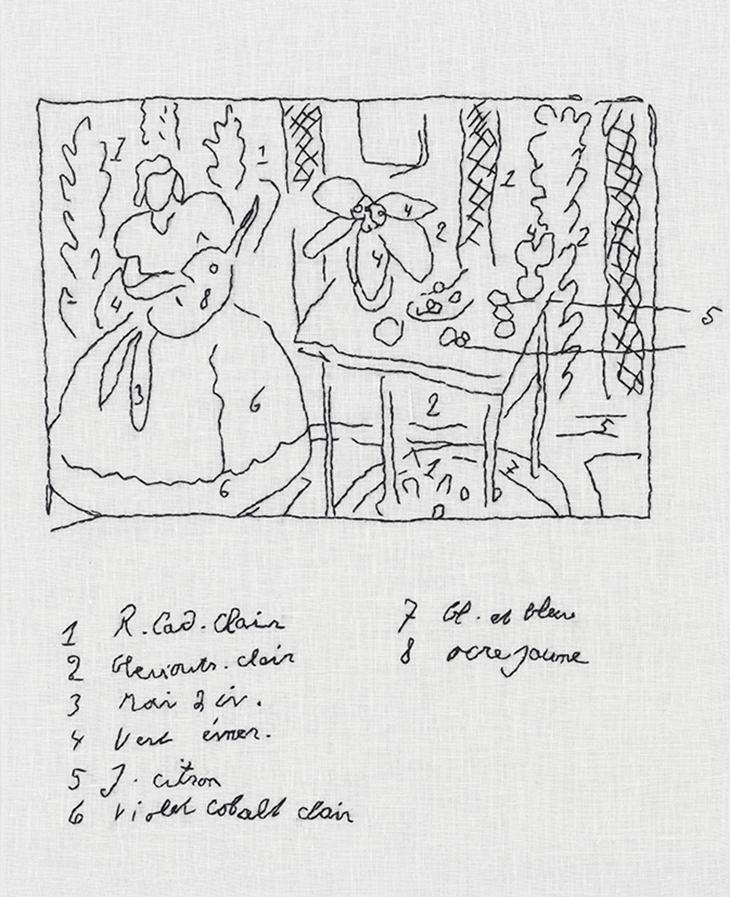
Elaine Reichek, “Matisse’s Tapestry Notes for ‘Le Luth’,
2021, hand embroidery on linen, 16 7/8 x 13 1/2”
|
|
By contrast, working by hand is equally effective in capturing the sensuousness of curving lines and handwriting in three works where Reichek uses black thread to embroider Matisse’s sketches and inscribed notes for different tapestries.
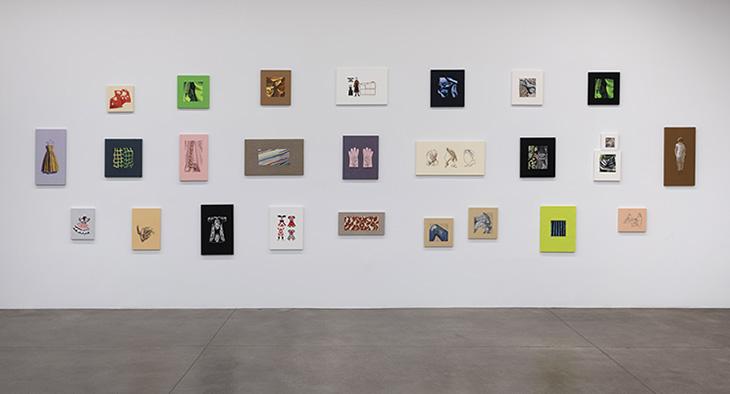
A Matisse composition is also present in Reichek’s, show-stopping installation of 24 small embroideries, both hand- and digitally sewn, that extend the concept of a sampler to an entire wall. In most of these cloth tiles Reichek embroiders a detail of clothing or other types of fabric that she appropriates from art historical sources, cleverly converting a painted image of a textile back into its original medium. Arranged in three horizontal rows, the installation presents a fascinating inventory of artists, including Old Masters Michelangelo, Bronzino, and Chardin, 19th/20th century painters Delacroix, Vuillard, Picasso, and Miro, and present day figures Kerry James Marshall and John Currin. Although male artists dominate, there is a notable presence of women in the mix, among them Artemisia Gentileschi, Sonia Delaunay, Alexandra Stepanova, and Meret Oppenheim. In addition to enlightening us about different approaches and styles that have been used for centuries to render textiles, the installation contains several aesthetically distinguished gems. Overall, the sampler installation is a great testament to Reichek’s art-historical chops, as well as to her sheer virtuosity as an artist.
|
|
Elaine Reichek, Installation view from “Frock-Conscious,” 2023, 24 hand-stitched and digitally-sewn embroideries, dimensions variable. |
|
|
|
David S. Rubin is a Los Angeles-based curator, writer, and artist. As a curator, he has held positions at MOCA Cleveland, Phoenix Art Museum, Contemporary Arts Center New Orleans, and San Antonio Museum of Art. As a writer he has contributed to Arts Magazine, Art in America, Artweek, ArtScene, Glasstire, Fabrik, Art and Cake, and Visual Art Source. He has published numerous exhibition catalogs, and his curatorial archives are housed in the Smithsonian Institution’s Archives of American Art.
|
|
|
|
© 2023 TDC/VAS
Contact Information:
231 Cedar Heights Dr., Thousand Oaks, CA 91360
Ph: (213) 482-4724
|
|
|
|
|
|
|
|