Conservation in the Kootenays
Monthly eNews
| | KCP respectfully acknowledges that our work and lives are situated in the traditional, ancestral, and unceded territories of the Ktunaxa, Secwépemc, Sinixt, and Syilx Okanagan peoples who have stewarded this land, water and all living things since time immemorial, and whose values and cultures continue to inspire and guide stewardship of this region. | | |
KCP Board of Directors
Welcome to new members of the Board
Four new Board of Directors were elected at KCP’s AGM which was held on October 15 in Nelson as part of the Fall Gathering. The new Directors are Justine Burns with the Shuswap Band, Lindy Lin with Okanagan Nation Alliance, Randal McNair with Wildsight Elk Valley, and Ellen Walker-Matthews with the Thompson Okanagan Tourism Association (fiscal sponsor). We extend a warm welcome to these new members, and a heartfelt thank you to the Board members who departed this year: Chris Bosman with NTBC, Braydi Rice with the Shuswap Band, and Dave DeRosa with Okanagan Nation Alliance.
Learn more about the current KCP Board.
Fall Gathering 2026 was held in Nelson mid-October
Thank you to all Funders and Participants
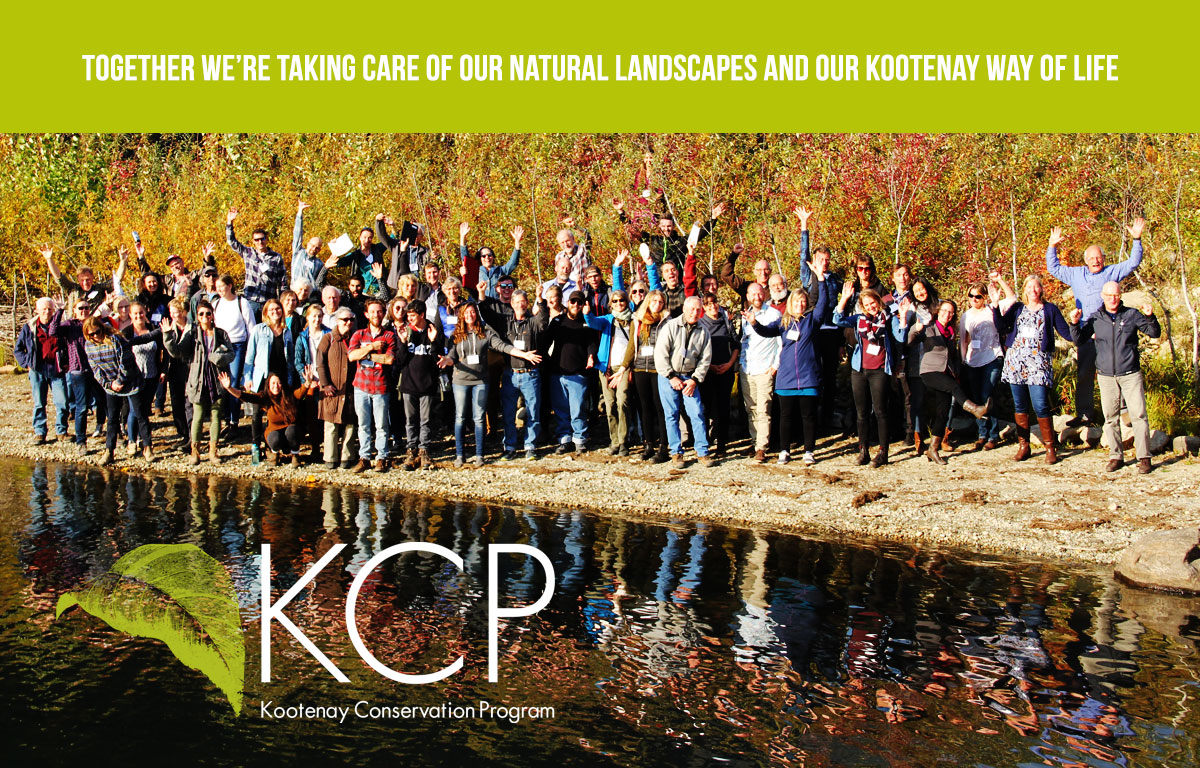
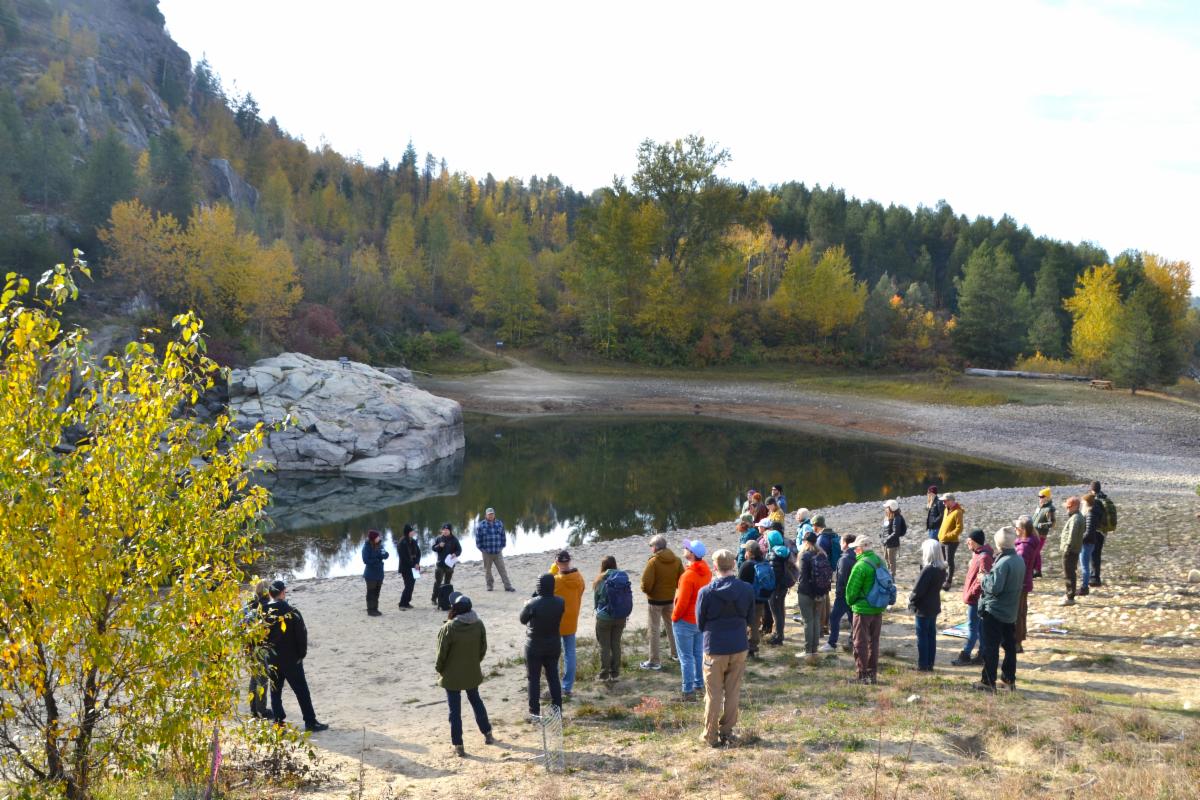
Kootenay Conservation Program would like to thank everyone who made the 2026 Fall Gathering such a success. This was the largest Fall Gathering to date. We would like to thank all presenters including the second-year Selkirk College Recreation, Fish and Wildlife students who participated in the event this year, and our program sponsors who make this event and all of KCP’s work possible: Columbia Basin Trust, Fish & Wildlife Compensation Program, The Nature Trust of BC, Nature Conservancy of Canada, and Environment & Climate Change Canada. We also extend our appreciation to the event sponsors: FortisBC, Columbia Power Corporation, Teck, and Kootenay Coop. A big thank you to everyone who attended the Fall Gathering. It wouldn’t be such a collaborative and inspiring event without each of your contributions and energy.
Click here for photos and the full summary.
Marcy Mahr receives special award at Fall Gathering
Outstanding contribution to KCP
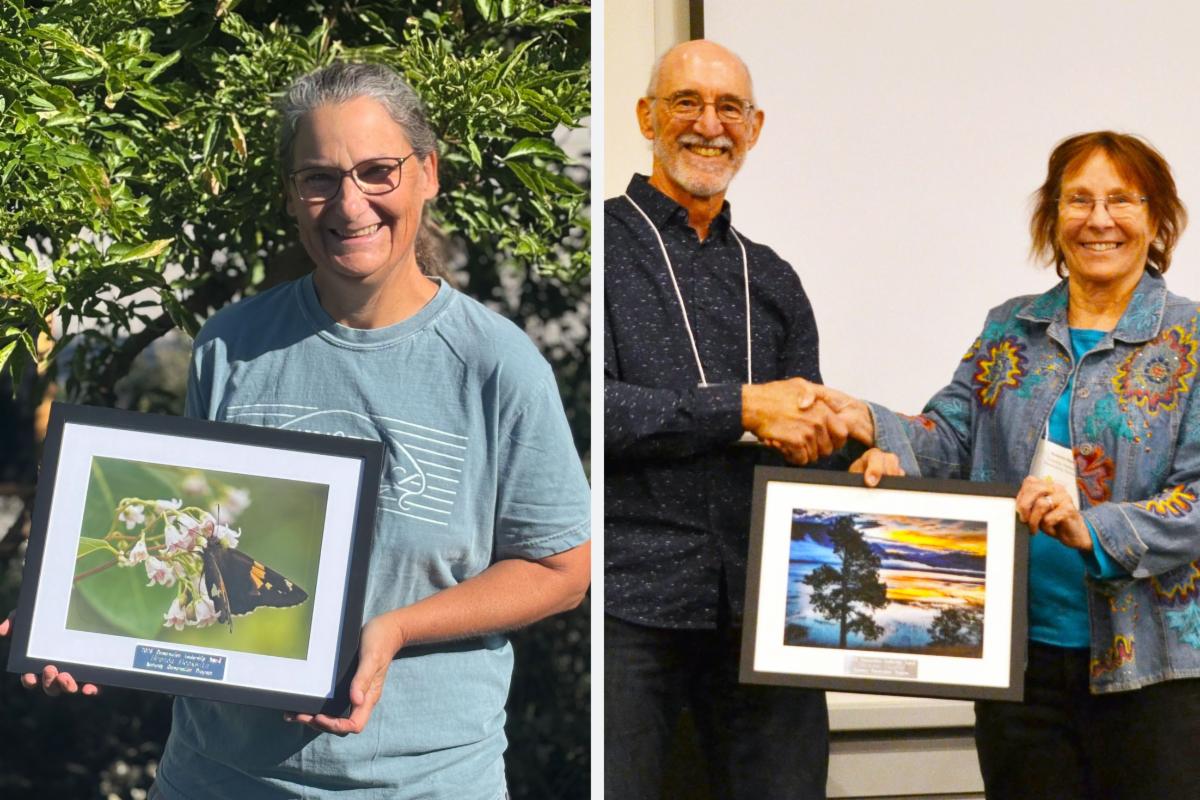
Presented at the 2026 Fall Gathering by KCP Board Chair Derek Petersen, Marcy Mahr received an award for her outstanding contribution to KCP over the years. Marcy was recognized as a pioneer, a visionary, and a leader. Marcy began working with the East Kootenay Conservation Program (EKCP) in 2009 and co-led the geographical expansion of EKCP in 2012 to include the West Kootenay, effectively doubling KCP’s service area to include much of the Canadian Columbia Basin. More recently, Marcy developed and managed the seven-year Kootenay Connect Community-Nominated Priority Places project funded by Environment and Climate Change Canada, from 2019 to 2026. Marcy received a stunning framed photo of Slocan Lake by Tyson Ehlers.
Read the full story here.
Conservation Ambassador Training Google Classroom
Self-paced learning for stewardship practitioners
A reminder to all stewardship practitioners! Our Conservation Ambassador Training Google Classroom is a self-paced learning opportunity where you can access all 7 interactive modules and earn a Conservation Ambassador Certificate. Each training module is an engaging workshop with expert presenters who share relevant information, case studies of Best Management Practices and innovative techniques to help fellow practitioners become more knowledgeable when they are out doing their work. The content covers diverse topics, from stewarding for wildlife resilience to stewarding for insect biodiversity, including knowing what to look for, how to initiate a conversation with a landowner on these topics, and tips for providing more holistic advice. Watch all 7 modules to receive a beautiful Kootenay Conservation Ambassador certificate.
Click here for more information and to get started.
KCP & CMI Winter Webinar series
'In the Field Together – Community Science' theme
In partnership with the Columbia Mountains Institute of Applied Ecology (CMI), Kootenay Conservation Program presents our Annual Winter Webinar Series on the theme of In the Field Together – Community Science. Community science initiatives and platforms are transforming the ways in which people interact with their natural world, the way we collect ecological data, and the vast opportunities to learn. This webinar series will explore what ‘community science’ means, including its origins, current uses, and potential future risks and limitations for supporting land management and conservation planning. Presenters will share inspiring projects at the leading edge of what’s currently possible with community science tools, and lessons learned for practitioners wanting to set up their own citizen science programs. Registration for this series from January 21 to February 25 is free and will open in December.
Find more details here or on the CMI website here.
| | | |
Okanagan Nation Alliance
Dove Hill Brushland Ecosystem Enhancement
The Dove Hill brushland is an important mosaic of habitats inhabited by a wide range of ungulates, reptiles and birds, including many species-at-risk. The Okanagan Nation Alliance (ONA) aims to reduce the density of exotic and invasive plants at Dove Hill and support the native species suited to its low-elevation dry brushland ecosystem. Restoring native species habitat and reintroducing low-severity fires will improve fire resilience, benefiting the ecosystem and community.
More information on the Dove Hill project.
Wildlife Conservation Society Canada and Okanagan Nation Alliance
CBC's 'What on Earth' features bats and roosting solutions
CBC’s What on Earth with Johanna Wagstaff aired a program on October 25 about bats and their requirements for roosts. The program features Cori Lausen, director of bat conservation with Wildlife Conservation Society Canada (WCSC) at 9 min and Caroline Lafond, wildlife technician with Okanagan Nation Alliance (ONA) at 18:45 as well as John Saremba, bat ambassador with Burke Mountain Naturalists Society Bat Program, and Leah Rensel, PhD candidate in wildlife biology, University of Montana. Discussion includes advice for people using bat boxes to install multiple boxes with varied amounts of shade and solar aspects, and a collaborative project with WCSC, ONA, and Selkirk College for tree roost enhancement.
Find the bat housing discussion here.
The Land Conservancy of BC
Fort Shepherd Conservancy Area - survey open until November 22
Have your say about the future care and stewardship of Fort Shepherd! The Land Conservancy of BC (TLC) is updating the 10-year management plan for Fort Shepherd Conservancy Area and invites community members, local organizations, conservation and recreation groups, and other interested parties to share their perspectives on this special place and its future. The survey takes approximately 10 to 15 minutes to complete, closes at midnight on November 22 and participants can optionally enter a draw for a gift card.
Access the survey here.
Friends of Kootenay Lake Stewardship Society
Artist Contest - until December 4
Friends of Kootenay Lake Stewardship Society (FoKLSS) is launching an artist contest to generate original designs for their new merchandise. Any species featured in the designs must be local to the West Kootenay. All designs should be sent as a PNG with a transparent background so that it is easy to transfer onto merchandise. “Friends of Kootenay Lake Stewardship Society” also needs to be on the design. No use of AI please. Members of FoKLSS will vote on the 4 designs they like best, which will all be featured on various merchandise. If your design is chosen, your name and art handle will be featured on the merchandise in small font, and you will receive an item with your art on it. Send your design to joelle@friendsofkootenaylake.ca by December 4.
Here’s a poster for more info.
Province of BC
Request for Review and Feedback: Draft Wetland and CIAS Guidance Under Development
The Ministry of Water, Land and Resource Stewardship (WLRS) invites feedback on a suite of draft standards, guidance documents, assessment tools, and data resources currently under development to support wetland management and activities occurring in and around streams under the Water Sustainability Act. Several documents are expected to become preferred or pilot standards for use in wetlands-related permitting and mitigation planning. Topics and deadlines are as follows: Draft Wetland Environmental Mitigation Guidance: Deadline TBD; Wetland Data Tools and Resources: Deadline Dec 31; Wetland Ecosystem Services Protocol (WESP-BC): Deadline Spring 2027; Wetlands Identification and Delineation Manual: Ongoing feedback welcome. WLRS appreciates any feedback you can provide, and welcomes continued input as these materials evolve. Comments can be submitted using the document-specific surveys and comment forms or directly via email to PermittingSolutions@gov.bc.ca.
Click here for all the draft documents and surveys / comment forms.
| | | |
International Symposium of the North American Lake Management Society
November 3 to 6, Kelowna
With the annual North American Lake Management Society (NALMS) conference coming to Canada this year, the BC Lake Stewardship Society encourages everyone to consider attending the NALMS International Symposium in Kelowna this fall, the most water-scarce region of Canada. The theme is ‘Swimming Upstream: Tackling Environmental Challenges through Partnership, Innovation, & Science’.
Click here for more information and to register.
Fossorial Friends Forum & Shrub-Steppe Stewards
November 4 & 5, Oliver (or online)
This year’s gathering will build on the first Fossorial Friends Forum and broaden the conversation to include shrub-steppe habitat stewardship, restoration, connectivity, and the recovery of underground-dependent wildlife across Washington State and B.C. Conservation Northwest’s Sagelands Heritage Program team looks forward to reconnecting with partners from across the border, sharing progress, exploring lessons learned, and identifying opportunities for collaboration. The event will include presentations, panels, discussion sessions, and opportunities to connect around topics such as soils, shrub-steppe restoration, fire, research, fossorial species conservation, and transboundary habitat connectivity.
More info here.
Camera Trap Survey Design and Data Management
November 11 to 14, Revelstoke
The number of projects employing camera traps to understand ecological phenomena is growing rapidly – as are the number of statistical tools to analyze the resultant data. Consequently, the management and analysis of camera trap data can seem complex and overwhelming. This course aims to guide participants in effective ways to store, manipulate and analyze camera trap data. Course content includes data storage and exploration best practices, and introductions to the major methods used to analyze camera trap data – all using real world camera data. The course will give participants the tools to manage, analyze and share camera trap data in an approachable and practical way. Participants can register for Day 1 only, or the entire course.
Click here for more details and to register.
Cycles of Indigenous Learning
November 12 to Spring 2027
This annual Indigenous-led course supports participants in deepening their understanding of Indigenous knowledge and perspectives while strengthening connections with the local land and taking action to support more reciprocal relationships. For this learning cycle, the course has been updated to shine more light on the local land and culture where you live, better empower participants on your learning journey, and acknowledge that this learning is best done in cycles. There are seven sessions offered by an incredible group of Indigenous leaders, elders and educators from across Turtle Island (North America). For 2026/2027, presenters include veteran broadcast-journalist Shelagh Rogers, who is member of the Métis Nation, with family roots in Red River, Manitoba, and Faro Burgoyn, who sits on council for the ʔakisq̓nuk First Nation. Registration closes November 30.
Find more information here.
Kootenay Lake Summit 2026: Collaboration in Conservation
November 15, Nelson
Join the Friends of Kootenay Lake Stewardship Society (FoKLSS) for their annual Kootenay Lake Summit. This year’s theme is ‘Synergy: Collaboration in Conservation’, celebrating the powerful impact that partnerships and collaboration can have in creating meaningful change. Join community members, lake users, organizations, and stewards from across the watershed for an evening of connection, learning, conversation, and inspiration. Robin Louie, Yaqan Nukiy land steward, will be hosting the lakeside opening ceremony, and the Summit will feature keynote speaker Juliet Craig, MSc, RPBio, Program Director of Kootenay Conservation Program, along with interactive activities, a locally catered dinner, live music, and opportunities to connect with others who care about the future of Kootenay Lake. No one will be turned away for lack of funds. The Summit will take place at the Prestige Lakeside Resort from 3 to 8 pm PT.
Click here for more details and to register, and here for a poster.
| | | |
Fish & Wildlife Grants, Habitat Conservation Trust Foundation
Deadline: November 6
HCTF Fish & Wildlife Grants are available to anyone (provincial or municipal governments, First Nations, academic institutions, non-government organizations, industry) for projects that: focus on native freshwater fish, wildlife, and their habitats; have the potential to achieve a significant conservation outcome; and align with HCTF’s purposes as laid out in the Wildlife Act. One of HCTF’s priorities is to support fish and wildlife habitat enhancement and restoration, therefore, projects that involve on-the-ground habitat enhancement and/or restoration activities are strongly encouraged.
Click here for more information and to apply.
UBC Sustainability Hub - Sustainability Scholars Program
Deadline: November 13
The UBC Sustainability Hub invites you to submit a project proposal for the Summer 2027 Sustainability Scholars Program. The program provides an opportunity to partner with a UBC graduate student on an applied research project that advances your organization's sustainability goals. Scholars are recruited from both UBC campuses and across all graduate programs, providing access to a diverse talent pool with expertise spanning sustainability, planning, engineering, public policy, business, health sciences, forestry, data science, economics and many other disciplines. Partner organizations provide project funding and direction, while the Sustainability Scholars team manages recruitment, hiring, payroll administration, and program delivery.
Find more information here.
Canada Nature Fund for Aquatic Species at Risk
Deadline: November 16
The Canada Nature Fund for Aquatic Species at Risk (CNFASAR) has been renewed under the 2026 Nature Strategy, securing continued funding for aquatic species at risk conservation and recovery. Funding is now available under the fourth round of CNFASAR (2027-2031), with the aim to support the recovery and protection of aquatic species at risk. The fund supports multi-species, place-based and threat-based stewardship actions that recover and protect aquatic species at risk. If you have questions regarding the application process, you are encouraged to contact Pacific Region CNFASAR staff by email well in advance of the deadline.
Find more information including how to apply here.
TD Friends of the Environment Foundation Grant
Deadline: December 15
The TD Friends of the Environment Foundation supports a wide range of environmental initiatives, with a primary focus on environmental education and green space programs. Eligible projects include schoolyard greening, park revitalization, community gardens, park programming and citizen science initiatives. Organizations eligible to receive funding include registered Canadian charities, educational institutions, municipalities, and Indigenous groups/communities.
Click here for more information and to apply.
Climate Emergency Grant Program
Deadline: Ongoing until funding is committed
The Climate Emergency Grant Program supports First Nations in BC to respond to urgent environmental emergencies affecting ecosystems and species in their territories. This program is intended to enable timely action when urgent environmental threats arise and require immediate intervention. Eligible project types include wildfire recovery, drought relief, flooding, landslides, and at-risk aquatic species rescue. Funding through the Climate Emergency Grant Program provides a minimum of CAD $25K per project, with a total budget of $300K available each fiscal year to support all approved projects. Projects must be completed within a one-year timeframe, as multi-year initiatives are not eligible under this program. Applications are accepted on a rolling basis until available funds are fully allocated.
Find more information and apply here.
Investment Agriculture Foundation of BC Beneficial Management Practices
Deadline: Ongoing until funding is committed
The Beneficial Management Practices (BMP) of the Investment Agriculture Foundation of BC provides funding for projects and plans to improve a farm's environmental and sustainability goals. Through targeted investments, the BMP program supports producers by helping them reduce costs, improve operational efficiency and enhance long-term farm and ranch viability. Specific categories of BMP funding include biodiversity, riparian and grazing, and more. Applications will open for some categories on March 4 and are accepted until funding is fully subscribed.
Click here for more details and to apply.
Small-scale Ecosystem Grants
Deadline: Ongoing until funding is committed
Do you have a small-scale project, that can be completed in two years or less, that helps improve ecological health and native biodiversity in the Basin? Small-scale Ecosystem grants are available to enhance a terrestrial and/or aquatic ecosystem, such as wetlands, fish habitat, forests or grasslands. Eligible applicants include registered non-profits, local governments and First Nations in the Columbia Basin Trust region. Applications are accepted on a first-received, first-served basis and are assessed as they come in and continue until all funding for the program has been committed. Contact the Trust to enquire about your project, email Melissa Johnson at ecosystems@ourtrust.org.
Click here for more information and to apply.
Climate Change Grants, Peter Gilgan Foundation
Deadline: Ongoing
The Peter Gilgan Foundation's Climate Change Grants support nature-based solutions, low-emission and renewable technologies, green building and living, and community resilience. Understanding that greenhouse gas emissions are the driver of climate change, they prioritize projects with the potential to enable large-scale emission reductions in Canada. For the nature-based solutions category, the Foundation supports initiatives that protect and restore priority ecosystems, support Indigenous lands and protected areas, enhance natural infrastructure in our built environment, and/or decarbonize Canada’s agriculture and forestry sectors. The Foundation accepts applications for 3 types of grants: project grants, capacity-building grants, or general operating grants. Climate change grants typically range between $50,000 and $150,000 per year. There are no deadlines for the climate change program; expressions of Interest are accepted on a rolling basis.
Click here for more information and to apply.
Grassland and Rangeland Enhancement Program
Deadline: Ongoing
If you have an idea that will maintain or enhance grassland resources while meeting conservation, environment and recreation objectives, this program could help support it. This program is delivered by the Kootenay Livestock Association. The Grassland and Rangeland Enhancement Program (GREP) aims to promote the stewardship of grassland resources, maintain and enhance biodiversity and long-term fish and wildlife productivity in public grassland ecosystems, and improve compatibility between livestock management and recreation use.
Click here for more information and how to apply.
Columbia Basin Trust - Non-Trust Granting Directory
Resource for download
The Columbia Basin Trust recognizes that many projects require collaboration, additional partners and substantial funding. To assist with this, they’ve created a database of granting agencies and government grant programs that you can refer to, and made it available for download on their website.
Click here for more information and click here to download the directory.
| | | |
Whitebark Pine Ecosystem Foundation of Canada
Executive Director
Join the Whitebark Pine Ecosystem Foundation of Canada (WPEFC) and help lead conservation and recovery efforts for endangered whitebark and limber pine ecosystems across western Canada. WPEFC is seeking a collaborative, strategic, and highly organized Executive Director to lead their growing nonprofit organization. Working closely with the Board of Directors, staff, and partners, the Executive Director will provide leadership in organizational strategy, fundraising, financial management, partnerships, program oversight, and operations. Applications are accepted until November 29.
Click here for more information.
Columbia Basin Environmental Education Network
Wild Voices Community Educator
Are you a forester or geographer? A biologist or mountain guide? A historian or holder of traditional knowledge? Do you have some unique knowledge, skill, or expertise you can share with students? If so, Wild Voices for Kids, a program of the Columbia Basin Environmental Education Network, would like to connect with you! Each educator brings their own unique knowledge of environment or natural history, adds their passion for education, and creates classroom or field-based programs that will both captivate students and satisfy the learning objectives of teachers. For more information, see link below, or email the Wild Voices program manager at education@cbeen.org.
Click here for more information.
| | | | |
For a comprehensive list of up-to-date job postings, check the CBEEN Job & Volunteer Board, an excellent resource for Kootenay conservation career and volunteer opportunities.
| | |
Stewarding Agriculture Watercourses new guidance documents
Ministry of Agriculture and Food
The Ministry of Agriculture and Food has published two new Stewarding Agriculture Watercourses (SAW) guidance documents this year, to support outreach, education, and watercourse stewardship and restoration planning efforts. The ‘Legislative Guide to Watercourses on Agricultural Lands’ provides a plain-language overview of legislation commonly applicable to watercourses in agricultural settings, with the aim to support users in understanding how legislation applies in practice. The ‘Changes In and About a Stream (CIAS) Guide for Agricultural Users’ supports agricultural producers and agricultural professionals planning activities in and about streams to be compliant with the Water Sustainability Act and Regulation. It provides a beginner’s guide to CIAS processes and requirements and includes practical, agriculture-specific examples to support decision-making and planning, with the aim of improving the quality and efficiency of applications.
Find the overview of ‘Stewarding Agriculture Watercourses’ here.
Wetland Plants of British Columbia
BC Wildlife Federation
Wetlands are essential ecosystems — rich in biodiversity and home to a wide variety of species. This guide introduces common indicator species found in wetland habitats across the province and is designed to support users in confidently identifying wetland plants while exploring these vital ecosystems. Kootenay biologists Ryan Durand and Birch Matkowski are among the authors. The guide can be downloaded for free, or hard copies can be ordered.
Access the wetland guide here.
Sharing the snow – outdoor recreation and roads reduce the density of a rare carnivore
Mirjam Barrueto, Anne Forshner, et. al.
A new study published in Biological Conservation reveals that recreation and roads lower wolverine population density across Canada’s Rocky and Columbia Mountains. Led by Dr. Mirjam Barrueto during her PhD research at the University of Calgary, alongside researchers from Parks Canada, the Nature Conservancy of Canada, and Montana State University, it is one of the first studies demonstrating that recreation pressure is associated with reduced carnivore density, not just altered space use, and that the effects have stronger impact on female wolverines. These results highlight the importance of managing cumulative land uses, maintaining low road densities, and protecting low-disturbance refugia to conserve reproductive habitat and connectivity for terrestrial carnivores in fragmented, multi-use landscapes and protected areas.
Access the article here.
Kootenay Connect Priority Places Impact Report
Kootenay Conservation Program
Kootenay Connect Priority Places has been addressing the dual crises of decreasing biodiversity and intensified climate disruption in the Kootenay region, for seven years, across seven landscapes. Applying leading-edge practices, the initiative has supported a team of over 40 local partners and specialists with habitat-based projects in priority ecological corridors across the Kootenays. Species recovery depends on habitat recovery: these efforts have improved the overall capacity of wetlands, riparian areas, grasslands, and forests to withstand, recover and bounce back from stressors and major disturbances. This report shares the impact of Kootenay Connect Priority Places. It celebrates the remarkable work of local champions and partners—working together for the place we all call home, now and for the future.
Click here to view the Impact Report.
KCP Stewardship Solutions Toolkit
Resource updated with growing number of stewardship listings
Since 2019, KCP's Stewardship Solutions Toolkit, an easy-to-access stewardship resource for landowners and land managers in the Kootenays, has been available both in print and online. We keep this resource up to date, and encourage you to access all the available stewardship "solutions" (i.e. services and resources) available in each of the 14 Conservation Neighbourhoods. Visit the website, select your location on the homepage map, and you'll be brought to the growing list of stewardship options available in your region.
Visit the Stewardship Solutions website.
| | | | | |