View as Webpage

Linkedin  Youtube  Instagram  X  Facebook

New England First Amendment Coalition

Subscribe | Archives

September 2025


If you enjoy reading this newsletter, please forward it to a colleague or friend. If someone forwarded you this newsletter, please subscribe!


Connecticut

NEFAC, First Amendment Scholars Argue for Right to Record in Second Circuit

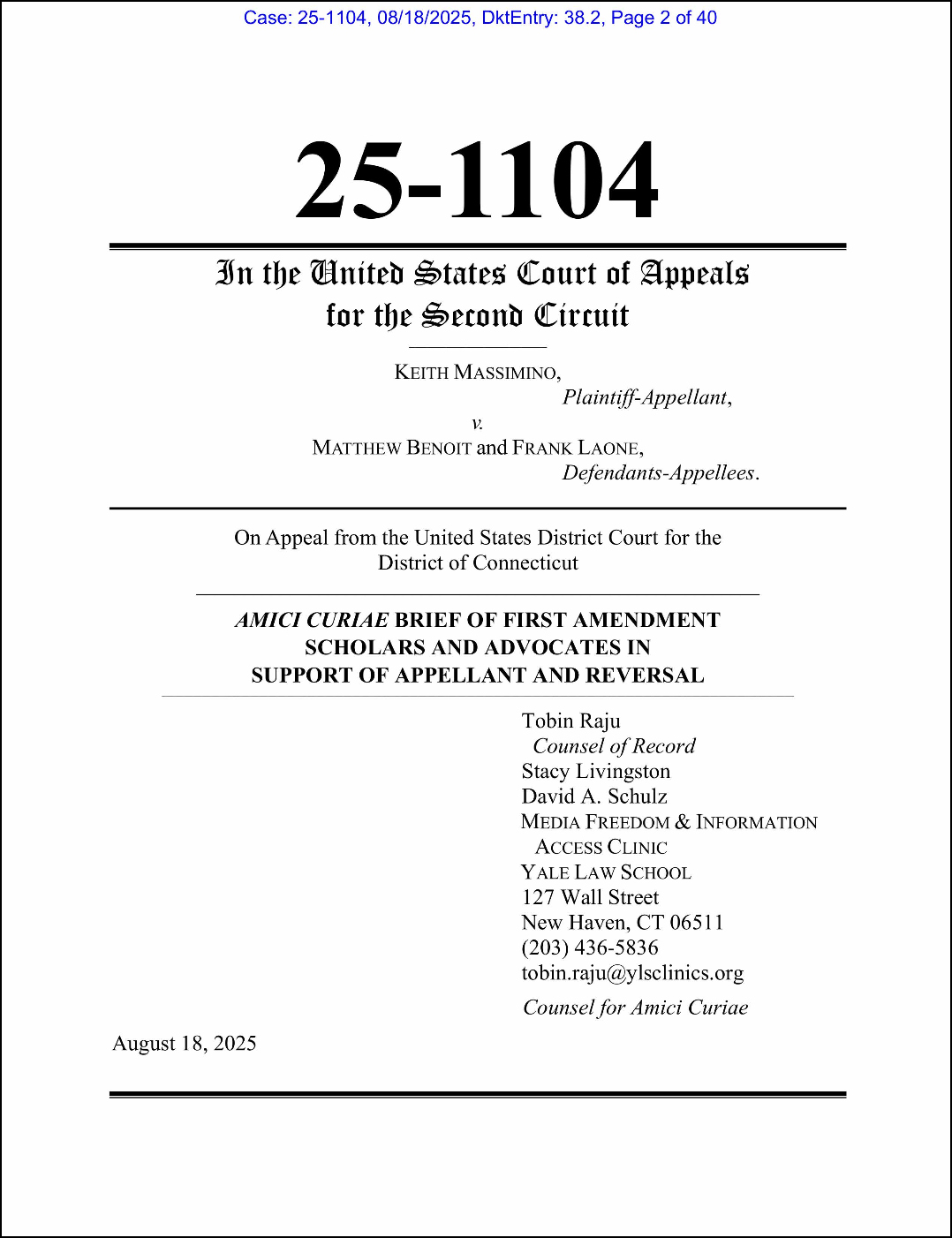
081825-brief image

Every circuit that addressed the issue — the First, Third, Fourth, Fifth, Seventh, Eighth, Ninth, Tenth, and Eleventh — has recognized that the First Amendment protects the act of recording, at least in the context of recording police activity in public.


NEFAC and a group of scholars and advocates explained in a recent amicus brief that:


“Recording warrants protection as an essential precursor to speech, it is often expressive in its own right, and it facilitates the right to gather and disseminate information. Each of these functions falls independently within the sphere of activity the First Amendment protects. Together, these three functions strongly support and clearly establish First Amendment protection for the act of recording in public.”

▶ Read Aug. 18 Amicus Brief


New Hampshire

For Open Meeting Laws to Work, We Need to Show Up

68cc5d4d79099-copy image

We all have a profound stake in local governance, writes NEFAC Executive Director Justin Silverman in a recent op/ed. But maybe you are one of the two-thirds of Americans who sit out this process and now you want to make your voice heard. Where to start?


Silverman provides a quick guide for those planning to attend their first local government meeting. The op/ed is part of Know Your News, a campaign launched on Constitution Day by the New England Newspaper and Press Association and the Granite State News Collaborative. The campaign features dozens of articles and op/eds about press freedom and the public’s right to know about government.

▶ Read Op/Ed

▶ Learn More About the Know Your News Campaign


Vermont

NEFAC, VPA to Judiciary Officials: Require Livestreaming of Criminal Proceedings

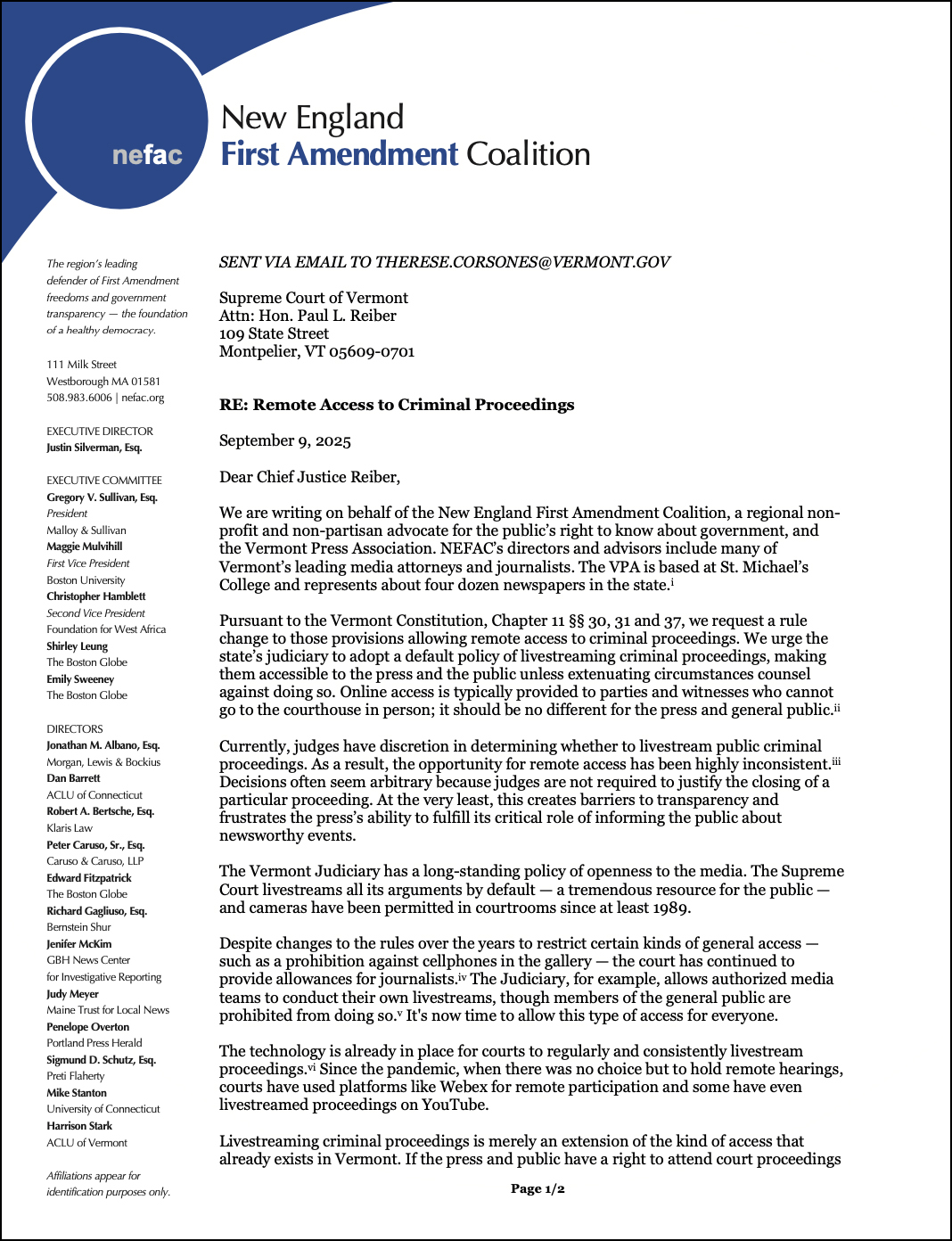
090925_vt_livestream image

In a recent letter by NEFAC and the Vermont Press Association, the groups explained that judges have discretion in determining whether to livestream public criminal proceedings.


"Decisions often seem arbitrary because judges are not required to justify the closing of a particular proceeding," they wrote. "At the very least, this creates barriers to transparency and frustrates the press’s ability to fulfill its critical role of informing the public about newsworthy events.”


Instead, NEFAC and VPA wrote, the courts should adopt a default policy of livestreaming criminal proceedings, making them accessible to the press and the public unless extenuating circumstances counsel against doing so.

▶ Read Sept. 9 Letter


ICYMI

▶ Police Body Camera Policies in Rhode Island Need Additional Consideration


▶ Limits on Banners, Flags and Signs in Nashua Conflict with Free Speech Rights


▶ NEFAC Delivers Opening Remarks for Annual Open Government Summit at Roger Williams University


Thank You to Our Supporters

NEFAC appreciates the support of all its donors and contributors. In particular, we would like to recognize the Estate of Gloria L. Negri, the John S. and James L. Knight Foundation and the following Leadership Circle donors ($10,000+) and Major Supporters ($2,500-$9,999): 


LEADERSHIP CIRCLE

Rhode Island Foundation

The Boston Globe

Paul and Ann Sagan

The Robertson Foundation


MAJOR SUPPORTERS

Boston University

Hearst Connecticut Media Group

Academy of New England Journalists

WCVB-Boston