IBANYS Weekly E-Newsletter | | |
Labor Day is a few days off, and as summer nears its end IBANYS remains active on behalf of our New York community banks on several important fronts – including our upcoming fall meeting and preparing our government relations agenda for the 2027 state legislative session.
-
REGISTER FOR THE EXECUTIVE LEADERSHIP SYMPOSIUM October 5-7, 2026 at the 1000 Island Harbor Hotel in Clayton, NY. You and your leadership team can network with community bank colleagues from across the state & gain valuable insights on AI and cybersecurity, economic trends, regulatory developments, technology modernization, executive leadership, and the future of community banking. Bank presidents will have the chance to discuss issues facing your organizations at our “Presidents Roundtable” panel moderated by Hartman Executive Advisors. And, we’ll have fun fishing, golfing and cruising the St. Lawrence River. Register today: Deadline is Sept. 18. Associate members, preferred partners and vendors: Secure your sponsorship before opportunities are gone! For full details on the Symposium, see the section directly below -- or, visit IBANYS’ website: www.ibanys.net
-
2027 Legislative Session. Before the 2027 session, IBANYS plans to share our thoughts and priorities with Senate Banks Chair Sanders (D-Queens) and current Assembly Banks Chair Vanel (D-Queens) to be prepared for a strong start in getting bills through the legislative process. That includes addressing current issues facing community banks. A few ideas were discussed of the Senator Sanders’ Summer Tour of banks, and at the meeting held recently with leaders from the senate, assembly, state comptroller’s office and NYC comptrollers’ office. See below in our Albany section for details.
. . .
Here are a few other updates I wanted to share with you:
-
Treasury’s Office of Cybersecurity and Critical Infrastructure Protection has issued an alert to financial institutions on business email compromise (BEC) scams.
. . .John
| | IBANYS EXECUTIVE LEADERSHIP SYMPOSIUM | | |
🚀LEAD. CONNECT. GET AHEAD.
2026 IBANYS Executive Leadership Symposium
October 5–7 | Clayton, NY
10 CPE Credits. Powerful insights. Meaningful connections.
👉 Register Today!
| | |
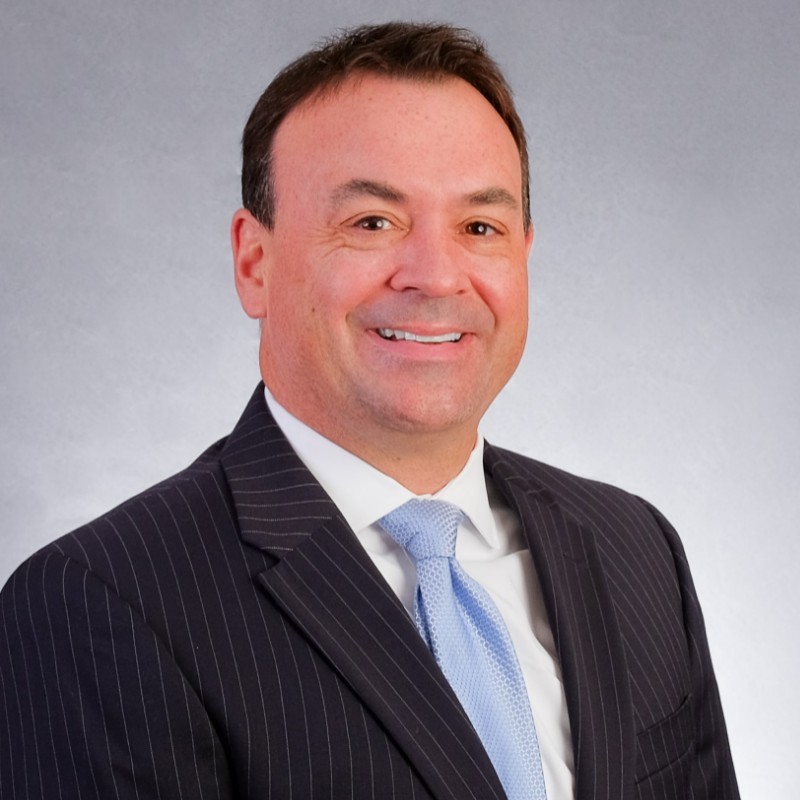
Glenn Grau, EVP Sales, PW Campbell
Since joining PWCampbell in 2000, Glenn has been leading our design-build sales efforts in Pennsylvania and was instrumental in developing the VA/MD/DC territories. A seasoned salesperson with a wealth of knowledge about the design-build process, Glenn understands how to match the needs of our clients with the services we provide to deliver exceptional results. In addition to his sales responsibilities, Glenn currently manages strategies for the PWCampbell sales team and serves as a member of the Planning Committee.
| | |
Grigoris Karakoulas, President and CEO InfoAgora
Grigoris Karakoulas is a visionary business leader combining over 30 years of risk management and predictive modelling/AI experience. He is the president and founder of InfoAgora that for 20+ years has been providing banks with credit risk rating, fraud scoring, price optimization, economic scenario generation and CECL/stress testing solutions, as well as model validation services. Prior to founding InfoAgora, Grigoris was working at CIBC as Vice President, Risk Analytics. He has also been Adjunct Professor in the Department of Computer Science at the University of Toronto.
Grigoris has published over 40 articles on predictive modeling and risk management and has been delivering courses through RMA, Risk.net, and SW Graduate School of Banking at SMU Cox on credit risk modelling, expected credit loss modelling for CECL/IFRS9, stress testing, model risk management, and AI/ML. He holds a PhD in Computer Science (Artificial Intelligence).
| | |
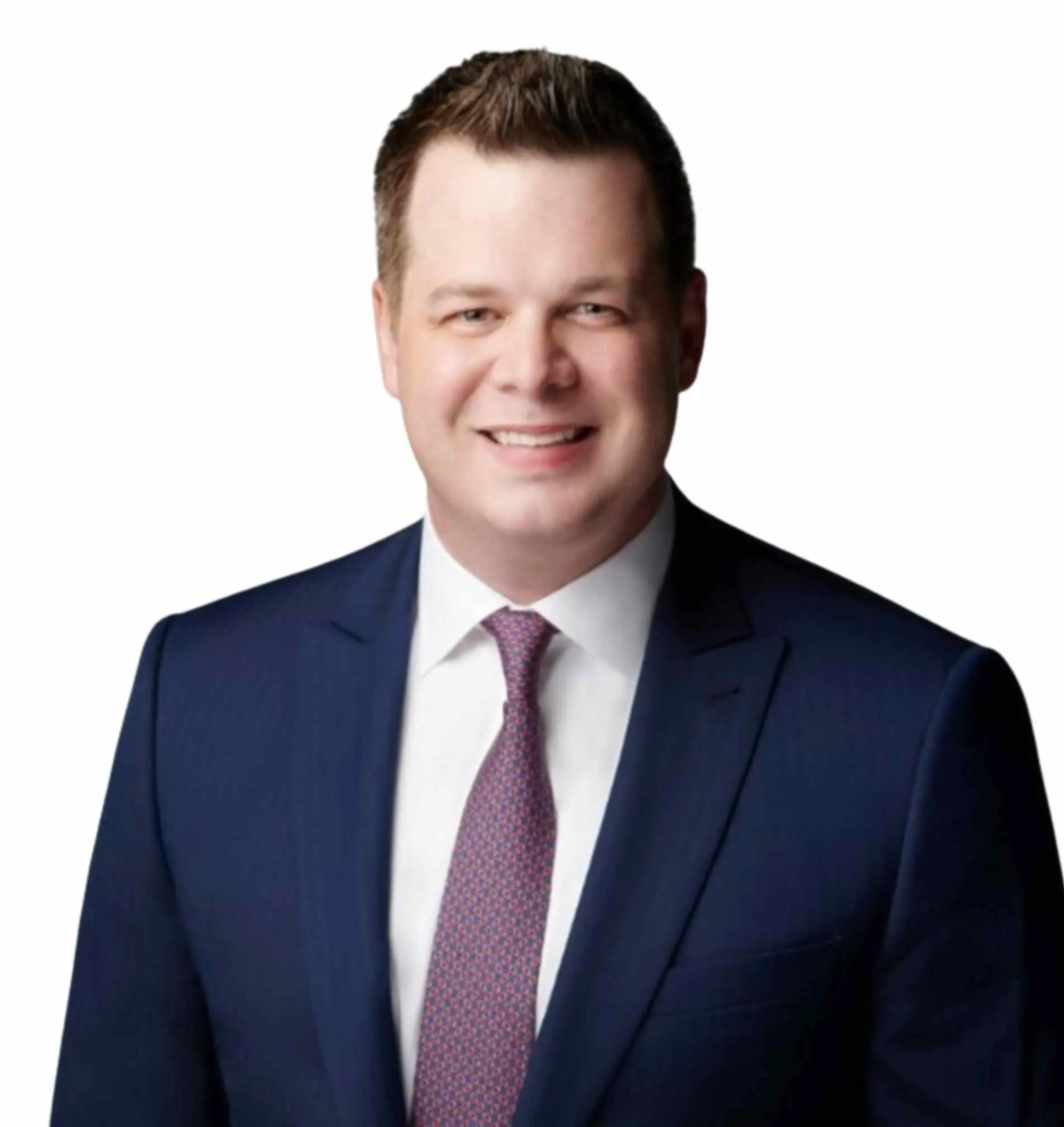
Nathaniel Siegel is a Managing Principal of Vanbridge and Director of Executive Benefits
He is responsible for client origination and relationship management.
Mr. Siegel has significant experience in the design and implementation of complex planning strategies for both the ultra-high net worth and institutional markets, with a particular focus on executive risk management, executive compensation, and supplemental retirement benefit programs.
Prior to joining Vanbridge, Mr. Siegel was Managing Director of a Fortune 100 insurance and investment management firm, where he was responsible for over 40 associates focusing on ultra-high-net-worth individuals and corporate planning strategies. He started his career in the industry with Liberty Mutual, where he was consistently a nationally ranked producer, and also served as a Principal at Lockton as the firm’s Washington, DC, series Executive Benefits Practice Leader.
Mr. Siegel earned a B.S.B.A. in corporate finance from Central Michigan University and lives in Falls Church, Virginia, with his family.
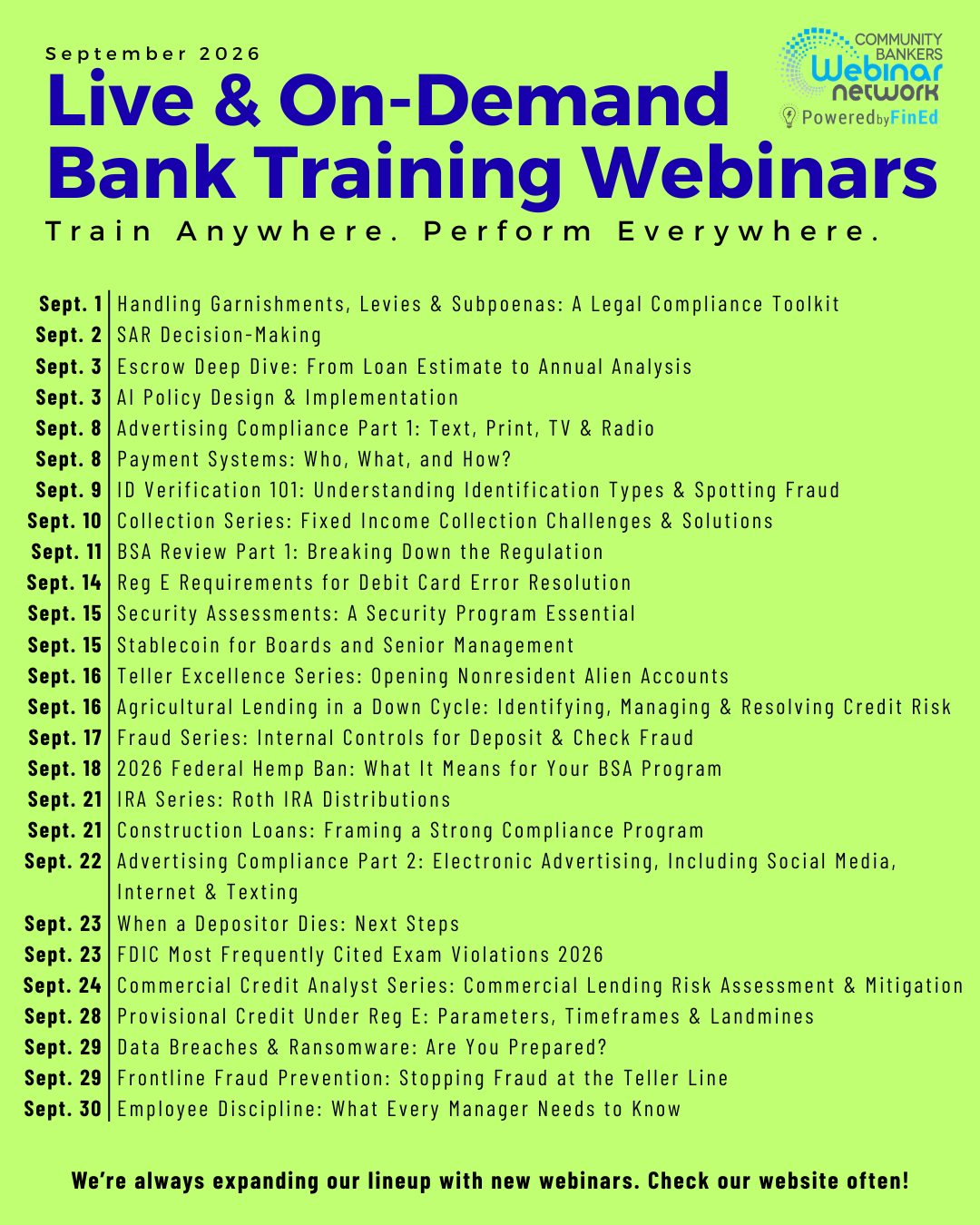
| | | | Fishing Boat & Golf Refreshment Cart | | Dinner Wine - Tuesday & Golf Tee | | | Cocktail Hour - Monday & Golf Tee | | | IBANYS SEPTEMBER WEBINARS | | Associate and Preferred Partners | | | |
IBANYS Welcome our newest Associate Member - Export-Import Bank of the US
EXIM is a federal agency that helps community banks better serve business customers that export. Its Community Lender Enhancement Initiative makes export financing easier to offer by reducing collateral monitoring and operational requirements.
Shannon Turner, VP Account Services
811 Vermont Avenue, NW
Washington DC 20571
(202) 565-3946
shannon.turner@alextom.com
https://exim.gov/
| |
Compliance Risk for Lenders: What It’s Really Measuring
Author: Robert Brosh
Compliance risk for lenders is constantly evolving as regulations, enforcement priorities, and oversight change. Understanding where risk is concentrated—and how effectively it is managed—is essential to preventing small issues from becoming significant problems.
Read Article
| |
From Scramble to Strategy: Using AI the Right Way in Compliance
Author: Stephanie Lyon
AI is changing compliance by helping officers spend less time on routine work and more time identifying risks, making informed decisions, and taking a strategic approach to compliance.
Read Article
| | This virtual/live workshop is designed to provide immediate, tangible training for employees new to commercial lending and to improve skills of less-experienced commercial lenders. | | | |
Instructor:
Richard Hamm
President of Advantage Consulting and Training
Huntsville, AL
| | |
-
IBANYS continues to advocate for N.Y. community banks. We have “a seat at the table” to present our views and to be part of the process on how to protect and enhance the interests of community banks -- AND, the local communities we serve, including fostering economic development. To prepare for the 2027 NYS legislative session that begins in January, IBANYS President & CEO John Witkowski met with State Senate Banks Committee Chair Sanders (D-Queens) and other key NYS leaders. Chairman Sanders noted he “listened and learned” during his banking tour this summer. He wants to have three or four pieces of legislation ready to go at the start of the session. IBANYS’ proposals include updating existing programs in place for years to promote changes or amendments to bring them into today’s very financial services environment. We need to enhance programs that worked in the past by making adjustments to improve outcomes. Among the subjects on our agenda:
-
Banking Development Districts – Easing the application process and increasing the funding for new branches;
-
Reciprocal Deposits - We are waiting for Governor Hochul to sign the bill allowing for reciprocal deposits to collateralize funding for BDD’s. Also, increase the level of deposits from the state to seed the branch.
-
Community Deposit Program – Developing a user friendly, less expensive, and flexible community deposit program to increase economic development into your communities.
-
Regarding NYS DFS: We discussed some reasons why banks are moving to a federal charter. Senator Sanders plans to schedule a meeting soon with DFS.
Other Legislative News
-
S10688, Myrie – AN ACT to amend the banking law and financial services law in relation to opting the state out of certain provisions of the Depository Institutions Deregulation and Monetary Control Act of 1980, Public Law 96-221. Introduced August 26, 2026 and referred to Senate Rules Committee. There is no “same as” bill in the Assembly). The sponsor says it is intended to exercise New York’s express authority under Section 525 of that federal Act; restore otherwise applicable New York law to consumer credit made in New York through state-chartered institutions. For more information: https://legislation.nysenate.gov/pdf/bills/2025/s10688
Taxes Will Be On Albany's '27 Agenda
-
Gov. Hochul "doesn’t want to scare away the state’s elite” by raising taxes -- noting New York relies on personal income taxes from the very wealthy for revenue – but supporters (including a coalition of interest groups and legislative Democrats) say higher taxes is necessary “to combat a growing gap between billionaires and everyone else.” https://www.politico.com/news/2026/08/26/democrats-split-taxing-rich-01049847.
-
The left-leaning Fiscal Policy Institute disagrees the rich will leave if taxes go up and will release a report that found states with progressive tax rates continue to have higher concentrations of millionaires: ”The lesson for state tax policy is clear: states with strong economies—educated workforces, quality public services, and infrastructure—attract and retain high earners, and the states that invest most in those foundations tax their millionaires to do it…The predicted exodus, year after year, fails to appear.”
-
A Staten Island judge this week put off a decision in the lawsuit against New York City’s pied-à-terre tax at a hearing today, allowing Mayor Mamdani’s rollout of the tax to continue as is for now, so the multifront war waged against the administration by Randy Mastro will continue too. Mamdani’s administration “faced sharp questions on Monday from the judge, who is expected to rule “in the coming days or weeks.” The Wall Street Journal’s Victoria Albert reports.
| | |
ICBA will host its third-quarter Community Bank Briefing webinar Thursday, Sept. 17 at 2 p.m. to provide the latest updates on policy developments in Washington and across the nation. The complimentary session will feature updates from ICBA President and CEO Rebeca Romero Rainey and members of ICBA’s Government Relations team. The briefing will spotlight regulatory and legislative issues from Washington, D.C. and across the U.S. Register here.
Congressional
-
The House returned to Washington this week and will be in session through Thursday, then leave again for a 10-day Labor Day and Rosh Hashanah recess. After this week, the House has scheduled just three session weeks until Election Day, and there is speculation GOP leadership could scrap at least one – and perhaps even all three -- of those weeks, or even leave until after election day. The Senate remains out until the week of Sept. 14. The 119th Congress has passed fewer than 300 bills so far, according to our analysis. That’s about the middle of the pack for the last few decades. President Trump has signed 102 bills into law this Congress, the fewest new laws enacted during any Congress over the last three decades.
-
By a vote of 370-48, the House yesterday passed a stopgap spending bill that would keep federal agencies funded through Dec. 11, avoiding the risk of a partial government shutdown this fall. President Trump is expected to sign it. The legislation would avoid a federal government shutdown when the new fiscal year begins on Sept. 30 if full-year appropriations aren’t in place. Republicans voted 193-19 for the bill. Democrats backed it, 176-29. https://rollcall.com/2026/09/01/funding-extension-clears-house-avoiding-shutdown-threat/
-
Members of the House Financial Services Committee introduced legislation to reform the Consumer Financial Protection Bureau.Committee Chairman Hill (R-Ark.), Financial Institutions Subcommittee Chairman Barr (R-Ky.), and nearly all GOP committee members unveiled the “Consumer Financial Protection Accountability and Reform Act of 2026.” It would bring the CFPB into the congressional appropriations process, clarify the bureau’s authority, establish a dedicated inspector general, and require periodic reviews of major rules
-
The House Financial Services Committee will hold a hearing today on “strengthening the American economy.” On the agenda: H.R. 7866 (the American Lending Fairness Act of 2026’’ to “restore and clarify the intent of the Federal interest rate exportation parity for State-chartered banks by allowing States to opt out of preemption only with respect to loans made by their own chartered institutions, and for other purposes.” Click here to view the livestream of this hearing and click here to view the Committee Memorandum.
Regulatory
-
ICBA applauded the FDIC for proposing to reduce deposit insurance assessments by 2 basis points and adjust the asset threshold for banks subject to the small bank scorecard, as advocated by ICBA. Read ICBA’s letter to the FDIC. Read ICBA’s national news release after the FDIC proposal was announced. Assessment rate calculators are available on the FDIC website to allow institutions to estimate their assessment rate under the proposed changes.
-
ICBA said it supports the FDIC's proposal to exempt institutions below $100 billion in assets from resolution submission requirements but cautioned the agency should not weaken substantive resolution readiness requirements for large banks. Read ICBA’s letter to the FDIC,
-
The OCC, together with the FDIC, issued a final rule defining the term "unsafe or unsound practice" and revising the supervisory framework for the issuance of matters requiring attention (MRAs) and other supervisory communications. The rule is intended to promote greater clarity and certainty regarding certain enforcement and supervision standards and ensure that examiners prioritize concerns related to material financial risks. It also clarifies how the agencies will tailor their use of the "unsafe or unsound practice" definition and MRA standard based on institution-specific risk factors. The final rule also explicitly limits its scope to institutions the agencies supervise.
-
The OCC issued a proposal to codify its supervisory framework for the issuance of MRAs in response to violations of laws or regulations. The proposed rule would establish two categories of violations of laws: "substantive violations" and "technical violations." The proposed distinction intends to focus supervisory attention on violations that have the greatest impact on an institution or its customers. For violations that are not substantive in nature, the proposal would provide a mechanism for addressing them outside the MRA process. Questions on these OCC updates? Contact Ryan Portell, OCC Director for Banking Relations: (202) 649-7244.
-
The FDIC announced updates to its Risk Management Manual of Examination Policies and Consumer Compliance Examination Manual. RMS updates address basic examination concepts and guidelines, violations of laws and regulations, examination instructions, example risk management pages, and examination planning. CEM updates cover documenting the exam, investigations and visitations, appeals, the Home Mortgage Disclosure Act, and small-dollar lending.
-
The FDIC board approved an interim final rule to amend the statutory framework governing reciprocal deposits in line with an ICBA-advocated provision of the 21st Century ROAD to Housing Act that took effect last month and includes an ICBA-advocated provision allowing community banks to hold custodial deposits and more reciprocal deposits without them being considered brokered deposits, which are subject to restrictions. Comments on the rule are due within 30 days after the date of publication in the Federal Register. Materials and information are available on the Board Matters webpage.
-
The FDIC and OCC issued a final rule designed to focus examiners’ and institutions’ attention on material financial risks and compliance with banking and banking-related laws and regulations. Read ICBA’s national news release issued after the proposal was released last year.
-
The SBA proposed changing the asset threshold for small banks from $850 million to $5 billion. The effort to simplify small business classification and expand access to federal programs would mean 760 additional banks would receive the regulatory relief that is tied to the SBA definition of a small business. Read what else the SBA said regarding its proposal.
Economic News
-
Fed Governor Barr also said the Federal Open Market Committee should act decisively to raise rates if inflation doesn’t moderate sufficiently. He noted there has been enormous progress from inflation's peak of more than 7% in 2022 to just above 2% in 2024, but progress stalled due to shocks such as tariffs, conflict in the Middle East, and the rapid AI buildout.
-
Construction spending decreased 0.5% in July and was down 3.8% from a year ago, the Commerce Department reported. Spending on private construction fell 0.5% from June, while public construction dropped 0.2%. Meanwhile, economic activity in the manufacturing sector expanded in August for the eighth month in a row according to the Institute for Supply Management. ISM’s manufacturing index decreased 1.0% to 54.6%.
| | | | |