July 2025 - Catch up on the latest news from CAARI! | | |
The summer is in full bloom and marked by the gathering of researchers and excavation teams in Nicosia for the annual Summer Archaeological Workshop. The gathering was held again, for its 41st iteration, on June 14, followed by the customary party in CAARI’s garden where so many connections and friendships are formed and rekindled. The full workshop program is succinctly reported and summarized by Cornell University graduate students, Kate Hall and Lauren Hlister, both of whom excavated with the Kalavasos and Maroni Built Environments Project this summer.
In addition to these summer hallmarks that many of those who frequent CAARI look forward to annually, this Newsflash also presents some key changes on the horizon. First, after many years of unwavering dedication and support of CAARI, Prof. Annemarie Weyl Carr will step down from her position as Vice President. We will hear her reflections on her time on Cyprus, on the CAARI board, both as a dedicated trustee, but also an accomplished scholar and dear colleague. We thank her for giving to so many so much of herself. In the same vein, we are elated to welcome Dr. Matthew Spigelman as the new Vice President, who will share with us his hopes for the future.
After all of these positive reports, we conclude with an update on the progress of the repairs to the exterior of CAARI’s building in Nicosia. But first, we will hear from CAARI Director, Dr. Lindy Crewe on developments from excavations at Kissonerga-Skalia, highlights from the workshop, and what awaits on the horizon.
| | |
Message from CAARI’s Director
Dear friends and supporters of CAARI,
I write from my summer second home (a classroom in Kissonerga primary school) as we have just wound up the excavation at Kissonerga-Skalia and held our end of dig party. It was a fantastic season with a great group of students and staff. The weather was kind for the first three weeks but this week hit us hard with temperatures of 40°C (104°F) and up to 97% humidity. Despite this we really achieved a lot, our latest four-metre diameter oven was fully excavated and lovely new Bronze Age walls were revealed. Our most exciting finds were two copper-base fish hooks. This makes a total of four known examples for the entire Early–Middle Cypriot Bronze Age, and all of them from Kissonerga-Skalia! I will be giving a lecture (live and online) on the latest news from the site for the University of Cyprus Archaeological Research Unit lecture series on November 10 so do tune in if you can.
As so ably reported below by Kate Hall and Lauren Hlister, the CAARI workshop was a day packed with many fascinating talks. At the evening party, we also surprised our dear Housekeeper, Photoulla Christodoulou, with the ASOR Albright Award for her many years of dedicated service to CAARI. The award was presented by CAARI President Nancy Serwint and we had arranged for members of Photoulla’s family to be present to take part in the celebrations. We honestly do not know how we will manage when Photoulla retires next year.
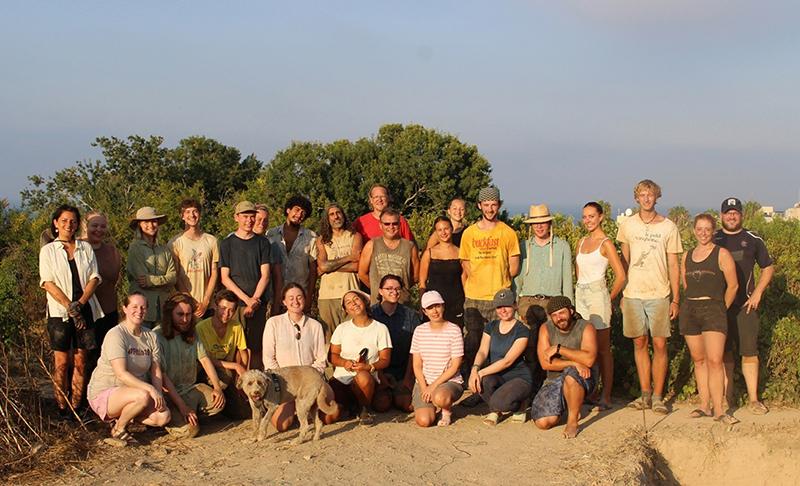
| | The 2025 Kissonerge-Skalia team (and barkaelogist Darcey) on the last day of excavation. | | |
For now, we have August ahead of us, the period when anyone who is able to will be exiting Nicosia. Gone are the days when the whole month was taken as a holiday but it is at least a quieter time to get things done. I will be planning our autumn lecture series and writing up reports on my season for the Department of Antiquities. The CAARI office will be closed during the major Orthodox holiday week of 11–15 August but the library is, of course, still available to our residents and regular researchers.
Wishing everyone an enjoyable and relaxing time for the remainder of the summer,
Lindy Crewe, PhD
Director, CAARI
| | |
CAARI’s 41st Annual Summer Archaeological Workshop
Kate Hall & Lauren Hlister
Cornell University
| | |
The 41st annual CAARI Archaeological Workshop convened on June 14th at the Bank of Cyprus Cultural Foundation. Dr. Lindy Crewe, Director of CAARI, greeted the workshop attendees alongside Dr. Athanasios Vionis of the University of Cyprus’s Archaeological Research Unit and Dr. Giorgos Georgiou, Director of the Department of Antiquities, Cyprus. All who delivered welcome messages stressed their sincere appreciation for the inter-institutional collaboration, which has enabled both the continuation of the workshop and the exciting past, present and future courses of archaeology in Cyprus.
Following these warm welcomes, Prof. Cyprian Broodbank reported on behalf of the Archaeology and Heritage of Akamas project, emphasizing the value of collaboration between research units and Cyprus’s Department of Antiquities in enabling the enhancement of knowledge and integrity of cultural heritage. Prof. Alan Simmons then followed with a summary of the status of research on pre-Neolithic Cyprus, expressing enthusiasm for the field’s future enabled by increasing involvement of young Greek and Cypriot archaeologists as well as new technology. The theme of digitization continued into Dr. Harry Paraskeva and Dr. Diane Bolger’s discussion of the Western Cyprus Survey project’s study and organization of archival material into a new user-friendly database. Dr. Victor Klinkenberg then presented an overview of the 2024 excavations at the Chalcolithic site of Chlorakas-Palloures. Dr. Klinkenberg outlined several areas of ongoing investigation across the site including a child burial which saw each layer excavated rigorously recorded and modeled through photogrammetry.
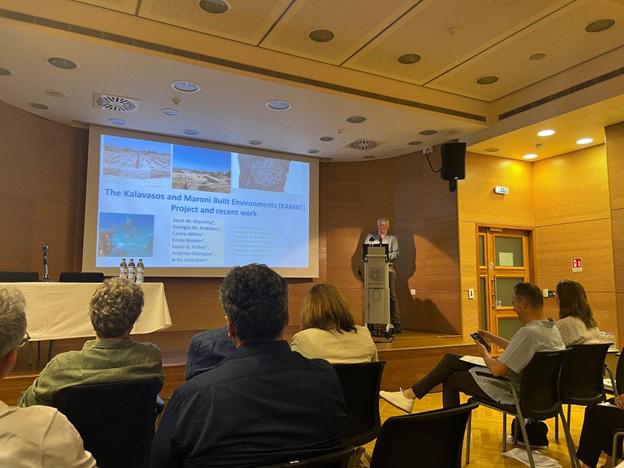
With CAARI director Dr. Lindy Crewe’s presentation on recent excavations at Kissonerga-Skalia, the workshop then moved into the Bronze Age. Dr. Crewe’s discussion of current research at the site emphasized its industrial nature as well as the reuse of building materials throughout various stages of construction. A new oven uncovered in Area B2 of Kissonerga-Skalia also contained evidence of processed grain and crushed terebinth seeds. Prof. Sturt Manning then summarized recent work from the Kalavasos and Maroni Built Environments Project. At Maroni this included investigation of a monumental wall predating the Maroni ashlar building and future plans to attempt OSL dating to establish coastline chronology at Maroni-Tsaroukkas. At Kalavasos-Ayios Dhimitrios investigations into ritual activity suggested by the presence of soluble salts are ongoing as well as LIDAR specialist studies.
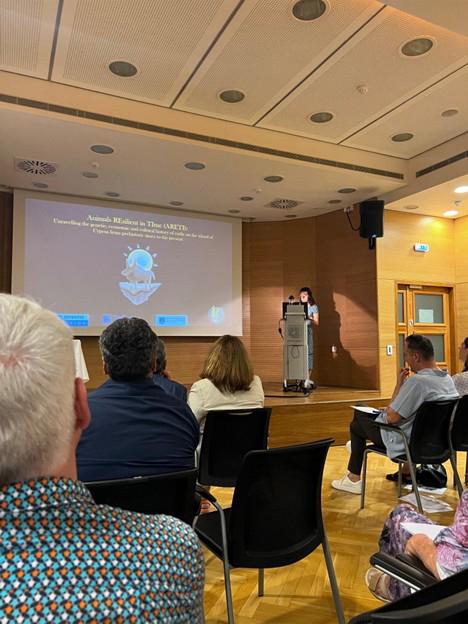
| Prof. Sturt Manning presents “The Kalavasos and Maroni Built Environments (KAMBE) Project and Recent Work”. | Prof. Maria Iacovou then followed with a presentation on Palaepaphos-Laona, emphasizing the reuse of Bronze Age architectural and defensive features into later periods. Dr. Konstantinos Kopanias then proceeded with a discussion of new finds from the excavation of Palaepaphos-Marchello. Recent work in particular appears to undermine the previously prevailing theory that the site’s mound was utilized as siege infrastructure. The morning session then concluded with Dr. Anna Spyrou’s presentation of the multidisciplinary ARETI project’s research into the genetic, economic and cultural history of Cyprus’s indigenous cattle breed. Dr. Spyrou discussed genetic insights from an early Archaic period sample from Kition which indicated the presence of the breed’s hybrid genetic makeup. A film on the indigenous cattle breed is also in progress and the workshop audience was treated to a brief clip. | Dr. Anna Spyrou presenting on the ARETI project on Cypriot cattle | |
Following a brief intermission, Prof. Thierry Petit shared the findings of his recent field seasons at Amathus Palace, including in his presentation images of a colorful preliminary stratigraphic drawing and a preserved Geometric floor. The objective of his 2025 excavations will be to find the complete plan of the building and determine the boundaries of the walls surrounding it. Dr. Pamela Gaber and Andrew Wright followed, presenting the OCHRE platform as a way to address the issue of analogue records produced at their site in Idalion. Their digitization of over 120,000 items and innovative archival methods together have revolutionized the project and are intended to inspire other archaeologists to utilize OCHRE. Shifting focus to Pyla-Vigla, Dr. Brandon Olson shared the material evidence recovered during the 2024 season that shed light on both martial and non-militaristic facets of the fortified site. The team intends to ‘chase the boundaries’ of the complex during the current field season. The next presentation was shared by Dr. Maria Michael, who outlined an archaeological, geographical, and geomorphological biography about Dreamer’s Bay port and the relationship between the ruins of a mole and the commercial activities of an ancient settlement on the Akrotiri Peninsula. Discussing another coastal site, Prof. Joan Connelly shared the findings of her previous season, including the discovery of 68 sherds with dipinti as well as a burned level in the site stratigraphy. This year she will celebrate her 35th season at Yeronisos Island and her 10th year at Cape Drepanum.
Dr. Fryni Hadjichristofi shifted focus to archaeological endeavors in the Common Era, sharing with the audience a summation of 11 years of excavations at Akaki-Piadhia. Alongside the unique subject and style of the ‘Villa of the Hippodrome’ mosaics uncovered at the site, excavation at Akaki-Piadhia has provided new data on urbanization during Late Antiquity. Results from the final season of the Kourion Urban Space Project Excavations were then presented by Dr. Laura Swantek. The 2024 season focused on determining the layout of Building 4 of the Earthquake House. Building 4 underwent multiple renovations during its pre-quake life, with notable finds including a marble statue of Artemis and the remains of multiple earthquake victims. Dr. Athanasios Vionis then shared the ArtLandS Lab’s findings of the last season at Kophinou Agios Herakleios, an early Byzantine basilica located in a contemporaneous village settlement. The 2024 excavation found evidence that the human remains discovered around the religious structure may indicate the first known organized cemetery on the island and the supplemental findings potentially bridged the 8th–12th centuries gap in the Cypriot material record.
The final presentation was delivered by Dr. Stella Demesticha, who discussed the 2024 excavation season of the Nissia Shipwreck. Although the wreck is believed to have been extensively pilfered by souvenir hunters and other unchecked divers, the remaining material culture includes firewood and a potentially 17th century cannon that the team hopes can assist in both dating the ship and extending the known historiography.
The evening was capped off at the reception in the CAARI courtyard, where the presenters and their collective research were celebrated!
| | |
Words on Leaving CAARI’s Vice Presidency
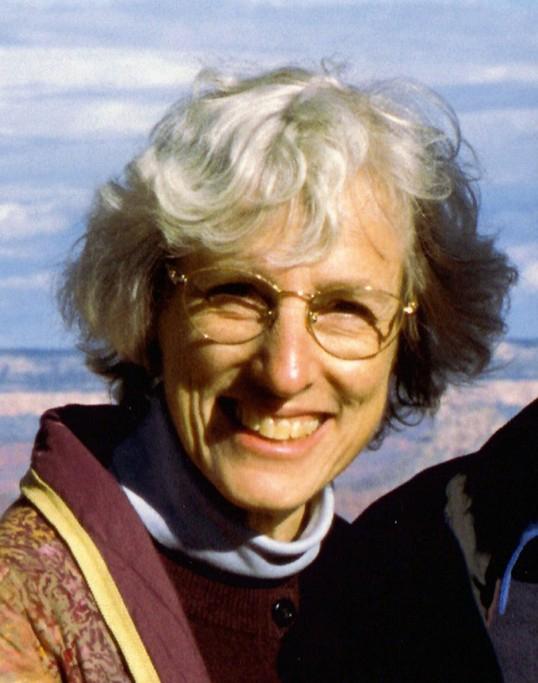
Dr. Annemarie Weyl Carr
Southern Methodist University; CAARI Vice President
| | |
As I leave CAARI’s vice presidency after more than a decade in that role, I feel a vast debt of gratitude to the countless people who have enabled the Institute to thrive. I’ve known six of CAARI‘s eight Directors and enjoyed being there with each. I have marveled at Vathoulla’s incomparable mastery of the institution’s complexity, marveled, too, at Katerina’s competence in taking over her role, cherished Photoulla’s caring, generous concern for each person, and welcomed Anthoulla to the library (and to cat-custodianship) with real joy.
I thank all of CAARI’s eleven, very different Presidents, perhaps especially Dr. Andrew Oliver, who invited me to apply for membership of the Board, and Ambassador Ray Ewing, who invited me to become the Vice President. I have worked happily with so many Board members, and CAARI’s Cypriot Advisory Committee deserve my deepest thanks, perhaps especially Achilleas Demetriades and Chris Christodoulou, for thoughtful guidance and boundless energy. I thank the many of our CAARI Fellows who have fascinated and often thrilled me with the reports they submitted for the CAARI Newsflash. And I can only begin to convey my thanks to the hundreds of friends and supporters who have enabled CAARI’s success with their generous financial gifts.
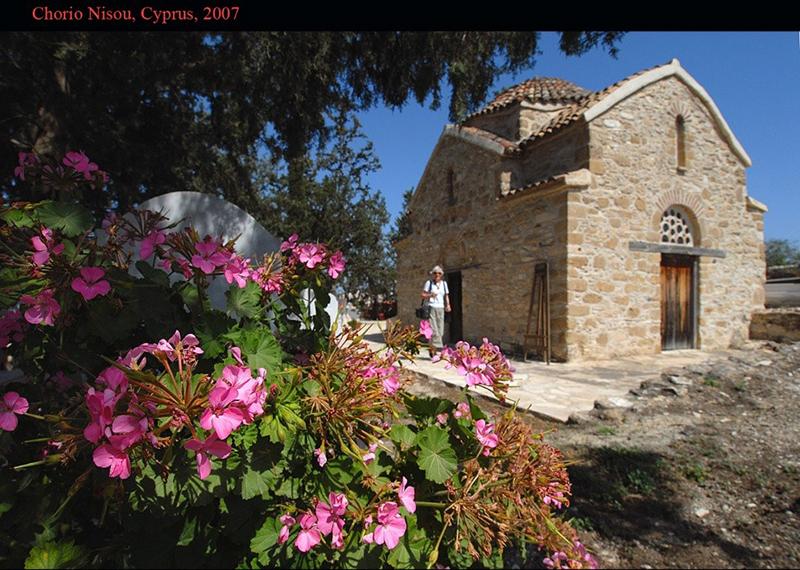
| | Annemarie at the Apostles’ Church at Pera Chorio | | |
Thinking back over the decades since the summer of 1990 when I first came to CAARI, my immediate instinct is to say “it is just the same; it hasn’t changed at all!” In fact, it’s hard to find what has not changed. CAARI was then on King Paul Street; it has since moved house, expanded its library, gained a professional librarian, launched a Web site, and added internet access, air conditioning, progressively newer digital library catalogue systems, Zoom and YouTube channels, and an ever more technologically sophisticated lab. Indeed, the archaeology itself that CAARI serves is changing, transformed by technology. Meanwhile, CAARI has accommodated a radically altered academic environment in Nicosia with the opening first of the University of Cyprus and its formidably accomplished Archaeological Research Unit (ARU) (1992), and then of the technologically dynamic Cyprus Institute (2005); it has also negotiated successive societal groundswells, with the opening of the north/south border in 2003, Cyprus’ entry into the EU and the euro-zone in 2004, the devastating bank crisis in 2013, the scourge of Covid in 2020. At the same time, the intellectual environment of Euramerica has shifted, too, shrinking the funding available for the pre- and postdoctoral research grants that CAARI has relied on. CAARI has accommodated these changes, too, itself funding the only research fellowships specifically earmarked for Cyprus, especially the prestigious Edgar J. Peltenburg Postdoctoral Research Fellowship in Cypriot Prehistory established in 2018. This resilience in the face of dynamic and sometimes challenging changes is impressive: CAARI has hardly been “just the same”!
Yet what I have loved most about CAARI has not changed over time: the environment for research that it offers. It has zealously maintained its unparalleled library resources despite skyrocketing costs of printed and digital publications; its small, super-effective staff remain keenly connected to relevant people and resources outside its walls; its residential areas are modest but retain the core of tastefulness conferred by Stuart and Laina Swiny. But what is significant above all is its distinctive human environment. CAARI prides itself on its warm, hospitable atmosphere, and new fellows are quickly taken under the wing of other residents. Many new fellows are young, but CAARI is a resource center for researchers at all stages of life and from all parts of the world, and senior as well as novice scholars converge there. Similarly, CAARI is an institute of archaeology, but researchers in a wide range of disciplines find their way there to use the rich resources. All settle to work in the one, unified library space, gather in the foyer for the same morning coffee hour, and savor the same freshness of the garden. There is a deeply egalitarian quality to the spaces at CAARI, and conversation moves readily within them. Discussions across disciplines, across age or seniority, across languages, across periods and methodologies happen easily. It is a setting designed to enrich one’s own thinking, opening up vistas, questions and insights, and challenging one always to ask how one’s own avenue of research fits into the larger picture of the island one has come to study. At the same time, it is a setting that deepens the quality of research on Cyprus, weaving together the efforts of varied disciplines, periods, generations and methodologies. There is an earnestness in the research atmosphere at CAARI, as everyone bends to the challenges of the material they have come to work on, and shares with others the thrills of discovery. This mutuality of earnest yet thrilling discovery is what I love about CAARI. It has always been there. It has never changed.
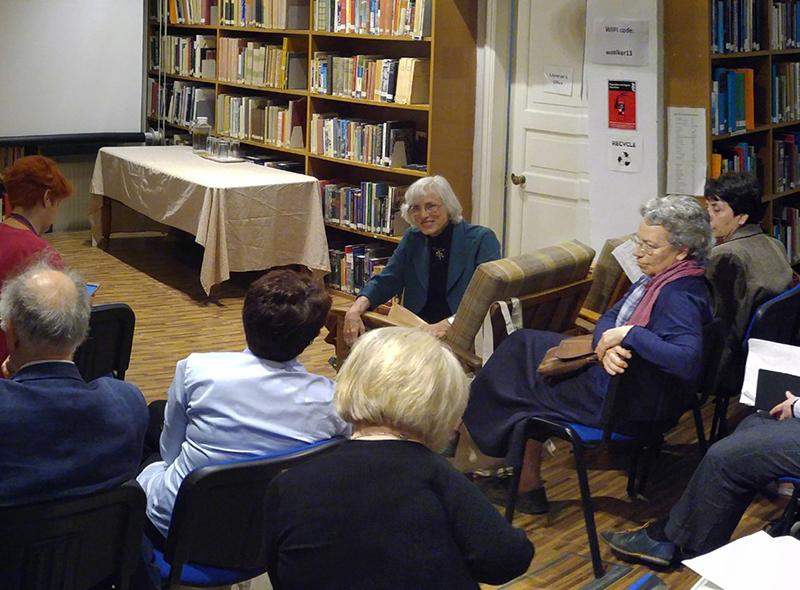
| Annemarie answering questions in CAARI’s library in the Melusine of Cyprus conference | |
It is this environment of mutual awareness and shared endeavor that I most sincerely hope can carry on at CAARI, right up to and beyond its 100th birthday. It is a deeply human environment, sustained by personally engaged thinkers responsive to those around them and to the lives—human or otherwise—that their work uncovers. I tend to see it as grounded in the field of archaeology itself, as archaeology is a discipline traditionally exercised by people in groups—far more so than either history or my own discipline of art history. Thus I have believed that CAARI had an underlying matrix of team responsivity rooted in its very archaeological DNA. However, two factors have made me less confident now than I used to be that this special environment can survive. The first of these is the U.S. Department of State’s currently ongoing suspension of most of its international aid programs. CAARI has depended since its origin on the State Department’s funds for international education and exchange. We literally do not know right now whether this funding will be available anymore. Its cancellation, even if only for three and a half years, could pose a formidable financial challenge for CAARI. The second factor is my humanist’s concern that the surging fascination with technology will slowly erase even from archaeological research the craving for interpersonal interchange that CAARI’s environment has been created to serve, making its survival unimportant to the digitally focused researchers and methodologies of the future. The human dimension of inquiry attached to faces may ebb in the face of technology’s astronomical costs and contentual abstraction, as the importance of tangible pages is already waning.
The challenges that may be posed by the State Department would be new in magnitude to CAARI but certainly not new in nature, and its Board is already at work refining strategies of budget management and rethinking modes of development and fundraising. Invaluable and deeply appreciated as its long-term donors will remain, CAARI must also develop a broader and younger corps of supporters to answer its needs into a future that is self-sustaining. The challenges that may be posed by technological methodologies are more gossamer, and here I do look squarely to our younger fellows and participants, to help us shape CAARI into a future research environment that answers not just our technological need for data, but also our shared human need for joy.
Yet what I have loved most about CAARI has not changed over time: the environment for research that it offers. It has zealously maintained its unparalleled library resources despite skyrocketing costs of printed and digital publications; its small, super-effective staff remain keenly connected to relevant people and resources outside its walls; its residential areas are modest but retain the core of tastefulness conferred by Stuart and Laina Swiny. But what is significant above all is its distinctive human environment. CAARI prides itself on its warm, hospitable atmosphere, and new fellows are quickly taken under the wing of other residents. Many new fellows are young, but CAARI is a resource center for researchers at all stages of life and from all parts of the world, and senior as well as novice scholars converge there. Similarly, CAARI is an institute of archaeology, but researchers in a wide range of disciplines find their way there to use the rich resources. All settle to work in the one, unified library space, gather in the foyer for the same morning coffee hour, and savor the same freshness of the garden. There is a deeply egalitarian quality to the spaces at CAARI, and conversation moves readily within them. Discussions across disciplines, across age or seniority, across languages, across periods and methodologies happen easily. It is a setting designed to enrich one’s own thinking, opening up vistas, questions and insights, and challenging one always to ask how one’s own avenue of research fits into the larger picture of the island one has come to study. At the same time, it is a setting that deepens the quality of research on Cyprus, weaving together the efforts of varied disciplines, periods, generations and methodologies. There is an earnestness in the research atmosphere at CAARI, as everyone bends to the challenges of the material they have come to work on, and shares with others the thrills of discovery. This mutuality of earnest yet thrilling discovery is what I love about CAARI. It has always been there. It has never changed.
| | |
Dr. Matthew Spigelman
Incoming CAARI Vice President
| |
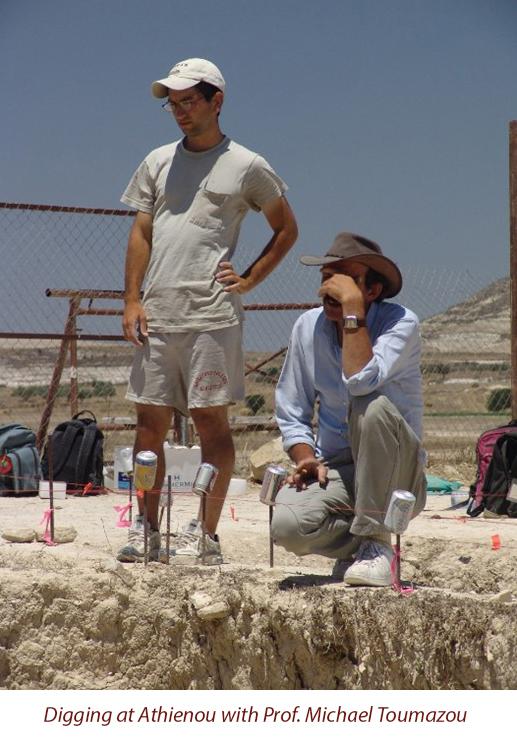
I arrived in Cyprus in 2002 as a participant in the Athienou Archaeological Project (AAP). I had a freshly minted undergraduate degree and a complete lack of archaeological field experience. I am thankful that CAARI was an integral part of the AAP excavation season, both through weekly research visits to the library and attendance at the Summer Archaeological Workshop. Stepping into the cool building after a long bus ride to be greeted by Director Robert Merrillees, learning to navigate a new library numbering system guided by librarian Diana Constantinides, and enjoying a brandy sour and the hospitality of administrator par excellence Vathoulla Moustoukki in the garden after the workshop, I most certainly felt welcomed, engaged, and at home.
After subsequent seasons, I was in residence at CAARI during the 2009–2010 academic year on a Fulbright Fellowship and it was during these winter months that I came to more fully understand the day-to-day workings of the Institute and the role it plays within the Cyprus archaeological community, most notably alongside the Department of Antiquities, the University of Cyprus Archaeological Research Unit, and STARC. Then Director Tom Davis helped me negotiate museum permissions, obtain meetings with officers, gain access to the storerooms, and export ceramic samples for my dissertation on Red-on-Black style ceramics from the Bronze Age. With funding from the National Science Foundation these samples returned to the States and have traveled far and wide, including to the research reactor at the University of Missouri to study their ceramic fabric, to the Field Museum in Chicago to test their pigment and slip, and to the thin section laboratory of the UPenn Museum to investigate their minerology. My project, and so many others like it, was only possible because of CAARI.
As I traveled to Cyprus for the 40th anniversary Gala Dinner in 2018 and joined the CAARI board in 2020 I began to appreciate and articulate what I think makes CAARI so special. The institute is built around a deep scholarly engagement with the books, articles, and archival records of the archaeology of the island. The community is open and generous, ideas are exchanged and wisdom and technical knowledge readily flows between generations of scholars. And lastly, the building is alive, with visitors, residents, staff, and seemingly much of the greater Nicosia archaeological community passing through its doors on any given day.
| |
I am forever grateful for the time I have spent, and will spend, on Cyprus and at CAARI. Learning the archaeology of the island, from hippos to Hospitallers (and beyond) prepared me well for a career in cultural resource management here in the States. My mind is never far from the archaeology of Cyprus, regardless of whether my company is excavating a Native American archaeological site in Rhode Island, a Revolutionary War era house in New Jersey, or a 19th century copper mine in Vermont.
I know that many feel similarly thankful for the experience and training they have received at CAARI and on Cyprus. It is my hope that during my time as Vice President that we can grow and strengthen the mutual connections of all those who were welcomed through CAARI’s doors so that the next generation of students and scholars will continue to do so.
| | |
A Message from Development
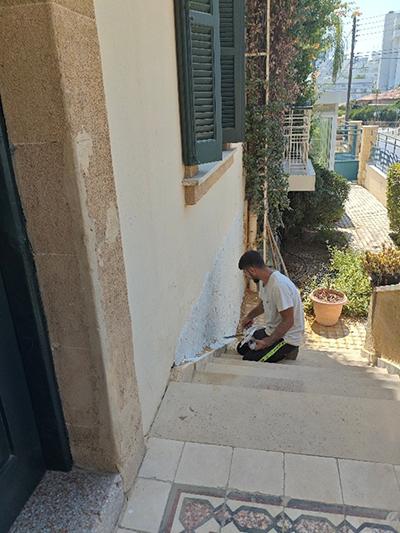
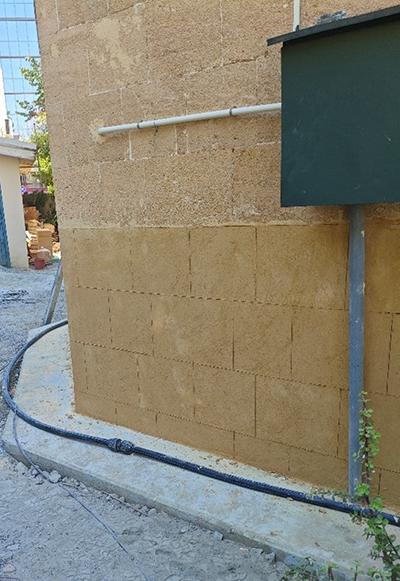
A special thanks to Annemarie from Development for her many years of work for the committee and all her efforts in advancing the mission of CAARI. Sincere thanks to all those that assisted in CAARI’s building project. The repair of CAARI’s façade is crucial to ensuring our home remains a welcoming space where old friends reunite, and new connections are made. We are pleased to report that the repair work began early in the summer. As shipments of sandstone material is received, work is being completed. Some key areas are illustrated below with final touches being added to CAARI’s entrance and completed sections around the building. Your generosity during the first and second phases of the project has enabled this positive progress.
| | The return of the annual Summer Archaeological Workshop is a potent programs. We are grateful to all those that have answered the call for this need. As we move into the third phase of the project, we are optimistic that, with the consistent help of our friends, we will be able to maintain our progress and complete reminder of the many friends that continue to help sustain CAARI and its the repairs on schedule. Even small gifts help us meet our goal! | | |
Donate to CAARI online:
HTTPS://CAARI.ORG/DONATE
| | |
Or by mail:
CAARI
209 Commerce Street
Alexandria, VA 22314 USA
or
CAARI
11 Andrea Dimitriou Street
Nicosia 1066 Cyprus
| | |
To All our Friends and Supporters
To ALL who play a role in addressing the various needs: our sincerest thanks! To all who help CAARI sustain its potent mission: thank you for your generous participation! We are very grateful for your support.
| | |
Zuzana Chovanec
CAARI Development Chair
| | | | | |