Explore New National and State Data to Inform Child Health Priorities and Strengthen Action!


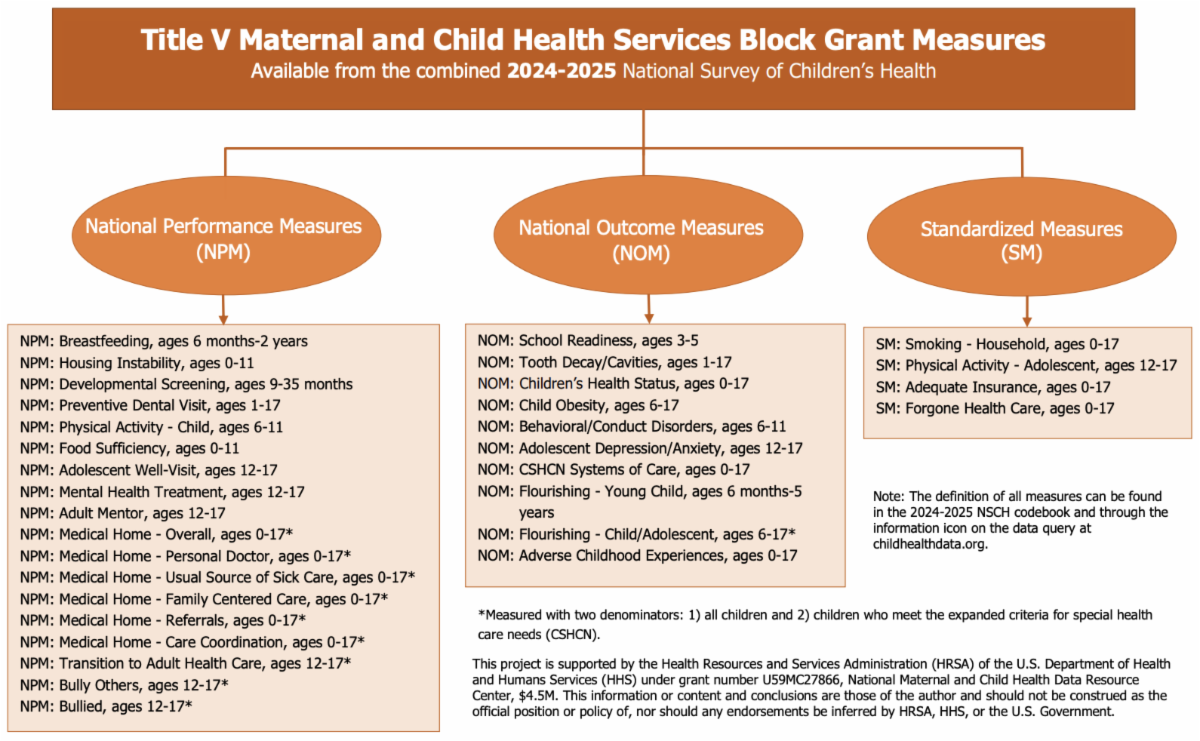
Visit the National Data Resource Center for Child and Adolescent Health (www.childhealthdata.org) to view estimates for Maternal and Child Health National Outcome and Performance Measures using the 2024-2025 National Survey of Children's Health

The National Data Resource Center for Child and Adolescent Health (DRC), a project of the Child and Adolescent Health Measurement Initiative (CAHMI), under a cooperative agreement with the Health Resources and Services Administration’s (HRSA) Maternal and Child Health Bureau (MCHB), is excited to announce that estimates for the National Performance Measures (NPMs), National Outcome Measures (NOMs) and Standardized Measures (SMs) using the 2024-2025 National Survey of Children’s Health (NSCH) are now available through the DRC. More information about the Title V Maternal and Child Health Services Block Grant and performance measurement system can be obtained at the MCHB website.

The NSCH is designed to provide national and state-level estimates on key indicators of health and well-being for children, their families and communities, as well as information about the prevalence and impact of special health care needs. The DRC-produced combined 2024-2025 NSCH dataset includes data from 96,514 children ages 0-17 years. By leveraging this larger analytic sample size, data users can analyze small population groups and rare outcomes that are not sufficiently represented in a single year sample as well as produce national and state-level estimates with smaller standard errors.

Understanding National Outcome and Performance Measures

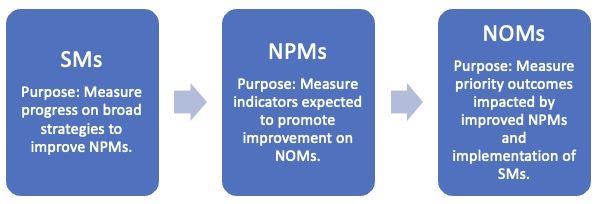
How these measures are connected and why they are important

NOMs are the “north star” outcomes that state and regional Title V Maternal and Child Health programs are working to achieve (e.g., percent of children meeting the criteria for school readiness). NPMs are indicators associated with improving NOMs (e.g., percent of children who received developmental screening). SMs measure progress on broad strategies to improve NPMs (e.g., convene partners essential to ensuring developmental screening).

Now that the Title V performance measure framework includes child flourishing, school readiness and ACEs, along with several NPMs critical to improving these outcomes, states can focus on select SMs that support achieving these interrelated outcomes and performance measures. Specifically, Title V programs are in a unique position to lead efforts that bring together other state programs and family and community partners that not only share similar goals but also have unique strengths and services essential to improving NOMs and NPMs.

Quick Links to Key DRC Resources

The DRC is here to support expediting and optimizing your data use for impact and change in research, policy, and practice. In addition to the interactive data query, visit the DRC NSCH Overview page to learn more about the survey and explore numerous NSCH resources:

students_classroom_kids.jpg

To support more meaningful use of NSCH data, the DRC also recently released two new guidance documents that help users interpret findings and conduct subgroup analyses.


1. Making Sense of the Data: How to Use and Interpret National Survey of Children’s Health (NSCH) Data


2.Using the Data Resource Center to Look at Subgroups to Assess Variations Across Groups vs. Distribution Across Groups

Additional resources are available at HRSA MCHB’s webpage on the NSCH, including the NSCH Data Briefs. NSCH public use data files are available on the U.S. Census Bureau’s NSCH page.

More data resources are coming soon!

Additional Child and Family Health Measures from the 2024-2025 NSCH will be added to the DRC interactive data query, with downloadable DRC Indicator datasets and codebooks expected in early 2027. The 2025 NSCH estimates will follow and will be added to the DRC with corresponding datasets and codebooks available for download in spring 2027.

We are also excited to announce the development of a new DRC trending feature for National Outcomes and Performance Measures. Keep your eye out for updates!

As always, if you have any questions, please contact the DRC team through our Ask Us a Question page. There you will find FAQs and common technical assistance (TA) questions and responses. If you cannot find what you need, you can submit your question through a TA request form. If you are a Title V leader, please be sure to indicate this in your request for information.

This project is led by the Child and Adolescent Health Measurement Initiative and is supported by the Health Resources and Services Administration (HRSA) of the U.S. Department of Health and Human Services (HHS) under grant number U59MC27866, National Maternal and Child Health Data Resource Center, $4.5M. This information or content and conclusions are those of the author and should not be construed as the official position of or policy of, nor should any endorsements be inferred by HRSA, HHS or the U.S. Government.

The CAHMI is a center within the Department of Population, Family, and Reproductive Health at the Johns Hopkins Bloomberg School of Public Health.

 
X  LinkedIn  YouTube  Web