Robert Spencer was a native of Nebraska, the son of a Swedenborgian clergyman and the daughter of a buggy maker. The family moved around throughout Spencer’s childhood but was in one place long enough for him to graduate from high school in New York state in 1899. Although he initially planned to study medicine, Spencer changed his mind and enrolled in the National Academy of Design in New York City. From there he went on to study with William Merritt Chase at his New York School of Art, and probably Ashcan School founder Robert Henri.
In 1906, Spencer moved to Bucks County, Pennsylvania and moved into a tumbledown house known as the Huffnagle Mansion with fellow artist Charles Ramsey. He began studying with noted landscape painter William Lathrop and in 1914 married Margaret Alexina Harrison Fulton, a fellow student of Lathrop’s who was an architect as well as a painter. In 1916, Spencer joined a group of other Bucks County artists in the New Hope Art Group and they began to arrange exhibitions of their work. Unfortunately, Spencer experienced a series of nervous breakdowns in the 1920s and ultimately died by suicide in 1931.
Spencer’s work differed from that of his New Hope colleagues in its subject matter as well as style. Spencer created renderings of everyday life in the community, often depicting mills, tenements, and factories of New Hope and surrounding areas, as opposed to more picturesque scenes currently in fashion. He claimed, “A landscape without a building or figure is a very lonely picture to me.”
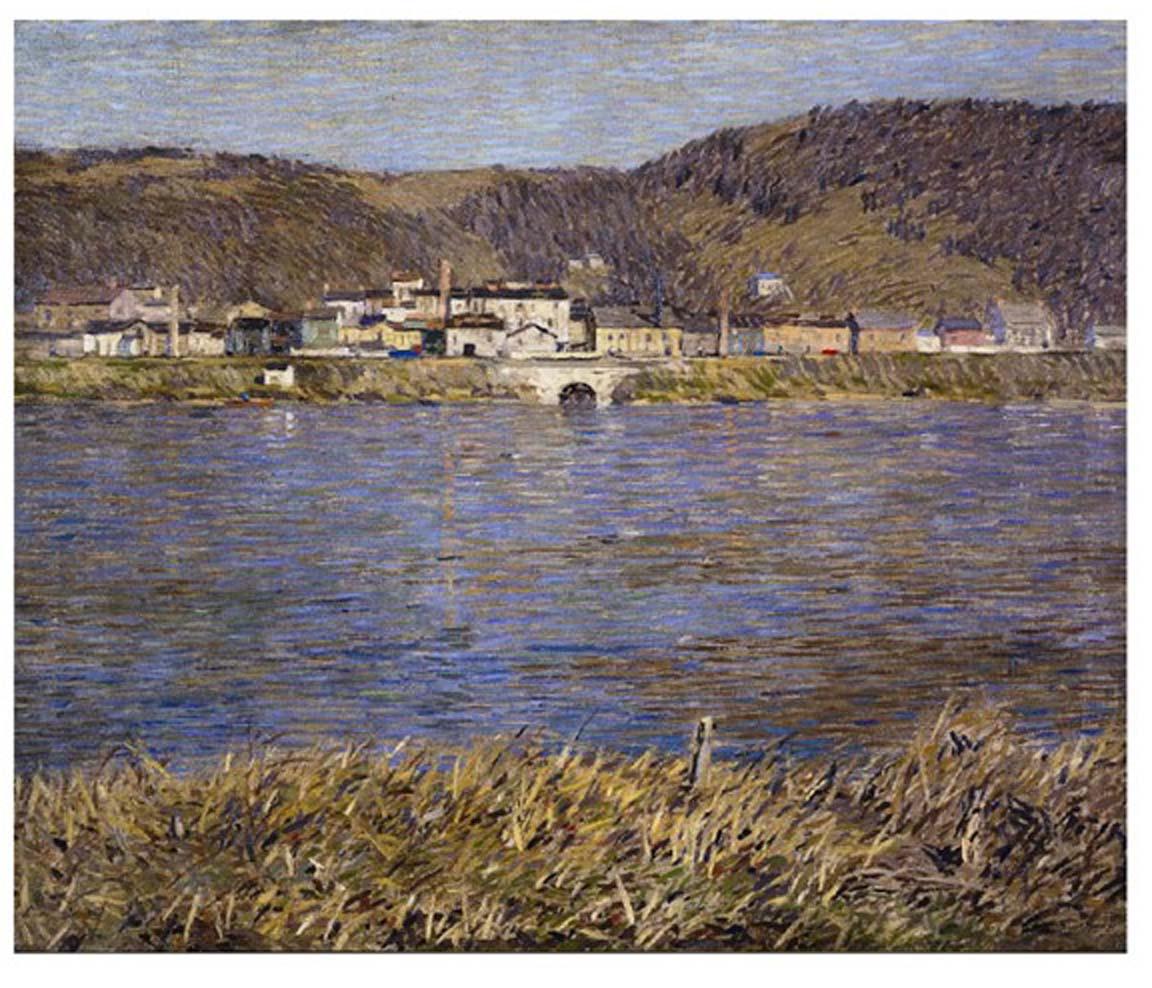
The River - March
, falls comfortably in the middle of Spencer’s career. Although he was known as a Pennsylvania Impressionist, the style seen here seems to be more of an elongated Pointillism. Each brushstroke is a slender reed of pure color, too long to be strict Pointillism, but much more distinct than the lush strokes of Monet or Renoir. The overall palette is redolent of early spring before green has fully returned to the world. Most of the grass is shades of brown and tan, with the promise of renewal coming from patches of deep green shoots. The surface of the canvas is very present in the painting, hovering just beneath the stripes of paint. The canvas is particularly helpful in lending verisimilitude to the river, as it enhances the idea of the water reflecting the hills on the far side.
--Associate Curator Kate Kunau