|
Research is always moving forward and you can be part of it! Explore the newest SCI research studies seeking participants and see where you can make an impact.
You’re reading The Peer Review, Spinal Cord Injury BC's research newsletter! We share new and exciting research opportunities and news with you a few times a year.
| | |
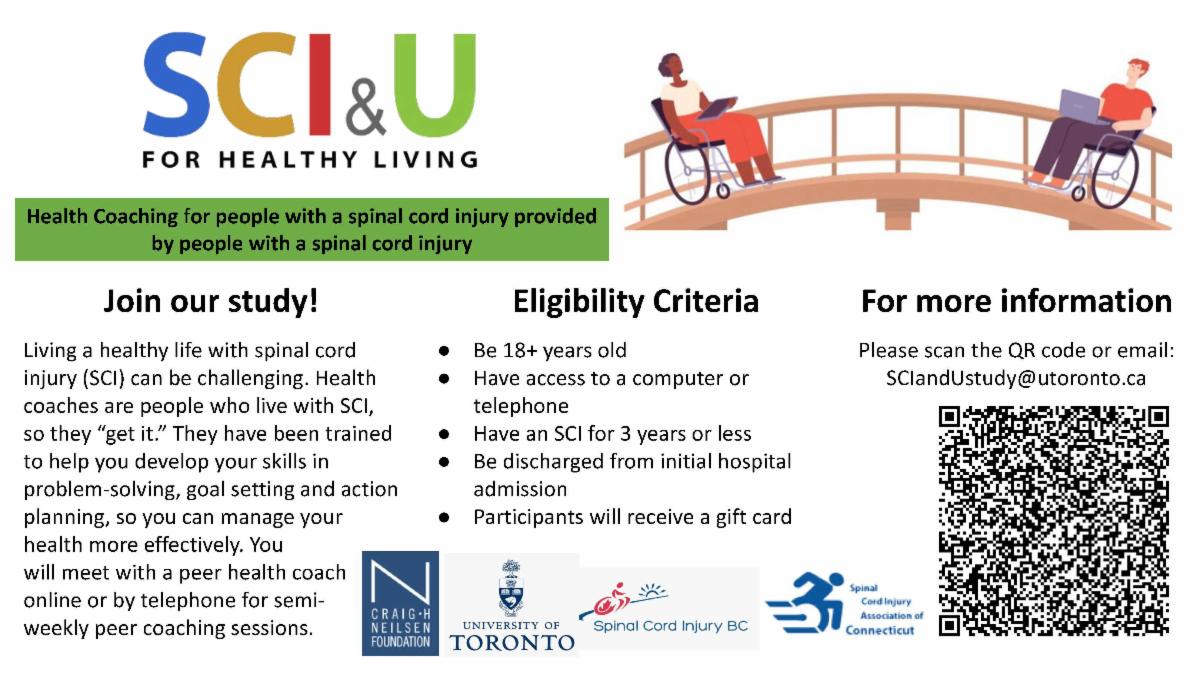
SCI&U Peer Health Coaching
Living a healthy life with SCI can be challenging. Health coaches are people who live with SCI, so they “get it.” They have been trained to help you develop your skills in problem-solving, goal setting and action planning, so you can manage your health more effectively. You will meet with a peer health coach online or by telephone for semi-weekly peer coaching sessions.
-
Location: Remote/online.
-
Time commitment: Up to 14 semi-weekly peer coaching sessions.
-
Eligibility: SCI for 3 years or less.
-
Compensation: Yes, gift card.
-
Contact: barana@sci-bc.ca.
| | |
Can Regular Use of a Standing Frame Combined with Nerve Stimulation Improve Bladder Function?
Bladder dysfunction significantly impacts quality of life in people with SCI, but rehabilitation options for managing bladder symptoms in SCI have been scarcely considered. Previous research has shown that there is important overlap between the part of the spinal cord that sends nerves to the bladder and the part of the spinal cord that receives sensory information from the legs. Other research has shown that walking programs, which inherently involve giving sensation to the feet through the soles, can improve bladder function in people with SCI. In this study, we will continue to explore these relationships by evaluating the potential effects of combining electrical leg stimulation and standing therapy on bladder symptoms.
- Location: In person (ICORD/Blusson Spinal Cord Centre).
- Time commitment: 3-month intervention of 3 sessions per week.
- Eligibility: SCI > 12 months ago; Have symptoms of urinary dysfunction from your SCI; Able to use a standing frame; Do not walk as your main mode of daily mobility.
- Compensation: Yes.
-
Contact: lamlab@icord.org or 604-675-8815.
| | |
Effects of rhythmic exercise on pelvic floor activity
Pelvic floor muscle (PFM) dysfunction can significantly affect quality of life in people with SCI, as it is associated with urinary incontinence, fecal incontinence and sexual dysfunction. PFM training is a common form of physical therapy that aims to strengthen these muscles, but is not readily prescribed to people with SCI. Research also suggests that rhythmic arm activity, such as arm cycling, can modulate neural activity in the lower limb muscles. In this pilot study, we aim to investigate how rhythmic exercises, such as arm cycling and ski ergometery, affect PFM activity.
- Location: In person (ICORD/Blusson Spinal Cord Centre).
- Time commitment: 3-4 hours total.
- Eligibility: Non-progressive SCI (at or above L1) > 12 months ago; No other concurrent neurological injuries or diagnoses (e.g. stroke, CP); Not currently experiencing an acute vaginal or urinary infection
- Compensation: Yes.
-
Contact: jiho.song@ubc.ca or (604) 675-8815.
| | | | |
Biomaterials to treat spinal cord injury
Mend the Gap is a group of 30 international scientists, including members of ICORD, working closely with people with lived experience of SCI toward a new experimental treatment for SCI. The treatment involves a combination of drugs and an injectable biomaterial that is intended to help nerves regrow in the spinal cord and improve functional outcome. Researchers are recruiting people living with SCI to take part in focus groups to share their opinions and perspectives about this new approach, considering both the benefits and risks they present.
- Location: Online survey/video call.
- Time commitment: 2 hours.
- Eligibility: Have a cervical or thoracic SCI;18 years of age or older; Have access to Zoom
- Compensation: $50 Amazon gift card
-
Contact: tanya.barretto@ubc.ca
| | |
Potential benefits of passive heating (hot tub) on your health – A pilot study
The goal of this pilot study is to demonstrate the safety, tolerance, and effectiveness of a 45-minute passive heating session providing a mild/moderate exercise response (warm up and 20-25 min activity equivalent) from full-body hot-water immersion in individuals with higher-level SCI (T7-C4). Participants will come to Dr. Victoria Claydon’s lab at SFU for a single hot tub immersion session. The session will take about 3 to 4 hours, including up to 45 min of hot tub immersion. Transfers to and from the hot tub will use a Hoyer style lift.
- Location: Simon Fraser University (Burnaby).
- Time commitment: 3-4 hours.
-
Eligibility: Have an SCI T7 to C4 (of any AIS level); Engage in a regular/consistent bowel/bladder management program; Are able to perform a level transfer with minimal assistance; Have received full immunization against COVID-19; Do not smoke/use tobacco products; Do not have any cardiac/respiratory illness or diabetes mellitus
- Compensation: $100 + parking pass/taxi reimbursement.
-
Contact: james.laskin@gmail.com or (604) 200-3426.
| | |
Usability of a Novel Alternative to the Universal Cuff: The OmniCuff
This UBC Master of Occupational Therapy project aims to understand how the OmniCuff device impacts daily activities and independence for people with SCI and limited hand function. The OmniCuff is a new device designed to allow individuals with limited hand/grasp function to perform daily activities. This device has only recently been brought to the market, so there is limited research on its usability and functionality.
-
Location: In participant's home (researchers will come to you) in Greater Vancouver area.
-
Time commitment: 4-5 hours over 2 weeks.
-
Eligibility: SCI for at least 1 year; Difficulty using your hands because of SCI; Have partial active shoulder, elbow, and wrist movement.
-
Compensation: Offered to keep the OmniCuff at the end of the study.
-
Contact: tsewell1@student.ubc.ca
| |
|
Measuring sedentary behaviour and pain among people with SCI
People with SCI engage in 12-13 hours a day of sedentary behaviour, which includes sitting. Prolonged inactivity may influence pain intensity, although no one has measured how sedentary behaviour may interact with pain experienced by people with SCI. The goal of this research is to begin to understand how sedentary behaviours could be modified to improve quality of life for people with SCI.
-
Location: UBC Okanagan Campus (Kelowna).
-
Time commitment: 12.5 hours total.
-
Eligibility: Have a traumatic SCI; do not ambulate (primary mode of mobility is a wheelchair); experience chronic pain.
-
Compensation: $250.
-
Contact: adamsnt@student.ubc.ca.
| |
|
Low oxygen therapy as a cardiac treatment for improving 24-hour blood pressure stability
This study aims to characterize the cardiovascular responses to low oxygen therapy in people with complete and incomplete cervical SCI. Low oxygen therapy is the repeated exposure to mildly decreased oxygen. In this study, they will test whether breathing low oxygen for a short period of time improves the function of the heart, blood vessels, kidneys, and brain.
-
Location: ICORD (Vancouver) or UBC Okanagan Campus (Kelowna).
-
Time commitment: 11.5 hours total (7 visits separated over at least 11 days).
-
Eligibility: Traumatic cervical SCI (at or above T1) > 12 months ago.
-
Compensation: $500.
-
Contact: sthrall@student.ubc.ca or (250) 807-8083.
| |
|
Non-invasive spinal cord stimulation for recovery of autonomic function after spinal cord injury
This study will assess the safety and effectiveness of non-invasive spinal cord stimulation in recovering cardiovascular, bladder, bowel, and sexual functions in people with SCI. We are interested in both the immediate effects (i.e., effects when the stimulation is turned on), effects after eight weeks of therapy (24 sessions), and long-term persisting effects (i.e., changes in functions when the stimulation is turned off, after several weeks of using the stimulation regularly).
The study protocol involves 42 visits for assessments, therapy, and follow-up, for a total of about 30 weeks. If eligible, you will be randomly assigned to receive stimulation at either mid/low thoracic (Group 1) or lumbosacral (Group 2) spinal cord levels for 8 weeks (3 times/week).
-
Location: ICORD (Vancouver).
-
Time commitment: 42 visits for a total of about 30 weeks.
-
Eligibility: Chronic traumatic SCI (at or above T6) > 1 year ago; 19-60 years old; Not ventilator dependent, receiving bladder/bowel Botox, nor have implanted metal or stimulators.
-
Compensation: Yes.
-
Contact: amaharaj@icord.org or (604) 675-8856.
| | |
TSCS Home Study
The Krassioukov lab is conducting a pilot study investigating the safety and feasibility of a new investigational device called SCONE— a portable non-invasive electrical device that provides transcutaneous spinal cord stimulation (tSCS) by electrodes connected to a battery-powered source which then goes on to activate and amplify circuitry that controls autonomic and motor function of organs throughout the body. The goal of this study is to evaluate whether SCONE could be used as a home-based therapy to help manage orthostatic hypotension (OH) and bowel dysfunction in individuals with SCI or multiple system atrophy (MSA).
-
Location: In person (Blusson Spinal Cord Centre, Vancouver).
-
Time commitment: Approximately 10 weeks with 29 study visits.
-
Eligibility: Resident of BC; chronic SCI at or above T6 or MSA of the parkinsonian type; 1 year since injury or diagnosis; Not ventilator dependent; No intrathecal baclofen pump or implanted medical devices.
-
Compensation: $20 CAD per visit to a maximum of $620 CAD.
-
Contact: escamilla@icord.org or (604) 675-8856.
| | |
Non-invasive MRI to measure brain and spinal cord changes after SCI
After SCI inflammation can persist for days to weeks, which can cause secondary damage in the spinal cord. In humans, we still don’t fully understand how long this inflammatory response within the spinal cord lasts, especially in the later, long-term stages after injury, which is what this study is trying to uncover. To address this issue, we are developing spinal cord thermometry, which leverages non-invasive MRI scans to measure temperature in the spinal cord in awake individuals. This method, we believe, would help us detect whether inflammation is still present in the spinal cord in individuals after several months or years after injury.
-
Location: In person (UBC's MRI Research Centre, Vancouver).
-
Time commitment: 3 hours.
-
Eligibility: Complete or incomplete SCI; Willing to undergo MRI scan.
-
Compensation: Travel expenses covered (parking, bus ticket, etc.)
-
Contact: john.kramer@ubc.ca or (604) 675-8815.
| | |
Patterns of respiration: paced and sleep breathing dynamics in SCI
ICORD researcher Dr. Claydon and her research team at SFU are interested in studying how SCI may impact the relationship between breathing and cardiovascular function, and to characterise the interactions between breathing-related cardiovascular regulation and obstructive sleep apnoea. Participation in this study will involve one lab visit and two nights of sleep testing from the comfort of your own home.
-
Location: ICORD (Vancouver) or the SFU Burnaby Campus.
-
Time commitment: 2 hours (in-person) + at-home sleep testing over 2 nights.
-
Eligibility: SCI >1 year ago and able to transfer to a testing bed independently or with assistance; Do not use a ventilator or positive airway pressure (PAP) machine.
-
Compensation: $20 and parking pass.
-
Contact: rebekah_lee@sfu.ca or call (778) 782-8513.
| | | | |
Lab Legend
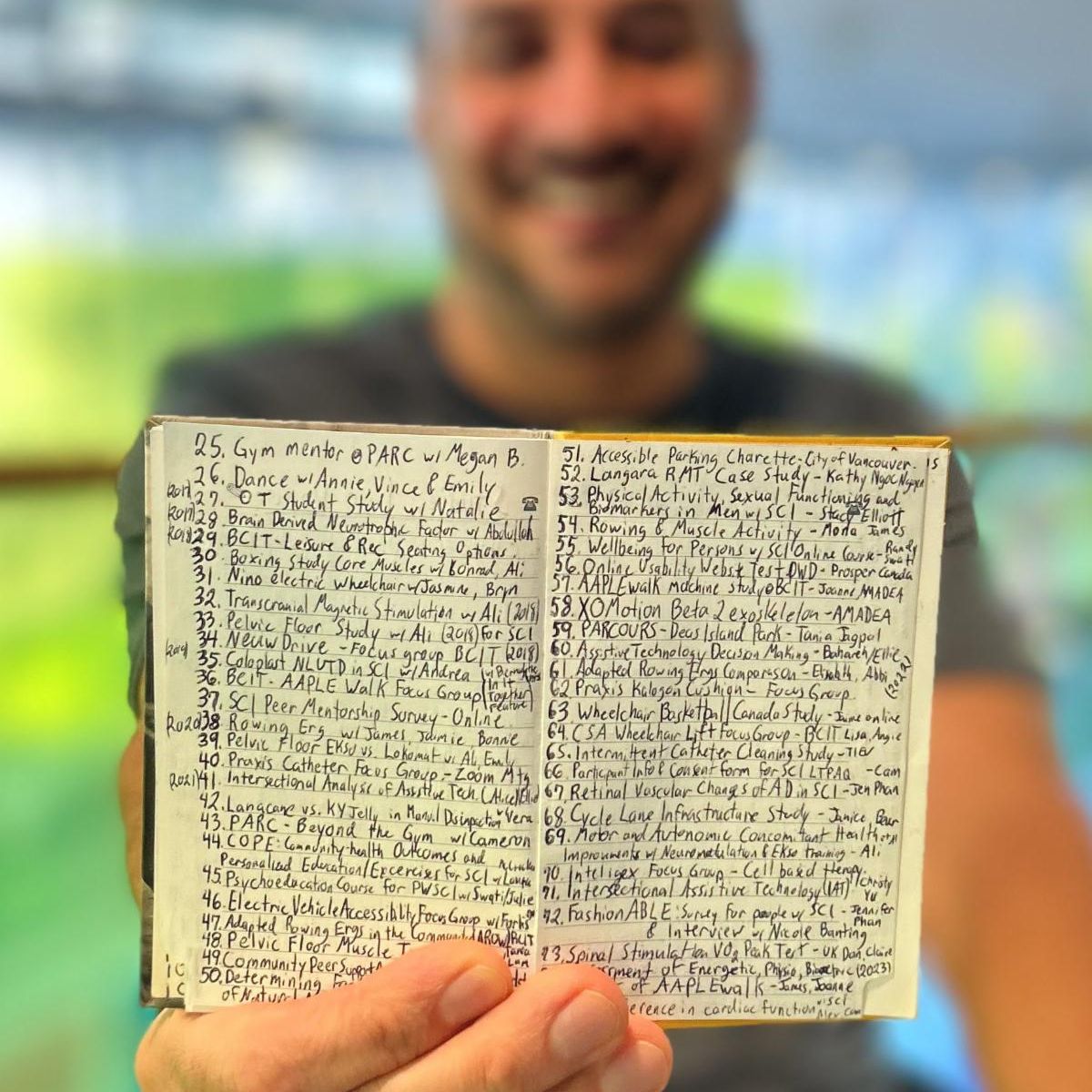
SCI BC peer Kyle Gieni reflects on his participation in 100 research studies...and counting. Read the full story on our blog!
| | | | |
SCI Community Research Night
Bringing SCI research out of the lab and into the community!
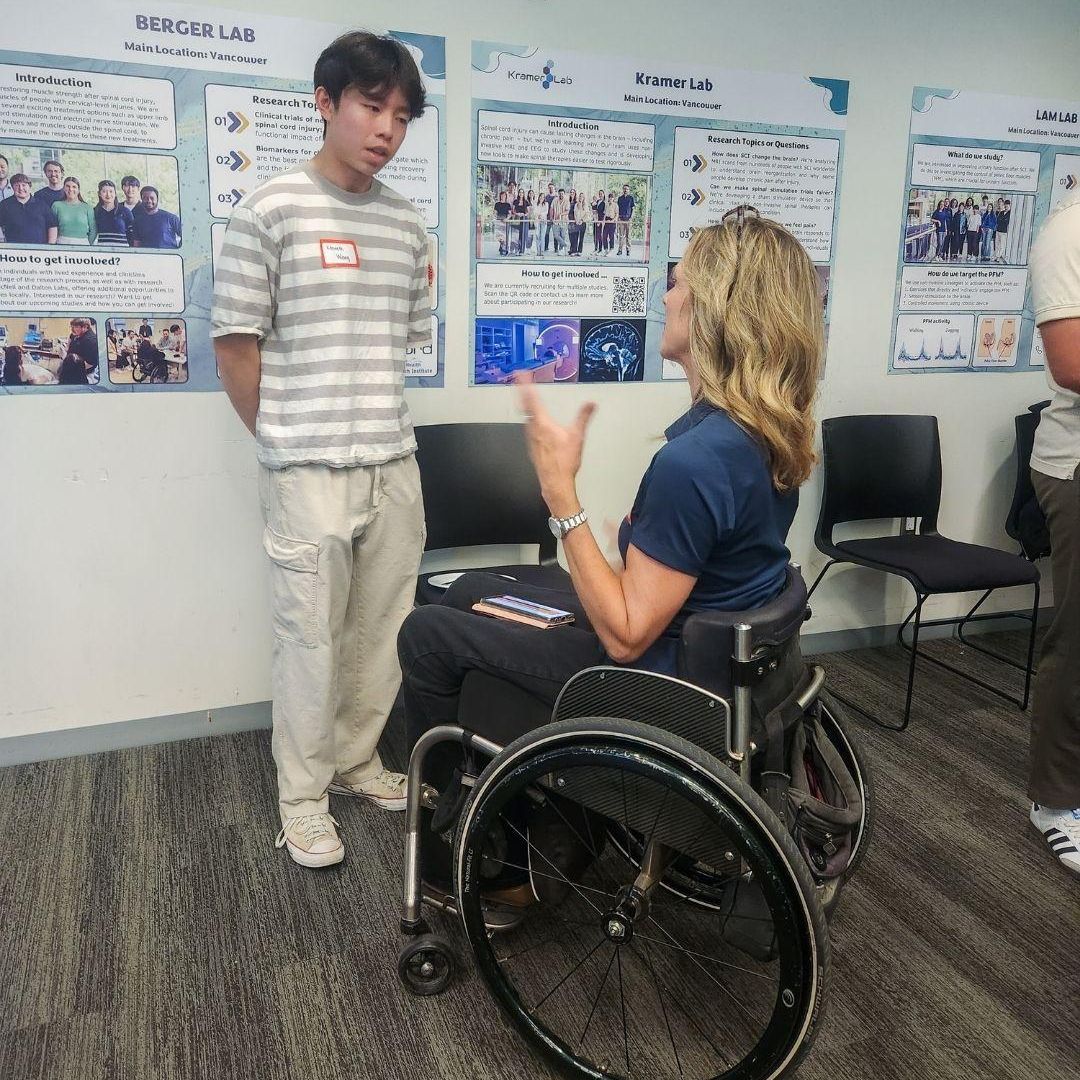
Thank you to everyone who came out to our SCI Community Research Night in Kelowna on May 11. Together with ICORD, Praxis Spinal Cord Institute and Accessible Okanagan, we brought together peers and researchers to learn, share and build connections that move research forward.
| | |
RESEARCH PAPERS
A selection of research studies SCI BC has partnered on
| | | |
We respectfully acknowledge that our head office is on the traditional territories of the Coast Salish Peoples, specifically, the xʷməθkwəy̓əm (Musqueam), Skwxwú7mesh (Squamish) and Səl̓ílwətaʔ/Selilwitulh (Tsleil-Waututh) First Nations whose historical relationships with the land continue to this day. Our provincial work takes place on the territories of Indigenous peoples who have lived on and cared for the land for time immemorial.
We are grateful to live, work, share stories, and connect in these spaces.
| |
*NOTE: If you choose to click Unsubscribe below you will no longer receive any communications from us ever again. Please consider clicking Update Profile instead, so you receive only the content that interests you. Thanks!*
| | | | |