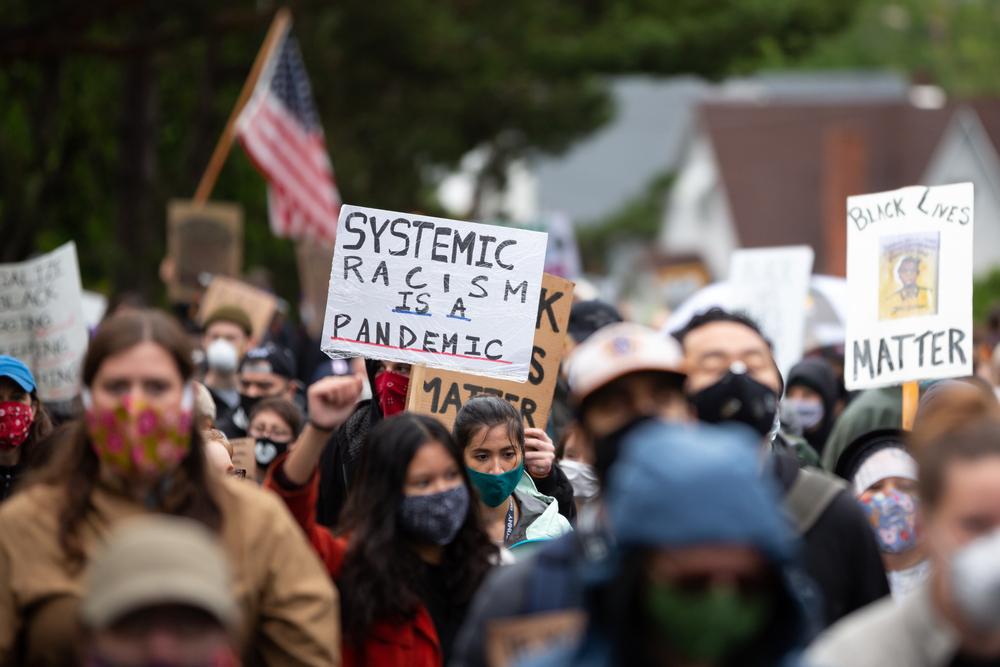
Even in this time when people presume to be having a “racial reckoning,” signs of enduring racial inequity pop up everywhere. From nagging disparities in health—Black, Indigenous and People of Color (BIPOC) die at higher rates than other groups from COVID-19 and are underrepresented in medical research (except in vile experiments such as in the Tuskegee study) … to the steep declines in Black and Latino students submitting the Free Application for Federal Student Aid (FAFSA) … to Black food service workers experiencing disproportionate short-tipping for enforcing social distancing rules … inequality reigns. These persistent forces should be a big deal for New England’s Historically White Colleges and Universities, which are rarely called out as HWCUs. Executive Editor John O. Harney reports on the racial equity conversation monitored mostly by Zoom since the pandemic began.
|
|
|
More from The New England Journal of Higher Education
|
|
|
We know that students who use "open textbooks" instead of commercial textbooks save money, and that adopting so-called OER (open educational resources) can enhance equity and pedagogy. But what incentives are there for faculty and others to create such "open" scholarly products? In this latest installment of NEJHE's OER Practitioner Perspectives series, Andrew McKinney, OER coordinator at the City University of New York (CUNY), and Amanda Coolidge, director of Open Education at BCcampus in British Columbia, Canada, explore the role of open educational resources activity in the tenure and promotion process. They explain how a collaborative of public higher education systems called Driving OER Sustainability for Student Success (DOERS3) has convened OER professionals to brainstorm some possible solutions to this tenure and promotion challenge. One product is an OER Contributions Matrix. Its goal: to empower faculty, staff and administrators to make OER initiatives more sustainable and ingrained in the cultures of their institutions.
|
|
|
Tracking Coronavirus: A Deep Dive |
|
|
This semester, NEBHE is deep-diving on topics related to New England institutions' response to COVID-19 (see our updated COVID-19 response page here). We will publish periodic briefs on topics including: plans for spring 2021, federal actions that affect higher education, vaccination distribution, mental health and planning for fall 2021. Interested in a topic we haven't covered? Reach out to Charlotte Peyser at cpeyser@nebhe.org.
|
|
|
COVID-19 had a significant impact throughout the U.S. Enrollment at higher education institutions (HEIs) declined by 2.5% overall, nearly twice the rate of decline reported in fall 2019, according to the National Student Clearinghouse. Freshman enrollment overall decreased an unprecedented 13%. Public colleges and universities saw a 4% decrease from fall 2019 enrollment, and community colleges saw a 10% decrease. Although the majority of New England public colleges and universities saw overall enrollment decreases in fall 2020, 40% of them saw increases in the number of students enrolled through NEBHE's Tuition Break. Total enrollment through Tuition Break increased about 1% at the four-year institutions and decreased nearly 12% at the community colleges.
|
|
|
Passed on strict party lines, the $1.9 trillion relief measure provides $128.6 billion for the Elementary and Secondary School Emergency Relief Fund and $39.6 billion to the Higher Education Emergency Relief Fund. It also includes $39 billion for childcare and $1 billion for Head Start. The Senate confirmed Miguel Cardona as the 12th U.S. secretary of education, and DeVos-era tinkering with Title IX sexual assault rules to be reconsidered. Read the latest from NEJHE's DC Shuttle, featuring national news drawn from our friends at the New England Council.
|
|
|
As Americans grapple with one of the most severe recessions in history, there's new appreciation of the many different pathways to gainful employment. This month, Credential Engine released its third Counting Credentials report, which curated a list of 967,734 unique credentials available through U.S. secondary and postsecondary education institutions—an increase of 31% from the 738,428 credentials published in its 2019 report. |
|
|
budgeting, human resources, administration and IT.
The director will play a critical role in partnering with the senior leadership
team in strategic decision-making and operations as NEBHE continues to enhance its quality programming and build capacity. Qualified candidates may submit a cover letter and resume to gdavis@nebhe.org. |
|
|
NEBHE and CollegeSource are pleased to offer a transfer and retention webinar on March 19, 2021 from 12 noon to 1 p.m. Eastern.
To help improve transfer access for New England institutions, NEBHE and CollegeSource have formed a partnership to offer TES® the Transfer Evaluation System and Transferology® a discount on new subscriptions to new institutional users in the region.
- John Panzica, Facilitator, Product Solutions Specialist, CollegeSource
- Allison Misky, Registrar, Goodwin College
- Rebecca Siggelkoe, Coordinator of Enrollment and Articulation, Bunker Hill Community College
|
|
|
NEJHE NewsBlast is a summary of NEJHE content and other news around NEBHE prepared weekly by NEJHE Executive Editor John O. Harney and emailed every Wednesday to opinion leaders and practitioners. When responding to NEJHE content, please make sure that your remarks are relevant, courteous and engaging. Individuals are responsible for their comments, which do not represent the opinions of the New England Board of Higher Education. We urge commenters to briefly note their occupational or other interest in the topic at hand. Please refrain from offensive language, personal attacks and distasteful comments or they may be deleted. Comments may not appear immediately. Thank you for staying engaged.
|
|
NEJHE NewsBlast is sponsored by
|
|
For more information about partnering with NEBHE, click here
or send an email message to our events coordinator Marla Phippen.
|
|
© 2020 New England Board of Higher Education |
|
|
|
|
|
|
|