|
On a Saturday in February something beautiful happened in the Sanctuary. Twenty-five people from Olympia and beyond gathered around the topic of grief. They arrived that afternoon as strangers—tentative, nervous. By that evening, they were sharing a meal like old friends.
That is the strange magic of a community grief ritual. We gather around a topic most of us dread and we leave the gathering lighter, happier, and in deeper connection with ourselves, each other, and our world.
How do we get there? It’s the sort of thing that must be experienced to be understood. It’s difficult to convey the appeal of a grief ritual to someone who hasn’t experienced one. And the ingredients don’t quite capture the finished meal.
I could tell you how we sing together, how we share our stories in small groups. I could tell you how we support each other mainly by listening. How for many participants, this is their first experience of speaking their truth and being compassionately witnessed by a group of people.
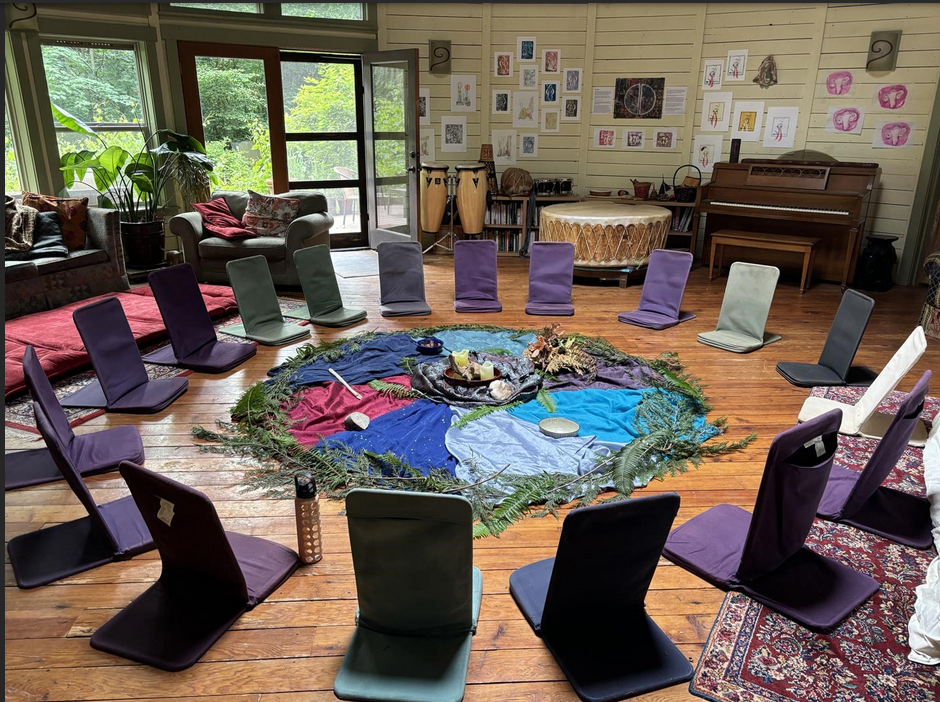
I could tell you how we build a grief altar and then gather as a group to express our grief. And I could tell you about the extraordinary and beautiful things that happen at grief rituals. I’ve seen people set down painful burdens that are decades old. I’ve seen one person’s pain become another person’s medicine—the solace of a shared grief, the opportunity to care for another.
And I can tell you what it feels like by the end. It feels like a village.
This is the essence of what a community grief ritual is about. It is about reminding us how to be a people. And the reminder comes through an old gate that we have forgotten in the modern world—the gate of shared grief. Malidoma and Sobonfu Somé, two revered teachers in this work, would often speak of grief ritual as a “technology of belonging,” or “community glue.”
Grieving together is also about bringing us back to a right relationship with grief.
The modern world is avoidant of grief, or worse (grief expert Francis Weller calls us “grief illiterate.”) And we have exiled grief to a far-off corner of our world, the realm of death and bereavement.
My indigenous teachers hold grief very differently. They frame it as an ever-present part of being alive:
“Grief is an obligation to the life one has been awarded, an obligation to life to make more life.”
Martín Prechtel, The Smell of Rain on Dust
And like life, grief will not be exiled or corralled. It exists in many more places than we acknowledge in the modern world. Francis Weller speaks to this with his Five Gates of Grief, only the first of which is directly tied to loss:
- Everything we love, we will lose
- The places that have not known love
- The sorrows of the world
- What we expected and did not receive
- Ancestral grief
Teachers in this work also link grief to many modern ills that bedevil us with their intransigence and mystify us as to their source. What if grief is at the heart of addiction, of depression and suicidality, of violence, abuse, and war, and of our degradation of the earth herself?
What do we do about all this?
We do what our ancestors have done since time immemorial. We do what traditional cultures around the world still do, including our tribal neighbors here in the Pacific Northwest. We do what our bodies know how to do, because it’s in our bones.
We grieve together.
“It is so healing to be in a safe space with others who want to grieve. Grieving creates space within me to feel more joy, and grieving in community gives me some sense of mending or healing all the brokenness that I feel from the losses.”
Participant, Olympia Community Grief Ritual, 2025
Upcoming Event
We are hosting one more grief ritual this spring. You are welcome to join us, no matter who you are, no matter your relationship to grief. Registration and more details can be found in the links below:
April Ritual
Saturday, April 18 at the Olympia Unitarian Universalist Congregation
What to expect: We will spend the better part of a day together, get to know one another, talk about our grief, and hold a grief ritual together. At the ritual people can participate however they wish. There are opportunities to grieve or support, all in a supportive group container, and with the aid of music, singing, poetry, and natural beauty. We finish with a shared meal.
You can help us conduct this work by joining us, or spreading the word about our events, or in a few other ways (see below).
The Alliance
We are working towards the creation of The Alliance for Common Ground, a non-profit to support these types of community resiliency events. Our vision is a transformed society in which we gather for healing, repair, and positive action. We will get there by remembering how to be together, through events like grief rituals and song circles.
The Olympia Community Grief Rituals are our first offering. We are doing something unusual, which is to offer these rituals by donation. We also ran a small grief ritual in a Washington State prison this month—another setting where this work is desperately needed and where we will need to find funding.
Once the non-profit is up and running, we will be able to finance these events through grants and other sources. At present, however, we are unable to adequately pay our facilitators, or provide food and childcare based on the donations we are collecting through our events.
Fortunately, we have our first sponsor in the Olympia Unitarian Universalist Congregation. Reverend Mary and the congregation have made these events possible through the generous donation of the church facility.
You can follow our progress through our newsletter.
How to help
We are actively seeking a fiscal sponsor, a non-profit that would help us apply for grants. If you know of an organization that might be interested, please let us know.
We also are seeking help in defraying facilitator costs, and in providing dinner, and childcare for our participants. We could also use volunteers to help us set-up and break-down these events.
We are also seeking housing for our facilitator team, some of whom are coming from two hours away to help us with these events. We are seeking accommodation for 4-5 people on April 18-19.
If you’d like to help in any way, please contact us.
|