Numbers, like those in polling and survey audiences, population samples, and research cohorts, are not inherently objective or neutral. They are a sample of real humans and the product of myriad factors. And just because big data is big does not mean that it, or algorithms that stem from large data sets, are representative or unbiased.
How do journalists fairly use numbers in reporting? What does it really mean for a sample to be representative? In what ways can reporters vet numbers quickly and reliably for potential bias?
Join the National Press Club Journalism Institute and the National Association of Science Writers for a program that will answer these questions and leave participants with new tactics to:
- Detect deep bias in numbers before they use them
- Surface hidden traps and avoid them
- Accurately represent the people and lives reflected in the data
|
|
Advice from Jill Geisler, Bill Plante Chair in Leadership & Media Integrity at Loyola University Chicago and Freedom Forum Fellow in Women’s Leadership
Managers often struggle with difficult conversations. They put off talking about performance issues because they don’t feel fully prepared, don’t believe it will make things better, or just don’t like confrontation.
We’re not helping people when we keep our concerns to ourselves; we’re denying people a chance to learn and grow. It doesn’t mean they’ll accept our negative feedback unquestioningly, in fact, they may be defensive and unhappy. It happens. That’s why it’s important to be prepared to provide objective data — examples, specifics — not to beat people up with “gotchas” but to offer measurable things they can change.
But even with that goal, of being clear and specific in negative feedback, you need to bring a few more goals into each tough conversation.
-
Respect the human dignity of the person you’re talking with. This isn’t about punishing people. Avoid sarcasm, hyperbole, and condescension. (Even if you are firing a person for wrongdoing, the termination needn’t be delivered with a side order of humiliation.)
-
Resist the temptation to win a debate. If you are someone who loves to get the last word, you may try to slap down the other person’s responses rather than listen to them. People are often defensive when criticized. The person whom you’re talking to about late arrivals to meetings may respond by telling you the meetings run too long and achieve too little. Don’t start a verbal war over that point. Go back to your original message, “We need you there on time AND we can review our meeting process to see if we can improve it.”
-
Don’t expect rainbows to appear at the end of tough talks. Some people may thank you for pointing out a gap in their performance or sharing the news that they didn’t get the promotion they wanted. But don’t count on it. People need time to process negative information. If you’re a person who wants to be liked, prepare for people who are unhappy to act that way toward you in the moment. But today’s tough conversation can lead to many more better ones, if you do them right. Plan for a follow-up, which is something managers can let fall through the cracks and shouldn’t, because it is where the real growth begins.
-
Think of tough conversations as part of a continuum of feedback. Be sure you are giving a healthy diet of the positive stuff, so people know you are as apt to cheer their accomplishments as you are to tell them when they’re getting in their own way.
Keep in mind that we tend to remember negative feedback more than positive, because criticism touches some sensitive nerves. If I ask you to tell me about a criticism that still stays with you, I can bet you’ll be able to roll one out with ease. Our emotions cause memories of critiques to be more vivid. By comparison, hearing “Hey, nice job today” doesn’t have that longer-lasting impact.
So, build your social capital by providing specific and sincere positive feedback whenever possible. Enlist colleagues in making sure you, as a busy manager, don’t miss knowing about something praiseworthy. When people know you are as willing to acknowledge what works as well as what needs work, they may not love being on the receiving end of your corrective conversations, but it will make them at least a little less tough for all parties.
|
|
|
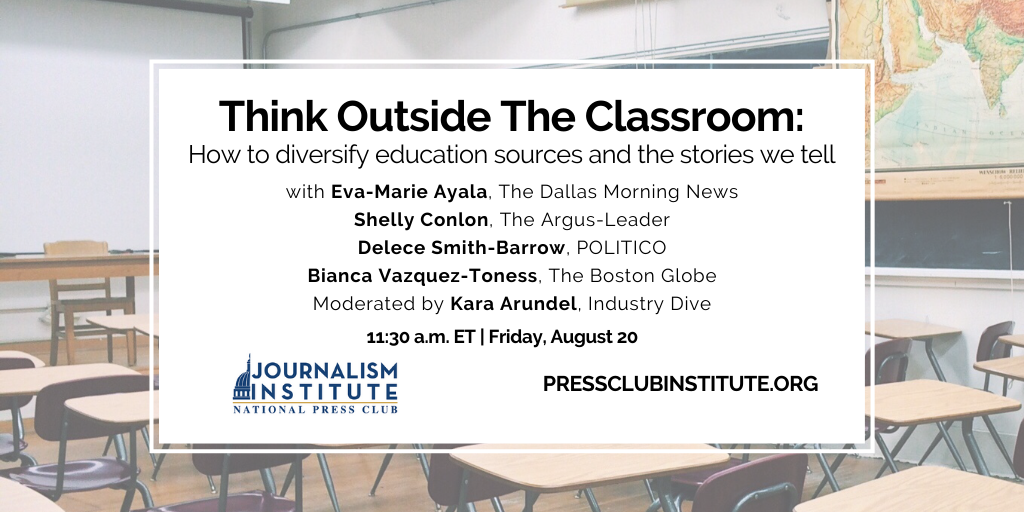
Education reporters have witnessed and documented the pandemic’s enormous effects on students, parents, teachers, administrators, and their communities. With so many voices – and quickly changing policies going into the next academic year – how can an education reporter lift the voices of those most impacted?
In “Think Outside The Classroom: How to diversify education sources and the stories we tell,” a distinguished panel of veteran education reporters and editors will share their techniques for finding and shaping stories driven by the voices of those underrepresented in education coverage, including families of color, students with disabilities, rural residents, families experiencing homelessness, and others facing circumstances that impact their learning.
Registration is open for this virtual discussion, which will take place from 11:30 a.m. to 12:30 p.m. ET on Friday, Aug. 20, 2021.
Participants will learn how to:
- Move from authority-driven sourcing and framing to community-driven sourcing and framing
- Avoid tokenism and stereotypes: Listen for and represent the truth between the extremes of success and despair in underrepresented communities
- Cover dailies and in-depth stories with sensitivity, respect, and completeness
The Institute is offering this program at no cost thanks to a generous grant from the Gannett Foundation.
|
|
This newsletter is written & edited by the National Press Club Journalism Institute staff: Beth Francesco, Holly Butcher Grant and Julie Moos. Send us your questions and suggestions for topics to cover.
|
|
|
|
|
|
|