Weekly Digest Number 31, August 2nd 2022 |
|
Welcome to the RWU Rail & Labor News! This news bulletin is produced and emailed out each Tuesday morning. We hope you find each week's news and information useful. If so, please share with co-workers, friends, and colleagues. If you like, you can sign them up to get all the news from RWU HERE. Or forward them the link. Note: If you read over this news bulletin each week, you will be sure to never miss the important news of what is going on in the railroad world from a worker's perspective!
|
|
(Editor's Note: Thanks to Brother Michael Lindsey and More Perfect Union for collaborating to make this excellent video!)
|
|
U.S. Railroad Workers Could Strike & Shut Down The Economy |
|
Hugely profitable railroad companies are putting the entire American economy in jeopardy. The railroads refuse to negotiate a fair contract with workers who are on call 24/7 & haven’t gotten a raise in 3 years. 115,000 railroad workers could be forced to strike in September. |
|
(Editor's Note: The carriers first proposed running trains with less than a 2-person crew on November 1, 2004. We have stopped them at most every turn. This FRA announcement represents a step forward in our movement to stop the rail carriers, but do not think for a moment that the war is over. All rail workers must step up and comment - see Special Bulletin link below - and be ever ready for the next battle. The carriers will never give up. And we will never give up our efforts to stop them.) |
|
FRA Issues Proposed Rule to Enhance Train Safety, Codify Train Crew Size Requirements |
|
WASHINGTON – To enhance safety, the U.S. Department of Transportation’s Federal Railroad Administration (FRA) today announced a proposed rule requiring a minimum of two train crewmembers for over-the-road railroad operations, with some exceptions for certain low risk operations and circumstances where mitigating measures are in place to protect railroad employees, the public, and the environment.
“For the past few years, our rail workers have worked hard to keep people and goods moving on our nation’s railroads, despite a global pandemic and supply chain challenges,” said U.S. Transportation Secretary Pete Buttigieg. “This proposed rule will improve safety for America’s rail passengers—and rail workers—across the country.”
This proposal would also enhance safety nationwide by replacing the existing patchwork of State laws regarding crew size with a uniform national standard. Without consistent guidelines, railroads may be subjected to disparate requirements in every State in which they operate, resulting in potential safety risks, operational inefficiencies, and significant costs. The NPRM also proposes requirements for the location of crewmembers on a moving train, and would prohibit the operation of some trains with fewer than two crewmembers from transporting large amounts of certain hazardous materials. The risk assessment and annual oversight requirements in the NPRM are intended to ensure that railroads fully consider and address all relevant safety factors associated with using less than two person crews.
|
|
(Editor's Note: Given how far apart the two sides are on the issues, it is hard to imagine a PEB that could satisfy both NCCC and United Rail Unions. Whatever the recommendation of PEB #250, you can bet there will be enormous pressure for railroad workers to vote for it. RWU encourages rails to read any proposal thoroughly and carefully. Then vote YES if you like it and NO if you do not. Let your conscience be your guide. ) |
|
Labor, Railroads Far Apart on Contract Proposals Presented to Presidential Emergency Board |
|
WASHINGTON — A significant gulf between the two sides on pay and medical benefits defines proposals presented by rail labor unions and railroads as the Presidential Emergency Board addressing the contract dispute begins its work.
The board began a week of hearings on Sunday afternoon. The three-person board was appointed by President Joe Biden earlier this month [see “Biden names members of emergency board …,” Trains News Wire, July 18, 2022].
Unions are seeking a contract which would include a 31.2% wage increase, when compounded, over the five-year life of a new contract that would be retroactive to Jan. 1, 2020. Railroads want a deal with a 17% compounded increase over the same term, according to the United Rail Unions, part of the coalition representing labor groups in the bargaining. The railroads offer includes annual increases of 2% or 3%, except for a 6% increase in 2022, while the unions’ proposal includes increases of 6% in 2020 and 2021, 8% in 2022, and 4% in each of the final two years.
The unions are also seeking the status quo in employee healthcare costs — with a monthly cost of $228.89 — with increases in autism and hearing benefits. The railroads’ proposal would increase monthly costs to an estimated $321, with significant increases in deductibles, coinsurance, and out-of-pocket maximums for individuals and families.
The union proposal also includes 15 days of paid sick leave and three new holidays— Veteran’s Day, Martin Luther King Jr. Day, and Juneteenth — while the railroads’ plan includes one additional paid day off “in a manner to be determined by each individual carrier and labor organization.”
|
|
(Editor's Note: The author does a good job summarizing the essentials. RWU Organizer Ron Kaminkow and UP engineer Michael Lindsey are quoted extensively.) |
|
U.S. Railroad Workers Inch Closer to a Possible National Strike
After Biden appointed an emergency board to help resolve the labor dispute, rail workers warn: “We have the ability to stop the trains from moving.”
|
|
After waiting over two years to secure a new union contract, and still reeling from the impacts of Wall Street-ordered cost-cutting measures, 115,000 beleaguered workers who operate the nation’s freight railroads are inching closer towards a possible strike, which could come as soon as September.
In an effort to drive down operating expenses and reward their wealthy shareholders, in recent years railroad companies have implemented “precision scheduled railroading,” or PSR — a version of just-in-time, lean production that centers on reducing the workforce and closing facilities.
“For years, they cut and cut and cut. It didn’t matter which department or terminal, it was indiscriminate,” said Michael Paul Lindsey, an Idaho-based locomotive engineer with Union Pacific.
Over the past six years, the major Class I railroads like BNSF, Union Pacific, CSX and Norfolk Southern have slashed their collective workforce by 29 percent (around 45,000 workers), leaving the industry woefully understaffed and putting extra strain on workers already accustomed to long, irregular hours.
Lindsey said the severe staffing shortages have resulted in “constant chaos and crisis,” with workers being called at all hours, day and night, expected to take on assignments they were not initially scheduled for.
Cost-cutting has also meant freight trains are running with more cars and more cargo than existing infrastructure is equipped to handle, or else misrouting rail cars just to get them moving. This cost-cutting, along with a labor shortage, have been major contributors to the supply-chain crisis.
Meanwhile, the railroad companies remain highly profitable, with owners raking in $183 billion in stock buybacks and dividends since 2010.
|
|
(Editor's Note: Longshore workers are a key link in the supply chain. The West Coast longshore union (ILWU) has its own fight brewing with the West Coast Maritime Association. This presents a golden opportunity for railroad unions to announce their mutual support for these workers. Together, railroad workers and longshore workers would be a force to be reckoned with!) |
|
West Coast Longshore Union Announces Solidarity with Railroad Workers |
|
In July, the International Longshore & Wharehouse Union (ILWU) Coast Longshore Division issued a statement of solidarity and support for railroad workers. The union proclaimed its support for railroaders "right to bring home a decent wage and benefits to their families, and calls upon the employers to reach a fair agreement without further delay."
Railroad Workers United has worked closely with member of the ILWU for a number of years now, and has Solidarity Members among the ranks in key ports like LA-Long Beach, Portland, Vancouver and Seattle. Members have attended rail safety conferences we have sponsored and RWU members have assisted ILWU members in their struggles. Both dock workers and rail workers understand the need to organize along the supply chain in order to achieve the power to win better contracts.
|
|
(Editor's Note: It is great to see "industry insiders" such as the author of the piece below sounding the alarm and making it very clear that yes, a strike is quite possible, maybe even likely. And that perhaps it could drag on longer than we might expect due to Congressional ineptitude and political wrangling. That's right, better not provoke a strike. To avoid it is quite simple. Meet the unions' modest demands!) |
|
Grasping at Straws to Avoid a Shutdown |
|
In a prior era, railroad management sometimes attempted to keep trains operating at a low level using management employees and “replacement workers” (affectionately known as scabs.) However, modern regulatory requirements and liability concerns have basically eliminated this option. The rail system could grind to a complete halt in the midst of an economy already plagued by difficult supply chain issues.
The usual way to resolve such a crisis is for Congress to pass a law imposing contractual terms on railroad management and labor. But passing such legislation requires civility, collaboration and cooperation. These are in short supply on Capitol Hill.
To be more specific, Congress has numerous internal rules that keep proceedings moving at a slow but steady pace. During past shutdowns, these rules were waived by “Unanimous Consent,” allowing settlement legislation to move at lightning speed. This may be impossible in the current political environment. A few rogues on either side could derail the process.
If Congress fails to enact a settlement, can the other branches of government step in? Not really.
While a federal judge might be able to enjoin a certain rowdy picket line or specific incidents of management overreach, the courts have no overarching legal authority to impose a settlement. A federal judge cannot force the unions back to work or require management to unlock their gates.
With the other branches of government paralyzed, the Executive Branch will be tempted to step in. Does the President have the unilateral power to reopen the rail system? No, but he might still consider a number of things:
1. Seize the U.S. rail system. Unfortunately for advocates of rail nationalization, no statute gives the president this authority. Woodrow Wilson took control of the railroads in World War I, but Congress had granted this authority in the 1917 Army Appropriations Act. That statute is long gone. As the Supreme Court told Harry Truman when he tried to nationalize the steel plants via an Executive Order, “The President’s power, if any, to issue the order must stem either from an act of Congress or from the Constitution itself. There is no statute that expressly authorizes the President to take possession of property as he did here.” See Youngstown Sheet & Tube Co. v. Sawyer, 343 U.S. 579 (1952)
2. “Fill the Gaps” in the current RLA.
|
|
(Editor's Note: There new rules are in response to a series of runaway train wrecks in Canada in the past decade. Safe train securement rules have all to often been lacking. Let's hope the new rules make Canadian railroading safer for workers and trackside communities.) |
|
Minister of Transport Announces New Measures to Improve Rail Safety |
|
Transport Canada’s top priority in the rail sector is the safety of Canadians and their communities. That is why we are putting in place additional measures to protect all Canadians who live and work along rail lines and reduce the risk of serious accidents.
Today, the Minister of Transport, the Honourable Omar Alghabra, announced that the Government of Canada is taking new actions to improve rail safety, in alignment with the Transportation Safety Board of Canada’s recommendations regarding the derailment in Field, British Columbia, in 2019.
On July 25, a new Ministerial Order will come into effect and will require railway companies to propose revisions to rules for the Minister’s approval. The revisions to be proposed will enhance regular pre-departure inspections and periodic maintenance of air brakes on trains and address the elevated risks of operating trains in cold temperatures. In addition, the order requires rail companies to develop a winter operating plan for their equipment. That plan would specify actions to be taken when temperatures are very cold, including implementing speed restrictions and performing enhanced inspections. This will address the Transportation Safety Board of Canada’s recommendation to enhance inspection and maintenance requirements for brakes on steep grades in cold weather.
|
|
(Editor's Note: Predictably, the rail industry is complaining that "the sky is falling" in the face of the FRA's announcement of Proposed Rule Making on Minimum train crew size (see article #2 above). Despite first pushing for single person crews in 2004, the railroad industry has yet to achieve this type of operation. Nevertheless, they have achieved record profits up to this day (see article below). And hey, what would the rail industry know about "sound safety policy" anyway? They have opposed each and every safety proposal - from universal application of the Janney coupler to the air brake; from the EOT, to switch point indicators and PTC.) |
|
FRA Issues Crew Size NPRM; AAR Calls it ‘Politics Over Sound Safety Policy’ |
|
“This proposal would … enhance safety nationwide by replacing the existing patchwork of State laws regarding crew size with a uniform national standard,” FRA said. “Without consistent guidelines, railroads may be subjected to disparate requirements in every State in which they operate, resulting in potential safety risks, operational inefficiencies, and significant costs. The NPRM also proposes requirements for the location of crewmembers on a moving train, and would prohibit the operation of some trains with fewer than two crewmembers from transporting large amounts of certain hazardous materials. The risk assessment and annual oversight requirements in the NPRM are intended to ensure that railroads fully consider and address all relevant safety factors associated with using less than two person crews.”
“We are committed to data-driven decision making,” said FRA Administrator Amit Bose. “In cases where railroads wish to operate with fewer than two crewmembers, we are proposing that they perform a rigorous, thorough, and transparent risk assessment and hazard analysis, and FRA will provide an opportunity for public comment on these submissions.”
|
|
AFL-CIO Says Support Freight Rail Workers: Sign the Petition |
|
Freight rail workers are a vital part of our supply chain, responsible for moving billions of dollars worth of consumer goods and cargo.
While seven rail companies have made $146 billion in profit since 2015, how are the rail workers, who actually make sure we get the supplies we need, faring?
Some 45,000 of their jobs were cut.
Workers have been fighting for a fair contract for nearly three years. Earlier this month, President Biden stepped in and appointed an emergency board to mediate. It’ll make recommendations in mid-August, and we need to be ready.
The labor movement must rally behind these workers who transport the supplies we need to live and work. If you’re a person who supports fairness and dignity for our rail workers, add your name in support.
|
|
.(Editor's Note: There is something disgusting about a group of Fortune 500 corporations making a lot of money while their employees are miserable, their customers are disgruntled, their tenants - Amtrak and commuter services - are abused, and the nation as a whole is paying the price for the mess they have made. We cannot let this continue.) |
|
Despite the Mess the Class Ones Have Made of the Rail Industry, Second Quarter Profits Roll In |
|
Despite the fact that the railroad has provided rotten service to just about everyone this past year or so; despite alienating its workforce, the unions, passengers and Amtrak; despite increased dwell time, decreasing average train speed, railcar shortages, and all the rest, the rail industry Class One's have done it again, making big profits on less volume. So despite their claims to be working diligently to correct the problems, one simply has to question their sincerity. |
|
(Editor's Note: Once again, we urge all North American rail workers to keep your eyes on the UK where a knock-down-drag-out fight is occurring with the rail unions there. Initiated by the RMT, now the drivers (engineers) union ASLEF is jumping into the fray. It looks like the strike may just spread to other disaffected workers in other industries and sectors, as calls for a General Strike begin to reverberate. Could such a movement of labor - led by rail workers - take place in the U.S.? Canada? Mexico?) |
|
Unions Issue Threat of UK General Strike as Rail Crisis Grows |
|
Unions warned the UK could face a general strike this year as rail workers voted for fresh action set to intensify a summer of industrial unrest.
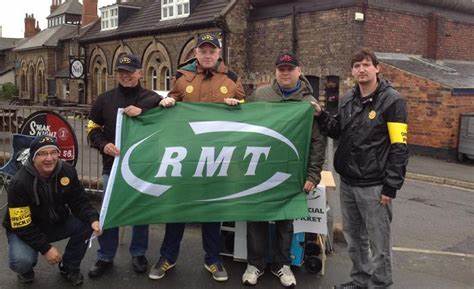
The vote for further transport strikes came as Keir Starmer sacked shadow transport minister Sam Tarry who conducted broadcast interviews alongside striking RMT workers at Euston station – a move that is likely to increase divisions between Labour and trade unions.
Other shadow ministers are expected to escape serious sanction but Tarry was told by Labour whips he had broken collective responsibility by making statements about pay and inflation that are not party policy.
Senior shadow ministers have expressed private concern at Starmer’s policy not to allow frontbenchers to join picket lines – saying it could become unsustainable with unprecedented levels of industrial action in the offing.
As much of Britain’s rail network ground to a halt, the Rail, Maritime and Transport (RMT) union chief, Mick Lynch, called for a general strike in retaliation to ministers’ threats to curb industrial action, warning of “the biggest resistance mounted by the entire trade union movement”.
|
|
(Editor's Note: Even folks like the author of this piece - the editor of a rail industry magazine - are speaking out. David Lester boldly proclaims that 50 years after the railroad service meltdown of the 1970s, things improved, only for rail freight service today to deteriorate to the point where it has now "returned to the toilet.") |
|
Opinion: We’ve Come Full Circle
|
|
During the 1970s, the railroad industry as a whole was struggling. Some thought nationalization was imminent, and rail service was generally in the toilet.
Fifty years later, after Staggers, huge mergers, massive technology and physical plant investments, big new or remodeled headquarters buildings, strong financial performance, and PSR, rail service has returned to the toilet. Recognition of this by shippers and the federal government resulted in Surface Transportation Board hearings on April 26-27, entitled “STB Hearing on Urgent Issues in Freight Rail Service.” Regulators, shippers, and railroads gathered for these two days to listen to shippers tell horror stories about how poor rail service had cost them millions of dollars.
Hearing transcripts and videos are available on the web, but my colleague Frank Wilner, Railway Age’s man in Washington, offered some highlights in a recent piece on the hearing: “The American Farm Bureau Federation reported unfilled grain car orders up 47%. The Fertilizer Institute said a railroad told customers to ‘curtail’ shipments, menacing maximum crop yields owing to a short window for fertilizer application. Ranchers said they are ‘depopulating’ (killing?) herds owing to feed shortages. Increases in dwell time (cars not moving), said a witness, elevates storage fees even when the customer has ‘no control’ over the delay. A municipality said its water supply system is dangerously short of chlorine. A shipper said a car destined for Galesburg, Ill., was detoured to Nashville to alleviate carrier congestion, arriving in Galesburg 33 days late.” What a mess...
|
|
|
|
|
|
|