February/March 2024
“The present moment is the only moment you have any power over.” Eckhart Tolle
As we make our way into 2024, we are still reflecting on the other side of COVID and all its ramifications, especially its impact on the mental health of our students, families, and educators. More than ever, self-care is essential! Some quick tips: take a 30 second breathing break, go for a short walk, read some positive quotes, or look at pictures of people who make you happy.
In this newsletter, we highlight awareness weeks and topics that are impacting our students and communities including School-Based Health Centers, school fitness and wellness initiatives, and Black History Month. And don’t miss our extensive list of upcoming professional development opportunities.
We wish you a year filled with new inspiration and fascinating learning!
The ESC of NEO Student Wellness Department
| |
Student Health and the Whole Child | |
|
Katie Davis Bellamy, MSN, RN, PHNA-BC | Executive Director, Community & Corporate Health, MetroHealth System
Dr. Lisa Ramirez, PhD, ABPP | Child Psychologist, MetroHealth System; Associate Professor, CWRU School of Medicine
| |
|
Across the state of Ohio, educators rely on the Whole Child, a framework that underscores children’s need to be healthy, safe, engaged, supported and challenged. And critical to these needs, is a coordinated effort from schools, health systems, mental health partners, and communities. Now consider this:
“Health and success in school are interrelated. Schools cannot achieve their primary mission of education if students and staff are not healthy and fit physically, mentally, and socially.”
—National Association of State Boards of Education
This sentiment captured in this quote is one of the guiding principles behind a steady increase in the establishment and use of school-based health clinics. School health clinics provide an opportunity to provide comprehensive, and often integrated, physical and behavioral health care to students, and in some cases school staff and student family members. One major opportunity for school health clinics to benefit educators and students is around attendance. A recent publication in the journal Pediatrics highlighted that “Chronic school absenteeism, starting as early as preschool and kindergarten, puts students at risk for poor school performance and school dropout, which in turn, put them at risk for unhealthy behaviors as adolescents and young adults as well as poor long-term health outcomes.” Consistent health care services, such as childhood vaccinations and well child checks can keep students healthy and prevent long-term health problems. Chronic health conditions, such as asthma, diabetes and mental health challenges are all leading causes of high rates of absenteeism. When the school and health clinic work collaboratively, many schools also report an increase in family engagement and student achievement!
But don’t just take our word for it, check out this family’s perspective on School-Based Health Centers, and join us February 12th at the ESC to learn more about the history, current trends and various models of school health centers across Ohio.
Register for professional development HERE.
| |
|
CLICK HERE for resources:
- National School Counseling Week
- Black Lives Matter at School Week of Action
- Random Acts of Kindness Week
- Black History Month
| |
|
CLICK HERE for resources:
- Gender Equality Month
- Self-Injury Awareness Month
- School Social Work Week
- Say Something Week
| |
|
CLICK HERE for resources:
- Local Resources
- National Resources
| |
Using the Modified Tiered Fidelity Inventory Walkthrough Tool to Enhance Cultural Responsiveness
Are you conducting a Tiered Fidelity Inventory (TFI) this year?
Are you applying for PBIS recognition?
Do you want to hear directly from students on how PBIS connects to their life outside of school?
If you answered "yes" to one or more of these questions, keep reading to learn about the Modified Tiered Fidelity Inventory (TFI) Walkthrough Tool from the PBIS Cultural Responsiveness Field Guide: Resources for Trainers and Coaches.
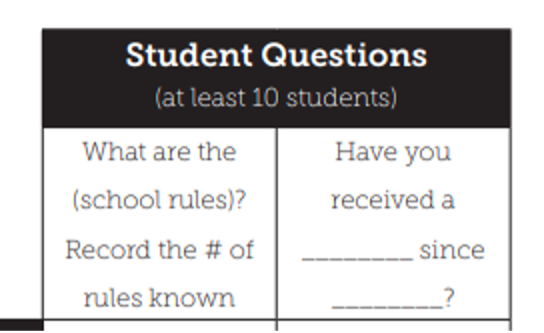
This important tool is used in conjunction with the Tier I section of the Tiered Fidelity Inventory (TFI) to collect data on the acknowledgement system and school-wide expectations. The student questions on the original walkthrough tool can be seen below:
| | |
|  |
|
Acknowledgement/Reward
for demonstrating
positive behavior
| |
|
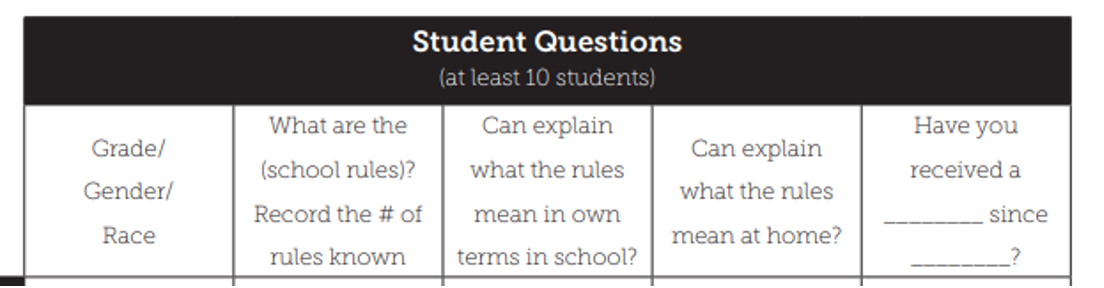
In contrast, the Walkthrough Tool from the Cultural Responsiveness Field Guide includes the following open-ended questions:
- What do the school-wide expectations mean in school?
- What do the school-wide expectations mean at home?
It also asks the interviewer to record the student’s grade, race and gender.
|  | |
This additional information provides the Tier I PBIS team with important data that can provide insight into how the perceptions of varying groups of students may differ. For example, when developing school-wide expectations, it’s important that teams avoid rules that are linked to the dominant culture and that they not assume all students have common experiences. Answers provided to these questions during the walkthrough may indicate a need for changes or modifications that are consistent with the cultures represented in the building.
Recommendations for Use:
-
Use the Modified TFI Walkthrough Tool (Appendix K, page 60) to interview a random selection of staff (at least 10% of staff or at least 5 for smaller schools) and students (minimum of 10).
- Randomly select staff and students that are demographically representative of the school’s population as you walk through the school.
-
Use the Modified School-wide PBIS Tiered Fidelity Inventory Walkthrough Tool Interview and Observation Form (Appendix K, page 61 - 62) to record staff and student responses.
- This process should take no more than 15 minutes.
- Use the results to complete the TFI: Tier I subscale.
It is recommended that this tool be completed by an individual who is external to the school (e.g., external coach, coordinator, evaluator). Please contact Nyeshja Malone (nyeshja.malone@escneo.org) with questions.
|  | Click here for more information. | |
Kirtland Champions Fitness for School Success
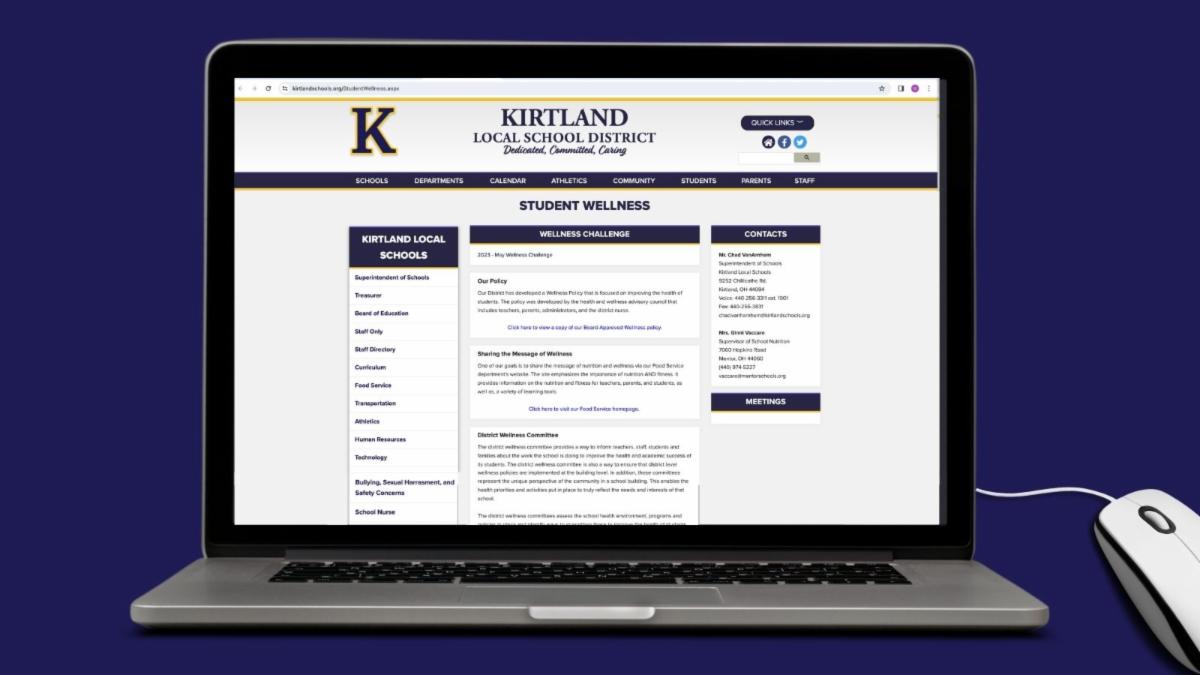
At a time when many districts responded to academic challenges by reducing recess time, PE, Health, or Family and Consumer Science classes, Kirtland Local Schools did what seemed counterintuitive; they increased their focus on fitness, wellness, and nutrition districtwide.
According to the superintendent, Chad VanArnhem, test scores at all levels, including SAT scores, are at their highest ever.
| |
|
|
Kirtland initiated fitness in schools with the establishment of “Just Run” clubs in 2014. Moreover. the current movement and wellness priority connects fitness, learning, and social emotional development.
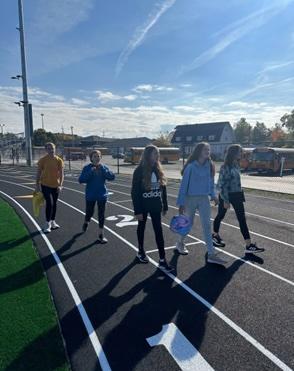
The emphasis on wellness begins early at Kirtland, with access to a fitness room at the elementary school. The converted classroom is used as part of the MTSS process, with all students visiting the fitness room at least once per week and some students with attention concerns incorporating physical activity at the start of each day. The room is part of a robust elementary initiative that includes student fitness challenges, yoga practice, and an “Action for Happiness” calendar. Additionally, classrooms participate in “Walking Wednesdays,” snow or shine, to connect with the outdoors.
The middle school is planning to open its first fitness room this year. They also provide a 9-week wellness class during advisory where the focus is on overall wellbeing, including such initiatives as “Reducing Your Screen Time” challenges and “Wellness Bingo.” Rec time is offered during lunch, and movement breaks are standard during block classes, too.
The high school continues the tradition by offering a wellness and nutrition class taught by a history teacher, who happens to be a CrossFit champion. Initiatives go beyond fitness, as the high school hosted a gratitude challenge as part of their wellness movement. They also get students involved, having one of the most active Sources of Strength programs in the area. Here, student leaders promote eight key life strengths, including healthy activity, mental and physical health to their peers.
Fitness and wellness have become part of the fabric of Kirtland Schools, and this year nutrition has been added to the district “Focus of the Month.” Activities include but are not limited to reading food labels, and “Try it Tuesdays,” where nutrition staff package bite size healthy foods for sampling and discussion.
Kirtland doesn’t leave out staff either. Teachers compete in student challenges, lead “Wellness Wednesday” walks, and join friendly staff and cross-building competitions. There is also a staff fitness room, and every staff professional development day begins with 30 minutes of a wellness or fitness activity. Kirtland also offers a related book study and in-district flu shots.
“We have always known that fitness and wellness make students more focused and ready to learn,” said Mr. VanArnhem. “We formalized simple principles and created opportunities (movement breaks, reflection time, breathing, and physical activity) so that everyone has the ability to participate.”
| |
ESC of Northeast Ohio and Partner Events
District Professional Development Days are approaching! Click here for virtual, free mental health training for your staff.
PBIS/MTSS
PBIS Tier II Interventions
Feb. 16, 2024
Strategies & Considerations: Responding to Challenging Behaviors -
Through a Trauma-Informed Lens
February 26, 2024
Integrating Culturally Responsive Practices Into a PBIS Program
March 14, 2023
PBIS Coaching Network
Mental Health
ADAMHS Board Winter Training Institute
February-March 2024
Mental Health Symposium
May 6th, 2024 - Registration coming soon
Mental Health Training for Coaches
Family Engagement
Family Engagement Academy - Hybrid
January 22, February 15, March 26, and May 14, 2024
How to Promote Inclusive Practices For Students with Disabilities
January 24, 2024
Whole Child
School Based Health Center
Feb. 12, 2024
Ohio Youth Led Programs - Ready to Explore
April 12, 2024
Threat Assessment / Abuse Prevention
CSTAG
February 12th, March 18th, and June 6th
CSTAG Level 3
April 8th and June 7th
SB288
February 5th, 2024 - 2 sessions
Trauma
Trauma-Informed Care and Trauma-Sensitive Interventions
February 12-13, 2024
Other
Student Wellness On-Demand Webinars
School Counselor & Social Worker Network
| | | | |