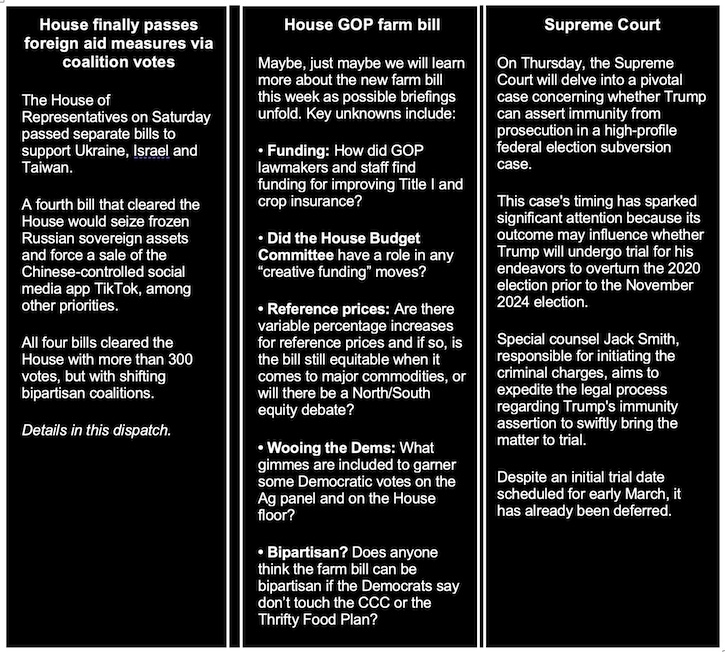

House Clears Series of Foreign Aid Measures; Senate to Act on Tuesday
Some House GOP farm bill details could surface this week
Washington Focus
The House has left for a weeklong recess. They will return on April 29. The Senate will convene Tuesday, April 23, to clear foreign aid legislation.
— House Democrats joined Republicans on Saturday to pass a $95.3 billion foreign aid package for Ukraine, Israel and the Indo-Pacific region. The measures now go to the Senate for a Tuesday vote. A fourth bill that cleared the House would seize frozen Russian sovereign assets and force a sale of the Chinese-controlled social media app TikTok, among other priorities.
— The House passed legislation aimed at banning TikTok in the U.S. unless its Chinese owner sells its stake within a year. The decision to include TikTok in a foreign aid package fast-tracked the ban, reflecting national security concerns. The modified bill now goes to the Senate, but even if it becomes law, legal challenges from TikTok are expected, potentially delaying or blocking the ban's implementation.
Details: The legislation, approved by the House in a 360-58 vote, would force China-based TikTok owner, ByteDance, to sell the app to a buyer that is not controlled by a foreign adversary, such as Russia, China or Iran, within 270 days (with an option for President Joe Biden to extend the timeline by 90 days if he sees progress toward a sale) or face a ban.
It’s unlikely TikTok, or the Chinese government, will agree to the terms — the company has criticized the proposal as a free speech violation and a blow to the economy and has spent $5 million on ads against the legislation since mid-March, according to the ad-tracking firm AdImpact, while the Chinese government has also expressed resistance to a forced sale and would need to approve the transaction.
The company has indicated it could challenge the legislation in court, with TikTok CEO Shou Zi Chew telling users in a video last month the company will “continue to do all we can, including exercising our legal rights, to protect this amazing platform that we have built with you.”
— Fourteen Republicans voted against all four bills on the House floor, including the one that would force a sale of TikTok from Chinese ownership. Here is the list in alphabetical order: Andy Biggs (Ariz.), Lauren Boebert (Colo.), Andrew Clyde (Ga.), Elijah Crane (Ariz.), Matt Gaetz (Fla.), Bob Good (Va.), Paul Gosar (Ariz.), Marjorie Taylor Greene (Ga.), Andy Harris (Md.), Thomas Massie (Ky.), Troy Nehls (Texas), Ralph Norman (S.C.), Matt Rosendale (Mont.), Chip Roy (Texas).
Another 17 GOP Members voted for arms for Israel but not for Taiwan and Ukraine.
— No further action on threatened motion to vacate speaker… for now. Rebel GOP Rep. Marjorie Taylor Greene (R-Ga.) — who had pledged to eject Johnson from the speakership if he advanced Ukraine aid — did not take action. She told reporters she hopes colleagues face backlash from constituents while they’re on recess this week and consider joining the effort to oust the speaker on their return to Washington. Most observers think that will not occur. When asked Saturday whether he believed he would still be speaker by November, Johnson simply said, “Yes.”
— Mexico’s presidential frontrunner wants to focus on U.S. trade ties. Claudia Sheinbaum, the frontrunner in Mexico's June presidential election, emphasized the importance of U.S. trade ties and hinted at encouraging companies to relocate operations to Mexico from China. This stance contrasts with the confrontational approach of her mentor, President Andrés Manuel López Obrador. She highlighted the significance of the U.S.-Mexico-Canada Agreement (USMCA) and the potential benefits of nearshoring for the Mexican economy. Despite the enthusiasm for nearshoring, Mexico's economic growth has been stagnant under López Obrador's administration, leading to criticism from opposition politicians and economists. The next president will face significant economic challenges, including revitalizing state-owned oil company Pemex, attracting foreign investment in the energy sector, and combating organized crime.
— The IRS collected nearly $5 trillion in taxes from Americans during the last fiscal year, alongside increasing the amount it paid out in refunds by almost 3%. Despite criticisms and concerns about funding boosts potentially leading to increased tax enforcement, the IRS emphasized its commitment not to raise audit rates for individuals earning less than $400,000 per year.
The significant tax intake was facilitated in part by a substantial funding increase, including $78 billion from the Inflation Reduction Act of 2022. This funding was utilized to employ more enforcers and implement advanced technologies like artificial intelligence to improve compliance and detect noncompliance more effectively. Although there were initial concerns from some Republicans that this funding would lead to aggressive enforcement tactics against ordinary taxpayers, the IRS asserted that its focus was primarily on high-wealth non-filers and those engaging in complex tax schemes.
The agency expanded its workforce by approximately 5%, hiring around 5,800 new employees, many of whom were assigned to compliance-related tasks. Despite the increased enforcement efforts, the IRS maintained that it adhered to its pledge of not increasing audits for taxpayers earning less than $400,000 annually.
Additionally, the IRS announced an increase in tax refunds by 2.7% ompared to the previous fiscal year, totaling $659 million. This was attributed partly to the effects of the Inflation Reduction Act funding, which allowed for the hiring of more IRS employees and the modernization of the agency's technology and systems.
Looking ahead, a report from the Treasury Inspector General for Tax Administration (TIGTA) revealed that the IRS plans to hire thousands more tax enforcers in 2024. However, it clarified that claims of an "army of 87,000" tax enforcers were unfounded, as the only armed enforcement personnel are special agents in the Criminal Investigation Division, who represent a minority of IRS enforcement staff.
— The Biden administration is gearing up to issue a significant executive order on immigration, intending to utilize Section 212 of the Immigration and Nationality Act. This move aims to establish new obstacles for asylum seekers who enter the country unlawfully. This strategy echoes a tactic employed by former President Donald Trump in 2018, where he issued a similar proclamation to restrict asylum claims. However, implementing this proclamation effectively may encounter legal challenges, as evidenced by Trump's experience when his attempt to block illegal border crossers from seeking asylum was ultimately rejected by the Supreme Court. This move by the Biden administration is another attempt to address a key vulnerability for the president, given that public opinion on his immigration policies and the situation at the southern border tends to be negative.
— NBC poll: RFK Jr.’s candidacy may hurt Trump more than Biden in 2024. The latest poll suggests that Robert F. Kennedy Jr.'s independent candidacy for the presidency might affect former President Donald Trump more than President Joe Biden in the 2024 election. In a hypothetical one-on-one matchup, Trump narrowly leads Biden 46% to 44%. However, when Kennedy is included, Biden edges out Trump 39% to 37%, with Kennedy polling at 13%. Other candidates like Jill Stein and Cornel West also receive minor percentages.
While some previous polls have shown different results, this poll reflects a tightening race between Trump and Biden. Trump's lead over Biden nationally has decreased to just 0.4 percentage points, according to RealClearPolitics. However, when Kennedy, Stein, and West are factored into the equation, Trump's lead increases to 1.3 percentage points.
For Kennedy to qualify for the debate stage, he needs to reach 15% in select polling. The poll reveals that 15% of those who switched their support to Kennedy had initially favored Trump, while only 7% had favored Biden.
Kennedy garners more positive views from Republicans (40%) compared to Democrats (16%), with Democrats expressing more negative views (53%).
Both the Trump and Biden campaigns are concerned about Kennedy potentially acting as a spoiler in the election. Notably, some members of the Kennedy family have endorsed Biden's reelection bid, cautioning against voting for their relative.
The NBC poll surveyed 1,000 registered voters from April 12 to 16, with a margin of error of plus or minus 3.1 percentage points.
Of note: Kennedy Jr. will appear on the ballot in at least two states, Utah and Michigan — a swing state where a victory for Biden will be crucial to his chances of winning re-election. Independent candidates not affiliated with a major political party are required to petition for ballot access. His campaign and its backers have also said they’ve collected enough signatures for him to appear on the ballot in Nevada, North Carolina, Arizona and Georgia, though the states have yet to verify the petitions.
Hearings and Other Events of Note
Monday, April 22
Tuesday, April 23
Wednesday, April 24
Thursday, April 25
Friday, April 26
Economic Reports and Events
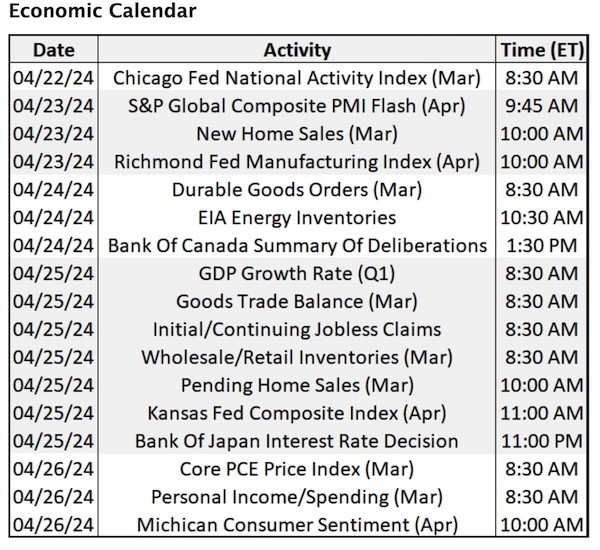
Focus will be on the latest U.S. personal income and outlays report, due Friday. The data will also contain readings on the Federal Reserve's preferred inflation gauge — the personal consumption expenditures price index (it tends to show weaker inflation than the CPI). Also, Thursday will see the publication of the first estimate of U.S. GDP growth in Q1.
Federal Reserve policymakers will not be commenting on monetary policy this week since it falls within the communications blackout period that surrounds the April 30-May 1 FOMC meeting.
Monday, April 22
Tuesday, April 23
Wednesday, April 24
Thursday, April 25
Friday, April 26
Key USDA & international Ag & Energy Reports and Events
USDA on Thursday issues its latest food price outlook while London will host a commodity trading event during the week.
In the energy sector, major energy companies including Chevron, Exxon Mobil and TotalEnergies will report first quarter results during the week. The World Energy Congress will start in Rotterdam on Monday.
Monday, April 22
Ag reports and events:
Energy reports and events:
Tuesday, April 23
Ag reports and events:
Energy reports and events:
Wednesday, April 24
Ag reports and events:
Energy reports and events:
Thursday, April 25
Ag reports and events:
Energy reports and events:
Friday, April 26
Ag reports and events:
Energy reports and events:
|
KEY LINKS |
WASDE | Crop Production | USDA weekly reports | Crop Progress | Food prices | Farm income | Export Sales weekly | ERP dashboard | California phase-out of gas-powered vehicles | RFS | IRA: Biofuels | IRA: Ag | | Russia/Ukraine war, lessons learned | | SCOTUS on WOTUS | SCOTUS on Prop 12 pork | New farm bill primer | | Gov’t payments to farmers by program | Farmer working capital | USDA Ag Outlook Forum |