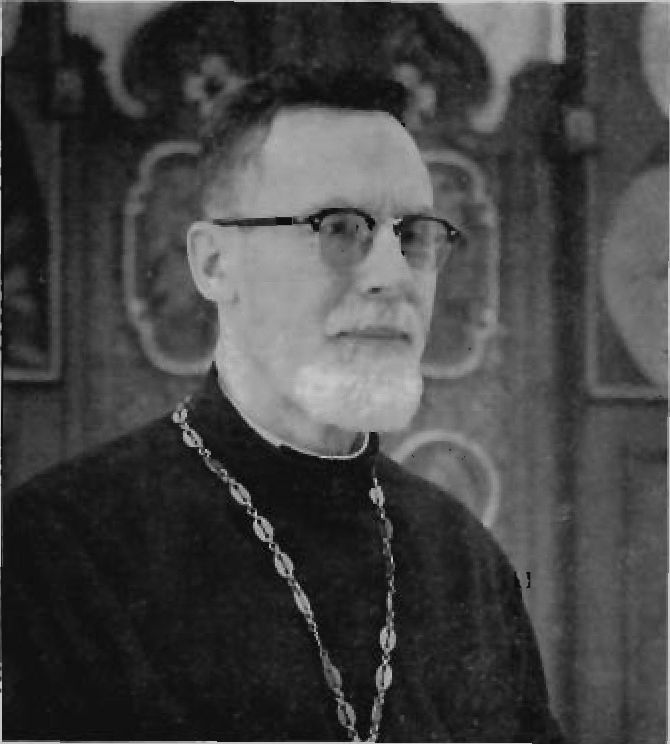
Remembering Father Paul Lutov (1900-1978)
Archpriest Paul T. Lutov was born 11/18/1900 in Mikhaylovsk in the northern Caucuses region of Russia to a family of Kuban Cossacks. He studied agricultural engineering at the University of Yekaterinodar. He fled Russia during the Bolshevik Revolution on a tortuous trek over the Ural Mountains to Turkey. He arrived deathly ill with TB and was forced to live on a quarantine barge on the Black Sea. When he regained his strength, he worked as an oarsman paid with fish, then walked to Prague to continue studies in agriculture as a teacher’s assistant at the Czech Polytechnic Institute. Next he joined the Russian Student Christian Movement in Paris, where he met his future wife and Matushka, Jeanne Olga Schrepffer.
Fr. Paul graduated with honors from St. Sergius Theological Academy in Paris and continued graduate work at the Sorbonne and then Oxford University on full scholarship. Upon return to Paris he was ordained to the deaconate at St. Alexander Nevsky Cathedral and lectured for four years at St. Sergius Orthodox Theological Institute. In 1938 he came with his wife and young daughter Natasha to the U.S. by invitation as a visiting professor of Old Testament at Howard University School of Divinity in Washington, D.C. Their son Paul was born three years later.
Father was ordained to the priesthood by Metropolitan Theophilus, and appointed pastor of the growing parish of St. Nicholas established in 1930, meeting in a townhouse in Northwest Washington. During his pastorate, a building fund was initiated; this resulted in the 1963 dedication of the Russian Orthodox Church of St. Nicholas, National War Memorial Shrine, on Massachusetts Avenue’s Embassy Row, later to become St. Nicholas Cathedral, primatial cathedral of the Orthodox Church in America (OCA).
Fr. Paul continued his academic studies and received a master’s degree in Semitic Philology from Catholic University. In 1947, while working on his doctorate, he left the country to go to Europe at the request of the Tolstoy Foundation to assist refugees displaced after WWII. He worked as an immigration and welfare officer and field worker for the World Council of Churches. Matushka Olga had stayed in D.C. with the children, running a boarding house to keep afloat. When Fr. Paul returned to D.C. in 1948, he requested a lesser position at St. Nicholas due to his health but remained an assistant pastor until his retirement in 1977. To help provide for his family, he worked at the Library of Congress as a senior researcher for 16 years and served for a time as consultant on Alaskan affairs to the U.S. Department of the Interior.
Over the years at St. Nicholas, Fr. Paul had introduced the English language into the Divine Services previously conducted in Church Slavonic. By the late 1960s, an English language Liturgy was celebrated once a month at 8:30am, preceding Liturgy in Slavonic. Fr. Paul taught a Bible study class which Matushka Olga continued after his death. Father and Matushka stood as godparents for numerous converts to Orthodoxy in the 1970s as a weekly Sunday Liturgy and other services were celebrated and sung in English. When a group of parishioners, mostly young parents with children, showed interest in starting a parish in Reston VA, a distance from the city, Fr. Paul helped them get started, awaiting Fr. John Meyendorff’s 1977-78 sabbatical from SVS at Dumbarton Oaks in Georgetown. Fr. Paul Harrilchak became the longtime pastor who serves to this day.
Fr. Paul fell asleep in the Lord on Great and Holy Friday of 1978. Metropolitan Theodosius celebrated Paschal Divine Liturgy followed by the funeral on Bright Tuesday. It was May 2nd, a glorious Spring day when mourners wore Paschal colors of white and pastels. The choir sang “Christ is Risen” numerous times as prescribed for a Paschal funeral. Fr. Paul was known for his deep humility, his sermons on an academic level, and long confessions. Some current adult parishioners remember the attention and love he showed them as children. A favorite memory is an annual birthday phone call.