|
Peninsula Diary
Mayo Hayes O’Donnell wrote this article in the Monterey Peninsula Herald on October 12, 1953
Our First Theater
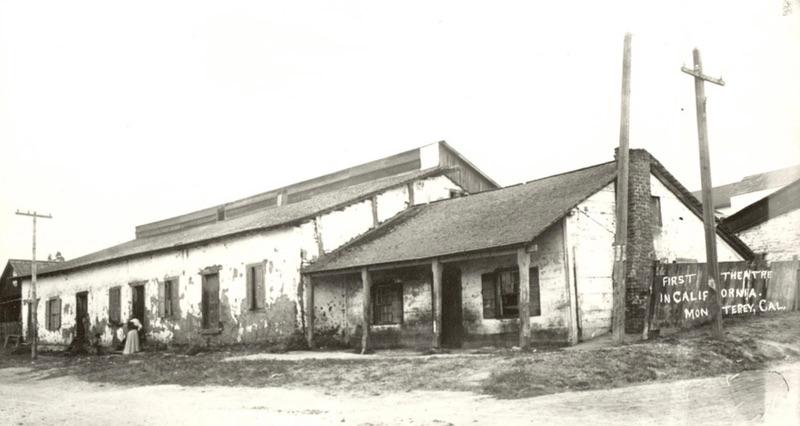
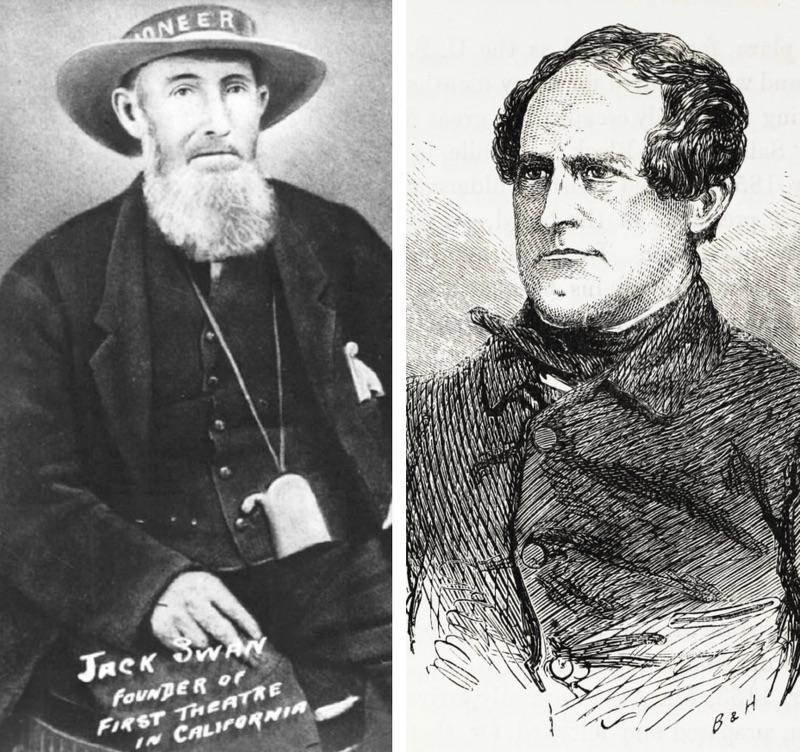
A bronze plaque to the memory of Colonel J.D. Stevenson’s regiment, who produced the first plays in California’s First Theater and to Jack Swan, the builder of the old adobe building will be dedicated Tuesday evening, October 13th, at the theater at 8 o’clock. This notice was mailed out to the entire membership of the Monterey History and Art Association Ltd., the sponsors of the event, inviting them to attend and bring guests.
Dr Aubrey Neasham, historian for the Division of Beaches and Parks will be the speaker, giving a short account of the history of the Stevenson Regiment and of Jack Swan.
The first detachment of the First New York Volunteers, recruited in New York as a part of Gen. Stephen W. Kearney’s Army of the West, and mustered in at Governor’s Island August 1, 1846, arrived at San Francisco under command of Col. Jonathan D. Stevenson. The regiment journeyed to California around Cape Horn in five small transports. Hostilities being at an end on their arrival, the soldiers were employed in garrisoning San Francisco, Monterey, Santa Barbara, La Paz, in Baja California, and elsewhere.
The regiment was ordered mustered out of service on August 7, 1848, many of the soldiers taking up permanent residence in California with several remaining in Monterey to marry and raise families.
Colonel Stevenson, commander of the regiment, settled in San Francisco and took a very active part in the affairs of the growing community. He married in 1851 and raised a small family. His investments were very profitable, but due to his activity in public affairs his private fortune suffered. He was U.S. Shipping Commissioner at San Francisco and also active in the real estate business. The town of Pittsburg is the result of his attempt to build a “New York of the Pacific” which he hoped would become the metropolis of the West Coast. He was the first Grand Master of Masons in the state. He died February 14, 1894.
President James Knox Polk approved the formation of the Seventh New York Regiment of Volunteers, to be under the command of Colonel Jonathan Drake Stevenson. The idea behind the sending of the regiment to California was for colonization purposes. Several members of the outfit returned to the East Coast immediately upon their discharge, some remained but left no record of the activities, but the members of a third group were too busy to take part in public affairs while plying their trades, while a fourth group became prominent citizens of California.
The regiment was made up largely of single men under 26 years of age, although there were a few married men who were allowed to take their wives along to California as laundresses. The regiment was officially mustered into service on August 1st, 1846, and originally intended to be known as the Seventh Regiment of New York Volunteers, but as the other six did not materialize it automatically became the First.
Three boats were chartered by the government. The Thomas H. Perkins, Loo Choo, and the Susan Drew, and the sloop-of-war Preble, to convoy the ships to California. The SS Brutus, the Isabella, and the Sweden later carried those who missed the first boats and the added volunteers.
Upon disembarking the companies were scattered from Sonoma to Los Angeles. Three companies, E., G. and I. were assigned to Monterey under Colonel Stevenson. It was during their stay here that the members of the regiment persuaded Jack Swan to allow the use of his sailors’ rooming house for theater productions. Since that day the old adobe building, now owned by the State of California, has been known as California’s First Theater. Companies A, B, and D were mustered out in Monterey October 23 and 24th, 1848.
It is interesting to note that the following members of Stevenson’s Regiment were elected to attend the First Constitutional Convention in Colton Hall, Monterey in 1849: Capt. Kimball H. Dimick, Edward Gilbert, John McH. Hollingsworth, Francis J. Lippett, Captain William G. Marcy and Thomas L. Vermulele. Others who settled in Monterey were Eli B. Forbes, a carpenter (1847); James A. Gray elected to the first legislature from Monterey in 1885; H.M. Guild, carpenter here in 1848; William Hardmont, killed in Monterey by Vasquez in 1851; Ira Johnson, building contractor here; William S. Johnson, former Monterey County clerk, recorder and treasurer and cashier of the Salinas Bank; James Lynch, sheep raiser in 1882; Aaron Lyons, one time sheriff of Monterey, died here in 1865; William D. Robinson, watchman in Monterey in 1848; Preston K. Woodside, clerk of the Naval Agency at Monterey in 1848 and clerk of supreme court in 1881; and Sgt. John M. O’Neill, who was in the U.S. Customs Service from 1861 to 1883, once Major in the Second Cavalry. He died at Monterey in 1885.
|