
Congress Returns to Work on Sensitive Issues While Farm Bill Drags On
Aid to Ukraine | House speaker | FISA | Japan PM | Food inflation | WASDE | CPI | Bridge
Washington Focus
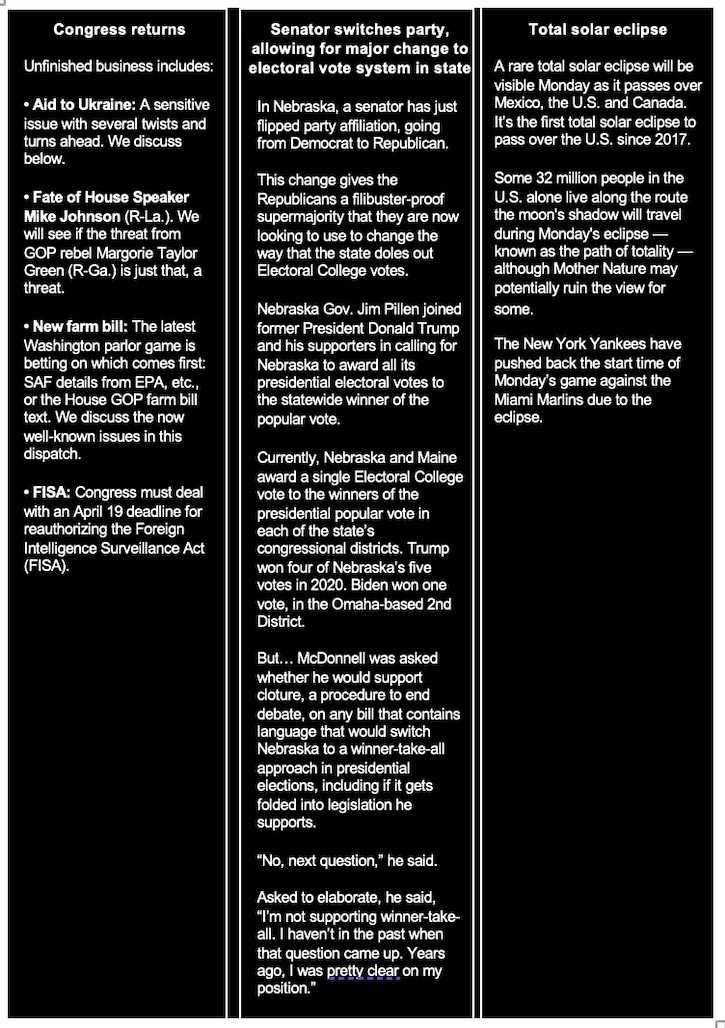
The Senate returns Monday and the House on Tuesday.
— Initial focus will be on the House to see whether GOP rebel Margorie Taylor Green (R-Ga.) follows through with her typical hand grenade move, this time to oust Speaker Mike Johnson (R-La.).
Greene alienated many of her colleagues on the right and got kicked out of the House Freedom Caucus. Moderate Rep. Mike Lawler (R-N.Y.), has called her move against Johnson “idiotic,” while even rebel Rep. Bob Good (R-Va.), the current Freedom Caucus chairman, accused her of “grandstanding.” Even lead-rebel Matt Gaetz (R-Fla.) doesn’t support what Greene has done, despite him being the main thrust in axing former Speaker Kevin McCarthy (R-Calif.).
Johnson has had to rely on Democratic votes to pass legislation and keep the government open, and will likely need them again to push an aid bill for Ukraine. If so, he would be testing Greene and her support, if any.
— President Joe Biden pressed Congress to quickly approve funds to rebuild a collapsed Baltimore bridge. Visiting on Friday the site of a disaster that killed six people and shut a major shipping and transportation artery, Biden said that Baltimore’s port would be able to accept some commercial traffic by the end of April and fully reopen its shipping channel by the end of May, thanks to recovery efforts. But he said the federal government must do more to fully restore the bridge and port, including paying for “all” of the rebuilding costs. “I call on Congress to authorize this effort as soon as possible,” the president said. “We will support Maryland and Baltimore every step of the way to help you rebuild and maintain all the business and commerce that’s here now.”
White House budget director Shalanda Young sent a letter to Congress ahead of Biden’s visit asking for a “100% federal cost share” for rebuilding the bridge. She said that was consistent with a bipartisan measure lawmakers approved in response to a 2007 bridge collapse in Minnesota. Federal officials have told Maryland lawmakers that replacing the 1.6-mile (bridge would cost at least $2 billion, including cleanup. The Department of Transportation has allocated an initial $60 million to defray costs. Biden said he is “committed” to ensuring companies responsible for the catastrophe will “pay to repair the damage and be held accountable to the fullest extent the law will allow.”
— Will mid-April finally be the time when a House GOP farm bill is unveiled? That is what farm bill insider Dr. Joe Outlaw signaled last week. However, other sources say it could be into May before an official unveiling. Key topics:
— House to send Mayorkas impeachment articles to Senate. The House of Representatives on Wednesday plans to send the impeachment articles against Department of Homeland Security Alejandro Mayorkas to the Senate. This marks the next procedural step towards holding an impeachment trial in the Senate. Senate Majority Leader Chuck Schumer's (D-N.Y.) office has acknowledged the letter, noting that senators will be sworn in as jurors the day after.
Mayorkas was impeached by the House in February by a slim margin, becoming the first Cabinet secretary to face impeachment in nearly 150 years. While the Democratic-controlled Senate is not expected to convict Mayorkas, there is potential for the impeachment to be swiftly dismissed. However, Schumer has not provided specific details on how the Senate will handle the trial.
— President Biden will host Japanese Prime Minister Fumio Kishida for an official visit to the U.S. this week, which will include a joint news conference and a state dinner on Wednesday. The visit and state dinner — the fifth Biden has hosted as president — are intended to emphasize the importance of the alliance between the U.S. and Japan as both countries seek to counterbalance China’s influence.
A joint meeting of the House and Senate will be held to hear from the Japanese prime minister.
— Triad summit. On Thursday, President Ferdinand Marcos Jr. of the Philippines will join Biden and Japan Prime Minister Kishida at the White House for the first trilateral U.S.-Japan-Philippines leaders’ summit. The summit will talk about the growing security threat from China and how to counter it.
Meanwhile, Tokyo and Manila are expected to agree a reciprocal access agreement that could see Japanese troops deployed in the Philippines and conducting joint military exercises with the U.S.
— Pennsylvania governor concerned over Biden's LNG project halt. Pennsylvania's Governor, Josh Shapiro, a Democratic ally of Joe Biden, has expressed concern over Biden's recent decision to halt approvals for new liquefied natural gas (LNG) projects. Shapiro warned that this policy pause is negatively impacting Pennsylvania, a crucial swing state for the 2024 presidential election, where the shale gas industry is a significant employer.
Republicans are seizing on this issue to criticize Biden's climate policies, positioning themselves as supporters of the fossil fuel industry, particularly in states like Pennsylvania. Polls suggest a tight race between Biden and former President Donald Trump in Pennsylvania, making it a focal point for both campaigns.
Shapiro argues that natural gas can be part of the transition to green energy without sacrificing jobs, emphasizing that policymakers can prioritize both economic growth and environmental protection.
A recent poll indicates that a majority of Pennsylvanians oppose the Biden administration's pause on LNG projects, which could have implications for the upcoming election.
Pennsylvania is a significant producer of shale gas, and the fracking industry has boosted the state's economy. However, Biden's pause on LNG projects has created uncertainty and led to concerns about job losses in the industry.
Of note: In Washington, the LNG pause has become a bargaining chip, with Republicans suggesting that its reversal could be tied to funding requests, such as aid for Ukraine (see next item) or infrastructure projects. The Biden administration has defended the LNG pause, citing the need to update the approvals process considering significant changes in both domestic and global natural gas markets.
— House Speaker Mike Johnson (R-La.) is facing significant challenges in bringing up a vote on Ukraine aid in the House of Representatives. Despite his pledge to do so soon after Congress reconvenes from Easter recess, uncertainties persist regarding the form of the bill and the level of support it will garner, given fractures among both Republicans and Democrats.
The Senate has already passed a $95 billion package for Ukraine, Israel, and Taiwan with bipartisan support. However, Johnson has resisted pressure to simply bring the Senate bill up for a vote in the House, opting instead to craft his own bill with additional provisions. He's considering splitting Ukraine aid and Israel aid into separate votes to maximize support, particularly from Democrats for Ukraine aid and from Republicans for Israel aid.
Various policy proposals have been floated, including converting some Ukraine aid to a loan, using seized Russian assets to fund Ukraine’s reconstruction, and lifting the moratorium on new liquefied natural gas export projects. However, the details remain unclear.
Johnson may bring the House aid bill up under suspension of the rules, which would require a two-thirds supermajority for passage, making him heavily reliant on Democratic votes. However, opposition among some House Democrats to aid for Israel complicates the math, which is one of the likely reasons why there may be separate aid measures.
— Food inflation in wealthy nations has decreased to its lowest level since before the full-scale invasion of Ukraine by Russia. This decline in price growth has relieved pressure on households affected by the two-year surge in food costs. Factors contributing to the surge included rising energy costs, decreased trade due to the war in Ukraine, droughts, and supply chain disruptions related to Covid-19. However, agricultural commodity prices have dropped significantly since their peak following the invasion of Ukraine, leading to a disinflationary effect. Supply chains have normalized, gas prices have reduced, and Ukraine's grain exports have resumed, contributing to the decrease in food prices.
The annual change in consumer food prices across 38 industrialized countries eased to 5.3% in February, down from 6.2% in the previous month and well below a peak of 16.2% in November 2022, according to the latest OECD data.
The Organization for Economic Co-operation and Development (OECD) is expected to comment on the food price figures, which are the lowest since October 2021, in its broader inflation update on Monday.
The UN Food and Agriculture Organization (FAO) reported a slight increase in the food commodity price index in March but noted a decrease compared to the previous year. While food price inflation has eased in developed and emerging markets, some countries still face challenges, particularly those with exchange rate pressures and reliance on imports. Turkey and Nigeria, for instance, experienced significant food inflation due to currency devaluation and reliance on food imports, respectively. Additionally, countries dependent on Indian rice imports, such as the Philippines and Bangladesh, saw continued food price inflation following India's ban on rice exports.
Despite falling wholesale agricultural prices, consumer food prices have not decreased significantly due to various factors affecting retail costs beyond commodity prices, including labor, marketing, and distribution. However, the recent decline in agricultural prices is expected to eventually translate into lower grocery prices.
— Hezbollah: Iran response to attack on Damascus consulate ‘inevitable.’ The leader of Lebanon’s Hezbollah militant group said that the strike on the Iranian consulate in Damascus widely blamed on Israel marked a “turning point” and vowed that Iran’s response would be “inevitable.” Iran has vowed to respond to the attack, which killed 13 people, including a senior general. “Rest assured that the Iranian response to the attack on the Iranian consulate will inevitably come,” Hassan Nasrallah told his followers in a public address commemorating Quds Day, an annual event marking support for Palestinians and opposition to Israel’s occupation. He deferred to Iran’s supreme leader on when and what form that retaliation would take. Ayatollah Ali Khamenei has vowed to respond, saying “Israel would regret its crimes.”
Of note: Israel says it has pulled out of Khan Younis to prepare for a move on Rafah. “Our forces left the area in order to prepare for their future missions, including their mission in Rafah,” Israeli defense minister Yoav Gallant said after meeting senior officers of the army’s southern command. An army statement said the minister had been briefed on preparations for the destruction of Hamas’s Rafah Brigade, “an achievement which will finalize the dismantling of Hamas as a military authority in Gaza.”
— Treasury Secretary Janet Yellen addressed concerns over China's increasing exports of low-cost electric vehicles and green energy products, emphasizing the potential threat to American jobs and urging China to adjust its industrial strategy. During talks with her Chinese counterpart, Vice Premier He Lifeng, Yellen also cautioned against Chinese companies supporting Russia's actions in Ukraine, warning of "significant consequences."
The discussions, spanning two days in Guangzhou, aimed to tackle trade and geopolitical tensions between the world's largest economies, seeking to stabilize relations strained in the previous year. Both parties agreed to future discussions on combating international money laundering and promoting balanced growth to address worries about China's export-driven economic approach distorting global markets.
Yellen's focus on China's heavily subsidized green technology exports reflects concerns in the Biden administration, which has invested in similar sectors domestically. She expressed the U.S.'s apprehensions regarding Chinese industrial strategies potentially inundating American markets and harming local firms' competitiveness.
Before the official talks, Yellen met with American and European business leaders in China, discussing their concerns about China's treatment of foreign companies and the global implications of China's export strategies.
While Yellen received a positive reception in Guangzhou, China defended its export policies as beneficial globally, emphasizing the scarcity of high-quality industrial capacity and productive forces worldwide.
Both sides acknowledged the complexity of the issues discussed, with China expressing concerns about U.S. economic measures and Yellen recognizing the challenges faced by China in addressing these issues promptly.
Besides economic matters, Yellen and her Chinese counterpart discussed Russia's conflict in Ukraine, with the U.S. expressing worries about Chinese companies indirectly supporting Russia's military efforts. Yellen expressed hope for cooperation on this front, noting China's stance against providing direct military support to Russia.
Yellen continued her diplomatic engagements, traveling to Beijing for further discussions with Chinese officials, including Premier Li Qiang and Beijing's mayor, Yin Yong.
Other Events of Note This Week
Monday, April 8
Tuesday, April 9
Wednesday, April 10
Thursday, April 11
Friday, April 12
Economic Reports and Events for the Week
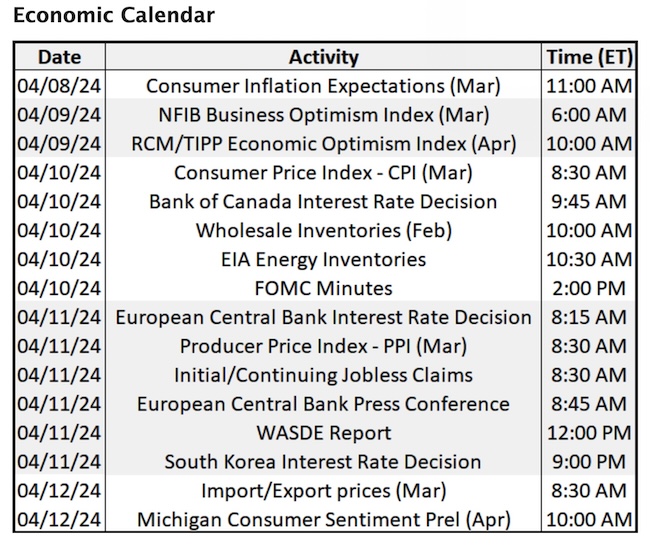
This week, investors' focus will primarily be on Wednesday's release of the consumer price index (CPI) report for March. The headline CPI is expected to show a 0.4% increase compared to the previous month, remaining unchanged from February. On a year-over-year (Y/Y) basis, the anticipated increase is 3.1%, slightly lower than the prior month's 3.2%. Core CPI, which excludes volatile food and energy prices, is forecasted to show a deceleration both on a monthly (M/M) and yearly basis, with expected increases of +0.3% and +3.7%, respectively. Traders late last week pushed back their predictions for the Fed’s first rate cut to come in July, rather than in June.
On Wednesday, investors will get the release of the minutes from the Federal Reserve's March meeting. This follows last week's release of robust labor market data, which diminished expectations for interest rate cuts. Market participants will scrutinize both the minutes and the consumer inflation report for any insights into the future trajectory of monetary policy.
This week will commence the first quarter earnings season, including JPMorgan, Citi, State Street, Wells Fargo and BlackRock on Friday. Other company data includes Boeing reporting first-quarter deliveries on Tuesday. These will add to the already heightened market scrutiny and potentially impacting investor sentiment and market dynamics.
Monday, April 8
Tuesday, April 9
Wednesday, April 10
Thursday, April 11
Friday, April 12
Key USDA & international Ag & Energy Reports and Events
USDA’s World Agricultural Supply & Demand Estimates (WASDE) will be released on Thursday, while China will publish its first batch of trade data for March, including imports of edible oils.
On the energy front, the International Energy Agency will publish its monthly oil market report on Friday, a day after OPEC issues its outlook. The U.S. Energy Information Administration releases its Short-Term Energy Outlook on Tuesday.
Monday, April 8
Ag reports and events:
Energy reports and events:
Tuesday, April 9
Ag reports and events:
Energy reports and events:
Wednesday, April 10
Ag reports and events:
Energy reports and events:
Thursday, April 11
Ag reports and events:
Energy reports and events:
Friday, April 12
Ag reports and events:
Energy reports and events:
|
KEY LINKS |
WASDE | Crop Production | USDA weekly reports | Crop Progress | Food prices | Farm income | Export Sales weekly | ERP dashboard | California phase-out of gas-powered vehicles | RFS | IRA: Biofuels | IRA: Ag | | Russia/Ukraine war, lessons learned | | SCOTUS on WOTUS | SCOTUS on Prop 12 pork | New farm bill primer | | Gov’t payments to farmers by program | Farmer working capital | USDA Ag Outlook Forum |