Advance Your Skills This August
with ASIPP's Hands-On Workshops
| | |
Join ASIPP this August at the Medical Education & Research Institute (MERI) in Memphis, Tennessee for these hands-on educational workshops:
ACCOMMODATIONS
The Westin Memphis, Beale Street
170 Lt. George W Lee Ave, Memphis, TN 38103
901-334-5900
Click Here to Book Your Room
Cut-off date for special room rates: August 13, 2026.
In order to ensure you receive the discounted room block rate of $189 plus tax per night let the hotel know you are with the ASIPP workshops.
Space is limited for these workshops.
Early registration is encouraged.
| | | |
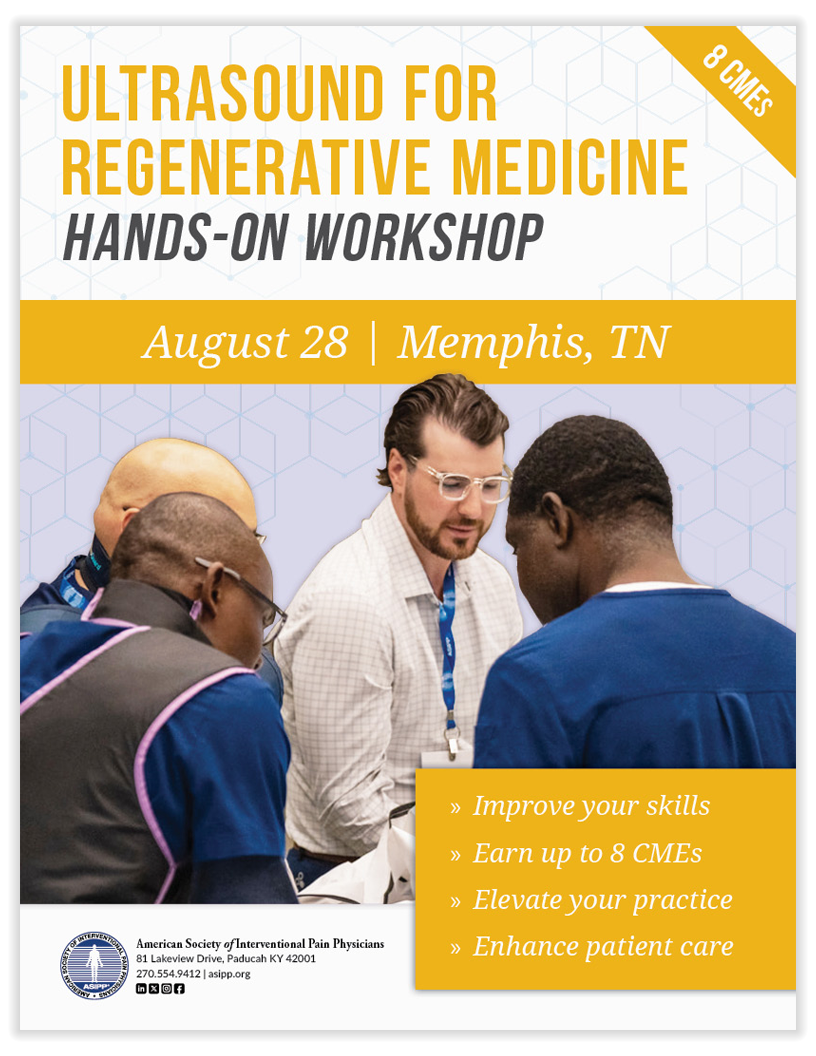
FRIDAY, AUGUST 28
Ultrasound for Regenerative Medicine Hands-On Workshop
Earn 8 CMEs while gaining practical ultrasound experience focused on regenerative medicine applications.
| | | |
SATURDAY, AUGUST 29
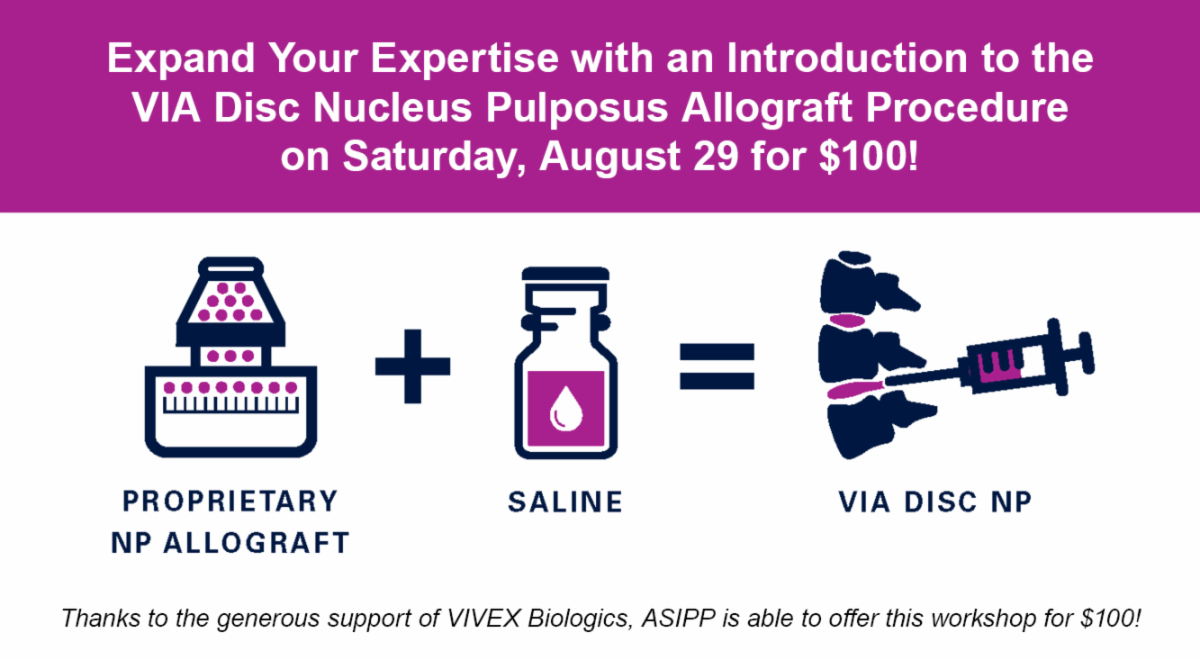
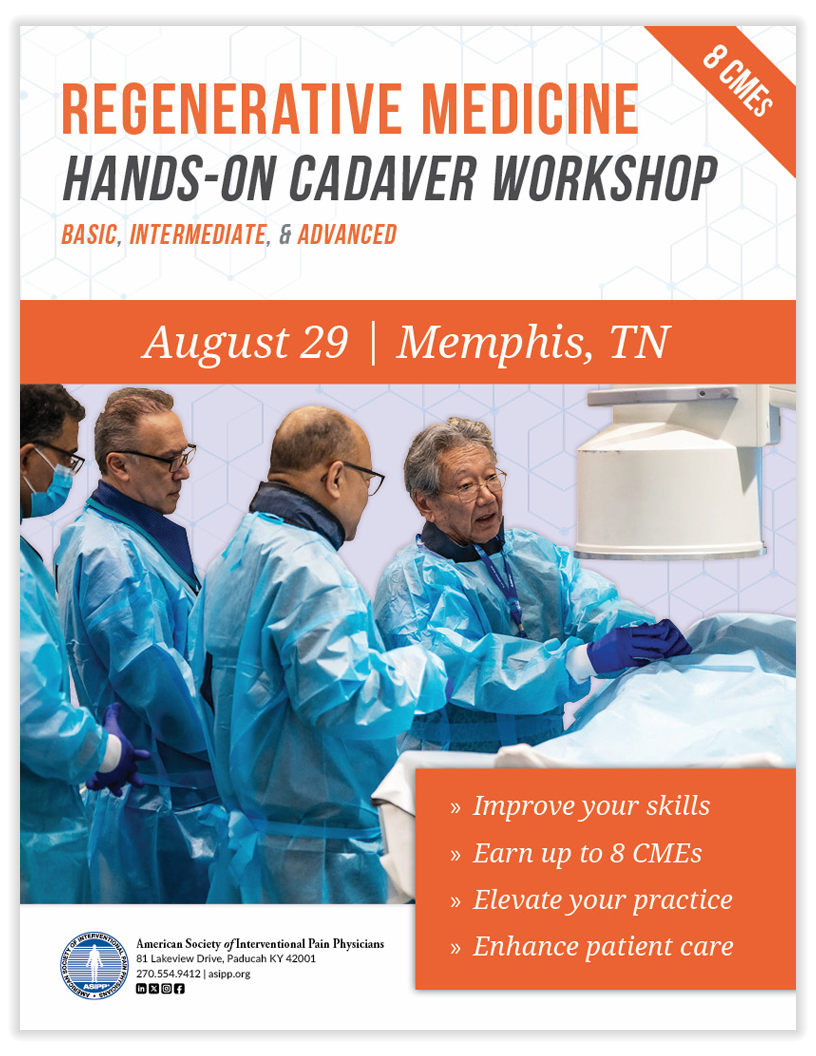
Regenerative Medicine Hands-On Cadaver Workshop
(Basic, Intermediate, & Advanced)
Earn 8 CMEs in this cadaver workshop with hands-on instruction covering regenerative medicine techniques across varying experience levels.
| | | |
SATURDAY, AUGUST 29
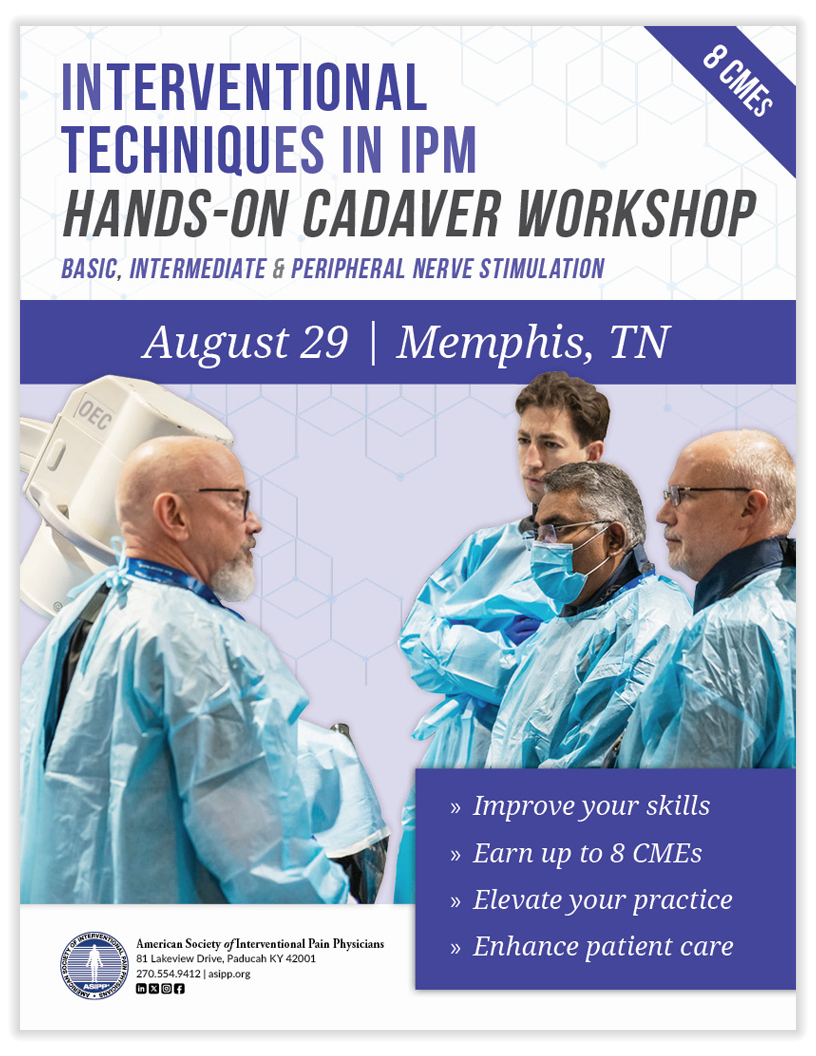
Interventional Techniques in IPM Hands-On Cadaver Workshop
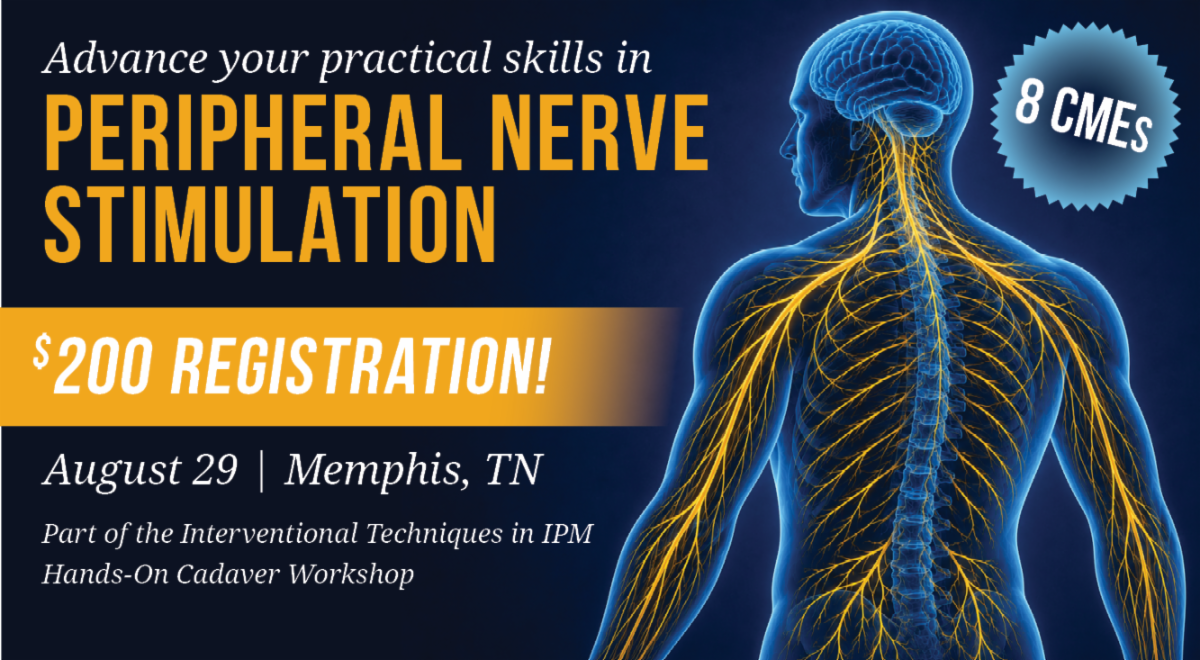
(Basic, Intermediate & PNS)
Earn 8 CMEs in this workshop focused on interventional pain management techniques and peripheral nerve stimulation applications.
| | |
ASIPP members are invited to participate in a national survey examining current utilization, practice patterns, and clinical perspectives regarding basivertebral nerve ablation (BVNA) for vertebrogenic low back pain.
This survey is being conducted by investigators at Yale School of Medicine and your input will help inform future research, education, and consensus-building efforts within interventional pain medicine.
Estimated completion time: 5–7 minutes.
Click here to take the survey.
Thank you for contributing to this important research effort and helping advance the evidence base for interventional pain management.
| | |
Jump signals a "structural change in care delivery," editorialists note
| | |
We celebrated the extension of Telehealth through next year. During the legislative process and our advocacy efforts, the understanding was that Telehealth flexibilities would continue as they had in previous years. However, a significant change was made that has caught many organizations and practitioners by surprise.
For the past several years, CMS allowed physicians and other practitioners to provide Telehealth services from their homes while billing under their group’s practice address. That flexibility ended on January 1, 2026.
Effective January 1, 2026, physicians and other practitioners must separately enroll each location from which they provide Telehealth services. According to CMS, “virtual-only telehealth practitioners whose only physical practice location is their home address will need to enroll their home address as a practice location.”
This means that:
- If you are currently billing for Telehealth services provided from your home while using your group’s practice address, you should discontinue this practice unless your home location has been appropriately enrolled.
- If you provide Telehealth services in multiple states, you may face significant enrollment and update backlogs, particularly if you intend to enroll multiple practice locations for each physician and other practitioners within your organization.
We encourage all practices to review their Telehealth billing and enrollment processes to ensure compliance with the updated CMS requirements.
Click here to read the updated Telehealth CMS requirements.
|
| | |
The CMS announced the Wasteful and Inappropriate Service Reduction model last summer, as part of a move to crack down on what the agency called fraud and wasteful spending in Medicare.
Under the program, the federal government contracts with private companies to add AI-enabled prior authorization for some services considered vulnerable to inappropriate use, like skin and tissue substitutes and epidural steroid injections for pain management.
WISeR went into effect in six states in January. Democrats quickly railed against the model, arguing it delays care for seniors and adds additional administrative burdens on providers.
Click here to read the full article.
| | |
ASIPP is proud to launch our Resident and Fellow Mentorship Program. This initiative is designed to connect trainees with experienced pain physicians to foster professional growth, provide guidance, and strengthen the future of our specialty.
Each mentor would be paired with one to two trainees, but can take more if interested. Trainees will be responsible for initiating introductions and arranging at least one to two video calls per year. These sessions will provide opportunities for mentees to seek advice on clinical decision-making, career planning, research opportunities, and professional development.
We believe that your experience, expertise, and insight can have a lasting impact on the next generation of pain physicians. By volunteering as a mentor, you will play a critical role in shaping the future of our field and ensuring that ASIPP continues to cultivate excellence in interventional pain medicine.
If you are interested in serving as a mentor, please confirm your participation by filling out the appropriate form below.
| | |
Medicine has always attracted perfectionists. The problem is that the kind of perfectionism increasingly common among young adults today may be exactly the kind physicians can least afford.
A new meta-analysis published in Psychological Bulletin found that while perfectionism among college students has risen substantially since the 1980s, the sharpest increases came in what researchers call “perfectionistic concerns”: a fear-driven orientation centered on anxiety about mistakes, failure, and others’ critical judgment.
Researchers say this shift matters for medicine, a field that has long rewarded diligence, precision, and exceptionally high personal standards. But when perfectionism is driven more by fear of failure than by the pursuit of excellence, it may undermine learning, decision-making, and potentially even patient care.
Click here to read the full article.
| |
ASIPP is pleased to announce the launch of the Regenerative and Longevity Medicine Section!
This section reflects the growing importance of regenerative and longevity medicine—fields dedicated to restoring health, enhancing vitality, and extending the healthy years of life. From stem cell therapies and tissue engineering to gene therapy and orthobiologics, these disciplines are transforming the way we approach pain management and age-related decline.
Section membership offers:
- Access to ASIPP’s physician database and future data registry
- Opportunities for certification and continuing education
- Section-exclusive resources and updates
No additional cost for ASIPP members!
| |
Patients with episodic or chronic migraine who responded to preventive treatment with anti-calcitonin gene-related peptide (CGRP) monoclonal antibodies (mAbs) or botulinum toxin (BoNT) showed a significantly greater improvement in interictal executive cognitive performance than those who did not respond, regardless of the treatment type.
METHODOLOGY:
- Researchers conducted an observational two-centre cohort study to evaluate whether preventive treatment with anti-CGRP mAbs or BoNT improves interictal cognitive performance in patients with migraine and whether changes in performance differ between treatment responders and non-responders.
- They included 90 patients with migraine (mean age, 42 years; 96.7% women), comprising 58 with chronic migraine and 32 with episodic migraine; 64 patients were treated with anti-CGRP mAbs, and 26 were treated with BoNT. The mean follow-up duration was 4.5 months.
- Participants underwent two comprehensive cognitive evaluations at baseline and after 3-6 months of treatment, covering four domains: episodic memory, language, attention and processing speed, and executive functions.
Click here to read the full article.
| | |
Apply now for one of the following 2026 dates:
July 25, September 26, October 24, November 14,& December 12
Four (4) hour virtual exam
- ABIPP Path – Combined CCPM/ CSM Exam
For those with subspecialty in Pain Medicine
Two (2) hour virtual exam
- ABIPP Competency Exam in IPM
For those without primary board certification
Two (2) hour virtual exam
- ABIPP Competency Exam in Regenerative Medicine
Two (2) hour virtual exam
- Controlled Substance Management Competency Exam
Two (2) hour virtual exam
- Documentation, Coding, Compliance, Practice Management Competency Exam
Two (2) hour virtual exam
August 28, 2026
- ABIPP Part II Oral and Practical Examination
Topics that will be covered:
Caudal epidural injections; Lumbar interlaminar epidural injections; Lumbar/sacral transforaminal epidural injections; Cervical epidural injections; Thoracic epidural injections; Lumbar/sacral medial branch and L5 dorsal ramus blocks; Cervical medial branch blocks; Thoracic medial branch blocks; Lumbar/sacral facet joint nerve radiofrequency neurolysis; Cervical medial branch radiofrequency neurolysis; Thoracic medial branch radiofrequency neurolysis; Sacroiliac joint injections; Cervical sympathetic blocks; Lumbar paravertebral sympathetic blocks; Intercostal nerve blocks; Lumbar discography; Celiac plexus blocks (not Splancnic nerve blocks); Percutaneous epidural adhesiolysis; Spinal cord stimulation lead placement
| | |
In France, inflammatory bowel disease (IBD)-associated chronic non-bacterial osteomyelitis (CNO) was a rare pediatric condition, with an estimated incidence of 0.12%; it typically presented with chronic bone pain mainly affecting the lower limbs and pelvis, and most patients achieved remission with anti-TNF-alpha therapy.
METHODOLOGY:
- Researchers aimed to describe a national pediatric cohort with coexisting IBD and CNO and to estimate the incidence of this association.
- They retrospectively collected all reported cases of the IBD-CNO association from French pediatric gastroenterology and rheumatology centers (2000-2024), and the incidence of IBD-CNO was estimated using data from the EPIMAD registry.
- A total of 37 children diagnosed with IBD-CNO (median age at diagnosis, 13.5 years; 20 boys) between 2011 and 2024 were included.
- Inflammation was assessed using standard laboratory markers (C-reactive protein levels and/or erythrocyte sedimentation rates), and CNO was identified on whole‑body MRI on the basis of findings consistent with inflammatory bone disease.
Click here to read the full article.
| | |
Pain Medicine Case Reports (PMCR) and Editor-in-Chief Alaa Abd-Elsayed, MD, PhD would like to invite you to submit case reports and case series to the PMCR journal. Your article will be published free of charge.
Open access journals are freely available online for immediate worldwide open access to the full text of published articles. There is no subscription fee for open access journals. Open access journals are no different from traditional subscription-based journals: they undergo the same peer review and quality control as any other scholarly journal.
Interested in becoming a member of the PMCR Editorial Board?
Editorial board members are asked to review 2-6 manuscripts per year. Please submit your most up-to-date CV to sgold@asipp.org for consideration.
For more information or to submit your articles, click here.
| | |
We are excited to announce that Pain Medicine Case Reports (PMCR) journal (eISSN 2768-5152) has been accepted for inclusion in MEDLINE and PubMed, the prestigious bibliographic database of the U.S. National Library of Medicine. PMCR, a companion publication to the prestigious Pain Physician journal by ASIPP, joins its counterpart in achieving indexing in both MEDLINE and PubMed, marking ASIPP’s dual presence in these renowned databases.
The inclusion of PMCR journal in MEDLINE signifies a higher level of selectivity, as MEDLINE consists of the top 5,200 biomedical journals. This indexing also means that articles from PMCR will be searchable using NLM Medical Subject Headings (MeSH terms) and other metadata.
The selection for MEDLINE follows a rigorous evaluation process by reviewers from the Literature Selection Technical Review Committee (LSTRC). According to their criteria, the scientific quality of a journal’s content is the primary factor considered for indexing.
We extend our congratulations to the Pain Medicine Case Reports Editor-in-Chief, Deputy Editor-in-Chief, Journal Team, and Editorial Board for this achievement, which underscores the significance and excellence of this esteemed journal.
| | | | |
|
ASIPP is in collaboration with Curi Medical Liability Program
Since this malpractice insurance program officially launched in November 2018, ASIPP has signed up hundreds of providers with an average savings of 30%. This is professional liability insurance tailored to our specialty and will stand up for us and defend our practices.
Curi is a full-service advisory firm that serves physicians and their practices. Their valued advice is grounded in your priorities and elevated in your outcomes. They are driven by a deep understanding of your specific circumstances in medicine, business, and life. To read a few important points to keep in mind about the program, including discounts, administrative defense, cyber coverage, aggressive claims handling, and complimentary risk management CME activities, visit our website.
| | |
IMPORTANT UPDATE
SPR is happy to announce an important update regarding Humana Medicare Advantage. As of May 1, Humana is now recognizing SPRINT as a PNS therapy. Previously, SPRINT was categorized as PNT (Percutaneous Nerve Stimulation), which allowed denials on the grounds that the therapy fell outside the NCD.
Additional details are as follows:
Payer: Humana Medicare Advantage (click here to view policy)
Policy Title: Peripheral Nerve Stimulators
Policy changes: SPRINT no longer misclassified as PNT and is now appropriately classified as PNS. Humana is applying the Noridian Medicare LCD criteria to ALL PNS devices – Including SPRINT PNS!
Effective Date: 5/1/2025
Click here to view a PDF of the official policy update.
| | |
|
Group Purchasing Organization Offer Better Pricing and Creates Added Value
ASIPP has formed a partnership with Henry Schein and PedsPal, a national GPO that has a successful history of negotiating better prices on medical supplies and creating value-added services for independent physicians. Working with MedAssets, PedsPal provides excellent pricing on products like contrast media that alleviate some of the financial pressures you experience today.
Learn More
For updated information concerning tariffs on products, click here.
| |  |
|
ASIPP, Fedora Healthcare Solutions Partnership
ASIPP offers our members the benefit of a unique revenue cycle management/ billing service.
We have received a tremendous amount of interest in the ASIPP billing and coding program.
Click here to learn more about the negotiated rate for practices and more!
| | |
Like and Follow ASIPP® on Facebook, X, LinkedIn,
and YouTube for the most up-to-date news
related to you, your practice, and your patients!
| | | | |