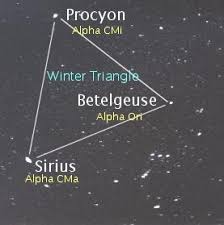
Winter Triangle: Betelgeuse, Procyon & Sirius
Most of us have heard of the Summer Triangle but how about the winter triangle?
This week you can see one of the stars just after sunset: Sirius. Astronomy.com com writes: Often depicted as the nose of Canis Major the Big Dog, Sirius’ magnitude –1.4 glow is easy to spot shortly after sunset. The star’s name itself is derived from the Greek word for “searing,” which makes sense for such a searingly bright star! Sirius is intrinsically bright (shining 26 times brighter than the Sun), but it’s so stunning in large part because it is so close to Earth — just over 8 light-years away. In fact, if you were to snag nearby magnitude 0.2 Rigel, Orion’s left knee, and pull it as close to Earth as Sirius sits, it would appear much brighter.
Sirius is part of the Winter Triangle best viewed in the early mornings, together with Betelgeuse in Orion and Procyon in Canis Major’s fellow hunting dog, Canis Minor. You should be able to easily spot all three of these bright stars despite the waxing Moon