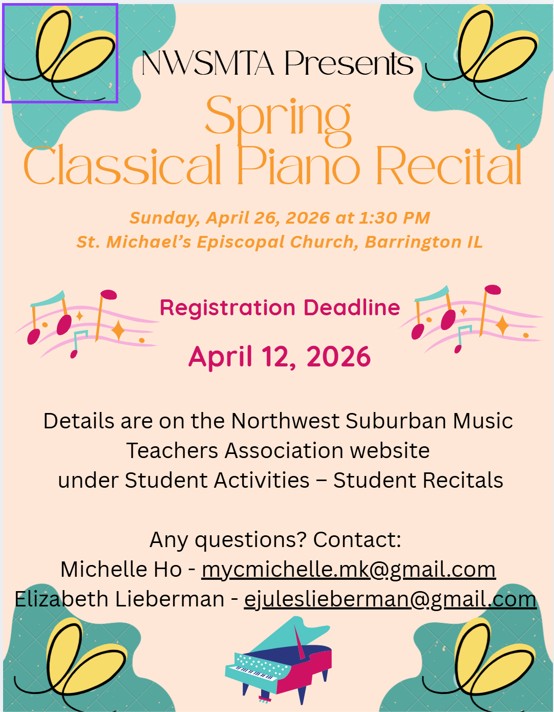
NOTE: THE MARCH MEETING WILL BE VIRTUAL ONLINE ZOOM ONLY. | | SPRING CLASSICAL PIANO RECITAL | | |
Registration for the 2026 Spring Classical Student Recital is now open. Enrollment is accepted on a first-come, first-served basis, so early registration is strongly encouraged. Please note that only online registrations will be accepted.
Before registering your students, carefully review all rules and procedures. Complete details are available on the Northwest Suburban Music Teachers Association website under Student Activities – Student Recitals or click the links below.
1. Link to the online registration form:
https://www.nwsmta.org/classical-recital-entry-form.html
2. Link to the Rules and Procedures:
https://drive.google.com/file/d/1TB2xFtIPWByNqjbPJRWiJGw9_jyoWO9B/view
Any questions? Contact:
Michelle Ho - mycmichelle.mk@gmail.com
Elizabeth Lieberman - ejuleslieberman@gmail.com
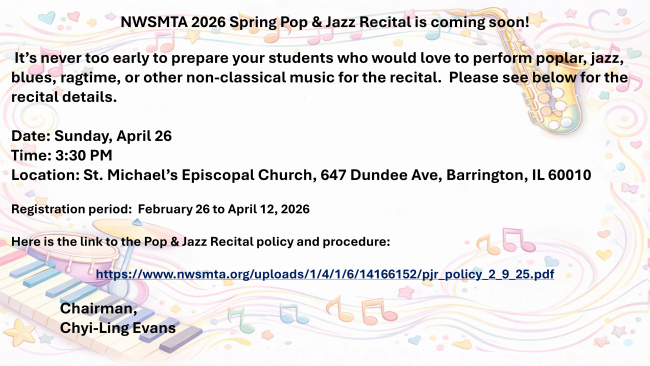
| | SPRING POP & JAZZ RECITAL | | OAKTON SIX PIANO ENSEMBLE IN CONCERT | | |
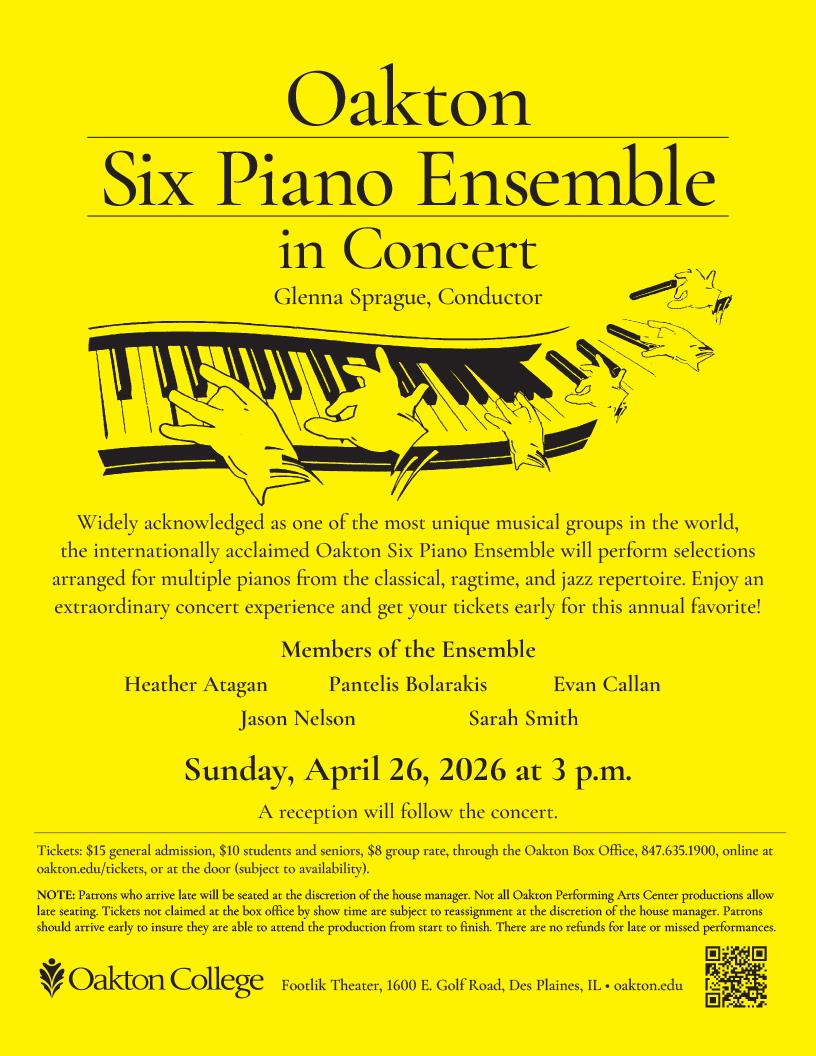
Oakton Six Piano Ensemble Concert April 26
The Oakton Six Piano Ensemble, conducted by Glenna Sprague, will present its annual concert on Sunday, April 26th at 3:00 p.m. in the Footlik Theater at Oakton College, 1600 East Golf Road, Des Plaines.
The group is founded by Glenna Sprague, Professor and Coordinator of Music at Oakton, where she also teaches piano. Performing at multiple pianos, the group performs not only traditional classical piano music; but also, symphonic literature as well as ragtime, popular, and jazz music. Performing with a conductor, the rich, layered sound of the Six Piano Ensemble compares to that of an orchestra, with each member playing a different part of a composition as the melody transfers from pianist to pianist. This year’s concert features the following works: Samba triste from Four Piece Suite by Richard Rodney Bennett; Suite in C Minor for Two Keyboards by Handel; Sonata in D Major, K.381 by Mozart; Ain’t Misbehavin by Thomas Waller; The Strenuous Life Rag by Scott Joplin as well other selections.
Tickets are $15 for general admission; $10 for seniors and students; and $8 for groups. For ticket information, call the Oakton Box Office at 847-635-1900; order tickets online at www.oakton.edu/tickets or get tickets at the door (subject to availability). A reception will follow the concert.
Widely acknowledged as one of the most unique music groups in the world, the Oakton Six Piano Ensemble has performed both internationally and throughout the United States, including the World Conference of the International Society for Music Education (ISME) at the Royal Conservatoire of Scotland in Glasgow; the College Music Society International Conference in Vienna, Austria; MTNA National Conferences in Atlanta and Spokane; numerous MTNA state conferences; National Conference on Keyboard Pedagogy in Chicago. Critics from Vienna to Glasgow hail the Ensemble as “extraordinary”, “technically superb”, and “musically innovative.”
| | |
Dear NWSMTA members,
Have you heard the saying, “Grandchildren are God’s reward for allowing our children to survive.” That may be an exaggeration, but there were moments that my husband and I asked each other, “Can you remind me why we decided to have children?” Perhaps we were holding on for the grandchildren to arrive.
I no longer get up at 5:00 A.M. to go to my grandsons to practice piano. Now, I go to practice with them after school. I see the window for that getting smaller every year as they get closer to high school and college. I try to keep our music positive for all of us. I often bring healthy treats and reward them for playing for others without complaining. Most people are amazed by their eagerness to perform. Five dollars for each song goes a long way. I also reward them with money for working hard with a good attitude. We call Friday “payday”. One Friday, Seth was having an off day, so I felt we should wait a day to evaluate his past week and I left him to finish practicing on his own. The next day, I found out he had completed all his songs. I told him that was wonderful and showed he’s probably able to do more on his own. Being a Gramma, I asked if he missed me, or liked it better to practice without me. Seth said he definitely missed me. Then he added that should be worth an extra dollar. I agreed with him. I am not suggesting anyone try to follow this plan. I am just happy I do not have to tazer them.
Seth, the child who called the fire department when he was four years old, while I was teaching his older brother, loves to suggest ways I should improve my teaching. He does not really mind practicing or would not if I would heed his advice. When Seth comes in the door, his face lights up, and he greets me with ”Hi Gramma.” Then he immediately has a snack, while I play the piano for him. I have noticed my playing shapes his playing. It’s like subliminal learning. Dynamics get more creative, the beat gets more even and I need to talk less. He does not like to be interrupted while playing. Seth says it is impolite to interrupt the student. His pieces can be four pages long at this stage, and I cannot remember everything I think he should be changing. I also feel overloaded. I have tried to have him start on different pieces, pages or phrases. Seth prefers doing the newest piece first and ending up with what he can play in his sleep. Negotiations can take even more time. Teaching Seth has taught me to be quick on the draw. Get your idea on the table fast. After he tries my idea’ he can suggest one of his own. There are a few times this actually works. He has also taught me “Tomorrow is another day.”
The difference between teaching a student and a grandchild is your grandchild has more invested in the outcome. Just last week, Seth and I had a disagreement between what notes the composer wrote and which notes were played incorrectly. After begging him to just listen to me play the example, I heard the music playing softly. I realized Seth had secretly recorded himself to prove he had it right. He said nothing but agreed to look at it again. We have a new goal of creating five new recordings a day. They can be very short, or quite long. We go over them and try to analyze if there is truly a problem. He seems willing to make the corrections if he can tell they are needed.
When I studied piano, I don’t remember ever asking my teachers a question. When I teach, I agree with Seth, it is important for the student to be able to speak up and question why or why not.
Deb Lynch
Newsletter Editor
| | Northwest Suburban Music Teachers Association | https://www.nwsmta.org | | | | |