Weekly Digest Number 7 - February 14th, 2023 |
|
Welcome to the RWU Rail & Labor News! This news bulletin is produced and emailed out each Tuesday morning. We hope you find each week's news and information useful. If so, please share with co-workers, friends, and colleagues. If you like, you can sign them up to get all the news from RWU HERE. Or forward them the link. Note: If you read over this news bulletin each week, you will be sure to never miss the important news of what is going on in the railroad world from a worker's perspective!
|
|
(Editor's Note: Great to see the unions all come together around this basic demand. Now we need an ironclad bargaining coalition of ALL rail unions - one predicated upon the idea that no union settle until all settle - to bring this and other demands to fruition. RWU is working diligently to build that coalition for the next round of bargaining. That effort starts today. To be part of this effort, contact Committee Chair Matt Weaver at bmweaver2624@frontier.com.)
|
|
On the 30th Anniversary of FMLA, Rail Unions Adopt Resolution Calling for Universal Paid Sick Leave |
|
WASHINGTON – As the nation commemorates the 30th anniversary of the Family and Medical Leave Act (FMLA), all U.S. rail labor unions unanimously adopted a Resolution calling for paid sick leave.
“The lack of paid sick leave for rail workers came into the national spotlight during this last round of national contract bargaining that concluded in December,” said Greg Regan, President of the Transportation Trades Department (TTD) of the AFL-CIO. “A worker should not be fired for going to the doctor. Yet it is 2023 and railroaders are fighting for sick leave in the richest country on Earth.”
The United States is one of just six countries without a national leave policy. In November, the House of Representatives narrowly passed a measure to guarantee seven days of paid sick leave to all rail workers, by a vote of 221-207. The measure failed to garner the 60-vote threshold required to pass the Senate, failing by a vote of 52-43.
“Thirty years after the passage of the Family Medical Leave Act, the lack of paid sick leave for all railroad workers is unacceptable,” said Leo McCann, Chair of the Rail Labor Division of TTD. “All of rail labor is united and resolved to fight for paid sick leave for all rail workers through collective bargaining or voluntary agreement with the railroads.”
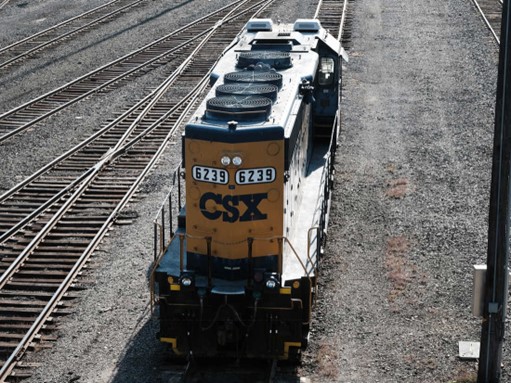
Last week, three major U.S. railroads announced record-breaking profits: Union Pacific made a record profit of $7 billion in 2022; CSX and Norfolk Southern also announced record profits of $4.17 billion and $4.8 billion respectively in 2022. The fourth major U.S. railroad, BNSF, will report its earnings later this month.
Rail corporations are raking in record profits and can afford to provide every worker with paid sick leave.
“Absent a national paid sick leave policy, the burden of securing this humane policy falls onto the shoulders of workers and the unions that represent them,” said TTD President Regan. “Rail labor is committed to pursuing and securing paid leave for workers this year to create a safer, healthier national rail system for all.”
|
|
(Editor's Note: As this issue goes to "press", four unions have penned contracts with CSX providing sick time. To every railroad workers who picketed, demonstrated, raised hell and voted NO on the contract, RWU commends you! It is the working railroader who has moved this whole issue forward. Just imagine where we would be now if we had taken the advice of the carriers, the PEB, the government and the union officials and celebrated the PEB and joyfully voted yes. That's right, Nothing would be happening. Thanks to the "uprising of the rail workers" this past fall, this is just the beginning as we move this issue - and others - forward!) |
|
Rail Workers Never Stopped Fighting for Paid Sick Days. Now Persistence is Paying Off
February 10, 2023 Andrea HSU
|
|
It seemed like a done deal just two months ago.
Rail workers had brought the country to the brink of a nationwide rail shutdown over the fact that they didn't have paid sick leave - and wouldn't get any in the contract they were negotiating with their bosses, the massive freight railroad companies. But then, Congress stepped in to end the impasse. Strike averted.
Through a bipartisan vote, lawmakers imposed a contract that gave workers a substantial raise but no paid sick days.
In rail yards across the country, workers felt deflated — and defeated.
"Here is America's essential workers — rail workers. We have no paid sick days," said Matthew Weaver, a railroad carpenter in Toledo, Ohio, just after the vote. "It's disgusting."
Fast forward to this week.
One of the largest freight railroads in the world, CSX, announced a deal with two rail unions, including Weaver's, to provide four days of paid sick leave annually, plus the option of converting three personal days into additional paid sick time.
"It's very exciting. It's a good faith effort to show that we're essential employees rather than expendable," Weaver said this week. "It gives me hope."
What CSX has agreed to so far only covers about 5,000 workers, but the rail carrier says it's pursuing similar agreements with the other rail unions.
The White House took some credit for the developments, with Press Secretary Karine Jean-Pierre telling reporters on Thursday that the deals follow "continued advocacy and involvement from the Biden administration."
|
|
(Editor's Note: While leave provisions in the U.S. are far less generous than in most European countries, the FMLA is landmark legislation for working people. Most railroad workers are eligible and if you qualify, a rail worker may take up to 12 weeks of unpaid leave all at once or a day here and a day there. You or an immediate family member must have a medical condition that warrants the use of such leave from work. Talk to your doctor.) |
|
Family & Medical Leave Act - Helping All Working People for 30 Years |
|
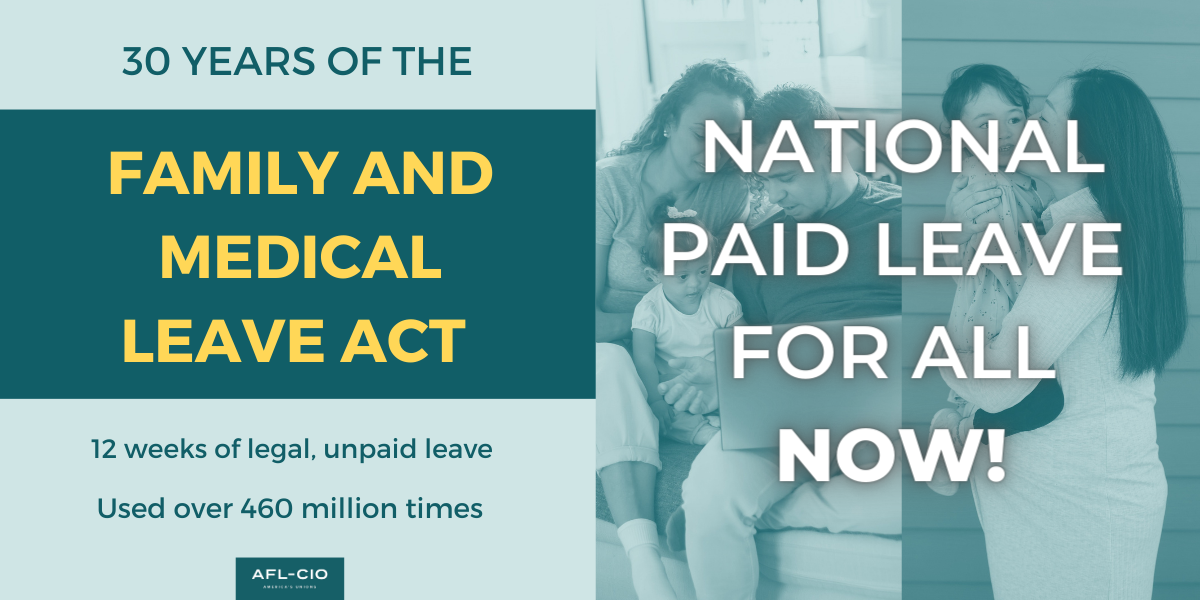
The Family and Medical Leave Act (FMLA) passed 30 years ago and guaranteed 12 weeks of unpaid leave each year to working families. Led by the National Partnership for Women & Families, the labor movement fought in coalition with women’s, disability, children’s, religious and senior citizens’ groups.
After nine years, politicians finally put good policy ahead of party and passed the FMLA with bipartisan support. Working people in the United States have used the FMLA more than 460 million times since then.
But the FMLA is a stepping stone—unpaid leave isn’t good enough.
We’re one of the only countries in the world that has no national paid leave.
Working people deserve better. No one should have to choose between a paycheck or their health and family.
So we’ll keep fighting—for paid sick leave, for paid parental leave, and for the dignity and respect working families deserve.
Tell your member of Congress to support a national paid leave policy!
|
|
(Editor's Note: Environmentalists are discovering the railroad! And not just passenger, but freight. Our recent battle with the national freight rail carriers has opened the eyes of citizens everywhere. People are starting to understand the key role that freight rail plays in our economy, and the need to expand and improve it. But since the companies that own the infrastructure have no interest in that, the solution is to nationalize the Big Class Ones.) |
|
In December, Congress and the Biden Administration forced a deal on railroad workers and stripped them of their right to strike. This made two things clear: how draconian the private freight railroads are to their workers, and yet how essential they are to the functioning of the country. Equally, private railroads are not only essential to the economy, but to the climate. Transportation is responsible for more greenhouse gas emissions than any other sector, including electricity generation. Within transportation, among the modes primarily used for freight (trucks, rail, and boats), railroads were responsible for only 7% of emissions despite carrying 27% of cargo (in ton-miles). Despite being a net reducer of emissions by taking trucks off the roads, the private railroads are avowed enemies of climate action. Afraid of losing their lucrative coal-hauling traffic, the same four railroads who Congress acted on behalf of have spent millions to lobby against climate action and deny climate change. Capitalists who bankroll climate deniers own the most important system of low-carbon infrastructure on the continent.
The effects of the existing freight railroads on climate change, both good and ill, are minuscule compared to the unrealized potential that they hold. The railroads would have a higher share of freight traffic if not for the shortsighted management of their private ownership. Additionally, 57% of transportation emissions come from “light duty vehicles,” i.e. passenger cars. The strongest opportunities to eliminate car trips are in urban centers, by building inviting pedestrian spaces, safe bicycle infrastructure and robust public transit networks. At the same time, to build a credible alternative to automobile travel, these green transportation systems must be connected to one another into metropolitan and intercity rail networks. This cannot be done without the infrastructure that, outside the Northeast, is controlled by the private freight railroads.
|
|
(Editor's Note: As in any train wreck, there are multiple layers as to what the causes were. Behind every failed bearing, broken rail, broken knuckle, "human error" or "act of God" there is a deeper story. Often, factors such as chronic crew fatigue, improper training/qualifying, short-staffing, deferred maintenance and other management failures comes into play. And there can be even more insidious behind-the-scenes factors as well, such as corporate lobbying that forestalls or puts the kybosh on legislation/regulation that would have prevented or mitigated the seriousness of the wreck. RWU has produced a series of Special Reports this past week or so. If you missed them, they are linked below this main article. ) |
|
Rail Workers Blame Fiery Train Crash in Ohio on Wall Street Profit-Seeking |
|
An inter-union alliance of rail workers argued Tuesday that the massive freight train crash in East Palestine, Ohio late last week was a predictable consequence of Wall Street-backed policy decisions that have hollowed out the industry's workforce, pushed remaining employees to chronic exhaustion, and sacrificed safety for profits.
In an assessment of the Norfolk Southern (NS) train derailment based on currently available information, Railroad Workers United (RWU) wrote that "the root causes of this wreck are the same ones that have been singled out repeatedly, associated with the hedge fund-initiated operating model known as 'Precision Scheduled Railroading' (PSR)."
The group noted that the "immediate cause" of the wreck "appears to have been a 19th-century-style mechanical failure of the axle on one of the cars—an overheated bearing—leading to derailment and then jackknifing tumbling cars."
"There is no way in the 21st century, save from a combination of incompetence and disregard to public safety, that such a defect should still be threatening our communities," wrote RWU, which supports nationalization of the U.S. rail system.
"Forty percent of the weight of NS 32N was grouped at the rear third of the train, which has always been bad practice and made more dangerous with longer heavier trains," the statement continued. "This fact almost certainly made the wreck dynamically worse. But increasingly the PSR-driven carriers, driven to cut costs and crew time by any means necessary, cut corners and leave crews and the public at risk."
According to RWU, "The short-term profit imperative, the so-called 'cult of the Operating Ratio' - of NS and the other Class 1 railroads - has made cutting costs, employees, procedures, and resources the top priority. In this case, NS and the other carriers have eliminated many of the critical mechanical positions and locations necessary to guarantee protection against these kinds of failures."
The crash in Ohio "has been years in the making," the group added. "What other such train wrecks await us remains to be seen. But given the modus operandi of the Class One rail carriers, we can no doubt expect future disasters of this nature."
|
|
More Perfect Union Weighs in on the East Palestine, OH Wreck |
|
Back in December a union rail worker warned about the potential for a catastrophic train derailment. Then, a week ago, it happened in Ohio. |
|
(Editor's Note: Metro-North is one of the nation's largest passenger carriers, and a strike would tie up the greater New York Metropolitan area. Will the U.S. government attempt to break this looming strike if/when it comes to fruition? Stay tuned.) |
|
Metro-North Electrical Workers Gear Up for Potential Strike
Rail travelers from three states may need alternate transportation if the first Metro-North strike in 40 years materializes.
|
|
Unions representing more than 1,000 Metro-North Railroad workers are beginning to rumble about a potential strike against the country’s second-busiest weekday commuter railroad.
Members of System Council No. 7 of the International Brotherhood of Electrical Workers (IBEW) last week received letters requesting they vote to approve a strike against Metro-North Railroad, the MTA commuter rail line that takes close to 180,000 riders on weekdays between towns in New Jersey, New York and Connecticut and into The Bronx and Manhattan.
“We’re at a deadlock, we’re not getting anywhere with Metro-North,” Arthur Davidson, the union’s general chairman, told THE CITY. “They won’t deviate from their position.”
In a January 20 four-page letter to electrical workers, Davidson laid out the union’s positions.
“Metro-North’s position is that we must accept their wage proposal because other unions have accepted their proposal and established a ‘contract pattern,’” he wrote.
Contract negotiations with the MTA have been ongoing since 2019. Labor leaders said that after 10 collective bargaining and mediation sessions, talks have hit an impasse. The union leaders charge that electrical workers on the Long Island Rail Road receive “considerably greater compensation” than their Metro-North counterparts.
The IBEW is one of several unions that represent Metro-North workers and is backed by two Transport Workers Union locals, whose members include mechanics and car inspectors. The TWU filed a separate federal request for mediation in the contract dispute, according to documents obtained by THE CITY.
“If and when IBEW strikes, we will not cross the picket lines,” John Samuelsen, international president of the TWU, told THE CITY. “They will have no ability to run trains.”
|
|
(Editor's Note: This study is long-awaited and can have a dramatic effect upon the Amtrak Map. If all of the routes that have been taken off in the last 50 years of Amtrak's existence were to be restored, we would actually have some semblance of a national passenger rail system. All rail workers should get involved in support of these train restorations. Freight guys too! The job you help create may one day be your own!) |
|
Federal Railroad Administration Conducts Amtrak
Daily Long-Distance Service Study
|
|
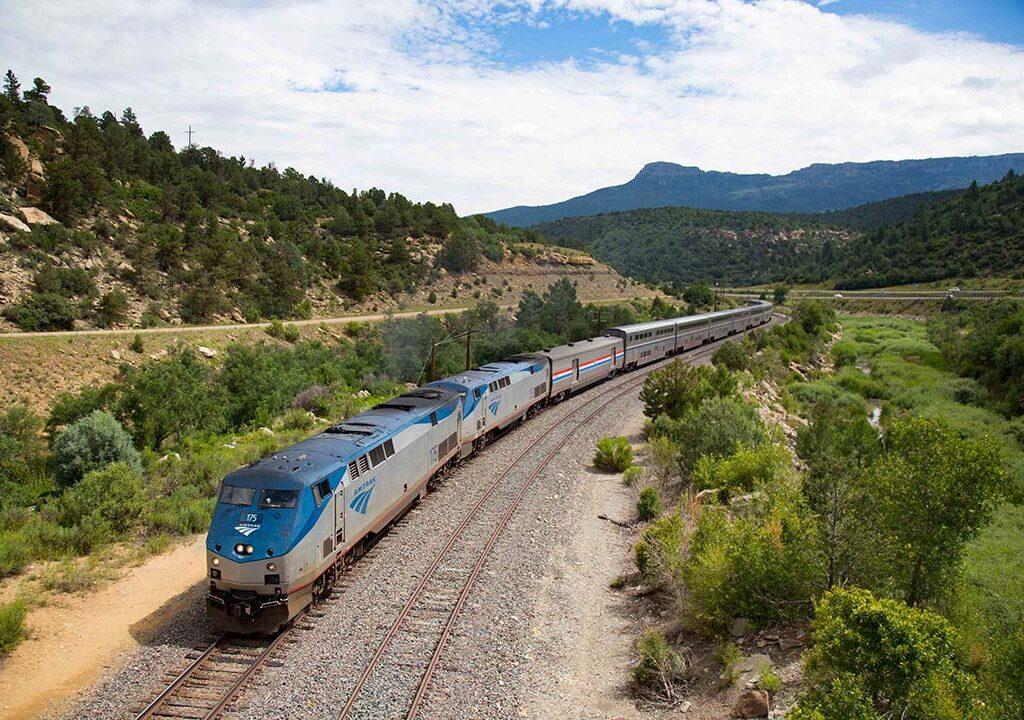
The Federal Railroad Administration (FRA) is conducting an Amtrak Daily Long-Distance Service Study to evaluate the restoration of daily long-distance intercity rail passenger service and the potential for new Amtrak long-distance routes. This study will ultimately create a long-term vision for long-distance passenger rail service and identify capital projects and funding needed to implement that vision.
Section 22214 of the Bipartisan Infrastructure Law (BIL) of 2021 tasks the FRA, under delegation from the Secretary of Transportation, with conducting an Amtrak Daily Long-Distance Service Study to evaluate the restoration of daily intercity passenger rail service and the potential for new Amtrak long-distance routes. Under BIL, the FRA is required to conduct a study to evaluate the restoration of daily intercity rail passenger service along:
- any Amtrak long-distance routes that were discontinued; and
- any Amtrak long-distance routes that occur on a nondaily basis.
- In evaluating intercity passenger rail routes, FRA may evaluate potential new Amtrak long-distance routes, including with specific attention provided to routes in service as of April 1971 but not continued by Amtrak, taking into consideration whether those new routes would:
- link and serve large and small communities as part of a regional rail network;
- advance the economic and social well-being of rural areas of the United States;
- provide enhanced connectivity for the national long-distance passenger rail system; and
- reflect public engagement and local and regional support for restored passenger rail service.
|
|
'Workers Know the Truth’ About the Derailment Disaster - Why Are They Being Ignored?
By Bob Hennelly
|
|
Throughout the recent hazardous chemical freight train derailment in Ohio and the four-day ordeal that followed while the flaming wreck was stabilized, the one perspective that was consistently missing from the reporting was that of the union railroad workers. It didn’t matter if it was the New York Times, the Washington Post, or the Associated Press , the reporting relied on interviews with local, state and federal officials as well as statements from the Norfolk Southern, the rail carrier but not the perspective of their union workers.
It was as if robots and AI were already driving the train. The entire narrative of the cataclysm was framed by officials and the corporation whose malfunctioning train was now putting workers and the community in life-threatening jeopardy. The derailment played out in the rural borderland of Ohio and Pennsylvania requiring both states to activate an emergency evacuation response.
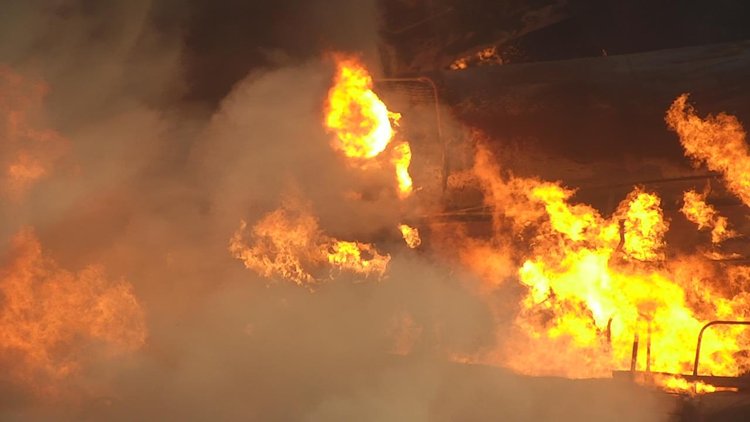
On Friday evening, the tranquility of East Palestine, Ohio, with a population of 4,761 people, was upended when a Norfolk Southern train with 150 cars in tow, derailed sparking a conflagration that inundated the area with toxic smoke. According to the U.S. Environmental Protection Agency [EPA], 20 of the cars in train were carrying hazardous materials.
The U.S. EPA had to start monitoring the air for carbon monoxide, oxygen hydrogen sulfide, hydrogen cyanide, phosgene, and hydrogen chloride. Throughout the weekend, firefighters did their best to keep the disabled tanker cars cool as some of the hazardous cargo burned off. The local fire chief told reporters he was concerned about the presence of vinyl chloride, a colorless, toxic, and flammable gas.
|
|
(Editor's Note: Every rail workers should be asking themselves these questions: How did we come to this point in history? How do we keep the momentum going? How can we build a more effective coalition of ALL rail workers in the next round of bargaining. How can we win better working conditions in the environment we find ourselves in? Would we fare better if the railroad industry was publicly owned and run by the workers? What is MY role in this struggle?) |
|
Where Do Railroad Workers Go from Here?
Four railroad workers discuss Congress’s handling of the rail contract dispute, and how Wall Street’s destruction of the freight rail system is only going to get worse for workers, shippers, and all of us.
|
|
After a three-year saga of stalled contract negotiations between the country’s freight rail carriers and the 12 unions representing over 100,000 railroad workers, “pro-union” President Biden and Congress “averted” a national rail shutdown by overriding the democratic will of rail workers and forcing a contract down their throats. So, what happens now?
In December, shortly after the Biden administration and Congress intervened, Working People convened a special all-railroader panel to break down the events of the last week and to discuss where railroad workers and the labor movement go from here.
Panelists include: Jay, a qualified conductor who was licensed to operate locomotives at 19 years old, and who became a qualified train dispatcher before he was 23; Marilee Taylor, who worked on the railroads for over 30 years and retired earlier this year from her post as an engineer for BNSF Railway, but is still an active member of Railroad Workers United; John Tormey, a writer and BWMED-IBT member who works as a track laborer for the commuter rail in Massachusetts; and Matt Parker, a full-time locomotive engineer who’s worked on the railroads for 19 years and also serves part-time as Chairman on the Nevada State Legislative Board of the Brotherhood of Locomotive Engineers and Trainmen.
John Tormey: My name is John Tormey. I’ve been a member of BMW EDIBT for about 11 years, and I work on a commuter railroad in Massachusetts.
Jay: Hey everyone, my name is Jay. I started with the railroad in 2005 in Maryland and worked in the transportation side as a conductor and remote control operator until 2010. And then in May of 2010 I took promotion to train dispatcher and I’ve been doing that ever since, still currently doing that.
Marilee Taylor: My name is Marilee Taylor. I recently retired from the BNSF in Chicago after over 28 years on the BNSF. I started on the railroad in the South in 1987. All together it’s 34 years actually working on the railroad. That’s basically it, and I’m so happy to be retired.
Matthew Parker: Hi, my name is Matt Parker. I live in Northern Nevada. Went to work for the railroad in 2004 as a brakeman conductor. Took promotion to engine service about a year later, and I’ve worked for the railroad for about 19 years now. I’ve been a member of the Brotherhood of Locomotive Engineers and Trainmen since I hired out.
|
|
(Editor's Note: Another homespun video making the rounds. Railroad workers are finding their oats and speaking out in creative ways. Maybe you too, Mr. or Ms. Railroad Worker, want to join the band?) |
|
Video - Just Another Day on the Railroad
"Calling Out Corruption"
|
|
6 Billion in share stick buybacks for Wall Street while your freight is carelessly delayed by trains too long for sidings |
|
(Editor's Note: We include this article here because it is interesting to see a contract on a small shortline railroad in this day and age. There was a time when the conditions of employment in general were not nearly as good as on a Class One railroad. No more. Check it out. They won removal of the wage step AND 5 weeks of vacation after just 11 years of service! The national vacation agreement that most Class One rail workers labor under was negotiated well over half a century ago and allows for 5 weeks after a whopping 25 years! Time for the Class One employees to catch up. Next contract? Here we go! |
|
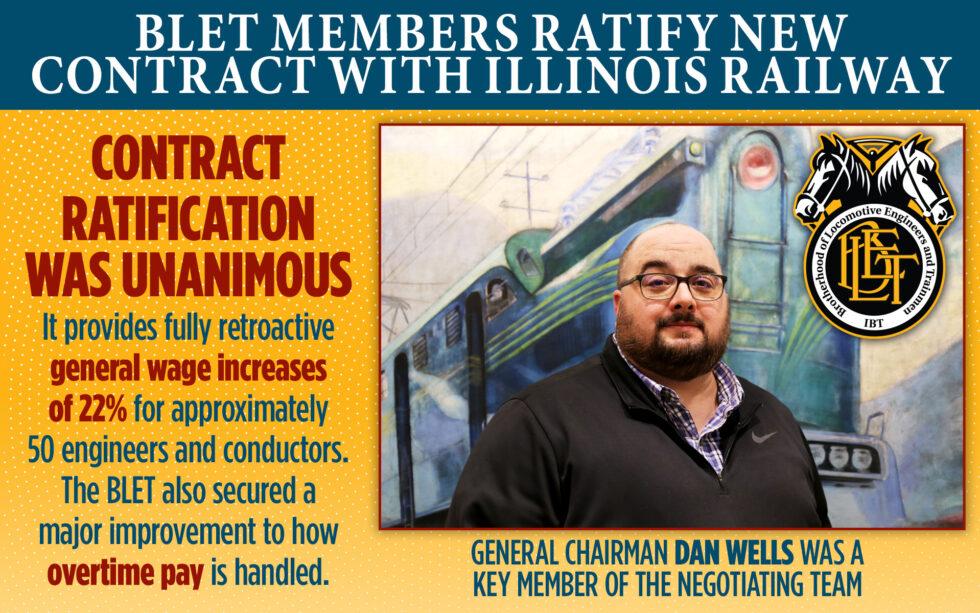
BLET Members Ratify New Contract with Illinois Railway |
|
INDEPENDENCE, Ohio, February 10 — Today, members of the Brotherhood of Locomotive Engineers and Trainmen (BLET) unanimously ratified a new collective bargaining agreement with the Illinois Railway.
The new five-year agreement governs rates of pay, work rules, and health & welfare for approximately 50 engineers and conductors. The contract provides fully retroactive general wage increases of 22% over the life of the deal. The BLET secured a major improvement to how overtime pay is handled. Members will now earn overtime pay (at one and one-half times) after 8 hours instead of after 50 hours under the previous contract. The new contract guarantees all members will be eligible for five weeks of vacation (25 days) after 11 years of service, two paid personal days, an additional holiday, and secured overtime rates of pay for working rest days and holidays. Additionally, the BLET secured the removal of the wage step rate and incorporated training pay and a 30-minute lunch period.
|
|
(Editor's Note: Another year, another week-over-week decline. No surprises here.) |
|
Week 5: U.S. Rail Volume Slide Continues |
|
U.S. railroads hauled 449,586 carloads, containers and trailers in the week ending Feb. 4, a 1.9% decrease compared with the same week last year, according to Association of American Railroads data.
Carloads for the week totaled 216,700, down 0.9%, while containers and trailers totaled 232,886, down 2.9%.
Six of the 10 carload commodity groups that AAR follows on a weekly basis logged increases. They included motor vehicles and parts, up 2,725 carloads to 13,155; petroleum and petroleum products, up 1,578 carloads to 10,727; and nonmetallic minerals, up 1,445 carloads to 25,578.
Commodity groups that posted decreases during the week included coal, down 6,723 carloads to 58,224; grain, down 1,236 carloads to 22,244; and chemicals, down 1,182 carloads, to 32,743.
|
|
|
|
|
|
|