POLICY & ADVOCACY UPDATE

Issue #10, 29 November 2023

  • Closing Loopholes IR Bill closer to being passed
  • Meeting of Skills Ministers
  • Price rises in travel and accommodation below CPI average
  • Tourism Industry meets with Federal Minister
  • Occupancy rates for October 2023
  • Two cruise companies pull out of Melbourne

Closing Loopholes IR Bill closer to being passed

Yesterday the Minister for Employment and Workplace Relations tabled amendments to the Fair Work Legislation Amendment (Closing Loopholes) Bill 2023 including the changes negotiated by the AHA concerning casuals as well as those negotiated with other parties on labour hire, and employee-like arrangements. The tabled amendments on casuals include:

  • A new note in the casual definition inserted to state that “A regular pattern of work does not of itself indicate a firm advance commitment to continuing and indefinite work.”
  • An amendment to clarify that no single consideration is determinative of an employee’s status under the casual definition.
  • abolishing the existing sections 66F-66J in the Fair Work Act which provides for the residual right to request casual conversion. This means that the new right to request conversion would become the only such right for employees.
  • the removal of the proposed offence in section 359A from the Bill which would have penalised employers for hiring someone as a casual when the worker did not meet the definition of a casual.
  • an amendment to provide that any period of employment of a casual employee that occurred before the commencement of the casual changes would not affect the employee’s status for the purpose of exercising the new right to request conversion.


The Minister has also finalised a deal with the Greens that has resulted in further amendments to the Bill including an amendment addressing intractable bargaining where any arbitrated outcome will only ever leave the employer worse off and an expansion to wage theft offences to include underpayments for superannuation, long service leave and other forms of paid leave.

Meeting of Skills Ministers

State and Territory Skills Ministers met with the Federal Minister for Skills and Training on 17 November 2023 to set national priorities arising out of the new training agreement (see previous advocacy update), and to set the agenda for national reform work in 2024. Key Priorities for the Council in the coming year include: embedding the new model of stewardship to deliver national priorities; placing TAFE at the heart of the VET sector, building sector capability and establishing TAFE Centres of Excellence; delivery of key National Skills Agreement initiatives and reform of foundation skills; and First Nations engagement including Closing the Gap.

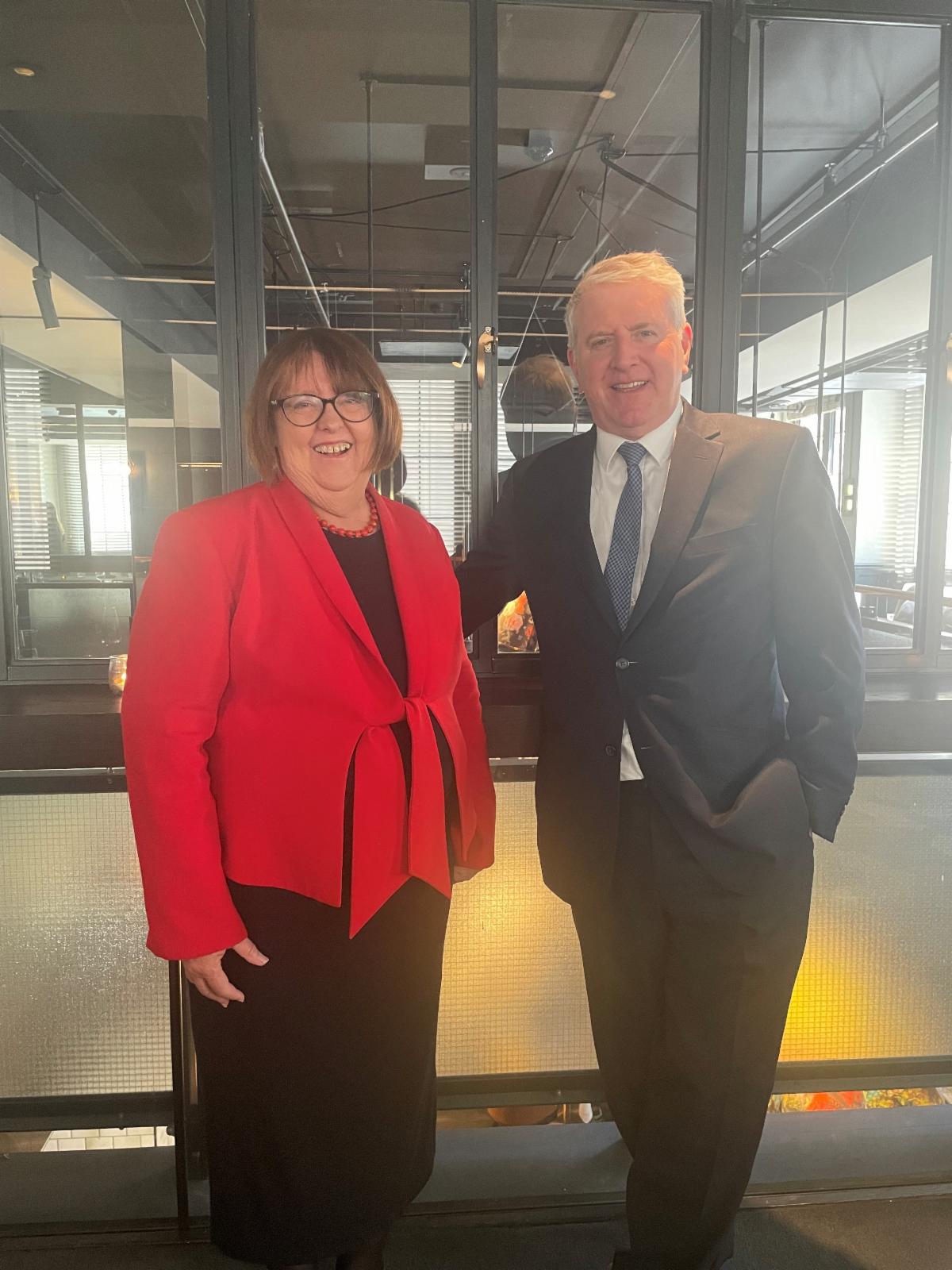
Despite this rosy picture, there remain concerns in our industry that important qualifications such as in food & beverage are not being funded except when part of an apprenticeship. TAFE NSW advised me this week that only one qualification in tourism and hospitality was being funded in 2024 which is sure to lead to students choosing other subsidised courses. I raised this concern when I met last week with the Minister for Skills and Training Brendan O'Connor (see photo).


Price rises in Travel and Accommodation below CPI average

In what may be good news for business loans and mortgages, the inflation rate for the year to October 2023 has dropped to 4.9% which will hopefully result in the Reserve Bank keeping interest rates on hold at next week's board meeting. Interestingly over the year to October, the average price of alcohol rose 4.5% (around the average) but for holiday travel and accommodation, prices rose only 1.8% which is more than 3 percentage points below the average price increase across all goods and services in the index. Gas, electricity, food, health and insurance all rose above the index average.

Tourism Industry meets with Federal Minister

At a roundtable organised by Austrade on 21 November, tourism and travel industry leaders met with the Minister for Trade and Tourism, Senator Don Farrell, to raise issues important to our sectors. AA took the opportunity to highlight the importance of the imminent migration strategy as well as the need for appropriate regulation of short-term rental accommodation. Other industry bodies raised concerns that there was still a lag in the return of international holiday makers and also that persistent skills shortages continue. The head of Tourism Research Australia also drew attention to the recent release of the five-year forecasts for tourism. which indicate an overall positive outlook for the visitor economy. In the next five years, TRA predicts that international travel to Australia will exceed its pre-pandemic level in 2025, and tourist spend in Australia will exceed its pre-pandemic level in 2024. Also, domestic travel will stabilise in 2023, after strong growth in 2022, but domestic tourism spend, which already exceeds its pre-pandemic level, will continue to rise. For the full forecast report see here.

Occupancy Rates for October 2023

The latest monthly report from STR for October 2023 shows that occupancy rates for that month were virtually the same as for the previous year, with the average rate being 72.7% in October 2023 compared with 72.1% In October 2022. Western Australia continues to record the highest average occupancy rate at 80.4% which is 6 percentage points higher than October 2022. Rates in the NT continue to struggle, with the average only 57.5%. The ACT at 69.6% is well below its previous October rate of 78.3%. In all states except WA, the rates continue to be below pre-COVID 2019 levels, where the national average occupancy rate for October 2019 was 78.5%. The average national daily rate (ADR) for October 2023 was $236 which was below $242 achieved in October last year but up on $191 for October 2019. Averages for the year to October 2023 indicate a post-COVID recovery trend with a national average occupancy rate of 69.3% compared with 64.5% last year, but still below pre-COVID average for the year to October 2019 of 73.6%.

Two cruise companies pull out of Melbourne

Princess Cruises and Cunard have both announced that they will no longer sail from Melbourne from 2025-26 which will be a blow for accommodation members in that city as cruise customers generate strong accommodation demand. The Cruise Lines International Association estimate that this will be the loss of 23 home port visits and 69,000 cruise guests. CLIA blamed the decision on port fees, taxes and other costs.

Drop me an email at policy@accommodationaustralia.org or give me a call on 0418 277 919 if you have any national policy issue that you think AA should be following up.  If you know an AA member who is not receiving this advocacy report but wants to, then encourage them to email me and we can add them to the distribution list.


Kind Regards


Jenny Lambert

National Policy & Research Advisor

Accommodation Australia

Facebook  Linkedin