A Newsletter from the Connecticut Department of Energy and Environmental Protection
Exploring Long Island Sound - Issues and Opportunities
| |
|
In Stony Brook, NY, floodwaters damaged a dam on Mill Pond, causing the pond to empty into Long Island Sound in what Brookhaven Town Supervisor Dan Panico called “an environmental and economic disaster.” Similarly, Blydenburgh Lake (also known as Stump Pond), a popular freshwater fishery, was wiped out after a dam collapse. This has led to debate over whether the dams should be rebuilt to retain the two water bodies, or if the Nissequogue River, which feeds both, should be allowed to return to its natural flow.
While the remnants of Hurricane Ernesto were travelling along the East Coast at the time, the storm that hit Connecticut and then Long Island was separate from that storm system. The storm itself was not forecasted to be anything particularly unusual, but the amount of rain falling in a short time was both unusual and unexpected. The amount of moisture in the air, combined with the slow-moving weather system, created the perfect conditions for the storm to unload far more precipitation than predicted. In this issue, we will discuss why climate change is increasing the likelihood of these severe precipitation events. Calling these events “natural disasters” may not be the appropriate term if we evaluate the definition of those two words.
| 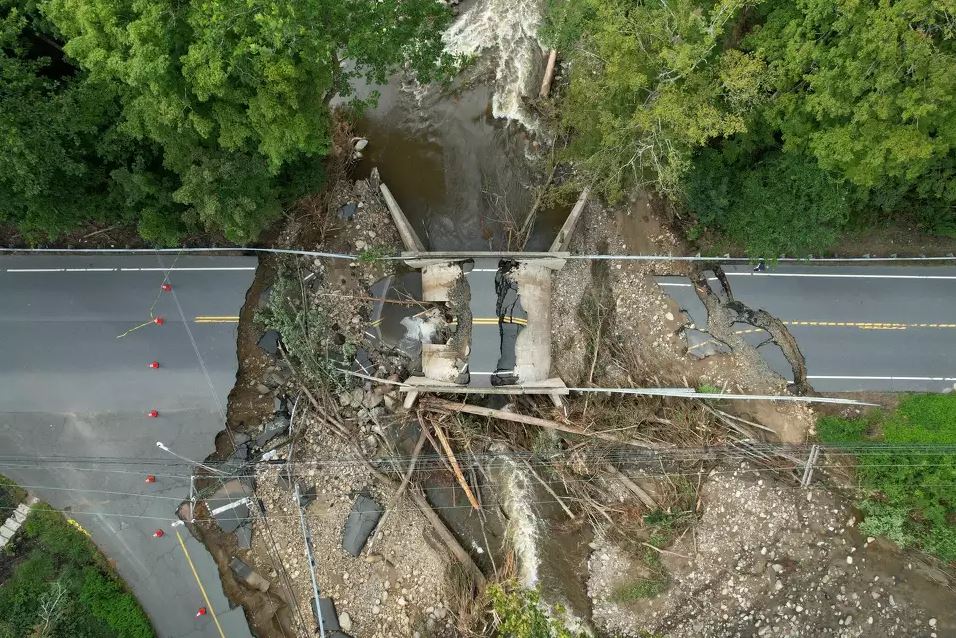 | |
Flood damage at the intersection of Roosevelt Drive and Loughlin Road in Oxford, closing Route 34
Photo: Tyler Sizemore/Hearst Connecticut Media
| |
|
Just How "Natural" Are These "Disasters"?
When people hear the word “disaster,” they often think of it as an acute event, a disruption, or something unpredictable. However, many weather events we may refer to as disasters are not matters of pure chance, but rather the result patterns and decisions over a longer timetable. The circumstances and human decisions leading up to the event can often provide context which may call into question just how unexpected the event really was. For example, a lightning strike may be thought of as a one in a million disaster, but if you examine a larger timeframe and gain the context of knowing a person was out in a thunderstorm on an open dam carrying a large metal umbrella and camera equipment, the shock isn’t quite as great.
Similarly, when we use the word “natural,” which is usually taken to mean something existing in or caused by nature and not made or caused by humans, to describe some of these disasters that are being accelerated by climate change, should we consider that there is a point where these weather events no longer fit that description? Human activity has actively accelerated climate change, altering global weather patterns and causing changes to the frequency of floods, droughts, and wildfires, often to increasingly deadly consequences.
When the two words are put together to create the term “natural disaster,” we may be normalizing these events and the suffering they cause by characterizing them as a one-off event, independent from a larger picture rather than a consequence of our own decisions and policies.
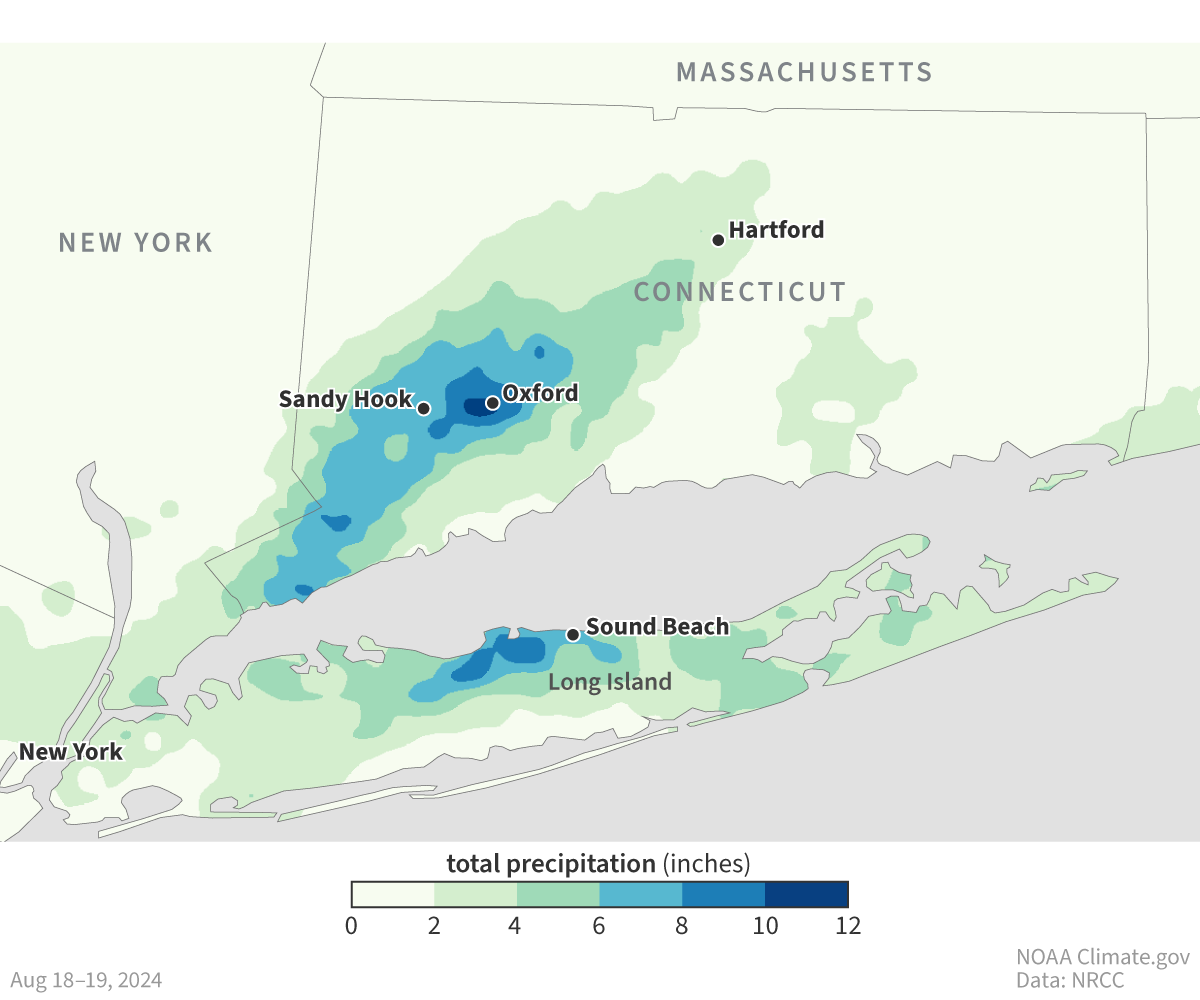
To use a more apt example for the Northeast, let’s think back to last month, when heavy rains turned deadly in Connecticut and floodwaters caused significant damage to roads, bridges, residences, and infrastructure across the southwestern part of the state. One rain station in Oxford, for example, reported 14.83 inches of rain in 24 hours, about four times the town’s average for the month of August. This was a one in 1,000-year storm according to federal rainfall probability data, meaning it has a 0.1% chance of occurring annually. However, the frequency of 100-year and 1,000-year storms is increasing. We may think of this as a natural disaster, but when examined with the context of climate change, we are experiencing severe precipitation events that are worse than forecasted much more frequently, and therefore cannot forget that we have played a role in these events. At what point do we begin to see these disasters as something with a manmade component, and begin to plan accordingly?
| |
|
This precipitation map shows the epicenter of the historic August storm was around Oxford, while significant rainfall also occurred across Fairfield County and on Long Island near Stony Brook
Photo: NOAA
| |
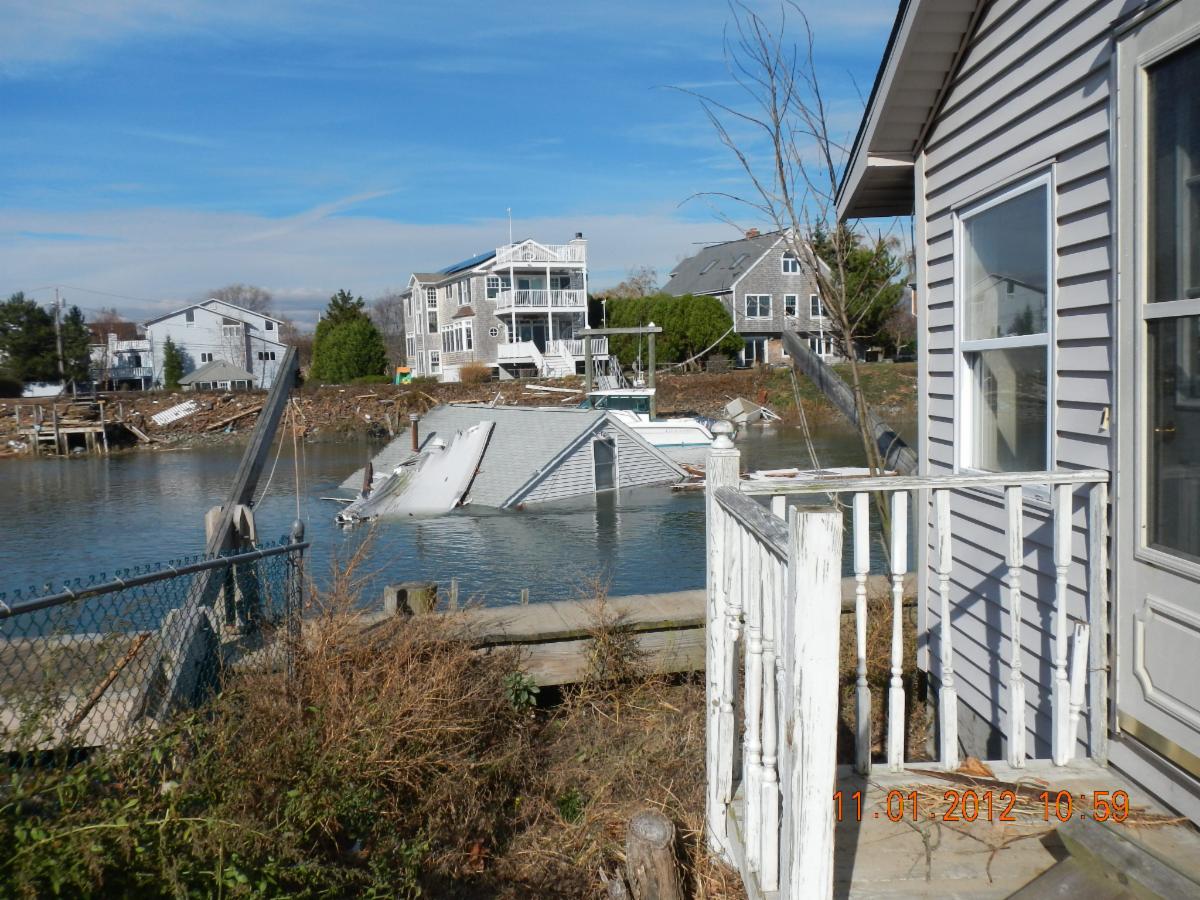
We used to see disasters such as Hurricane Katrina as one-off’s, events that could never happen here in Connecticut. But throughout the last few decades, we have seen an increasing frequency and intensity of storms and floods that are happening in our state. Tropical Storms Sandy and Irene both caused several deaths, major flooding, and shoreline damage in Connecticut in back-to-back years in 2011 and 2012 respectively, and neither was hurricane strength by the time it reached us. Other tropical storms including Isaias, Henri, Elsa, and Ida have caused deadly flash flooding, power outages, tree damage, and infrastructure damage in Connecticut and across the northeast. However, regular thunderstorms such as the one we saw in August have the potential to cause just as much or even more rain than tropical storms and hurricanes, as the rainfall totals in several Connecticut towns far exceeded what was seen during Tropical Storm Sandy or the 1938 New England Hurricane. Changing weather patterns are causing increased severe precipitation from slow-moving summer rainstorms and wet winter nor’easters that cause increasingly severe hazards to life and damage to property. | |
|
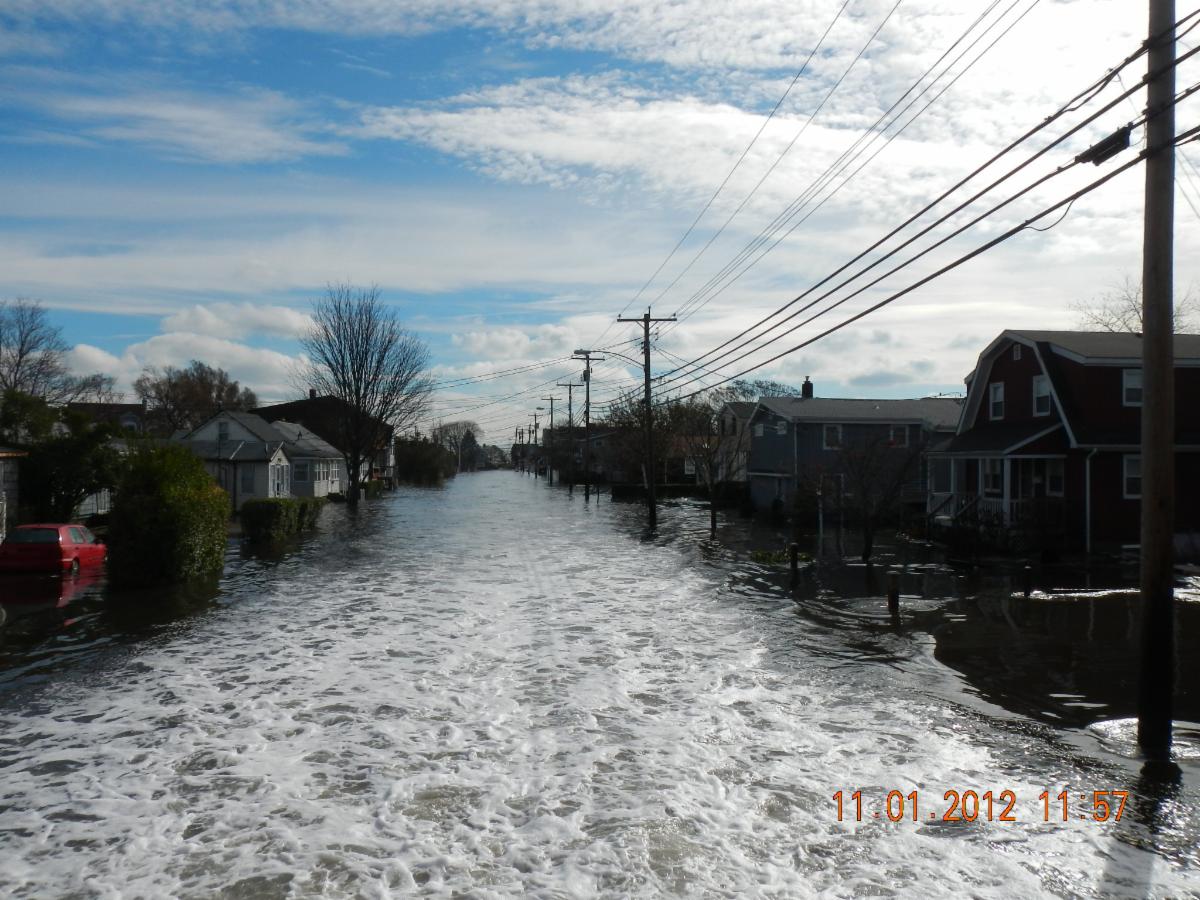
Flood damage from storm surge during Tropical Storm Sandy in Fairfield, CT.
Photos: DEEP LWRD
| |
|
This pattern of increasingly severe precipitation, especially in the Northeast, is forecasted to continue as global average temperatures rise. For every degree of warming in Fahrenheit, the atmosphere can hold about 3%-4% more moisture. Global temperatures in 2023 were more than 2 degrees Fahrenheit above the pre-industrial average, and with particular heat records being set in Connecticut, it’s no surprise that precipitation records were also set as the atmosphere’s moisture capacity increased.
The National Climate Assessment found that days with 3 inches of precipitation or more went up 62% from 1958 to 2018, and the number of days with at least 5 inches more than doubled. A recent study projects that extreme precipitation will increase by 51.6% by the end of the century, with total precipitation increasing by 9.7%. More extreme precipitation means Connecticut towns will need to prepare for more severe flooding events, and the likelihood of floods like the one we experienced in August will only continue to increase.
| |
|
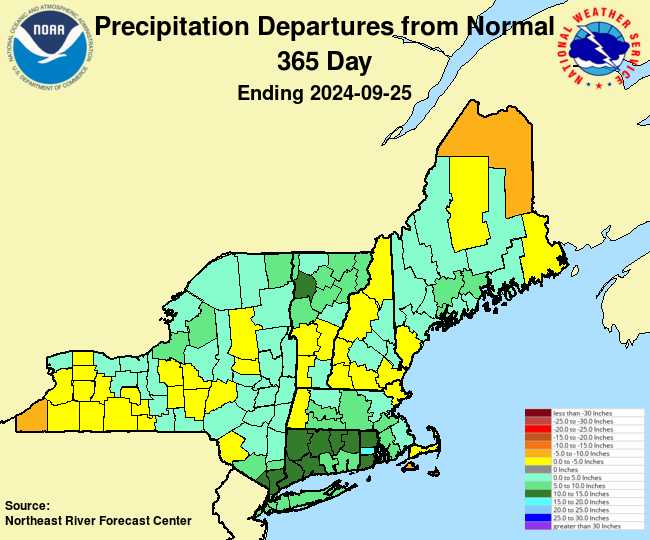
Both 2023 and 2024 have seen higher than normal precipitation in the northeast and specifically in Connecticut. Note that in a 365-day period from September 25, 2023 to September 25, 2024, 6 of 8 counties in the state saw at least 10 inches more than the normal precipitation totals, and all 8 counties saw at least 5 inches more than normal.
Photo and data: National Weather Service Northeast River Forecast Center
| |
Increased precipitation isn’t the only consequence climate change is having on the Northeast. Last year was the second-hottest year at Bradley International Airport since the station began recording in 1949. At Groton-New London Airport, it was also second-hottest year, and at Igor Sikorski in Stratford, it was the sixth-hottest year on record. The EU’s Copernicus Climate Change Service confirmed that 2023 was the hottest year in recorded history worldwide, surpassing 2016. Connecticut saw its warmest January in recorded history in 2023, which was also the least snowy winter ever in Bridgeport. Data from the Connecticut Institute for Resilience & Climate Adaptation (CIRCA) indicates that by 2050, Connecticut is expected to have an average of 20 additional days per year where the temperature rises above 90 degrees.
"This summer, our state experienced the impacts of a rapidly changing climate – from Canadian wildfire smoke creating hazardous air quality conditions to torrents of rain that damaged our roads, flooded homes and businesses, and swelled our rivers," said DEEP Commissioner Katie Dykes of our record-setting 2023 weather.
2023 was also one of the warmest years on record for the surface-sea temperature of Long Island Sound, two degrees Fahrenheit warmer than the long-term (1991-2020) average, according to Gulf of Maine Research Institute. Although weather patterns affect sea temperatures less dramatically than land temperatures, even slight increases in water temperatures can lead to increased hypoxia and negative impacts on biodiversity in Long Island Sound.
| 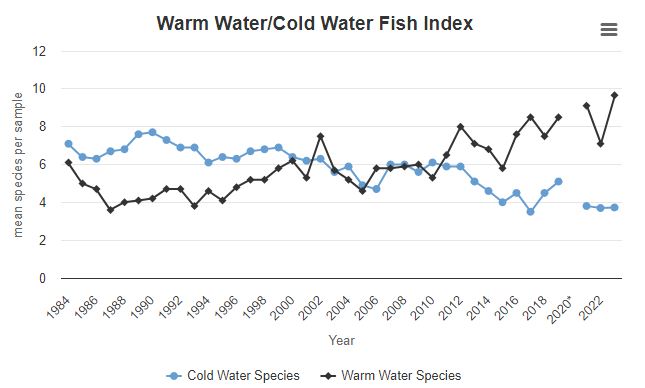 | |
As temperatures in Long Island Sound have gradually increased, warm-water fish, such as black sea bass and summer flounder, are replacing cold-water fish, such as little skate and winter flounder.
Graph/Data: Long Island Sound Study
| |
According to Adam Kemberling, a quantitative research associate at the Gulf of Maine Research Institute, Long Island Sound has warmed at a rate of 0.91 degrees Fahrenheit per decade since 1982, which is three times the global average of all oceans and shows that Connecticut’s coast in particular will be seeing the effects of climate change at a rapid pace. This has already been a factor in reduced lobster and shellfish populations, as we covered in last year’s fall article, as well as increased presence of competing species appearing from further south.
So, if we have the data showing that the hotter and wetter summers are increasing the danger of these events occurring, it is important to plan for them at the individual, municipal, and statewide level. We tend to think of climate change and rising sea level as something that is going to be a consequence that we will have to deal with in 10 years, or 50 years, or next century. However, the fact of the matter is we are already experiencing the effects now, and they are approaching faster than we are prepared for. We know these events are going to continue to happen, and that it’s not a matter of “if,” but “when” they will occur. And we know that the “when” is only becoming more frequent.
| 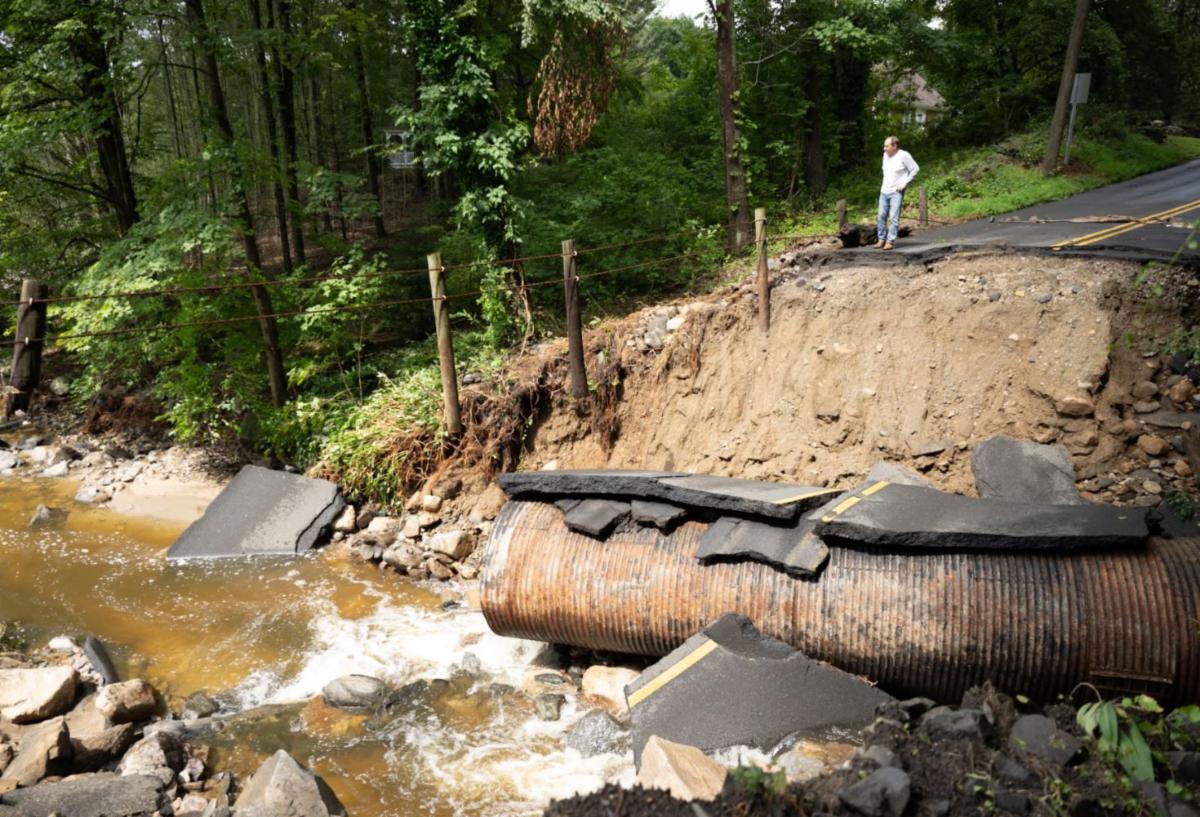 | |
A nearby resident inspects flood damage to Kettletown Road in Southbury
Photo: Tyler Russell/Connecticut Public
| |
Towns across the state are grappling with more severe weather and its impacts on our aging infrastructure. As 100-year storms begin happening with more frequency (as covered in the Fall 2014 Sound Outlook issue), Connecticut must prepare to handle them more regularly. Rather than being reactive and responding only after a flood occurs, it is important that developers and municipalities are proactive in mitigating the effects of theses floods. When making planning decisions, it is important to consider that floods are occurring more frequently and infrastructure at the level of individual property owners and public facilities may need to be upgraded from current outdated or undersized systems. Ensuring that stormwater management systems and municipal drainage systems are properly used and maintained statewide and making stormwater management a central part of the planning process will be a crucial step towards mitigating the damage caused by the increasing precipitation, especially as low-lying areas are already facing increased flood risk from rising sea levels. However, as the August flash floods showed, many of these storms can be worse than forecasted. We must also plan for and be ready to respond to emergencies caused by severe precipitation and flash floods, as we know they will occur. Municipalities should look at the vulnerable areas of their communities and evaluate whether their land use decision-making is being done in a manner that keeps people safe from the worst impacts of our changing weather.
Additionally, municipal land use commissions should be considering flood hazards when reviewing new development proposals. Routes of dry egress are important considerations to provide both access for emergency services and egress for residents to evacuate during a storm or flood event. A route of dry egress should always be provided for significant residential development to ensure residents don’t become trapped in a flood. Large scale residential development in a flood zone should always be discouraged, but especially when there is no ability for residents to safely evacuate or be reached by emergency services. Being able to leave safely is the most effective way to save lives in a storm, and it is important that municipalities ensure that the infrastructure and public services are in place to evacuate. People who rely on public transportation are particularly vulnerable to becoming stranded in a storm, and putting high-density residential buildings in flood hazard zones increases their vulnerability during a flood.
One of LWRD’s responsibilities is to review site plans for coastal development and offer comments to the relevant Planning and Zoning Commission or Zoning Board of Appeals about flood resilience, FEMA compliance, stormwater management, and other coastal resource-related concerns. As Long Island Sound is warming faster than the global average and the frequency of severe storms and precipitation will continue to increase, it may be time for municipalities and planning officials to reevaluate land-use habits along Connecticut’s coastal and inland waterways and place a greater focus on stormwater management and flood resilience. The recent record-setting weather in Connecticut is likely the new normal, and unless we are able to upgrade our aging infrastructure and take a long-term, resilience-based approach to new development, we will be setting ourselves up for failure down the line and finding ourselves increasingly unprepared when the next “natural disaster” hits.
| |
|
SPOTLIGHTED COASTAL RESOURCE: Coastal Water Conditions Lead to Increased Sightings of Whales, Dolphins, Sharks, and Seals
Since the mid-20th century, Connecticut and New York have engaged in efforts to clean up Long Island Sound by improving water quality and addressing wastewater discharge and land-based runoff. These efforts were bolstered by the passage of the 1972 Clean Water Act (CWA). Also passed in 1972, the Marine Mammal Protection Act (MMPA) aimed to protect marine mammals by prohibiting their harassment, hunting, capturing, collecting, or killing in waters of the United States. At the time of the passage of the CWA and MMPA, polluted waters in Connecticut and New York were having ecosystem-wide effects on the populations of marine life at every step of the food chain.
| |
|
As a result of the protections of federal legislation and decades of collaborative efforts between state and non-profit organizations, water quality has steadily improved, and populations of many species of fish and marine mammals are rebounding thanks to both the improved water conditions and efforts to address overfishing.
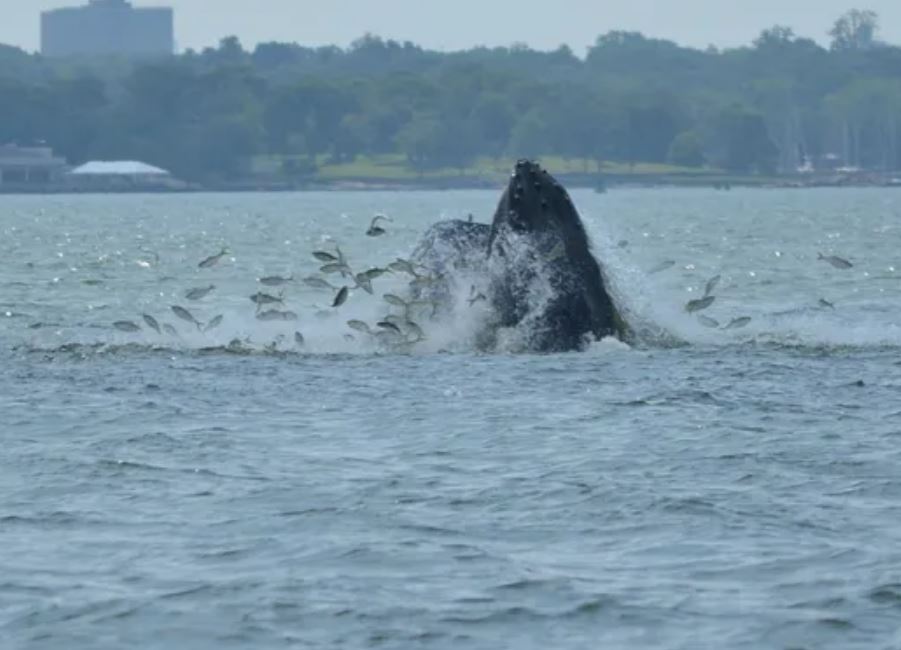
Over the past decade or so, whale sightings and whale counts have both been increasing in Long Island Sound waters, according to Barrett Christie of the Maritime Aquarium. While a breaching whale used to be a very rare sight in Long Island Sound, forage fish such as menhaden and alewife have seen population rebounds that are attracting whales into the Sound.
| |
|
A humpback whale in Long Island Sound near New Rochelle, NY
Photo: Hannah Doyle/Lohud
| |
“It’s taken fish populations more than 30 and up to 50 years to rebound,” Christie said in 2022. “We’re seeing not only more whales, but also more Atlantic white-sided dolphin, more seals, more sharks, and further down the food chain more sand eels and herring.” | |
|
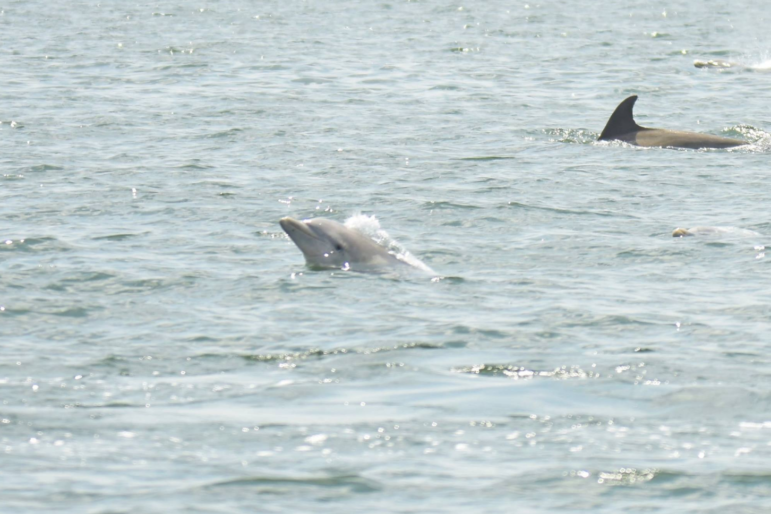
Bottlenose dolphins in Long Island Sound
Photo: Patty Doyle/Maritime Aquarium
| |
In addition to more frequent sightings of humpback and minke whales in the Sound, and even a trio of beluga whales following food as far west as Fairfield, Atlantic white-sided dolphin and bottlenose dolphin sightings are also increasing. Throughout August and September, readers may have seen news articles about several dolphins being spotted in Clinton and Bridgeport. LWRD staff even spotted a dolphin swimming close to shore at Hammonasset Beach State Park in August. | |
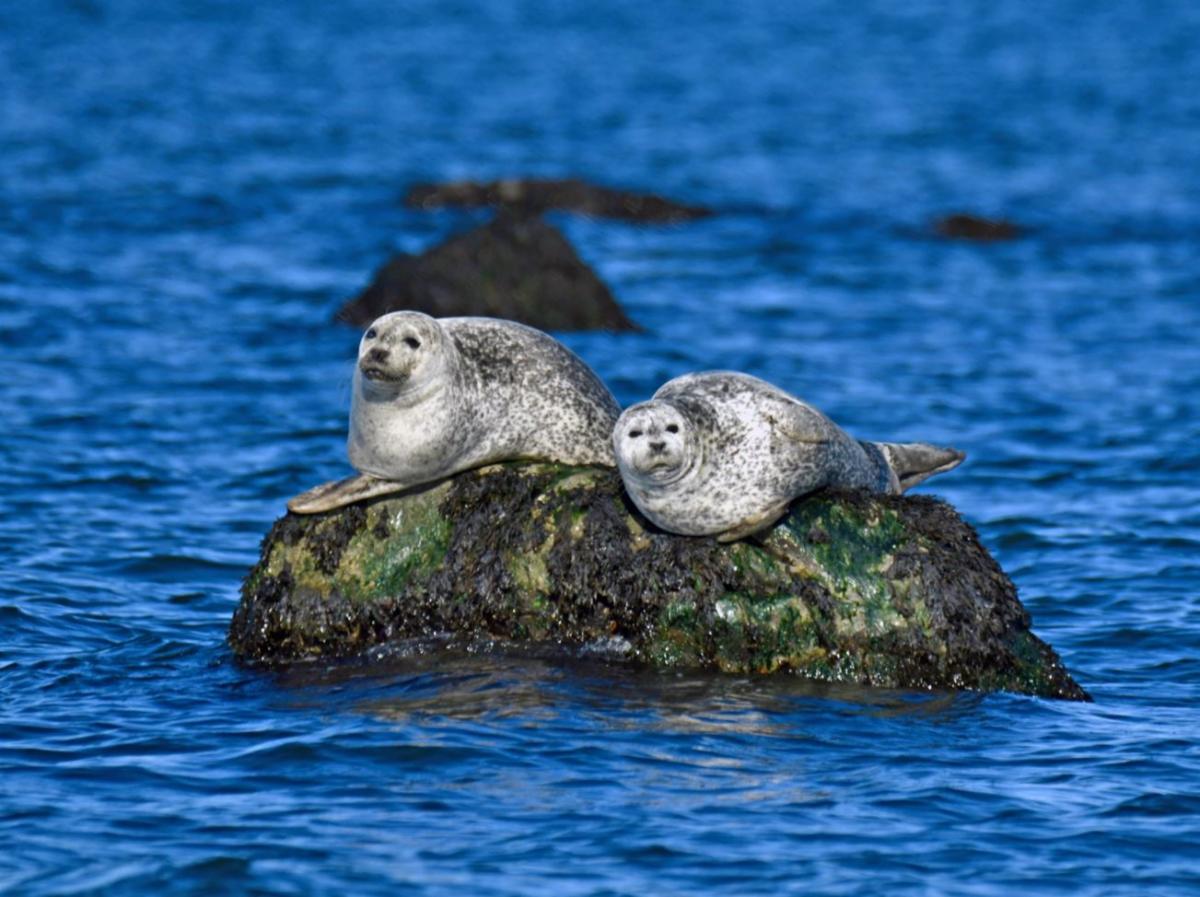
Several species of seals and sharks, which call the waters of Long Island Sound home for part or all of the year, are also experiencing gains in population. Harbor and gray seals stay in the Sound through the winter, from as early as September to as late as June—although some populations are thought to not leave at all. Additionally, harp and hooded seals have been visiting the Sound since the mid-1990s and can usually be spotted from January to early May. Although an increase in seal populations has been a factor in increased great white shark sightings in New England, great whites are not thought to enter Long Island Sound. Species which are common and doing well in the Sound include sand tiger, brown, smooth dogfish, and spiny dogfish sharks. | |
|
Harbor seals on Long Island Sound near Norwalk
Photo: Patty Doyle/Maritime Aquarium
| |
While we have covered Long Islands Sound’s vulnerability to warming waters and climate change in this issue, it’s important to note that there are also great success stories related to water quality improvement and conservation efforts that have slowly and steadily improved the ecosystem of the Sound. Seeing a whale or dolphin in the Sound is still a rare treat, but anyone interested in spotting more abundant seals and other marine life can take seal watch cruises offered by various operators in Connecticut, including the Maritime Aquarium and Project Oceanology, and enjoy the benefits of decades of collaborative efforts to improve Long Island Sound. | |
|
FOUND IN THE SOUND: Four Seals Released by Mystic Aquarium
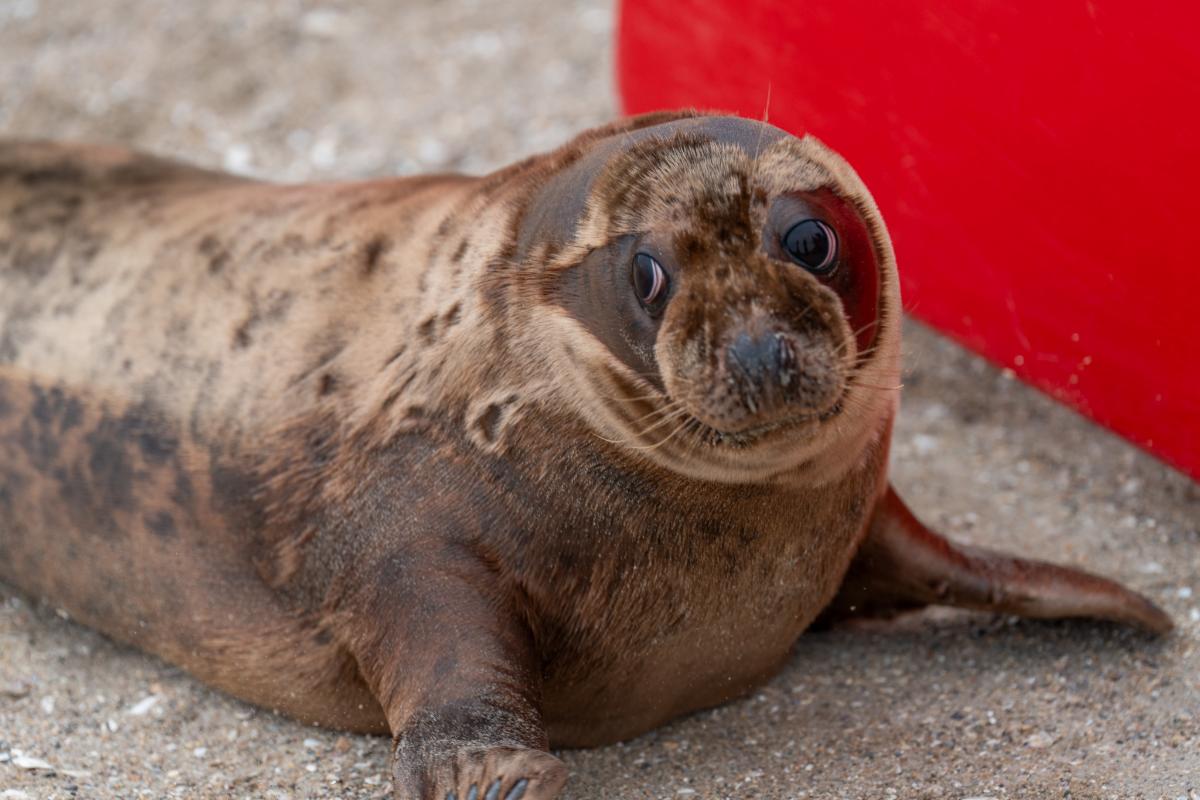
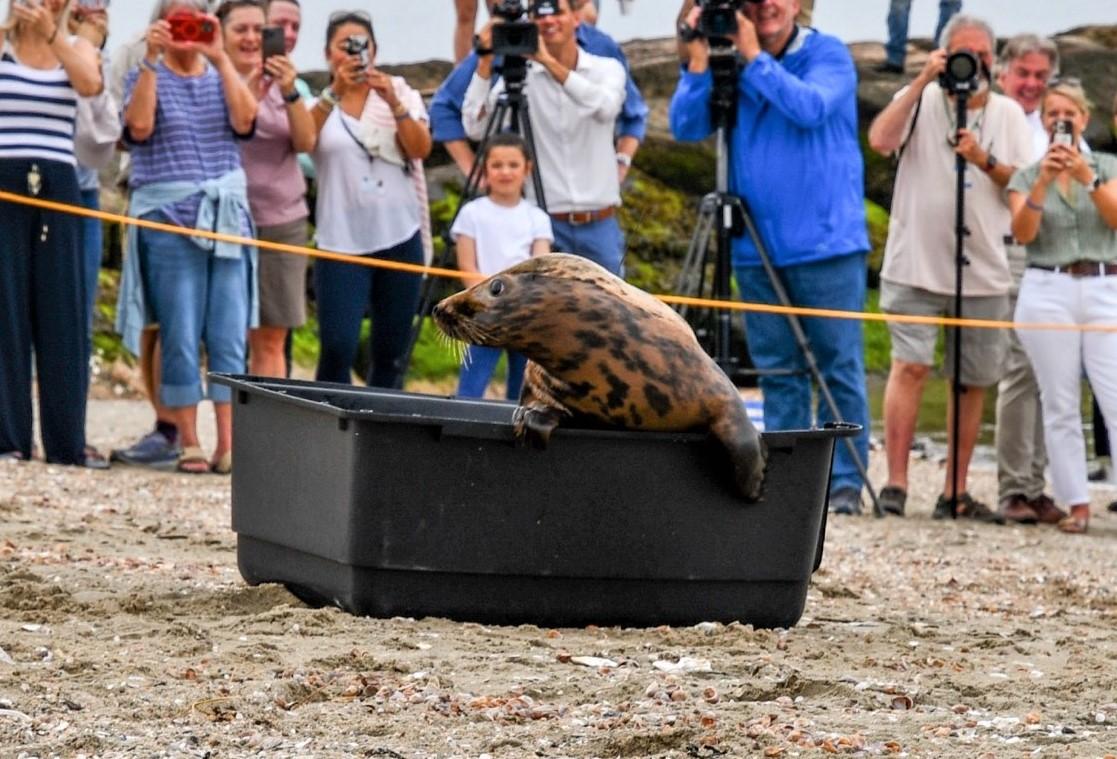
In other seal-related news, scientists and volunteers at Mystic Aquarium were able to release four rehabilitated gray seals back to the wild this past summer. As Mystic Aquarium’s largest seal release ever, it drew a crowd of hundreds to send the seals off on July 25, 2024.
| | |
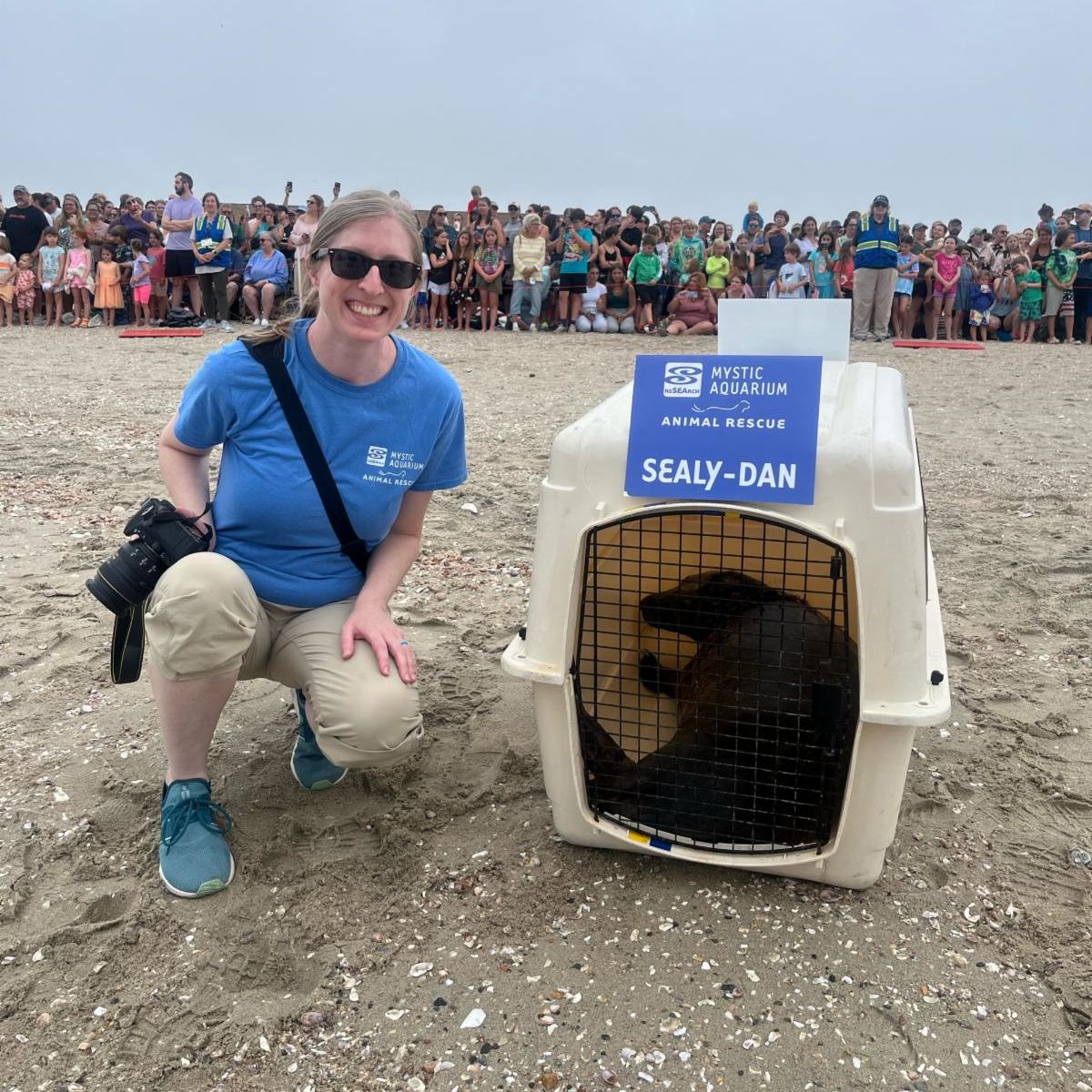
Kathleen Perzanowski (former First Impressions subject) of LWRD volunteers with Mystic Aquarium's Animal Rescue Program | |
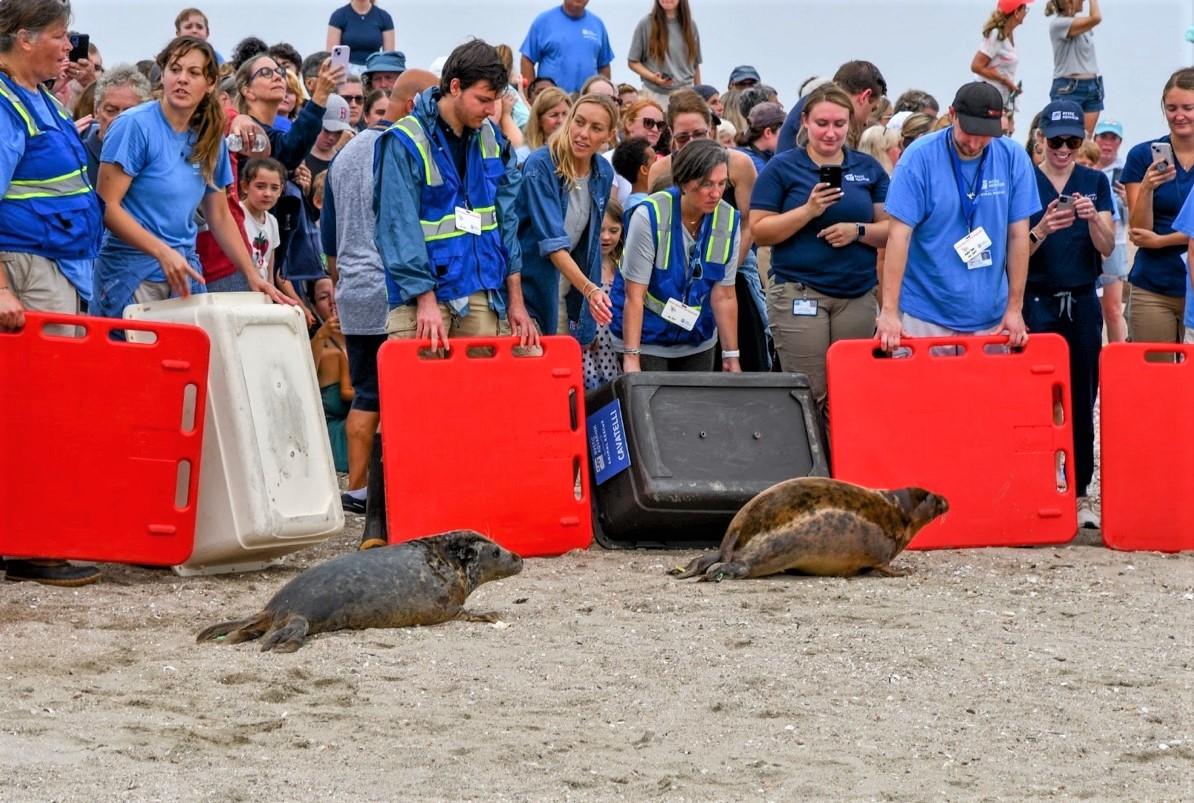
The seals were set free at Hammonasset Beach State Park in Madison and flopped around the sand a bit before swimming out into the waters of Long Island Sound, a treat for the roughly 1,000 people in attendance. The released seals were all taken in from Block Island and included Tortellini, a young female that was found entangled in rope and fishing line; Orecchiette, another young female who was thin and lethargic upon rescue, had an infected wound on her rear flipper, and gained 50 lbs. during her rehabilitation; Sealy-Dan, a young male with a significant puncture wound on his shoulder; and Cavatelli, another young male with numerous lacerations on the right side of his abdomen. All of the seals made full recoveries with the help of their caretakers. Mystic Aquarium's Animal Rescue Program manager Sarah Callan said that warming waters in Long Island Sound allows bacteria to thrive and that rescuers are seeing more infections. | |
At the time of their release, the seals were four of 20 taken in by the aquarium this year due to fishing line entanglements or injuries. While these four were found near Block Island, others came in from Groton, Old Lyme, Rhode Island, and Cape Cod. Now that they are back in the wild, they will have likely headed to northern New England or Canadian waters, where they will stay until water temperatures begin to drop, at which time they will likely return to the Sound for the winter. The Aquarium will use satellite tags on some of the seals to track their movement, which will provide up to three months of data including the seal’s real time location and diving depths, so researchers will be able to see exactly where they venture after their release. | |
|
A crowd of about 1,000 people came out to Hammonasset Beach State Park to watch and participate in the release. Seals pictured: Sealy Dan (left), Orecchiette (left and top right), and Tortellini (right).
Photos: Kathleen Perzanowski, Mystic Aquarium Animal Rescue Program / DEEP LWRD
| |
|
New York Horseshoe Crab Protection Bill Still Awaits Governor's Signature
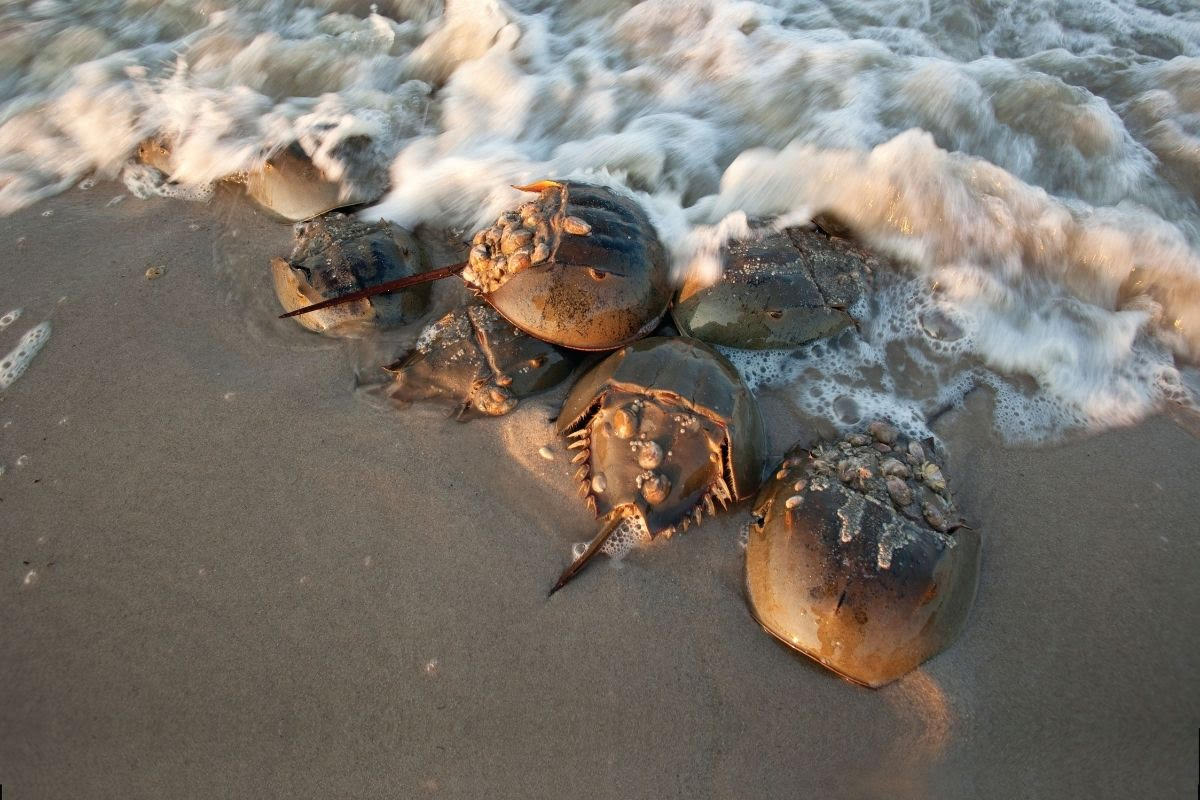
In June of 2024, the New York State Legislature approved a bill which would ban the harvesting of horseshoe crabs from New York State waters, except for educational and research purposes. However, the legislation is still awaiting the signature of New York Governor Kathy Hochul.
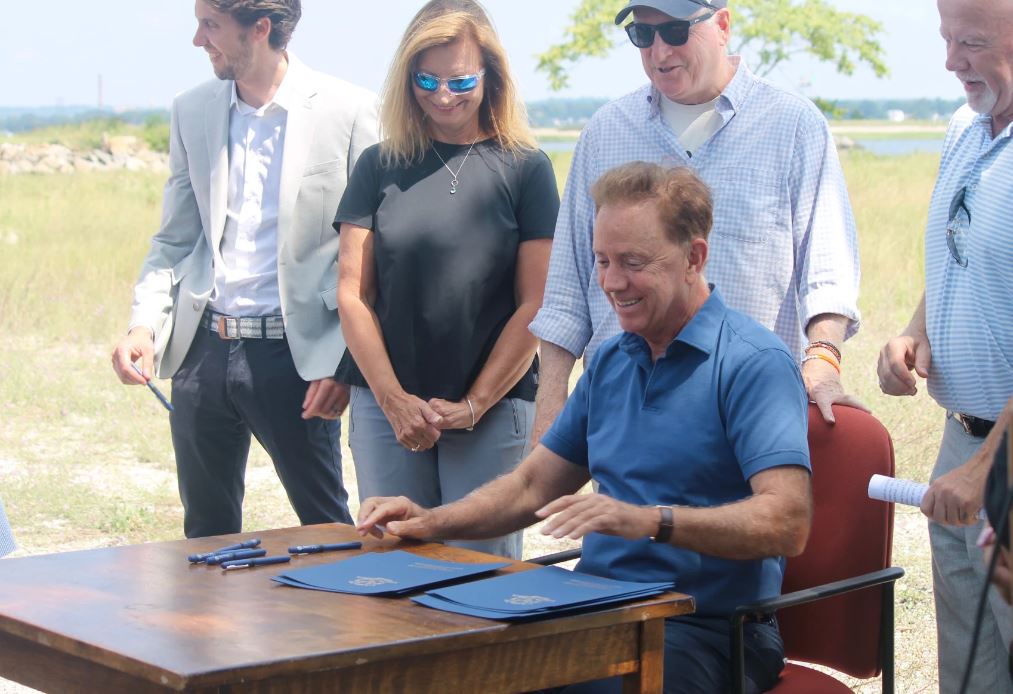
Governor Ned Lamont signed legislation banning the harvesting of horseshoe crabs in Connecticut back on August 9, 2023, and the legislation went into effect October 1 of the same year. He urged neighboring states to follow suit.
| |
|
Governor Lamont signs legislation protecting horseshoe crabs at a 2023 ceremony in Stratford
Photo: Sabrina Garone / WHSU
| |
“The number of horseshoe crabs in Long Island Sound and throughout the Atlantic Coast has been severely depleted in recent years, raising concerns that this ancient species that has been around longer than the dinosaurs could be driven into extinction from overharvesting,” Governor Lamont said. “This law says that we need to take a break and let this species regenerate and get back to a state of good health. I strongly urge our neighboring states to join this growing coalition and enact similar laws to protect the population in their waters.” | |
|
Although the New York bill passed the State Assembly with a 101-39 vote and the State Senate with a 53-7 vote, as of the time of publication of this issue of Sound Outlook, there has been no signature or veto from Governor Hochul.
The New York State Department of Environmental Conservation has set annual harvest quotas for the crabs at 150,000 animals, but unfortunately that has failed to reverse the decline in population for the species. According to Dr. John Tanacredi, director of the Center for Environmental Research and Coastal Oceans Monitoring (CERCOM) and a global expert on horseshoe crabs, the main purpose for harvesting them is to be used for bait to catch whelk and eel.
Several environmental organizations have sent letters to Governor Hochul urging her to sign the legislation. The letters acknowledge the opposition to the legislation from the Long Island Farm Bureau, which represents several companies that ‘bleed’ horseshoe crabs to produce Limulus Amebocyte Lysate (LAL), which is used to detect bacteria on surgical equipment and implants. The letters attest that synthetic alternatives for LAL and alternative baits for whelk and eel fishing have proven effective.
A new laboratory-manufactured product has emerged as an alternative to LAL and is already replacing LAL in Europe. The product, called recombinant Factor C (rFC), has proven to be as effective or more effective than LAL.
With alternatives available, several environmentalists, organizations, and citizens in New York are urging Governor Hochul to sign the legislation and stop the harvest of horseshoe crabs so that the population can recover, as the Center for Biological Diversity and 22 partner organizations petition NOAA fisheries to grant Endangered Species Act protection to the species.
| |
|
Second Round of LISCIF Funding Now Available
The Long Island Sound Community Impact Fund (LISCIF) is now accepting applications for its second round of up to $1.5 million in competitive funding to support projects in Connecticut and New York. LISCIF is a partnership among Restore America’s Estuaries, the U.S. Environmental Protection Agency, and the Long Island Sound Study (LISS) to provide technical and financial assistance to communities with environmental justice concerns to address environmental issues and improve the accessibility and quality of Long Island Sound.
The EPA provides funding for LISCIF via the Bipartisan Infrastructure Law, and funds projects to help meet the Justice40 Initiative, which aims to ensure that 40% of the benefits of Federal investments flow to disadvantaged communities.
LISCIF’s funding priorities are aligned with the CCMP themes and Implementation Actions. For 2025, LISCIF’s main funding themes are:
- Clean Waters and Healthy Watersheds
- Thriving Habitats and Abundant Wildlife
- Sustainable and Resilient Communities
- Sound Science and Inclusive Management
Funding is available for:
- Projects that result in quantifiable pollutant prevention or reduction.
- Restoring habitat within the Important Coastal Habitat Types targeted by LISS.
- Projects that foster a diverse balance and abundant populations of fish, birds, and wildlife.
- Public engagement, knowledge, and stewardship.
- Projects that enhance community resilience and sustainability.
- Planning and design that sets the stage for the implementation of water quality projects, eligible habitat restoration projects, and resilience projects.
- Community-based science projects.
- Data management and integration projects.
- Other similar activities that the applicant proposes, and EPA approves consistent with section 119 of the Clean Water Act.
For more information and to apply, please visit the LISCIF 2025 Request for Applications page. Letters of Intent are due November 22, 2024.
| |
|
Dana Dam: One Year Later
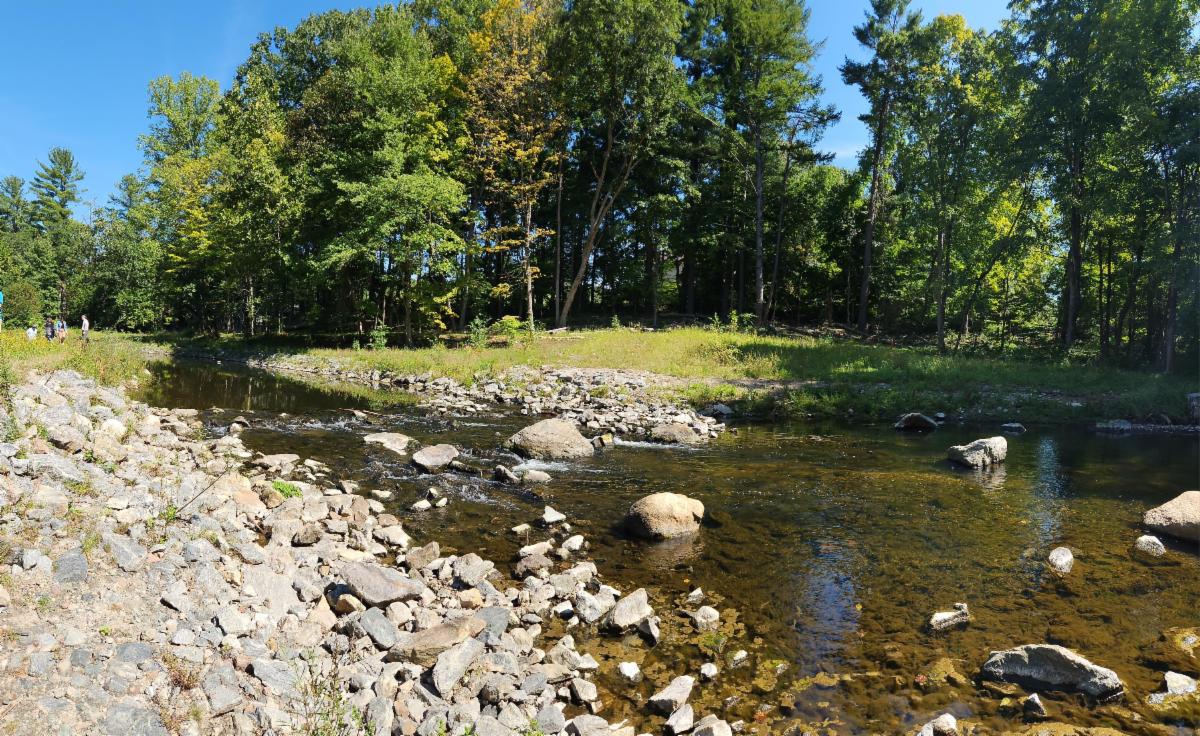
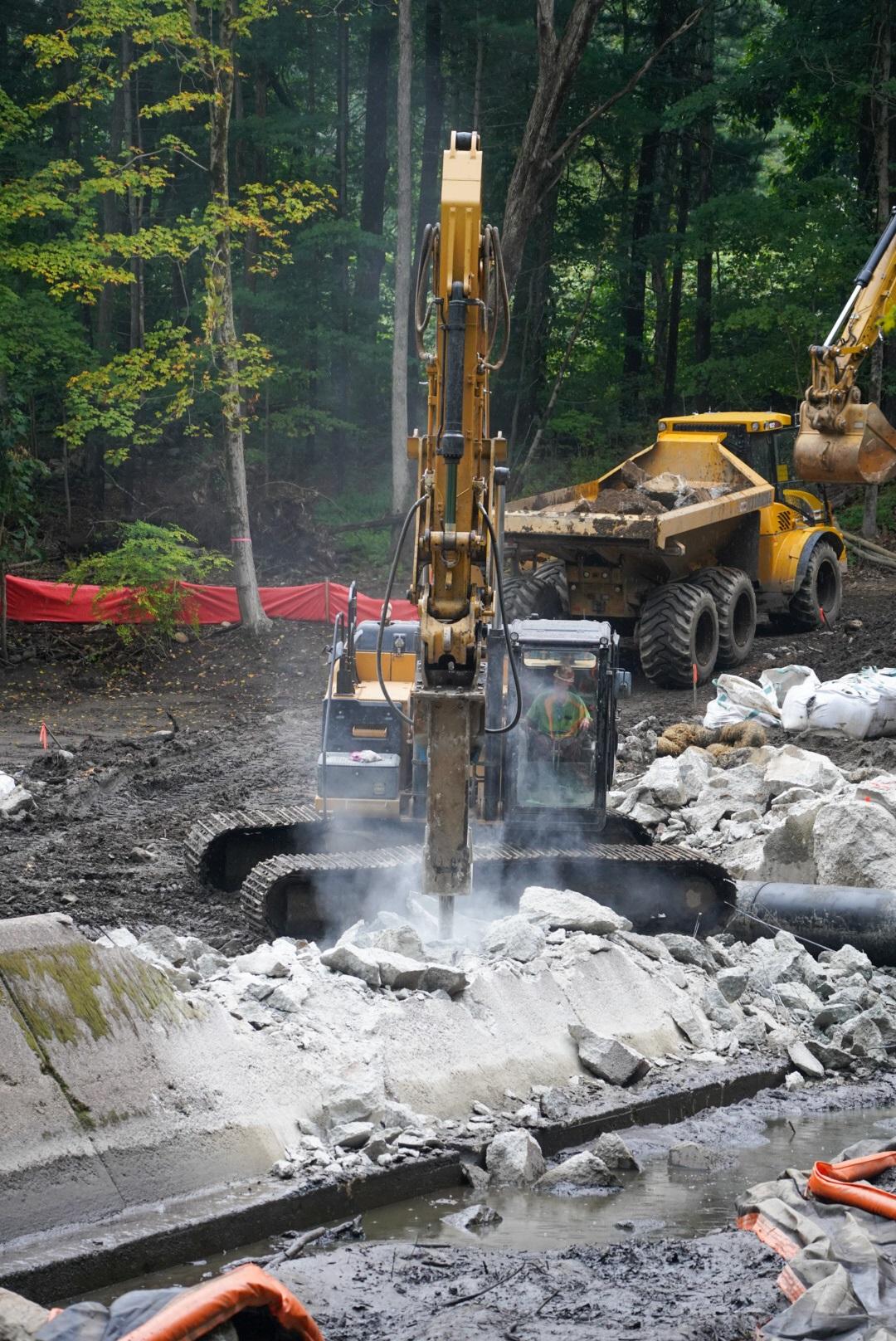
Regular readers of Sound Outlook might recall that last year’s fall issue covered the benefits of dam removal along Connecticut’s rivers, including the removal of Dana Dam on the Norwalk River, which occurred on September 11, 2023. Now, one year later, DEEP staff were able to join Save the Sound and other partner organizations to return to the site and see the result of the restored river channel.
The dam, also known locally as Strong Pond Dam, was originally constructed in 1940 by industrialist Charles Dana. Unfortunately, like many other dams along Connecticut waterways, the adverse impacts on the area’s ecology would include warming water temperatures, slow stream flows, and a barrier to fish passage. Inquiries about removing the dam were being made as early as the 1990s, and Save the Sound stepped in a few years ago to lead the project in partnership with the Town of Wilton, Long Island Sound Study, Connecticut DEEP, and several other partners.
With the dam finally removed last year, the area has seen an increase in upland riparian habitat thanks to a narrower channel, water quality improvements as increased flow has improved dissolved oxygen, and a reduction in stream temperatures, among other benefits. An estimated 5 miles of the upstream river habitat is now accessible for fish passage, as well as an additional 5 miles of tributaries.
While we often focus on coastal public access when we feature public access sites across the state, it is important to note that healthy rivers are a critical part of the Long Island Sound ecosystem, as they allow diadromous fish (fish that migrate between freshwater and saltwater environments) such as salmon, herring, alewife, sturgeon, and eel, to access freshwater spawning habitat. The removal of Dana Dam allows for these species to access inland waters that they once historically occupied but were barred from due to our construction of dams. This improves the ecosystem of both the Norwalk River and Long Island Sound, while also improving the scenery of the area for a more pleasant recreational experience.
Whether you are interested in fishing the river or just taking a leisurely stroll, the former site of Dana Dam is now free from the sight of Dana Dam! The area can be seen a short stroll upriver from Merwin Meadows Park in Wilton, within the Lovers Lane Open Space. Walk along the Norwalk River Valley Trail until you spot the educational signs to the right of the trail where the old dam used to be. While DEEP staff were visiting earlier in September, several people were fishing the free-flowing river where the dam used to stand.
| |
|
The Strong Pond Dam/Dana Dam site on September 11, 2023 (left) vs September 11, 2024 (right)
Photos: Braden Lynn/DEEP LWRD
| |
|
SPOTLIGHTED PUBLIC ACCESS/FIRST IMPRESSIONS: Mallory Lentz, NOAA Coastal Public Access Fellow
This column features the "First Impression" that set someone on his or her path to environmentalism. We hope Sound Outlook readers will relate to these "First Impressions" and recall their own experiences that led them to appreciate and care about Long Island Sound.
The National Oceanic and Atmospheric Administration (NOAA) established their Coastal Management Fellowship in 1996. The program provides on-the-job education and training opportunities in coastal resource management and policy for postgrad students, while providing project assistance to state coastal zone management programs.
The high cost of living and rent in Connecticut can make—and has made—it difficult for Connecticut DEEP to match with a coastal fellow, as we have to compete with programs from other parts of the country and the world such as the Pacific Northwest, California, Hawaii, or as far away as the Northern Mariana Islands. And let’s face it, Hartford, Connecticut is no tropical island chain. Fortunately, LWRD was able to match with a fellow who is talented, experienced, and possibly crazy enough to join our office for the next two years.
Mallory Lentz, nominated as a fellow by Rhode Island Sea Grant, matched with DEEP LWRD to spearhead a multipronged approach for addressing coastal public access needs in Connecticut through an equity and environmental justice lens. This position will involve coordination with our office’s planning and technical resources staff, as well as partners and municipalities, to provide enhanced and equitable public access to Connecticut’s coastal waters.
Mallory grew up on the Chesapeake Bay in Maryland, which at the time was notoriously polluted. More specifically, she lived on the Severn River, but it went by the nickname “Hershey River” to her and her friends, and not because it was discovered by a famous chocolate-making family. In the summer, the brown color of the river resembled chocolate milk. Swimming in the river could lead to bacterial infections, and swimming with an open cut often meant a trip to the doctor. Her First Impression came from spending days on the polluted river.
I think my start into being an environmentally focused person came from kayaking up and down the Severn and noticing a bunch of cans and trash floating past me. I would put them in my kayak and 9 times out of 10 I would come back to my neighborhood beach with a kayak just full of trash. I would say “this is awful, and I would like this to change.”
On top of the pollution problem, she remembers dead fish piling up on the shoreline and huge algal blooms, symptoms of the environmental degradation that was occurring. Seeing the condition of the river that she grew up on developed a sense of environmentalism in her from a young age.
In high school, Mallory took AP Environmental Science as an elective, which was the first class she had experienced that was focused on environmental studies and climate change issues. She credits one of her teachers for pushing her to take her First Step towards a career in the environmental field, as well as assigning her a little too much homework.
I had a strict teacher, like very strict, but she really did her job well, and I think that is what pushed me to start exploring a career in that field. She just did a great job and taught me a lot. She was very hands on, but really wanted people to know and understand what was happening. I think some people didn’t take it seriously, but I really did.
After high school, it came time to do what all young people must do at only 18 years old: decide what their career will be for the rest of their life. While Mallory had developed a strong sense of environmentalism, she entered college undecided. Like many of us in this field can relate to, she loved the idea of environmental protection, but wasn’t quite sure if it is a good career move.
I was undecided, and I actually didn’t know whether or not I would do an environmental major. Then, at our orientation, they split us up into groups and one group was the environmental program. I went to check it out and looked at the class list and thought, “Oh my gosh, these sound really cool.” They had classes like endangered species conservation and soil sciences. I had never thought about soil sciences before, and so many of these classes were interesting.
| |
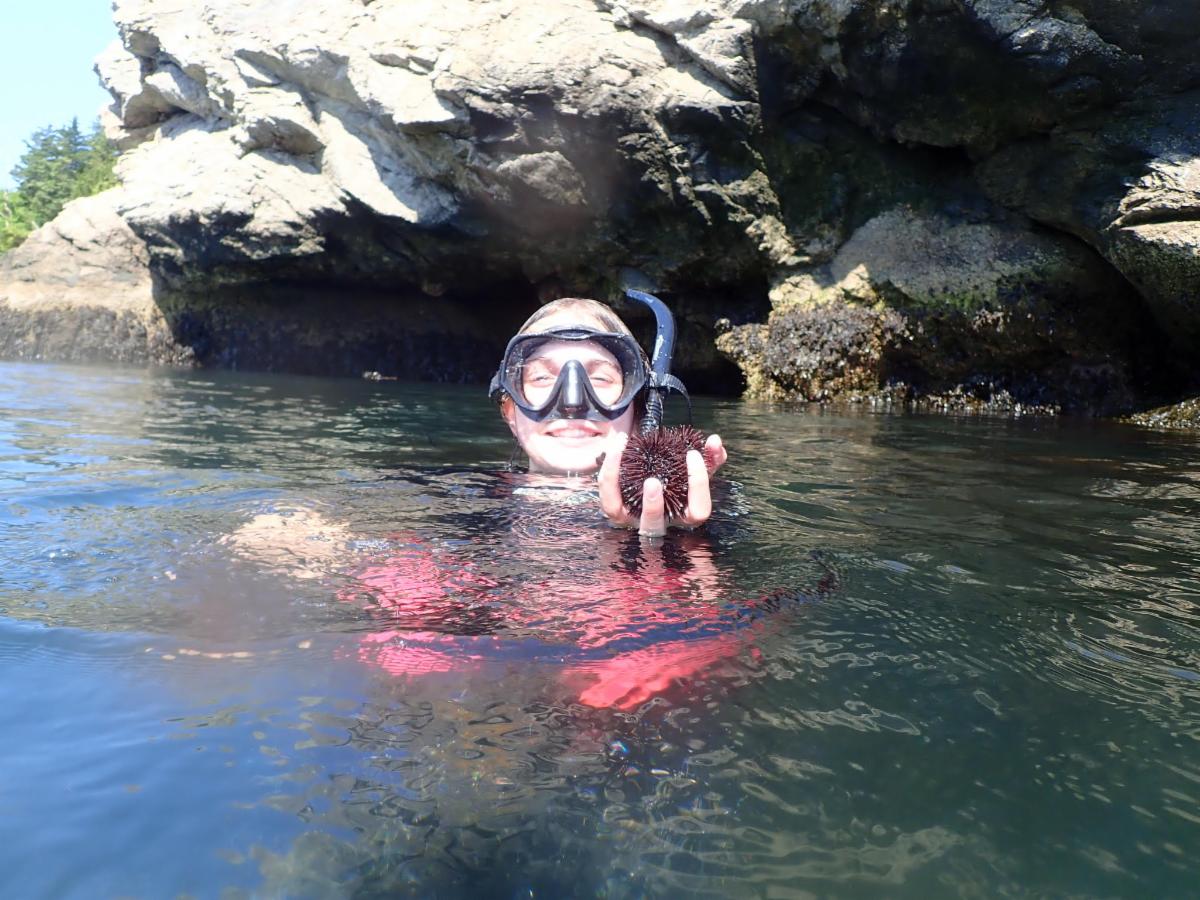
Seeing the variety of interesting courses that were available led to Mallory’s Behavior Change, where she realized the environmental field was a viable (or, at least, spiritually rewarding) career option. Mallory ended up loading her schedule with these environmental courses in her first year at the University of Rhode Island (URI). By the end of the year, she had narrowed her options down to environmental science and wildlife conservation. She ended up pursuing and earning a bachelor's degree in wildlife conservation, while also working in a lab at URI called the Echinonerd Lab (which any echinoderm nerd will tell you is a very hilarious and clever play on words!). | |
Mallory collecting purple sea urchins in Jamestown, RI while working in the Echinonerd Lab | |
|
Thanks to all of those AP classes in high school, Mallory was able to graduate a year early with a bachelor’s degree and jump right into a seasonal position with the Rhode Island Department of Environmental Management.
I applied, I got the job… and it was super impactful because it changed how I wanted to use my degree going forward, because I was more research science based; I worked in a lab doing sea urchin research in college. I was doing mostly research-based work and felt stuck, wondering if I wanted to keep doing laboratory research. Then the park naturalist position happened, and that was mostly public engagement married to field work. I would collect sea creatures and create an aquarium exhibit to teach kids all about the different animals. That made me want to go into the science-communications aspect of the field.
| |
|
The graduate program that she then entered was a master’s program in environmental science and management, again at URI, which had several different concentrations that one could specialize in. Originally, she assumed that she might specialize in wildlife conservation, but after taking a course called Public Engagement with Science in the last semester of her undergrad and landing the park naturalist position, she decided to specialize in environmental communication. While in grad school, she also spent another summer as a park naturalist, this time with the Maryland Department of Natural Resources, before graduating with a master's degree.
Next up for Mallory came the NOAA Coastal Management Fellowship Program, otherwise known as her Big Step into a career in the environmental field. During her second summer as a park naturalist, she met a past fellow who thought Mallory would be a great fit for the program.
| |
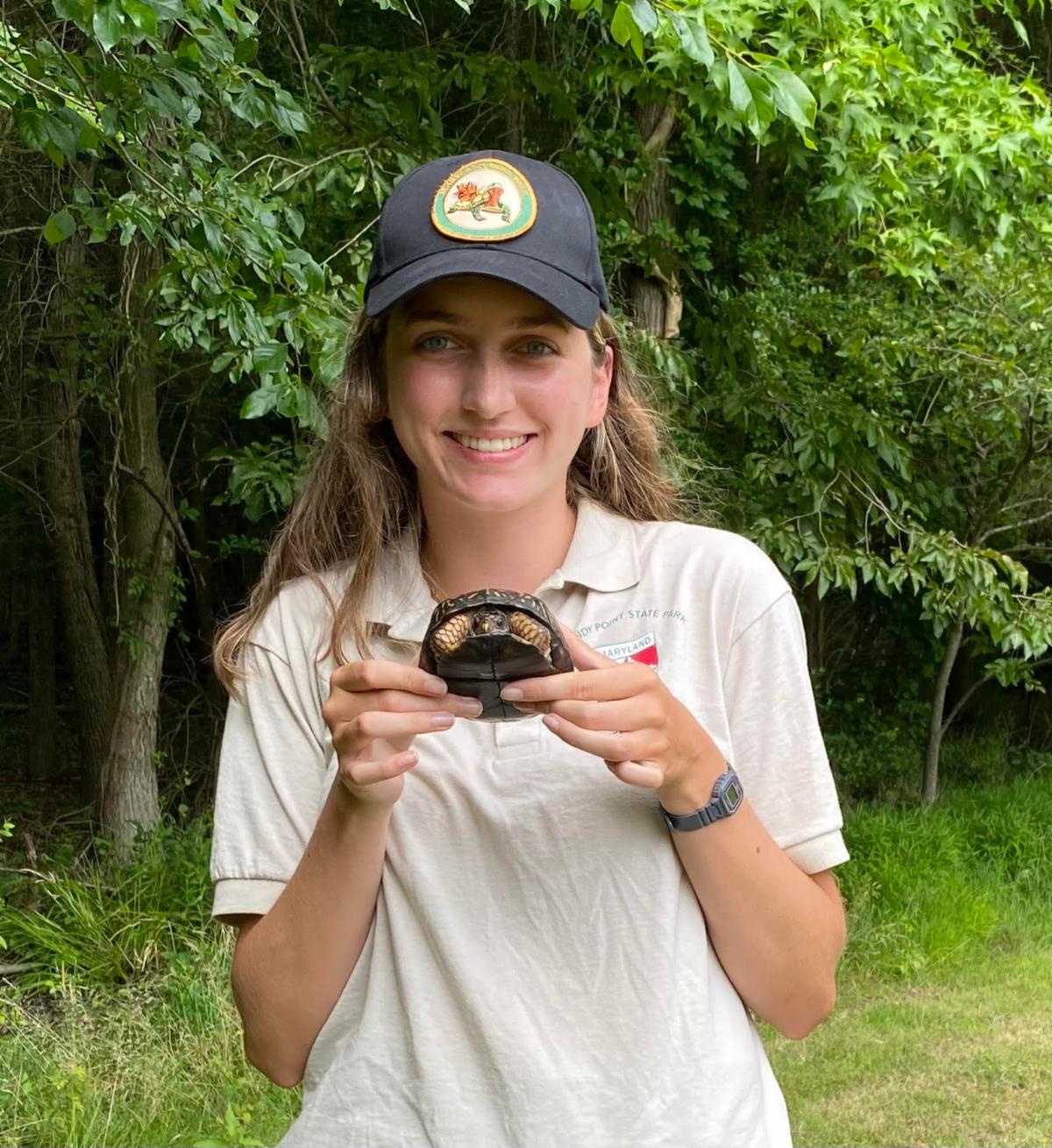
Mallory while working as a park naturalist with Maryland DNR | |
|
On the website, they said they would like people from a variety of backgrounds, so I thought, “Oh, this could be interesting!” I talked to my advisor, who said it was a really good program, and I applied. It was actually a pretty rigorous program. I’m glad I found this fellowship, because it has already given me a great experience and an in-depth perspective into the environmental field in a public engagement program.
While the end of this two-year fellowship program is a long way away, Mallory hopes to continue in the public engagement and environmental communications position in the future. However, her experiences growing up on Chesapeake Bay, attending school in southern Rhode Island, and her experience working with NOAA and LWRD have inspired her to want to steer her career towards something that will combine her experience in public engagement with her love of the ocean and its ecology. We at LWRD are sure that Mallory will do great things in her career and will help bring meaningful and equitable engagement opportunities with the ocean and the environment to many.
Mallory also expressed that having Mary-beth Hart (former Sound Outlook editor) and Del McCloe (former First Impressions subject) as her mentors here at DEEP has been an incredible experience and looks forward to the project she will be spearheading alongside LWRD.
I think it’s really awesome that we all share this passion and intrinsic value to protect this environment, and that we can turn it into a career, which is very fun.
| | |
|
|
Published by the Department of Energy and Environmental Protection, Bureau of Water Protection and Land Reuse.
Editor: Braden Lynn
Contributors: Mallory Lentz, Kathleen Perzanowski
Layout: Caryn Furbush; Illustrations: Tom Ouellette
The Connecticut Department of Energy and Environmental Protection is an Affirmative Action/Equal Opportunity Employer that is committed to complying with the requirements of the Americans with Disabilities Act. If you are seeking a communication aid or service, have limited proficiency in English, wish to file an ADA or Title VI discrimination complaint, or require some other accommodation, including equipment to facilitate virtual participation, please contact the DEEP Office of Diversity and Equity at 860-418-5910 or by email at deep.accommodations@ct.gov. Any person needing an accommodation for hearing impairment may call the State of Connecticut relay number - 711. In order to facilitate efforts to provide an accommodation, please request all accommodations as soon as possible following notice of any agency hearing, meeting, program or event.
| | | | | |