|
|
Bob "Coach" Henriquez, CFA
Hillsborough County Property Appraiser
| | |
Welcome to the first quarterly edition of the Hillsborough County Property Appraiser’s newsletter!
Beginning with this issue, we are transitioning from a monthly to a quarterly publication. This new format will allow us to provide more comprehensive and timely information centered around the key dates and events in Florida’s property tax calendar. Each edition will bring together the topics that matter most to property owners at the time they need the information.
In this issue, we’re helping you prepare for the months ahead. With property tax bills typically mailed in November, we explain how to better understand your tax bill and clarify the different roles of the Property Appraiser and Tax Collector.
As we approach the new year, we also take a closer look at why January 1 is such an important date for property assessments and exemptions. For those who recently purchased a home, our New Homeowner feature covers several important things to know about reassessment, Homestead Exemption, Save Our Homes and portability.
We also address an important consideration for homeowners thinking about transferring a homesteaded property to an LLC and how changes in ownership can potentially affect a property’s assessment. Finally, we provide a legislative update on two important amendments that Florida voters will consider in November.
Our goal with this quarterly newsletter is simple: to provide useful, easy-to-understand information that helps you better understand your property assessment, exemptions and Florida’s property tax process.
We hope you enjoy our new quarterly format, and as always, it is our privilege to serve the residents and property owners of Hillsborough County.
Respectfully,
| |
Bob "Coach" Henriquez, CFA
Hillsborough County Property Appraiser
| | |
PROPERTY APPRAISER OR TAX COLLECTOR?
ROLES AND RESPONSIBILITIES
| | |
When it comes to property taxes, it’s easy to confuse the roles of the Hillsborough County Property Appraiser and the Hillsborough County Tax Collector. While both offices play an important role in the property assessment process, their responsibilities are very different.
The Property Appraiser’s Office is responsible for identifying, locating and fairly valuing all property within Hillsborough County for property tax purposes. Our office determines your property’s just, assessed and taxable values and administers property tax exemptions and assessment limitations, including Homestead Exemption and Save Our Homes. We also maintain property ownership records and send the annual Notice of Proposed Property Taxes, commonly known as the TRIM Notice.
One thing the Property Appraiser does not do is set tax rates or collect property taxes. Tax rates are established by local taxing authorities, such as the county, municipalities, School Board and other taxing districts.
The Tax Collector’s Office is responsible for mailing property tax bills and collecting property tax payments. Property tax bills are typically mailed in November, with discounts available for early payment.
Here’s an easy way to remember the difference: If you have questions about your property’s value or exemptions, contact the Property Appraiser CLICK HERE. If you have questions about your tax bill or making a payment, contact the Tax Collector CLICK HERE.
Understanding who does what can help you get your property tax questions answered quickly and by the right office.
| UNDERSTANDING YOUR TAX BILL | |
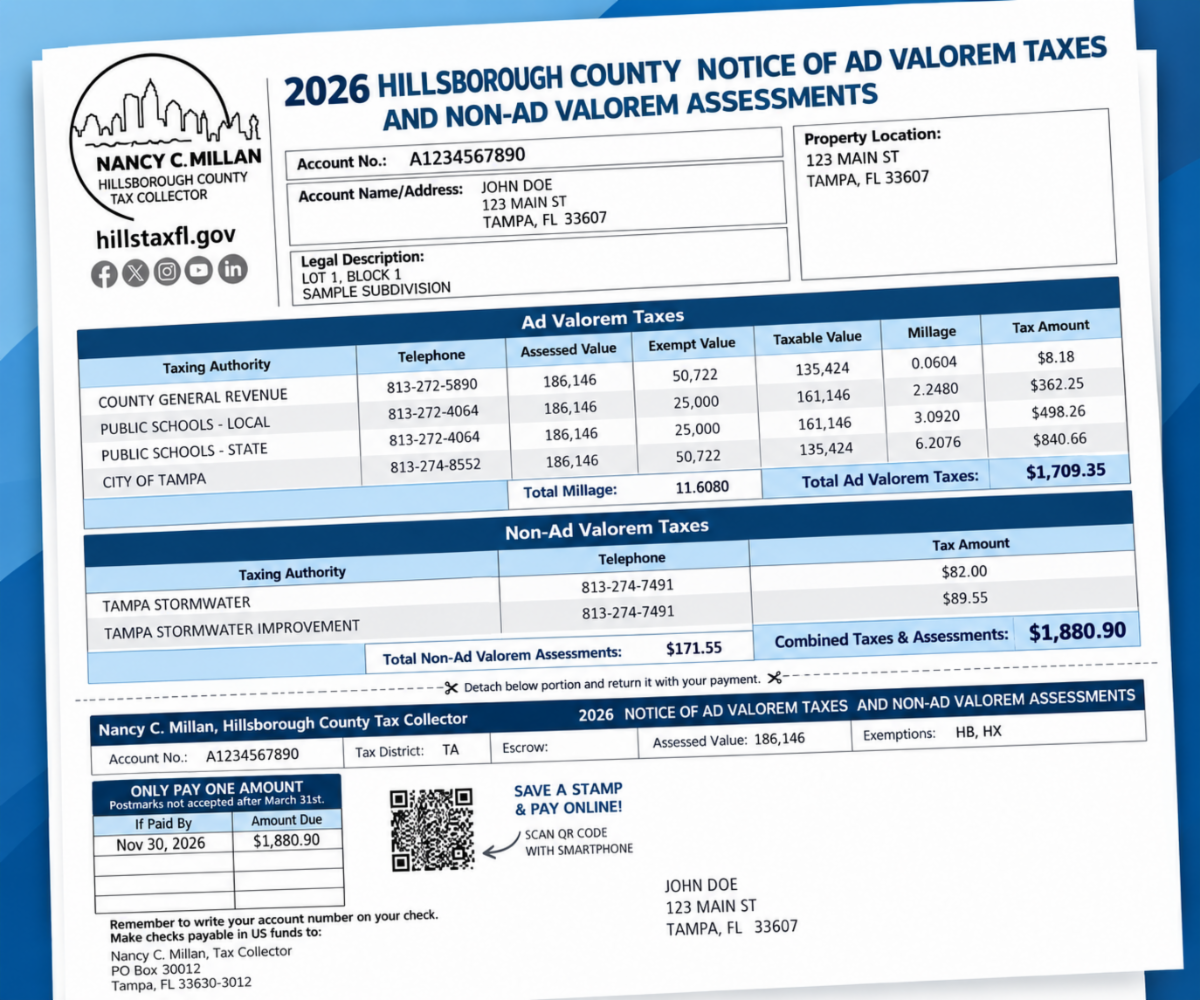
Property tax bills are mailed each November, but understanding what goes into your bill can make it easier to know what you’re paying—and why.
Your property tax bill is based on several factors, including your property’s taxable value, applicable tax rates and any non-ad valorem assessments. The Hillsborough County Property Appraiser’s Office determines your property’s value and administers exemptions and assessment limitations, such as Homestead Exemption and Save Our Homes. However, the Property Appraiser does not set tax rates or collect property taxes.
Tax rates are established by local taxing authorities, which may include Hillsborough County, the School Board, municipalities and other taxing districts. These rates are applied to your property’s taxable value to determine the ad valorem taxes shown on your bill.
You may also see non-ad valorem assessments. Unlike property taxes, these charges are not based on your property’s value. They are generally assessed for specific services or improvements and are determined by the government or taxing authority imposing the charge.
The Hillsborough County Tax Collector mails the tax bills and collects payments. Discounts are available for early payment, beginning with the largest discount in November and decreasing in subsequent months.
Have a question about your property’s value or exemptions? Contact the Hillsborough County Property Appraiser’s Office at 813-272-6100 or visit CLICK HERE. For questions about paying your tax bill, contact the Hillsborough County Tax Collector CLICK HERE.
| | |
NEW HOMEOWNER?
WHAT YOU NEED TO KNOW
Along with the excitement of homeownership, there are a few important property tax matters every homeowner should understand.
First, don't assume the previous owner's property tax bill will be the same as yours. After a change in ownership, the property cap may be reset to just (market) value as of January 1 of the following year. The previous owner may also have benefited from exemptions and assessment limitations that do not automatically transfer to you.
If your new home is your permanent residence, you may qualify for Homestead Exemption, which can reduce your property's taxable value. Homestead property may also benefit from the Save our Homes assessment limitation, which limits annual increases in assessed value once established.
If you owned a previous homesteaded property in Florida, you may also be eligible for portability, which allows you to transfer some or all of your Save Our Homes benefit to your new homestead, subject to eligibility requirements CLICK HERE.
Remember, January 1 is an important eligibility date, and the regular filing deadline for Homestead Exemption and portability is March 1.
| |
TRUTH VS MYTH:
TRANSFERRING MY HOMESTEAD TO AN LLC
RESETS MY ASSESSMENT CAP
| |
While a limited liability company (LLC) may provide certain liability protections, transferring Florida real property to an LLC constitutes a legal change of ownership for property tax purposes. This transfer may result in the reset of your property's tax value to current just/market value and the removal of all tax caps as of January 1 of the following year.
It is also important to note that an LLC is not eligible for the Homestead Exemption. Under Florida law, homestead property must be owned by a “natural person” who meets the applicable eligibility requirements; an LLC does not meet this ownership requirement.
Because ownership circumstances can vary and certain exceptions may apply, we strongly encourage property owners to contact the Hillsborough County Property Appraiser’s Office before making changes to the title or ownership of their property.
| | |
When it comes to property taxes in Florida, January 1 is one of the most important dates on the calendar.
January 1 is the annual assessment date. The Hillsborough County Property Appraiser’s Office uses the status of a property as of that date to determine its value and eligibility for exemptions and certain assessment limitations for the upcoming tax year.
Why does this matter? Changes that occur during the previous year—such as purchasing a home, completing new construction or improvements, or changing the ownership or use of a property—may affect how the property is assessed beginning January 1.
The date is also important for Homestead Exemption. To qualify, homeowners generally must own and occupy the property as their permanent residence as of January 1 of the tax year for which they are applying. Other exemptions and property classifications may also have January 1 eligibility requirements.
For example, if you purchase and move into a home after January 1, you generally will not qualify for Homestead Exemption on that property until the following tax year, provided you meet the eligibility requirements on January 1.
Remember, January 1 determines your status for the new tax year, but it is not the filing deadline. The regular deadline to apply for Homestead Exemption and many other exemptions is March 1.
Understanding the importance of January 1 can help property owners prepare for changes that may affect their property’s assessment and exemptions.
| | |
Florida voters will consider two important property tax-related constitutional amendments in the November 3, 2026 General Election.
Amendment 2 would exempt certain tangible personal property located on agricultural land and used in agricultural production or agritourism from ad valorem taxation. If approved, the exemption would first apply to tax years beginning January 1, 2027.
Amendment 3 would increase the homestead exemption for non-school property taxes and lower the annual assessment increase cap for certain non-homestead property from 10% to 5%. The proposed changes could affect the taxable value of qualifying homestead and non-homestead properties and the amount of property taxes they pay. For more information CLICK HERE.
We encourage voters to learn more about both amendments, review the official ballot language, and make their voices heard by voting in November.
| | |
FOLLOW US ON SOCIAL MEDIA FOR
TIMELY UPDATES
| | | | |