|
Greetings!
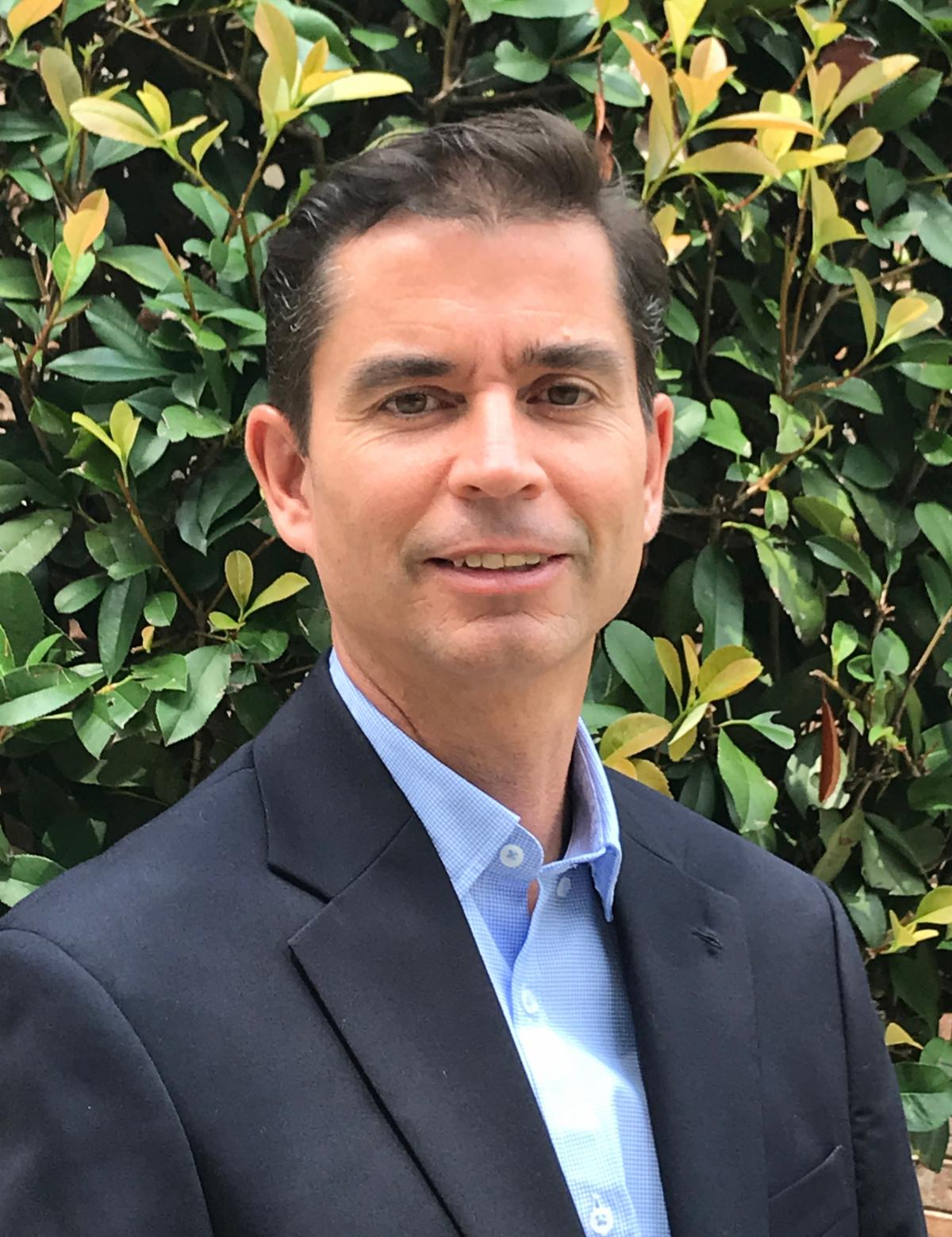
We just returned from the IOOS Association Fall Meeting. GCOOS was happy to host the meeting in New Orleans this year and have the opportunity to showcase the work we and our partners are doing in the Gulf. Association meetings give the leaders of the nation’s 11 regional observing systems an opportunity to network, exchange ideas and work together on topics and issues that impact ocean, coastal and Great Lakes observing across the nation. I was also honored to be elected to serve as the Vice Chair for the IOOS Association Board and am excited to take on a larger role in helping spread the word about the IOOS mission and its impact on the nation’s economy, environmental health and public health and safety.
Speaking of public health and safety, we’re now in the heart of hurricane season here in the Gulf and it’s surprisingly quiet. The lack of activity is being attributed to the strong El Niño, despite record high ocean temperatures, and other factors. Some are even suggesting that general climate changes could just be shifting peak season to later in the year.
GCOOS is tracking nearly 40 autonomous vehicles now gathering a variety of data that will no doubt be important to improving future hurricane and other models, especially during El Niño years. There may be much we do not know about the changing climate and shifting weather patterns; what we can say is that the need for ocean observing systems is becoming more important every year.
Right now, the National Science Foundation is soliciting perspectives on what ocean observing capabilities it should provide and is seeking input to develop a vision for an effective system that is scientifically relevant and technologically up-to-date. I urge you to respond to the NSF request for input before the Sept. 30 deadline. You can learn more here.
While I’m sure we’re all rooting for a quiet end to hurricane season, it’s not over ‘til it’s over, so please stay prepared!
Until next month,
| | GCOOS Fall Members’ Meeting Save the Date | | |
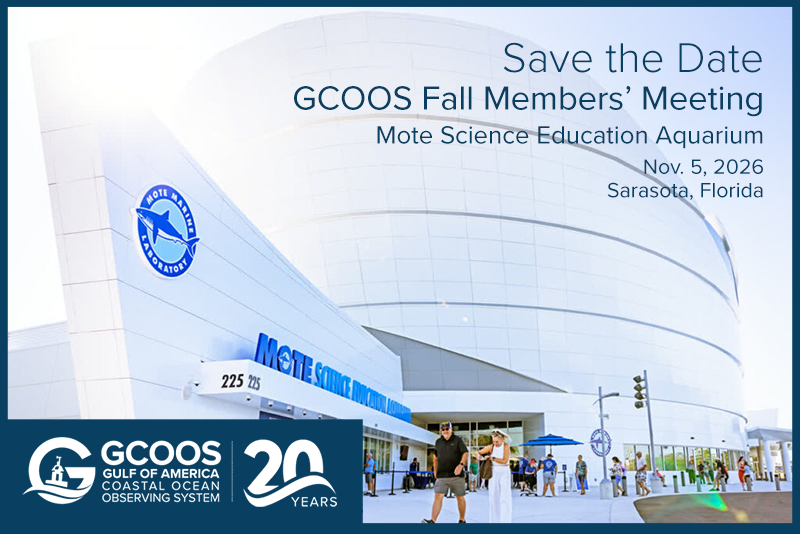
The GCOOS Fall Members’ Meeting has been scheduled for Thursday, Nov. 5 at the new Mote Science Education Aquarium (Mote SEA), 225 University Town Center Dr., Sarasota, FL 34243. We’ve reserved a hotel block at the Homewood Suites Sarasota Lakewood Ranch, 305 N Cattlemen Road, Sarasota, FL 34235.
Nearby airports include Sarasota Bradenton International Airport (5 miles); St. Petersburg-Clearwater International Airport (47 miles); Tampa International Airport (55 miles) and Punta Gorda Airport (55 miles).
| | GCOOS Welcomes IOOS Association to New Orleans | | |
GCOOS was pleased to host the IOOS Association in New Orleans for their Board, Fall and Marine Life Working Meetings Sept. 8-11. “On day one of the Fall Meeting, GCOOS showcased the breadth, depth, complexity and impact of GCOOS’ work across the Gulf sectors, highlighting the importance of collaborations toward achieving our goals,” said GCOOS Board Chair Dr. Kim Yates.
Executive Director Jorge Brenner started off the GCOOS session with an organizational update.
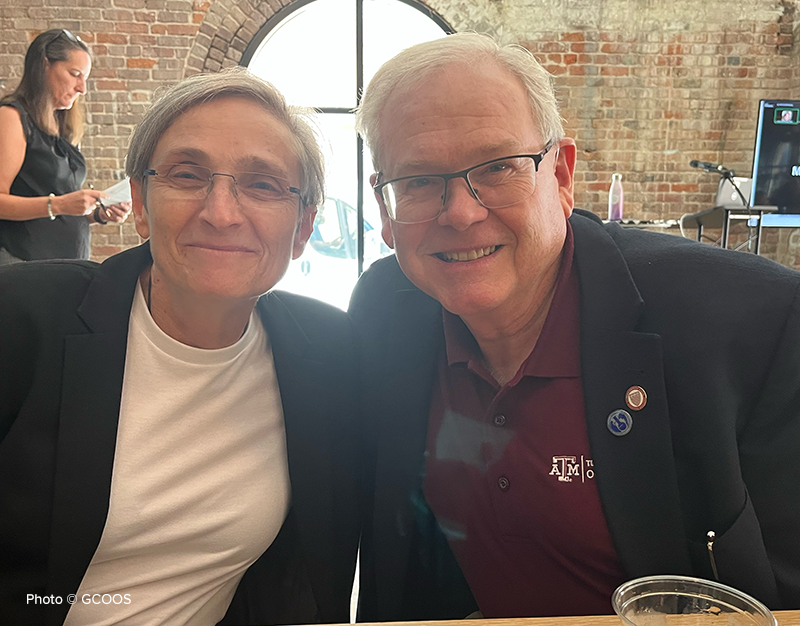
| | GCOOS Chair Kim Yates and Chair-Elect Jim Kendall in New Orleans | | |
Board member Dr. Sergio Jaramillo, Shell Global Solutions, followed by providing an overview of ongoing collaborations with the offshore energy industry, exemplified by the Notice to Lessees portal developed by GCOOS Co-Data Manager Felimon Gayanilo. Jaramillo also set the stage for the first of three panels:
- The Offshore Energy Industry panel, moderated by GCOOS Board Chair-Elect Dr. Jim Kendall, which included Board members Dr. Rafael Ramos, Woods Hole Group, Dr. Mike Yang, Chevron, and GCOOS Associate Director Marcus Ogle.
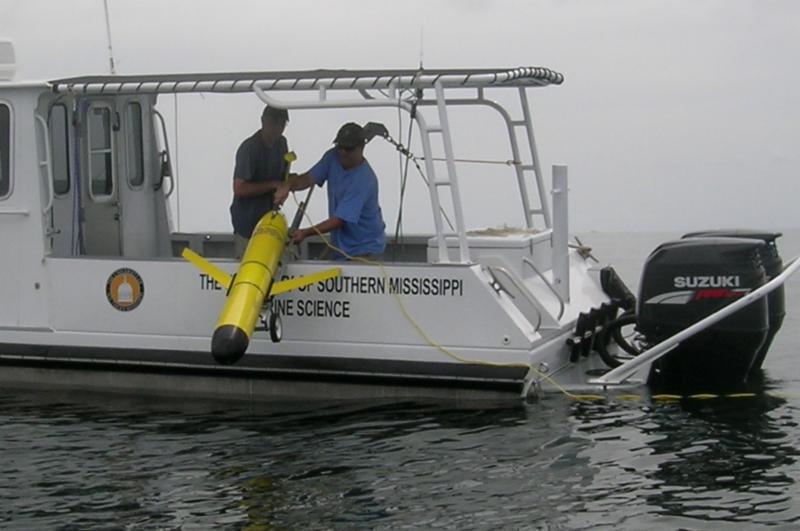
- The Storm Gliders panel, moderated by Board Vice-Chair Dr. Antonietta Quigg, which included Board member Dr. Stephan Howden, USM, John Shepetis and Rosemary Rowe, U.S. Navy, and Lev Looney, University of Miami and NOAA-AOML.
- The Marine Life panel, moderated by Yates, included presentations from Jason Rider and Ellen Flaherty, Mississippi Department of Marine Resources, and GCOOS staff Megan Howson and Dr. Chris Simoniello who shared progress on CETACEAN, Sea Turtle Atlas and MBON. This panel provided a segue to Friday’s Marine Life Working Meeting focused on developing coordinated messaging and analysis of funding needs for marine life program support across regional observing systems.
GCOOS looks forward to continuing these discussions and welcoming everyone at our upcoming November meeting.
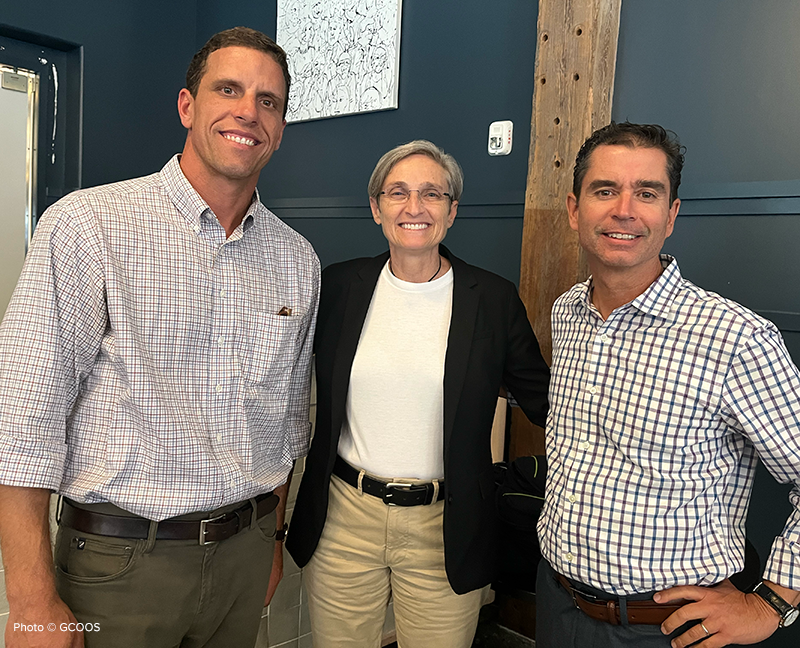
| Jason Rider, Director, Shellfish Bureau, Mississippi Department of Environmental Protection; GCOOS Chair Kim Yates and GCOOS Executive Director Jorge Brenner. | |
CETACEAN Gathers Sperm Whale Data from Veracruz | |
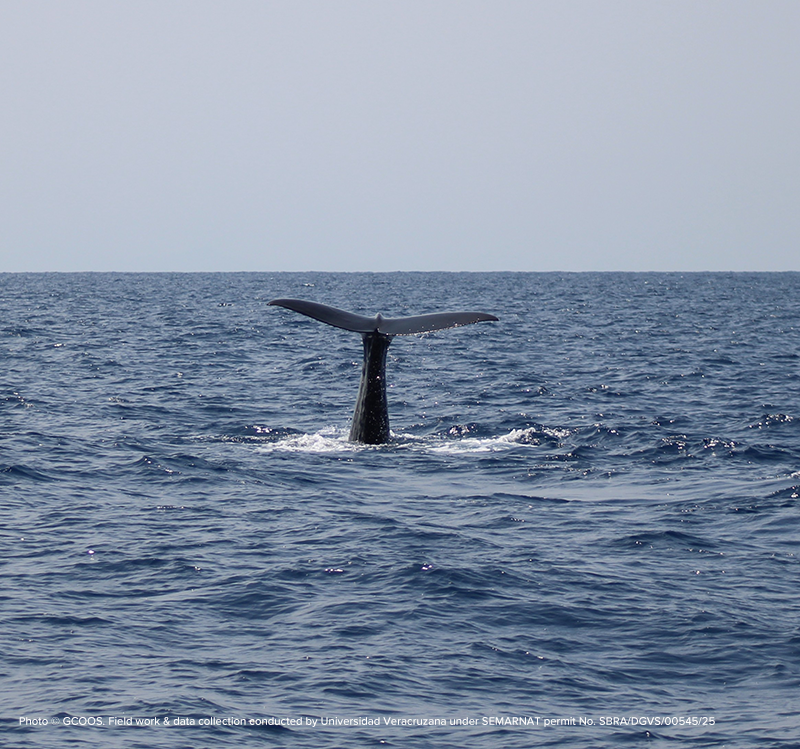
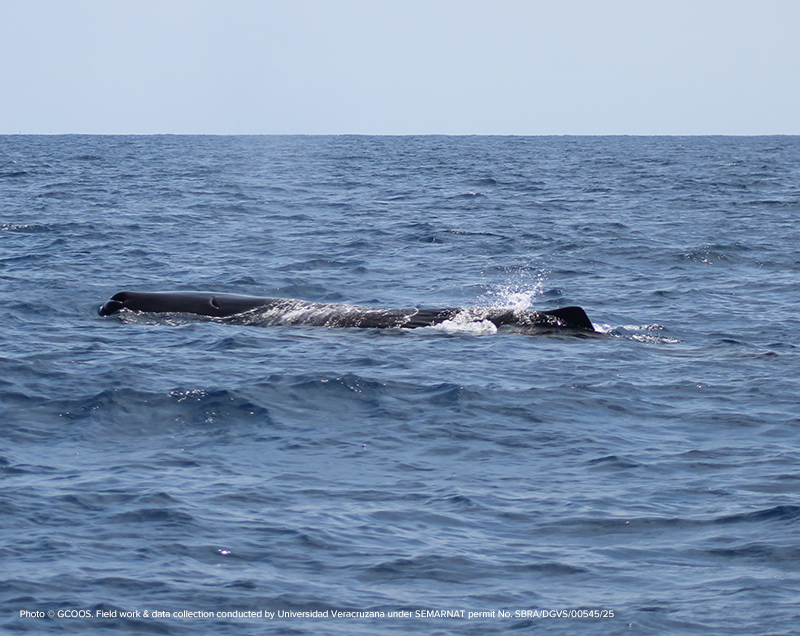
In August GCOOS Executive Director Dr. Jorge Brenner and Marine Mammal Biologist Megan Howson joined researchers in Veracruz, Mexico, to study sperm whales.
Manolo Fernandez and Dr. Isabel Hernandez with the Veracruz State University have been studying a potential summer aggregation of sperm whales along the shelf break off of Veracruz for several years. (Manolo’s data can be found on the CETACEAN Data Portal.) Along with Dr. Hernandez, two students from the university joined the trips.
The group sighted sperm whales on several days of the trip, resulting in great opportunities for data collection. Acoustic recordings collected throughout the week revealed sperm whales each day — even days where there were no sightings. These recordings will be processed by GCOOS in the hopes that they will reveal more details about this sperm whale population.
GCOOS Co-Data Manager Bob Currier will also use these recordings to help train GCOOS’s AI acoustic classifier. While the group was in the field, Currier was able to provide daily analysis of these files to help refine recordings — even while the field work was being conducted. Data from the trip will be made available on CETACEAN when processing is complete.
(Field work & data collection conducted by Universidad Veracruzana under SEMARNAT permit No. SBRA/DGVS/00545/25)
| | GCOOS Heads to Puerto Rico for the Marine Mammal Conference | | |
We’re off to Puerto Rico next month for the 26th Biennial Conference on the Biology of Marine Mammals. GCOOS Co-Data Manager Bob Currier’s work using AI to help track Rice’s whales in the Gulf will be featured during the panel session “Evolving AI Applications in Modern Marine Mammal Science.” Currier, GCOOS Marine Mammal Biologist and Data Scientist Megan Howson and Project Coordinator Grant Craig, will also present joint posters focused on CETACEAN, the Compilation of Environmental, Threat, and Animal Data for Cetacean Population Health Analyses Platform that is tracking open-ocean mammals in the Gulf as an effort to restore populations damaged by the Deepwater Horizon oil spill.
| |
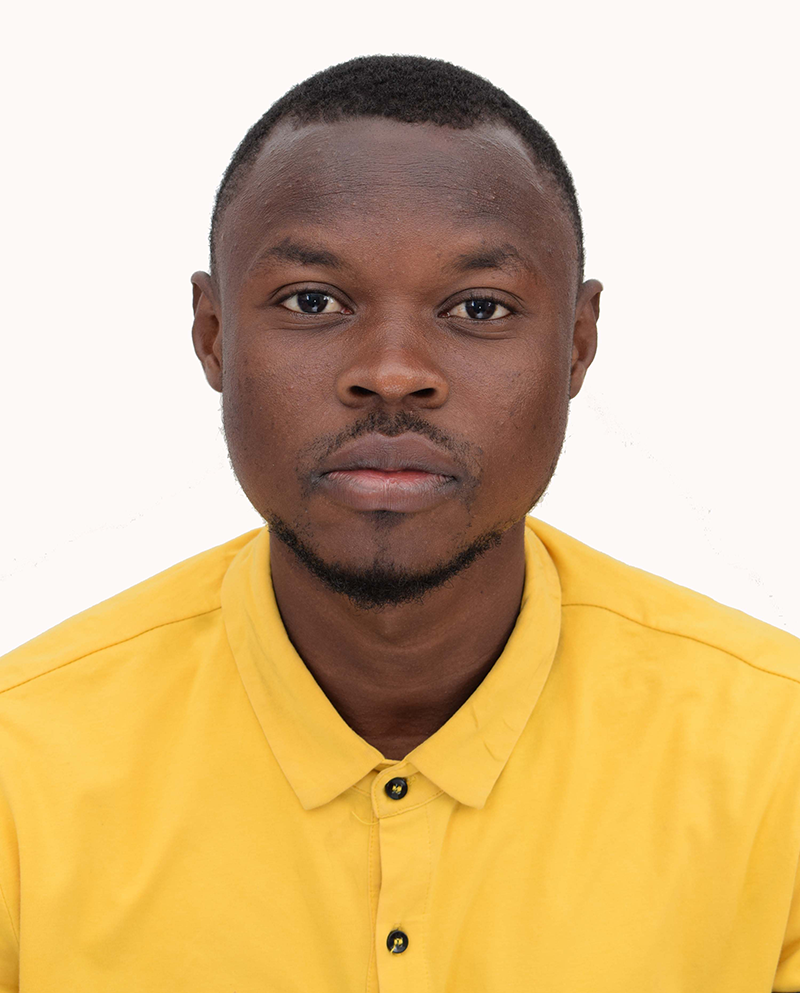
Please join us in welcoming Hafeez Oladejo, GCOOS's new Modeling Fellow funded as part of a collaboration with the Mississippi-Alabama Sea Grant Program.
Hafeez earned a Bachelor of Technology in marine science and technology from the Federal University of Technology Akure in Nigeria, a Master of Science in climate change and marine science from Atlantic Technical University in Mindelo, Cape Verde, and a Master of Science in marine science from The University of Southern Mississippi (USM). He is pursuing a doctorate in marine science at USM, and his research focuses on enhancing the accuracy of hurricane wave and wind forecasts, refining model physics to better represent extreme wind-wave conditions and developing new high-wind correction methods for hurricane studies.
In his joint position for GCOOS and Sea Grant, he’s been working to inventory and evaluate physical oceanography models used throughout the Gulf region, with an emphasis on models related to hurricanes and coastal resilience. He is also preparing technical reports and scientific documentation, contributing to the development of decision-support tools and public resources and collaborating with researchers at Mississippi-Alabama Sea Grant, GCOOS, and other project partners.
| | Register Today for This Month's GCAN Webinar | | |
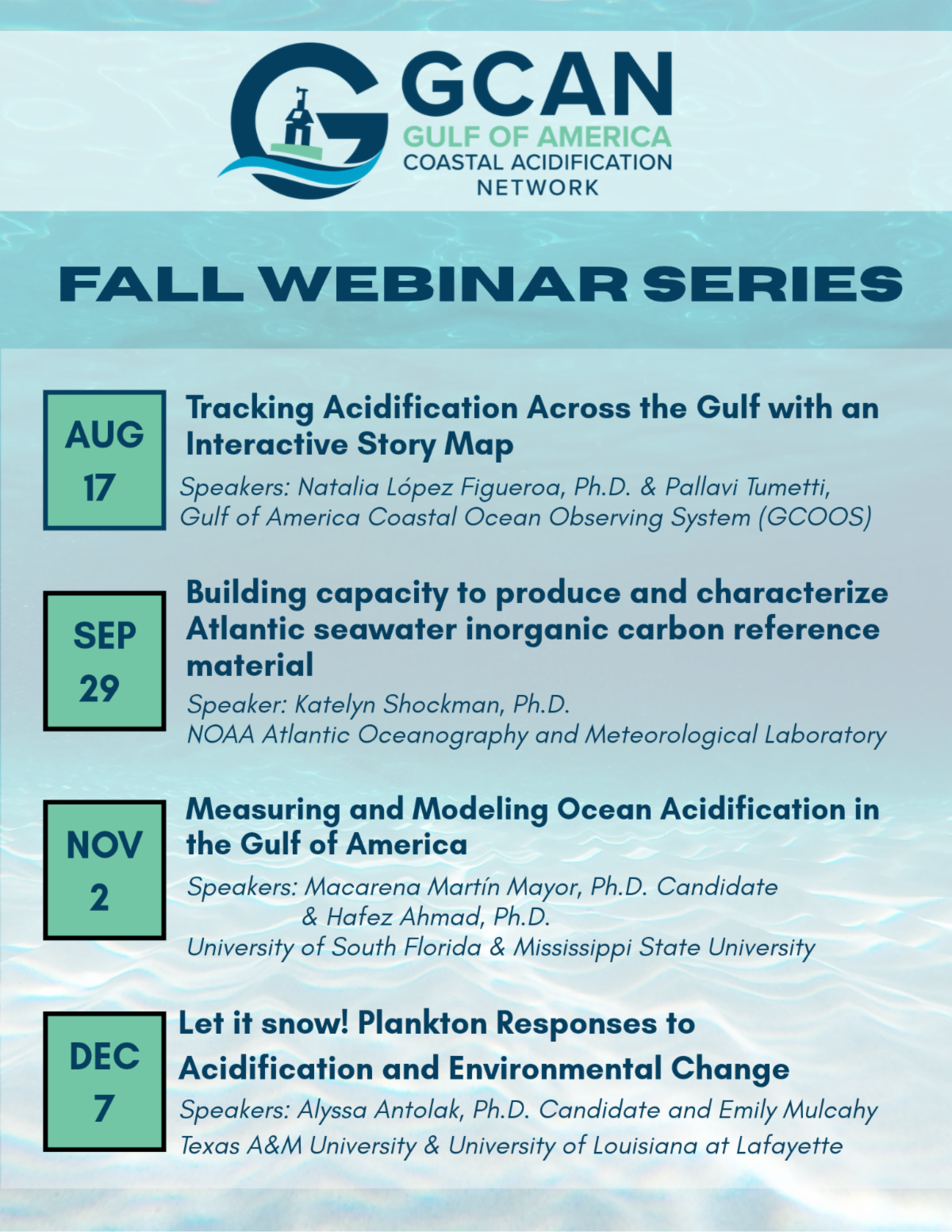
Don't forget to register today for this month's GCAN Webinar: “Building capacity to produce and characterize Atlantic seawater inorganic carbon reference material,” with speaker Katelyn Shockman, Ph.D., NOAA Atlantic Oceanographic and Meteorological Laboratory (AOML).
-
Click here to register and review the speaker's abstract.
And don't forget to mark your calendar for these upcoming webinars:
- Nov. 2: “Measuring and Modeling Ocean Acidification in the Gulf of America,” with speakers Macarena Martín Mayor, Ph.D. Candidate University of South Florida and Hafez Ahmad, Ph.D., Mississippi State University
- Dec. 7: “Let it snow. Plankton Responses to Acidification and Environmental Change,” with speakers Alyssa Antolak, Ph.D. Candidate, Texas A&M University, and Emily Mulcahy, Louisiana State University
Webinars will take place from 1-2 p.m. EST (Noon-1 p.m. CST). Registration for the November and December webinars will be posted here.
| | New Buoys Collecting Data in Mississippi Sound | |
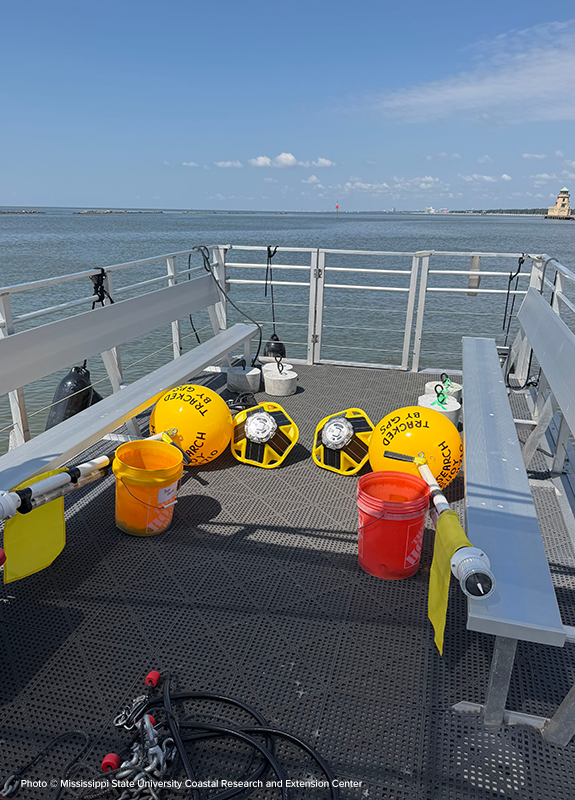
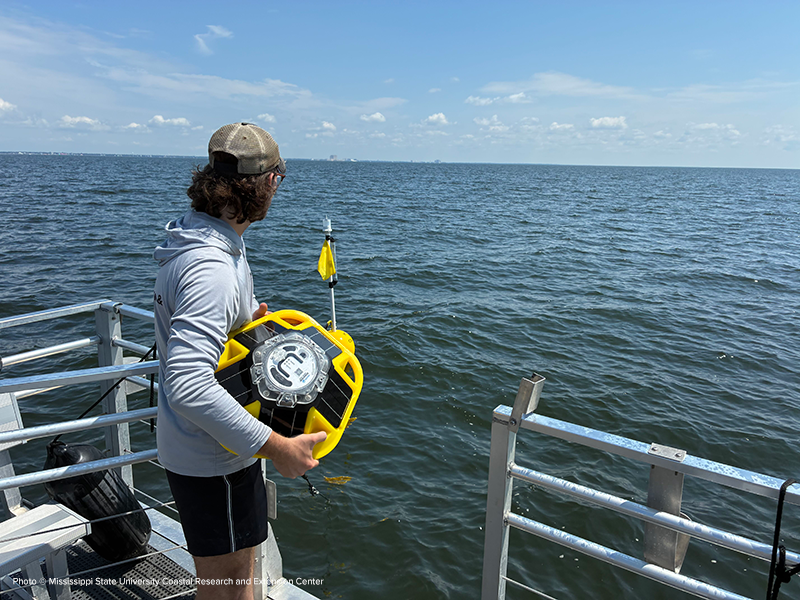
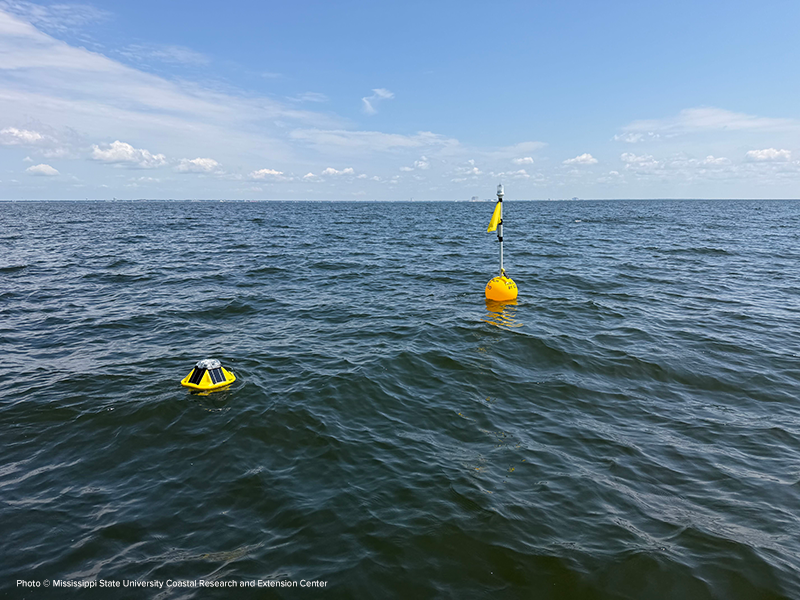
Mississippi State University has deployed two Sofar Spotter buoys in the Mississippi Sound near Gulfport and Biloxi, providing new, real-time observations of local wave conditions. The buoys are reporting consistently and collecting wave height, wave direction, wave period, sea surface temperature, and atmospheric pressure data to help improve understanding of conditions across the Sound.
Data are also publicly available through the Backyard Buoys app, providing valuable information for recreational and commercial boaters, researchers, resource managers, and the coastal community. This community-led monitoring project strengthens the Gulf Coast observing network by filling an important gap in localized, in-situ wave observations, while also providing a scalable model for expanding real-time environmental monitoring and coastal stewardship across the Gulf Coast.
The Land Trust for the Mississippi Coastal Plain has funded the project, which is helping provide valuable data to support the communities that rely on the Mississippi Sound.
-
The new Mississippi Spotter buoy data are available here and here.
- To view a plot of their data, select any of their sensors in the left panel.
These are interactive plots and viewers can highlight a section, and it will zoom in. If you want to return to the original view, double-click on the plot and it will return to its original view.
| | Register Today for 2026 IOOS Code Sprint | | |
Registration is now open for the IOOS 2026 DMAC Code Sprint being co-sponsored by GCOOS. During this three-day hackathon style event, teams of developers, academic researchers, and community members will work on projects that address pressing data and information challenges that relate to the IOOS mission to produce, integrate, and communicate high quality ocean, coastal and Great Lakes data that meets the nation’s safety, economic, and stewardship needs.
- When: Nov. 17-19
-
Where: Texas A&M University Mays Business School — City Centre, in Houston, Texas, (click for map) with an option for virtual participation.
-
Topics: As in previous Code Sprint events, the topics are identified by the participants. Have a problem that’s been nagging you? Need some help pushing something over the finish line? Have an idea but need to brainstorm on a solution? Submit your ideas here
-
To review the list of proposed projects, click here
-
Registration: Register here before Nov. 1
-
Hotel: Room block rate is available at The Moran Hotel . Reservations must be made before Friday, Oct. 16 using the group code 2611GCOOSR. · Click here and here for more details
- Travel Vouchers: There are a limited number of travel vouchers available to assist with travel and hotel costs made available by the IOOS Program Office for IOOS Regional Association staff, members and partners. Please indicate your need for travel support in the registration form and one of the GCOOS organizers will reach out to you. If travel support is approved, the travel voucher will be paid with check in advance of the event.
| | |
Coastal Hazards &
Hurricane Season
| New NOAA Overview of Hurricane Gliders |
| |
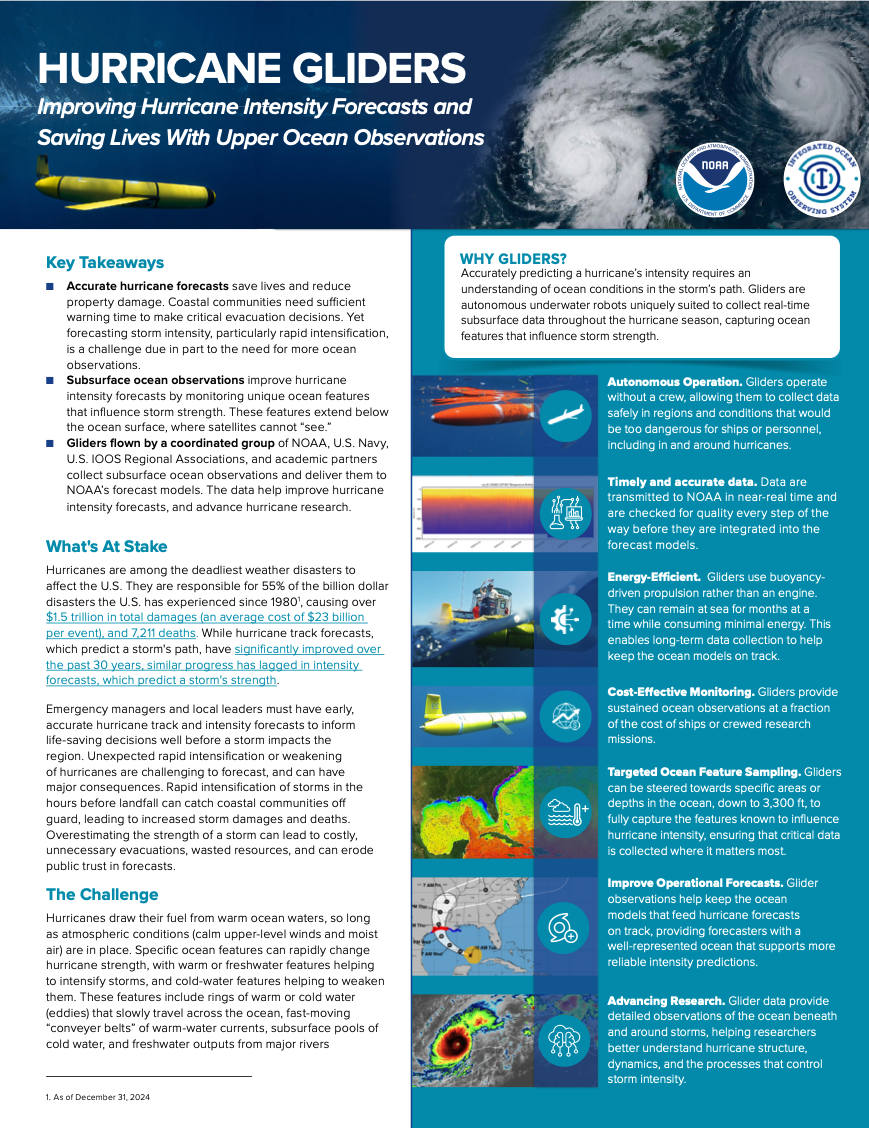
NOAA’s IOOS Office has released a new overview of glider facts and figures. “Hurricane Gliders: Improving Hurricane Intensity Forecasts and Saving Lives With Upper Ocean Observations” highlights the coordinated work of NOAA, the U.S. Navy, IOOS Regional Associations and academic partners to collect critical observations from below the ocean surface that help improve hurricane intensity forecasts.
| | | |
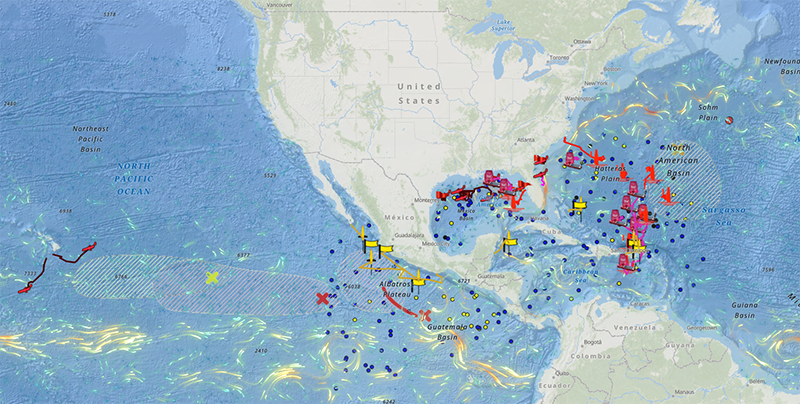
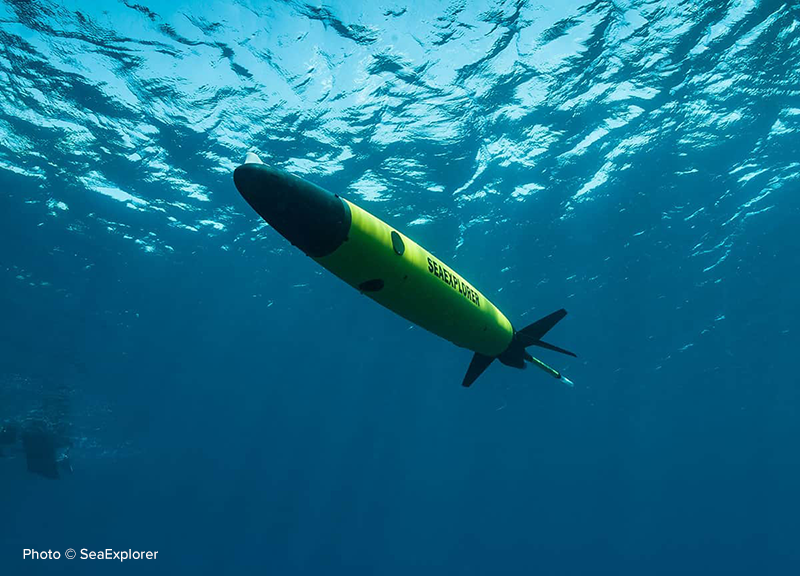
Seagliders, Slocum gliders and Saildrones, oh my! We’re tracking a record 38 autonomous vehicles on GANDALF, our glider-piloting dashboard. Check out all the vehicles (and vehicle types) and the data they’re gathering at GANDALF.
-
And don’t miss our hurricane resource page here.
| | Save the Date: Workshop on Developing Practical Workflows for Emerging Datasets | | |
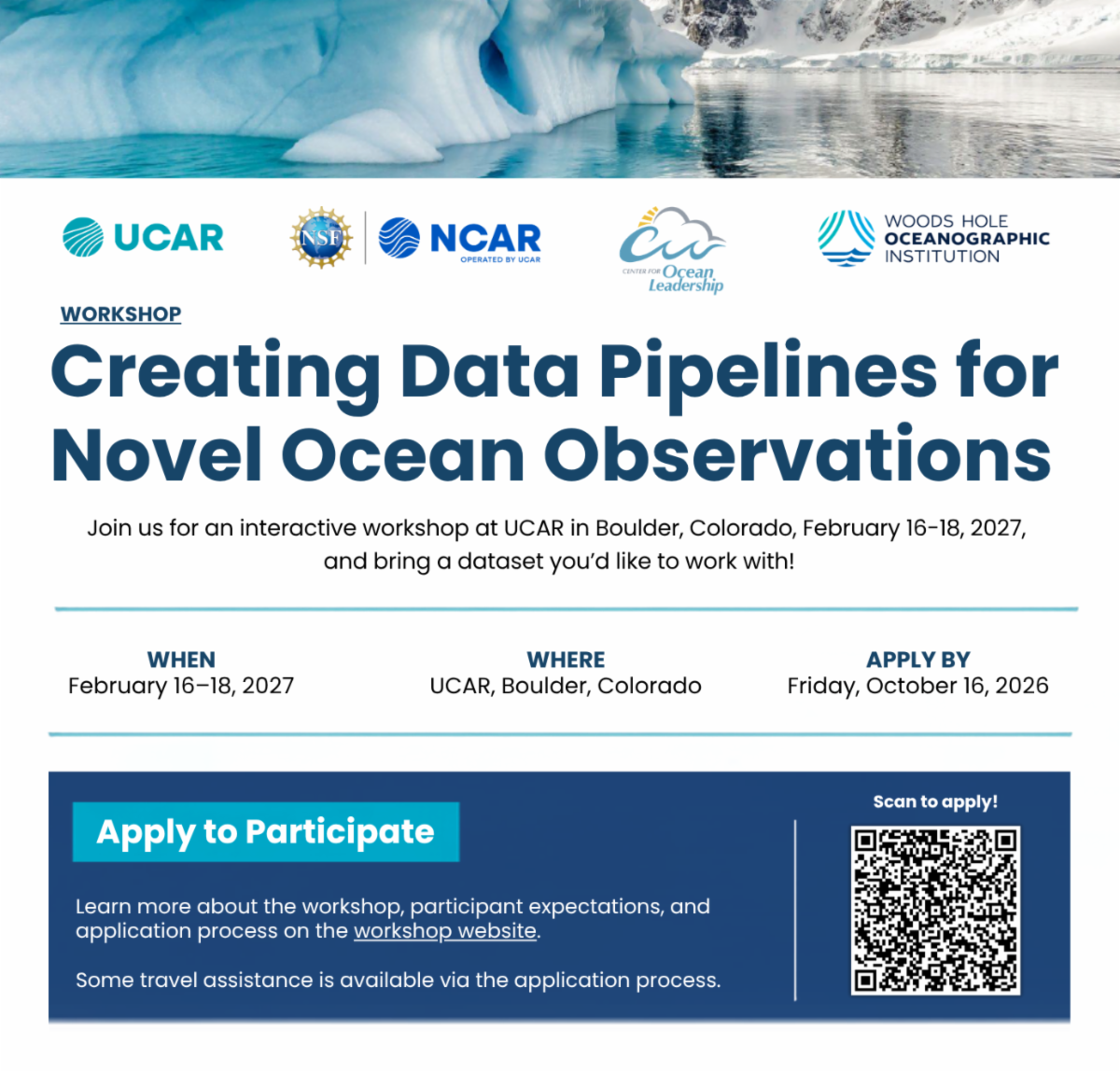
UCAR, NSF NCAR, Woods Hole Oceanographic Institution, and the Center for Ocean Leadership (COL) are inviting applications for the “Creating Data Pipelines for Novel Ocean Observations” workshop at UCAR in Boulder, Colorado.
Scheduled for Feb. 16-18, 2027, the workshop will focus on observations from novel platforms, including surface vehicles, underwater gliders, and other emerging systems, with hands-on work to put data in a public repository, compare observations to model output, and explore tools for high-resolution modeling and observing system simulation experiments.
-
Learn more about the workshop, participant expectations, and application process on the workshop website
- The deadline to submit applications to attend the workshop is Oct. 16
| |
Automating Glider Data Flow | |
A new paper published in Frontiers in Marine Science discusses ways to maximize data utilization by automating data processing. “An open-source quality control pipeline for SeaExplorer glider data: a case study in La Palma, Canary Islands” describes how the authors used a Python-based pipeline to standardize post-mission raw SeaExplorer data, apply automated Quality Control (QC) tests, and generate both diagnostic and user-oriented products designed for reproducible scientific use. They designed the framework to automate — under expert supervision — the entire processing chain, from raw data ingestion to the generation of CF-compliant NetCDF files.
| | |
Healthy Ecosystems and Living Resources
| | Pelagic Seascapes as Dynamic Habitats for Marine Megafauna | |
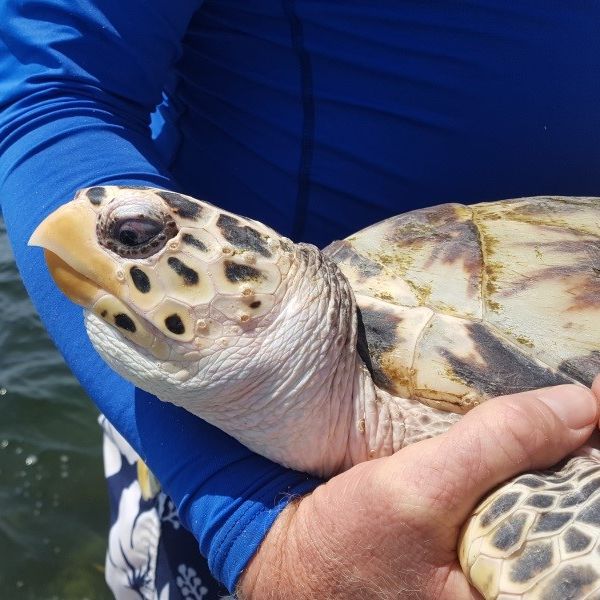
Congratulations to MBON BioTrack partners who recently published the new paper "Marine megafauna select pelagic habitats in a dynamic ocean" in the journal Landscape Ecology. Led by Dr. Ben D'Antiono, this new collaborative paper demonstrates that pelagic seascapes act as ecologically meaningful dynamic habitats for marine megafauna (sharks, whales, turtles), influencing their broad-scale movement decisions. “Interestingly, the results show how these marine megafauna select pelagic environments in a way analogous to habitat selection in terrestrial systems (i.e. wolves selecting forests),” said co-author Dr. Neil Hammerschlag. The authors also reveal how pelagic seascapes could be used in an applied wildlife management context, serving as near-real time indicators of areas where marine megafauna are more likely to occur to serve conservation planning.
| | |
The National Algae Association is inviting researchers focused on algae to present during monthly webinars hosted by the organization, which is a nonprofit industry association dedicated to the commercialization, deployment and market development for algae-based technologies and products. They're seeking presentations focused on nutrient runoff capture, recycling, repurposing and harmful algae bloom remediation Presentations include nature-based solutions proven outside the lab that are scalable, economically feasible and do no harm.
The National Algae Association promotes the reduction of nutrient runoff entering waterways and creating harmful algae blooms that close U.S. lakes and beaches. It also supports nutrient runoff reduction. To make a presentation for the upcoming webinar scheduled for 9 a.m. to 11 a.m. CT Friday, Oct. 16, please your send topic to Founder Barry Cohen at Barry@nationalalgaeassociation.org.
| | Tags Reveal Whale Shark Travels Over Time and Space | | |
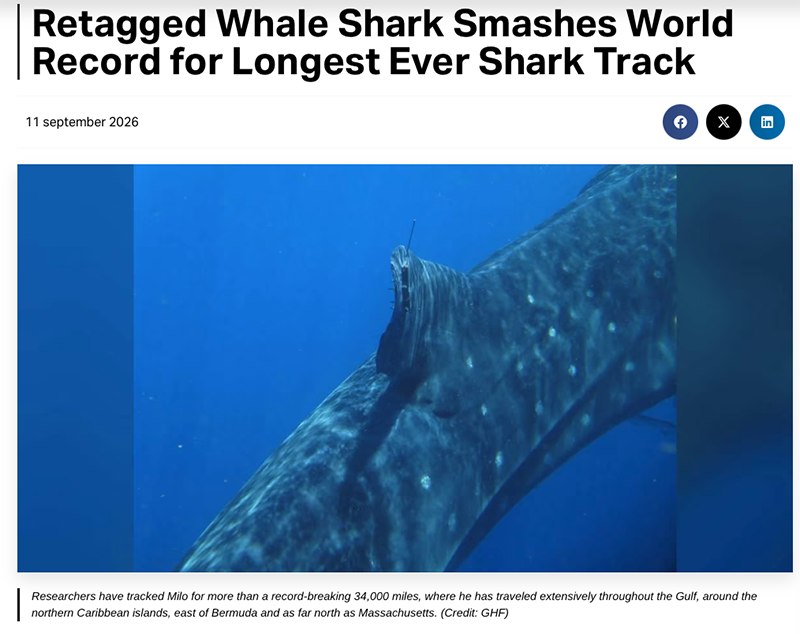
A sequential tagging effort that began in 2017 has provided the longest record of a whale shark’s movements, offering groundbreaking insight into the life history of these long-lived marine creatures. The shark, nicknamed Milo, has been tagged five times over a decade, most recently in July. To date, researchers have tracked Milo for more than a record-breaking 34,000 miles, during which he has traveled extensively throughout the Gulf, around the northern Caribbean islands, east of Bermuda, and as far north as Massachusetts.
-
Read more from ECO magazine
| | |
University of Southern Mississippi
Grants Support Continuation of Oceans Scholarship
| |
The University of Southern Mississippi's Coastal Enterprise and Entrepreneurship Scholarship (formerly the Ocean Engineering Entrepreneurship Pathway), has received a five-year grant extension through February 2031, allowing students to continue pursuing a unique accelerated degree program that combines engineering, business, and entrepreneurship while supporting Mississippi's growing Blue Economy.
The scholarship covers all tuition and fees for the Master of Business Administration and supports the state’s comprehensive regional strategy to establish the Mississippi Gulf Coast as a national leader in ocean science and engineering and maritime technology development, testing, evaluation, and training.
The scholarship was announced in 2019 as part of 15 restoration projects through the RESTORE Act. Funds were distributed by the Mississippi Department of Environmental Quality (MDEQ) and the US Department of the Treasury in the state’s restoration efforts related to the Deepwater Horizon oil spill.
| | |
NOAA
Davidson Fellowship Applications Update
| | |
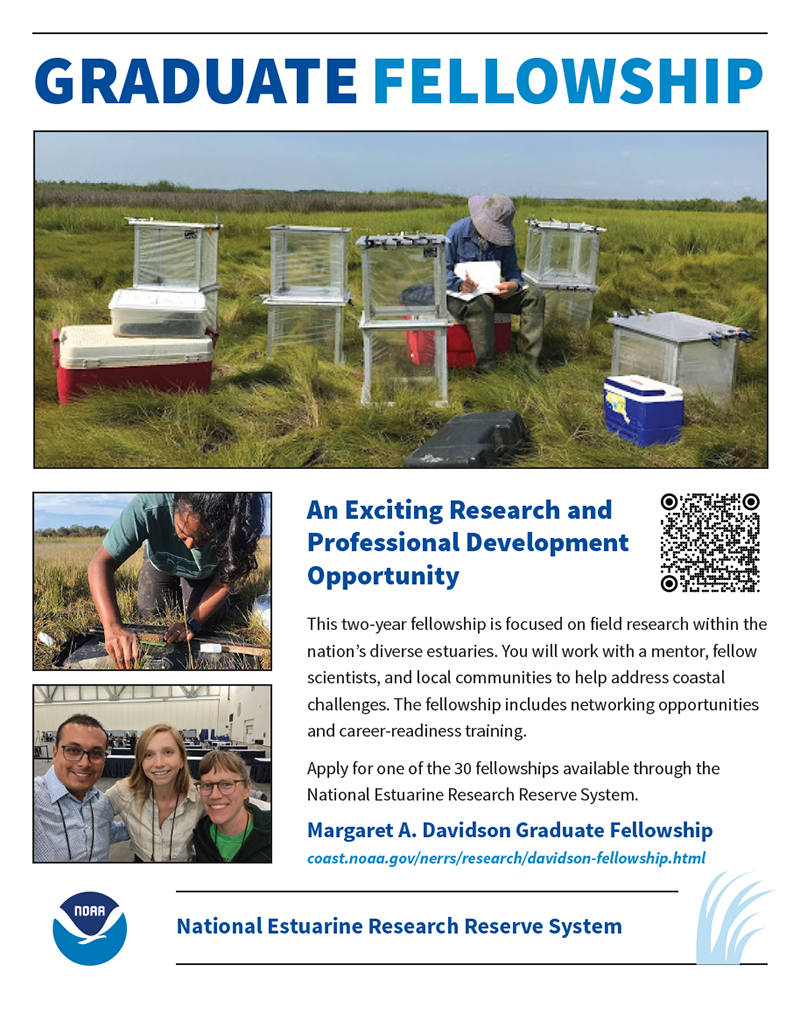
NOAA’s Office for Coastal Management will begin accepting applications for the 2027–2029 Margaret A. Davidson Graduate Fellowship this fall. Additional information about the application process and deadline will be shared as it becomes available. Use the QR code to visit the Fellowship website or click here
| | |
National Science Foundation (NSF)
Call for Experts
| | |
The National Academies of Sciences, Engineering, and Medicine’s Office of Fellowships is seeking experts to serve as reviewers for the 2027 NRC Research and Fellowship Programs. Reviewers will support the evaluation of applications for three prestigious research fellowship programs administered on behalf of federal research sponsors and designed to support postdoctoral and/or senior researchers.
| | |
Cooperative Institute for Research to Operations in Hydrology (CIROH)
CIROH Visiting Scholar Application Open
| | |
Applications are open for the CIROH visiting scholar program for faculty, researchers and professionals seeking support for short-term visits to CIROH at The University of Alabama. Visits may include collaborative research, engagement with CIROH teams and/or scholarly presentations. Priority will be given to researchers from CIROH member and partner institutions.
Supported activities must align with CIROH’s mission in hydrologic modeling, prediction and decision support. Activities must not be covered by existing project funding. The Visiting Scholar program supports visits between Jan. 2 and Dec. 15, 2027.
- Application deadline: Oct. 15, 2026
- Details
| | |
NERACOOS
Changes at the Top
| |
NERACOOS has announce that Jackie Motyka is taking the helm as Executive Director as Dr. Jake Kritzer steps into the position of CEO at the NSF Seafood Engine of New England. Jackie, formerly Strategy Director, will now oversee the direction and implementation of IOOS from Long Island Sound through the Gulf of Maine. Jake, who served as Executive Director of NERACOOS since 2020, will lead the Engine’s regional coalition in leveraging advanced technologies that reduce the national seafood deficit and strengthen every level of the seafood supply chain.
| | |
-
Texas A&M University: Commercial Fisheries and Seafood Specialist (Program Coordinator II)
-
NOAA - NOS: Director Office of Coastal Management
-
University of Southern Mississippi: Visiting Instructor or Assistant Teaching Professor
-
Hello.gov: Sr. Cloud and Data Engineer
- Mote Marine Laboratory
-
CODAR Ocean Sensors seeks to fill an algorithm and software engineering role.
Postdoctoral Positions:
-
Sustainable Marine Solutions: postdoctoral researcher to play a leading role in a five-year project, "Cooperative Research and Management for Fish Spawning Aggregations in the Gulf of America
- Knauss Marine Policy Fellowship
- Marine Research Scientist / Postdoctoral Scientist
-
Monterey Bay Aquarium Research Institute: Postdoctoral Fellowship
-
National Research Council: Research Associateship Programs Postdoctoral and Senior Research Awards
-
Mississippi State University: Postdoctoral Associate
-
Downeast Institute: Research Scientist
Fellowships:
- ARL Distinguished Postdoctoral Fellowships
-
National Academies of Science, Engineering and Mathematics: Early Career Fellowships
- Department of Defense: Visualization of Coastal Data, Coastal Vulnerability Assessment Fellow
- Margaret A. Davidson Graduate Fellowship
| |
-
Gulf of America Alliance: Biodiversity Net Positive Impact
-
2026 US HAB CTI: Funding Opportunity
-
National Oceanic and Atmospheric Administration: Ernest F. Hollings Undergraduate Scholar
-
National Academies of Sciences, Engineering and Medicine, Gulf Research Program: Empowering K-8 Through Place Based Education
-
Gulf of Mexico Alliance: Increasing Participation in Clean and Resiient Marine Programs
-
The National Academies of Sciences, Engineering, and Medicine: Early Career Research Fellowship
-
National Oceanic and Atmospheric Sciences: Prevention, Control, and Mitigation of Harmful Algal Blooms
-
BOEM: Environmental Studies Planning
| | GCOOS Fall Meeting (date TBD) | | 7-11: AGU 2026, San Francisco, California | | Dr. Jorge Brenner, Executive Director • Marcus Ogle, Associate Director • Dr. Chris Simoniello, Outreach & Education Manager • Dr. Natalia López Figueroa, GCAN Coordinator and GCOOS 2025-26 Gulf Science Policy Fellow with the National Academies of Sciences, Engineering and Medicine • Felimon Gayanilo, Systems Architect, Co-Data Manager • Bob Currier, Product Developer, Co-Data Manager • Pallavi Tummeti, GIS Administrator and Developer • Tuomo Saari, Scientific Computing Specialist • Xiao Qi, Scientific Computing Specialist • Megan Howson, Marine Mammal Biologist and Data Scientist • Hafeez Oladejo, GCOOS/Mississippi-Alabama Sea Grant Modeling Fellow • Sandeep Jilla, Software Developer • Grant Craig, Project Manager and HABscope Volunteer Coordinator • Nadine Slimak, Public Relations & Content Marketing, Vetted Communications, LLC • Laura Caldwell, Program Assistant | | | | |