ASBURY FIRST MONDAY READER | FEBRUARY 2, 2026

CONTENTS:

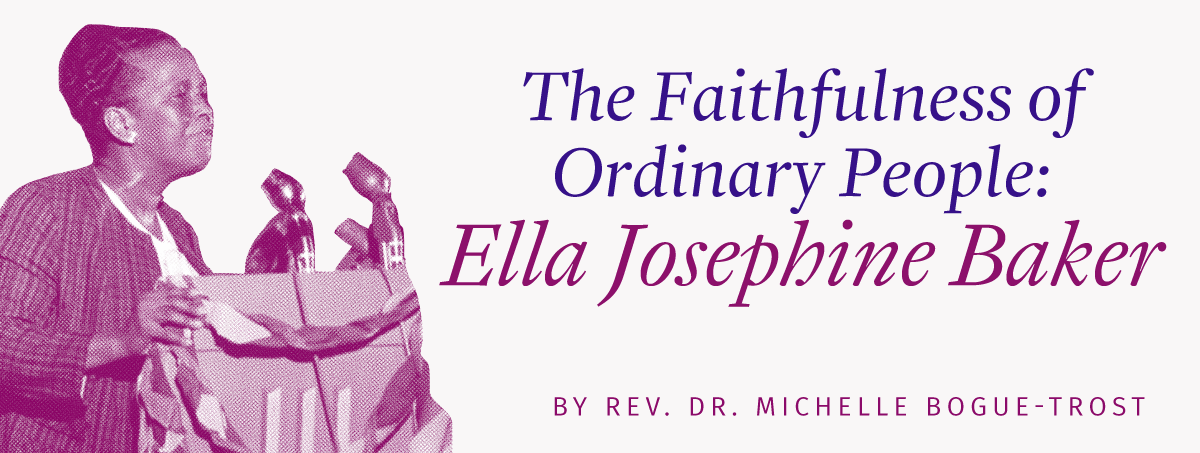
THE FAITHFULNESS OF ORDINARY PEOPLE: ELLA JOSEPHINE BAKER

by REV. DR. MICHELLE BOGUE-TROST

ELEVEN YEARS OF WELCOME:

CELEBRATING ASBURY FIRST'S RECONCILING MINISTRY


"Strong people do not need strong leaders." 


— Ella Baker, quoted in Ella Baker and the Black Freedom Movement


Ella Josephine Baker (December 13, 1903 – December 13, 1986) was an African-American civil rights and human rights activist. She was a largely behind-the-scenes organizer whose career spanned more than five decades. In New York City and the South, she worked alongside some of the most noted civil rights leaders of the 20th century, including W. E. B. Du Bois, Thurgood Marshall, A. Philip Randolph, and Martin Luther King Jr. She also mentored many emerging activists, such as Diane Nash, Stokely Carmichael, and Bob Moses, as leaders in the Student Nonviolent Coordinating Committee (SNCC). She criticized professionalized, charismatic leadership; she promoted grassroots organizing, radical democracy, and the ability of the oppressed to understand their worlds and advocate for themselves. She realized this vision most fully in the 1960s as the primary advisor and strategist of the SNCC. Biographer Barbara Ransby calls Baker "one of the most important American leaders of the twentieth century and perhaps the most influential woman in the civil rights movement." She is known for her critiques of both racism in American culture and sexism in the civil rights movement. She is the Civil Rights leader we hear least about. 


Ella Baker spent her life insisting on a truth that quietly unsettles many of our assumptions about how change happens. She believed that transformation does not depend on charisma, visibility, or the presence of a singular leader who can carry the work on their own. It depends on ordinary people who are willing to show up, listen to one another, and take shared responsibility for the world they inhabit.


Baker worked alongside some of the most recognizable leaders of the Civil Rights Movement, yet she consistently resisted being placed at the center herself. She was wary of hierarchies that concentrated power and of movements that depended too heavily on personality. Her insistence on shared leadership challenged the idea that progress comes from having the right person in charge, an idea that remains deeply familiar in well-resourced and educated communities.


Ella Baker did not frame her work as theology, but her insistence on shared dignity, collective responsibility, and patient endurance reflects a deeply formed moral vision shaped by Black religious life. Her witness broadens what counts as faithfulness. It shifts attention away from performance and proclamation and toward practices of trust, participation, and mutual accountability. For communities accustomed to thinking of faith as personal belief or institutional stability, Baker’s legacy presses in a different direction. It suggests that faith is revealed not primarily in what we say, but in who is allowed to speak, who is trusted to lead, and how decisions are made. It calls into question habits of comfort that equate order with justice or expertise with wisdom.


As we begin Black History Month, Ella Baker invites us into a deeper kind of listening. Not listening that looks for inspiration or affirmation, but listening that is willing to be reshaped. Her life reminds us that enduring change is rarely dramatic and almost never fast. It grows through patience, shared courage, and communities willing to remain present to one another when the work is long and the outcome uncertain.


In the weeks ahead, we will continue to reflect on voices that have shaped the moral and spiritual life of this country. We do so not to admire them from a distance, but to learn from the ways faithfulness has been practiced in lives committed to dignity, responsibility, and hope.

For eleven years, Asbury First has stood as a beacon of inclusion and acceptance as a member of the Reconciling Ministries Network. This milestone, reached in January 2026, represents more than a decade of living out the church's commitment to welcome all people with open minds, open hearts, and open doors.


The journey began in the fall of 2013 when Nancy Specht, a lifelong Methodist and daughter, granddaughter, great-granddaughter, sister, and spouse of United Methodist ministers, met with Rev. Susan Shafer. Nancy was contemplating leaving the church she loved due to the United Methodist Church's discriminatory policies toward LGBTQ+ persons. Instead of accepting her departure, Rev. Shafer proposed a different path: working together to transform Asbury First into a Reconciling Congregation.


What followed was a remarkable example of grassroots organizing and faithful dialogue. A dedicated team of approximately ten people met biweekly for four months, carefully developing a strategy to engage the entire congregation. They recognized that such a significant decision required thorough education, honest conversation, and broad consensus. The team set an ambitious goal: at least 75 percent approval would be necessary to move forward.


Throughout 2014, Nancy and her team embarked on a comprehensive outreach effort, meeting with every group in the church—Adult Sunday School classes, committees, choirs, youth groups, and the Administrative Cabinet (what we now call the Governing Board). They assembled educational resources, purchased videos for the church library, and made themselves available for individual conversations with anyone who had questions or concerns. Nancy personally met with those who opposed the initiative, creating space for respectful dialogue even amid disagreement.


The team drafted and refined a Reconciling Statement that would articulate the church's commitment to full inclusion. At the heart of their advocacy was a fundamental theological principle: at baptism, all people are recognized as children of God, worthy of love and acceptance without exception. This conviction challenged the United Methodist Church's then-official stance that homosexuality was "incompatible with Christian teaching," even while affirming LGBTQ+ persons as having "sacred worth."


On January 18, 2015, at the annual church conference, the congregation cast their votes by secret ballot. Young people from the United Methodist Youth Fellowship even returned early from their Casawasco weekend retreat to participate in this historic decision. The result was overwhelming: 215 to 11 in favor—exceeding the 75 percent threshold and reaching an extraordinary 95 percent approval.


Since joining RMN, Asbury First has been part of a growing movement that now spans four continents, encompasses over 1,400 ministries, and includes 45,000 individuals working to advance justice and inclusion for all LGBTQ+ people. Founded in 1984 as a faith-based response to institutionalized homophobia in the denomination, RMN has worked through grassroots organizing, education, and denominational change-making to transform hearts, churches, and communities.


The journey toward full inclusion continues. While the 2024 General Conference finally removed harmful language that had appeared in the Discipline since 1972, the work of reconciliation and healing remains ongoing. As Nancy Specht reminds us, "We as the church of Jesus Christ have much more to do."


Eleven years later, Asbury First continues this sacred work with joy and pride, following the Great Commandment to love one another—without exception.


Asbury First United Methodist Church

1050 East Avenue, Rochester NY, 14607

(585) 271-1050

Facebook  Instagram  Youtube