|
|
Defending wildlife and habitat through:
Advocacy
Conservation
Education
|
|
|
News & Updates: October 2023 |
|
In this issue:
- Help AOK plan for the future - We need your input!
- AOK is looking for a new Director of Philanthropy and Event Manager
- USFWS reverses its decision to protect its senior water right at Quivira National Wildlife Refuge
- Open house at Hutton Sanctuary draws a crowd
- Former AOK Executive Director Ron Klataske honored
- Don't be spooked by bats
-
Philanthropy Reflection: What can AOK do better?
- AOK Events
- Celebration of Cranes Nov 3-4: Last Chance to register!
- Request a presentation for your group
-
Chapter Spotlight: Sperry-Galligar Audubon Society discusses saving birds from building collisions in their recent newsletter
-
AOK Nature Spot Recommendations: Sand Creek Trail in Newton
|
|
|
Help AOK plan for the future - We need your input! |
|
Every three years, AOK undergoes a strategic planning process. The last strategic plan was created when AOK was transitioning to a new Executive Director, something the organization had not done previously. The plan emphasized 1) continuing AOK's environmental advocacy, 2) developing stewardship plans for existing AOK sanctuaries as well as creating a process for accepting new sanctuaries, 3) increasing environmental education and outreach, 4) connecting with Audubon chapters throughout the state, and 5) evaluating AOK processes and procedures.
Much of that strategic plan has come to fruition and has prepared us for the growth in staff and programming that we are able to do today. Now it is time to plan where we go from here, and we could use your help! Please fill out the form on the link below to let us know what we are doing well and where there are opportunities for growth.
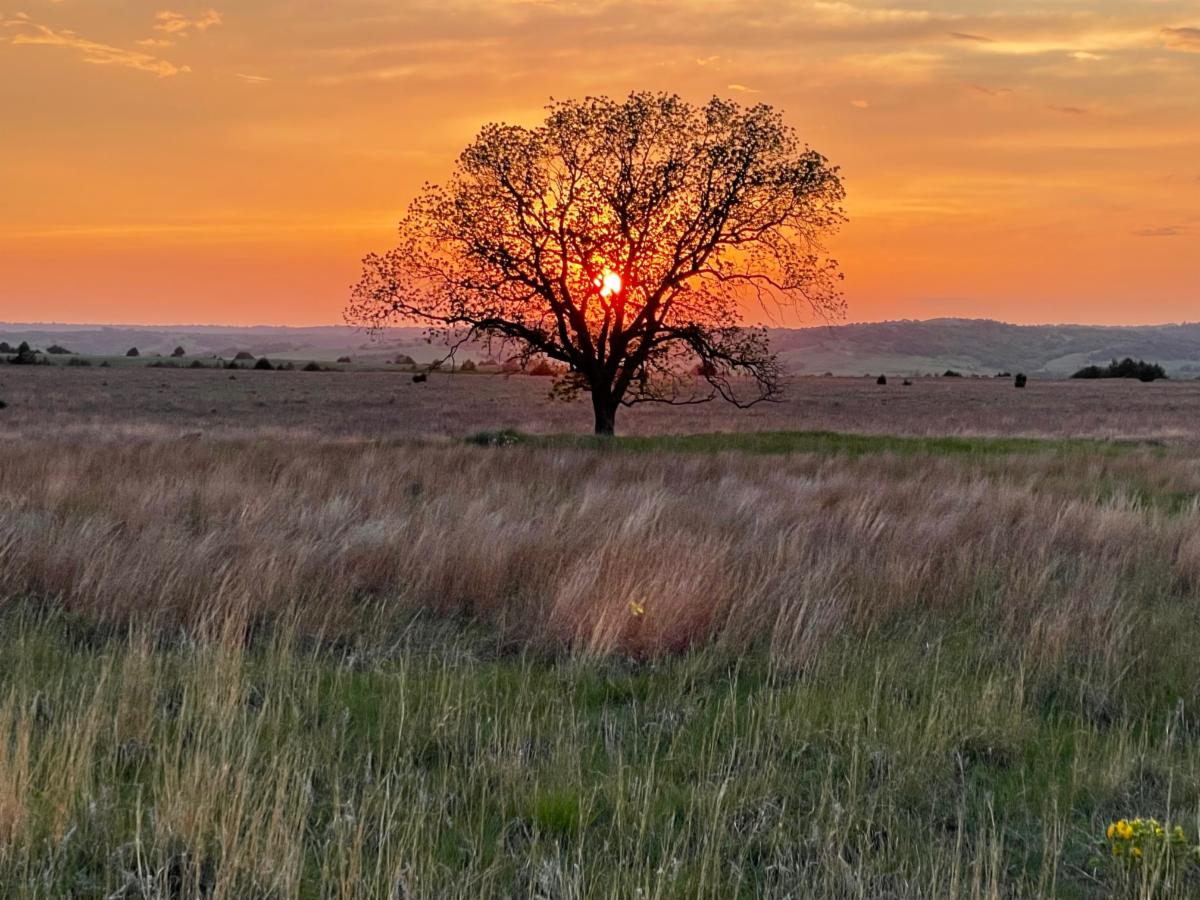
Photo: Tree at Hutton Niobrara Ranch Wildlife Sanctuary to inspire you to help us plan for the future.
|
|
|
AOK is looking for a new
Director of Philanthropy and Event Manager
|
|
Kelley Hurst, our current Director of Philanthropy, has done amazing things for Audubon of Kansas. In her 2.5 years with AOK, she has moved the donor database to a new system, strengthened and updated the database, personalized thank you and giving letters, organized our event registration process, and so much more. She has also helped us think strategically about giving approaches. It is her efforts which have allowed us to expand this position from part time to a full time position.
Kelley's last day will be December 31. She wants to focus on finishing her anthropology degree and pursuing a masters focusing on Cultural Anthropology and African culture generally, and female retirement specifically. Kelley will be missed.
We are looking for another person who is passionate for our mission, strategic in their thinking, and comfortable developing relationships with donors. Does this sound like you or someone you know? Please share this job with anyone you think might be a good fit for AOK. We will be reviewing applications shortly, so please submit an application ASAP.
|
|
|
USFWS reverses its decision to protect its senior water right at Quivira National Wildlife Refuge |
|
Last month, AOK applauded the US Fish and Wildlife Service's ('the Service') request to enforce its senior water right at Quivira National Wildlife Refuge ('the Refuge') so the refuge gets the water that it is entitled. Water is obviously needed to preserve a functional wetland, but it is especially needed now, when migration of cranes is at its peak.
Regrettably, the Service has now stepped back from that request. A press release from Governor Kelly states "I am pleased that both parties have agreed to collaborate on a sustainable solution." Unfortunately, 'sustainable solutions' have been attempted in the past and have never yielded an increase in water for the refuge.
We are extremely disappointed in the Service's response. Even if the water right was restored today, it would take 2-5 years for the water to percolate through the system and make it to Quivira. Given that the various entities will likely take 2 years to devise a plan, another 5 years to implement the plan, and that it takes 2-5 years after implementation for the water to reach Quivira, wildlife at Quivira are unlikely to see any relief in the next decade. Once again, officials bow to political pressure and away from sustainable water use for wildlife, communities, and agriculture.
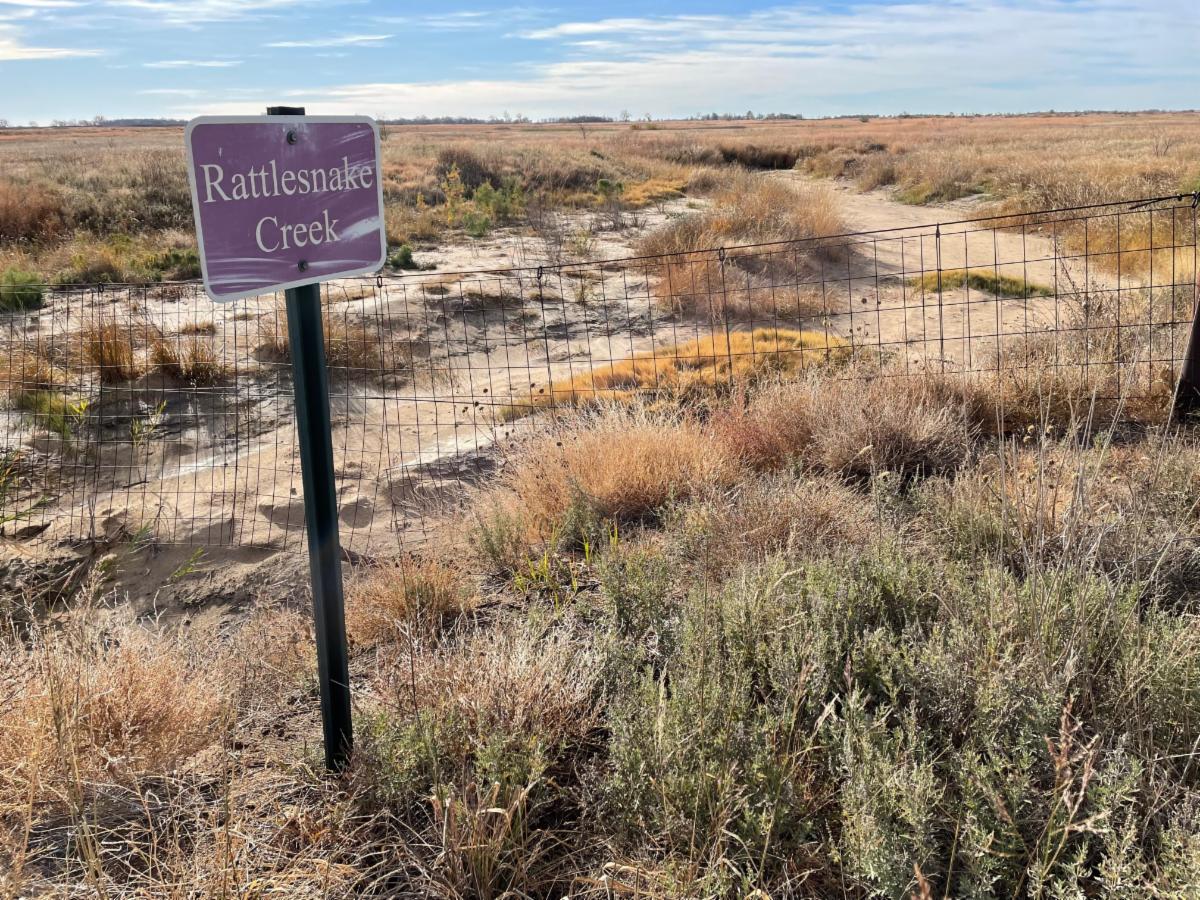
Photo: Rattlesnake Creek is bone dry as it passes through Quivira National Wildlife Refuge (photo taken Nov 2021).
|
|
|
Open house at Hutton Sanctuary draws a crowd |
|
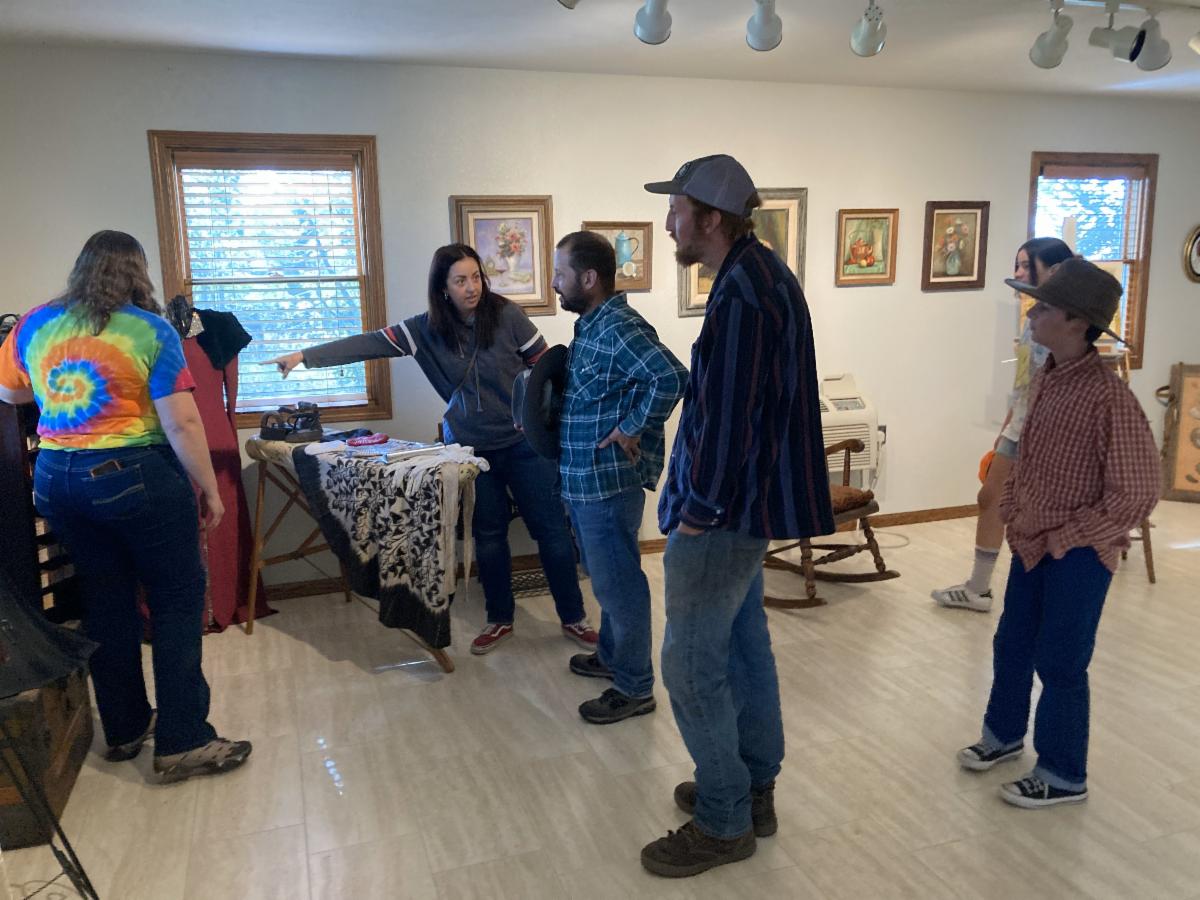
Over 20 people attended the open house at Hutton Niobrara Ranch Wildlife Sanctuary on Sunday, Oct 1. We met in the house to peruse the museum which includes Harold's books, Lucille's paintings, and various items they owned as a couple. Afterwards, we toured the ranch and saw the cattle-grazed rangelands, Niobrara overlook, the wetland easement area, and the Hutton homestead. |
|
|
Former AOK Executive Director Ron Klataske honored |
|
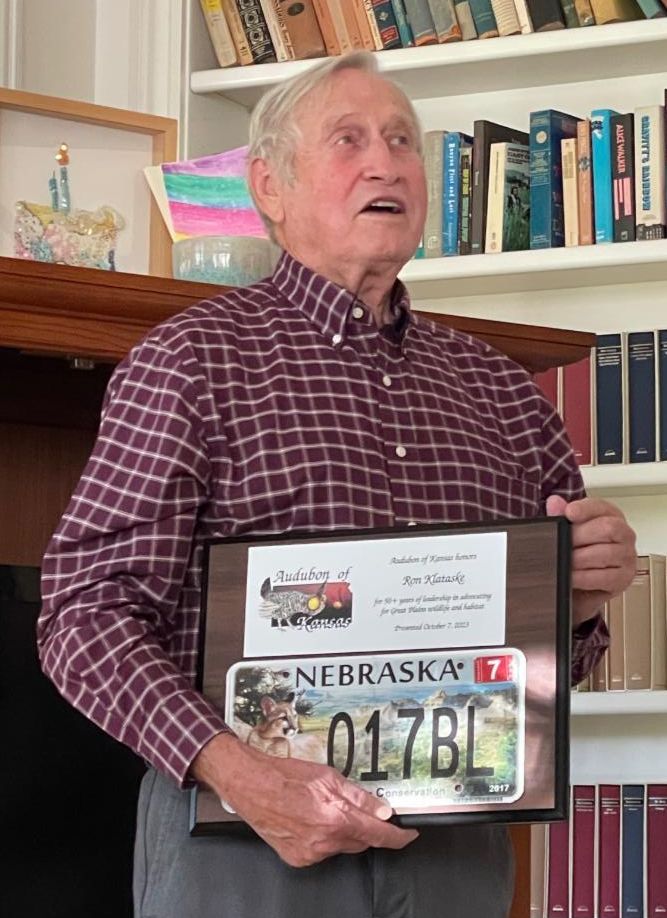
AOK Founding Board Member, Dick Seaton of Manhattan, hosted a reception honoring former AOK Executive Director, Ron Klataske, for his legacy of environmental conservation. He has spent over 50 years being the voice for wildlife. He had a hand in protecting the Niobrara River in Nebraska from the construction of a dam and protecting it as a National Scenic River, in preserving tallgrass prairie in Kansas and Oklahoma, in reintroducing black-footed ferrets and protecting prairie dogs in western Kansas, in improving roadside management, and in so many other conservation efforts. It was great seeing so many of Ron's supporters through the years and hearing their stories.
AOK presented Ron with a plaque that included AOK's original logo that Ron created and a mountain lion license plate from Nebraska. Ron is fond of all wildlife, but he has a special place in his heart for mountain lions including those that roam AOK's Hutton sanctuary in Nebraska.
|
|
|
There are many bat decorations proudly displayed at this time of year. However, they are often depicted as creepy and vicious. However, bats, like birds, are indicators of healthy environments. Bat Conservation International states that "With more than 1,400 species, they are the second largest order of mammals, and are widely dispersed across six continents. Globally, bats provide vital ecosystem services in the form of insect pest consumption, plant pollination, and seed dispersal, making them essential to the health of global ecosystems."
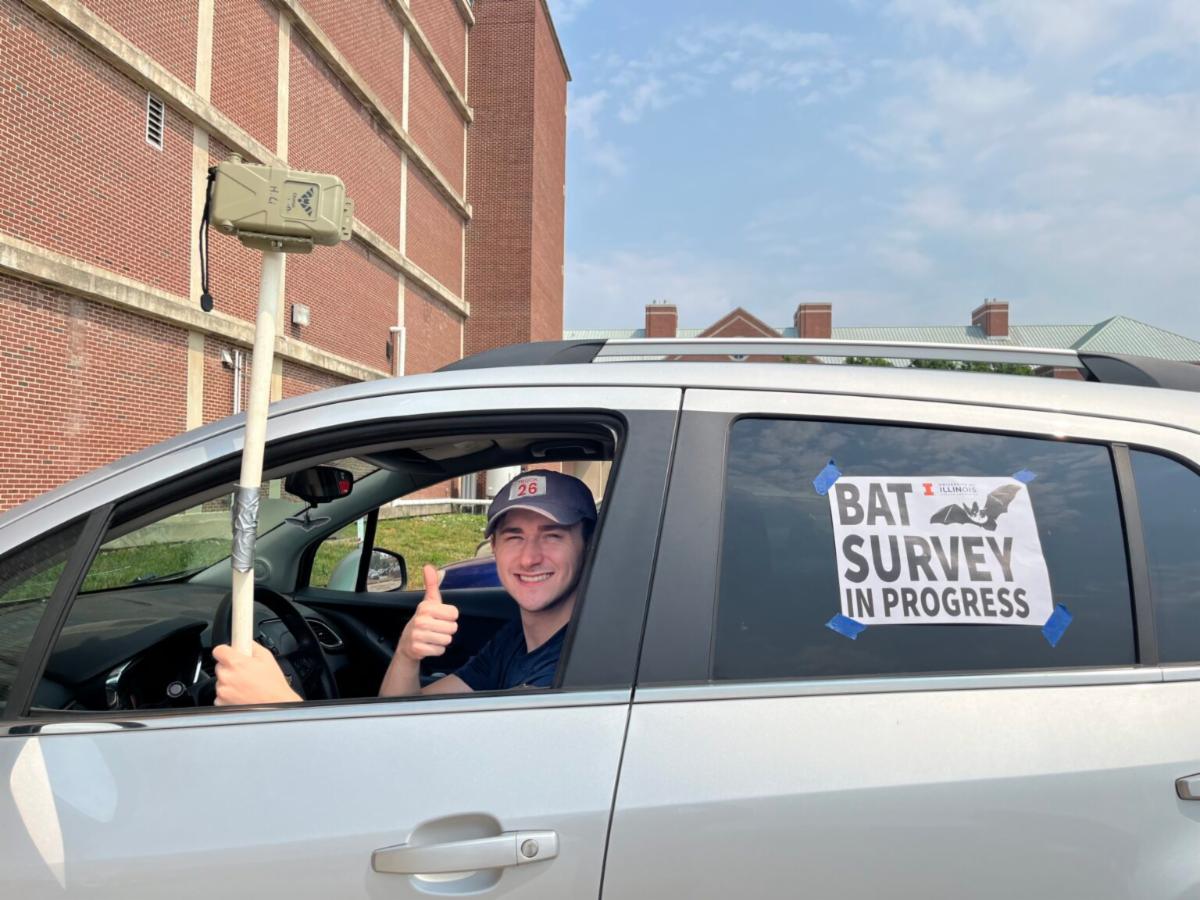
When I heard that the 'Bats in Small Cities' project was looking for volunteers, I jumped at this opportunity to learn more about this elusive group. For four nights in June, I surveyed 12 pre-determined sites within the Topeka city limits starting a half hour after sunset to around midnight. At each designated point, I sat in my vehicle and put the recorder out the window for 10 minutes. I had a set of headphones that converted the echolocation of the bats into something I could hear. I listened intently trying to guess how many species were present based on the 'song' I heard.
After I completed the recordings for the project, I asked if I could record the bats on AOK's sanctuaries. They graciously allowed me the use of the recorder for another month. Big brown, silver-haired, eastern red, and evening bats were detected at all three AOK sanctuaries (Hutton near Bassett, NE; Achterberg near Lincoln, KS; and Mount Mitchell near Wamego, KS). Little brown, hoary, and Mexican free-tailed bats were detected at both Hutton and Achterberg. Pallid, western small-footed, and tricolored bats were also detected but could have been mis-identified by the software. We would be willing to share our recordings with any bat experts interested in learning more about what we detected.
Text by Jackie Augustine
Photo of and by Sean Obrochta, University of Illinois graduate student, showing sampling technique (although sampling would happen at night)
|
|
|
Philanthropy Reflection:
What can AOK do better?
|
|
|
|
Philanthropy reflection time: What kind of giving makes you happiest? How do you prefer to give to the organizations that you share values with? Do you like to hear what is happening at the organization and give to those specific needs? Do you like to set up donations to happen regularly and forget them (set it and forget it?)? Do you prefer to give at the end of the year or just spontaneously whenever the mood strikes?
How well does AOK do at meeting your preferred style of giving? Have you had the chance to give in the way you prefer? Let us know how we can do better - we would love to hear from you: giving@audubonofkansas.org
We offer online giving for one-time and monthly gifts (as well as tributes) and return envelopes inside Prairie Wings. We send letters at the end of the year and for special projects and we email a monthly newsletter. What are we missing? How can we better suit your style of giving? Thank you for partnering with us to protect wildlife and habitat in the Great Plains!
|
|
Mark these AOK events on your calendar!
February 25-March 10, 2024: AOK-sponsored trip to Guatemala CANCELLED due to lack of participants
|
|
|
 |
Last chance to register for Celebration of Cranes!
The event is THIS Friday and Saturday (Nov 3-4)!
Whooping and Sandhill Cranes are being spotted now at Quivira National Wildlife Refuge. This festival offers the best chance for nature lovers to see an endangered species in Kansas. There are only about 850 Whooping Cranes left in the world - and you could be one of a few that get to see them in the wild. Register now!
With your registration, you will also receive lunch and the opportunit y to learn more about these unique birds through our afternoon presentations. Paityn Bower from the International Crane Foundation will talk about the life history of Whooping Cranes. Our second presenter is Kathleen Kaska, the author of The Man Who Saved the Whooping Crane.
|
|
|
|
Want Jackie to come talk to your group?
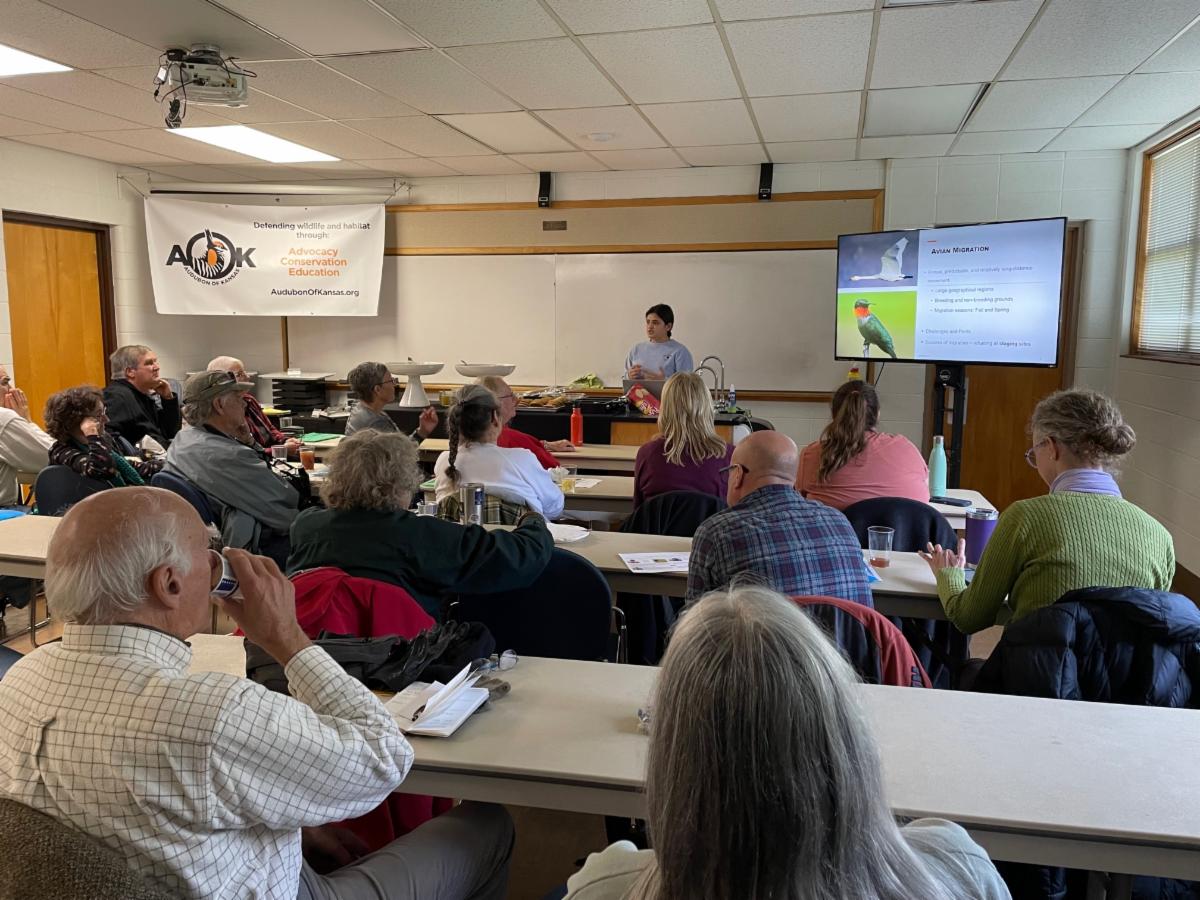
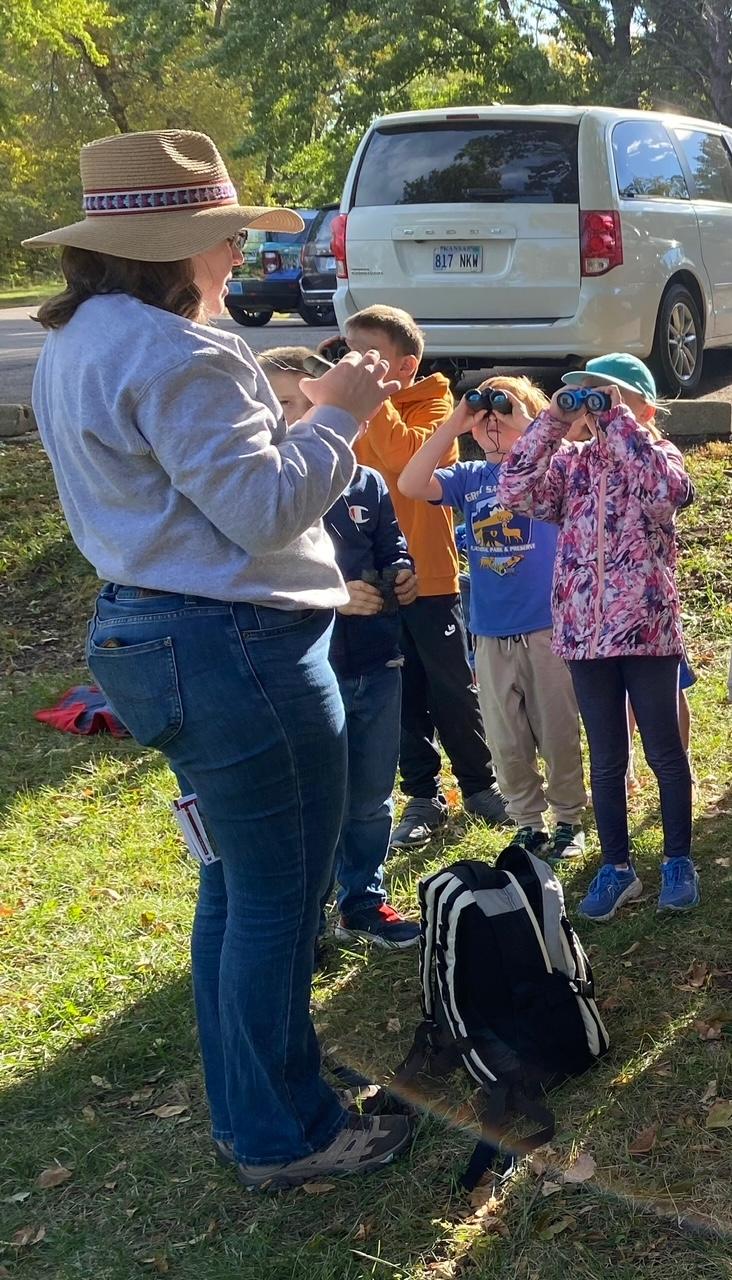
Jackie is now accepting program reservations for 2024. She talks to community organizations, Audubon Chapters, service groups, gardening groups, hunters, and of course libraries! Recently, she talked about migration and bird watching to a home school group (pictured above).
Her most popular talks are 1) Home on the Range: The breeding biology of prairie-chickens; 2) Plants for Birds; 3) Marvelous Migration; 4) Beginning Birdwatching; 5) Birding by Ear; 6) 3 Billion Birds Gone and what to do about it; 7) Black-footed Ferrets - Back from the Brink!; and many more!
Email Jackie for a full list of presentation topics and to reserve your date.
|
|
|
|
Chapter Spotlight:
Sperry-Galligar Audubon Society discusses saving birds from building collisions in their recent newsletter
|
|
Sperry-Galligar Audubon Society includes Bourbon, Crawford, and Cherokee Counties. The chapter is active with monthly bird walks, meetings, and newsletters. They also participate in special events.
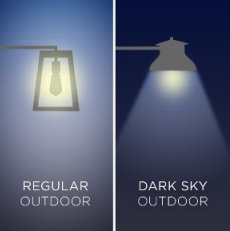
I particularly enjoy their newsletters. They always have informational articles, summaries of events, and lists of upcoming events. The most recent newsletter had a large section on protecting birds from building collisions. By changing lighting and adding UV-reflecting dots to windows, Krystal Anton at Johnson County Community College was able to reduce window mortalities by more than half.
|
|
|
AOK shares favorite birding spots! |
|
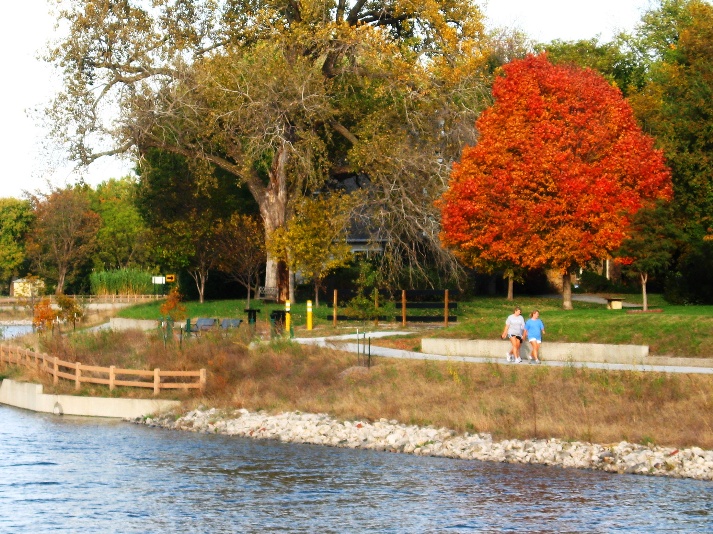
Sand Creek Trail is a National Recreation Trail in Newton
Sand Creek Trail in Newton connects the Kauffman Museum and Memorial Grove on the Bethel College campus. Sand Creek Trail is set in a beautiful, mostly wooded area and is open year-round, sunrise to sunset. The trail contains both paved and unpaved sections. AOK Board member, Tom Ewert, recommended this trail because all riparian birds are common in season. The trail hosts a variety of plant, animal and bird life: more than 40 varieties of trees include cottonwood, willow, hackberry, redbud, and black walnut; year-round resident bird species include Cooper’s hawk, wild turkey, red-bellied woodpecker, northern cardinal, and American goldfinch; winter birds include white-breasted nuthatch, spotted towhee, dark-eyed junco, and eastern bluebird. As tree and groundcover have expanded, sightings of the following have become increasingly common: white-tailed deer, beaver, Great Plains skink, and armadillo.
The Kauffman Museum hosts 'First Saturday Bird Walks'. The walks depart from the kiosk in the museum parking lot for a mile-and-a-half hike through Chisholm Park and along Sand Creek Trail. Be prepared for some unpaved/steep terrain and fall weather. Binoculars and a bird book are recommended but not required. Children accompanied by an adult are welcome but should be able to remain quiet so they don’t scare away the birds! Walks are free and open to the public.
The next walk is this Saturday, Nov 4 at 8am.
Kauffman Museum
27th & Main St.
North Newton, KS 67117
Organizer: Andi Schmidt Andres
Phone: (316) 283-1612
Email: asa@bethelks.edu
|
|
|
Amy Kucera - Sanctuaries Coordinator - Questions about AOK sanctuaries and habitat management amy@audubonofkansas.org
Lana Arrowsmith - Hutton Niobrara Coordinator - Hutton Sanctuary Management & Reservations lanamicheel@gmail.com
Audubon of Kansas
PO Box 1106 - Manhattan, KS 66505
785-537-4385
|
|
|
|
|
|
|