|
|
NFFV Action Request
Upcoming
Health and Human
Services Committee Hearing
Thursday, February 13, 2025
1:30 PM, Room 1510
| |
|
|
Support
LB512 - Adopt the Chemical Abortion Safety Protocol Act
| |
The Stated Intent: LB 512 would enact safety regulations concerning chemical abortions (sometimes referred to as “medication” or “medical” abortions) to protect women from serious adverse health consequences. These regulations include in-person screening of the woman for ectopic pregnancy and Rh negativity before abortion-inducing drugs are dispensed. The bill also requires follow-up after a chemical abortion to ensure treatment for serious complications and accurate reporting. | |
|
So what is LB512 all about?
Disappointedly, LB512 would not stop or even limit the use of abortion-inducing drugs. What it does do is add protections for women when they are given these drugs. The protections come in the way of personal medical oversight. That oversight would require a physician to perform the following before providing an abortion-inducing drug:
- Examine the woman in person;
- Independently verify that the woman is pregnant;
- Determine whether the woman has an ectopic pregnancy;
- Document in the medical record the gestational age and location of the pregnancy;
- Determine the woman's blood type, and if a woman is Rh negative, offer to administer Rh immunoglobin to prevent Rh incompatibility, complications, or miscarriage in future pregnancies; and
- Document in the medical record whether or not the woman received treatment for Rh negativity.
In addition, the physician would be required to have a follow-up visit with the woman between the 3rd and 14th day from when the drugs were provided. They would then be obligated to file a report to include among other things, the name of the drug and if any adverse affects resulted from taking said drug.
As a final note: An abortion-inducing drug shall not include a drug, medicine, or other substance that may be known to cause an abortion but is provided for other medical reasons.
| |
|
The overview
Chemical abortion has been around a lot longer than most people realize. The US Conference of Catholic Bishops has a three page brochure that covers the start of chemical abortions and how it's grown in use through the years. Following are a few key takeaways from the brochure:
What is a chemical abortion? “Chemical abortion is a two-drug process meant to kill and expel a developing child from the womb early in a pregnancy.” The first drug Mifepristone ends the child's life while the second drug Misoprostol, taken 24 to 48 hours later, "induces uterine contractions strong enough to expel the dead child and placenta".
How does chemical abortion work? “Mifepristone blocks progesterone, a hormone essential to maintaining pregnancy. This leads to the breakdown of the uterine lining and cuts off the child’s supply of oxygen and nutrients. Mifepristone alone will usually kill the developing child, but his or her remains may not be expelled. This can lead to infection, sepsis, and even the mother’s death. Therefore a second pill— misoprostol—is taken 24 to 48 hours later, to induce uterine contractions strong enough to expel the dead child and placenta.”
What are the risks to the mom? "The FDA’s record of “adverse events” cites 32 women’s deaths from September 2000 through December 2022. Although the FDA stopped requiring reports of non-fatal adverse events in 2016, it reports a total of 4,218 adverse events, including 1,049 hospitalizations (excluding deaths), 604 cases of blood loss requiring transfusions, 97 ectopic pregnancies, and 418 infections (75 of them “severe”).
The Colson Center reported "data has shown that “one in five women experienced an adverse event following a chemical abortion, and rates of complication were four times higher in chemical abortions compared to surgical abortions.” In fact, the FDA’s own label warns that one in 25 women who take abortion drugs will end up in the emergency room."
| |
|
Where's the battle at?
The Obama and Biden administrations made access to and use of chemical abortion drugs easier by removing safeguards for the women who take them. The Obama administration expanded the list of who could prescribe the drug and eliminated a two-week follow-up requirement. Biden's administration did away with the once required "in-person" appointment with a licensed physician.
Now with the June 2024 Supreme Court unanimous decision to dismiss a case filed against the FDA for wrongfully expanding access to abortion drugs at the expense of safety, the states are once again going to have to step in. Many states have done just that by passing laws to protect women from the harms of chemical abortion drugs.
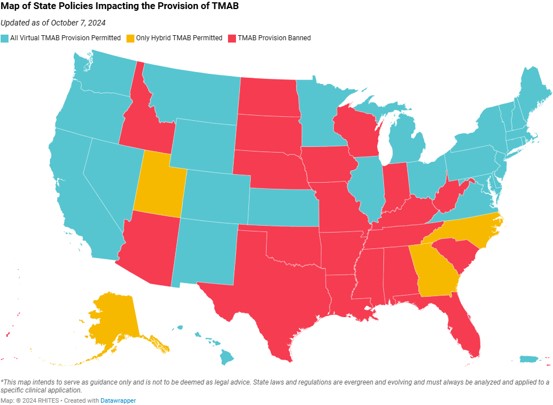
The RHITES map below highlights where states are in allowing Telehealth Medication Abortions - TMAB. It should be noted - even though Nebraska shows on the map as "red", its the only red state that allows TMAB up to 12 weeks. The other "red" states have a total ban. Will Nebraska join the rest of the red states with a total ban?
| |
Not surprising, varying state laws are pitting states against one another. The most recent example is New York shielding a New York doctor Margaret Carpenter from extradition after she was indicted by a grand jury in West Baton Rouge Parish, Louisiana for prescribing abortion pills to a pregnant minor in Louisiana. You can read more in the Forbes article "New York Gov. Refuses To Extradite Doctor Charged In Louisiana For Abortion Pill". | |
|
Seldom talked about
Stating the obvious - killing your baby is an emotional experience. On top of the emotion of just ending your child's life, the would-be-mother, now has to dispose of the child's remains. How should the remains be handled - morally and ethically? Who is responsible to educate and support the would-be-mother? Many are unprepared to handle this.
Nebraska statute 23-1816 states in part "coroner shall cause the body to be decently buried". What does "decently buried" mean? Does "body" apply to a child whose life was ended by chemical abortion?
Statute 71-20,121 states
"Every hospital...shall maintain a written policy for the disposition of the remains of a child born dead at such hospital. A parent of such child shall have the right to direct the disposition of such remains, except that disposition may be made by the hospital if no such direction is given by a parent within fourteen days following the delivery of such remains.".
It goes on to say
"child born dead means a child at any stage of gestation (a) who has died in utero, (b) whose remains have been removed from the uterus of the mother, for whom pregnancy has been confirmed prior to such removal, and (c) whose remains are identified with the naked eye at the time of such removal by the attending physician or upon subsequent pathological examination if requested by a parent."
| |
|
One final thought
Does Nebraska statue 28-335 already require the physician physically see the mother before an abortion? What does the following mean to you?
"No abortion shall be performed, induced, or attempted unless the physician who uses or prescribes any instrument, device, medicine, drug, or other substance to perform, induce, or attempt the abortion is physically present in the same room with the patient when the physician performs, induces, or attempts to perform or induce the abortion."
| |
|
Let YOUR senator(s) know:
- There are many physical and emotional harms tied to chemical abortions. Some of those include nausea, vomiting, diarrhea, abdominal pain, cramping, heavy bleeding, incomplete abortion, infection, allergic reaction, and death.
- More than one woman dies per year with chemical abortion while over 260 women per year have adverse affects. Data shows 1 in 5 women experience an adverse event and FDA labeling indicate 1 in 25 women who take the chemical abortion drugs will end up in the emergency room.
- Few women are prepared to handle the moral and ethical disposal of a baby killed by chemical abortion drugs.
| |
|
Your voice is powerful, make it heard on LB512. The committee hearing is scheduled for Thursday, February 13, 2025. NFFV recommends you "Support" this bill.
How to be heard? Here are three ways:
-
Most Effective: Testify in person. Going to the Committee hearing and sharing YOUR story with committee member Senators is very impactful. For first time in person testifier here are some helpful hints.
-
Effective: Submit written testimony. If you can't be there in person then submit written testimony. Not sure how to do that, click here. Note: The deadline to submit and verify a comment for the hearing record for LB512 is Thursday, February 13, 2025 at 8:00 AM Central Time.
-
Least Effective: Email your position letter to the Committee Senators and CC your own Senator. For a listing of the Health and Human Services Committee Senators click here. Note: emails should be sent by noon, the business day before the committee hearing. It's not likely these emails will be included in official hearing minutes, however, there is a better chance Committee Senators will see your comments. You can request they be added to meeting minutes in your email to Committee Senators.
| |
If you liked the content provided in this Minuteman, consider donating to NFFV. You can donate by clicking the button below or by mailing a check made to Nebraska for Founders' Values. | |
|
Nebraskans for Founders' Values
PO Box 255
Walton, NE 68461
| |
|
|
NEBRASKANS FOR FOUNDERS' VALUES
Board of Directors Team
www.nffv.org
| | | | |