|
In the spring I put together the Soleil EV Buyer’s Guide. What I tried to do was bring together and package all the most relevant information on E-Mobility: the vehicles as well as the rates and measures that explain charging and consumption. I’m in the process of updating and expanding it with road tests and articles on each EV, along with videos which will be on my YouTube channel. It’s a mountain of work, with few EVs to sell at the moment, but I’m doing it anyway because I want to be part of the future and I’m confident the investment will pay off.
I’ve studied automobiles all my life, and I like all types of cars, and enjoy rescuing, buying and selling them. I’m selling a client's Porsche 997.2 Carrera 4S Cabriolet, and it’s the perfect car to take the #1A highway to Canmore in, just for the pleasure of it. I’m looking at a 55 T-Bird this afternoon, and will be listing a first generation Mustang in the next couple weeks: both are iconic machines that have a rich social history.
I’m selling my friend Loc’s Mercedes Unimog which is the perfect thing for transporting 1,500kg of cargo over rough terrain and through rivers. Now, you may not have an immediate use for it, but it’s nice to have one in case you need it. I want to buy it and put a ‘Bowness Flood Rescue’ sign on it and park it in front of our house, but my wife won’t let me. If I were single, I would get a Jaguar E-Type and park it in Mission and wait for pretty girls to come and talk to me. Every car has its purpose.
The Case For Electric Cars
When it comes to commuting, the school run and doing errands you can’t beat an electric car. It’s not even a contest. They are quick, smooth and quiet. Plugging the car in at home is much more convenient than stopping at a gas station. At $.15 per kWh ‘filling up’ at home with 300km of range costs about $9 - the 30L of fuel that you would need to cover that distance in an ICE vehicle would cost over $40. You will never have to replace brakes, and you only service them every 2 years, and even that is mostly just ‘checks’. Most EV owners that I know rarely see their vehicle with less than 50% ‘State of Charge’: they drive the 50km or 100km they need to each day, and plug it in at night. More people are installing home Solar arrays that generate all the power the vehicle needs, so they are burning nothing to drive their cars.
They used to describe the power of a Rolls Royce as ‘adequate’. I would describe the power of the Tesla Model 3 Performance that I’m driving right now as ‘unlimited’ - it has more power than I’ll ever need to use. If I press the accelerator too hard I start to feel ill, such are the accelerative forces acting on my body. The powertrain refinement that Rolls Royce or Bentley will charge you $400k for, can be had for a fraction of the price. Million dollar supercars look silly racing Tesla sedans. The latest, greatest Ferrari will get humiliated next to a Rimac. Even the most hard core gearheads like Jay Leno drive electric cars to get around now.
You don’t have to worry that buying an electric car will crater the Alberta economy. Even with the world totally locked down and nobody driving or flying anywhere in early 2020, oil demand only went down 20%. Investment in renewable energy, which is also abundant in Alberta, will diversify the economy and provide jobs for oil workers who have lost out to industry consolidation. Solar, Wind and EVs will find their place - alongside oil, gas and combustion engined vehicles.
People calling for the complete elimination of fossil fuels and 100% adoption of EVs will re-think their position once they realize they can’t go anywhere. An electric airliner would be so heavy it would barely be able to get off the ground, let alone stay in the air for several hours.
What About Highway Driving?
But what happens when you have an EV and want to drive further than the city limit? Then it gets a little more complicated.
The way I see it, the willingness to drive long distance in an EV comes down to the ratio between charging and driving. My Toyota Tundra with its 150L fuel tank would go over 800km on the highway, but I would usually stop every 300km or so for 20 minute rest/bathroom/fuel stops. That is a 1:9 ratio between stopping and driving.
The Porsche Taycan, with its 800V architecture, should be the fastest point-to-point EV available. Forgive the math here...
[Porsche advertises 5% to 80% charge in 22 minutes. The battery is 93.4kWh, so 75% of that is 70kWh. Adding 70kWh in 22 minutes infers an average charge rate of 200kW. A Taycan will use about 22kWh per 100km going 100km/hr. 70kWh of usable battery capacity at 22kWh/100km gives a range of 318km.]
So, that's about 20 minutes of charging for 3 hours of driving, or a 1:6 ratio. A little bit slower than I’m used to, but still acceptable - if you are averaging 200kW when you charge it. I had a look at some data from European Taycan owners using the 800V Ionity network, and they were able to get reasonably close to this. The technology does work...In Europe.
When I took a Taycan to the Petro Canada 350kW (400V) station I averaged 37kW.... It would have taken me 2 hours to put 70kWh in the car! This is a 400V station which means that the Taycan can’t accept as much charge as the 800V stations - it is rated for 150kW at 400V. But I didn’t get anywhere close to that. At this rate the car would have needed 40 minutes of charging to drive for each hour!
The Unimog that I mentioned above weighs 6,000lbs and has a 2.2L straight 6 with 80hp. It is shaped, more or less, like a house. If it is perfectly flat it will go 80km/hr. A 1% grade will slow you to half that. Even on the prairie it can only average about 70km/hr. It makes no difference if there is a road or no road. It will go faster, point-to-point, than a Taycan if it has to stop and charge at 37kW!
Charging EV Batteries
EV batteries, and the power electronics that control how much charge they accept, will charge at different rates depending on many factors - but the main ones are the state of charge and the temperature. Maximum charge rates will occur in the 10%-30% range, and then they will decrease and then slow right down near 100%. If you try to put in too much charge too quickly at the wrong temperature, the battery degrades - the power electronics look after the batteries health, and the manufacturers warranty costs.
Batteries need to be at the optimum temperature of about 35C to accept the maximum charge. Some cars like the Tesla and the Taycan have a provision to heat up the battery before you start charging to facilitate the fastest rates. Changing the temperature of the battery pack requires time and energy. Think of changing the temperature of a pool of water that is 8’ x 4’ x 1’, and you get the idea. Using a pile of energy to heat up the battery pack, just before you charge it, isn’t that intuitive. Nor is letting the vehicle charge go down to 10% on the highway before you charge it up again.
Electrify America / Electrify Canada:
North America’s Fastest Charge Network
The Electrify America/Electrify Canada DC stations are owned by the VW/Audi Group, and were set up as part of the ‘Dieselgate’ settlement, where along with the other tens of billions of fines they were forced to pay, they agreed to invest $2B in electric infrastructure. They also had to launch and electric car (the Taycan) and build the stations by a certain date, or face even more penalties. Electrify America decided to develop 800V charging stations, that when matched to their high-end EVs would be able to offer the highest charge rate, and presumably give the VW, Audi and Porsche EVs a competitive advantage.
They had some problems. Nobody made 800V chargers. The only way they could get enough chargers custom made in such a short time span was to get four different suppliers to make them. So they had four different chargers that were supposed to communicate with each of the 30 or so EVs, then manage the payment system. They were installing 100 chargers per month. Predictably, none of it worked very well. I talked to a friend in Lake Tahoe with an Audi Q-Tron who told me that they have tried about 20 times to charge their car at an Electrify America station and it has only worked once! She said the stations are deteriorating, and suffer from lack of maintenance. Half the time the station was off-line, so it couldn’t even be reset remotely. They would phone in the problem to the help line and receive a free charge credit - but they can’t use it because the stations don’t work!
I talked to a Taycan owner who was doing a 10,000 km trip through the US and Canada. He pulled into one fast charging station, attached to an A&W and gas station, and plugged in. He took out the power of the entire facility!
Calgary just got its first Electrify Canada station at Deerfoot City, and there is one in Canmore. There are stations from Victoria to Calgary on the #1, nothing in Saskatchewan and Manitoba, and then they resume to cover Ontario and Quebec. These should be the fastest DC stations in the country. I was evaluating the Volvo XC-40 Recharge and Jaguar I Pace last week and tried them both at the Petro Canada 350kW (400V) Station and the Electrify Canada 350 kW (800V) station. The Volvo is rated for 150kW DC and the Jaguar 100kW DC. I couldn’t get any more than 60kW out of either of them. That is about a 1:2 ratio between charging and driving.
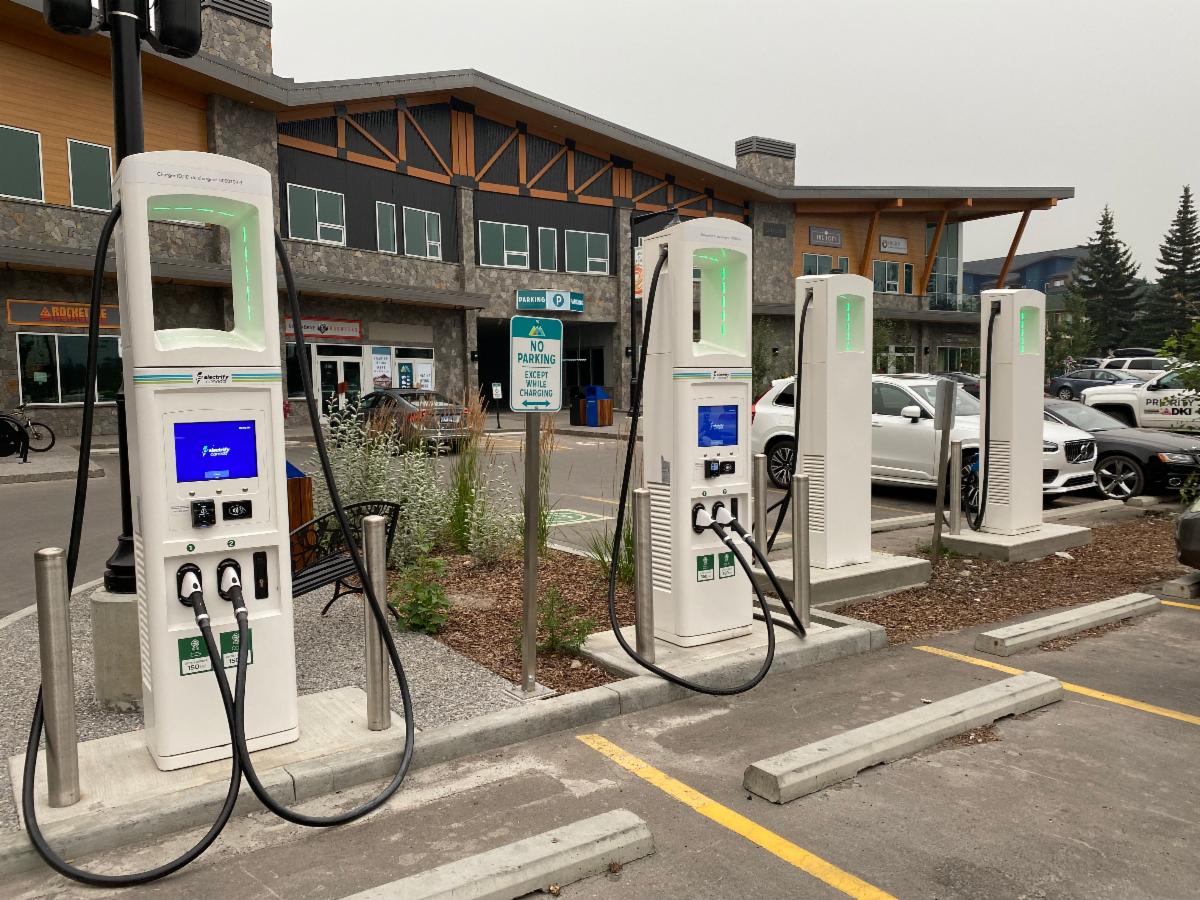
The Electrify Canada installation had four chargers, one 350kW and 150kW. They all look the same, and have the same massive liquid-cooled charging cords, but they are rated differently. The 350kW charger was inoperative the two times I visited.
While the charing stations certainly have their issues, they will only supply as much charge as the EV asks for. It is probable, in my opinion, that the manufacturers are intentionally restricting charge rates in order to carefully monitor battery temperatures and battery health as it applies to safety and battery longevity. That’s fine, as long as they disclose what they are doing - they may need to have a conversation with their marketing departments.
I’m going to test the Tesla this weekend. Tesla has their own charging network, though there was talk of them opening it up to all EVs. In Europe Teslas can use an adapter to charge at non-proprietary stations. Locally, there is a 150kW Tesla ‘Supercharger’ station in Cross Iron Mills in Calgary and one in Canmore. From what Tesla owners tell me, they get something approaching the maximum charge rate. The Tesla Model 3 that I am borrowing should get consumption in the 18kWh/100km range - a little bit better than the Volvo and Jag compact SUV’s that I borrowed earlier in the week. There is a little less air to push out of the way in a car vs. an SUV. From what I read on line I should be able to get the 1:6 ratio that makes long distance driving realistic. Certainly there are lots of Model 3’s driving on the Trans Canada Highway between Calgary and Vancouver. We’ll see.
Digesting all this, I think we can come to the conclusion that developing a reliable fast charge network takes time. Secondly, that the infrastructure needs to come before you can expect to sell an EV to someone who needs to drive it on the highway. All the manufacturers are touting the day that they will phase out ICE vehicles, but they should be concentrating on improving the charging infrastructure first.
|